charging TOYOTA VERSO S 2011 Owners Manual
[x] Cancel search | Manufacturer: TOYOTA, Model Year: 2011, Model line: VERSO S, Model: TOYOTA VERSO S 2011Pages: 664, PDF Size: 160.56 MB
Page 1 of 664
RAV4 Plug-in Hybrid_OM_OM42C53E_(EE)
1
6
5
4
3
2
8
7
9
Pictorial indexSearch by illustration
For safety
and security
Make sure to read through them
(Main topics: Child seat, theft deterrent system)
Plug-in hybrid
system
Plug-in hybrid system features, charging method, etc.
(Main topics: Driving tips, charging methods)
Vehicle status
information and
indicators
Reading driving-related information
(Main topics: Meters, multi-information display)
Before driving
Opening and closing the doors and windows,
adjustment before driving
(Main topics: Keys, doors, seats, power windows)
Driving
Operations and advice which are necessary for
driving
(Main topics: Starting hybrid system, refueling)
Interior featuresUsage of the interior features
(Main topics: Air conditioner, storage features)
Maintenance
and care
Caring for your vehicle and maintenance procedures
(Main topics: Interior and exterior, light bulbs)
When trouble
arises
What to do in case of malfunction and emergency
(Main topics: 12-volt battery discharge, flat tire)
Vehicle
specifications
Vehicle specifications, customizable features
(Main topics: Fuel, oil, tire inflation pressure)
IndexSearch by symptom
Search alphabetically
Page 2 of 664
2TABLE OF CONTENTS
For your information ........................6
Reading this manual........................ 9
How to search ............................... 10
Pictorial index ................................ 12
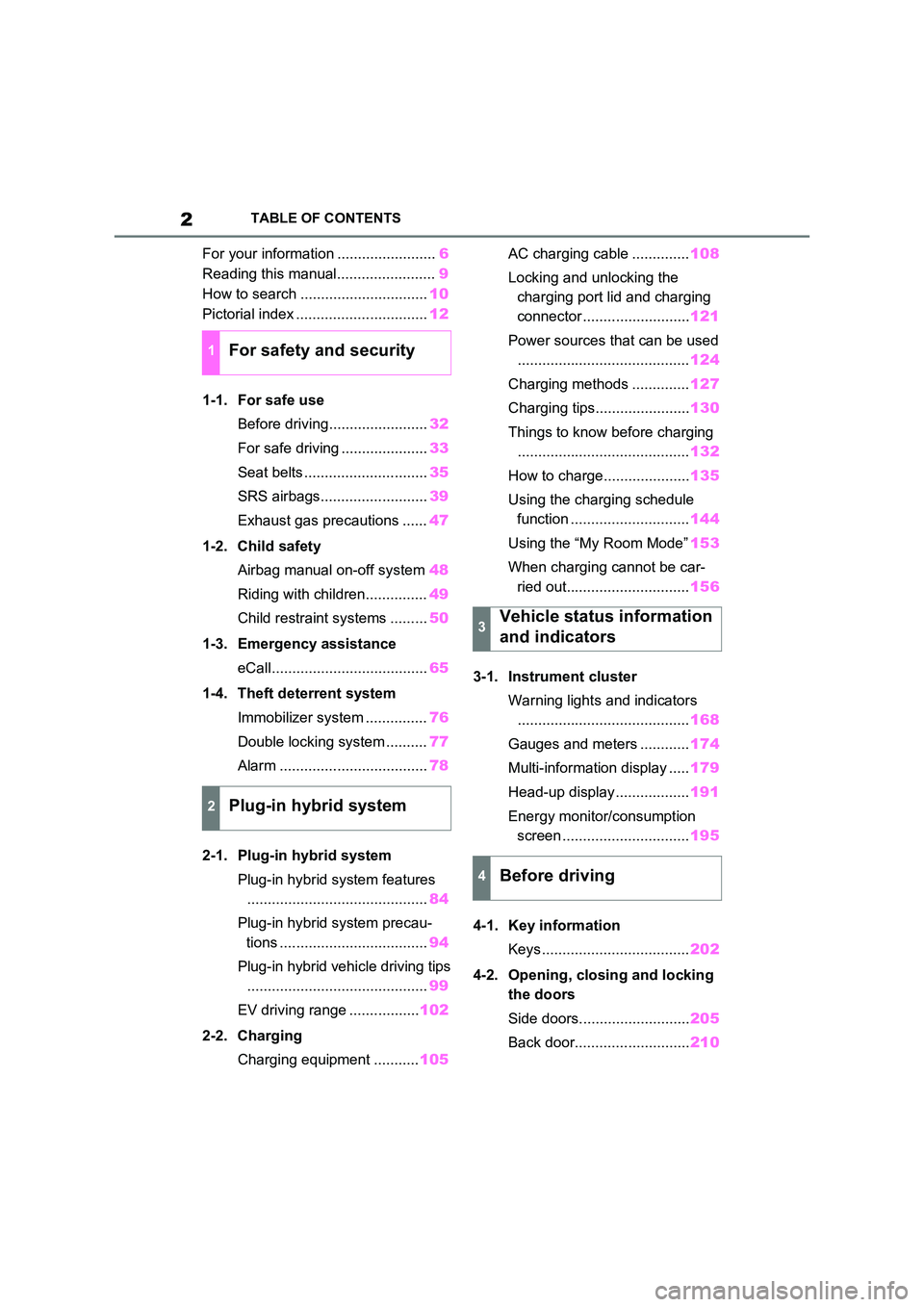
1-1. For safe use
Before driving........................ 32
For safe driving ..................... 33
Seat belts .............................. 35
SRS airbags.......................... 39
Exhaust gas precautions ...... 47
1-2. Child safety
Airbag manual on-off system 48
Riding with children............... 49
Child restraint systems ......... 50
1-3. Emergency assistance
eCall...................................... 65
1-4. Theft deterrent system
Immobilizer system ............... 76
Double locking system .......... 77
Alarm .................................... 78
2-1. Plug-in hybrid system
Plug-in hybrid system features
............................................ 84
Plug-in hybrid system precau-
tions .................................... 94
Plug-in hybrid vehicle driving tips
............................................ 99
EV driving range ................. 102
2-2. Charging
Charging equipment ........... 105
AC charging cable .............. 108
Locking and unlocking the
charging port lid and charging
connector .......................... 121
Power sources that can be used
.......................................... 124
Charging methods .............. 127
Charging tips....................... 130
Things to know before charging
.......................................... 132
How to charge..................... 135
Using the charging schedule
function ............................. 144
Using the “My Room Mode” 153
When charging cannot be car-
ried out.............................. 156
3-1. Instrument cluster
Warning lights and indicators
.......................................... 168
Gauges and meters ............ 174
Multi-information display ..... 179
Head-up display .................. 191
Energy monitor/consumption
screen ............................... 195
4-1. Key information
Keys .................................... 202
4-2. Opening, closing and locking
the doors
Side doors........................... 205
Back door............................ 210
1For safety and security
2Plug-in hybrid system
3Vehicle status information
and indicators
4Before driving
Page 13 of 664
13Pictorial index
Precautions against winter season ................................................. P.445
To prevent freezing (windshield wiper de-icer)
*1............................. P.457
Precautions against car wash ......................................................... P.489
Replacing the wiper insert............................................................... P.539
Fuel filler door ............................................................................... P.342
Refueling method ............................................................................ P.342
Fuel type/fuel tank capacity ............................................................ P.620
Charging port ................................................................................ P.105
Charging method ............................................................................ P.127
Tires ............................................................................................... P.509
Tire size/inflation pressure .............................................................. P.624
Winter tires/tire chain ...................................................................... P.445
Checking/rotation/tire pressure warning system ............................. P.509
Coping with flat tires................................................................ P.582, 593
Hood ............................................................................................... P.498
Opening .......................................................................................... P.498
Engine oil ........................................................................................ P.621
Coping with overheat ...................................................................... P.611
Warning messages ......................................................................... P.578
Headlights/front position lights/daytime running lights ........... P.332
Turn signal lights .......................................................................... P.325
Front fog lights.............................................................................. P.337
Tail lights ....................................................................................... P.332
Tail lights ....................................................................................... P.332
Back-up lights
Shifting the shift lever to R .............................................................. P.321
Light bulbs of the exterior lights for driving
(Replacing method: P.548, Watts: P.625)
E
F
G
H
I
J
K
L
M
Page 79 of 664
79
1
1-4. Theft deterrent system
For safety and security
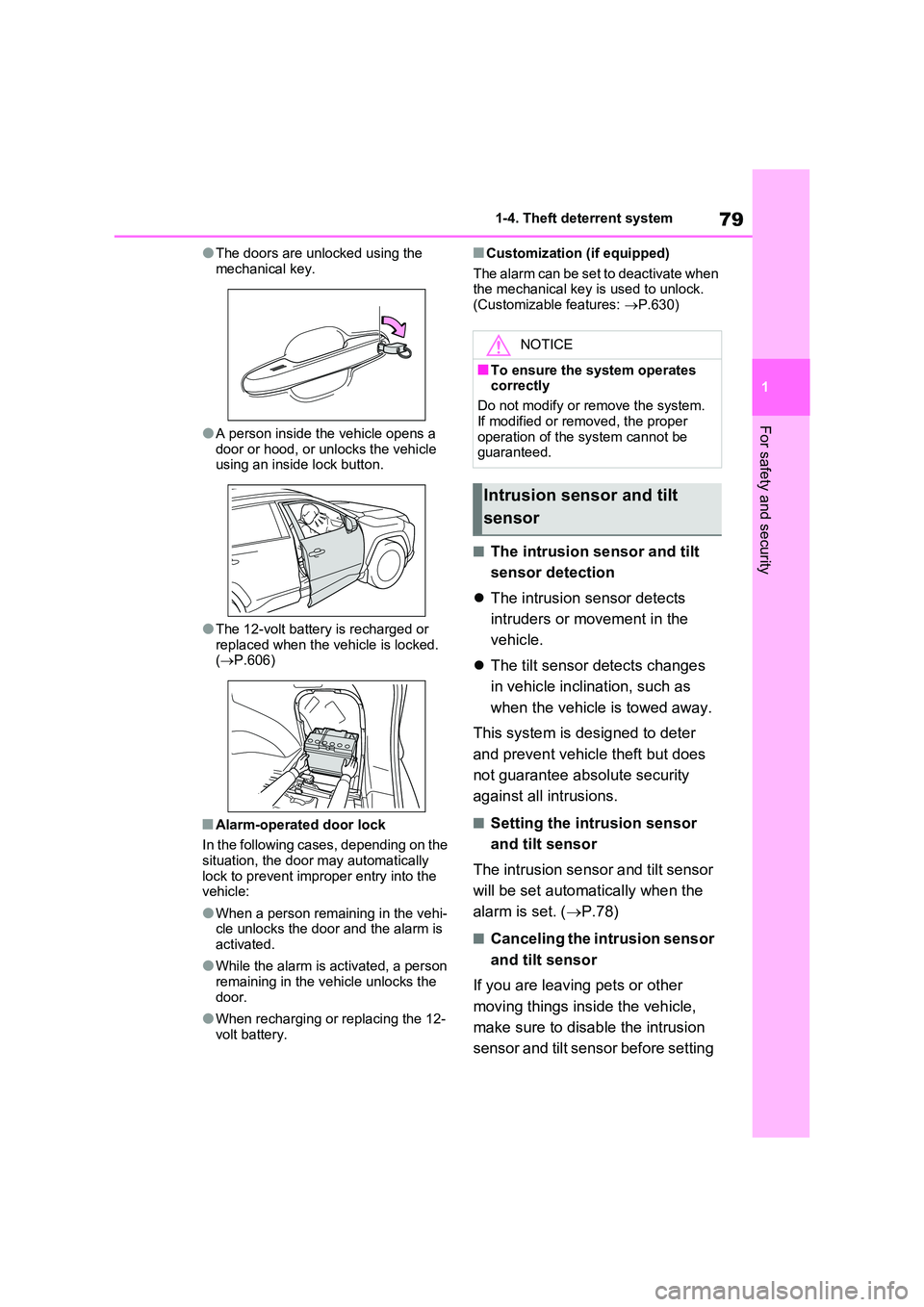
●The doors are unlocked using the
mechanical key.
●A person inside the vehicle opens a
door or hood, or unlocks the vehicle using an inside lock button.
●The 12-volt battery is recharged or replaced when the vehicle is locked. ( P.606)
■Alarm-operated door lock
In the following cases, depending on the
situation, the door may automatically lock to prevent improper entry into the vehicle:
●When a person remaining in the vehi-cle unlocks the door and the alarm is
activated.
●While the alarm is activated, a person
remaining in the vehicle unlocks the door.
●When recharging or replacing the 12-volt battery.
■Customization (if equipped)
The alarm can be set to deactivate when the mechanical key is used to unlock.(Customizable features: P.630)
■The intrusion sensor and tilt
sensor detection
The intrusion sensor detects
intruders or movement in the
vehicle.
The tilt sensor detects changes
in vehicle inclination, such as
when the vehicle is towed away.
This system is designed to deter
and prevent vehicle theft but does
not guarantee absolute security
against all intrusions.
■Setting the intrusion sensor
and tilt sensor
The intrusion sensor and tilt sensor
will be set automatically when the
alarm is set. ( P.78)
■Canceling the intrusion sensor
and tilt sensor
If you are leaving pets or other
moving things inside the vehicle,
make sure to disable the intrusion
sensor and tilt sensor before setting
NOTICE
■To ensure the system operates correctly
Do not modify or remove the system.
If modified or removed, the proper operation of the system cannot be guaranteed.
Intrusion sensor and tilt
sensor
Page 83 of 664
2
83
2
Plug-in hybrid system
Plug-in hybrid system
2-1. Plug-in hybrid system
Plug-in hybrid system features
......................................... 84
Plug-in hybrid system precau-
tions .................................. 94
Plug-in hybrid vehicle driving
tips .................................... 99
EV driving range ............... 102
2-2. Charging
Charging equipment ......... 105
AC charging cable ............ 108
Locking and unlocking the
charging port lid and charging
connector........................ 121
Power sources that can be
used ................................ 124
Charging methods ............ 127
Charging tips .................... 130
Things to know before charging
....................................... 132
How to charge .................. 135
Using the charging schedule
function ........................... 144
Using the “My Room Mode”
....................................... 153
When charging cannot be car-
ried out ........................... 156
Page 85 of 664
85
2
2-1. Plug-in hybrid system
Plug-in hybrid system
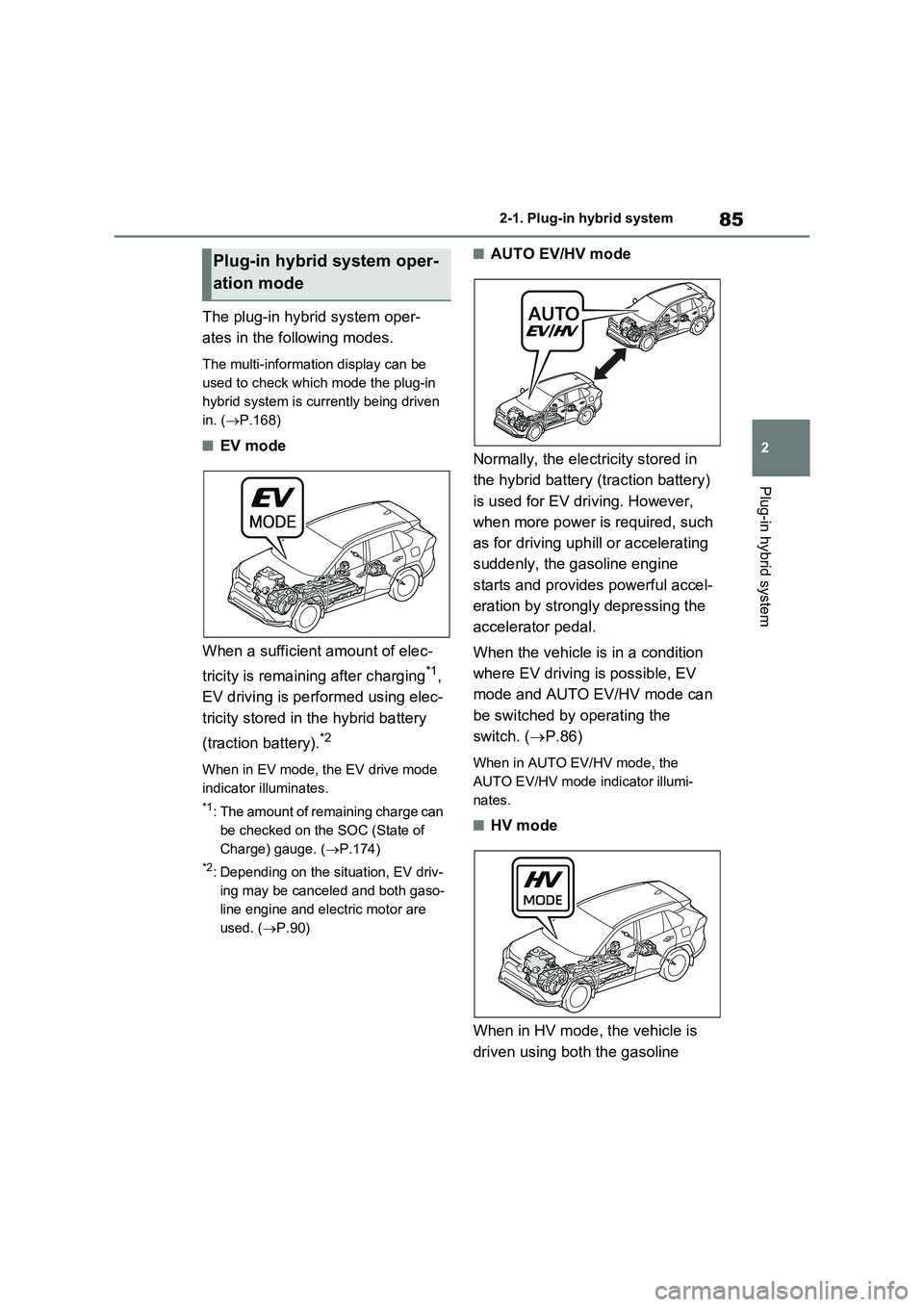
The plug-in hybrid system oper-
ates in the following modes.
The multi-information display can be
used to check which mode the plug-in
hybrid system is currently being driven
in. ( P.168)
■EV mode
When a sufficient amount of elec-
tricity is remaining after charging*1,
EV driving is performed using elec-
tricity stored in the hybrid battery
(traction battery).*2
When in EV mode, the EV drive mode
indicator illuminates.
*1: The amount of remaining charge can
be checked on the SOC (State of
Charge) gauge. ( P.174)
*2: Depending on the situation, EV driv-
ing may be canceled and both gaso-
line engine and electric motor are
used. ( P.90)
■AUTO EV/HV mode
Normally, the electricity stored in
the hybrid battery (traction battery)
is used for EV driving. However,
when more power is required, such
as for driving uphill or accelerating
suddenly, the gasoline engine
starts and provides powerful accel-
eration by strongly depressing the
accelerator pedal.
When the vehicle is in a condition
where EV driving is possible, EV
mode and AUTO EV/HV mode can
be switched by operating the
switch. ( P.86)
When in AUTO EV/HV mode, the
AUTO EV/HV mode indicator illumi-
nates.
■HV mode
When in HV mode, the vehicle is
driven using both the gasoline
Plug-in hybrid system oper-
ation mode
Page 86 of 664
862-1. Plug-in hybrid system
engine and electric motor. (P.89)
• If electricity needed for EV driv-
ing in EV mode or AUTO EV/HV
mode is not remaining, the oper-
ation mode will be automatically
switched to HV mode.
• The operation mode can be
switched to HV mode at any tim-
ing by operating the switch to
keep electricity for EV driving
etc.
* (P.86). Switching to HV
mode when driving on a highway
or when driving uphill is recom-
mended in order to conserve bat-
tery power.
When in HV mode, the HV drive mode
indicator illuminates.
*: The EV driving range may reduce
even after switching to HV mode.
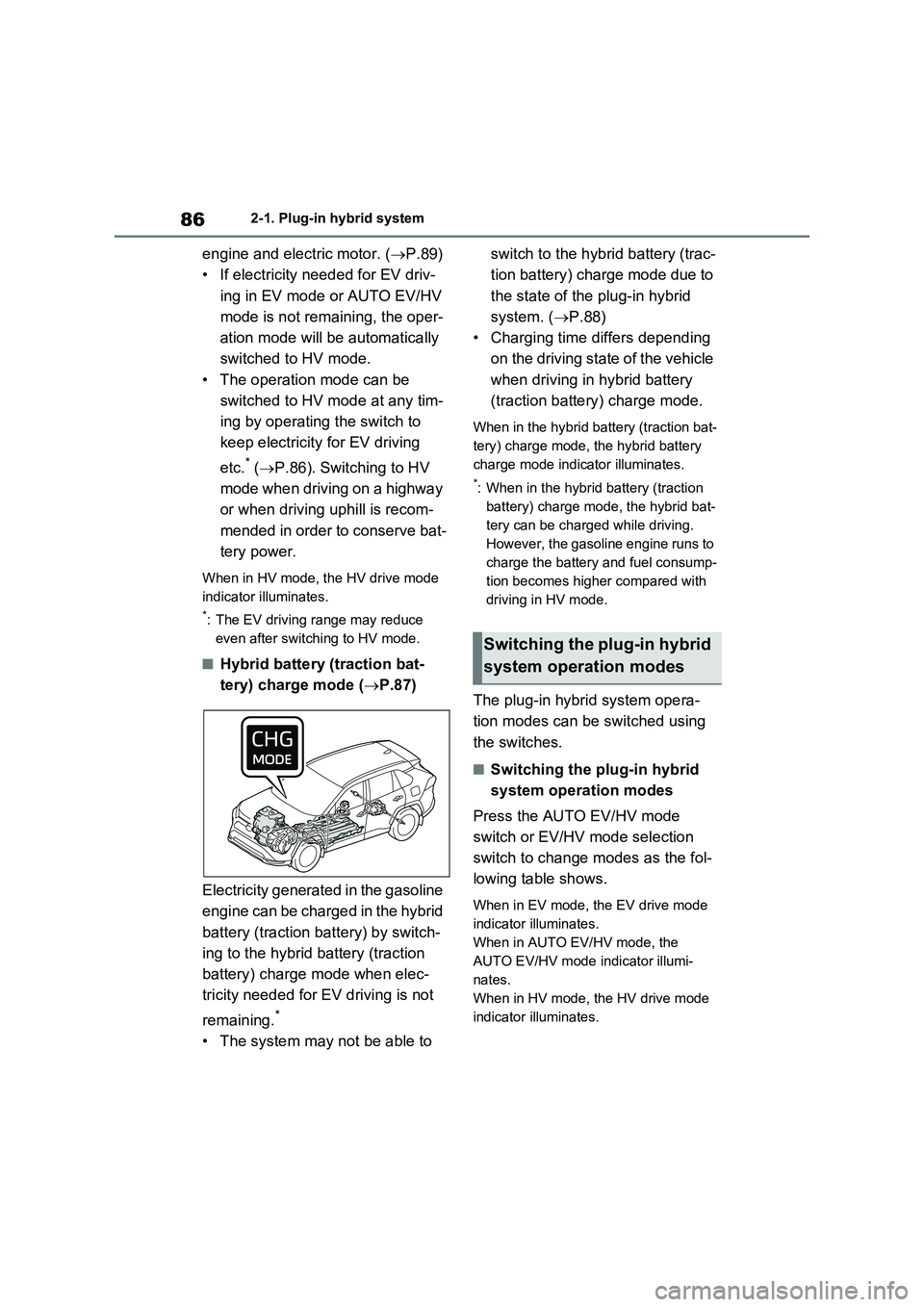
■Hybrid battery (traction bat-
tery) charge mode (P.87)
Electricity generated in the gasoline
engine can be charged in the hybrid
battery (traction battery) by switch-
ing to the hybrid battery (traction
battery) charge mode when elec-
tricity needed for EV driving is not
remaining.
*
• The system may not be able to switch to the hybrid battery (trac-
tion battery) charge mode due to
the state of the plug-in hybrid
system. (P.88)
• Charging time differs depending
on the driving state of the vehicle
when driving in hybrid battery
(traction battery) charge mode.
When in the hybrid battery (traction bat-
tery) charge mode, the hybrid battery
charge mode indicator illuminates.
*: When in the hybrid battery (traction
battery) charge mode, the hybrid bat-
tery can be charged while driving.
However, the gasoline engine runs to
charge the battery and fuel consump-
tion becomes higher compared with
driving in HV mode.
The plug-in hybrid system opera-
tion modes can be switched using
the switches.
■Switching the plug-in hybrid
system operation modes
Press the AUTO EV/HV mode
switch or EV/HV mode selection
switch to change modes as the fol-
lowing table shows.
When in EV mode, the EV drive mode
indicator illuminates.
When in AUTO EV/HV mode, the
AUTO EV/HV mode indicator illumi-
nates.
When in HV mode, the HV drive mode
indicator illuminates.
Switching the plug-in hybrid
system operation modes
Page 87 of 664
87
2 2-1. Plug-in hybrid system
Plug-in hybrid system
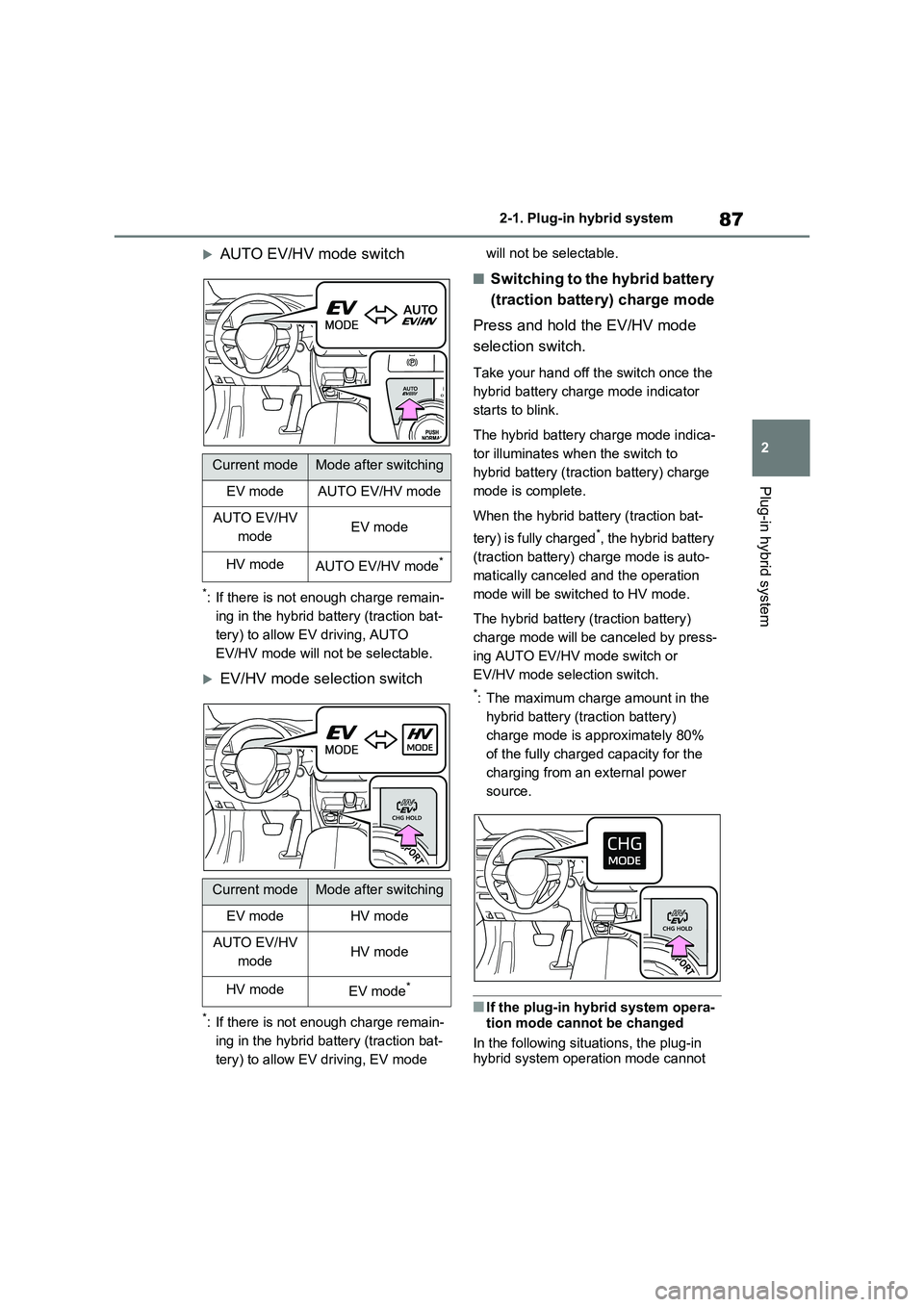
AUTO EV/HV mode switch
*: If there is not enough charge remain-
ing in the hybrid battery (traction bat-
tery) to allow EV driving, AUTO
EV/HV mode will not be selectable.
EV/HV mode selection switch
*: If there is not enough charge remain-
ing in the hybrid battery (traction bat-
tery) to allow EV driving, EV mode will not be selectable.
■Switching to the hybrid battery
(traction battery) charge mode
Press and hold the EV/HV mode
selection switch.
Take your hand off the switch once the
hybrid battery charge mode indicator
starts to blink.
The hybrid battery charge mode indica-
tor illuminates when the switch to
hybrid battery (traction battery) charge
mode is complete.
When the hybrid battery (traction bat-
tery) is fully charged
*, the hybrid battery
(traction battery) charge mode is auto-
matically canceled and the operation
mode will be switched to HV mode.
The hybrid battery (traction battery)
charge mode will be canceled by press-
ing AUTO EV/HV mode switch or
EV/HV mode selection switch.
*: The maximum charge amount in the
hybrid battery (traction battery)
charge mode is approximately 80%
of the fully charged capacity for the
charging from an external power
source.
■If the plug-in hybrid system opera-
tion mode cannot be changed
In the following situations, the plug-in
hybrid system operation mode cannot
Current modeMode after switching
EV modeAUTO EV/HV mode
AUTO EV/HV
modeEV mode
HV modeAUTO EV/HV mode*
Current modeMode after switching
EV modeHV mode
AUTO EV/HV
modeHV mode
HV modeEV mode*
Page 88 of 664
882-1. Plug-in hybrid system
be changed even if the AUTO EV/HV
mode switch or EV/HV mode selection switch is pressed. (In this case, the warning message is displayed on the
multi-information display when the switch is pressed.)
●When electricity needed for EV driving is not remaining (when in EV mode or AUTO EV/HV mode)
●When the traction battery is almost completely charged (hybrid battery
[traction battery] charge mode)
■When switching from EV mode to another mode using the switch
●After switching from EV mode to HV
mode or hybrid battery (traction bat- tery) charge mode and the power
switch is turned off, the system returns to EV mode the next time the
vehicle is started.*
●After switching from EV mode to
AUTO EV/HV mode and the power switch is turned off, the system does not return to EV mode the next time
the vehicle is started.*
*: If there is not enough charge remain-
ing in the hybrid battery (traction bat-
tery) to allow EV driving, the system
switches to HV mode.
■Hybrid battery (traction battery) charge mode
●The following may occur to protect the system, etc.• Cannot switch to hybrid battery (trac-
tion battery) charge mode or cannot cancel it• Gasoline engine does not start or
stops even after switching to hybrid battery (traction battery) charge mode
●If a load to the system is large, such as when the power consumption of the air conditioning system is large or
when the temperature of the engine coolant is high, it may take longer time than usual to charge using the hybrid
battery (traction battery) charge mode, or charging to the hybrid bat-tery (traction battery) may not be per-
formed.
■When in EV mode
In EV mode, EV driving (driving
using only the electric motor)* is
possible. However, depending on
the situation, EV driving may be
canceled and both gasoline engine
and electric motor are used
( P.90). Also, if a little electricity is
remaining in the hybrid battery
(traction battery), HV mode is auto-
matically selected. To drive in EV
mode long, observe the followings.
Avoid sudden acceleration and
sudden deceleration, and be
sure to drive smoothly.
If you repeatedly accelerate, the
hybrid battery (traction battery)
WARNING
■When using the hybrid battery (traction battery) charge mode
Observe the following precautions
when using the hybrid battery (trac- tion battery) charge mode while park-ing.
Failure to do so may lead to death or serious health hazard, as the gasoline engine operates when in the hybrid
battery (traction battery) charge mode.
●Do not stop the vehicle near flam-
mable materials.
●Do not use the hybrid battery (trac-
tion battery) charge mode in a closed area where ventilation is insufficient, such as in a garage or
area with snow buildup.
Control when driving in
each mode
Page 89 of 664
89
2 2-1. Plug-in hybrid system
Plug-in hybrid system
charge will deplete quickly. Also,
EV driving may be canceled by
rapid acceleration or vehicle
speed.
Restrain your speed as much as
possible. The distance that can
be driven in EV mode will reduce
considerably at high speeds.
*: The EV driving range can be checked
using the multi-information display.
(P.181)
■When in AUTO EV/HV mode
Only the electric motor is used for
EV driving
* during normal driving,
but when the accelerator pedal is
strongly depressed, the gasoline
engine starts. (P.90)
Also, when the hybrid battery (trac-
tion battery) level is low, the mode
switches to HV mode automatically
the same as in EV mode.
AUTO EV/HV mode is suitable for
driving conditions when more
power is required, such as for driv-
ing uphill or accelerating suddenly.
However, because the gasoline
engine will start more easily, it is
recommended to drive in EV mode
usually.
*: The EV driving range can be checked
using the multi-information display.
(P.181)
■When in HV mode
The vehicle can be used in the
same way as a standard hybrid
vehicle.
In HV mode, controls are primarily carried out as follows in accor-
dance with the driving conditions.
The gasoline engine stops
* when
the vehicle is stopped.
During start off, the electric
motor (traction motor) drives the
vehicle.
During normal driving, the gaso-
line engine and electric motor
(traction motor) are controlled
effectively, and the vehicle is
driven with optimum fuel effi-
ciency. Also, when necessary,
the electric motor (traction
motor) operates as an electrical
generator to charge the hybrid
battery (traction battery).
When the accelerator pedal is
depressed heavily, drive force
from both the gasoline engine
and the electric motor (traction
motor) is used to accelerate.
*: When the hybrid battery (traction bat-
tery) requires charging or the engine
is warming up, etc., the gasoline
engine will not automatically stop.
(P.91)
■When braking (regenerative
braking)
The electric motor (traction motor)
charges the hybrid battery (traction
battery).
The EV driving range can be
extended by actively using this
regenerative braking to store elec-
tricity in the hybrid battery (traction
battery).