Vin TOYOTA VERSO S 2012 Owners Manual
[x] Cancel search | Manufacturer: TOYOTA, Model Year: 2012, Model line: VERSO S, Model: TOYOTA VERSO S 2012Pages: 540, PDF Size: 17.43 MB
Page 421 of 540
5
421 5-1. Essential information
When trouble arises
VERSO-S_EE
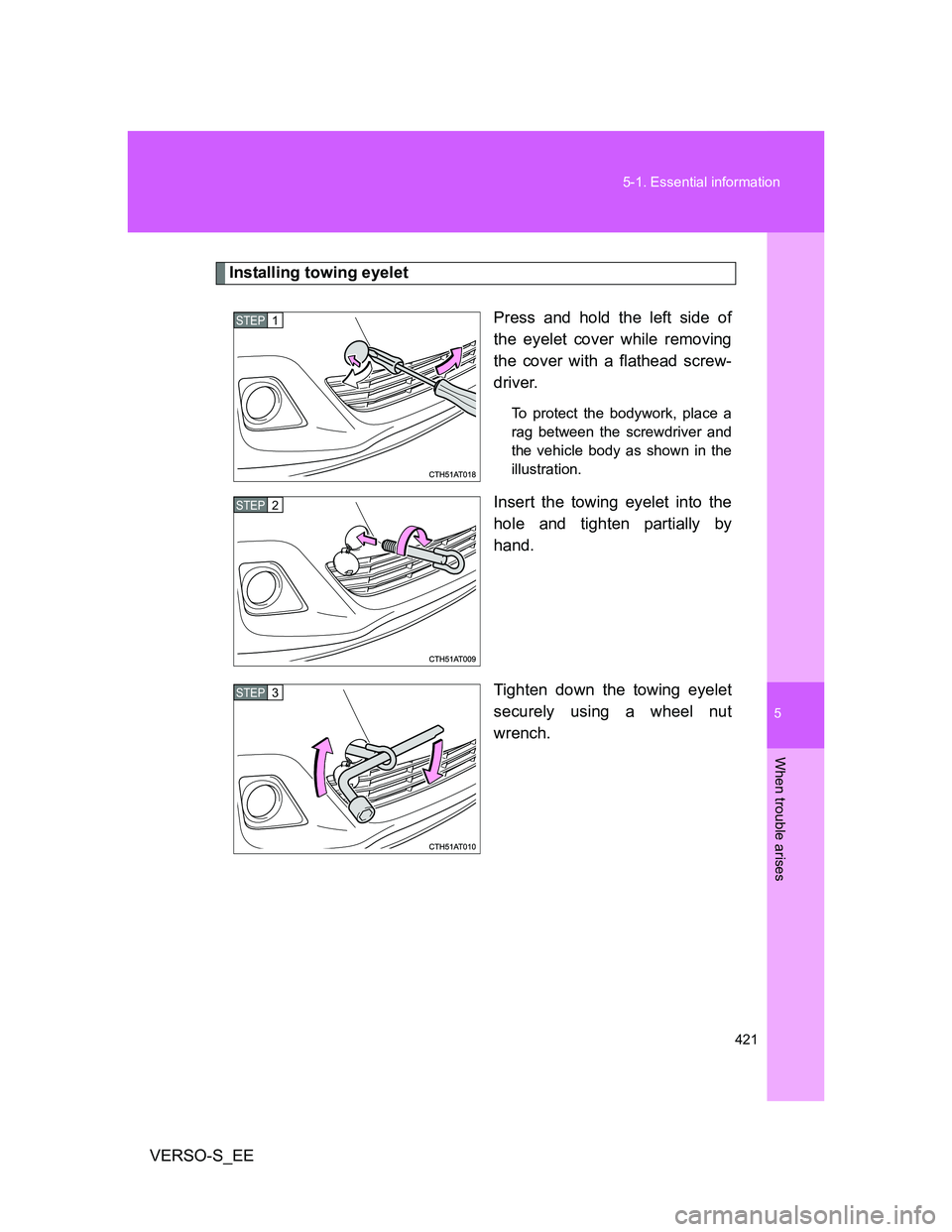
Installing towing eyelet
Press and hold the left side of
the eyelet cover while removing
the cover with a flathead screw-
driver.
To protect the bodywork, place a
rag between the screwdriver and
the vehicle body as shown in the
illustration.
Insert the towing eyelet into the
hole and tighten partially by
hand.
Tighten down the towing eyelet
securely using a wheel nut
wrench.
STEP1
STEP2
STEP3
Page 425 of 540
5
425 5-1. Essential information
When trouble arises
VERSO-S_EE
CAUTION
Caution while towing
Use extreme caution when towing the vehicle.
Avoid sudden starts or erratic driving maneuvers which place excessive
stress on the emergency towing eyelets and the cables or chains. Always
be cautious of the surroundings and other vehicles while towing.
Vehicles with a smart entry & start system: Do not turn the “ENGINE
START STOP” switch off.
Doing so will lock the steering wheel and prevent operation, possibly caus-
ing an accident and resulting in death or serious injury.
If the engine is not running, the power assist for the brakes and steering
will not function, making steering and braking more difficult.
Installing towing eyelet to the vehicle
Make sure that towing eyelet is installed securely.
If not securely installed, towing eyelet may come loose during towing. This
may lead to accidents that cause serious injury or even death.
Page 427 of 540
5
427
5-1. Essential information
When trouble arises
VERSO-S_EE
If you think something is wrong
If you notice any of the following symptoms, your vehicle probably
needs adjustment or repair. Contact any authorized Toyota dealer or
repairer, or another duly qualified and equipped professional as
soon as possible.
Visible symptoms
Fluid leaks under the vehicle
(Water dripping from the air conditioning after use is normal.)
Flat-looking tires or uneven tire wear
High engine coolant temperature warning light flashes or
comes on
Low engine coolant temperature indicator comes on or does
not come on continuously
Audible symptoms
Changes in exhaust sound
Excessive tire squeal when cornering
Strange noises related to the suspension system
Pinging or other noises related to the engine
Operational symptoms
Engine missing, stumbling or running roughly
Appreciable loss of power
Vehicle pulls heavily to one side when braking
Vehicle pulls heavily to one side when driving on a level road
Loss of brake effectiveness, spongy feeling, pedal almost
touches the floor
Page 429 of 540
5
429
When trouble arises
VERSO-S_EE
5-2. Steps to take in an emergency
If a war ning light tur ns on or a warning buzzer sounds...
Stop the vehicle immediately. Continuing to drive the vehicle
may be dangerous.
The following warning indicates a possible problem in the brake sys-
tem. Immediately stop the vehicle in a safe place and contact any
authorized Toyota dealer or repairer, or another duly qualified and
equipped professional.
*: Parking brake engaged warning buzzer:
The buzzer sounds to indicate that the parking brake is still engaged (with
the vehicle having reached a speed of 5 km/h [3 mph]).
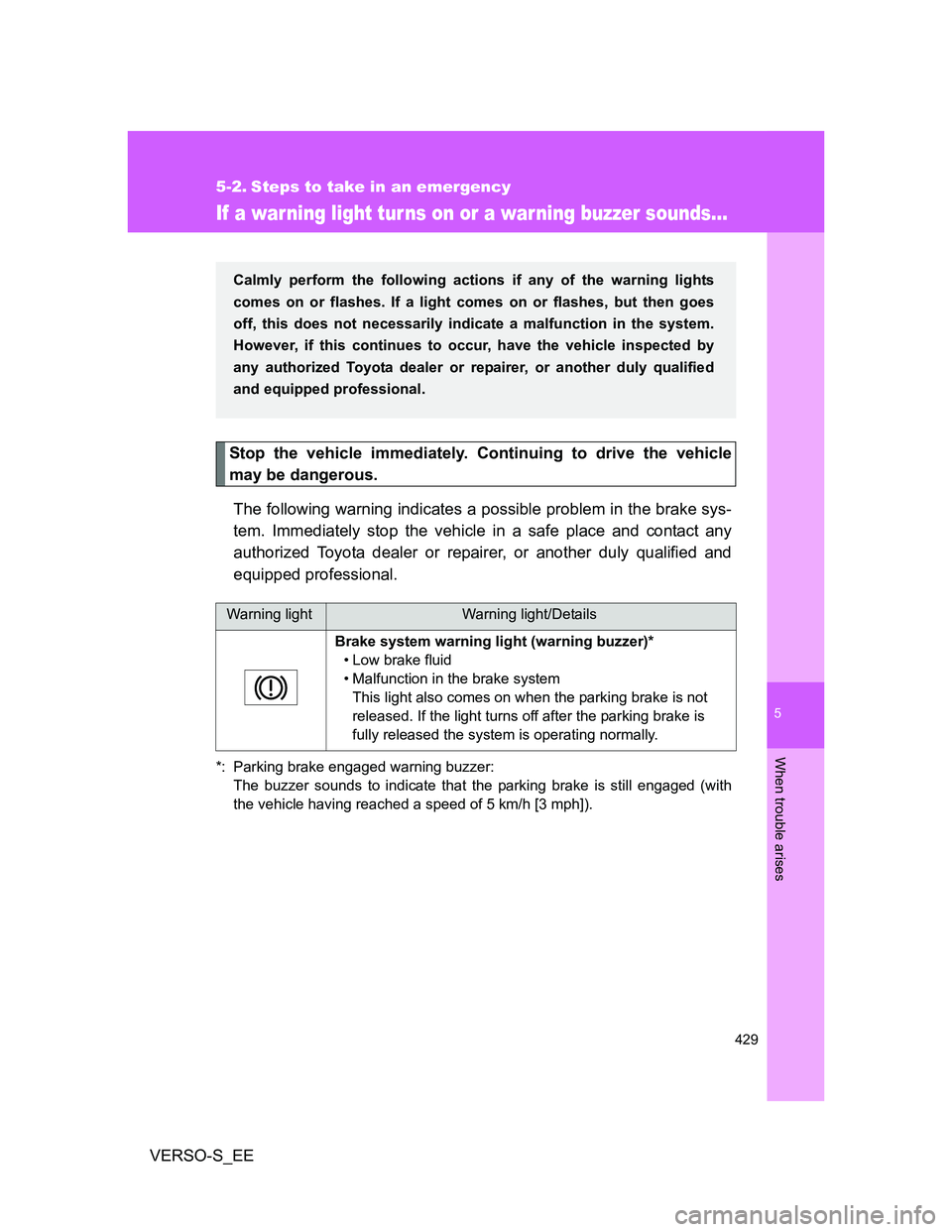
Warning lightWarning light/Details
Brake system warning light (warning buzzer)*
• Low brake fluid
• Malfunction in the brake system
This light also comes on when the parking brake is not
released. If the light turns off after the parking brake is
fully released the system is operating normally.
Calmly perform the following actions if any of the warning lights
comes on or flashes. If a light comes on or flashes, but then goes
off, this does not necessarily indicate a malfunction in the system.
However, if this continues to occur, have the vehicle inspected by
any authorized Toyota dealer or repairer, or another duly qualified
and equipped professional.
Page 435 of 540
5
435 5-2. Steps to take in an emergency
When trouble arises
VERSO-S_EE
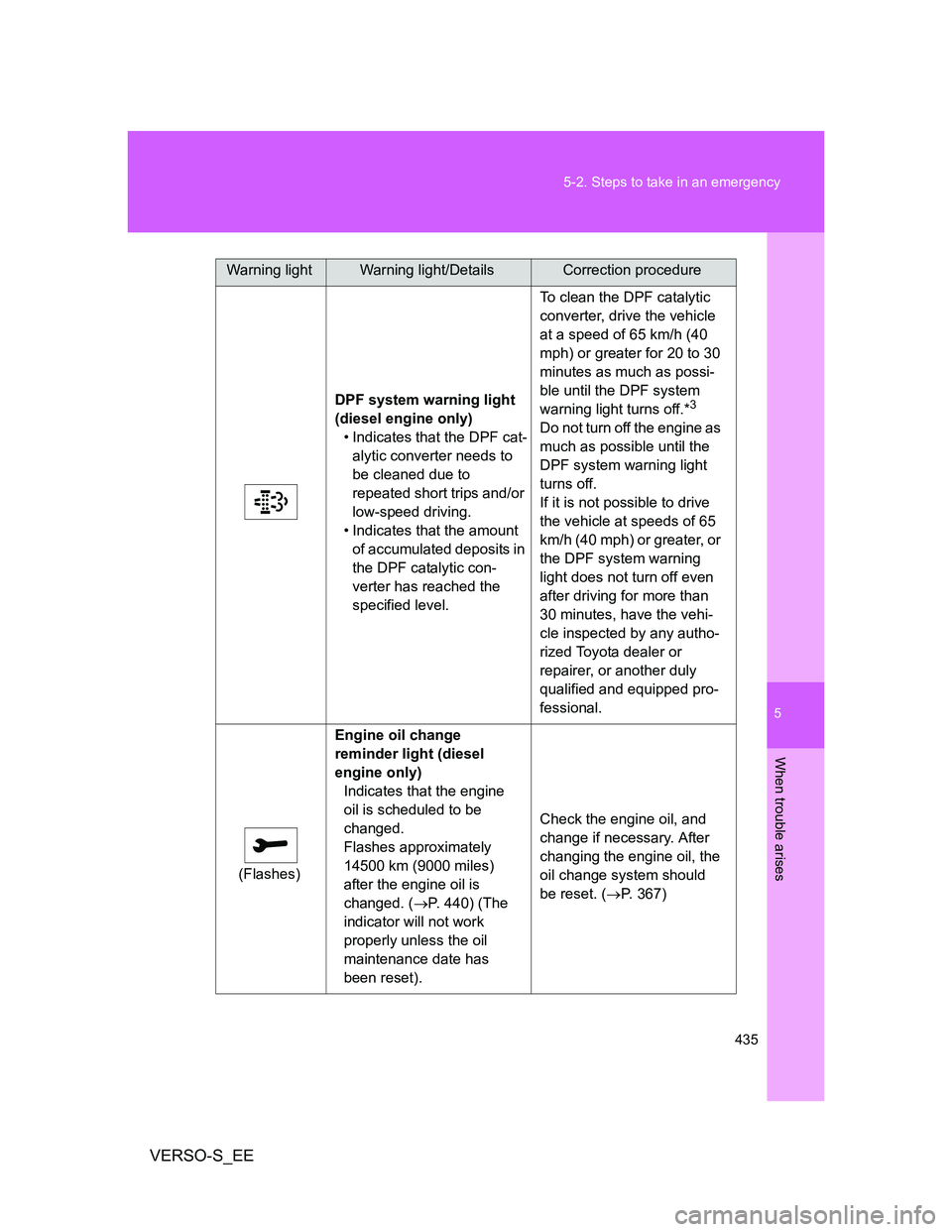
DPF system warning light
(diesel engine only)
• Indicates that the DPF cat-
alytic converter needs to
be cleaned due to
repeated short trips and/or
low-speed driving.
• Indicates that the amount
of accumulated deposits in
the DPF catalytic con-
verter has reached the
specified level.To clean the DPF catalytic
converter, drive the vehicle
at a speed of 65 km/h (40
mph) or greater for 20 to 30
minutes as much as possi-
ble until the DPF system
warning light turns off.*3
Do not turn off the engine as
much as possible until the
DPF system warning light
turns off.
If it is not possible to drive
the vehicle at speeds of 65
km/h (40 mph) or greater, or
the DPF system warning
light does not turn off even
after driving for more than
30 minutes, have the vehi-
cle inspected by any autho-
rized Toyota dealer or
repairer, or another duly
qualified and equipped pro-
fessional.
(Flashes)Engine oil change
reminder light (diesel
engine only)
Indicates that the engine
oil is scheduled to be
changed.
Flashes approximately
14500 km (9000 miles)
after the engine oil is
changed. (P. 440) (The
indicator will not work
properly unless the oil
maintenance date has
been reset).Check the engine oil, and
change if necessary. After
changing the engine oil, the
oil change system should
be reset. (P. 367)
Warning lightWarning light/DetailsCorrection procedure
Page 440 of 540
440 5-2. Steps to take in an emergency
VERSO-S_EE
If the malfunction indicator lamp comes on while driving
For some models, the malfunction indicator lamp will come on if the fuel tank
becomes completely empty. If the fuel tank is empty, refuel the vehicle
immediately. The malfunction indicator lamp will go off after several trips.
If the malfunction indicator lamp does not go off, contact any authorized
Toyota dealer or repairer, or another duly qualified and equipped profes-
sional, as soon as possible.
Passenger detection sensor and passenger seat belt reminder
If luggage is placed on a passenger seat, the passenger detection sensor
may cause the warning light to flash even if a passenger is not sitting in
the seat.
If a cushion is placed on the seat, the sensor may not detect a passen-
ger, and the warning light may not operate properly.
If the engine oil change reminder light flashes (diesel engine only)
Repeated short trips and/or low-speed driving may cause the oil to degrade
sooner than usual, regardless of the actual distance driven. If this happens,
the engine oil change reminder light will flash.
Engine oil change reminder light comes on (diesel engine only)
Replace the engine oil and oil filter when the engine oil change reminder
light does not come on even if you have driven over 15000 km (9300 miles)
after the engine oil was changed.
There is a possibility that the engine oil change reminder light has been illu-
minated when you have driven less than 15000 km (9300 miles) based on a
usage or driving condition.
Electric power steering warning light (warning buzzer)
The electric power steering warning light may come on and the warning
buzzer may sound when the voltage is low or the voltage drops.
Page 441 of 540
5
441 5-2. Steps to take in an emergency
When trouble arises
VERSO-S_EE
CAUTION
When the electric power steering system warning light comes on
The steering wheel may become extremely heavy.
If the steering wheel becomes heavier than usual when operating, hold
firmly and operate using more force than usual.
When driving to clean the DPF catalytic converter (diesel engine only)
When driving, pay sufficient attention to weather, road conditions, terrain and
traffic conditions, and be sure to observe traffic laws and/or regulations. Fail-
ure to do so may cause an unexpected accident, resulting in death or seri-
ous injury.
NOTICE
If the fuel filter warning light comes on (diesel engine only)
Never drive the vehicle with the warning light on. Continued driving with
water accumulated in the fuel filter will damage the fuel injection pump.
When the DPF system warning light comes on (diesel engine only)
If the DPF system warning light is left on without performing cleaning, after
an additional 100 to 300 km (62 to 187 miles), the malfunction indicator lamp
may come on. If this happens, have the vehicle inspected by any authorized
Toyota dealer or repairer, or another duly qualified and equipped profes-
sional immediately.
Page 452 of 540
452 5-2. Steps to take in an emergency
VERSO-S_EE
CAUTION
When using the spare tire
Remember that the compact spare tire provided is specifically designed
for use with your vehicle. Do not use your compact spare tire on another
vehicle.
Do not use more than one compact spare tire simultaneously.
Replace the compact spare tire with a standard tire as soon as possible.
Avoid sudden acceleration, deceleration and braking, as well as sharp cor-
nering.
When storing the compact spare tire
Be careful not to catch fingers or other body parts between the compact
spare tire and the body of the vehicle.
When the compact spare tire is attached
The vehicle speed may not be correctly detected, and the following systems
may not operate correctly:
ABS
Brake assist
VSC (if equipped)
TRC (if equipped)
Speed limit when using the compact spare tire
Do not drive at speeds in excess of 80 km/h (50 mph) when a compact spare
tire is installed on the vehicle.
The compact spare tire is not designed for driving at high speeds. Failure to
observe this precaution may lead to an accident causing death or serious
injury.
Using the tire jack
Improper use of the tire jack may cause the vehicle to suddenly fall off the
jack, leading to death or serious injury.
Do not use the tire jack for any purpose other than replacing tires or install-
ing and removing tire chains.
Page 453 of 540
5
453 5-2. Steps to take in an emergency
When trouble arises
VERSO-S_EE
CAUTION
Only use the tire jack that comes with this vehicle for replacing a flat tire.
Do not use it on other vehicles, and do not use other tire jacks for replac-
ing tires on this vehicle.
Always check that the tire jack is securely set to the jack point.
Do not put any part of your body under the vehicle while it is supported by
the jack.
Do not start or run the engine while your vehicle is supported by the jack.
Do not raise the vehicle while someone is inside.
When raising the vehicle, do not put an object on or under the jack.
Do not raise the vehicle to a height greater than that required to replace
the tire.
Use a jack stand if it is necessary to get under the vehicle.
Take particular care when lowering the vehicle to ensure that no one working
on or near the vehicle may be injured.
Replacing a flat tire
Observe the following precautions to reduce the risk of death or serious
injury:
Do not attach a heavily damaged wheel ornament, as it may fly off the
wheel while the vehicle is moving.
Do not touch the disc wheels or the area around the brakes immediately
after the vehicle has been driven.
After the vehicle has been driven the disc wheels and the area around the
brakes will be extremely hot. Touching these areas with hands, feet or
other body parts while changing a tire, etc. may result in burns.
Have the wheel nuts tightened with a torque wrench to 103 N•m (10.5
kgf•m, 76 ft•lbf) as soon as possible after changing wheels.
When installing a tire, only use wheel nuts that have been specifically
designed for that wheel.
If there are any cracks or deformations in the bolt screws, nut threads or
bolt holes of the wheel, have the vehicle inspected by any authorized
Toyota dealer or repairer, or another duly qualified and equipped profes-
sional.
Page 454 of 540
454 5-2. Steps to take in an emergency
VERSO-S_EE
CAUTION
When installing the wheel nuts
Be sure to install the wheel nuts with the tapered end facing inward.
(P. 383)
Failure to follow these precautions could cause the wheel nuts to loosen and
the tire to fall off, resulting in death or serious injury.
NOTICE
Do not drive the vehicle with a flat tire.
Do not continue driving with a flat tire.
Driving even a short distance with a flat tire can damage the tire and the
wheel beyond repair.
Be careful when driving over bumps with the compact spare tire
installed on the vehicle.
The vehicle becomes lower when driving with the compact spare tire com-
pared to when driving with standard tires. Be careful when driving over
uneven road surfaces.
Driving with tire chains and the compact spare tire
Do not fit tire chains to the compact spare tire.
Tire chains may damage the vehicle body and adversely affect driving per-
formance.