Vin TOYOTA VERSO S 2012 Owners Manual
[x] Cancel search | Manufacturer: TOYOTA, Model Year: 2012, Model line: VERSO S, Model: TOYOTA VERSO S 2012Pages: 540, PDF Size: 17.43 MB
Page 455 of 540
5
455
5-2. Steps to take in an emergency
When trouble arises
VERSO-S_EE
If you have a flat tire (vehicles with an emergency tire puncture repair kit)
A puncture caused by a nail or screw passing through the tire tread
can be repaired temporarily using the emergency tire puncture repair
kit. (The kit contains a bottle of sealant. The sealant can be used only
once to temporarily repair one tire without removing the nail or
screw from the tire.) Depending on the damage, this kit cannot be
used to repair the tire. (P. 458)
After temporarily repairing the tire with the kit, have the tire repaired
or replaced by any authorized Toyota dealer or repairer, or another
duly qualified and equipped professional. Repairs conducted using
the emergency tire puncture repair kit are only a temporary measure.
Have the tire repaired and replaced as soon as possible.
Before repairing the tire
Stop the vehicle in a safe place on a hard, flat surface.
Set the parking brake.
Shift the shift lever to P (vehicles with a Multidrive) or N (vehi-
cles with a multi-mode manual transmission and manual
transmission).
Stop the engine.
Turn on the emergency flashers.
Page 458 of 540
458 5-2. Steps to take in an emergency
VERSO-S_EE
Before performing emergency repair
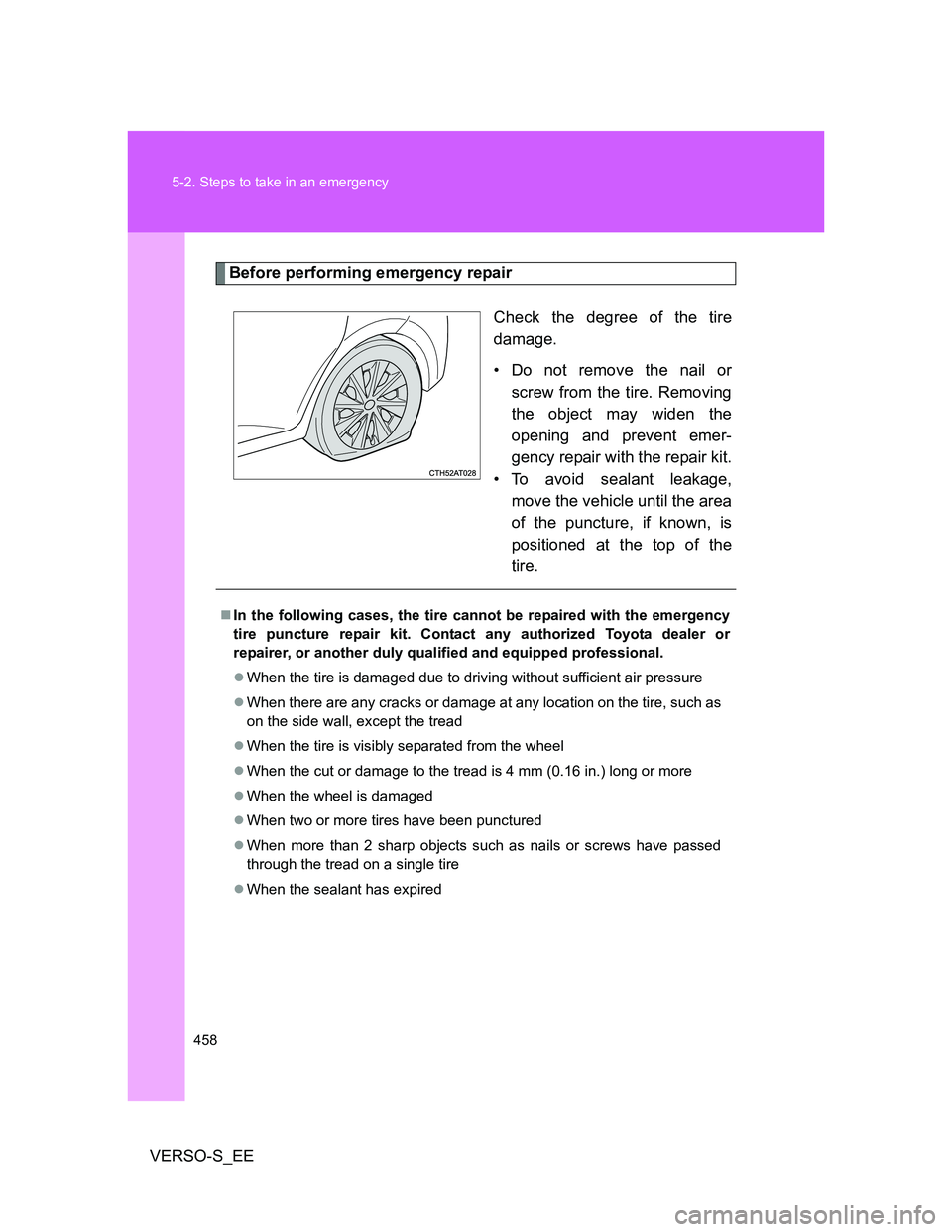
Check the degree of the tire
damage.
• Do not remove the nail or
screw from the tire. Removing
the object may widen the
opening and prevent emer-
gency repair with the repair kit.
• To avoid sealant leakage,
move the vehicle until the area
of the puncture, if known, is
positioned at the top of the
tire.
In the following cases, the tire cannot be repaired with the emergency
tire puncture repair kit. Contact any authorized Toyota dealer or
repairer, or another duly qualified and equipped professional.
When the tire is damaged due to driving without sufficient air pressure
When there are any cracks or damage at any location on the tire, such as
on the side wall, except the tread
When the tire is visibly separated from the wheel
When the cut or damage to the tread is 4 mm (0.16 in.) long or more
When the wheel is damaged
When two or more tires have been punctured
When more than 2 sharp objects such as nails or screws have passed
through the tread on a single tire
When the sealant has expired
Page 465 of 540
5
465 5-2. Steps to take in an emergency
When trouble arises
VERSO-S_EEWith the compressor switch off, disconnect the hose from the
valve on the tire and then pull out the power plug from the
power outlet socket.
Some sealant may leak when the hose is removed.
Install the valve cap onto the valve of the emergency repaired
tire.
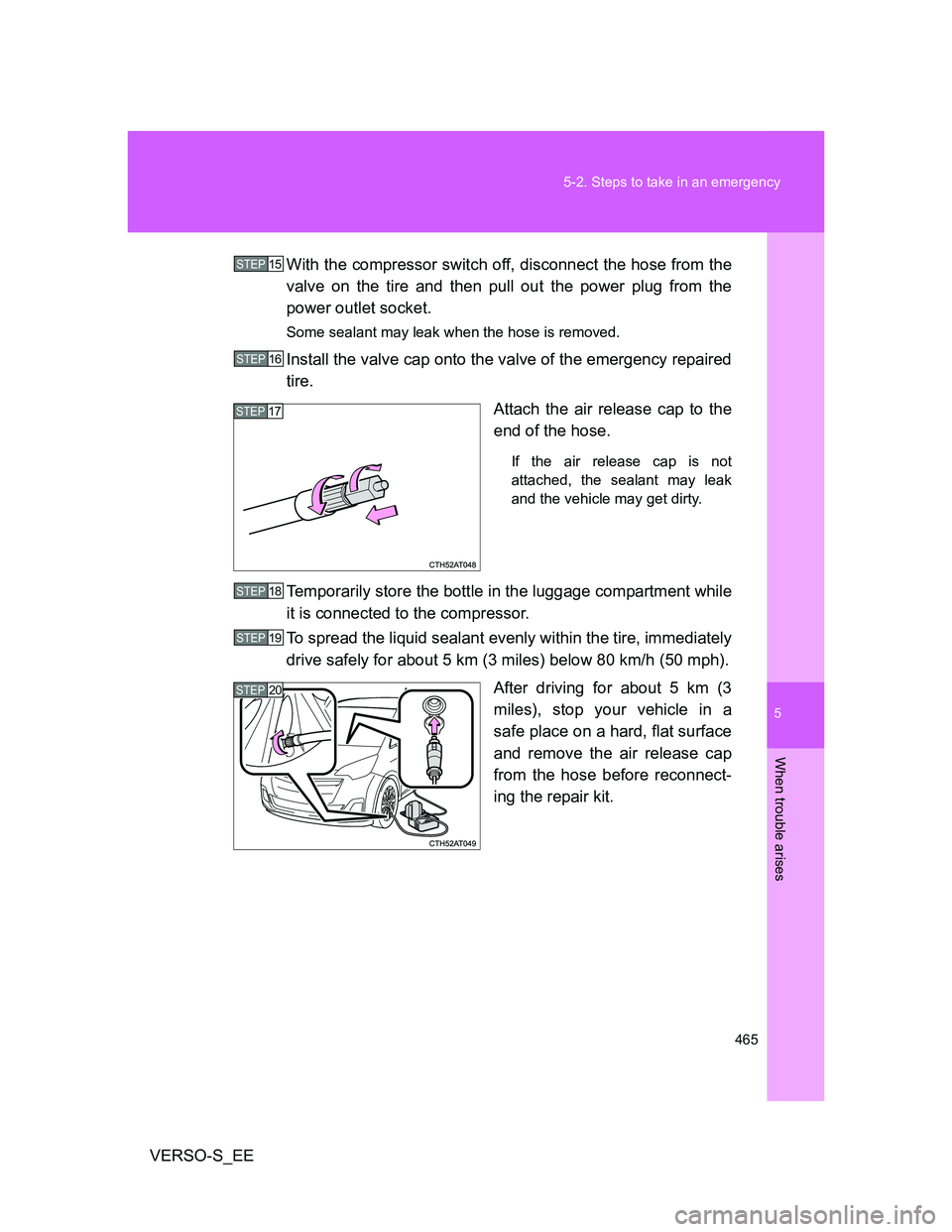
Attach the air release cap to the
end of the hose.
If the air release cap is not
attached, the sealant may leak
and the vehicle may get dirty.
Temporarily store the bottle in the luggage compartment while
it is connected to the compressor.
To spread the liquid sealant evenly within the tire, immediately
drive safely for about 5 km (3 miles) below 80 km/h (50 mph).
After driving for about 5 km (3
miles), stop your vehicle in a
safe place on a hard, flat surface
and remove the air release cap
from the hose before reconnect-
ing the repair kit.
STEP15
STEP16
STEP17
STEP18
STEP19
STEP20
Page 469 of 540
5
469 5-2. Steps to take in an emergency
When trouble arises
VERSO-S_EE
CAUTION
Do not drive the vehicle with a flat tire
Do not continue driving with a flat tire.
Driving even a short distance with a flat tire can damage the tire and the
wheel beyond repair.
Driving with a flat tire may cause a circumferential groove on the side wall. In
such a case, the tire may explode when using a repair kit.
Caution while driving
Store the repair kit under the front right seat.
Injuries may result in the event of an accident or sudden braking.
The repair kit is exclusively only for your vehicle.
Do not use repair kit on other vehicles, which could lead to an accident
causing death or serious injury.
Do not use repair kit for tires that are different size than the original ones,
or for any other purpose. If the tires have not been completely repaired, it
could lead to an accident causing death or serious injury.
Precautions for use of the sealant
Ingesting the sealant is hazardous to your health. If you ingest sealant,
consume as much water as possible, and then immediately consult a doc-
tor.
If sealant gets in eyes or adheres to skin, immediately wash it off with
water. If discomfort persists, consult a doctor.
When fixing the flat tire
Stop your vehicle in a safe and flat area.
Do not touch the wheels or the area around the brakes immediately after
the vehicle has been driven.
After the vehicle has been driven, the wheels and the area around the
brakes may be extremely hot. Touching these areas with hands, feet or
other body parts may result in burns.
Connect the valve and hose securely with the tire installed on the vehicle.
If the hose is not properly connected to the valve, air leakage may occur
as sealant may be sprayed out.
If the hose comes off the valve while inflating the tire, there is a risk that
the hose will move abruptly due to air pressure.
Page 470 of 540
470 5-2. Steps to take in an emergency
VERSO-S_EE
CAUTION
When fixing the flat tire
After inflation of the tire has completed, the sealant may splatter when the
hose is disconnected or some air is let out of the tire.
Follow the operation procedure to repair the tire. If the procedures not fol-
lowed, the sealant may spray out.
Keep back from the tire while it is being repaired, as there is a chance of it
bursting while the repair operation is being performed. If you notice any
cracks or deformation of the tire, turn off the compressor switch and stop
the repair operation immediately.
The repair kit may overheat if operated for a long period of time. Do not
operate the repair kit continuously for more than 40 minutes.
Parts of the repair kit become hot during operation. Be careful when han-
dling the repair kit during and after operation. Do not touch the metal part
around the connecting area between the bottle and compressor. It will be
extremely hot.
Do not attach the vehicle speed warning sticker to an area other than the
one indicated. If the sticker is attached to an area where an SRS airbag is
located, such as the pad of the steering wheel, it may prevent the SRS air-
bag from operating properly.
Driving to spread the liquid sealant evenly
Observe the following precautions to reduce the risk of accidents.
Failing to do so may result in a loss of vehicle control and cause death or
serious injury.
Drive the vehicle carefully at a low speed. Be especially careful when turn-
ing and cornering.
If the vehicle does not drive straight or you feel a pull through the steering
wheel, stop the vehicle and check the following.
• Tire condition. The tire may have separated from the wheel.
• Tire inflation pressure. If the tire inflation pressure is 130 kPa (1.3
kgf/cm
2 or bar, 19 psi) or less, the tire may be severely damaged.
Page 471 of 540
5
471 5-2. Steps to take in an emergency
When trouble arises
VERSO-S_EE
NOTICE
When performing an emergency repair
A tire should only be repaired with the emergency tire puncture repair kit if
the damage is caused by a sharp object such as nail or screw passing
through the tire tread.
Do not remove the sharp object from the tire. Removing the object may
widen the opening and disenable emergency repair with the repair kit.
The repair kit is not waterproof. Make sure that the repair kit is not
exposed to water, such as when it is being used in the rain.
Do not put the repair kit directly onto dusty ground such as sand at the
side of the road. If the repair kit vacuums up dust etc., a malfunction may
occur.
Precautions for the emergency tire puncture repair kit
The repair kit power source should be 12 V DC suitable for vehicle use. Do
not connect the repair kit to any other source.
If gasoline splatters on the repair kit, the repair kit may deteriorate. Take
care not to allow gasoline to contact it.
Place the repair kit in a storage to prevent it from being exposed to dirt or
water.
Store the repair kit under the front right seat out of reach of children.
Do not disassemble or modify the repair kit. Do not subject parts such as
the air pressure indicator to impacts. This may cause a malfunction.
Page 486 of 540
486 5-2. Steps to take in an emergency
VERSO-S_EE
Starting the engine when the battery is discharged (vehicles with a
Multidrive)
The engine cannot be started by push-starting.
To prevent battery discharge
Turn off the headlights and the audio system while the engine is off.
Turn off any unnecessary electrical components when the vehicle is run-
ning at a low speed for an extended period, such as in heavy traffic.
Charging the battery
The electricity stored in the battery will discharge gradually even when the
vehicle is not in use, due to natural discharge and the draining effects of cer-
tain electrical appliances. If the vehicle is left for a long time, the battery may
discharge, and the engine may be unable to start. (The battery recharges
automatically during driving.)
Precautions when the battery is discharged (vehicles with a smart
entry & start system)
In some cases, it may not be possible to unlock the doors using the smart
entry & start system when the battery is discharged. Use the wireless
remote control or the mechanical key to lock or unlock the doors.
The engine may not start on the first attempt after the battery has
recharged but will start normally after the second attempt. This is not a
malfunction.
The “ENGINE START STOP” switch mode is memorized by the vehicle.
When the battery is reconnected, the system will return to the mode it
was in before the battery was discharged. Before disconnecting the bat-
tery, turn the “ENGINE START STOP” switch off.
If you are unsure what mode the “ENGINE START STOP” switch was in
before the battery discharged, be especially careful when reconnecting
the battery.
Once the engine starts, have the vehicle checked at any autho-
rized Toyota dealer or repairer, or another duly qualified and
equipped professional, as soon as possible.
Page 497 of 540
5
497 5-2. Steps to take in an emergency
When trouble arises
VERSO-S_EE
CAUTION
If the engine has to be turned off while driving
Power assist for the brakes and steering wheel will be lost, making the
brake pedal harder to depress and the steering wheel heavier to turn.
Decelerate as much as possible before turning off the engine.
Vehicles without a smart entry & start system: Never attempt to remove
the key, as doing so will lock the steering wheel.
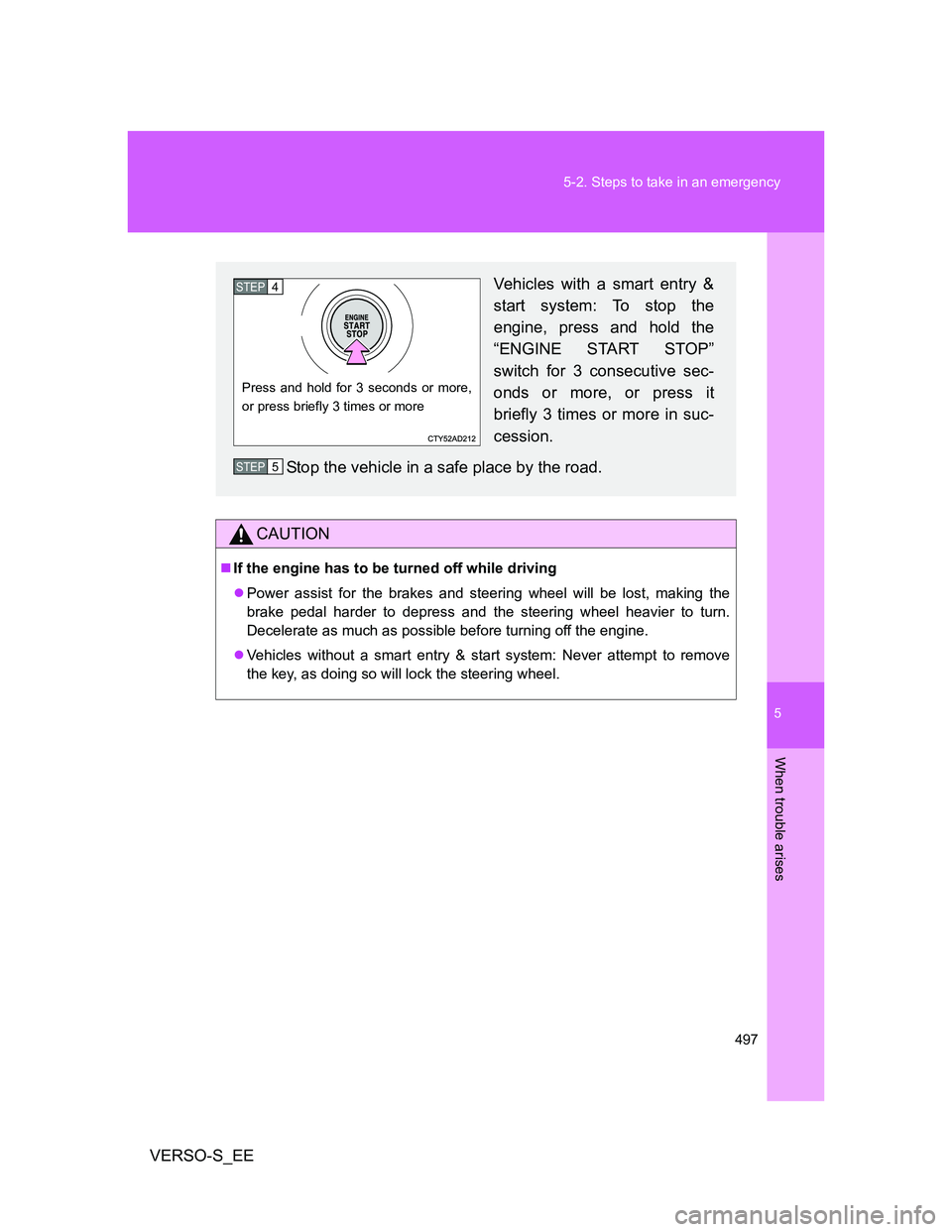
Vehicles with a smart entry &
start system: To stop the
engine, press and hold the
“ENGINE START STOP”
switch for 3 consecutive sec-
onds or more, or press it
briefly 3 times or more in suc-
cession.
Stop the vehicle in a safe place by the road.
Press and hold for 3 seconds or more,
or press briefly 3 times or more
STEP4
STEP5
Page 501 of 540
501 6-1. Specifications
6
Vehicle specifications
VERSO-S_EE
*1: Unladen vehicles
*2: Vehicles without Stop & Start system
*3: Vehicles with Stop & Start system
*4: Except vehicles with leather wrapped steering wheel
*5: Vehicles with leather wrapped steering wheel
Vehicle identification
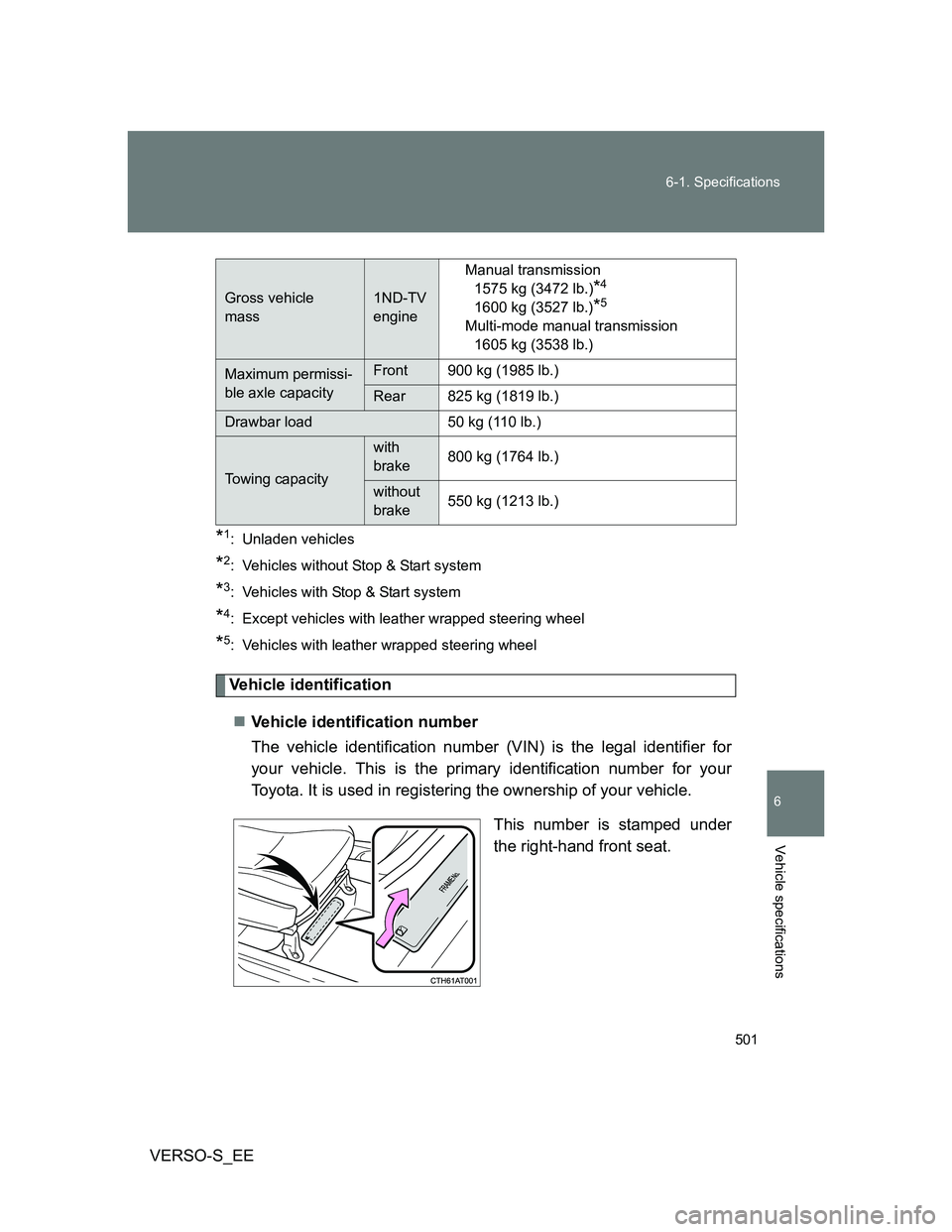
Vehicle identification number
The vehicle identification number (VIN) is the legal identifier for
your vehicle. This is the primary identification number for your
Toyota. It is used in registering the ownership of your vehicle.
This number is stamped under
the right-hand front seat.
Gross vehicle
mass1ND-TV
engineManual transmission
1575 kg (3472 lb.)*4
1600 kg (3527 lb.)*5
Multi-mode manual transmission
1605 kg (3538 lb.)
Maximum permissi-
ble axle capacityFront 900 kg (1985 lb.)
Rear 825 kg (1819 lb.)
Drawbar load 50 kg (110 lb.)
Towing capacity
with
brake800 kg (1764 lb.)
without
brake550 kg (1213 lb.)
Page 506 of 540
506 6-1. Specifications
VERSO-S_EEEngine oil selection
“Toyota Genuine Motor Oil” is used in your Toyota vehicle. Toyota rec-
ommends the use of approved “Toyota Genuine Motor Oil”. Another
motor oil of matching quality can also be used.
1NR-FE engine
Oil grade:
0W-20, 5W-20, 5W-30 and 10W-30:
API grade SL “Energy-Conserving”, SM “Energy-Conserving” or
ILSAC multigrade engine oil
15W-40 and 20W-50:
API grade SL or SM multigrade engine oil
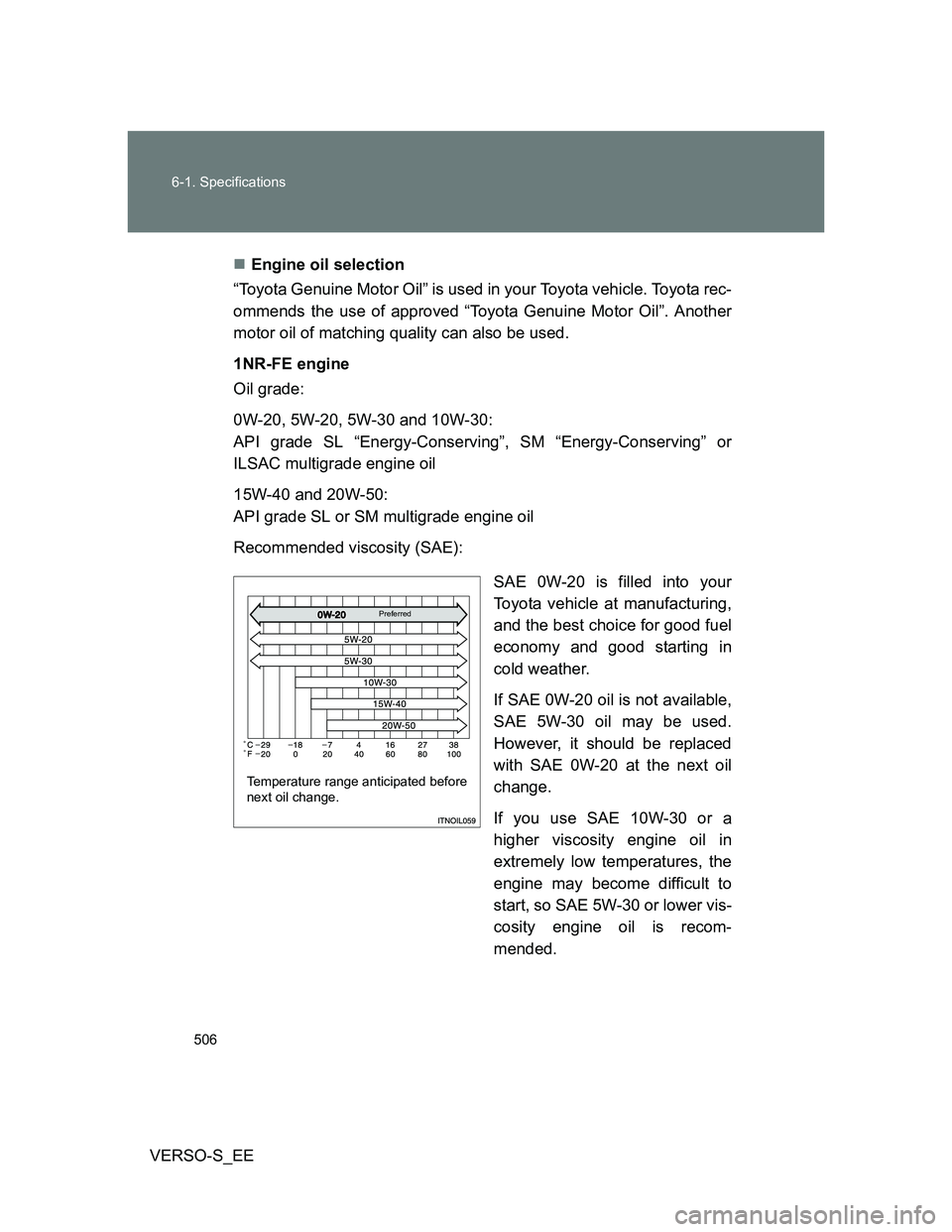
Recommended viscosity (SAE):
SAE 0W-20 is filled into your
Toyota vehicle at manufacturing,
and the best choice for good fuel
economy and good starting in
cold weather.
If SAE 0W-20 oil is not available,
SAE 5W-30 oil may be used.
However, it should be replaced
with SAE 0W-20 at the next oil
change.
If you use SAE 10W-30 or a
higher viscosity engine oil in
extremely low temperatures, the
engine may become difficult to
start, so SAE 5W-30 or lower vis-
cosity engine oil is recom-
mended.
Temperature range anticipated before
next oil change.
Preferred