All TOYOTA xB 2012 (in English) Owner's Guide
[x] Cancel search | Manufacturer: TOYOTA, Model Year: 2012, Model line: xB, Model: TOYOTA xB 2012Pages: 388, PDF Size: 10.38 MB
Page 62 of 388
62 1-5. Refueling
Scion_xB_U_(OM12F39U)
CAUTION
■When refueling the vehicle
Observe the following precautions while refueling the vehicle.
Failure to do so may result in death or serious injury.
● After exiting the vehicle and before opening the fuel door, touch an
unpainted metal surface to discharge any static electricity. It is important to
discharge static electricity before refueling because sparks resulting from
static electricity can cause fuel vapors to ignite while refueling.
● Always hold the grips on the fuel tank cap and turn it slowly to remove it.
A whooshing sound may be heard when the fuel tank cap is loosened.
Wait until the sound cannot be heard before fully removing the cap.
In hot weather, pressurized fuel may spray out the filler neck and cause
injury.
● Do not allow anyone that has not discharged static electricity from their
body to come close to an open fuel tank.
● Do not inhale vaporized fuel.
Fuel contains substances that are harmful if inhaled.
● Do not smoke while refueling the vehicle.
Doing so may cause the fuel to ignite and cause a fire.
● Do not return to the vehicle or touch any person or object that is statically
charged.
This may cause static electricity to build up, resulting in a possible ignition
hazard.
Page 63 of 388
63
1-5. Refueling
1
Before driving
Scion_xB_U_(OM12F39U)
CAUTION
■
When refueling
Securely insert the fuel nozzle into the fuel filler neck. If fuel is added with
the nozzle slightly lifted away from the fuel filler neck, the automatic shut off
function may not operate, resulting in fuel overflowing from the tank.
■ When replacing the fuel cap
Do not use anything but a genuine Scion fuel tank cap designed for your
vehicle. Doing so may cause a fire or other incident which may result in
death or serious injury.
NOTICE
■Refueling
Do not spill fuel during refueling.
Doing so may damage the vehicle, such as causing the emission control
system to operate abnormally or damaging fuel system components or the
vehicle’s painted surface.
Page 64 of 388
64
Scion_xB_U_(OM12F39U)
1-6. Theft deterrent system
Engine immobilizer system
: If equipped
■System maintenance
The vehicle has a maintenance-free type engine immobilizer system.
■ Conditions that may cause the system to malfunction
● If the grip portion of the key is in contact with a metallic object
● If the key is in close proximity to or touching a key to the security system
(key with a built-in transponder chip) of another vehicle
■ Certifications for the engine imm obilizer system (for vehicles sold in
Canada)
Operation is subject to the following two conditions: (1) this device may not
cause interference, and (2) this device must accept any interference, includ-
ing interference that may cause undesired operation of the device.
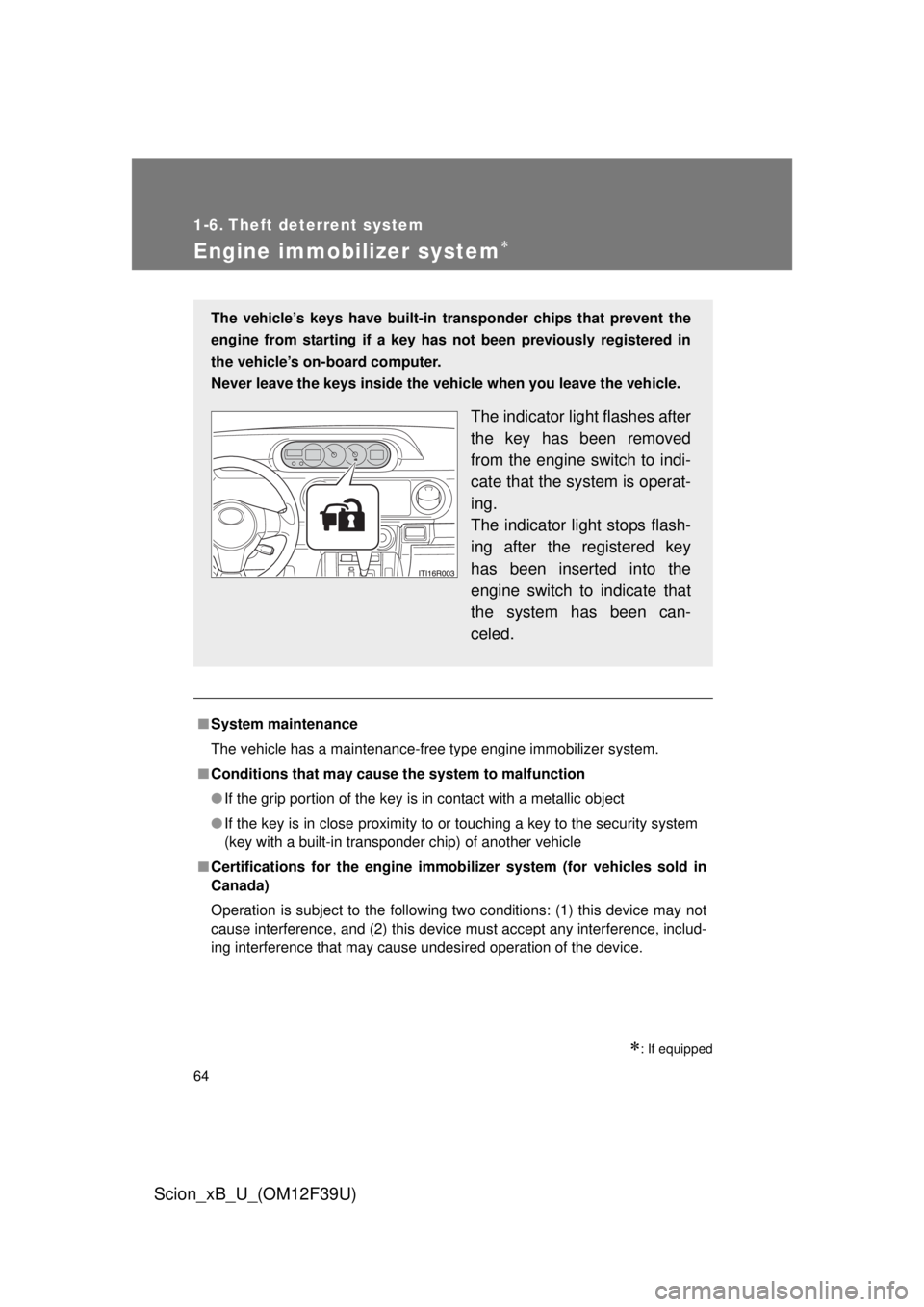
The vehicle’s keys have built-in tr ansponder chips that prevent the
engine from starting if a key has not been previously registered in
the vehicle’s on-board computer.
Never leave the keys inside the vehicle when you leave the vehicle.
The indicator light flashes after
the key has been removed
from the engine switch to indi-
cate that the system is operat-
ing.
The indicator light stops flash-
ing after the registered key
has been inserted into the
engine switch to indicate that
the system has been can-
celed.
Page 72 of 388
72 1-7. Safety information
Scion_xB_U_(OM12F39U)
■If the SRS airbags deploy (inflate)
● Bruising and slight abrasions may result from contact with a deploying
(inflating) SRS airbag.
● A loud noise and white powder will be emitted.
● Parts of the airbag module (steering wheel hub, airbag cover and inflator)
as well as the front seats, parts of the front and rear pillars, and roof side
rails, may be hot for several minutes. The airbag itself may also be hot.
● The windshield may crack.
■ SRS airbag deployment conditions (SRS front airbags)
● The SRS front airbags will deploy in the event of an impact that exceeds
the set threshold level (the level of force corresponding to an approxi-
mately 12 - 18 mph [20 - 30 km/h] frontal collision with a fixed wall that
does not move or deform).
However, this threshold velocity will be considerably higher if the vehicle
strikes an object, such as a parked vehicle and sign pole, which can move
or deform on impact, or if the vehicle is involved in an underride collision
(e.g. a collision in which the front of the vehicle “underrides”, or goes
under, the bed of a truck, etc.).
● It is possible that in some collisions where the forward deceleration of the
vehicle is very close to the designed threshold level, the SRS front air-
bags and the seat belt pretensioners may not activate together.
● The SRS front passenger airbag will not activate if there is no passenger
sitting in the front passenger seat. However, the SRS front passenger air-
bag may deploy if luggage is put in the seat, or the seat belt is fastened,
even if the seat is unoccupied. ( P. 81)
Page 73 of 388
73
1-7. Safety information
1
Before driving
Scion_xB_U_(OM12F39U)
■
SRS airbag deployment conditions (SRS side airbags and curtain
shield airbags)
The SRS side and curtain shield airbags will deploy in the event of an impact
that exceeds the set threshold level (the level of force corresponding to the
impact force produced by an approximately 3300 lb. [1500 kg] vehicle collid-
ing with the vehicle cabin from a direction perpendicular to the vehicle orien-
tation at an approximate speed of 12 - 18 mph [20 - 30 km/h]).
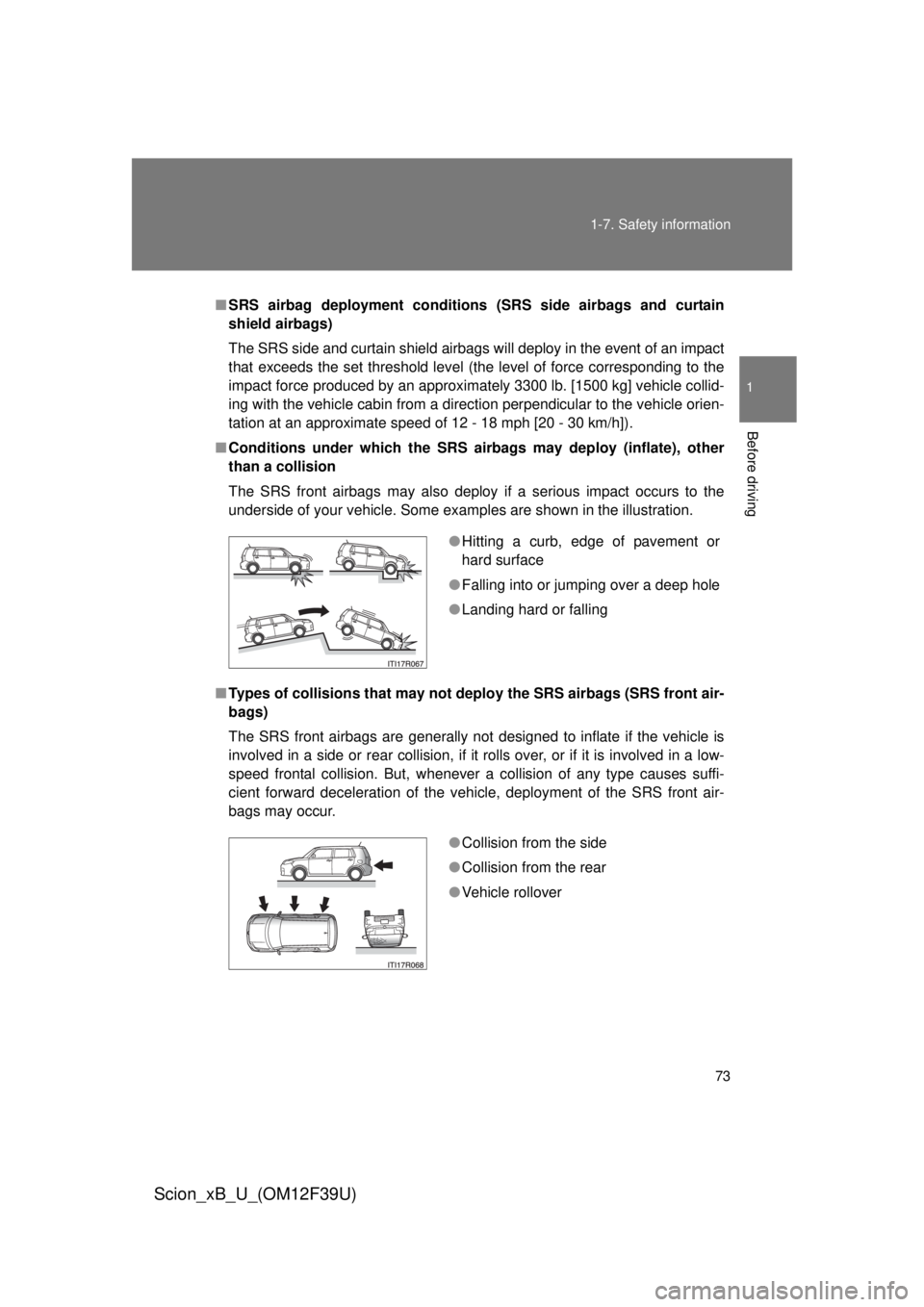
■ Conditions under which the SRS airbags may deploy (inflate), other
than a collision
The SRS front airbags may also deploy if a serious impact occurs to the
underside of your vehicle. Some examples are shown in the illustration.
■ Types of collisions that may not de ploy the SRS airbags (SRS front air-
bags)
The SRS front airbags are generally not designed to inflate if the vehicle is
involved in a side or rear collision, if it rolls over, or if it is involved in a low-
speed frontal collision. But, whenever a collision of any type causes suffi-
cient forward deceleration of the vehicle, deployment of the SRS front air-
bags may occur.
● Hitting a curb, edge of pavement or
hard surface
● Falling into or jumping over a deep hole
● Landing hard or falling
●Collision from the side
● Collision from the rear
● Vehicle rollover
Page 74 of 388
74 1-7. Safety information
Scion_xB_U_(OM12F39U)
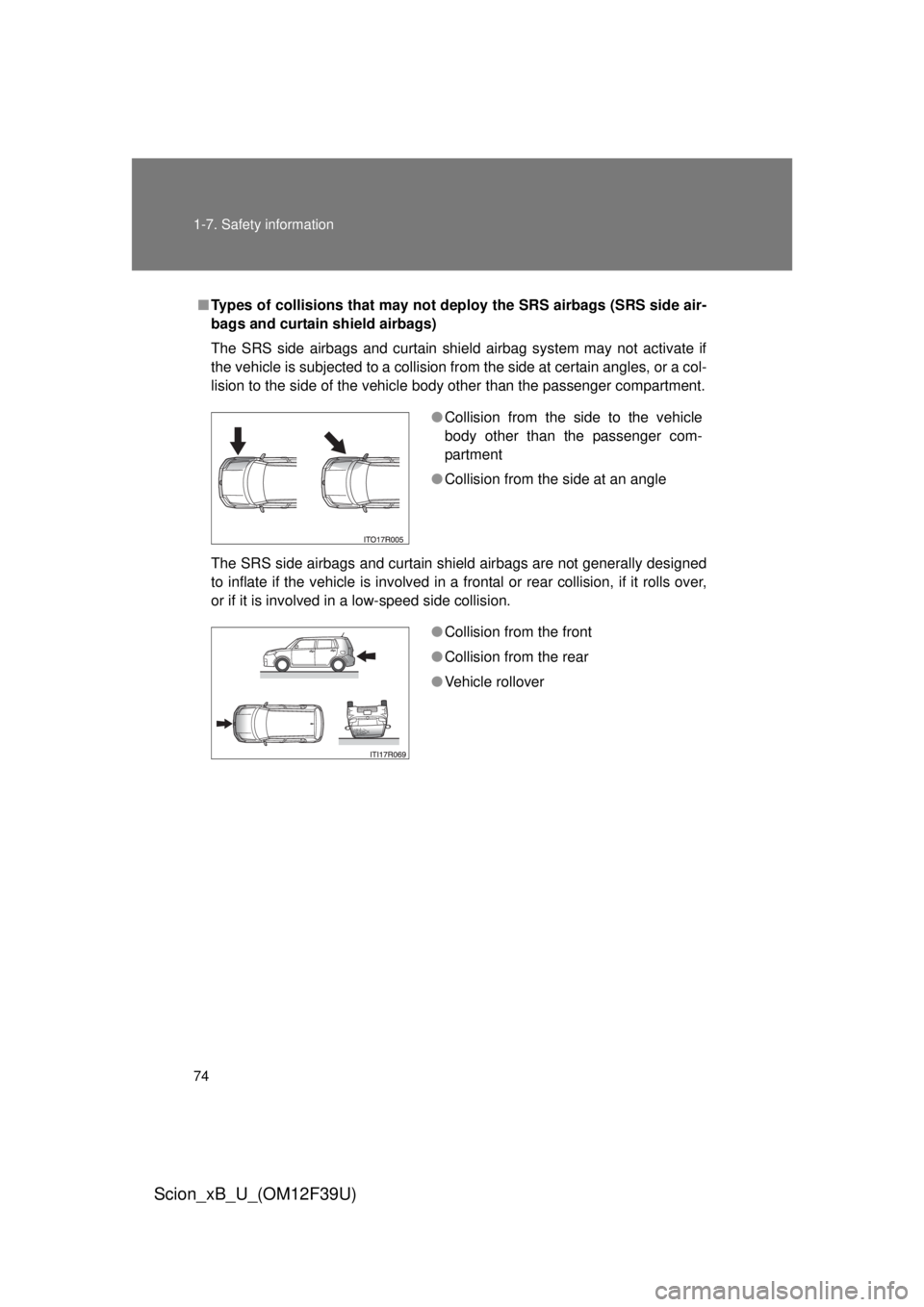
■Types of collisions that may not de ploy the SRS airbags (SRS side air-
bags and curtain shield airbags)
The SRS side airbags and curtain shield airbag system may not activate if
the vehicle is subjected to a collision from the side at certain angles, or a col-
lision to the side of the vehicle body other than the passenger compartment.
The SRS side airbags and curtain shield airbags are not generally designed
to inflate if the vehicle is involved in a frontal or rear collision, if it rolls over,
or if it is involved in a low-speed side collision.
● Collision from the side to the vehicle
body other than the passenger com-
partment
● Collision from the side at an angle
●Collision from the front
● Collision from the rear
● Vehicle rollover
Page 76 of 388
76 1-7. Safety information
Scion_xB_U_(OM12F39U)
CAUTION
■SRS airbag precautions
Observe the following precautions regarding the SRS airbags.
Failure to do so may cause death or serious injury.
● The driver and all passengers in the vehicle must wear their seat belts
properly.
The SRS airbags are supplemental devices to be used with the seat belts.
● The SRS driver airbag deploys with considerable force, and can cause
death or serious injury especially if the driver is very close to the airbag.
The National Highway Traffic Safety Administration (NHTSA) advises:
Since the risk zone for the driver’s airbag is the first 2 - 3 in. (50 - 75 mm)
of inflation, placing yourself 10 in. (250 mm) from your driver airbag pro-
vides you with a clear margin of safety. This distance is measured from the
center of the steering wheel to your breastbone. If you sit less than 10 in.
(250 mm) away now, you can change your driving position in several
ways:
• Move your seat to the rear as far as you can while still reaching the pedals comfortably.
• Slightly recline the back of the seat. Although vehicle designs vary, many drivers can achieve the 10 in.
(250 mm) distance, even with the driver seat all the way forward, sim-
ply by reclining the back of the seat somewhat. If reclining the back of
your seat makes it hard to see the road, raise yourself by using a firm,
non-slippery cushion, or raise the seat if your vehicle has that feature\
.
• If your steering wheel is adjustable, tilt it downward. This points the air- bag toward your chest instead of your head and neck.
The seat should be adjusted as recommended by NHTSA above, while
still maintaining control of the foot pedals, steering wheel, and your view of
the instrument panel controls.
Page 77 of 388
77
1-7. Safety information
1
Before driving
Scion_xB_U_(OM12F39U)
CAUTION
■
SRS airbag precautions
● The SRS front passenger airbag also deploys with considerable force, and
can cause death or serious injury especially if the front passenger is very
close to the airbag. The front passenger seat should be as far from the air-
bag as possible with the seatback adjusted, so the front passenger sits
upright.
● Improperly seated and/or restrained infants and children can be killed or
seriously injured by a deploying airbag. An infant or child who is too small
to use a seat belt should be properly secured using a child restraint sys-
tem. Scion strongly recommends that all infants and children be placed in
the rear seats of the vehicle and properly restrained. The rear seats are
safer for infants and children than the front passenger seat. ( P. 87)
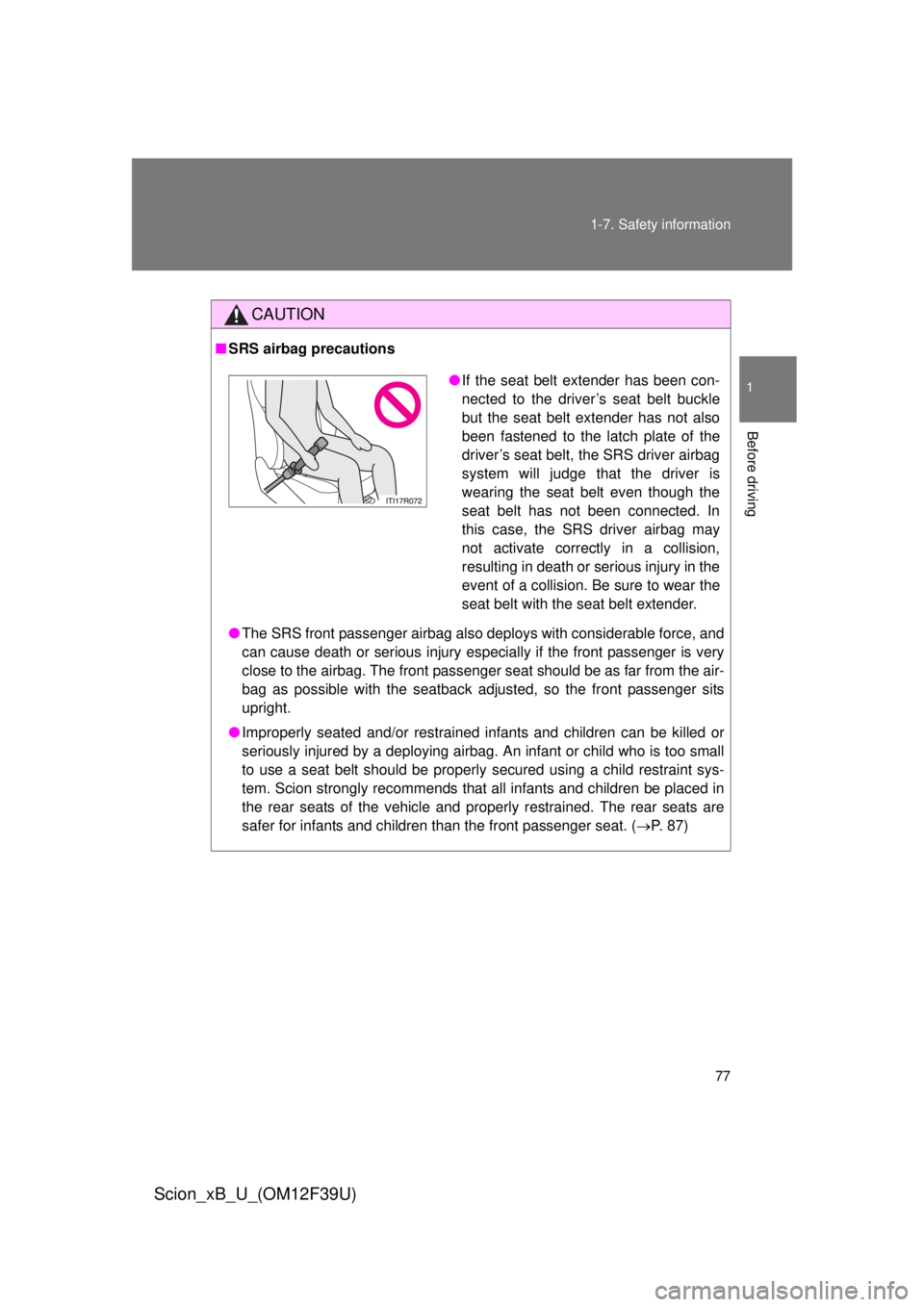
●If the seat belt extender has been con-
nected to the driver’s seat belt buckle
but the seat belt extender has not also
been fastened to the latch plate of the
driver’s seat belt, the SRS driver airbag
system will judge that the driver is
wearing the seat belt even though the
seat belt has not been connected. In
this case, the SRS driver airbag may
not activate correctly in a collision,
resulting in death or serious injury in the
event of a collision. Be sure to wear the
seat belt with the seat belt extender.
Page 78 of 388
78 1-7. Safety information
Scion_xB_U_(OM12F39U)
CAUTION
■SRS airbag precautions
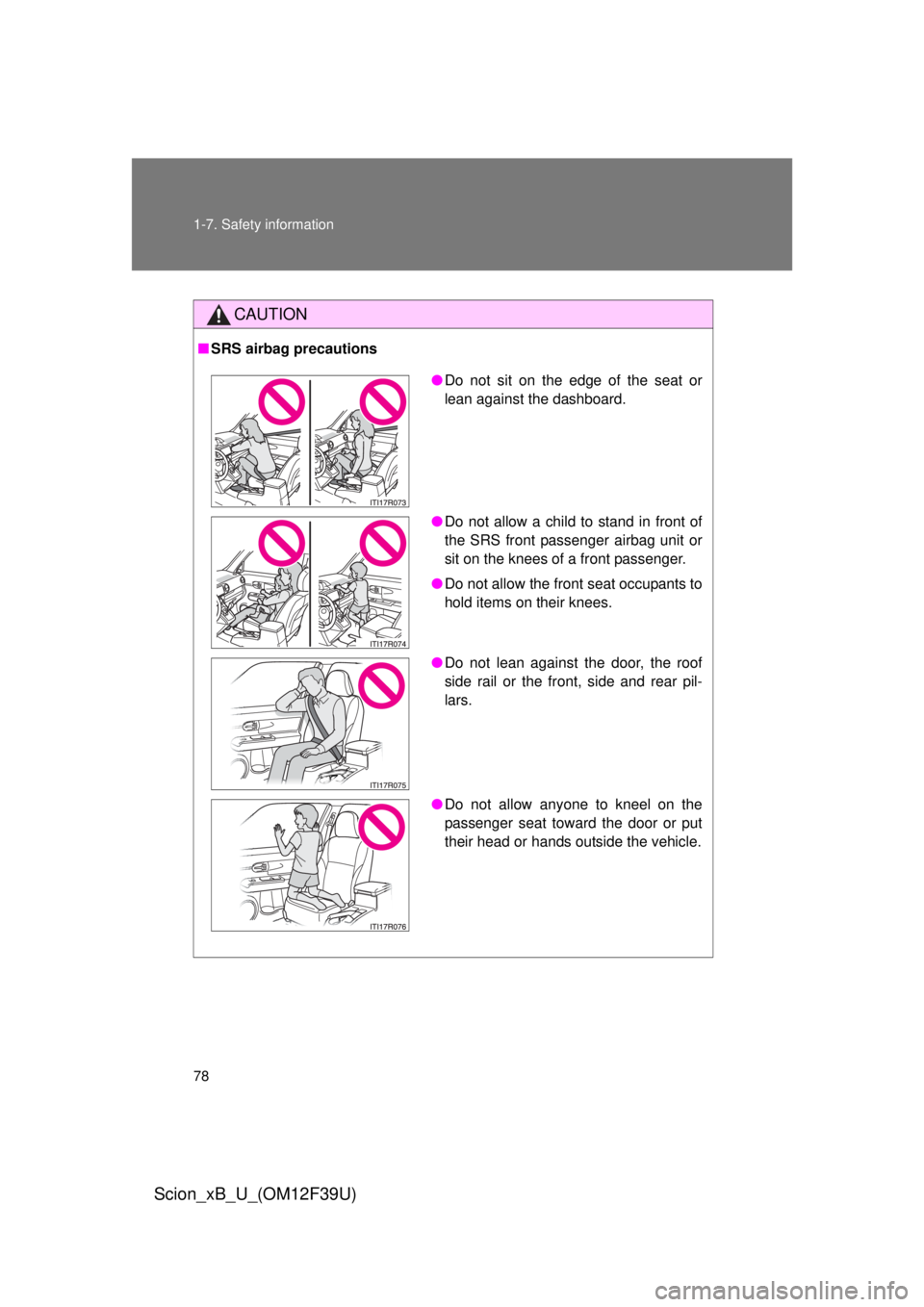
● Do not sit on the edge of the seat or
lean against the dashboard.
● Do not allow a child to stand in front of
the SRS front passenger airbag unit or
sit on the knees of a front passenger.
● Do not allow the front seat occupants to
hold items on their knees.
● Do not lean against the door, the roof
side rail or the front, side and rear pil-
lars.
● Do not allow anyone to kneel on the
passenger seat toward the door or put
their head or hands outside the vehicle.
Page 79 of 388
79
1-7. Safety information
1
Before driving
Scion_xB_U_(OM12F39U)
CAUTION
■
SRS airbag precautions
● Do not use seat accessories which cover the parts where the SRS side
airbags inflate as they may interfere with inflation of the airbags. Such
accessories may prevent the side airbags from activating correctly, disable
the system or cause the side airbags to inflate accidentally, resulting in
death or serious injury.
● Do not strike or apply significant levels of force to the area of the SRS air-
bag components.
Doing so can cause the SRS airbags to malfunction.
● Do not touch any of the component parts immediately after the SRS air-
bags have deployed (inflated) as they may be hot.
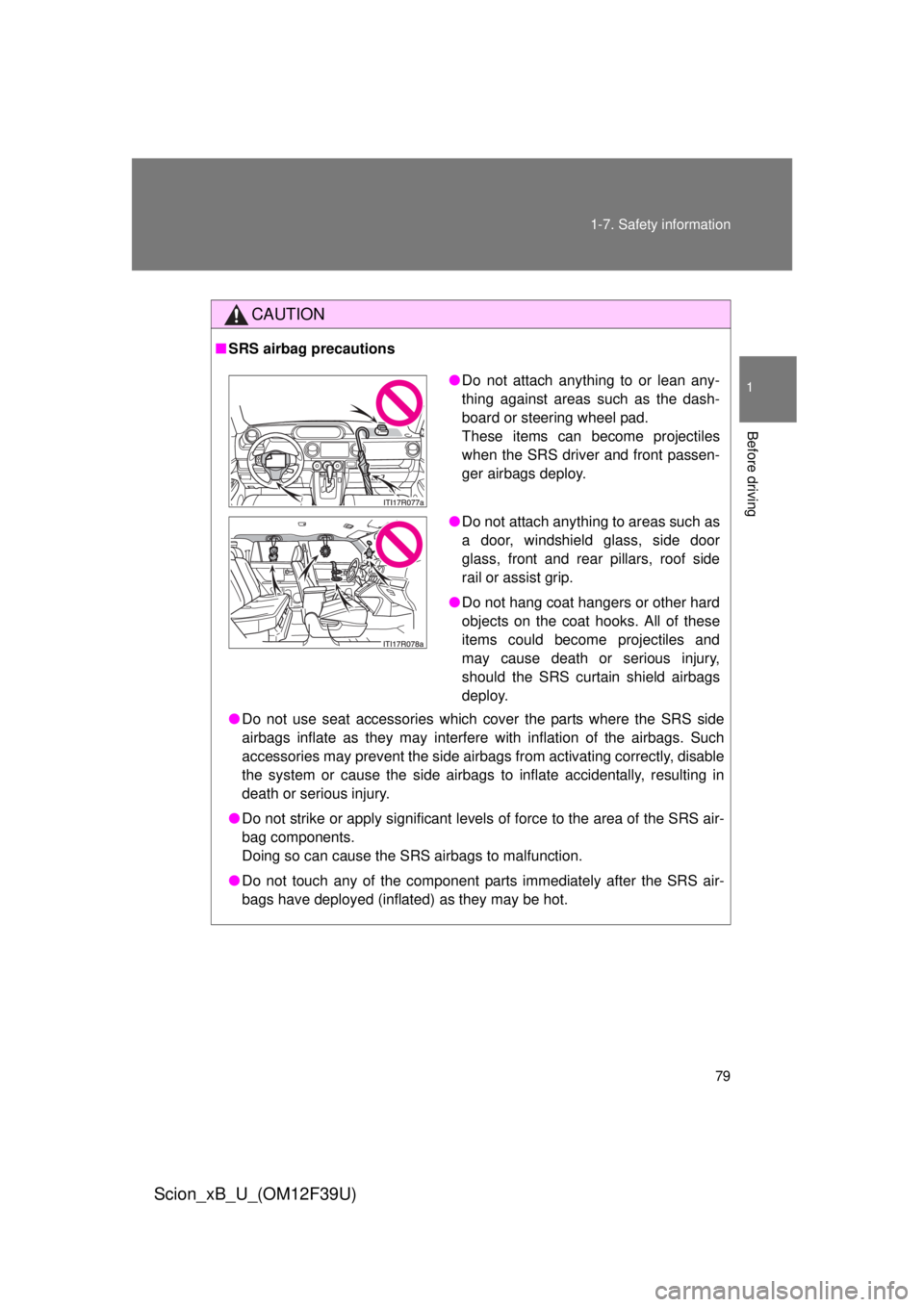
●Do not attach anything to or lean any-
thing against areas such as the dash-
board or steering wheel pad.
These items can become projectiles
when the SRS driver and front passen-
ger airbags deploy.
● Do not attach anything to areas such as
a door, windshield glass, side door
glass, front and rear pillars, roof side
rail or assist grip.
● Do not hang coat hangers or other hard
objects on the coat hooks. All of these
items could become projectiles and
may cause death or serious injury,
should the SRS curtain shield airbags
deploy.