pressure TOYOTA YARIS 2013 Owner's Manual
[x] Cancel search | Manufacturer: TOYOTA, Model Year: 2013, Model line: YARIS, Model: TOYOTA YARIS 2013Pages: 712, PDF Size: 30.2 MB
Page 585 of 712
5
585 5-2. Steps to take in an emergency
When trouble arises
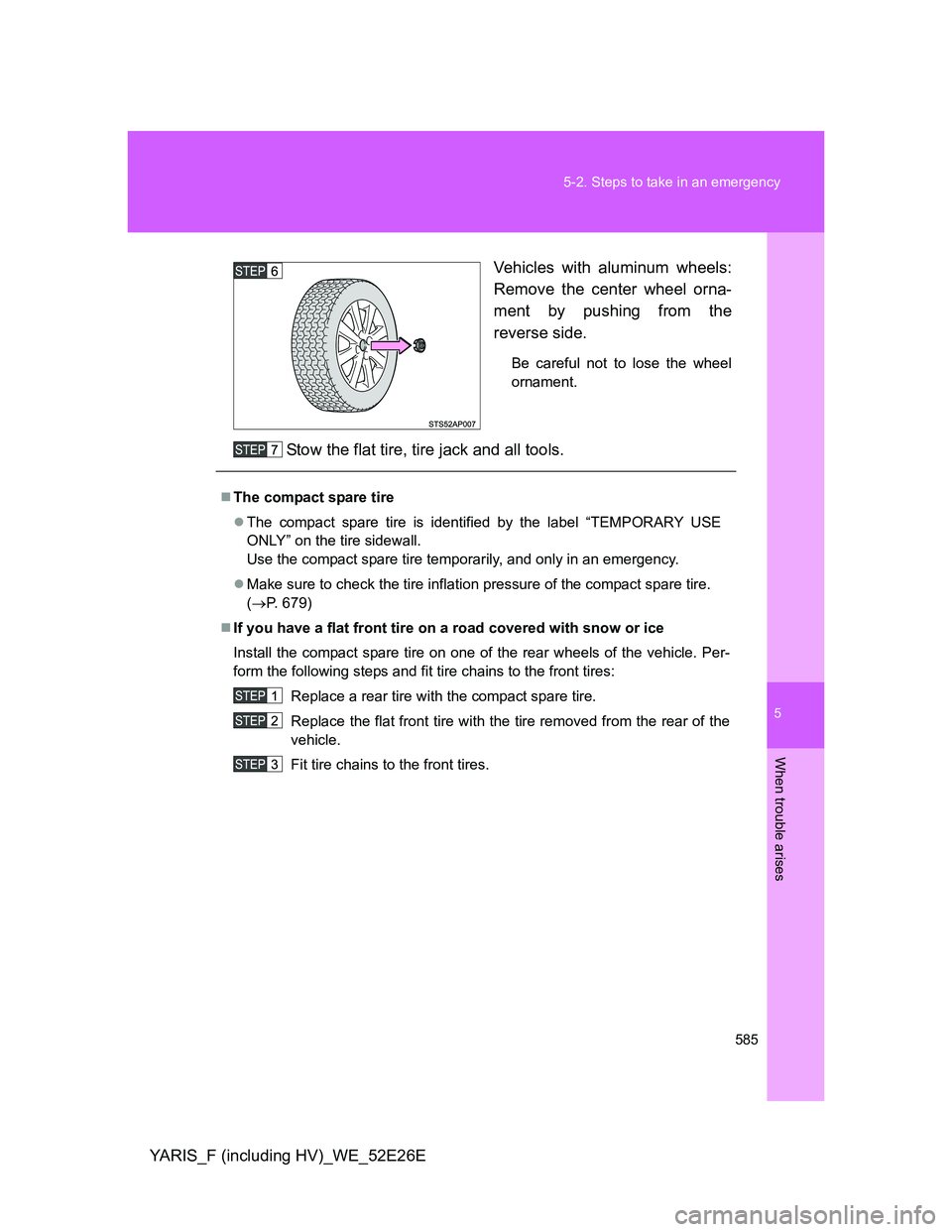
YARIS_F (including HV)_WE_52E26EVehicles with aluminum wheels:
Remove the center wheel orna-
ment by pushing from the
reverse side.
Be careful not to lose the wheel
ornament.
Stow the flat tire, tire jack and all tools.
The compact spare tire
The compact spare tire is identified by the label “TEMPORARY USE
ONLY” on the tire sidewall.
Use the compact spare tire temporarily, and only in an emergency.
Make sure to check the tire inflation pressure of the compact spare tire.
(P. 679)
If you have a flat front tire on a road covered with snow or ice
Install the compact spare tire on one of the rear wheels of the vehicle. Per-
form the following steps and fit tire chains to the front tires:
Replace a rear tire with the compact spare tire.
Replace the flat front tire with the tire removed from the rear of the
vehicle.
Fit tire chains to the front tires.
Page 593 of 712
5
593 5-2. Steps to take in an emergency
When trouble arises
YARIS_F (including HV)_WE_52E26E
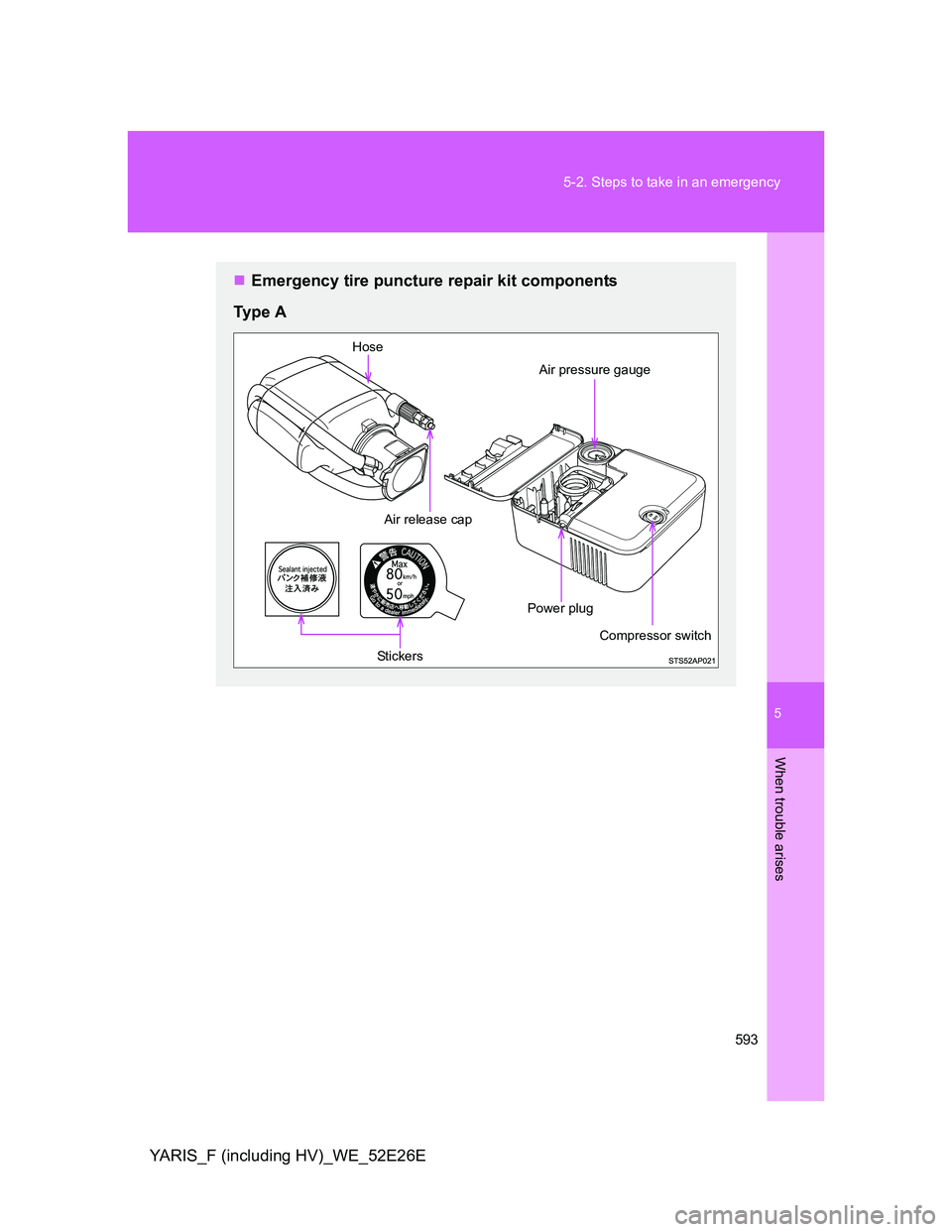
Emergency tire puncture repair kit components
Ty p e A
Air pressure gauge
Stickers
Hose
Air release cap
Power plug
Compressor switch
Page 594 of 712
594 5-2. Steps to take in an emergency
YARIS_F (including HV)_WE_52E26E
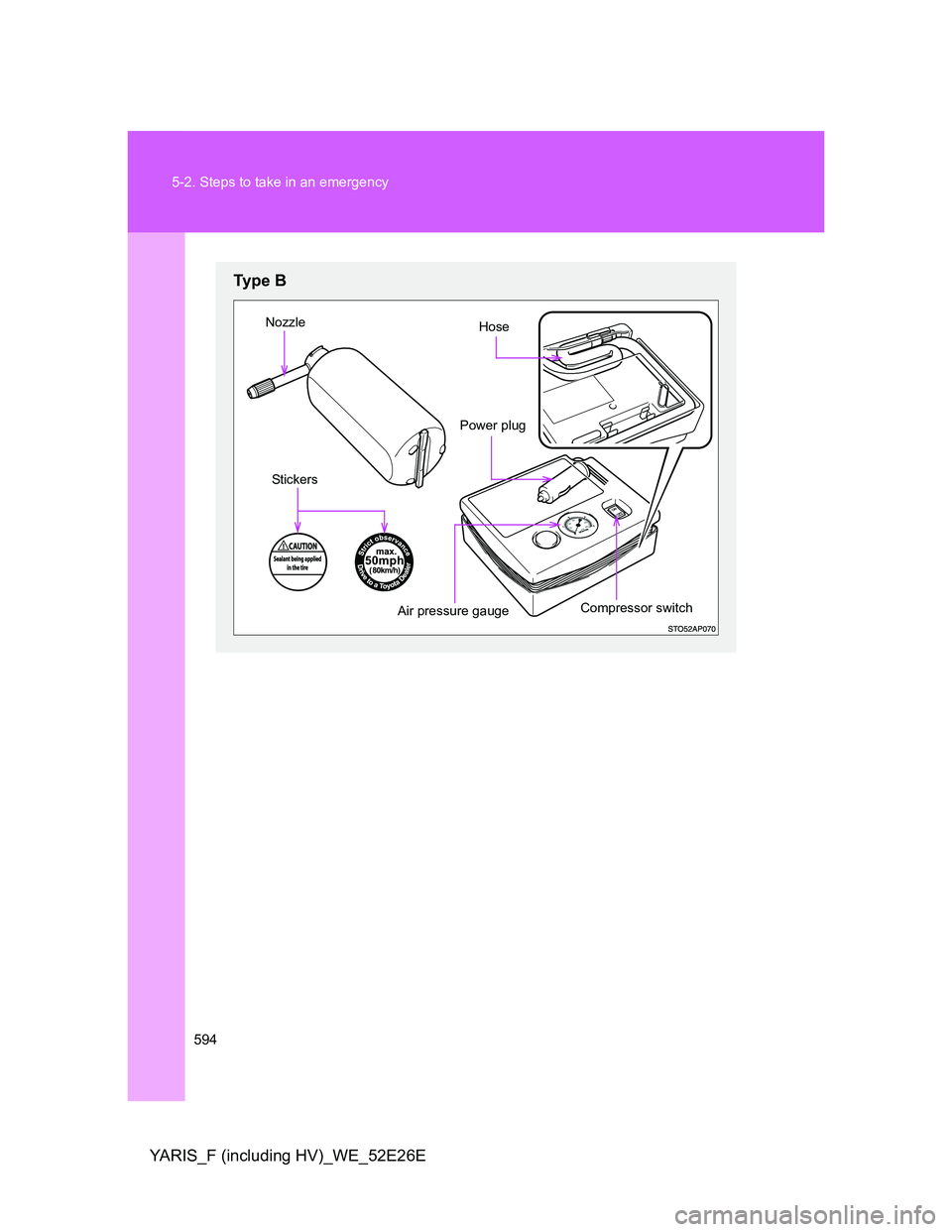
Ty p e B
Power plug
Compressor switchAir pressure gauge
HoseNozzle
Stickers
Page 595 of 712
5
595 5-2. Steps to take in an emergency
When trouble arises
YARIS_F (including HV)_WE_52E26E
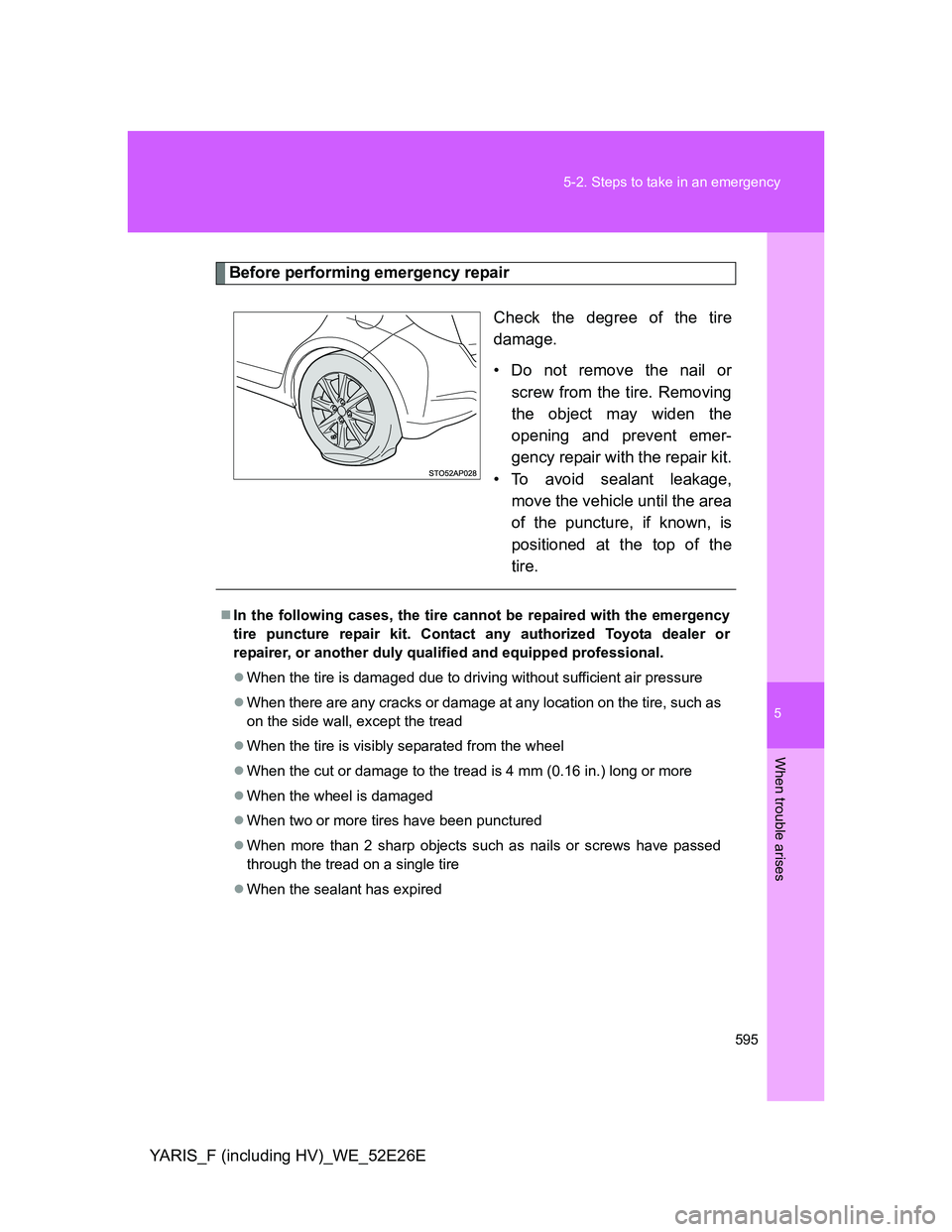
Before performing emergency repair
Check the degree of the tire
damage.
• Do not remove the nail or
screw from the tire. Removing
the object may widen the
opening and prevent emer-
gency repair with the repair kit.
• To avoid sealant leakage,
move the vehicle until the area
of the puncture, if known, is
positioned at the top of the
tire.
In the following cases, the tire cannot be repaired with the emergency
tire puncture repair kit. Contact any authorized Toyota dealer or
repairer, or another duly qualified and equipped professional.
When the tire is damaged due to driving without sufficient air pressure
When there are any cracks or damage at any location on the tire, such as
on the side wall, except the tread
When the tire is visibly separated from the wheel
When the cut or damage to the tread is 4 mm (0.16 in.) long or more
When the wheel is damaged
When two or more tires have been punctured
When more than 2 sharp objects such as nails or screws have passed
through the tread on a single tire
When the sealant has expired
Page 600 of 712
600 5-2. Steps to take in an emergency
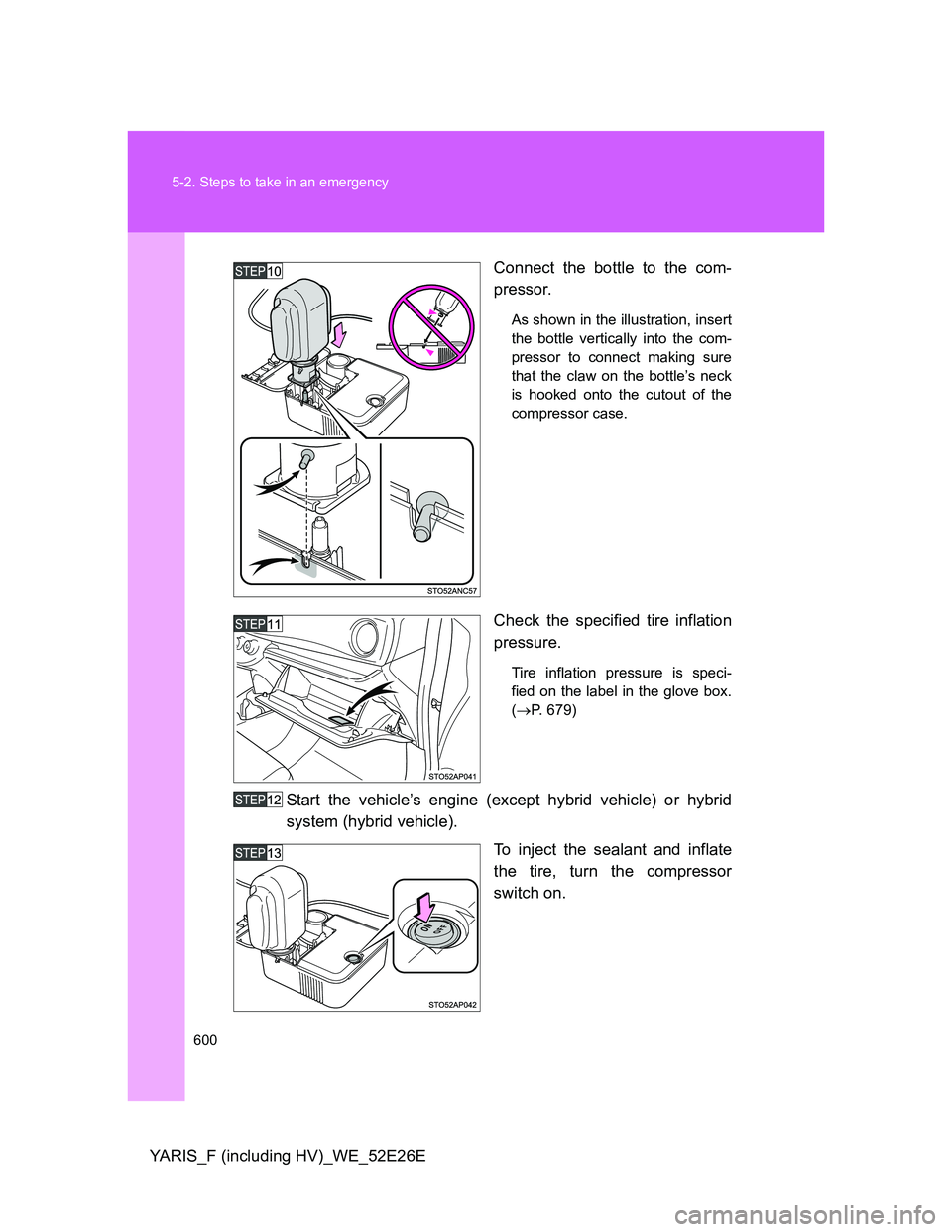
YARIS_F (including HV)_WE_52E26EConnect the bottle to the com-
pressor.
As shown in the illustration, insert
the bottle vertically into the com-
pressor to connect making sure
that the claw on the bottle’s neck
is hooked onto the cutout of the
compressor case.
Check the specified tire inflation
pressure.
Tire inflation pressure is speci-
fied on the label in the glove box.
(P. 679)
Start the vehicle’s engine (except hybrid vehicle) or hybrid
system (hybrid vehicle).
To inject the sealant and inflate
the tire, turn the compressor
switch on.
Page 601 of 712
5
601 5-2. Steps to take in an emergency
When trouble arises
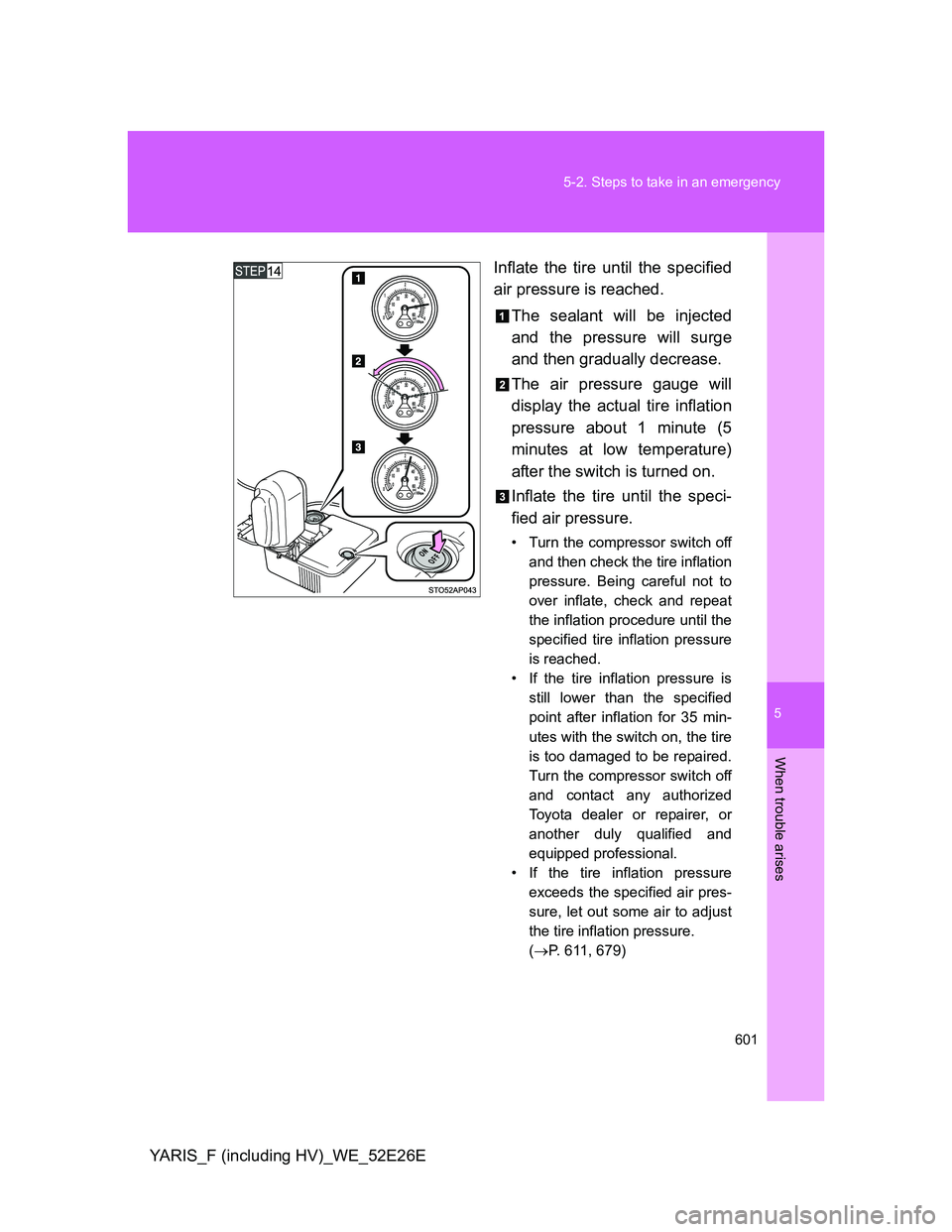
YARIS_F (including HV)_WE_52E26EInflate the tire until the specified
air pressure is reached.
The sealant will be injected
and the pressure will surge
and then gradually decrease.
The air pressure gauge will
display the actual tire inflation
pressure about 1 minute (5
minutes at low temperature)
after the switch is turned on.
Inflate the tire until the speci-
fied air pressure.
• Turn the compressor switch off
and then check the tire inflation
pressure. Being careful not to
over inflate, check and repeat
the inflation procedure until the
specified tire inflation pressure
is reached.
• If the tire inflation pressure is
still lower than the specified
point after inflation for 35 min-
utes with the switch on, the tire
is too damaged to be repaired.
Turn the compressor switch off
and contact any authorized
Toyota dealer or repairer, or
another duly qualified and
equipped professional.
• If the tire inflation pressure
exceeds the specified air pres-
sure, let out some air to adjust
the tire inflation pressure.
(P. 611, 679)
Page 603 of 712
5
603 5-2. Steps to take in an emergency
When trouble arises
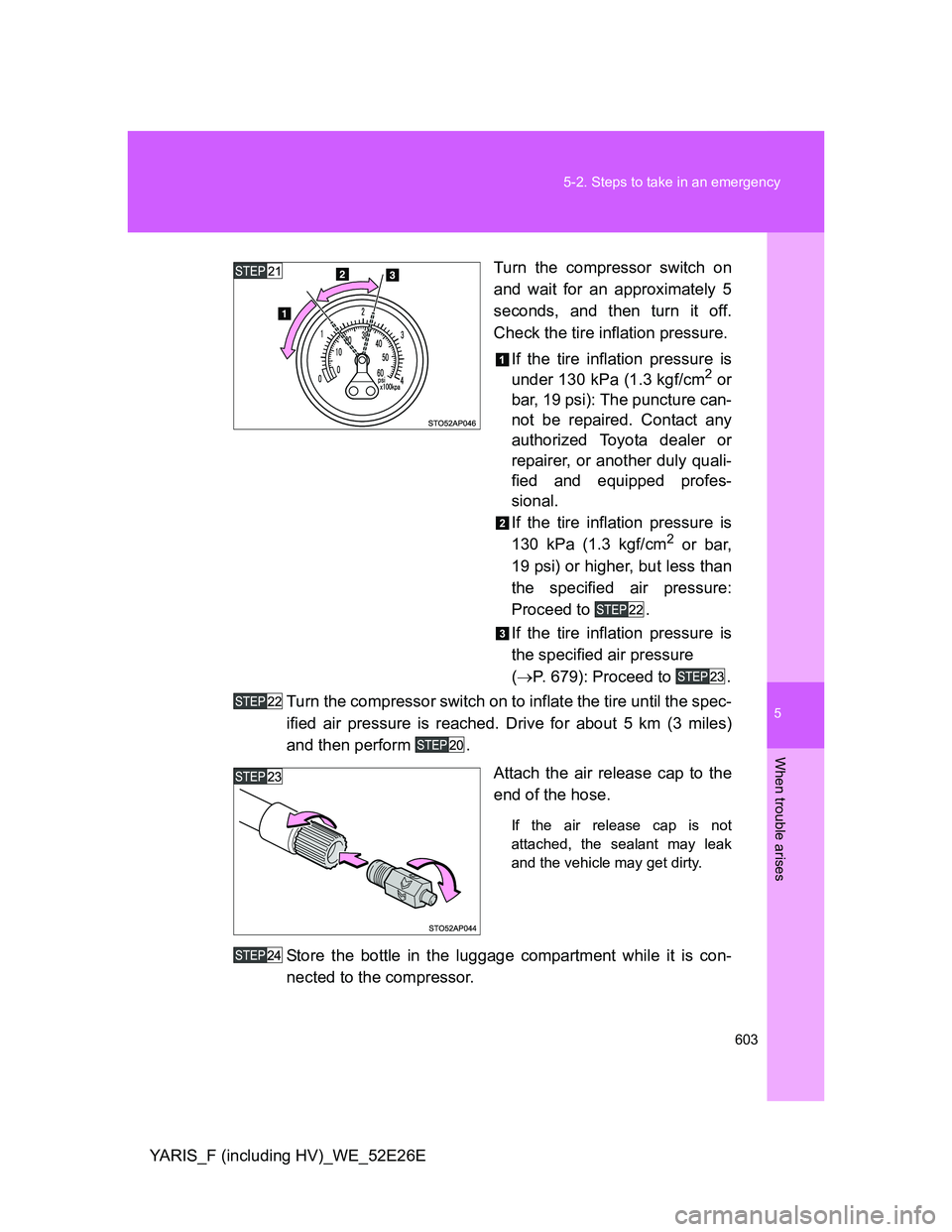
YARIS_F (including HV)_WE_52E26ETurn the compressor switch on
and wait for an approximately 5
seconds, and then turn it off.
Check the tire inflation pressure.
If the tire inflation pressure is
under 130 kPa (1.3 kgf/cm
2 or
bar, 19 psi): The puncture can-
not be repaired. Contact any
authorized Toyota dealer or
repairer, or another duly quali-
fied and equipped profes-
sional.
If the tire inflation pressure is
130 kPa (1.3 kgf/cm
2 or bar,
19 psi) or higher, but less than
the specified air pressure:
Proceed to .
If the tire inflation pressure is
the specified air pressure
(P. 679): Proceed to .
Turn the compressor switch on to inflate the tire until the spec-
ified air pressure is reached. Drive for about 5 km (3 miles)
and then perform .
Attach the air release cap to the
end of the hose.
If the air release cap is not
attached, the sealant may leak
and the vehicle may get dirty.
Store the bottle in the luggage compartment while it is con-
nected to the compressor.
Page 607 of 712
5
607 5-2. Steps to take in an emergency
When trouble arises
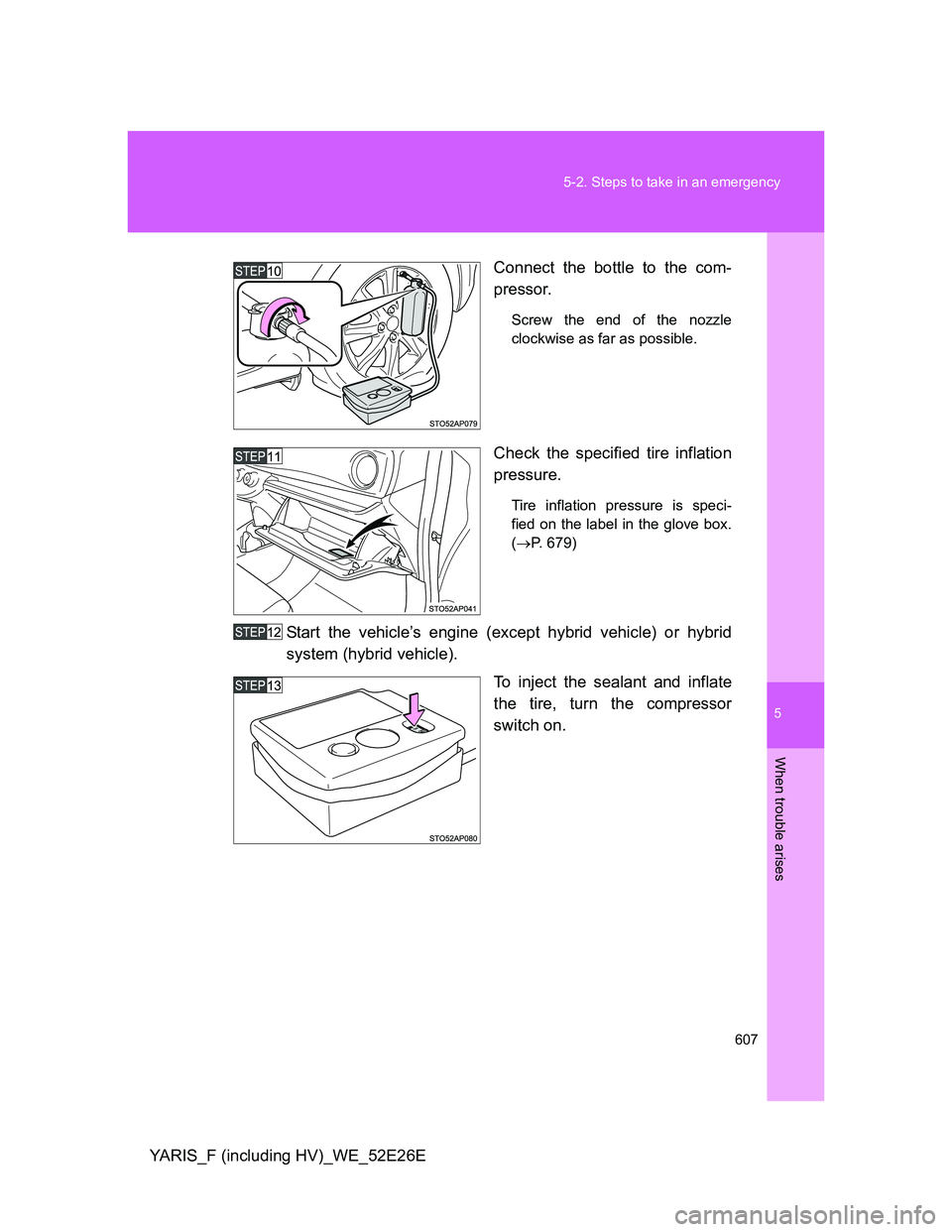
YARIS_F (including HV)_WE_52E26EConnect the bottle to the com-
pressor.
Screw the end of the nozzle
clockwise as far as possible.
Check the specified tire inflation
pressure.
Tire inflation pressure is speci-
fied on the label in the glove box.
(P. 679)
Start the vehicle’s engine (except hybrid vehicle) or hybrid
system (hybrid vehicle).
To inject the sealant and inflate
the tire, turn the compressor
switch on.
Page 608 of 712
608 5-2. Steps to take in an emergency
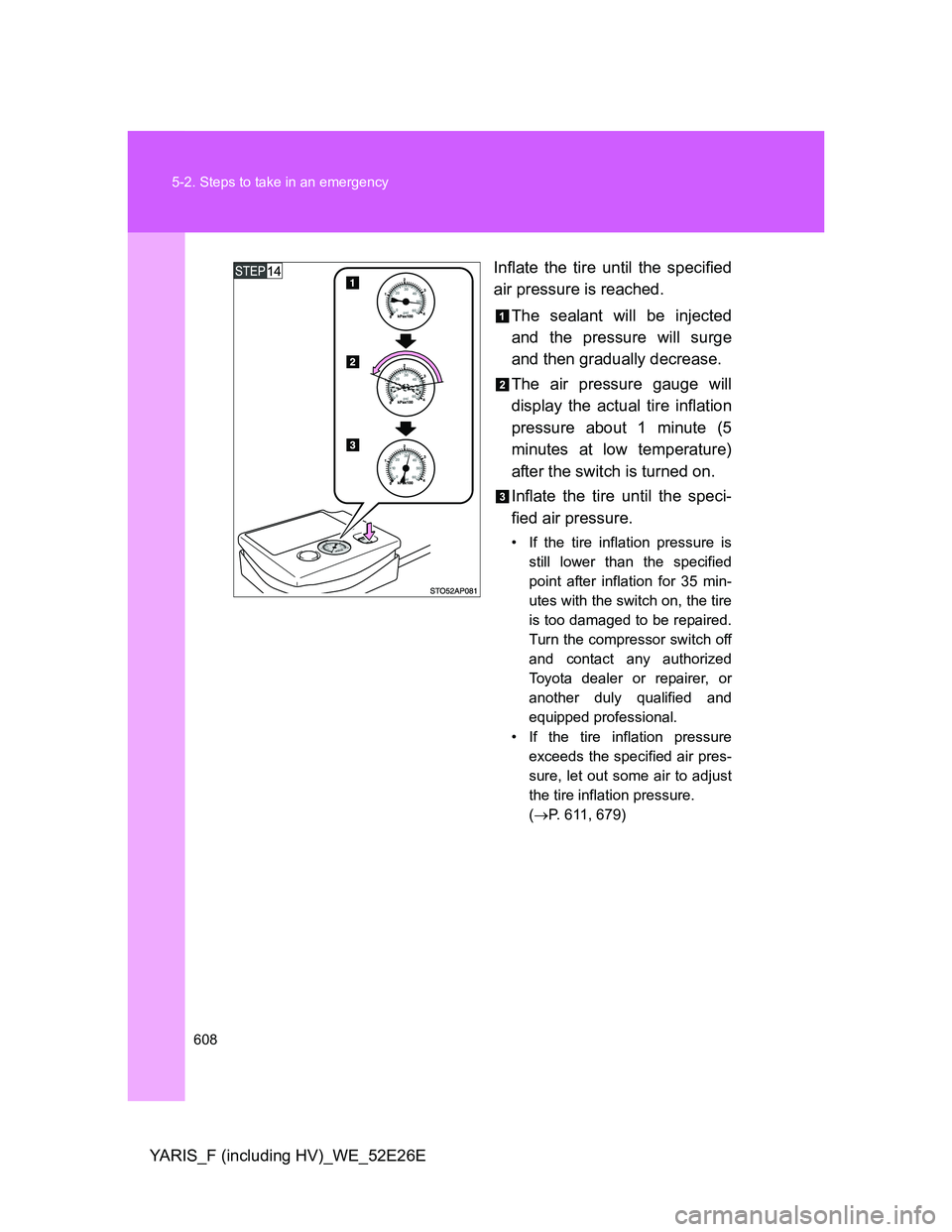
YARIS_F (including HV)_WE_52E26EInflate the tire until the specified
air pressure is reached.
The sealant will be injected
and the pressure will surge
and then gradually decrease.
The air pressure gauge will
display the actual tire inflation
pressure about 1 minute (5
minutes at low temperature)
after the switch is turned on.
Inflate the tire until the speci-
fied air pressure.
• If the tire inflation pressure is
still lower than the specified
point after inflation for 35 min-
utes with the switch on, the tire
is too damaged to be repaired.
Turn the compressor switch off
and contact any authorized
Toyota dealer or repairer, or
another duly qualified and
equipped professional.
• If the tire inflation pressure
exceeds the specified air pres-
sure, let out some air to adjust
the tire inflation pressure.
(P. 611, 679)
Page 610 of 712
610 5-2. Steps to take in an emergency
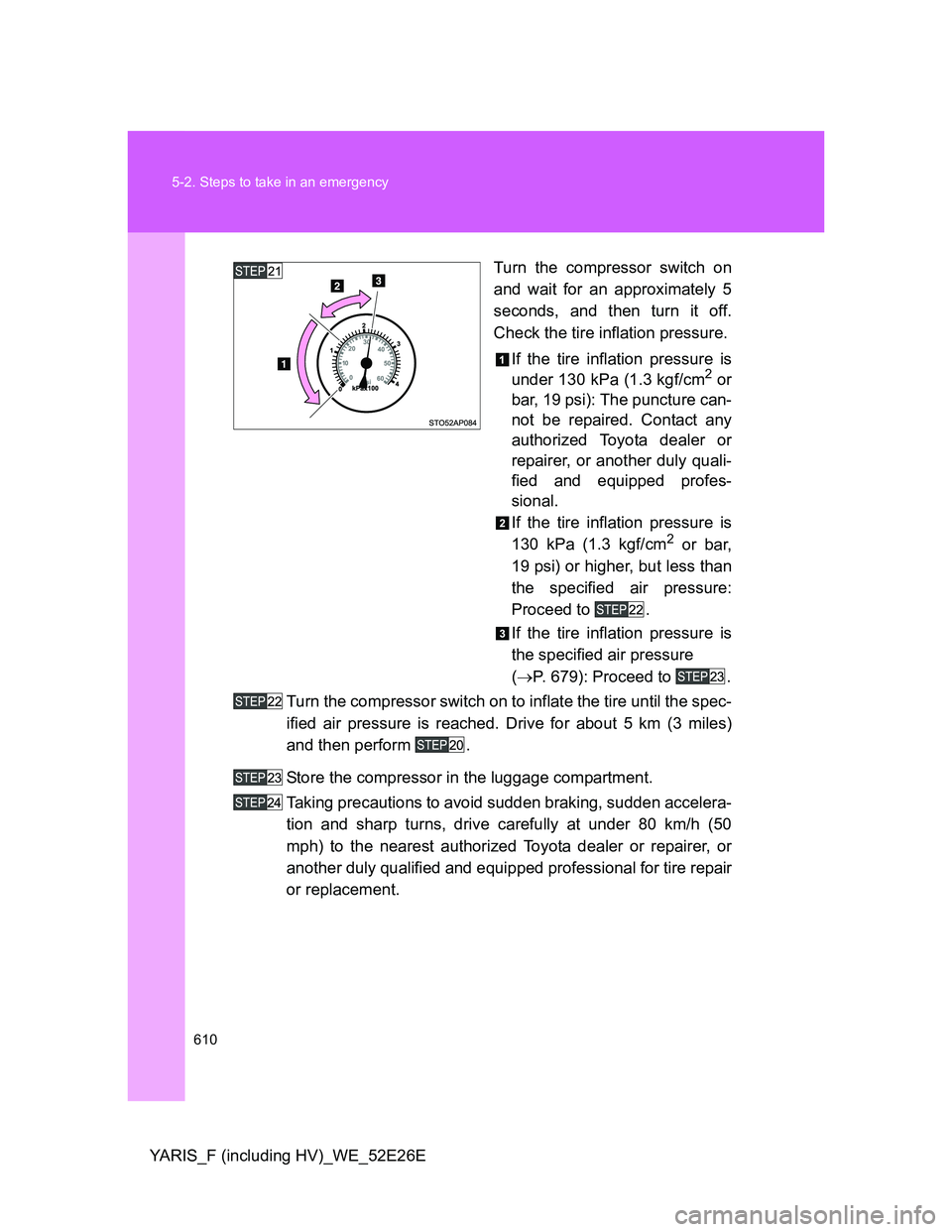
YARIS_F (including HV)_WE_52E26ETurn the compressor switch on
and wait for an approximately 5
seconds, and then turn it off.
Check the tire inflation pressure.
If the tire inflation pressure is
under 130 kPa (1.3 kgf/cm
2 or
bar, 19 psi): The puncture can-
not be repaired. Contact any
authorized Toyota dealer or
repairer, or another duly quali-
fied and equipped profes-
sional.
If the tire inflation pressure is
130 kPa (1.3 kgf/cm
2 or bar,
19 psi) or higher, but less than
the specified air pressure:
Proceed to .
If the tire inflation pressure is
the specified air pressure
(P. 679): Proceed to .
Turn the compressor switch on to inflate the tire until the spec-
ified air pressure is reached. Drive for about 5 km (3 miles)
and then perform .
Store the compressor in the luggage compartment.
Taking precautions to avoid sudden braking, sudden accelera-
tion and sharp turns, drive carefully at under 80 km/h (50
mph) to the nearest authorized Toyota dealer or repairer, or
another duly qualified and equipped professional for tire repair
or replacement.