pressure TOYOTA YARIS 2013 User Guide
[x] Cancel search | Manufacturer: TOYOTA, Model Year: 2013, Model line: YARIS, Model: TOYOTA YARIS 2013Pages: 712, PDF Size: 30.2 MB
Page 408 of 712
408 3-2. Using the audio system
YARIS_F(including HV)_WE_52E26E
Playback
• To play MP3 files with steady sound quality, we recommend a fixed bit
rate of at least 128 kbps and a sampling frequency of 44.1 kHz.
• There is a wide variety of freeware and other encoding software for
MP3 and WMA files on the market, and depending on the status of the
encoding and the file format, poor sound quality or noise at the start of
playback may result. In some cases, playback may not be possible at
all.
• Microsoft, Windows, and Windows Media are registered trademarks of
Microsoft Corporation in the U.S.A. and other countries.
CAUTION
Caution while driving
Do not connect USB memory or operate the controls.
NOTICE
If the glove box cannot be fully closed
Depending on the size and shape of the USB memory that is connected to
the system, the glove box may not close fully. In this case, do not try to forci-
bly close the glove box, as this may damage the USB memory or the termi-
nal, etc. Remove the USB memory, and use a different USB memory with a
size and shape that allows the glove box to close fully when connected to
the system.
To prevent damage to USB memory
Do not leave USB memory in the vehicle. The temperature inside the vehi-
cle may become high, resulting in damage to the player.
Do not push down on or apply unnecessary pressure to the USB memory
while it is connected as this may damage the USB memory or its terminal.
Do not insert foreign objects into the port as this may damage the USB
memory or its terminal.
Page 443 of 712
4Maintenance and care
443
YARIS_F(including HV)_WE_52E26E
4-1. Maintenance and care
Cleaning and protecting
the vehicle exterior ......... 444
Cleaning and protecting
the vehicle interior .......... 449
4-2. Maintenance
Maintenance
requirements................... 452
4-3. Do-it-yourself maintenance
Do-it-yourself service
precautions ..................... 455
Hood ................................. 460
Positioning a floor jack ...... 462
Engine compartment......... 465
12-volt battery
(hybrid vehicle) ............... 484
Tires .................................. 490
Tire inflation pressure ....... 494
Wheels .............................. 496
Air conditioning filter ......... 498
Wireless remote
control/electronic key
battery............................. 501
Checking and replacing
fuses ............................... 506
Light bulbs ........................ 531
Page 444 of 712
444
YARIS_F(including HV)_WE_52E26E
4-1. Maintenance and care
Cleaning and protecting the vehicle exterior
Automatic car washes
Fold the mirrors and remove the antenna before washing the vehicle.
Start washing from the front of the vehicle. Make sure to re-install the
antenna and extend the mirrors before driving.
Brushes used in automatic car washes may scratch the vehicle surface
and harm your vehicle’s paint.
Vehicles with a rear spoiler: In certain automatic car washes, the rear
spoiler may interfere with machine operation. This may prevent the vehi-
cle from being cleaned properly or result in damage to the rear spoiler.
High pressure car washes
Do not allow the nozzles of the car wash to come within close proximity
of the window and door borders, and high mounted stoplight.
Before using the car wash, check that the fuel filler door on your vehicle
is closed properly.
Perform the following to protect the vehicle and maintain it in prime
condition:
Working from top to bottom, liberally apply water to the vehicle
body, wheel wells and underside of the vehicle to remove any
dirt and dust.
Wash the vehicle body using a sponge or soft cloth, such as a
chamois.
For hard-to-remove marks, use car wash soap and rinse thor-
oughly with water.
Wipe away any water.
Wax the vehicle when the waterproof coating deteriorates.
If water does not bead on a clean surface, apply wax when the vehicle
body is cool.
Page 456 of 712
456 4-3. Do-it-yourself maintenance
YARIS_F(including HV)_WE_52E26E
ItemsParts and tools
Engine oil levelP. 469)• “Toyota Genuine Motor Oil” or
equivalent
• Rag or paper towel
• Funnel (used only for adding
engine oil)
Fuses (P. 506)• Fuse with same amperage rating
as original
Light bulbs (P. 531)• Bulb with same number and watt-
age rating as original
• Phillips-head screwdriver
• Flathead screwdriver
• Wrench
Radiator, condenser and inter-
cooler (P. 478)
Tire inflation pressure (P. 494)• Tire pressure gauge
• Compressed air source
Washer fluid (P. 482)• Water or washer fluid containing
antifreeze (for winter use)
• Funnel (used only for adding
water or washer fluid)
Page 477 of 712
477 4-3. Do-it-yourself maintenance
4
Maintenance and care
YARIS_F(including HV)_WE_52E26E
Coolant selection
Only use “Toyota Super Long Life Coolant” or a similar high quality ethylene
glycol based non-silicate, non-amine, non-nitrite, and non-borate coolant
with long-life hybrid organic acid technology.
“Toyota Super Long Life Coolant” is a mixture of 50% coolant and 50%
deionized water. (Minimum temperature: -35C [-31F])
For more details about engine coolant, contact any authorized Toyota dealer
or repairer, or another duly qualified and equipped professional.
If the coolant level drops within a short time of replenishing
Except hybrid vehicle: Visually check the radiator, hoses, engine coolant res-
ervoir cap, drain cock and water pump.
Hybrid vehicle: Visually check the radiator, hoses, engine/power control unit
coolant reservoir caps, drain cock and water pump.
If you cannot find a leak, have any authorized Toyota dealer or repairer, or
another duly qualified and equipped professional, test the cap and check for
leaks in the cooling system.
CAUTION
When the engine is hot (except hybrid vehicle)
Do not remove the radiator cap (gasoline engine), or the engine coolant res-
ervoir cap (diesel engine).
The cooling system may be under pressure and may spray hot coolant if the
cap is removed, causing serious injuries, such as burns.
When the hybrid system is hot (hybrid vehicle)
Do not remove the engine/power control unit coolant reservoir caps.
The cooling system may be under pressure and may spray hot coolant if the
cap is removed, causing serious injuries, such as burns.
Page 490 of 712
490
4-3. Do-it-yourself maintenance
YARIS_F(including HV)_WE_52E26E
Tires
Replace or rotate tires in accordance with maintenance schedules
and treadwear.
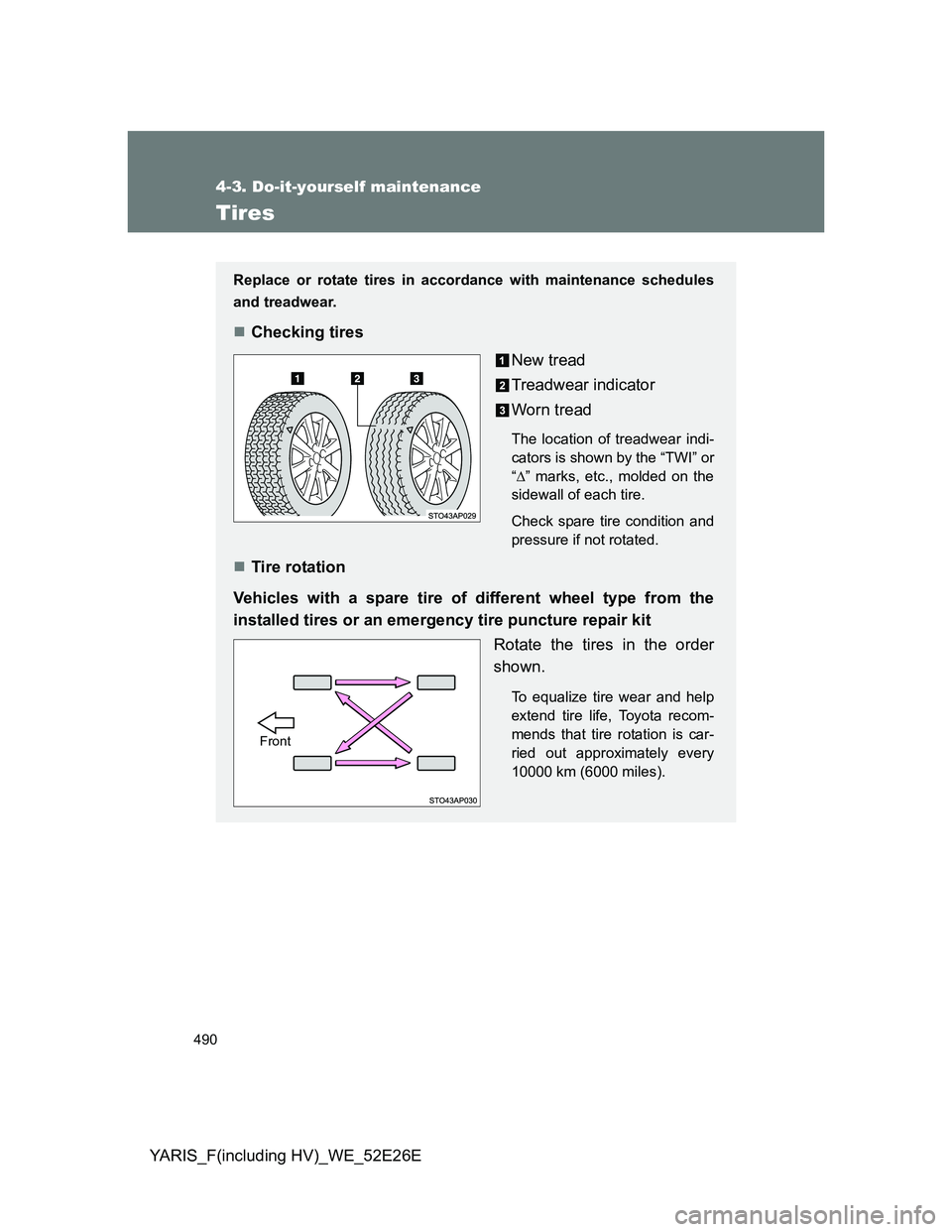
Checking tires
New tread
Treadwear indicator
Worn tread
The location of treadwear indi-
cators is shown by the “TWI” or
“” marks, etc., molded on the
sidewall of each tire.
Check spare tire condition and
pressure if not rotated.
Tire rotation
Vehicles with a spare tire of different wheel type from the
installed tires or an emergency tire puncture repair kit
Rotate the tires in the order
shown.
To equalize tire wear and help
extend tire life, Toyota recom-
mends that tire rotation is car-
ried out approximately every
10000 km (6000 miles).
Front
Page 493 of 712
493 4-3. Do-it-yourself maintenance
4
Maintenance and care
YARIS_F(including HV)_WE_52E26E
NOTICE
Driving on rough roads
Take particular care when driving on roads with loose surfaces or potholes.
These conditions may cause losses in tire inflation pressure, reducing the
cushioning ability of the tires. In addition, driving on rough roads may cause
damage to the tires themselves, as well as the vehicle’s wheels and body.
Low profile tires (vehicles with 195/50R16 tires)
Low profile tires may cause greater damage than usual to the tire wheel
when sustaining impact from the road surface. Therefore, pay attention to
the following:
Be sure to use proper tire inflation pressure. If tires are under-inflated, they
may be damaged more severely.
Avoid potholes, uneven pavement, curbs and other road hazards. Failure
to do so may lead to severe tire and wheel damage.
If tire inflation pressure of each tire becomes low while driving
Do not continue driving, or your tires and/or wheels may be ruined.
Page 494 of 712
494
4-3. Do-it-yourself maintenance
YARIS_F(including HV)_WE_52E26E
Tire inflation pressure
Effects of incorrect tire inflation pressure
Driving with incorrect tire inflation pressure may result in the following:
Reduced fuel efficiency
Reduced driving comfort and tire life
Reduced safety
Damage to the drive train
If a tire needs frequent inflating, have it checked by any authorized Toyota
dealer or repairer, or another duly qualified and equipped professional.
Instructions for checking tire inflation pressure
When checking tire inflation pressure, observe the following:
Check only when the tires are cold.
If your vehicle has been parked for at least 3 hours or has not been
driven for more than 1.5 km or 1 mile, you will get an accurate cold tire
inflation pressure reading.
Always use a tire pressure gauge.
The appearance of the tire can be misleading. In addition, tire inflation
pressure that is even just a few pounds off can affect ride quality and
handling.
Do not reduce tire inflation pressure after driving. It is normal for tire infla-
tion pressure to be higher after driving.
Never exceed the vehicle capacity weight.
Passengers and luggage weight should be placed so that the vehicle is
balanced.
Make sure to maintain proper tire inflation pressure. Tire inflation
pressure should be checked at least once per month. However, Toy-
ota recommends that tire inflation pressure be checked once every
two weeks. (P. 679)
Page 495 of 712
495 4-3. Do-it-yourself maintenance
4
Maintenance and care
YARIS_F(including HV)_WE_52E26E
CAUTION
Proper inflation is critical to save tire performance
Keep your tires properly inflated. Otherwise, the following conditions may
occur and result in an accident causing death or serious injury:
Excessive wear
Uneven wear
Poor handling
Possibility of blowouts resulting from overheated tires
Poor sealing of the tire bead
Wheel deformation and/or tire separation
A greater possibility of tire damage from road hazards
NOTICE
When inspecting and adjusting tire inflation pressure
Be sure to put the tire valve caps back on.
Without the valve caps, dirt or moisture could get into the valve and cause
air leakage, which could result in an accident. If the caps are lost, replace
them as soon as possible.
Page 562 of 712
562 5-2. Steps to take in an emergency
YARIS_F (including HV)_WE_52E26E
Stop the vehicle immediately.
The following warnings indicate the possibility of damage to the
vehicle that may lead to an accident. Immediately stop the vehicle
in a safe place and contact any authorized Toyota dealer or
repairer, or another duly qualified and equipped professional.
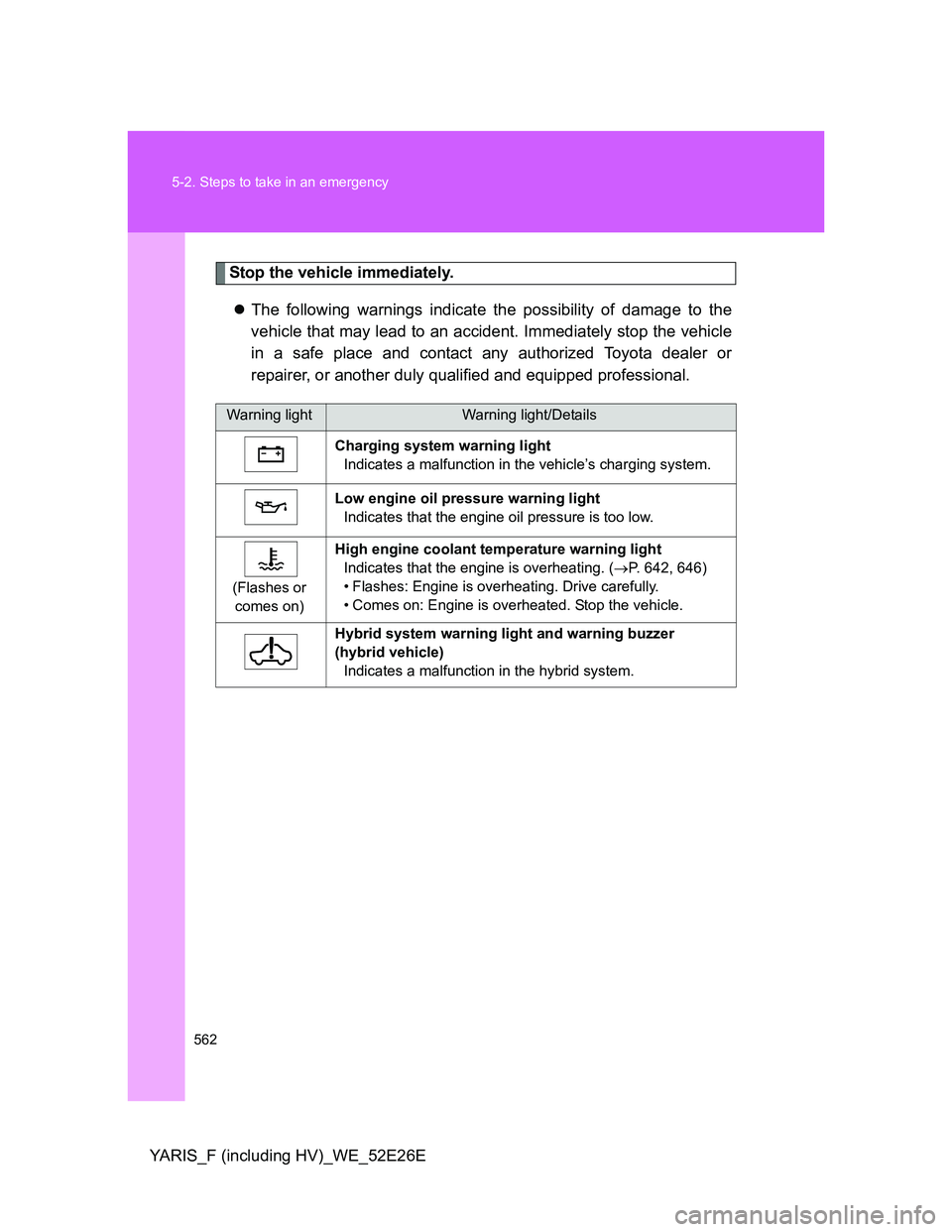
Warning lightWarning light/Details
Charging system warning light
Indicates a malfunction in the vehicle’s charging system.
Low engine oil pressure warning light
Indicates that the engine oil pressure is too low.
(Flashes or
comes on)High engine coolant temperature warning light
Indicates that the engine is overheating. (P. 642, 646)
• Flashes: Engine is overheating. Drive carefully.
• Comes on: Engine is overheated. Stop the vehicle.
Hybrid system warning light and warning buzzer
(hybrid vehicle)
Indicates a malfunction in the hybrid system.