pressure TOYOTA YARIS 2013 Owner's Guide
[x] Cancel search | Manufacturer: TOYOTA, Model Year: 2013, Model line: YARIS, Model: TOYOTA YARIS 2013Pages: 712, PDF Size: 30.2 MB
Page 611 of 712
5
611 5-2. Steps to take in an emergency
When trouble arises
YARIS_F (including HV)_WE_52E26E
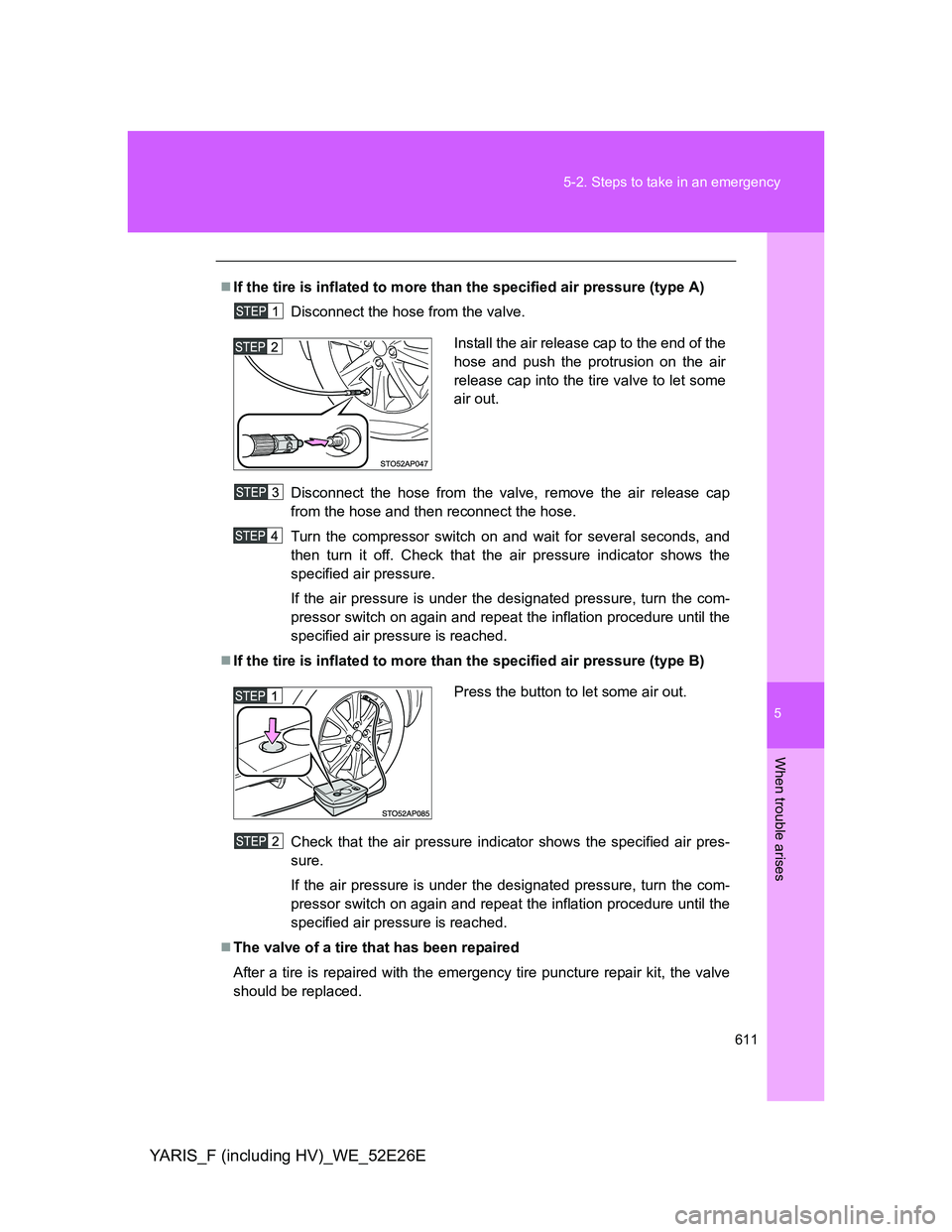
If the tire is inflated to more than the specified air pressure (type A)
Disconnect the hose from the valve.
Disconnect the hose from the valve, remove the air release cap
from the hose and then reconnect the hose.
Turn the compressor switch on and wait for several seconds, and
then turn it off. Check that the air pressure indicator shows the
specified air pressure.
If the air pressure is under the designated pressure, turn the com-
pressor switch on again and repeat the inflation procedure until the
specified air pressure is reached.
If the tire is inflated to more than the specified air pressure (type B)
Check that the air pressure indicator shows the specified air pres-
sure.
If the air pressure is under the designated pressure, turn the com-
pressor switch on again and repeat the inflation procedure until the
specified air pressure is reached.
The valve of a tire that has been repaired
After a tire is repaired with the emergency tire puncture repair kit, the valve
should be replaced.
Install the air release cap to the end of the
hose and push the protrusion on the air
release cap into the tire valve to let some
air out.
Press the button to let some air out.
Page 612 of 712
612 5-2. Steps to take in an emergency
YARIS_F (including HV)_WE_52E26E
Note for checking the emergency tire puncture repair kit
Check the sealant expiry date occasionally.
The expiry date is shown on the bottle. Do not use sealant whose expiry
date has already passed. Otherwise, repairs conducted using the emer-
gency tire puncture repair kit may not be performed properly.
Emergency tire puncture repair kit
The sealant stored in the emergency tire puncture repair kit can be used
only once to temporarily repair a single tire. If the sealant has been used
and needs to be replaced, purchase a new bottle at any authorized Toy-
ota dealer or repairer, or another duly qualified and equipped profes-
sional. The compressor is reusable.
The sealant can be used when the outside temperature is from -30°C
(-22°F) to 60°C (140°F).
The repair kit is exclusively designed for size and type of tires originally
installed on your vehicle. Do not use it for tires that a different size than
the original ones, or for any other purposes.
The sealant has a limited lifespan. The expiry date is marked on the bot-
tle. The bottle of sealant should be replaced with a new bottle before the
expiry date. Contact any authorized Toyota dealer or repairer, or another
duly qualified and equipped professional for replacement.
If the sealant gets on your clothes, it may stain.
If the sealant adheres to a wheel or the surface of the vehicle body, the
stain may not be removable if it is not cleaned at once. Immediately wipe
away the sealant with a wet cloth.
During operation of the repair kit, a loud operation noise is produced.
This does not indicate a malfunction.
Do not use to check or to adjust the tire pressure.
Page 614 of 712
614 5-2. Steps to take in an emergency
YARIS_F (including HV)_WE_52E26E
CAUTION
Connect the valve and hose securely with the tire installed on the vehicle.
If the hose is not properly connected to the valve, air leakage may occur
as sealant may be sprayed out.
If the hose comes off the valve while inflating the tire, there is a risk that
the hose will move abruptly due to air pressure.
After inflation of the tire has completed, the sealant may splatter when the
hose is disconnected or some air is let out of the tire.
Follow the operation procedure to repair the tire. If the procedures not fol-
lowed, the sealant may spray out.
Keep back from the tire while it is being repaired, as there is a chance of it
bursting while the repair operation is being performed. If you notice any
cracks or deformation of the tire, turn off the compressor switch and stop
the repair operation immediately.
The repair kit may overheat if operated for a long period of time. Do not
operate the repair kit continuously for more than 40 minutes.
Parts of the repair kit become hot during operation. Be careful when han-
dling the repair kit during and after operation. Do not touch the metal part
around the connecting area between the bottle and compressor. It will be
extremely hot.
Do not attach the vehicle speed warning sticker to an area other than the
one indicated. If the sticker is attached to an area where an SRS airbag is
located, such as the pad of the steering wheel, it may prevent the SRS air-
bag from operating properly.
Driving to spread the liquid sealant evenly
Observe the following precautions to reduce the risk of accidents.
Failing to do so may result in a loss of vehicle control and cause death or
serious injury.
Drive the vehicle carefully at a low speed. Be especially careful when turn-
ing and cornering.
If the vehicle does not drive straight or you feel a pull through the steering
wheel, stop the vehicle and check the following.
• Tire condition. The tire may have separated from the wheel.
• Tire inflation pressure. If the tire inflation pressure is 130 kPa (1.3
kgf/cm
2 or bar, 19 psi) or less, the tire may be severely damaged.
Page 615 of 712
5
615 5-2. Steps to take in an emergency
When trouble arises
YARIS_F (including HV)_WE_52E26E
NOTICE
When performing an emergency repair
A tire should only be repaired with the emergency tire puncture repair kit if
the damage is caused by a sharp object such as nail or screw passing
through the tire tread.
Do not remove the sharp object from the tire. Removing the object may
widen the opening and disenable emergency repair with the repair kit.
The repair kit is not waterproof. Make sure that the repair kit is not
exposed to water, such as when it is being used in the rain.
Do not put the repair kit directly onto dusty ground such as sand at the
side of the road. If the repair kit vacuums up dust etc., a malfunction may
occur.
Precautions for the emergency tire puncture repair kit
The repair kit power source should be 12 V DC suitable for vehicle use. Do
not connect the repair kit to any other source.
If gasoline splatters on the repair kit, the repair kit may deteriorate. Take
care not to allow gasoline to contact it.
Place the repair kit in a storage to prevent it from being exposed to dirt or
water.
Store the repair kit in the luggage room out of reach of children.
Do not disassemble or modify the repair kit. Do not subject parts such as
the air pressure indicator to impacts. This may cause a malfunction.
Page 645 of 712
5
645 5-2. Steps to take in an emergency
When trouble arises
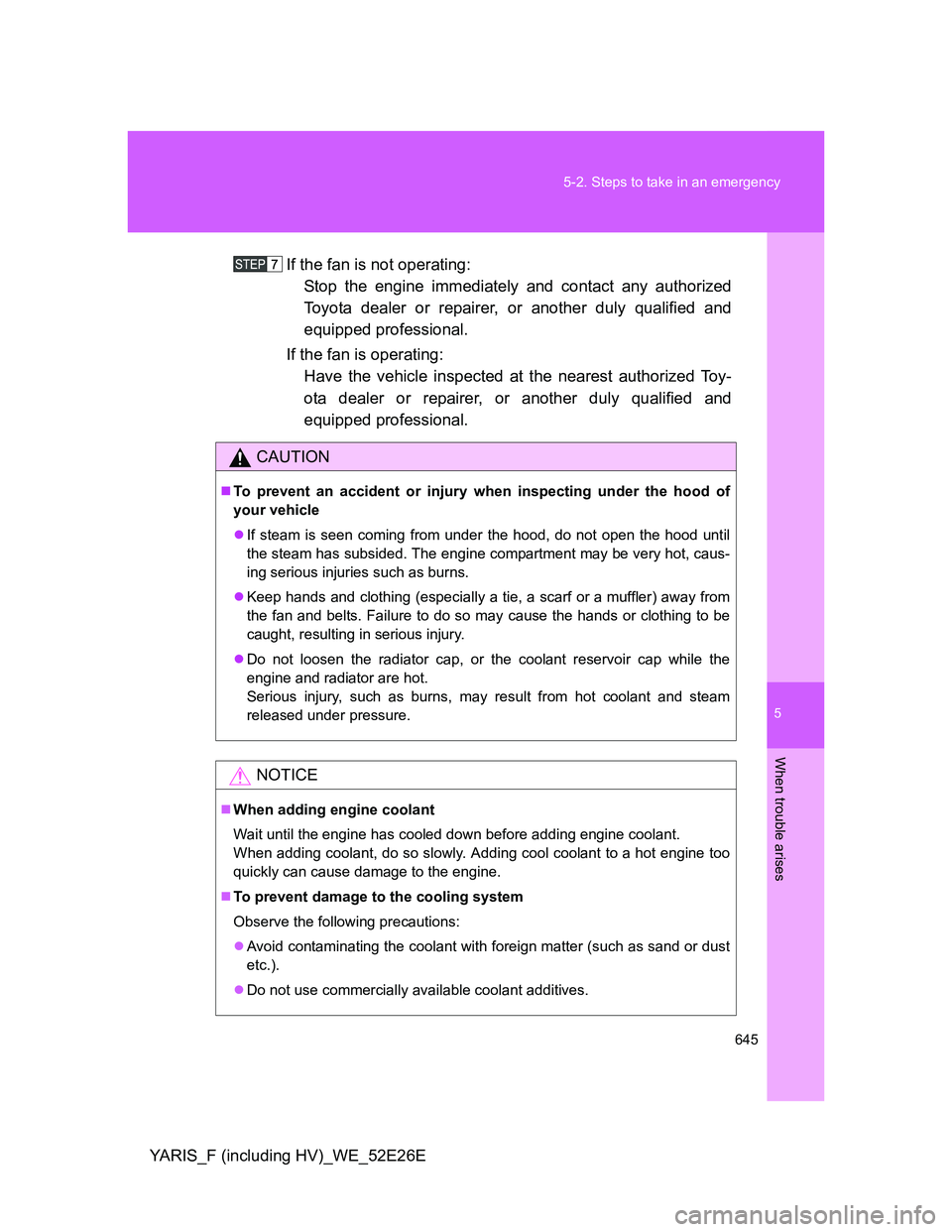
YARIS_F (including HV)_WE_52E26EIf the fan is not operating:
Stop the engine immediately and contact any authorized
Toyota dealer or repairer, or another duly qualified and
equipped professional.
If the fan is operating:
Have the vehicle inspected at the nearest authorized Toy-
ota dealer or repairer, or another duly qualified and
equipped professional.
CAUTION
To prevent an accident or injury when inspecting under the hood of
your vehicle
If steam is seen coming from under the hood, do not open the hood until
the steam has subsided. The engine compartment may be very hot, caus-
ing serious injuries such as burns.
Keep hands and clothing (especially a tie, a scarf or a muffler) away from
the fan and belts. Failure to do so may cause the hands or clothing to be
caught, resulting in serious injury.
Do not loosen the radiator cap, or the coolant reservoir cap while the
engine and radiator are hot.
Serious injury, such as burns, may result from hot coolant and steam
released under pressure.
NOTICE
When adding engine coolant
Wait until the engine has cooled down before adding engine coolant.
When adding coolant, do so slowly. Adding cool coolant to a hot engine too
quickly can cause damage to the engine.
To prevent damage to the cooling system
Observe the following precautions:
Avoid contaminating the coolant with foreign matter (such as sand or dust
etc.).
Do not use commercially available coolant additives.
Page 649 of 712
5
649 5-2. Steps to take in an emergency
When trouble arises
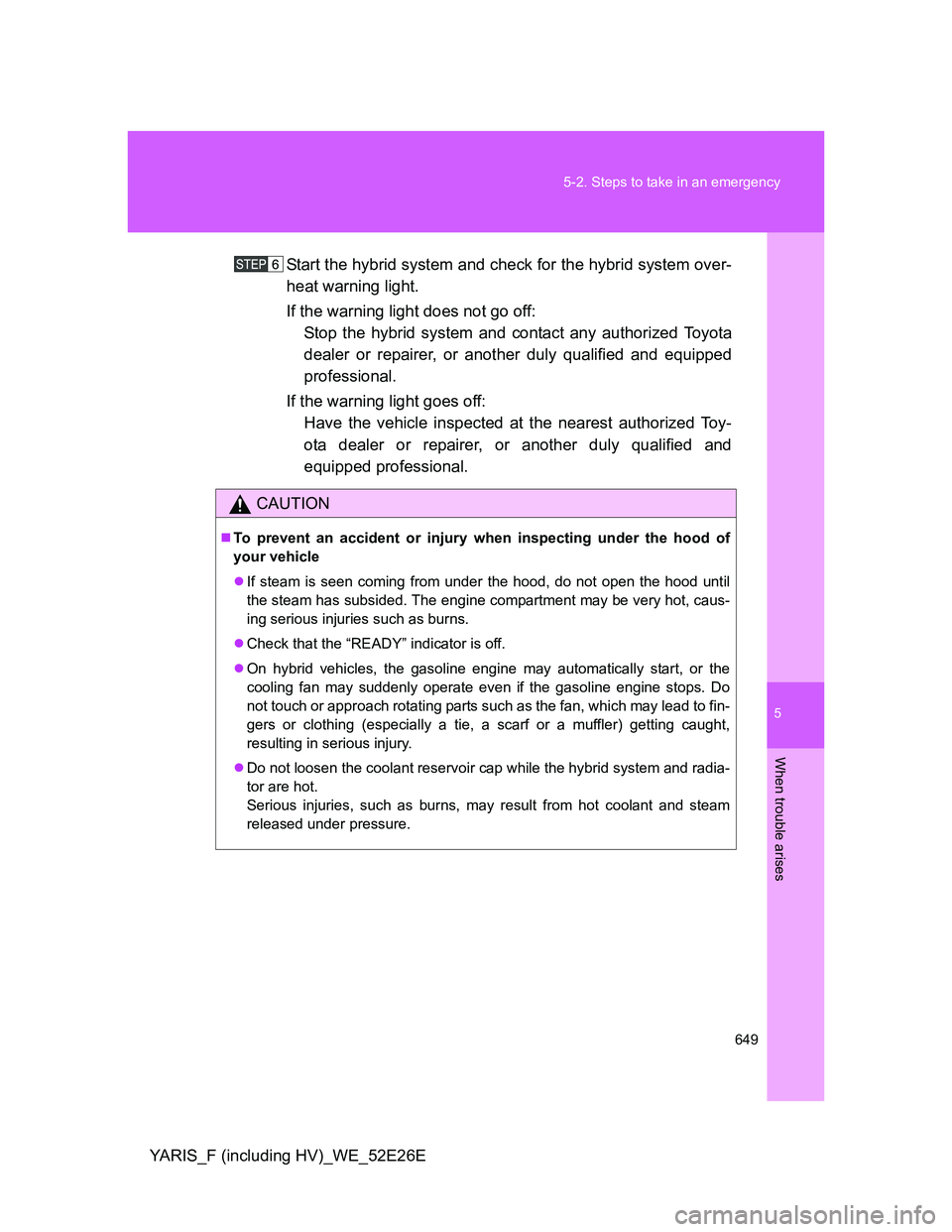
YARIS_F (including HV)_WE_52E26EStart the hybrid system and check for the hybrid system over-
heat warning light.
If the warning light does not go off:
Stop the hybrid system and contact any authorized Toyota
dealer or repairer, or another duly qualified and equipped
professional.
If the warning light goes off:
Have the vehicle inspected at the nearest authorized Toy-
ota dealer or repairer, or another duly qualified and
equipped professional.
CAUTION
To prevent an accident or injury when inspecting under the hood of
your vehicle
If steam is seen coming from under the hood, do not open the hood until
the steam has subsided. The engine compartment may be very hot, caus-
ing serious injuries such as burns.
Check that the “READY” indicator is off.
On hybrid vehicles, the gasoline engine may automatically start, or the
cooling fan may suddenly operate even if the gasoline engine stops. Do
not touch or approach rotating parts such as the fan, which may lead to fin-
gers or clothing (especially a tie, a scarf or a muffler) getting caught,
resulting in serious injury.
Do not loosen the coolant reservoir cap while the hybrid system and radia-
tor are hot.
Serious injuries, such as burns, may result from hot coolant and steam
released under pressure.
Page 679 of 712
679 6-1. Specifications
6
Vehicle specifications
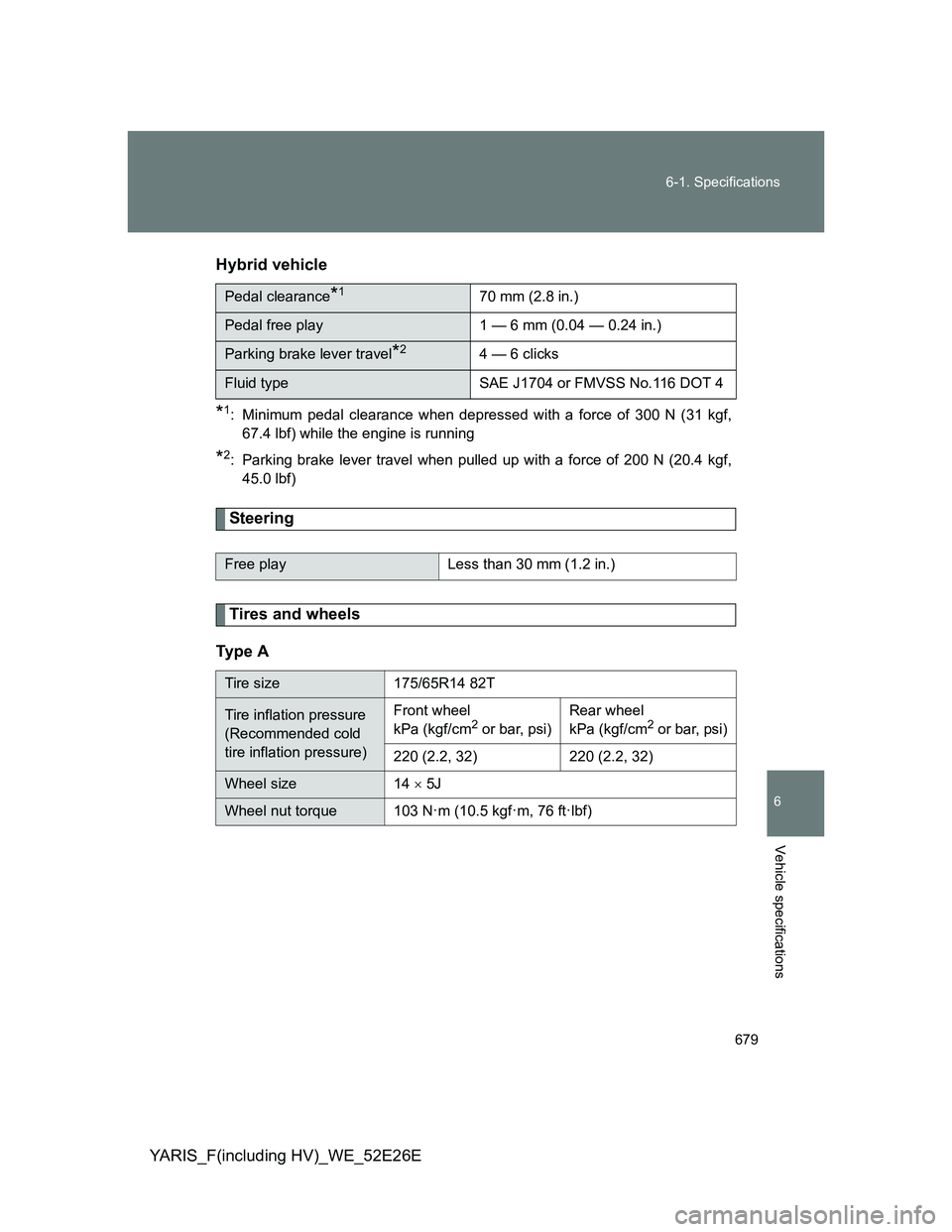
YARIS_F(including HV)_WE_52E26EHybrid vehicle
*1: Minimum pedal clearance when depressed with a force of 300 N (31 kgf,
67.4 lbf) while the engine is running
*2: Parking brake lever travel when pulled up with a force of 200 N (20.4 kgf,
45.0 lbf)
Steering
Tires and wheels
Ty p e A
Pedal clearance*170 mm (2.8 in.)
Pedal free play 1 — 6 mm (0.04 — 0.24 in.)
Parking brake lever travel*24 — 6 clicks
Fluid type SAE J1704 or FMVSS No.116 DOT 4
Free play Less than 30 mm (1.2 in.)
Tire size 175/65R14 82T
Tire inflation pressure
(Recommended cold
tire inflation pressure)Front wheel
kPa (kgf/cm2 or bar, psi)Rear wheel
kPa (kgf/cm2 or bar, psi)
220 (2.2, 32) 220 (2.2, 32)
Wheel size 14 5J
Wheel nut torque 103 N·m (10.5 kgf·m, 76 ft·lbf)
Page 680 of 712
680 6-1. Specifications
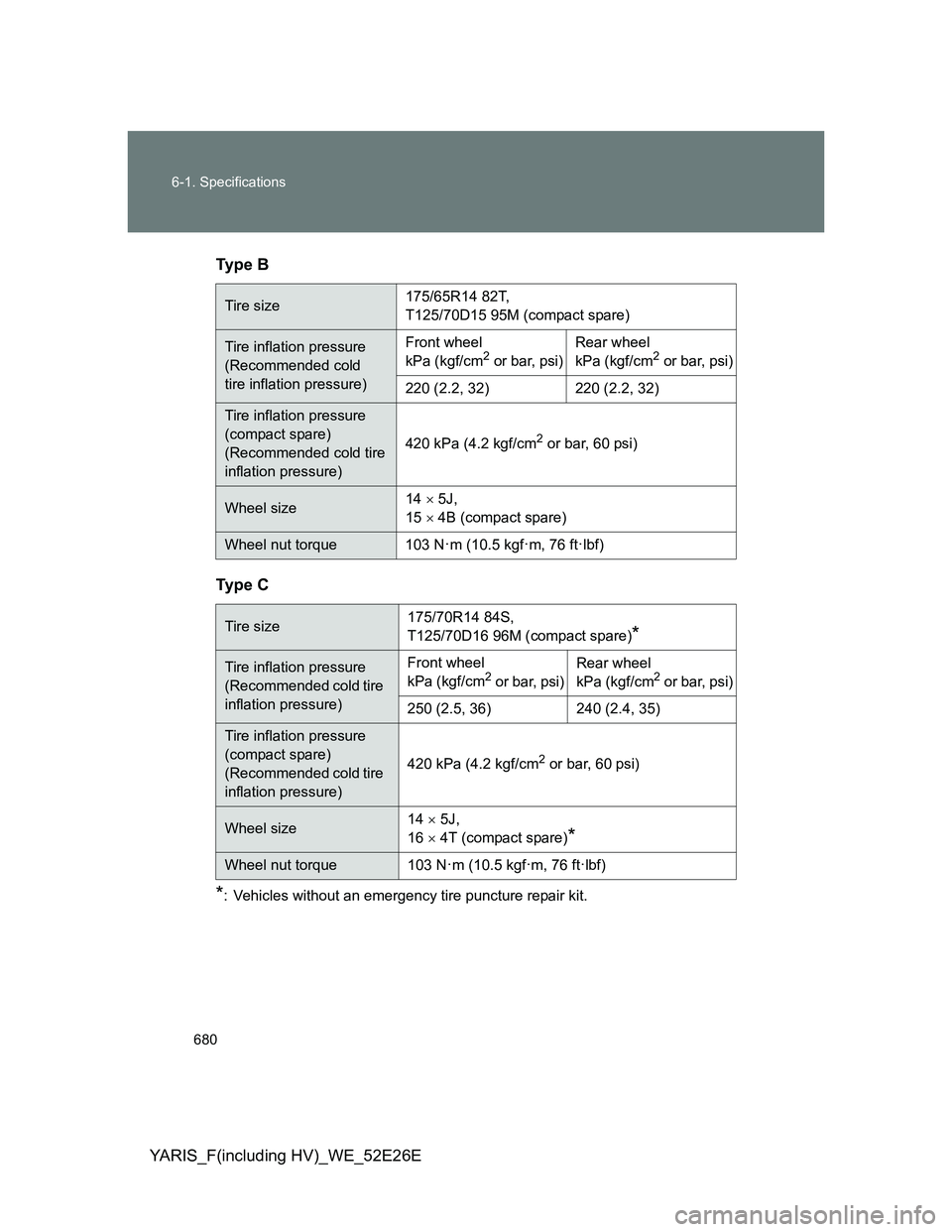
YARIS_F(including HV)_WE_52E26ETy p e B
Ty p e C
*: Vehicles without an emergency tire puncture repair kit.
Tire size175/65R14 82T,
T125/70D15 95M (compact spare)
Tire inflation pressure
(Recommended cold
tire inflation pressure)Front wheel
kPa (kgf/cm2 or bar, psi)Rear wheel
kPa (kgf/cm2 or bar, psi)
220 (2.2, 32) 220 (2.2, 32)
Tire inflation pressure
(compact spare)
(Recommended cold tire
inflation pressure)420 kPa (4.2 kgf/cm
2 or bar, 60 psi)
Wheel size14 5J,
15 4B (compact spare)
Wheel nut torque 103 N·m (10.5 kgf·m, 76 ft·lbf)
Tire size175/70R14 84S,
T125/70D16 96M (compact spare)*
Tire inflation pressure
(Recommended cold tire
inflation pressure)Front wheel
kPa (kgf/cm2 or bar, psi)Rear wheel
kPa (kgf/cm2 or bar, psi)
250 (2.5, 36) 240 (2.4, 35)
Tire inflation pressure
(compact spare)
(Recommended cold tire
inflation pressure)420 kPa (4.2 kgf/cm
2 or bar, 60 psi)
Wheel size14 5J,
16 4T (compact spare)*
Wheel nut torque 103 N·m (10.5 kgf·m, 76 ft·lbf)
Page 681 of 712
681 6-1. Specifications
6
Vehicle specifications
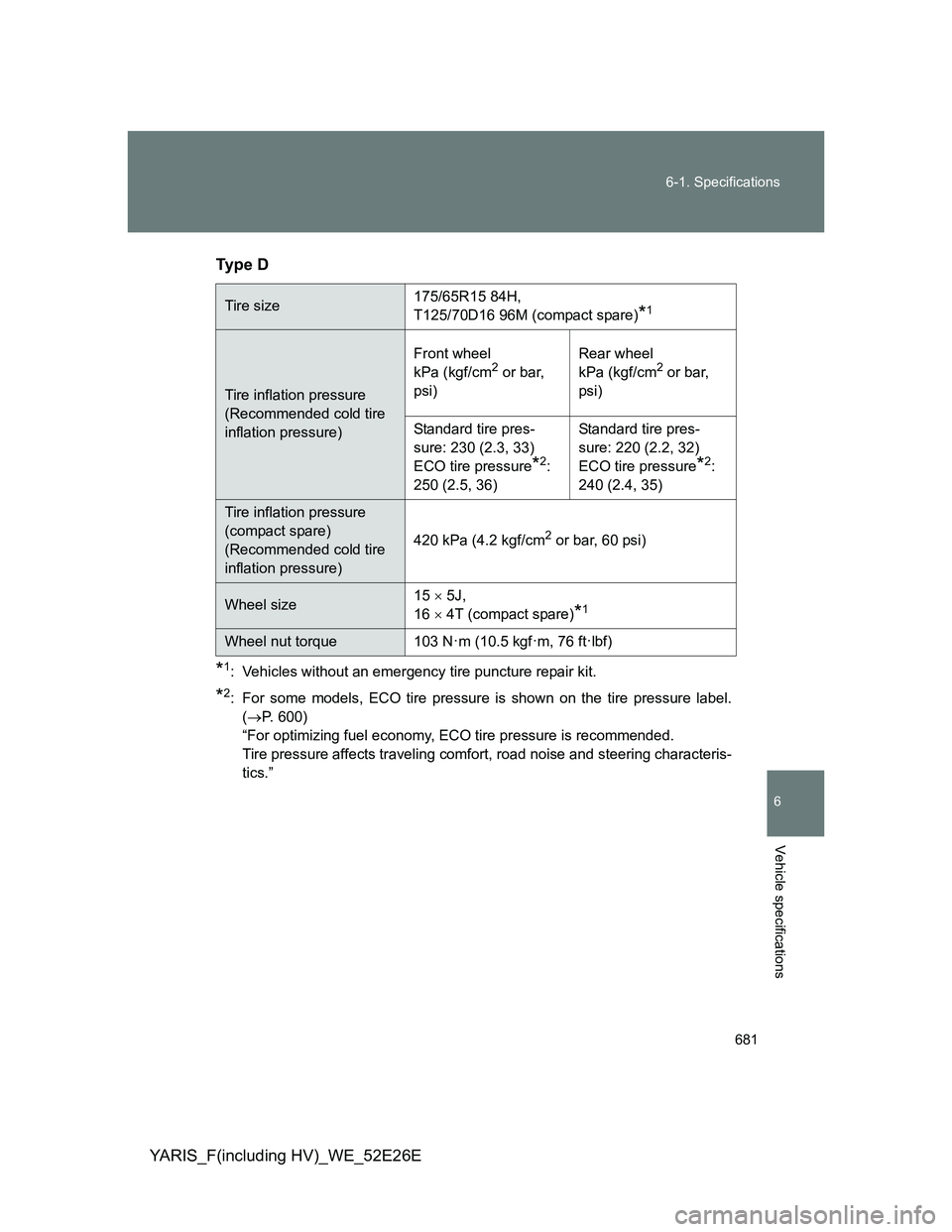
YARIS_F(including HV)_WE_52E26ETy p e D
*1: Vehicles without an emergency tire puncture repair kit.
*2: For some models, ECO tire pressure is shown on the tire pressure label.
(P. 600)
“For optimizing fuel economy, ECO tire pressure is recommended.
Tire pressure affects traveling comfort, road noise and steering characteris-
tics.”
Tire size175/65R15 84H,
T125/70D16 96M (compact spare)*1
Tire inflation pressure
(Recommended cold tire
inflation pressure)Front wheel
kPa (kgf/cm
2 or bar,
psi)Rear wheel
kPa (kgf/cm2 or bar,
psi)
Standard tire pres-
sure: 230 (2.3, 33)
ECO tire pressure
*2:
250 (2.5, 36)Standard tire pres-
sure: 220 (2.2, 32)
ECO tire pressure*2:
240 (2.4, 35)
Tire inflation pressure
(compact spare)
(Recommended cold tire
inflation pressure)420 kPa (4.2 kgf/cm
2 or bar, 60 psi)
Wheel size15 5J,
16 4T (compact spare)*1
Wheel nut torque 103 N·m (10.5 kgf·m, 76 ft·lbf)
Page 682 of 712
682 6-1. Specifications
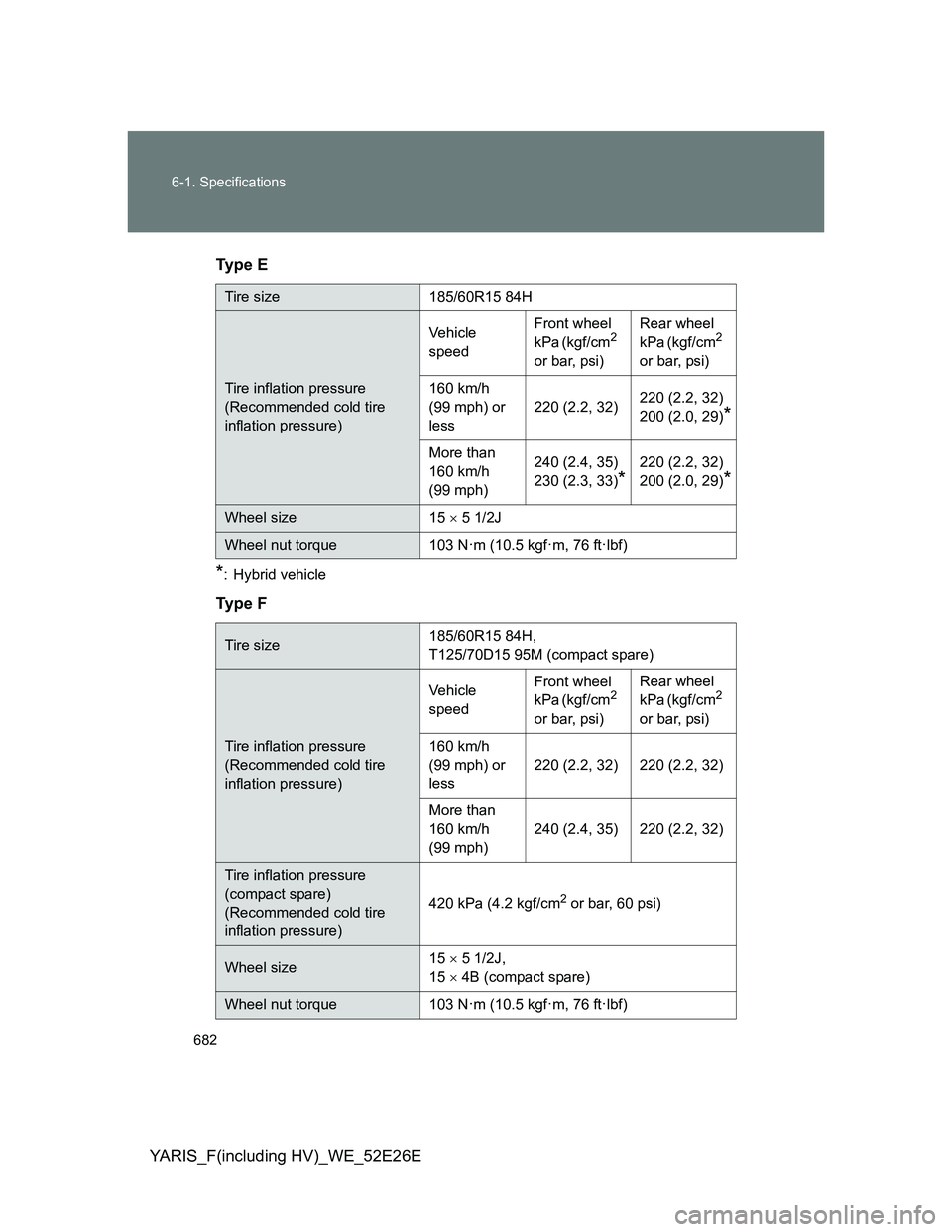
YARIS_F(including HV)_WE_52E26ETy p e E
*: Hybrid vehicle
Ty p e F
Tire size 185/60R15 84H
Tire inflation pressure
(Recommended cold tire
inflation pressure)Vehicle
speedFront wheel
kPa (kgf/cm
2
or bar, psi)Rear wheel
kPa (kgf/cm2
or bar, psi)
160 km/h
(99 mph) or
less220 (2.2, 32)220 (2.2, 32)
200 (2.0, 29)
*
More than
160 km/h
(99 mph)240 (2.4, 35)
230 (2.3, 33)
*
220 (2.2, 32)
200 (2.0, 29)
*
Wheel size 15 5 1/2J
Wheel nut torque 103 N·m (10.5 kgf·m, 76 ft·lbf)
Tire size185/60R15 84H,
T125/70D15 95M (compact spare)
Tire inflation pressure
(Recommended cold tire
inflation pressure)Vehicle
speedFront wheel
kPa (kgf/cm
2
or bar, psi)Rear wheel
kPa (kgf/cm2
or bar, psi)
160 km/h
(99 mph) or
less220 (2.2, 32) 220 (2.2, 32)
More than
160 km/h
(99 mph)240 (2.4, 35) 220 (2.2, 32)
Tire inflation pressure
(compact spare)
(Recommended cold tire
inflation pressure)420 kPa (4.2 kgf/cm
2 or bar, 60 psi)
Wheel size15 5 1/2J,
15 4B (compact spare)
Wheel nut torque 103 N·m (10.5 kgf·m, 76 ft·lbf)