tires TOYOTA YARIS 2016 User Guide
[x] Cancel search | Manufacturer: TOYOTA, Model Year: 2016, Model line: YARIS, Model: TOYOTA YARIS 2016Pages: 592, PDF Size: 10.44 MB
Page 195 of 592
193
YARIS_SEDAN_OM_OM99M18z_(U)
3-6. ABS/TCS/DSC
3
When Driving
Antilock Brake System (ABS)
The driver will feel a slight vibration in the brake pedal and may hear a
chattering noise from the brake system. This is normal ABS system
operation. Continue to depress the brake pedal without pumping the
brakes.
The warning light turns on when the system has a malfunction.
Refer to Warning Lights on P. 157.
●Braking distances may be longer on loose surfaces (snow or gravel, for
example) which usually have a hard foundation. A vehicle with a normal
braking system may require less distance to stop under these conditions
because the tires will build up a wedge of surface layer when the wheels
skid.
● The sound of the ABS operating may be heard when starting the engine or
immediately after starting the vehicle, however, it does not indicate a mal-
function.
The ABS control unit continuously monitors the speed of each
wheel. If one wheel is about to lock up, the ABS responds by
automatically releasing and reapplying that wheel’s brake.
WARNING
■Do not rely on ABS as a substitute for safe driving
The ABS cannot compensate for unsafe and reckless driving, excessive
speed, tailgating (following another vehicle too closely), driving on ice and
snow, and hydroplaning (reduced tire friction and road contact because of
water on the road surface). You can still have an accident.
YARIS_SEDAN_OM_OM99M18z_(U).book Page 193 Monday, June 1, 2015 9:22 PM
Page 196 of 592
194
YARIS_SEDAN_OM_OM99M18z_(U)
3-6. ABS/TCS/DSC
Traction Control System (TCS)
The warning light turns on when the system has a malfunction.
Refer to Warning Lights on P. 157.
To turn off the TCS, press the DSC OFF switch (→P. 197).
The Traction Control System (TCS) enhances traction and safety
by controlling engine torque and braking. When the TCS detects
driving wheel slippage, it lowers engine torque and operates the
brakes to prevent loss of traction.
This means that on a slick surface, the engine adjusts automati-
cally to provide optimum power to the drive wheels, limiting
wheel spin and loss of traction.
WARNING
■Do not rely on the Traction Control System (TCS) as a substitute for
safe driving
The Traction Control System (TCS) cannot compensate for unsafe and
reckless driving, excessive speed, tailgating (following another vehicle too
closely), and hydroplaning (reduced tire friction and road contact because
of water on the road surface). You can still have an accident.
■ Use snow tires or tire chains and drive at reduced speeds when roads
are covered with ice and/or snow
Driving without proper traction devices on snow and/or ice-covered roads is
dangerous. The Traction Control System (TCS) alone cannot provide ade-
quate traction and you could still have an accident.
YARIS_SEDAN_OM_OM99M18z_(U).book Page 194 Monday, June 1, 2015 9:22 PM
Page 198 of 592
196
YARIS_SEDAN_OM_OM99M18z_(U)
3-6. ABS/TCS/DSC
Dynamic Stability Control (DSC)
DSC operation is possible at speeds greater than 12 mph (20 km/h).
The warning light turns on when the system has a malfunction.
Refer to Warning Lights on P. 157.
The Dynamic Stability Control (DSC) automatically controls
braking and engine torque in conjunction with systems such as
ABS and TCS to help control side slip when driving on slippery
surfaces, or during sudden or evasive maneuvering, enhancing
vehicle safety.
Refer to ABS (→P. 193) and TCS ( →P. 194).
WARNING
■Do not rely on the Dynamic Stability Control as a substitute for safe
driving
The Dynamic Stability Control (DSC) cannot compensate for unsafe and
reckless driving, excessive speed, tailgating (following another vehicle too
closely), and hydroplaning (reduced tire friction and road contact because
of water on the road surface). You can still have an accident.
NOTICE
●The DSC may not operate correctly unless the following are observed:
• Use tires of the correct size specified for your Toyota on all four wheels.
• Use tires of the same manufacturer, brand and tread pattern on all four
wheels.
• Do not mix worn tires.
● The DSC may not operate correctly when tire chains are used or a tempo-
rary spare tire is installed because the tire diameter changes.
YARIS_SEDAN_OM_OM99M18z_(U).book Page 196 Monday, June 1, 2015 9:22 PM
Page 208 of 592
206
YARIS_SEDAN_OM_OM99M18z_(U)
3-10. Active Safety System
●The Smart City Brake Support (SCBS) sy stem will not operate if the driver is
deliberately performing driving operations (accelerator pedal and steering
wheel).
● The Smart City Brake Support (SCBS) system will operate under the follow-
ing conditions.
• The engine is running.
• The Smart City Brake Support (SCBS) warning light (amber) does not
illuminate.
• The vehicle speed is between about 2 to 18 mph (4 to 30 km/h).
• The Smart City Brake Support (SCBS) system is not turned off.
• The DSC is not malfunctioning.
● The Smart City Brake Support (SCBS) detects a vehicle ahead by emitting a
near-infrared laser beam and receiving the beam reflected off the reflector
of the vehicle ahead, and then using it for the measurement. Consequently,
the Smart City Brake Support (SCBS) may not operate under the following
conditions:
• Reflection of the laser is poor due to the shape of the vehicle ahead.
• The vehicle ahead is significantly dirty.
• Under bad weather condition, such as rain, fog and snow.
• The window washer is being used or the windshield wipers are not used
when it’s raining.
• The windshield is dirty.
• The steering wheel is turned completely left or right, or the vehicle is
accelerated rapidly and comes close to the vehicle ahead.
• Trucks with low loading platforms and vehicles with an extremely low or
high profile.
• Vehicles with certain shapes such as a vehicle carrier.
● Under the following conditions, the Sm art City Brake Support (SCBS) sys-
tem may not operate normally.
• Heavy luggage is loaded in the luggage compartment or on the rear seat.
• If there is the possibility of partial contact with a vehicle ahead.
• When driving on continuously curving roads, and entering and exiting
exits.
• Elongated luggage or cargo is loaded onto installed roof rails and covers the laser sensor.
• Exhaust gas from the vehicle in front, sand, snow, and water vapor rising from manholes and grating, and water splashed into the air.
• When towing a malfunctioning vehicle.
• When driving with tires having significantly different wear.
YARIS_SEDAN_OM_OM99M18z_(U).book Page 206 Monday, June 1, 2015 9:22 PM
Page 211 of 592
YARIS_SEDAN_OM_OM99M18z_(U)
2093-10. Active Safety System
3
When Driving
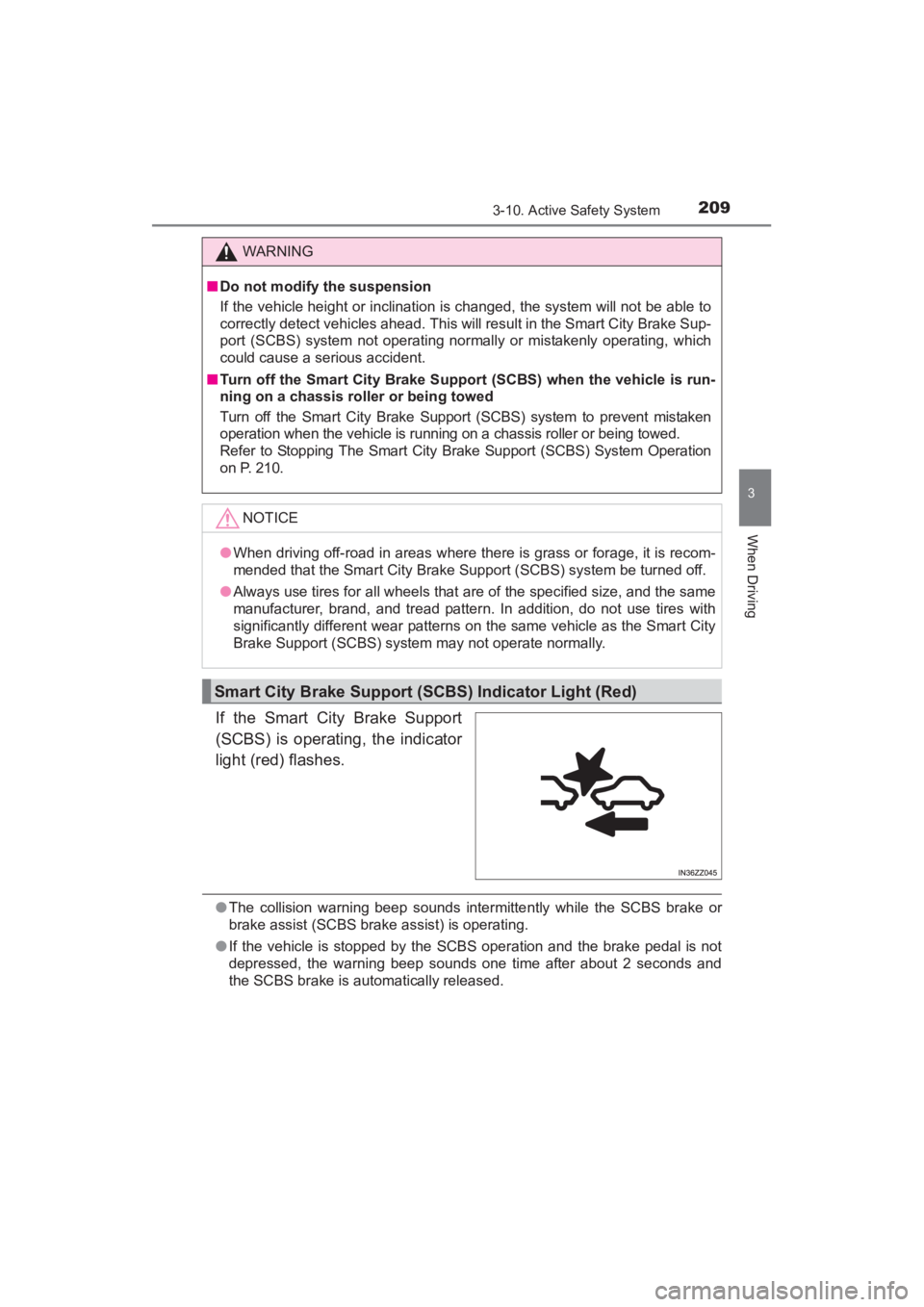
If the Smart City Brake Support
(SCBS) is operating, the indicator
light (red) flashes.
●The collision warning beep sounds intermittently while the SCBS brake or
brake assist (SCBS brake assist) is operating.
● If the vehicle is stopped by the SCBS operation and the brake pedal is not
depressed, the warning beep sounds one time after about 2 seconds and
the SCBS brake is automatically released.
WARNING
■Do not modify the suspension
If the vehicle height or inclination is changed, the system will not be able to
correctly detect vehicles ahead. This will result in the Smart City Brake Sup-
port (SCBS) system not operating normally or mistakenly operating, which
could cause a serious accident.
■ Turn off the Smart City Brake Suppor t (SCBS) when the vehicle is run-
ning on a chassis roller or being towed
Turn off the Smart City Brake Support (SCBS) system to prevent mistaken
operation when the vehicle is running on a chassis roller or being towed.
Refer to Stopping The Smart City Brake Support (SCBS) System Operation
on P. 210.
NOTICE
●When driving off-road in ar eas where there is grass or forage, it is recom-
mended that the Smart City Brake Support (SCBS) system be turned off.
● Always use tires for all wheels that are of the specified size, and the same
manufacturer, brand, and tread pattern. In addition, do not use tires with
significantly different wear patterns on the same vehicle as the Smart City
Brake Support (SCBS) system may not operate normally.
Smart City Brake Support (SCBS) Indicator Light (Red)
YARIS_SEDAN_OM_OM99M18z_(U).book Page 209 Monday, June 1, 2015 9:22 PM
Page 220 of 592
218
YARIS_SEDAN_OM_OM99M18z_(U)
3-12. Tire Pressure Monitoring System
Tire Pressure Monitoring System∗
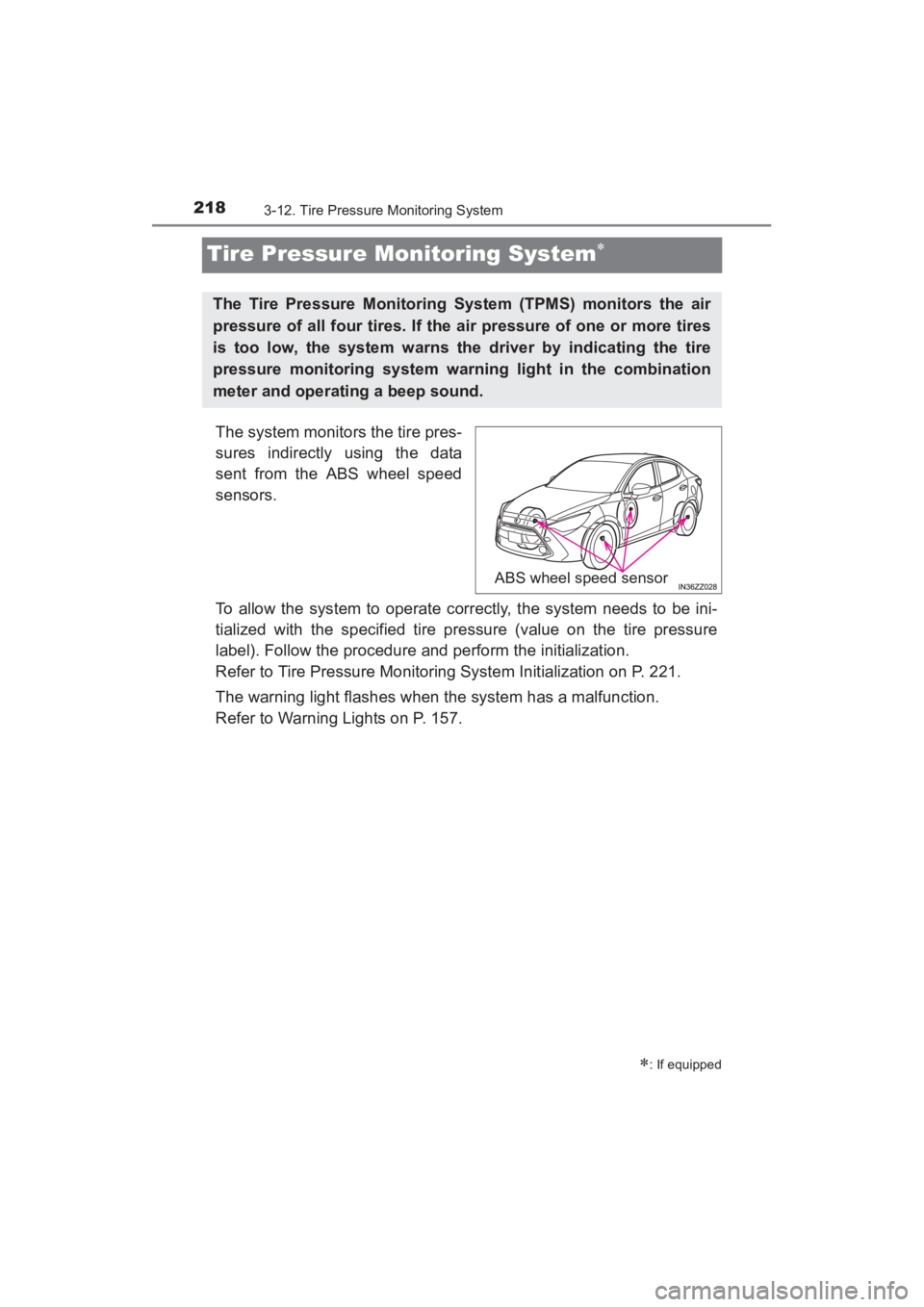
The system monitors the tire pres-
sures indirectly using the data
sent from the ABS wheel speed
sensors.
To allow the system to operate correctly, the system needs to be ini-
tialized with the specified tire pressure (value on the tire pressure
label). Follow the procedure and perform the initialization.
Refer to Tire Pressure Monitoring System Initialization on P. 221.
The warning light flashes when the system has a malfunction.
Refer to Warning Lights on P. 157.
∗: If equipped
The Tire Pressure Monitoring System (TPMS) monitors the air
pressure of all four tires. If the air pressure of one or more tires
is too low, the system warns the driver by indicating the tire
pressure monitoring system warning light in the combination
meter and operating a beep sound.
ABS wheel speed sensor
YARIS_SEDAN_OM_OM99M18z_(U).book Page 218 Monday, June 1, 2015 9:22 PM
Page 221 of 592
YARIS_SEDAN_OM_OM99M18z_(U)
2193-12. Tire Pressure Monitoring System
3
When Driving
Because this system detects slight changes in tire conditions, the timing
of the warning may be faster or slower in the following cases:
●The size, manufacturer, or the type of tires is different from the specifica-
tion.
●The size, manufacturer, or the type of a tire is different from the others,
or the level of tire wear is excessively different between them.
●A run-flat tire, studless tire, snow tire, or tire chains are used.
●An emergency tire is used (The tire pressure monitoring system warning
light may flash and then continue illuminating).
●A tire is repaired using the emergency flat tire repair kit.
●The tire pressure is excessively higher than the specified pressure, or
the tire pressure is suddenly lowered for some reason such as a tire
burst during driving.
●The vehicle speed is lower than about 9.3 mph (15 km/h) (including
when the vehicle is stopped), or the drive period is shorter than 5 min-
utes.
●The vehicle is driven on an extremely rough road or a slippery, icy road.
●Hard steering and rapid acceleration/deceleration are repeated such as
during aggressive driving on a winding road.
●Load on the vehicle is applied to a tire such as by loading heavy luggage
to one side of the vehicle.
●System initialization has not been implemented with the specified tire
pressure.
YARIS_SEDAN_OM_OM99M18z_(U).book Page 219 Monday, June 1, 2015 9:22 PM
Page 222 of 592
220
YARIS_SEDAN_OM_OM99M18z_(U)
3-12. Tire Pressure Monitoring System
NOTICE
●Each tire, including the spare (if provided), should be checked monthly
when cold and inflated to the inflation pressure recommended by the
vehicle manufacturer on the vehicle placard or tire inflation pressure
label. (If your vehicle has tires of a different size than the size indicated
on the vehicle placard or tire inflation pressure label, you should deter-
mine the proper tire inflation pressure for those tires.)
As an added safety feature, your vehicle has been equipped with a tire
pressure monitoring system (TPMS) that illuminates a low tire pres-
sure telltale when one or more of your tires is significantly under-
inflated. Accordingly, when the low tire pressure telltale illuminates,
you should stop and check your tires as soon as possible, and inflate
them to the proper pressure. Driving on a significantly under-inflated
tire causes the tire to overheat and can lead to tire failure. Under-infla-
tion also reduces fuel efficiency and tire tread life, and may affect the
vehicle’s handling and stopping ability.
Please note that the TPMS is not a substitute for proper tire mainte-
nance, and it is the driver’s responsibility to maintain correct tire pres-
sure, even if under-inflation has not reached the level to trigger
illumination of the TPMS low tire pressure telltale.
Your vehicle has also been equipped with a TPMS malfunction indica-
tor to indicate when the system is not operating properly.
The TPMS malfunction indicator is combined with the low tire pressure
telltale. When the system detects a malfunction, the telltale will flash
for approximately one minute and then remain continuously illumi-
nated. This sequence will continue upon subsequent vehicle start-ups
as long as the malfunction exists. When the malfunction indicator is
illuminated, the system may not be able to detect or signal low tire
pressure as intended. TPMS malfunctions may occur for a variety of
reasons, including the installation of replacement or alternate tires or
wheels on the vehicle that prevent the TPMS from functioning properly.
Always check the TPMS malfunction telltale after replacing one or
more tires or wheels on your vehicle to ensure that the replacement or
alternate tires and wheels allow the TPMS to continue to function prop-
erly.
●To avoid false readings, the system samples for a little while before
indicating a problem. As a result it will not instantaneously register a
rapid tire deflation or blow out.
YARIS_SEDAN_OM_OM99M18z_(U).book Page 220 Monday, June 1, 2015 9:22 PM
Page 223 of 592
YARIS_SEDAN_OM_OM99M18z_(U)
2213-12. Tire Pressure Monitoring System
3
When Driving
In the following cases, system initialization must be performed so that
the system operates normally.
●A tire pressure is adjusted.
● Tire rotation is performed.
● A tire or wheel is replaced.
● The battery is replaced or completely drained.
● The tire pressure monitoring system warning light is illuminated.
■Initialization method
Park the car in a safe place and firmly apply the parking brake.
Let the tires cool, then adjust the tire pressure of all four (4) tires
to the specified pressure indicated on the tire pressure label
located on the door jamb of the driver’s door (door open).
Refer to Tires on P. 570.
Switch the ignition ON.
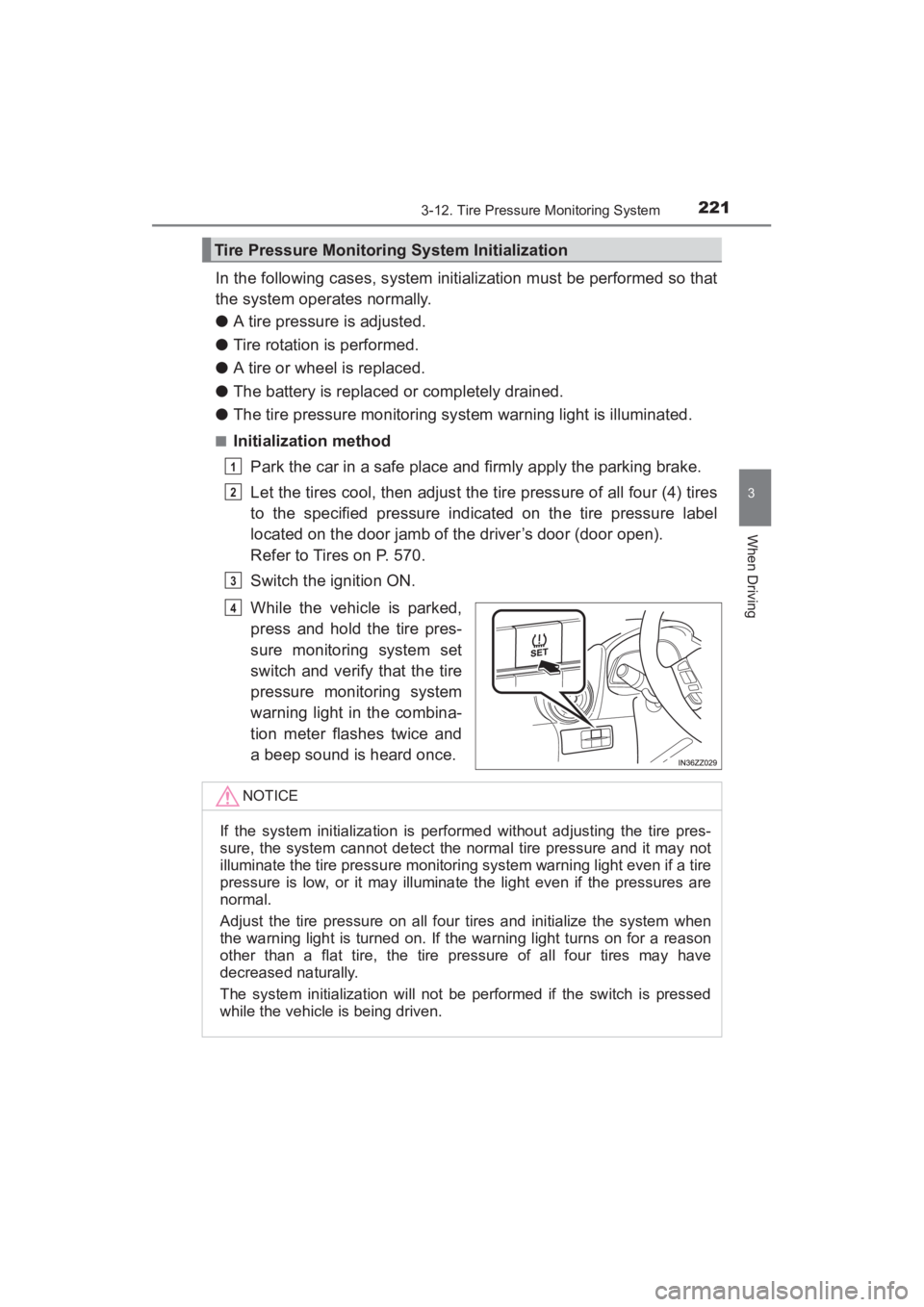
While the vehicle is parked,
press and hold the tire pres-
sure monitoring system set
switch and verify that the tire
pressure monitoring system
warning light in the combina-
tion meter flashes twice and
a beep sound is heard once.
Tire Pressure Monitoring System Initialization
1
2
3
4
NOTICE
If the system initialization is performed without adjusting the tire pres-
sure, the system cannot detect the normal tire pressure and it may not
illuminate the tire pressure monitoring system warning light even if a tire
pressure is low, or it may illuminate the light even if the pressures are
normal.
Adjust the tire pressure on all four tires and initialize the system when
the warning light is turned on. If the warning light turns on for a reason
other than a flat tire, the tire pressure of all four tires may have
decreased naturally.
The system initialization will not be performed if the switch is pressed
while the vehicle is being driven.
YARIS_SEDAN_OM_OM99M18z_(U).book Page 221 Monday, June 1, 2015 9:22 PM
Page 224 of 592
222
YARIS_SEDAN_OM_OM99M18z_(U)
3-13. Rear View Monitor
Rear View Monitor∗
●If water, snow, or mud is stuck on the camera lens, wipe it off using a soft
cloth. If it cannot be wiped off, use a mild detergent.
● If the camera temperature changes rapidly (Hot to cold, cold to hot), the rear
view monitor may not operate correctly.
● When replacing the tires, consult your Toyota dealer. Replacing the tires
could result in deviation of the guide lines which appear on the display.
● If the vehicle’s front, side, or rear has been involved in a collision, the align-
ment of the rear view parking camera (location, installation angle) may have
deviated. Always consult your Toyota dealer to have the vehicle inspected.
● If “No Video Signal Available” is indica ted in the display, there could be a
problem with the camera. Have your vehicle inspected at your Toyota
dealer.
∗: If equipped
The rear view monitor provides visual images of the rear of the
vehicle when reversing.
WARNING
■ Always drive carefully confirming the safety of the rear and the sur-
rounding conditions by looking directly with your eyes
Reversing the vehicle by only looking at the screen is dangerous as it may
cause an accident or a collision with an object. The rear view monitor is only
a visual assist device when reversing the vehicle. The images on the screen
may be different from the actual conditions.
■ Do not use the rear view monitor under the following conditions
Using the rear view monitor under the following conditions is dangerous and
could result in injury or vehicle damage or both.
●Icy or snow-covered roads.
● Tire chains or a temporary spare tire is installed.
● The trunk lid is not fully closed.
● The vehicle is on a road incline.
■ Rear view monitor display precautions in cold temperatures
When the display is cold, images may course across the monitor or the
screen and may be dimmer than usual, which could cause difficulty in con-
firming the surrounding conditions of the vehicle. Always drive carefully con-
firming the safety of the rear and the surrounding conditions by looking
directly with your eyes.
YARIS_SEDAN_OM_OM99M18z_(U).book Page 222 Monday, June 1, 2015 9:22 PM