tires TOYOTA YARIS 2016 Owners Manual
[x] Cancel search | Manufacturer: TOYOTA, Model Year: 2016, Model line: YARIS, Model: TOYOTA YARIS 2016Pages: 592, PDF Size: 10.44 MB
Page 7 of 592
5
1
8 7
6 4 3
2
YARIS_SEDAN_OM_OM99M18z_(U)
5
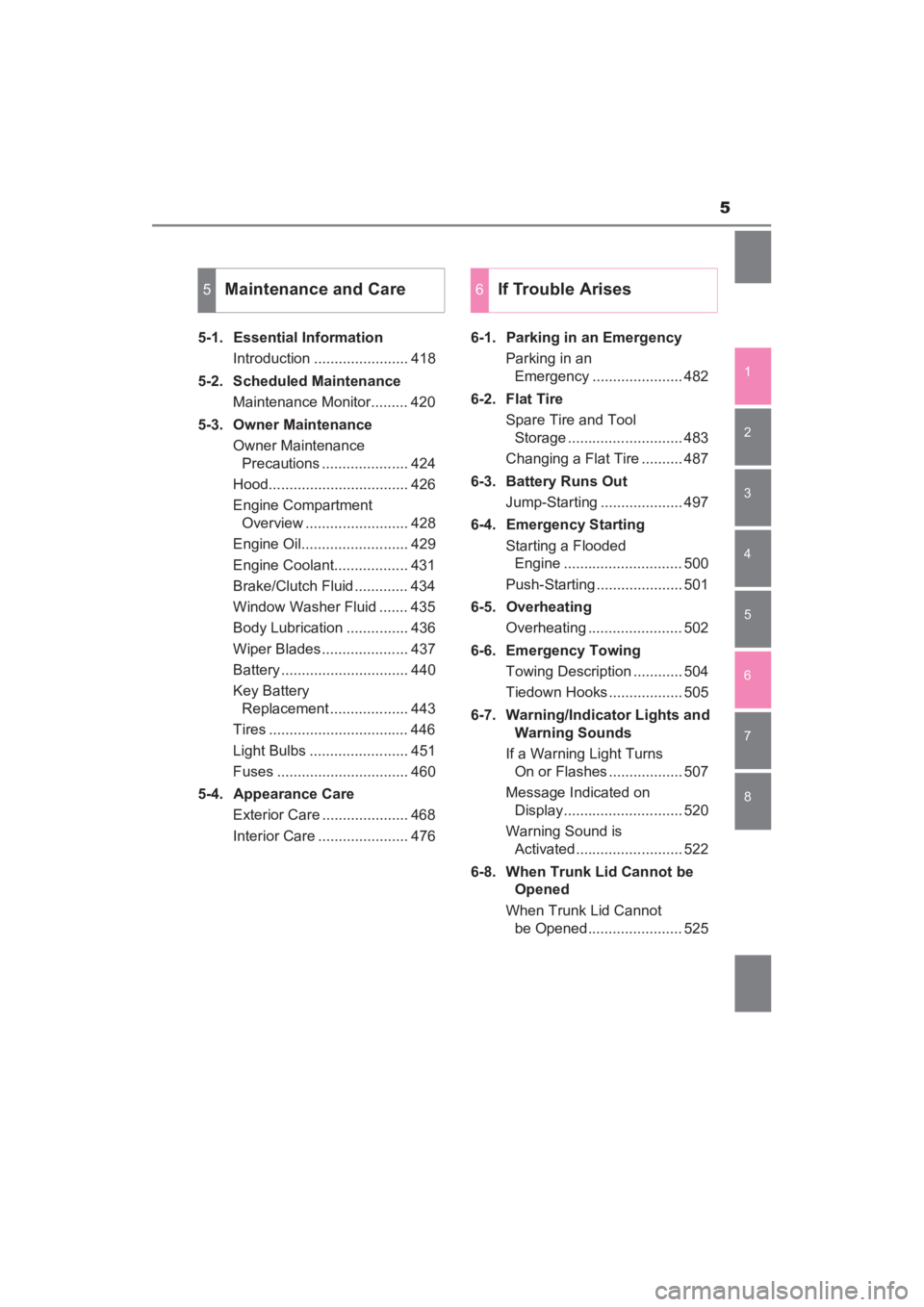
5-1. Essential InformationIntroduction ....................... 418
5-2. Scheduled Maintenance Maintenance Monitor......... 420
5-3. Owner Maintenance Owner Maintenance Precautions ..................... 424
Hood.................................. 426
Engine Compartment Overview ......................... 428
Engine Oil.......................... 429
Engine Coolant.................. 431
Brake/Clutch Fluid ............. 434
Window Washer Fluid ....... 435
Body Lubrication ............... 436
Wiper Blades ..................... 437
Battery ............................... 440
Key Battery Replacement ................... 443
Tires .................................. 446
Light Bulbs ........................ 451
Fuses ................................ 460
5-4. Appearance Care Exterior Care ..................... 468
Interior Care ...................... 476 6-1. Parking in an Emergency
Parking in an Emergency ...................... 482
6-2. Flat Tire Spare Tire and Tool Storage ............................ 483
Changing a Flat Tire .......... 487
6-3. Battery Runs Out Jump-Starting .................... 497
6-4. Emergency Starting Starting a Flooded Engine ............................. 500
Push-Starting ..................... 501
6-5. Overheating Overheating ....................... 502
6-6. Emergency Towing Towing Description ............ 504
Tiedown Hooks .................. 505
6-7. Warning/Indicator Lights and Warning Sounds
If a Warning Light Turns On or Flashes .................. 507
Message Indicated on Display............................. 520
Warning Sound is Activated.......................... 522
6-8. When Trunk Lid Cannot be Opened
When Trunk Lid Cannot be Opened....................... 525
5Maintenance and Care6If Trouble Arises
YARIS_SEDAN_OM_OM99M18z_(U).book Page 5 Monday, June 1, 2015 9:22 PM
Page 18 of 592

■Exterior Overview
Hood . . . . . . . . . . . . . . . . . . . . . . . . . . . . . . . . . . . .\
. . . . . . . . P. 426
Windshield wiper blades . . .")
16Pictorial index
YARIS_SEDAN_OM_OM99M18z_(U)
■Exterior Overview
Hood . . . . . . . . . . . . . . . . . . . . . . . . . . . . . . . . . . . .\
. . . . . . . . P. 426
Windshield wiper blades . . . . . . . . . . . . . . . . . . . . . . . . . . . . P. 437
Doors and keys . . . . . . . . . . . . . . . . . . . . . . . . . . . . . . . . . . . . P. 96
Fuel-filler lid . . . . . . . . . . . . . . . . . . . . . . . . . . . . . . . . . . . . . . P. 110
Wheels and Tires . . . . . . . . . . . . . . . . . . . . . . . . . . . . . . . . . . P. 446
Exterior lights . . . . . . . . . . . . . . . . . . . . . . . . . . . . . . . . . . . . . P. 451
Trunk lid . . . . . . . . . . . . . . . . . . . . . . . . . . . . . . . . . . . . . . . . . P. 104
Child safety locks . . . . . . . . . . . . . . . . . . . . . . . . . . . . . . . . . P. 102
Outside mirror . . . . . . . . . . . . . . . . . . . . . . . . . . . . . . . . . . . . P. 113
The equipment and installation position varies by vehicle
1
2
3
4
5
6
7
8
9
YARIS_SEDAN_OM_OM99M18z_(U).book Page 16 Monday, June 1, 2015 9:22 PM
Page 68 of 592
66
YARIS_SEDAN_OM_OM99M18z_(U)
1-4. SRS Air Bags
WARNING
■Do not touch the components of the supplemental restraint system
after the air bags have inflated
Touching the components of the supplemental restraint system after the air
bags have inflated is dangerous. Immediately after inflation, they are very
hot. You could get burned.
■ Never install any front-end equipment to your vehicle
Installation of front-end equipment, such as frontal protection bar (kangaroo
bar, bull bar, push bar, or other similar devices), snowplow, or winches, is
dangerous. The air bag crash sensor system could be affected. This could
cause air bags to inflate unexpectedly, or it could prevent the air bags from
inflating during an accident. Front occupants could be seriously injured.
■ Do not modify the suspension
Modifying the vehicle suspension is dangerous. If the vehicle’s height or the
suspension is modified, the vehicle will be unable to accurately detect a col-
lision or roll-over accident resulting in incorrect or unexpected air bag
deployment and the possibility of serious injuries.
■ To prevent false detection by the air bag sensor system, heed the fol-
lowing
● Do not use tires or wheels other than those specified for your Toyota:
Use of any tire or wheel other than those specified for your Toyota ( →P. 570)
is dangerous. Use of such wheels will prevent the vehicle’s accident detec-
tions system from accurately detecting a collision or roll-over accident result-
ing in incorrect or unexpected air bag deployment and the possibility of
serious injuries.
● Do not overload your vehicle:
Overloading your vehicle is dangerous as it could prevent the air bag
crash sensor system from accurately detecting a collision or roll-over acci-
dent resulting in incorrect or unexpected air bag deployment and the pos-
sibility of serious injuries. The gross axle weight rating (GAWR) and the
gross vehicle weight rating (GVWR) for your vehicle are on the Motor
Vehicle Safety Standard Label on the driver’s door frame. Do not exceed
these ratings.
● Do not drive the vehicle off-road:
Driving your Toyota off-road is dangerous because the vehicle has not
been designed to do so. Driving the vehicle off-road could prevent the air
bag crash sensor system from accurately detecting a collision or roll-over
accident resulting in incorrect or unexpected air bag deployment and the
possibility of serious injuries.
YARIS_SEDAN_OM_OM99M18z_(U).book Page 66 Monday, June 1, 2015 9:22 PM
Page 129 of 592
127
YARIS_SEDAN_OM_OM99M18z_(U)
2-8. Driving Tips
2
Before Driving
Saving Fuel and Protection of the Environment
How you operate your Toyota determines how far it will travel on a
tank of fuel. Use these suggestions to help save fuel and reduce CO2.
●Avoid long warm-ups. Once the engine runs smoothly, begin driv-
ing.
● Avoid fast starts.
● Drive at lower speeds.
● Anticipate when to apply the brakes (avoid sudden braking).
● Follow the maintenance schedule and have your Toyota dealer per-
form inspections and servicing.
● Use the air conditioner only when necessary.
● Slow down on rough roads.
● Keep the tires properly inflated.
● Do not carry unnecessary weight.
● Do not rest your foot on the brake pedal while driving.
● Keep the wheels in correct alignment.
● Keep windows closed at high speeds.
● Slow down when driving in crosswinds and headwinds.
WARNING
■Never stop the engine when going down a hill
Stopping the engine when going down a hill is dangerous. This causes the
loss of power steering and power br ake control, and may cause damage to
the drivetrain. Any loss of steering or braking control could cause an acci-
dent.
YARIS_SEDAN_OM_OM99M18z_(U).book Page 127 Monday, June 1, 2015 9:22 PM
Page 130 of 592
128
YARIS_SEDAN_OM_OM99M18z_(U)
2-8. Driving Tips
Hazardous Driving
When driving on ice or in water, snow, mud, sand, or similar hazards:
●Be cautious and allow extra distance for braking.
● Avoid sudden braking and sudden maneuvering.
● Do not pump the brakes. Continue to press down on the brake
pedal. Refer to Antilock Brake System (ABS) on P. 193.
● If you get stuck, select a lower gear and accelerate slowly. Do not
spin the front wheels.
● For more traction in starting on slippery surfaces such as ice or
packed snow, use sand, rock salt, chains, carpeting, or other non-
slip material under the front wheels.
Use snow chains only on the front wheels.
WARNING
■Be extremely careful if it is necessary to downshift on slippery sur-
faces
Downshifting into lower gear while driving on slippery surfaces is danger-
ous. The sudden change in tire speed could cause the tires to skid. This
could lead to loss of vehicle control and an accident.
YARIS_SEDAN_OM_OM99M18z_(U).book Page 128 Monday, June 1, 2015 9:22 PM
Page 134 of 592
132
YARIS_SEDAN_OM_OM99M18z_(U)
2-8. Driving Tips
■Use snow tires on all four wheels
Do not go faster than 75 mph (120 km/h) while driving with snow
tires. Inflate snow tires 30 kPa (0.3 kgf/cm
2, 4.3 psi) more than rec-
ommended on the tire pressure label (driver’s door frame), but
never more than the maximum cold-tire pressure shown on the
tires.
The vehicle is originally equipped with all season radials designed
to be used all year around. In some extreme climates you may find
it necessary to replace them with snow tires during the winter
months to further improve traction on snow and ice covered roads.
Check local regulations before using tire chains.
Install the chains on the front tires only.
Do not use chains on the rear tires.
Please consult your Toyota dealer.
■Installing the chains If your vehicle is equipped with wheel covers remove them, oth-
erwise the chain bands will scratch them.
Secure the chains on the front tires as tightly as possible.
Always follow the chain manufacturer’s instructions.
Retighten the chains after driving 1/4—1/2 mile (1/2—1 km).
If your vehicle is equipped with the tire pressure monitoring system, the
system may not function correctly when using tire chains.
Snow Tires
WARNING
■Use only the same size and type tires (snow, radial, or non-radial)
on all four wheels
Using tires different in size or type is dangerous. Your vehicle’s handling
could be greatly affected and result in an accident.
NOTICE
Check local regulations before using studded tires.
Tire Chains
1
2
3
YARIS_SEDAN_OM_OM99M18z_(U).book Page 132 Monday, June 1, 2015 9:22 PM
Page 135 of 592
YARIS_SEDAN_OM_OM99M18z_(U)
1332-8. Driving Tips
2
Before Driving
WARNING
■Driving with tire chains
●Chains may affect handling.
● Do not go faster than 30 mph (50 km/h) or the chain manufacturer’s rec-
ommended limit, whichever is lower.
● Drive carefully and avoid bumps, holes, and sharp turns.
● Avoid locked-wheel braking.
NOTICE
● Do not use chains on a temporary spare tire; it may result in damage to the
vehicle and to the tire.
● Do not use chains on roads that are free of snow or ice. The tires and
chains could be damaged.
● Chains may scratch or chip aluminum wheels.
YARIS_SEDAN_OM_OM99M18z_(U).book Page 133 Monday, June 1, 2015 9:22 PM
Page 138 of 592
136
YARIS_SEDAN_OM_OM99M18z_(U)
2-8. Driving Tips
Driving on Uneven Road
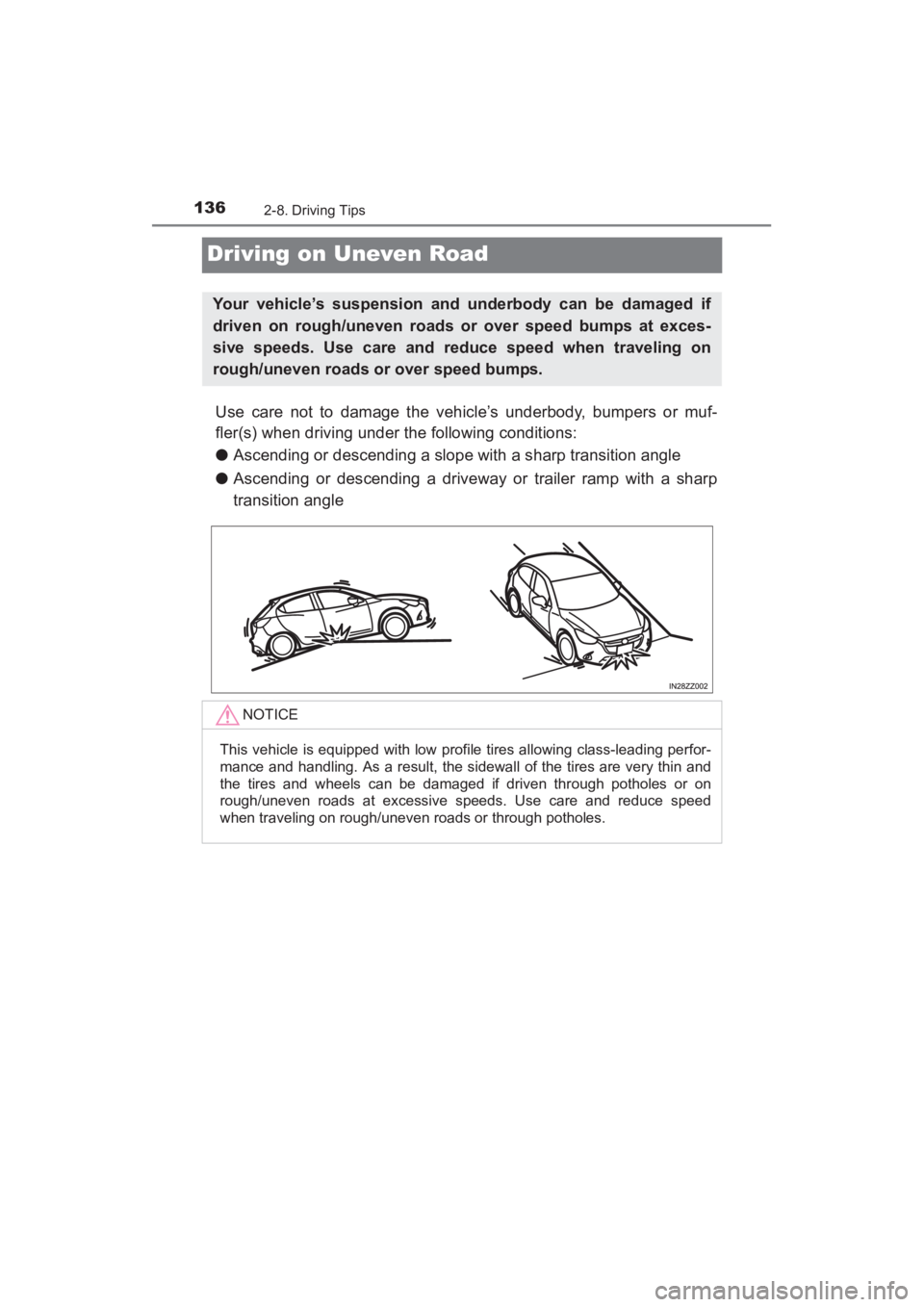
Use care not to damage the vehicle’s underbody, bumpers or muf-
fler(s) when driving under the following conditions:
●Ascending or descending a slope with a sharp transition angle
● Ascending or descending a driveway or trailer ramp with a sharp
transition angle
Your vehicle’s suspension and underbody can be damaged if
driven on rough/uneven roads or over speed bumps at exces-
sive speeds. Use care and reduce speed when traveling on
rough/uneven roads or over speed bumps.
NOTICE
This vehicle is equipped with low prof ile tires allowing class-leading perfor-
mance and handling. As a result, the sidewall of the tires are very thin and
the tires and wheels can be damaged if driven through potholes or on
rough/uneven roads at excessive speeds. Use care and reduce speed
when traveling on rough/uneven roads or through potholes.
YARIS_SEDAN_OM_OM99M18z_(U).book Page 136 Monday, June 1, 2015 9:22 PM
Page 162 of 592
160
YARIS_SEDAN_OM_OM99M18z_(U)
3-3. Transaxle
Manual Transaxle Operation
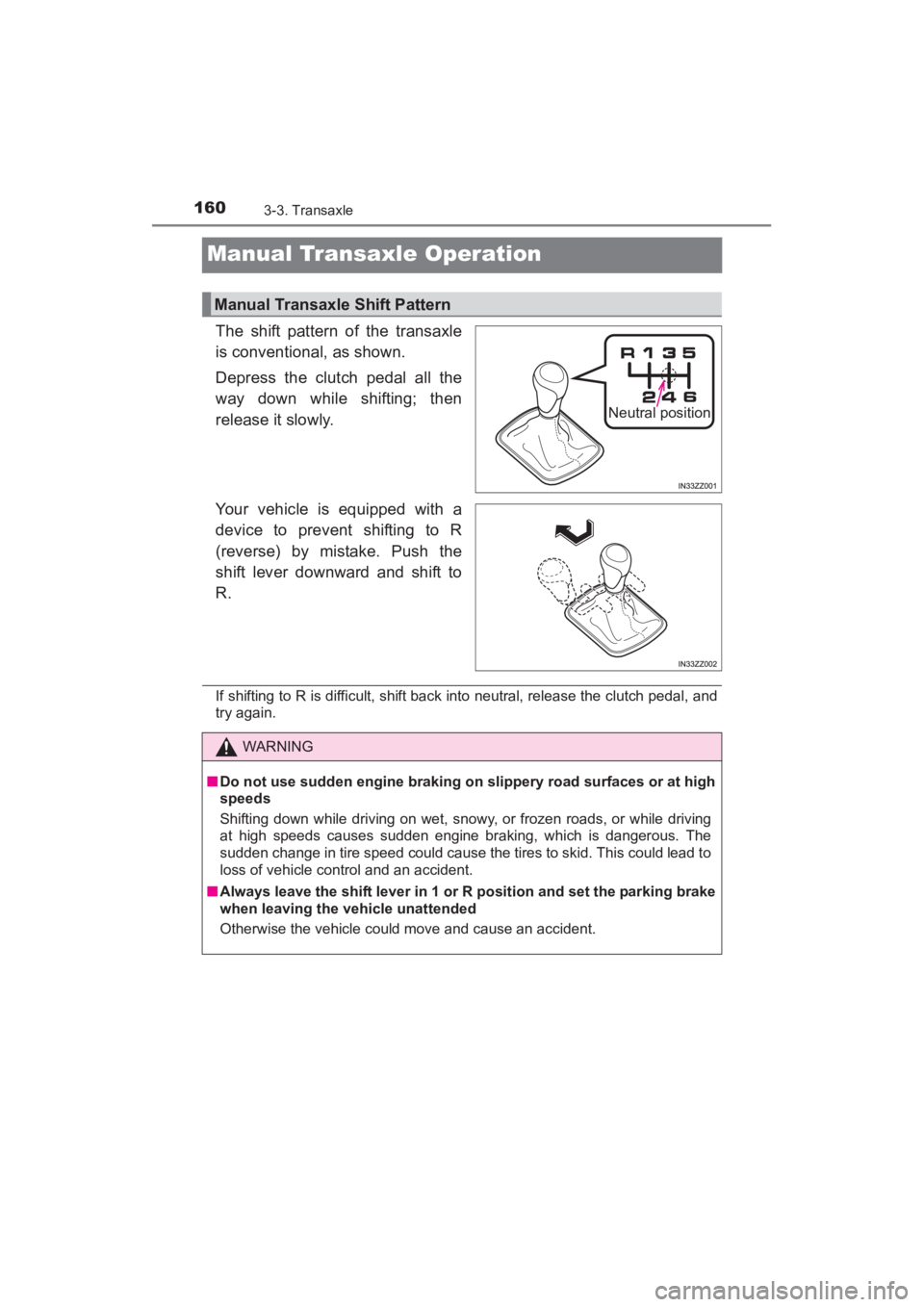
The shift pattern of the transaxle
is conventional, as shown.
Depress the clutch pedal all the
way down while shifting; then
release it slowly.
Your vehicle is equipped with a
device to prevent shifting to R
(reverse) by mistake. Push the
shift lever downward and shift to
R.
If shifting to R is difficult, shift back into neutral, release the clutch pedal, and
try again.
Manual Transaxle Shift Pattern
Neutral position
WARNING
■Do not use sudden engine braking on slippery road surfaces or at high
speeds
Shifting down while driving on wet, snow y, or frozen roads, or while driving
at high speeds causes sudden engine braking, which is dangerous. The
sudden change in tire speed could cause the tires to skid. This could lead to
loss of vehicle control and an accident.
■ Always leave the shift lever in 1 or R position and set the parking brake
when leaving the vehicle unattended
Otherwise the vehicle could move and cause an accident.
YARIS_SEDAN_OM_OM99M18z_(U).book Page 160 Monday, June 1, 2015 9:22 PM
Page 175 of 592
YARIS_SEDAN_OM_OM99M18z_(U)
1733-3. Transaxle
3
When Driving
■Manually shifting up
●When driving slowly, the gears may not shift up.
● In manual shift mode, do not run the engine with the tachometer needle in
the RED ZONE. When the engine rpm is high, a gear may shift up automat-
ically to protect the engine.
● When depressing the accelerator fully, the transaxle will shift to a lower
gear, depending on vehicle speed.
■ Manually shifting down
●When driving at high speeds, the gear may not shift down.
● During deceleration, the gear may automatically shift down depending on
vehicle speed.
● When depressing the accelerator fully, the transaxle will shift to a lower
gear, depending on vehicle speed.
WARNING
■Do not use engine braking on slippery road surfaces or at high speeds
Shifting down while driving on wet, snow y, or frozen roads, or while driving
at high speeds causes sudden engine braking, which is dangerous. The
sudden change in tire speed could cause the tires to skid. This could lead to
loss of vehicle control and an accident.
YARIS_SEDAN_OM_OM99M18z_(U).book Page 173 Monday, June 1, 2015 9:22 PM