transmission TOYOTA YARIS 2017 Owner's Manual
[x] Cancel search | Manufacturer: TOYOTA, Model Year: 2017, Model line: YARIS, Model: TOYOTA YARIS 2017Pages: 549, PDF Size: 33.09 MB
Page 196 of 549
1964-2. Driving procedures
YARIS_F_OM_Europe_OM52J20E
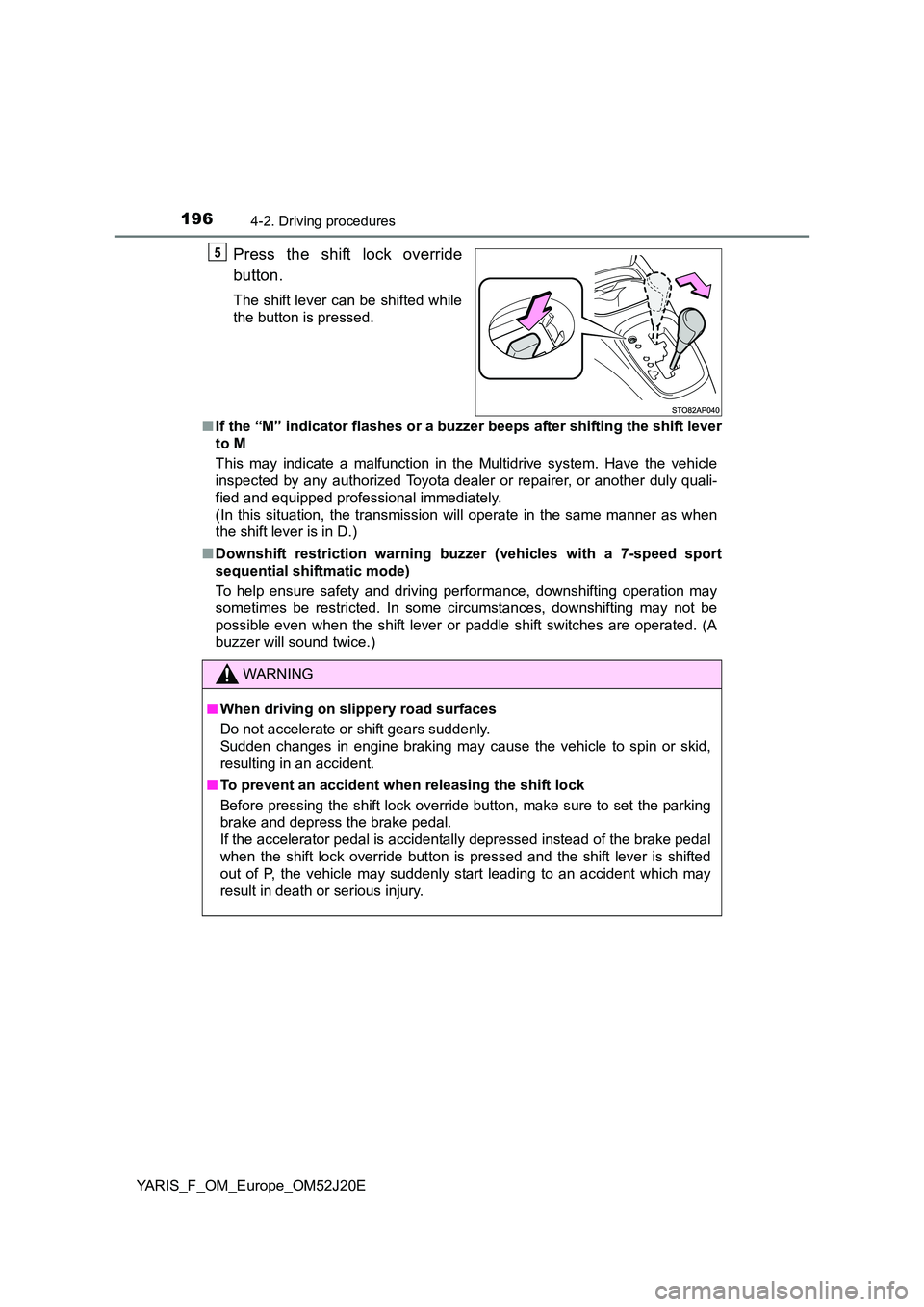
Press the shift lock override
button.
The shift lever can be shifted while
the button is pressed.
■ If the “M” indicator flashes or a buzzer beeps after shifting the shift lever
to M
This may indicate a malfunction in the Multidrive system. Have the vehicle
inspected by any authorized Toyota dealer or repairer, or another duly quali-
fied and equipped professional immediately.
(In this situation, the transmission will operate in the same manner as when
the shift lever is in D.)
■ Downshift restriction warning buzzer (vehicles with a 7-speed sport
sequential shiftmatic mode)
To help ensure safety and driving performance, downshifting operation may
sometimes be restricted. In some circumstances, downshifting may not be
possible even when the shift lever or paddle shift switches are operated. (A
buzzer will sound twice.)
5
WARNING
■ When driving on slippery road surfaces
Do not accelerate or shift gears suddenly.
Sudden changes in engine braking may cause the vehicle to spin or skid,
resulting in an accident.
■ To prevent an accident when releasing the shift lock
Before pressing the shift lock override button, make sure to set the parking
brake and depress the brake pedal.
If the accelerator pedal is accidentally depressed instead of the brake pedal
when the shift lock override button is pressed and the shift lever is shifted
out of P, the vehicle may suddenly start leading to an accident which may
result in death or serious injury.
Page 197 of 549
197
4
4-2. Driving procedures
Driving
YARIS_F_OM_Europe_OM52J20E
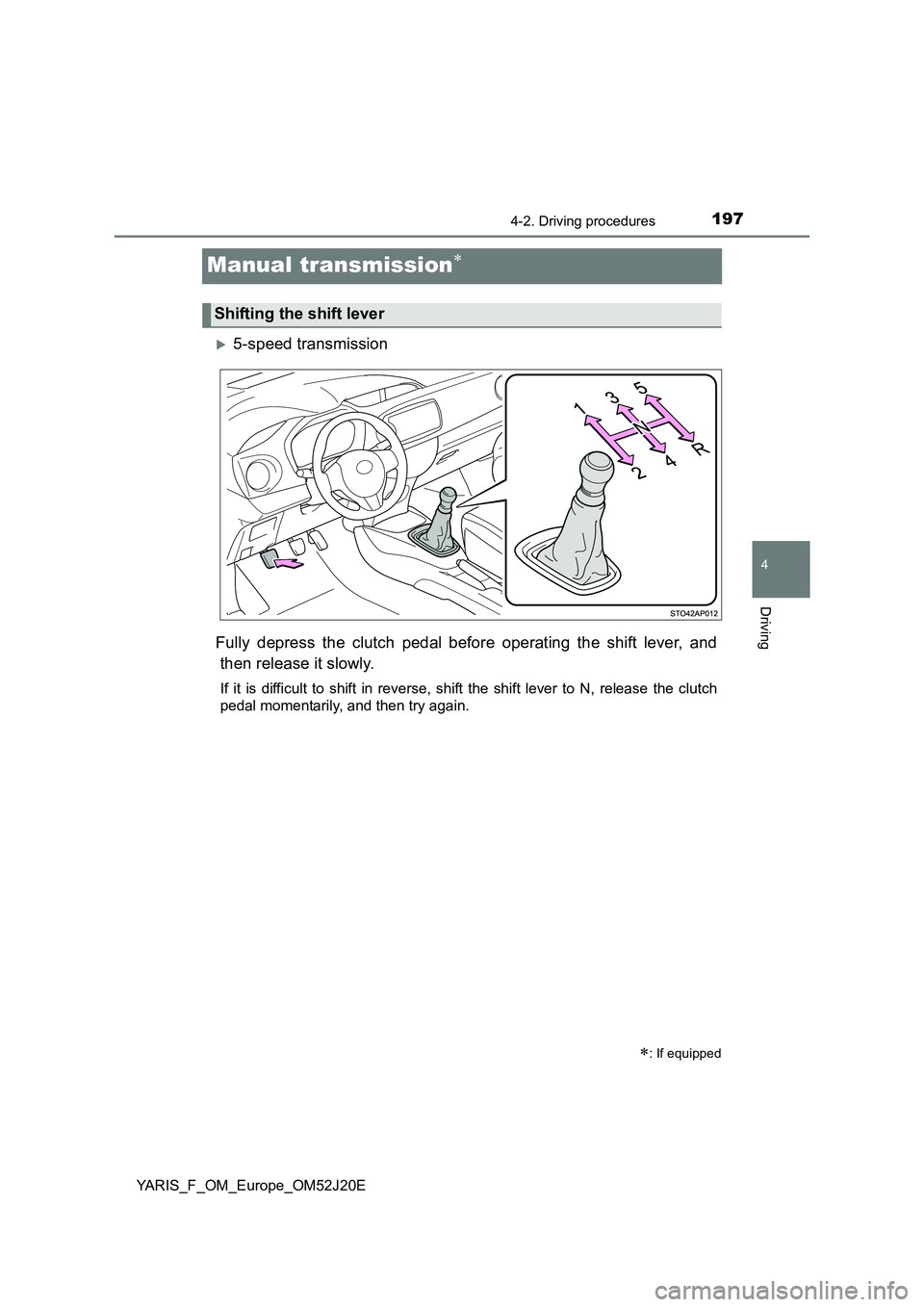
Manual transmission
5-speed transmission
Fully depress the clutch pedal before operating the shift lever, and
then release it slowly.
If it is difficult to shift in reverse, shift the shift lever to N, release the clutch
pedal momentarily, and then try again.
: If equipped
Shifting the shift lever
Page 198 of 549
1984-2. Driving procedures
YARIS_F_OM_Europe_OM52J20E
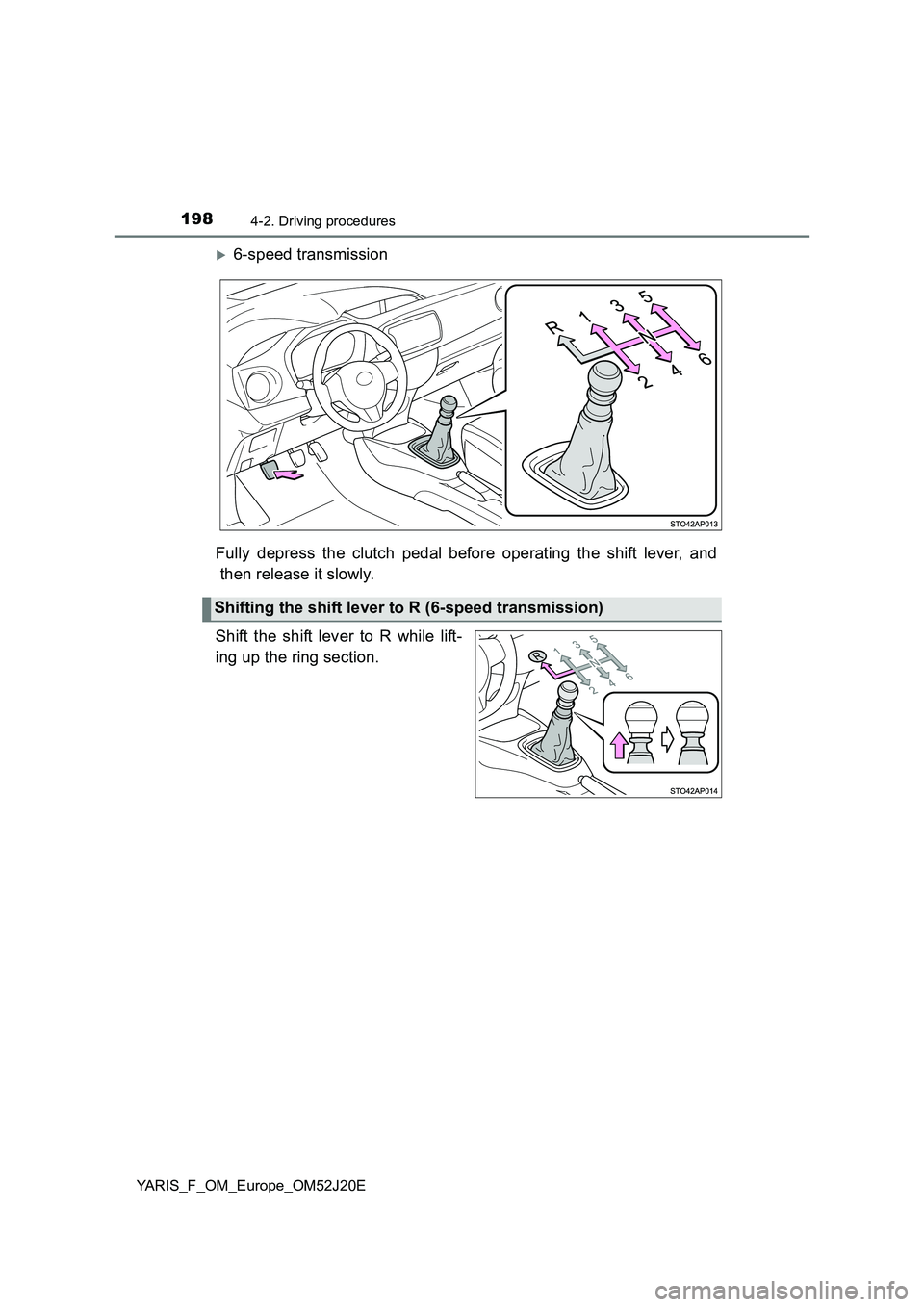
6-speed transmission
Fully depress the clutch pedal before operating the shift lever, and
then release it slowly.
Shift the shift lever to R while lift-
ing up the ring section.
Shifting the shift lever to R (6-speed transmission)
Page 200 of 549
2004-2. Driving procedures
YARIS_F_OM_Europe_OM52J20E
WARNING
■Gear Shift Indicator display
For safety, the driver should not look only at the display. Refer to the display
when it is safe to do so while considering actual traffic and road conditions.
Failure to do so may lead to an accident.
NOTICE
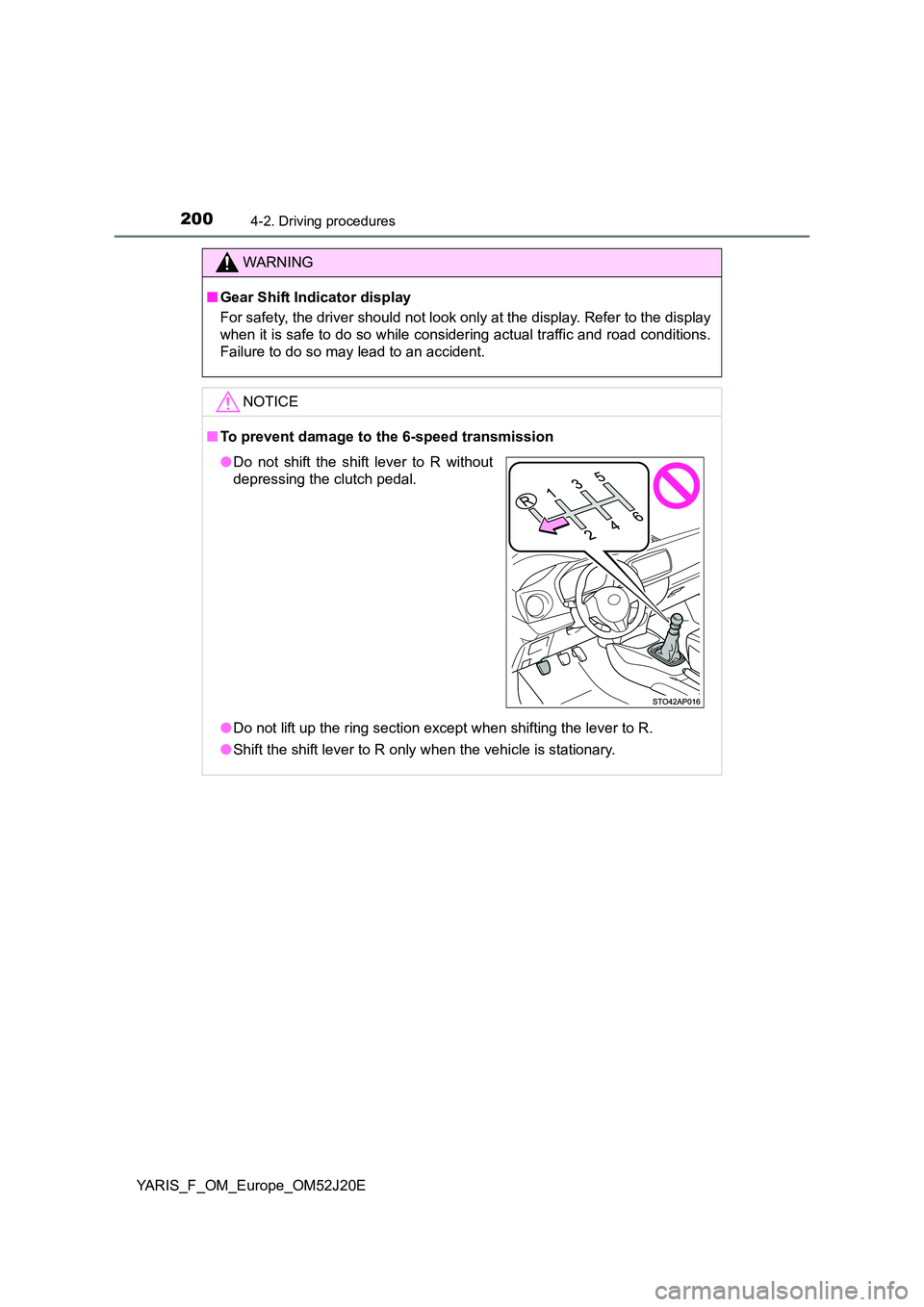
■ To prevent damage to the 6-speed transmission
● Do not lift up the ring section except when shifting the lever to R.
● Shift the shift lever to R only when the vehicle is stationary.
●Do not shift the shift lever to R without
depressing the clutch pedal.
Page 250 of 549
2504-6. Using the driving support systems
YARIS_F_OM_Europe_OM52J20E
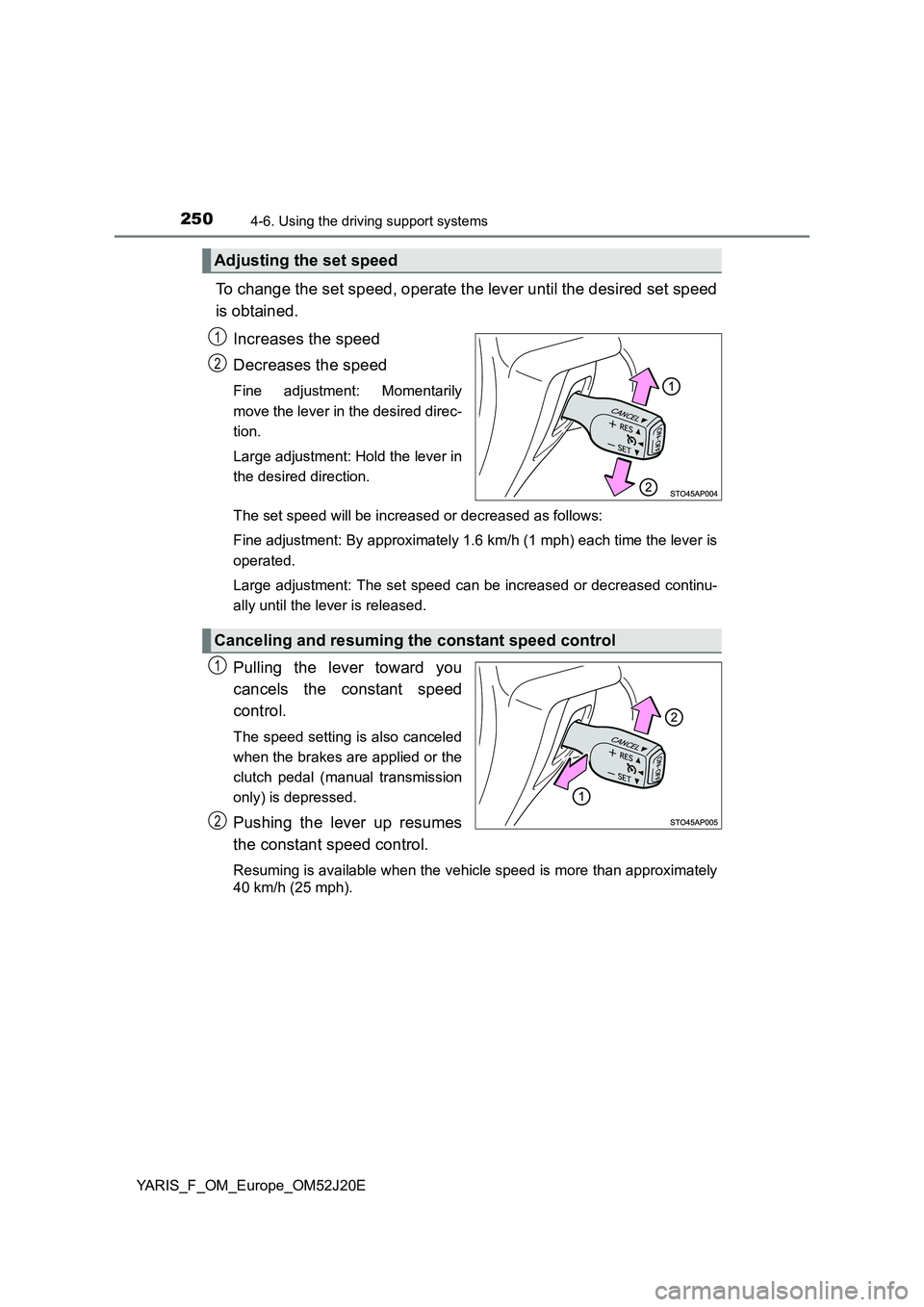
To change the set speed, operate the lever until the desired set speed
is obtained.
Increases the speed
Decreases the speed
Fine adjustment: Momentarily
move the lever in the desired direc-
tion.
Large adjustment: Hold the lever in
the desired direction.
The set speed will be increased or decreased as follows:
Fine adjustment: By approximately 1.6 km/h (1 mph) each time the lever is
operated.
Large adjustment: The set speed can be increased or decreased continu-
ally until the lever is released.
Pulling the lever toward you
cancels the constant speed
control.
The speed setting is also canceled
when the brakes are applied or the
clutch pedal (manual transmission
only) is depressed.
Pushing the lever up resumes
the constant speed control.
Resuming is available when the vehicle speed is more than approximately
40 km/h (25 mph).
Adjusting the set speed
1
2
Canceling and resuming the constant speed control
1
2
Page 251 of 549
2514-6. Using the driving support systems
4
Driving
YARIS_F_OM_Europe_OM52J20E
■Cruise control can be set when
Vehicles with a Multidrive
● The shift lever is in the D or range 4 or higher of M has been selected.
● Range 4 or higher has been selected by using the paddle shift.
● Vehicle speed is above approximately 40 km/h (25 mph).
Vehicles with a manual transmission
● Vehicle speed is above approximately 40 km/h (25 mph).
■ Accelerating after setting the vehicle speed
● The vehicle can be accelerated normally. After acceleration, the set speed
resumes.
● Even without canceling the cruise control, the set speed can be increased
by first accelerating the vehicle to the desired speed and then pushing the
lever down to set the new speed.
■ Automatic cruise control cancelation
Cruise control will stop maintaining the vehicle speed in any of the following
situations.
● Actual vehicle speed falls more than approximately 16 km/h (10 mph) below
the preset vehicle speed.
At this time, the memorized set speed is not retained.
● Actual vehicle speed is below approximately 40 km/h (25 mph).
● VSC is activated (if equipped).
● Speed limiter is activated (if equipped).
■ If the cruise control indicator comes in yellow
Press the “ON-OFF” button once to deactivate the system, and then press
the button again to reactivate the system.
If the cruise control speed cannot be set or if the cruise control cancels imme-
diately after being activated, there may be a malfunction in the cruise control
system. Have the vehicle inspected by any authorized Toyota dealer or
repairer, or another duly qualified and equipped professional.
Page 257 of 549
257
4
4-6. Using the driving support systems
Driving
YARIS_F_OM_Europe_OM52J20E
Stop & star t system
Vehicles with a Multidrive
While driving in D or M, depress the brake pedal fully, and stop the
vehicle.
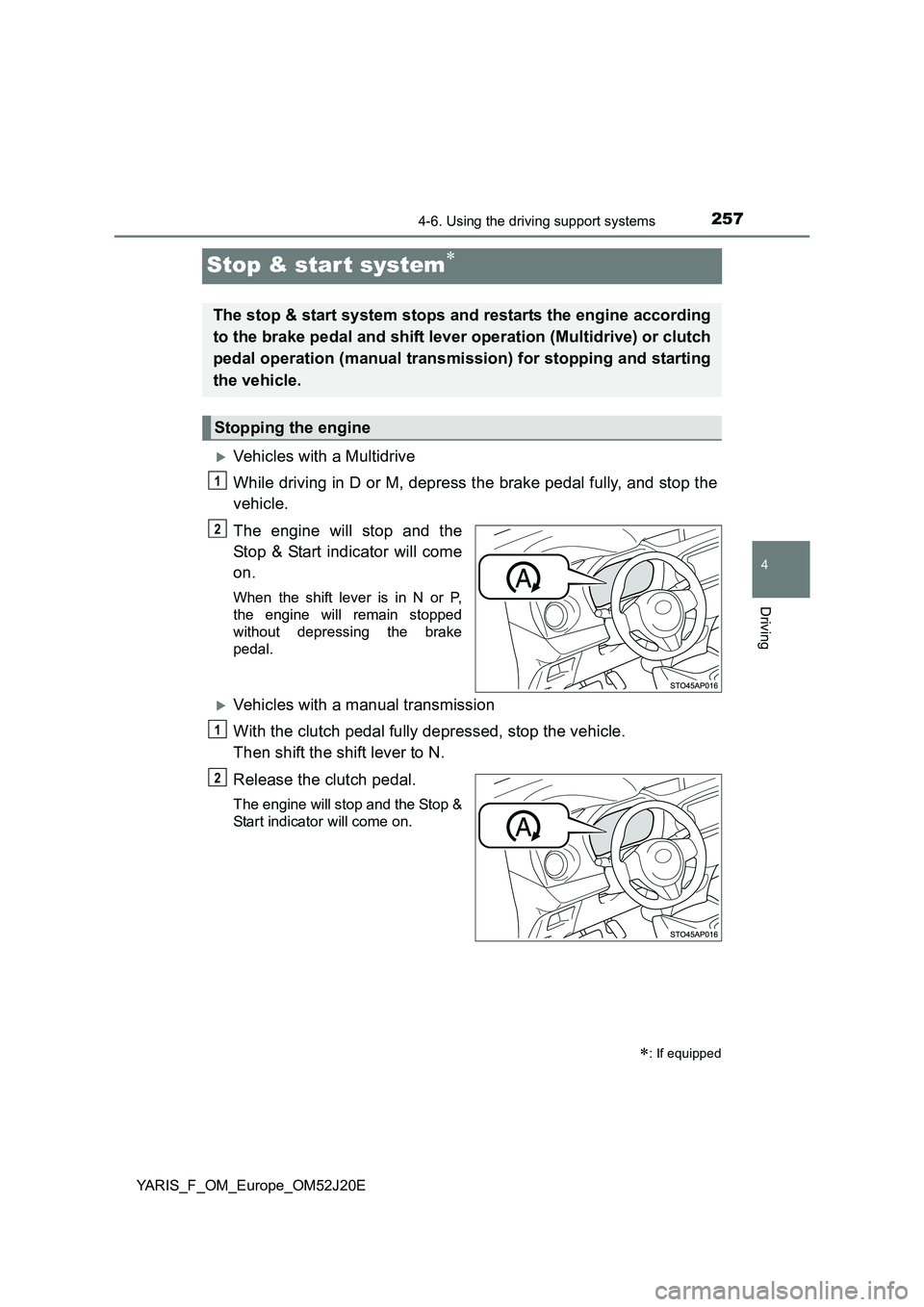
The engine will stop and the
Stop & Start indicator will come
on.
When the shift lever is in N or P,
the engine will remain stopped
without depressing the brake
pedal.
Vehicles with a manual transmission
With the clutch pedal fully depressed, stop the vehicle.
Then shift the shift lever to N.
Release the clutch pedal.
The engine will stop and the Stop &
Start indicator will come on.
: If equipped
The stop & start system stops and restarts the engine according
to the brake pedal and shift lever operation (Multidrive) or clutch
pedal operation (manual transmission) for stopping and starting
the vehicle.
Stopping the engine
1
2
1
2
Page 258 of 549
2584-6. Using the driving support systems
YARIS_F_OM_Europe_OM52J20E
Vehicles with a Multidrive
Release the brake pedal. When the shift lever is in N or P, depress
brake pedal and shift the shift lever to D or M.
The engine will restart. The Stop & Start indicator will go off.
Vehicles with a manual transmission
Check that the shift lever is in N and depress the clutch pedal.
The engine will restart. The Stop & Start indicator will go off. (In this situa-
tion, releasing the clutch pedal will not stop the engine again.)
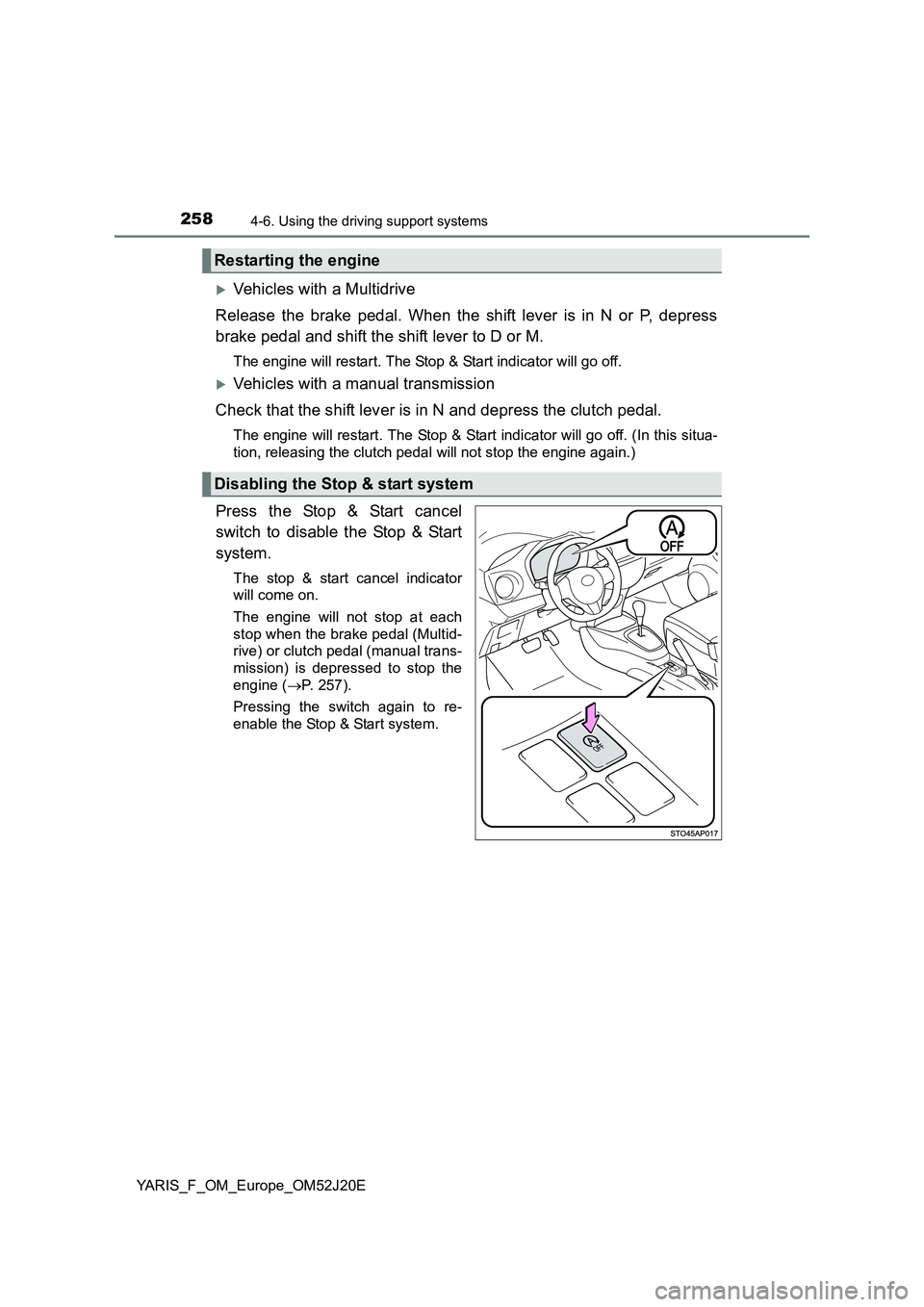
Press the Stop & Start cancel
switch to disable the Stop & Start
system.
The stop & start cancel indicator
will come on.
The engine will not stop at each
stop when the brake pedal (Multid-
rive) or clutch pedal (manual trans-
mission) is depressed to stop the
engine ( P. 257).
Pressing the switch again to re-
enable the Stop & Start system.
Restarting the engine
Disabling the Stop & start system
Page 260 of 549
2604-6. Using the driving support systems
YARIS_F_OM_Europe_OM52J20E
■Operating conditions
● The Stop & Start system is operational when all of the following conditions
are met:
• The engine is adequately warmed up.
• The battery is sufficiently charged.
• The driver’s door is closed.
• The driver’s seat belt is fastened.
• The hood is closed.
• The accelerator pedal is not being depressed.
• Vehicles with a Multidrive: The brake pedal is firmly depressed.
• Vehicles with a Multidrive: The shift lever is not in R.
• Vehicles with a manual transmission: The clutch pedal is not being
depressed.
• Vehicles with a manual transmission: The shift lever is in N.
● In the following circumstances the engine may not be stopped by the Stop &
Start system. This is not a malfunction of the Stop & Start system.
• Engine coolant temperature or transmi ssion fluid temperature is too low
or too high.
• The outside temperature is extremely low.
• The air conditioning system is being used when the outside temperature
is high or low.
• The air conditioning system is being used when the vehicle interior tem-
perature is extremely high such as after the vehicle was parked under the
hot sun.
• Vehicles with an automatic air c onditioning system: The windshield
defogger is being used.
• The battery is not sufficiently charged, or is undergoing a periodic
recharge.
• Due to traffic or other circumstances the vehicle is stopped repeatedly,
resulting in the amount of time the engine is stopped by the Stop & Start
system to become excessively high.
• The driver’s seat belt is unfastened.
• The driver’s door is opened.
• The hood is opened.
• The vehicle is stopped on a steep hill.
• The brake booster vacuum is low.
• A large amount of electricity is being used.
• At high altitude.
When the above conditions improve, the Stop & Start system will stop and
restart the engine from the next time the vehicle is stopped.
Page 261 of 549
2614-6. Using the driving support systems
4
Driving
YARIS_F_OM_Europe_OM52J20E
● In the following situations, the engine may start even without the brake
pedal being released (Multidrive) or clutch pedal being depressed (manual
transmission).
• The brake pedal is pumped or strongly depressed.
• The air conditioning system is being used or turned on.
• Vehicles with an automatic air c onditioning system: The windshield
defogger is turned on.
• The battery is not sufficiently charged.
• The vehicle starts to roll on an incline.
• Vehicles with a Multidrive: The hood is opened when the shift lever is in N
or P.
• Vehicles with a Multidrive: The shift lever is shifted into a position other
than N or P.
• The accelerator pedal is depressed.
• A large amount of electricity is being used.
• The driver’s door is opened.
• The driver’s seat belt is unfastened.
● In the following situations, it may take longer than normal for the Stop & Start
system to activate.
• The battery is discharged.
• After the battery terminals have been disconnected and reconnected
after a battery replacement, etc.
• The engine coolant temperature is low.
■ Automatic reactivation of the Stop & Start system
Vehicles without a smart entry & start system
Even if the Stop & Start system is disabled by the Stop & Start cancel switch,
it will be automatically re-enabled once the engine switch is turned to the
“LOCK” position then to the “START” position.
Vehicles with a smart entry & start system
Even if the Stop & Start system is disabled by the Stop & Start cancel switch,
it will be automatically re-enabled once the engine switch is turned off then
the engine is started.