lock TOYOTA YARIS 2017 Repair Manual
[x] Cancel search | Manufacturer: TOYOTA, Model Year: 2017, Model line: YARIS, Model: TOYOTA YARIS 2017Pages: 549, PDF Size: 33.09 MB
Page 144 of 549
1443-3. Adjusting the seats
YARIS_F_OM_Europe_OM52J20E
Head restraints
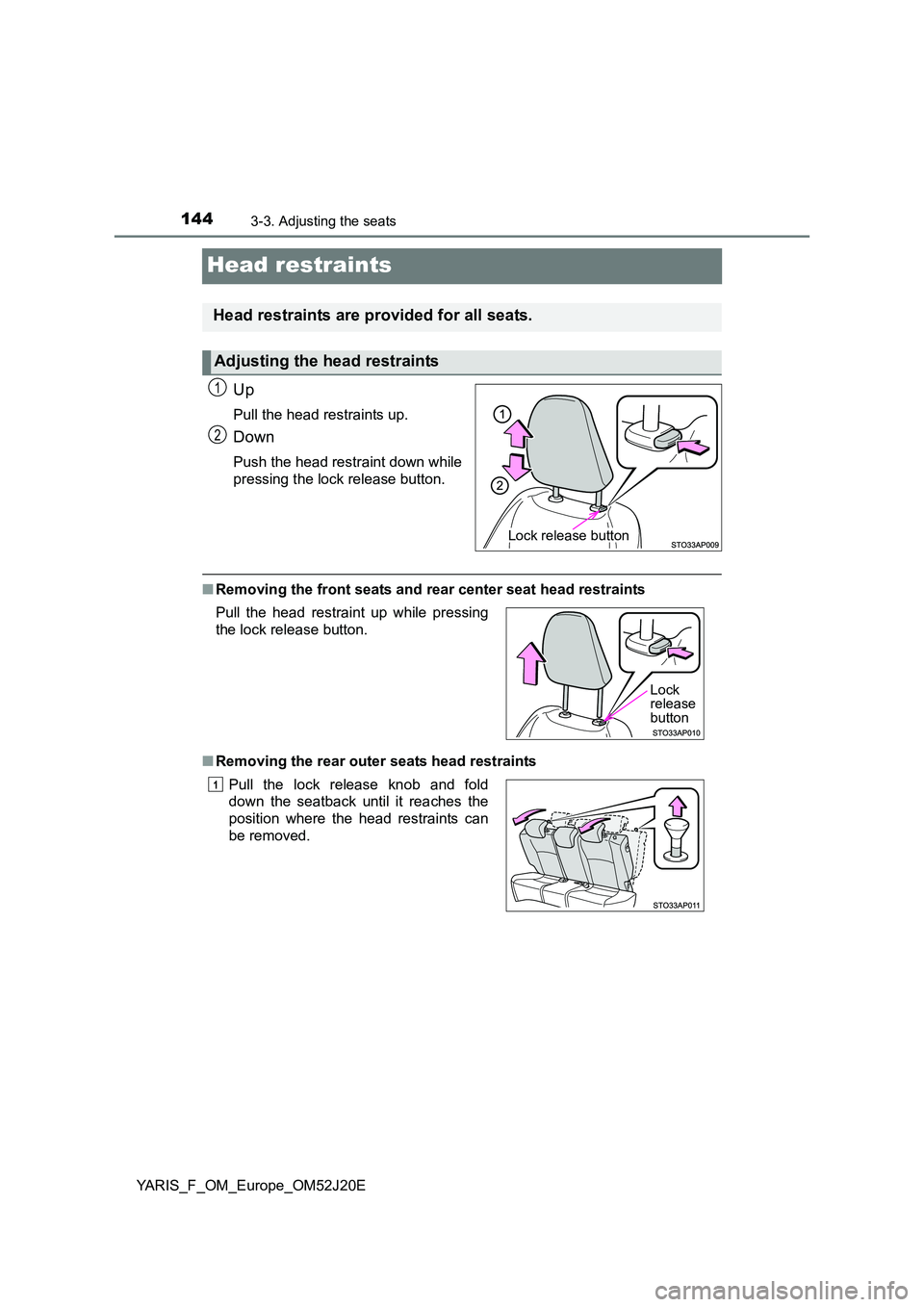
Up
Pull the head restraints up.
Down
Push the head restraint down while
pressing the lock release button.
■ Removing the front seats and rear center seat head restraints
■ Removing the rear outer seats head restraints
Head restraints are provided for all seats.
Adjusting the head restraints
Lock release button
1
2
Pull the head restraint up while pressing
the lock release button.
Pull the lock release knob and fold
down the seatback until it reaches the
position where the head restraints can
be removed.
Lock release button
1
Page 145 of 549
1453-3. Adjusting the seats
3
Operation of each component
YARIS_F_OM_Europe_OM52J20E
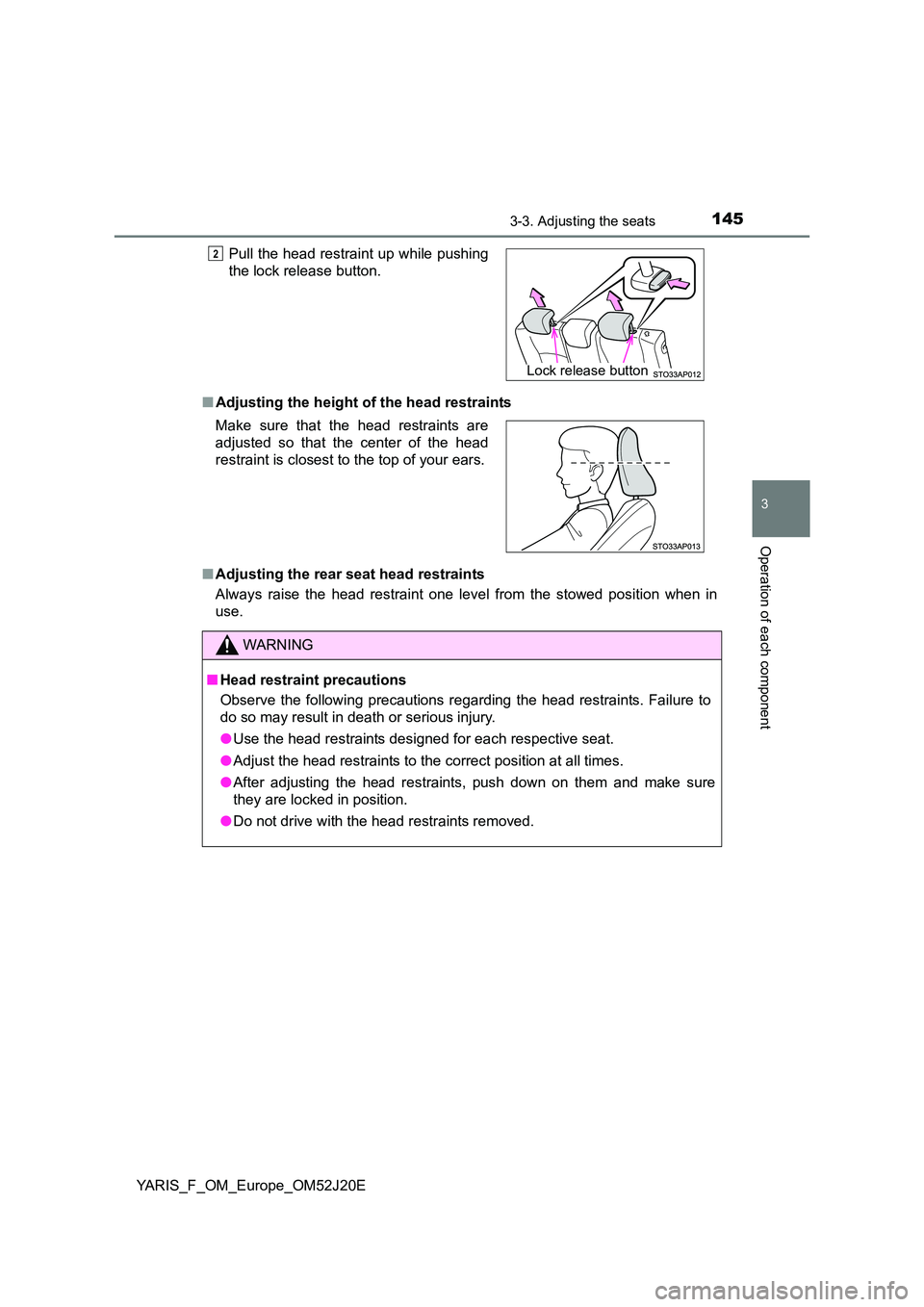
■ Adjusting the height of the head restraints
■ Adjusting the rear seat head restraints
Always raise the head restraint one level from the stowed position when in
use.
Pull the head restraint up while pushing
the lock release button.
Make sure that the head restraints are
adjusted so that the center of the head
restraint is closest to the top of your ears.
WARNING
■ Head restraint precautions
Observe the following precautions regarding the head restraints. Failure to
do so may result in death or serious injury.
● Use the head restraints designed for each respective seat.
● Adjust the head restraints to the correct position at all times.
● After adjusting the head restraints, push down on them and make sure
they are locked in position.
● Do not drive with the head restraints removed.
2
Lock release button
Page 147 of 549
1473-4. Adjusting the steering wheel and mirrors
3
Operation of each component
YARIS_F_OM_Europe_OM52J20E
WARNING
■Caution while driving
Do not adjust the steering wheel while driving.
Doing so may cause the driver to mishandle the vehicle and cause an acci-
dent, resulting in death or serious injury.
■ After adjusting the steering wheel
Make sure that the steering wheel is securely locked.
Otherwise, the steering wheel may move suddenly, possibly causing an
accident and resulting in death or serious injury.
Page 152 of 549
1523-4. Adjusting the steering wheel and mirrors
YARIS_F_OM_Europe_OM52J20E
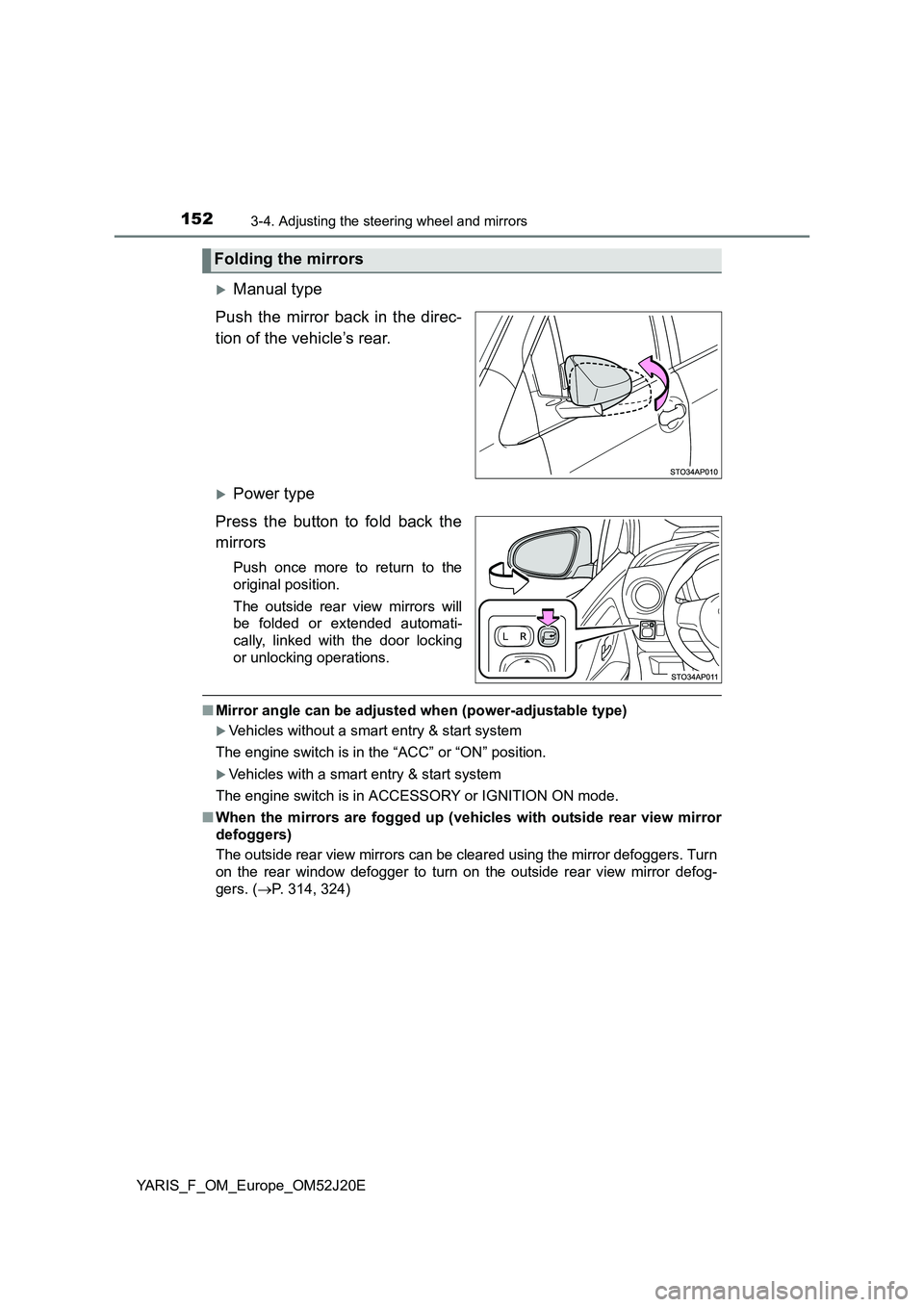
Manual type
Push the mirror back in the direc-
tion of the vehicle’s rear.
Power type
Press the button to fold back the
mirrors
Push once more to return to the
original position.
The outside rear view mirrors will
be folded or extended automati-
cally, linked with the door locking
or unlocking operations.
■ Mirror angle can be adjusted when (power-adjustable type)
Vehicles without a smart entry & start system
The engine switch is in the “ACC” or “ON” position.
Vehicles with a smart entry & start system
The engine switch is in ACCESSORY or IGNITION ON mode.
■ When the mirrors are fogged up (vehicles with outside rear view mirror
defoggers)
The outside rear view mirrors can be cleared using the mirror defoggers. Turn
on the rear window defogger to turn on the outside rear view mirror defog-
gers. ( P. 314, 324)
Folding the mirrors
Page 154 of 549
1543-5. Opening and closing the windows
YARIS_F_OM_Europe_OM52J20E
Power windows
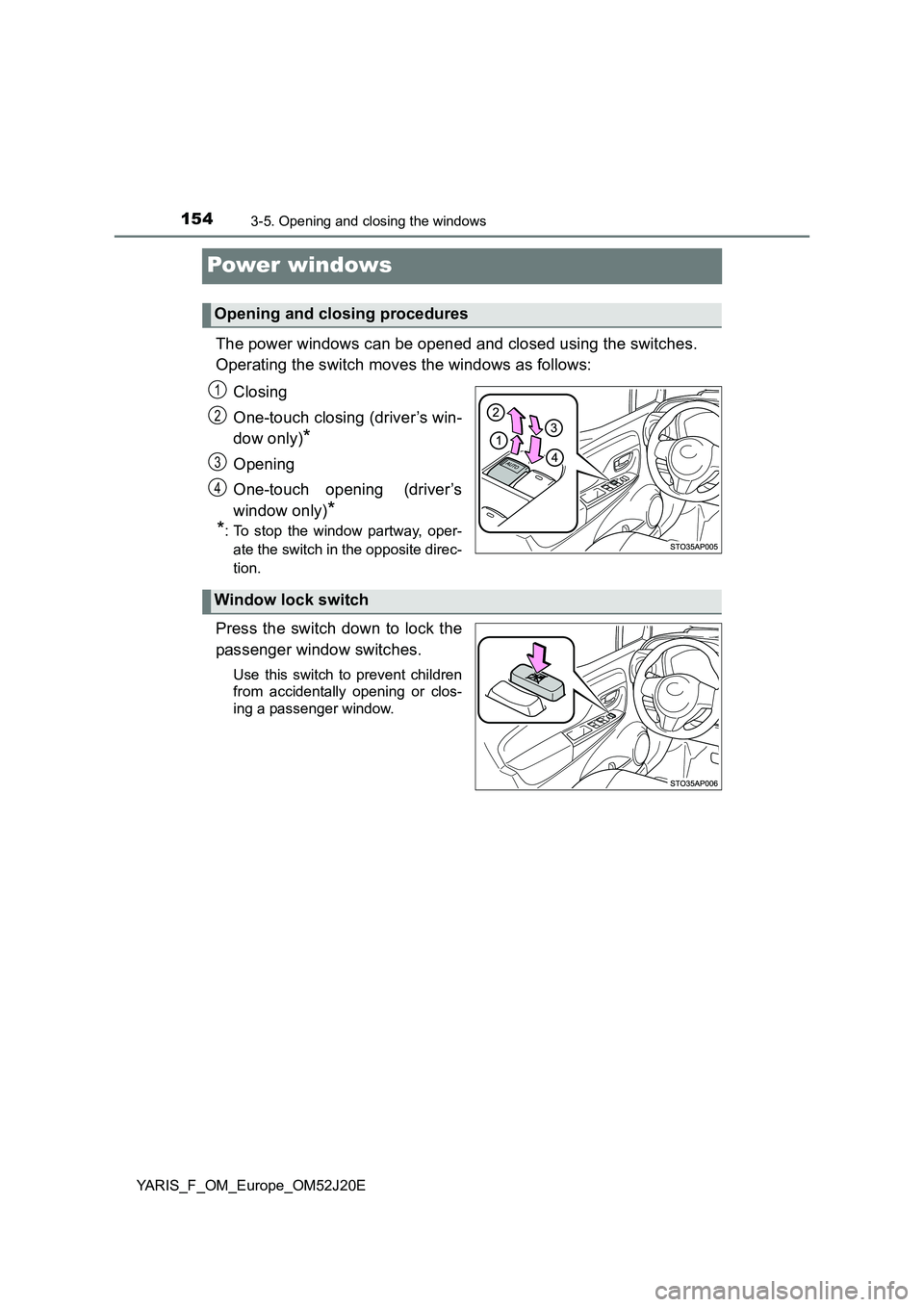
The power windows can be opened and closed using the switches.
Operating the switch moves the windows as follows:
Closing
One-touch closing (driver’s win-
dow only)*
Opening
One-touch opening (driver’s
window only)*
*: To stop the window partway, oper-
ate the switch in the opposite direc-
tion.
Press the switch down to lock the
passenger window switches.
Use this switch to prevent children
from accidentally opening or clos-
ing a passenger window.
Opening and closing procedures
1
2
3
4
Window lock switch
Page 155 of 549
1553-5. Opening and closing the windows
3
Operation of each component
YARIS_F_OM_Europe_OM52J20E
■The power windows can be operated when
Vehicles without a smart entry & start system
The engine switch is in the “ON” position.
Vehicles with a smart entry & start system
The engine switch is in IGNITION ON mode.
■ Operating the power windows after turning the engine off
Vehicles without a smart entry & start system
The power windows can be operated for approximately 45 seconds even
after the engine switch is turned to the “ACC” or “LOCK” position. They can-
not, however, be operated once either front door is opened.
Vehicles with a smart entry & start system
The power windows can be operated for approximately 45 seconds even
after the engine switch is turned to ACCESSORY mode or turned off. They
cannot, however, be operated once either front door is opened.
■ Jam protection function (driver’s window only)
If an object becomes caught between the window and the window frame, win-
dow travel is stopped and the window is opened slightly.
Page 157 of 549
1573-5. Opening and closing the windows
3
Operation of each component
YARIS_F_OM_Europe_OM52J20E
WARNING
Observe the following precautions.
Failure to do so may result in death or serious injury.
■ Closing the windows
● The driver is responsible for all the power window operations, including the
operation for the passengers. In order to prevent accidental operation,
especially by a child, do not let a child operate the power windows. It is
possible for children and other passengers to have body parts caught in
the power window. Also, when riding with a child, it is recommended to
use the window lock switch. ( P. 154)
● Check to make sure that all passengers do not have any part of their body
in a position where it could be caught when a window is being operated.
● When exiting the vehicle, turn the engine switch off, carry the key and exit
the vehicle along with the child. T here may be accidental operation, due to
mischief, etc., that may possibly lead to an accident.
■ Jam protection function (driver’s window only)
● Never use any part of your body to intentionally activate the jam protection
function.
● The jam protection function may not work if something gets caught just
before the window fully closes.
Page 161 of 549
1614-1. Before driving
4
Driving
YARIS_F_OM_Europe_OM52J20E
Vehicles with a Multidrive
With the shift lever in D, depress the brake pedal.
Vehicles with a Stop & Start system: If the Stop & Start system is enabled,
depressing the brake pedal will stop the engine. ( P. 257)
If necessary, set the parking brake.
If the vehicle is to be stopped for an extended period of time, shift the shift
lever to P. ( P. 191)
Vehicles with a manual transmission
While depressing the clutch pedal, depress the brake pedal.
If necessary, set the parking brake.
If the vehicle is to be stopped for an extended period of time, shift the shift
lever to N. ( P. 197)
Vehicles with a Stop & Start system: If the Stop & Start system is enabled,
shifting the shift lever to N and releasing the clutch pedal will stop the
engine. ( P. 257)
Vehicles with a Multidrive
With the shift lever in D, depress the brake pedal.
Set the parking brake ( P. 202), and shift the shift lever to P
( P. 191).
If parking on a hill, block the wheels as needed.
Vehicles without a smart entry & start system: Turn the engine
switch to the “LOCK” position to stop the engine.
Vehicles with a smart entry & start system: Press the engine switch
to stop the engine.
Lock the door, making sure that you have the electronic key on your
person.
Stopping
Parking the vehicle
1
2
1
2
1
2
3
4
Page 162 of 549
1624-1. Before driving
YARIS_F_OM_Europe_OM52J20E
Vehicles with a manual transmission
While depressing the clutch pedal, depress the brake pedal.
Set the parking brake. ( P. 202)
Shift the shift lever to N. ( P. 197)
If parking on a hill, shift the shift lever to 1 or R and block the wheels as
needed.
Vehicles without a smart entry & start system: Turn the engine
switch to the “LOCK” position to stop the engine.
Vehicles with a smart entry & start system: Press the engine switch
to stop the engine.
Lock the door, making sure that you have the key on your person.
Vehicles with a Multidrive
Firmly set the parking brake with the brake pedal depressed, and
then shift the shift lever to D.
Release the brake pedal and gently depress the accelerator pedal.
Release the parking brake.
Vehicles with a manual transmission
With the parking brake firmly set and the clutch pedal fully
depressed, shift the shift lever to 1.
Lightly depress the accelerator pedal at the same time as gradually
releasing the clutch pedal.
Release the parking brake.
Starting off on a steep uphill
1
2
3
4
5
1
2
3
1
2
3
Page 168 of 549
1684-1. Before driving
YARIS_F_OM_Europe_OM52J20E
WARNING
●Do not attach adhesive discs to the windshield or windows. Do not place
containers such as air fresheners on the instrument panel or dashboard.
Adhesive discs or containers may act as lenses, causing a fire in the vehi-
cle.
● Do not leave a door or window open if the curved glass is coated with a
metallized film such as a silver-colored one. Reflected sunlight may cause
the glass to act as a lens, causing a fire.
● On vehicles with a Multidrive, always apply the parking brake, shift the
shift lever to P, stop the engine and lock the vehicle.
Do not leave the vehicle unattended while the engine is running.
When the vehicle is left without applying the parking brake even if the shift
lever is in P, it may start to move, leading to an accident.
● Do not touch the exhaust pipes while the engine is running or immediately
after turning the engine off.
Doing so may cause burns.
■ When taking a nap in the vehicle
Always turn the engine off. Otherwise, if you accidentally move the shift
lever or depress the accelerator pedal, this could cause an accident or fire
due to engine overheating. Additionally, if the vehicle is parked in a poorly
ventilated area, exhaust gases may collect and enter the vehicle, leading to
death or a serious health hazard.
■ When braking
● When the brakes are wet, drive more cautiously.
Braking distance increases when the brakes are wet, and this may cause
one side of the vehicle to brake differently than the other side. Also, the
parking brake may not securely hold the vehicle.
● If the power brake assist function does not operate, do not follow other
vehicles closely and avoid hills or sharp turns that require braking.
In this case, braking is still possible, but the brake pedal should be
depressed more firmly than usual. Also, the braking distance will increase.
Have your brakes fixed immediately.
● Do not pump the brake pedal if the engine stalls.
Each push on the brake pedal uses up the reserve for the power-assisted
brakes.
● The brake system consists of 2 individual hydraulic systems; if one of the
systems fails, the other will still operate. In this case, the brake pedal
should be depressed more firmly than usual and the braking distance will
increase.
Have your brakes fixed immediately.