air condition TOYOTA YARIS 2019 User Guide
[x] Cancel search | Manufacturer: TOYOTA, Model Year: 2019, Model line: YARIS, Model: TOYOTA YARIS 2019Pages: 700, PDF Size: 65.2 MB
Page 241 of 700
2414-1. Before driving
4
Driving
YARIS_F_OM_Europe_OM52K19E
■Important points regarding stability
Vehicle movement resulting from uneven road surfaces and strong
crosswinds will affect handling. The vehicle may also be rocked by
passing buses or large trucks. Frequently check behind when mov-
ing alongside such vehicles. As soon as such vehicle movement
occurs, immediately start to decelerate smoothly by slowly applying
the brakes. Always steer the vehicle straight ahead while braking.
■Passing other vehicles
Consider the total combined length of your vehicle and trailer and
ensure that the vehicle-to-vehicle distance is sufficient before exe-
cuting lane changes.
■Transmission information
Vehicles with a Multidrive
To maintain engine braking efficiency, when using engine braking,
do not use the transmission in D. Transmission shift gear position
must be in 4 in the M mode. ( P. 255)
Vehicles with a manual transmission
To maintain engine braking efficiency, when using engine braking,
do not use the transmission in 5 and 6 (vehicles with a 6-speed
manual transmission) gear. ( P. 263)
■If the engine overheats
Towing a loaded trailer up a long, steep incline in temperatures
exceeding 30 C (85F) may result in the engine overheating. If the
high engine coolant temperature warning light flashes or comes on,
turn the air conditioning off immediately, leave the road and stop the
vehicle in a safe place. ( P. 636)
■When parking the vehicle
Always place wheel chocks under the wheels of both the vehicle
and trailer. Firmly set the parking brake and shift the shift lever to P
(Multidrive) or 1 or R (manual transmission).
Page 251 of 700
2514-2. Driving procedures
4
Driving
YARIS_F_OM_Europe_OM52K19E
■Auto power off function
Vehicles with a Multidrive
If the vehicle is left in ACCESSORY or IGNITION ON mode (the engine is
not running) for more than an hour with the shift lever in P, the engine
switch will automatically turn off. However, this function cannot entirely pre-
vent battery discharge. Do not leave the vehicle with the engine switch in
ACCESSORY or IGNITION ON mode for long periods of time when the
engine is not running.
Vehicles with a manual transmission
If the vehicle is left in ACCESSORY or IGNITION ON mode (the engine is
not running) for more than an hour, the engine switch will automatically turn
off. However, this function cannot entirely prevent battery discharge. Do not
leave the vehicle with the engine switch in ACCESSORY or IGNITION ON
mode for long periods of time when the engine is not running.
■ Electronic key battery depletion
P. 144
■ Conditions affecting operation
P. 168
■ Notes for the entry function
P. 169
■ If the engine does not start
● The engine immobilizer system may not have been deactivated. (P. 8 3 )
Contact any authorized Toyota retailer or Toyota authorized repairer, or any
reliable repairer.
● Check that the shift lever is securely set in P. The engine may not start if the
shift lever is displaced out of P.
Vehicles with monochrome display
The smart entry & start system indicator light (green) will flash quickly.
Vehicles with color display
“Shift to P position to start.” will be displayed on the multi-information dis-
play.
Page 261 of 700
2614-2. Driving procedures
4
Driving
YARIS_F_OM_Europe_OM52K19E
■ If the “M” indicator flashes or a buzzer beeps after shifting the shift lever
to M
This may indicate a malfunction in the Multidrive system. Have the vehicle
inspected by any authorized Toyota retailer or Toyota authorized repairer, or
any reliable repairer immediately.
(In this situation, the transmission will operate in the same manner as when
the shift lever is in D.)
■ Downshift restriction warning buzzer (vehicles with a 7-speed sport
sequential shiftmatic mode)
To help ensure safety and driving per formance, downshifting operation may
sometimes be restricted. In some circumstances, downshifting may not be
possible even when the shift lever or paddle shift switches are operated. (A
buzzer will sound twice.)
■ G AI-SHIFT
G AI-SHIFT automatically selects a suitable gear for sporty driving according
to driver’s input and driving conditions. G AI-SHIFT operates automatically
when the shift lever is in D and sport mode is selected for the driving mode.
(Selecting normal mode or shifting the shift lever to the M position cancels
this function.)
■ Engine speed while driving
In the following conditions, the engine speed may become high while driving.
This is due to automatic up-shifting c ontrol or down-shifting implementation to
meet driving conditions. It does not indicate sudden acceleration.
● The vehicle is judged to be driving uphill or downhill
● When the accelerator pedal is released
● With the “SPORT” switch activated, when the brake pedal is depressed
Page 287 of 700
2874-5. Toyota Safety Sense
4
Driving
YARIS_F_OM_Europe_OM52K19E
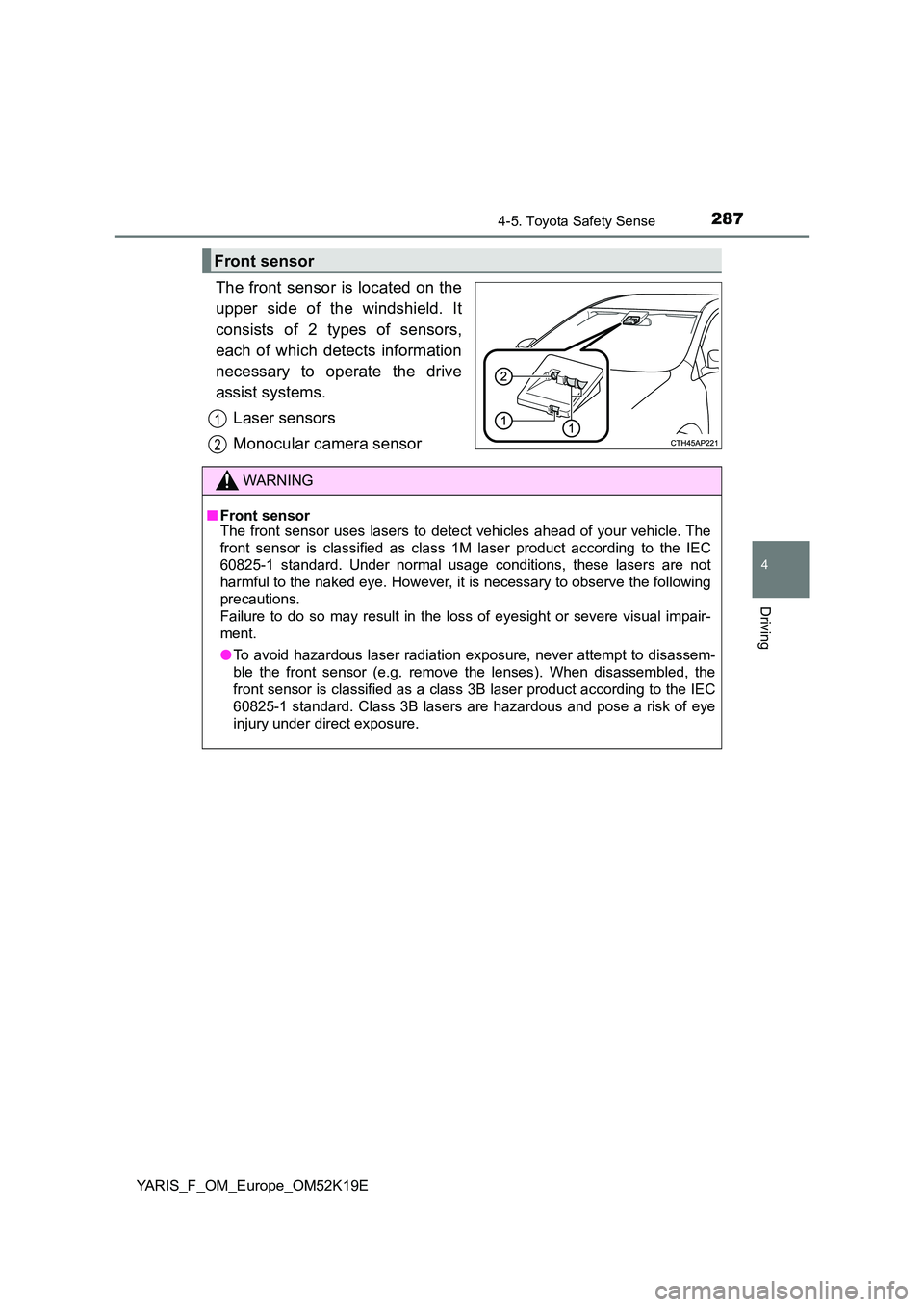
The front sensor is located on the
upper side of the windshield. It
consists of 2 types of sensors,
each of which detects information
necessary to operate the drive
assist systems.
Laser sensors
Monocular camera sensor
Front sensor
1
2
WARNING
■ Front sensor The front sensor uses lasers to detect vehicles ahead of your vehicle. The
front sensor is classified as class 1M laser product according to the IEC
60825-1 standard. Under normal usage conditions, these lasers are not
harmful to the naked eye. However, it is necessary to observe the following
precautions.
Failure to do so may result in the loss of eyesight or severe visual impair-
ment.
● To avoid hazardous laser radiation exposure, never attempt to disassem-
ble the front sensor (e.g. remove the lenses). When disassembled, the
front sensor is classified as a class 3B laser product according to the IEC
60825-1 standard. Class 3B lasers are hazardous and pose a risk of eye
injury under direct exposure.
Page 296 of 700
2964-5. Toyota Safety Sense
YARIS_F_OM_Europe_OM52K19E
WARNING
■Pre-crash braking
● While driving, such as when driving through a railway crossing, the system
may determine that the possibility of a collision with an object, such as rail-
way crossing barrier, is high and operate the pre-crash braking function.
To move the vehicle in an emergency, such as if the system operates in a
railway crossing, perform the following operations and then take the nec-
essary measures to ensure your safety.
• If the vehicle has been stopped, depress the accelerator pedal.
•If the vehicle is decelerating, fully depress the accelerator pedal.
( P. 300)
• Disable the pre-crash safety system. ( P. 297)
■ When to disable the pre-crash safety system
In the following situations, disable the system, as it may not operate prop-
erly, possibly leading to an accident resulting in death or serious injury:
● When the vehicle is being towed
● When your vehicle is towing another vehicle
● When transporting the vehicle via truck, boat, train or similar means of
transportation
● When the vehicle is raised on a lift with the engine running and the tires
are allowed to rotate freely
● When inspecting the vehicle using a drum tester such as a chassis dyna-
mometer or speedometer tester, or when using an on vehicle wheel bal-
ancer
● If the vehicle cannot be driven in a stable manner, such as when the vehi-
cle has been in an accident or is malfunctioning
● When the vehicle is driven in a sporty manner or off-road
● When the condition of the tires is poor and they do not perform well
( P. 503)
● When tires of a size other than specified are installed
● When tire chains are installed
● When a compact spare tire or an emergency tire puncture repair kit is used
Page 308 of 700
3084-5. Toyota Safety Sense
YARIS_F_OM_Europe_OM52K19E
■ If the PCS warning light flashes or illuminates (vehicles with mono-
chrome display)
The pre-crash safety system may be temporarily unavailable or there may be
a malfunction in the system.
● In the following situations, the warning light will be cleared and the system
will become operational when normal operating conditions return:
• When the area around the front sensor is hot, such as after the vehicle
has been parked in the sun
• When the windshield is fogged up or covered with condensation or ice
• When driving in conditions where the front sensor cannot detect an
object, such as in the dark (at night on a road without street lights or other
lights, etc.), when bright light is shining into the sensor, or in snow or fog.
• When the front sensor or the area around either sensor is cold, such as in
an extremely cold environment
• If the area in front of the front sens or is obstructed, such as when the
hood is open
● If the PCS warning light continues to flash or illuminate, the system may be
malfunctioning. Have the vehicle inspected by any authorized Toyota retailer
or Toyota authorized repairer, or any reliable repairer immediately.
■ If the PCS warning light flashes or illuminates and a warning message is
displayed on the multi-information di splay (vehicles with color display)
The pre-crash safety system may be temporarily unavailable or there may be
a malfunction in the system.
● In the following situations, the warning light will turn off, the message will
disappear and the system will beco me operational when normal operating
conditions return:
• When the area around the front sensor is hot, such as in the sun
• When the windshield is fogged up or covered with condensation or ice
( P. 434, 444)
• When driving in conditions where the front sensor cannot detect an
object, such as in the dark (at night on a road without street lights or other
lights, etc.), when bright light is shining into the sensor, or in snow or fog.
• When the front sensor or the area around either sensor is cold, such as in
an extremely cold environment
• If the area in front of the front sens or is obstructed, such as when the
hood is open
● If the PCS warning light continues to flash or illuminate or the warning mes-
sage does not disappear, the system may be malfunctioning. Have the vehi-
cle inspected by any authorized Toyota retailer or Toyota authorized
repairer, or any reliable repairer immediately.
Page 314 of 700

3144-5. Toyota Safety Sense
YARIS_F_OM_Europe_OM52K19E
■Temporary cancelation of the LDA system functions
If any of the following occurs, the LDA system functions will be temporarily
canceled. The functions will resume after the necessary operating conditions
have returned.
● The turn signal lever is operated.
● The vehicle speed deviates from the operating range of the LDA system
functions.
● When the lane lines cannot be recognized while driving.
● When the lane departure warning sounds.
The lane departure warning function will not operate again for a several sec-
onds after it has been activated, even if the vehicle leaves the lane again.
■ The lane departure warning
Depending on the audio system sound level or air conditioning fan noise
while the audio system or air conditioning sy stem is in use, it may be difficult
to hear the warning sound.
■ After the vehicle has been parked in the sun
The LDA system may not be immediately available. When the temperature in
the cabin decreases and the temperature around the front sensor ( P. 310)
becomes suitable for its operation, the functions will begin to operate.
■ If there are lane markers on only one side of the vehicle
The lane departure warning will not oper ate for the side on which lane mark-
ers could not be recognized.
■ Conditions in which the function may not operate correctly
In the following situations, the front sensor may be unable to recognize lane
markers causing the lane departure warning function to operate incorrectly.
However, this does not indicate a malfunction.
● When driving through an area, such as a tollbooth, a crossing or before a
ticket checkpoint
● When driving on a sharp curve
● When lane markers are extremely narrow or extremely wide
● When the vehicle leans to one side an unusual amount due to a heavy load
or improper tire inflation pressure
● When the following distance between your vehicle and the vehicle ahead is
extremely short
Page 340 of 700
3404-6. Using the driving support systems
YARIS_F_OM_Europe_OM52K19E
■Operating conditions
● The Stop & Start system is operational when all of the following conditions
are met:
• The engine is adequately warmed up.
• The battery is sufficiently charged.
• The driver’s door is closed.
• The driver’s seat belt is fastened.
• The hood is closed.
• The outside temperature is -5°C (23°F) or higher.
• The accelerator pedal is not being depressed.
• Vehicles with a Multidrive: The brake pedal is firmly depressed.
• Vehicles with a Multidrive: The shift lever is not in R.
• Vehicles with a manual transmission: The clutch pedal is not being
depressed.
• Vehicles with a manual transmission: The shift lever is in N.
● In the following circumstances the engine may not be stopped by the Stop &
Start system. This is not a malfunction of the Stop & Start system.
• Engine coolant temperature or transmi ssion fluid temperature is too low
or too high.
• The outside temperature is extremely low.
• The air conditioning system is being used when the outside temperature
is high or low.
• The air conditioning system is being used when the vehicle interior tem-
perature is extremely high such as after the vehicle was parked under the
hot sun.
• Vehicles with an automatic air conditioning system: The windshield
defogger is being used.
• The battery is undergoing a periodic recharge.
• The battery is not sufficiently charged, such as if the vehicle has been
parked for a long time and the battery charge has decreased, the electric
load is large, the battery fluid temperature is excessively low or the bat-
tery has deteriorated.
• The battery fluid temperature is extremely low or high.
• Due to traffic or other circumstances the vehicle is stopped repeatedly,
resulting in the amount of time the engine is stopped by the Stop & Start
system to become excessively high.
• The driver’s seat belt is unfastened.
• The driver’s door is opened.
• The hood is opened.
• The vehicle is stopped on a steep hill.
• The brake booster vacuum is low.
• A large amount of electricity is being used.
• At high altitude.
When the above conditions improve, the Stop & Start system will stop and
restart the engine from the next time the vehicle is stopped.
Page 341 of 700
3414-6. Using the driving support systems
4
Driving
YARIS_F_OM_Europe_OM52K19E
● In the following situations, the engine may start even without the brake
pedal being released (Multidrive) or clutch pedal being depressed (manual
transmission).
• The brake pedal is pumped or strongly depressed.
• The air conditioning system is being used or turned on.
• Vehicles with an automatic air conditioning system: The windshield
defogger is turned on.
• The battery is not sufficiently charged.
• The vehicle starts to roll on an incline.
• Vehicles with a Multidrive: The hood is opened when the shift lever is in N
or P.
• Vehicles with a Multidrive: The shift lever is shifted into a position other
than N or P.
• The accelerator pedal is depressed.
• A large amount of electricity is being used.
• The driver’s door is opened.
• The driver’s seat belt is unfastened.
● In the following situations, it may take longer than normal for the Stop & Start
system to activate.
• The battery is discharged.
• After the battery terminals have been disconnected and reconnected
after a battery replacement, etc.
• The engine coolant temperature is low.
■ Automatic reactivation of the Stop & Start system
Vehicles without a smart entry & start system
Even if the Stop & Start system is disabled by the Stop & Start cancel switch,
it will be automatically re-enabled once the engine switch is turned to the
“LOCK” position then to the “START” position.
Vehicles with a smart entry & start system
Even if the Stop & Start system is disabled by the Stop & Start cancel switch,
it will be automatically re-enabled once the engine switch is turned off then
the engine is started.
Page 343 of 700
3434-6. Using the driving support systems
4
Driving
YARIS_F_OM_Europe_OM52K19E
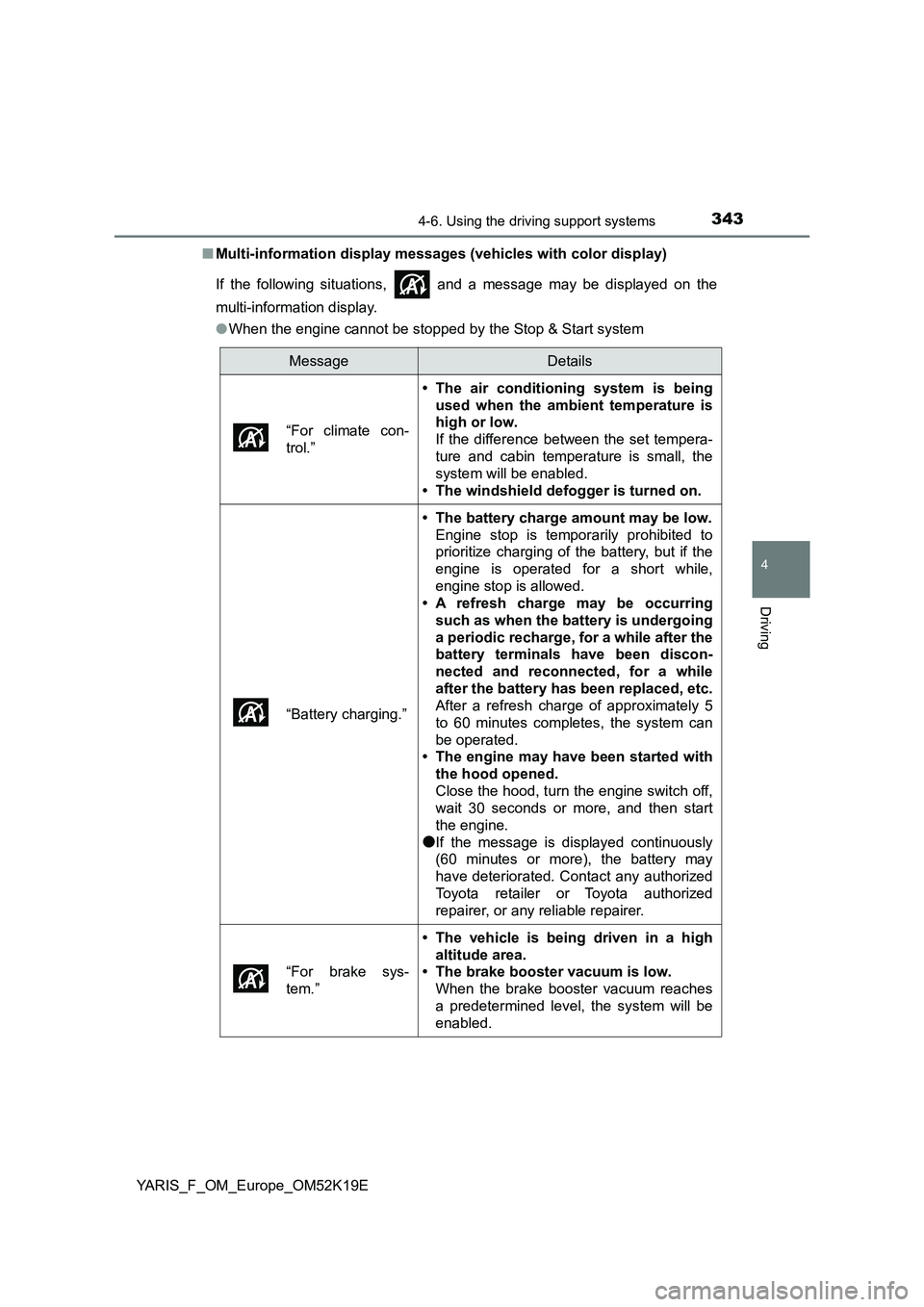
■ Multi-information display messages (vehicles with color display)
If the following situations, and a message may be displayed on the
multi-information display.
● When the engine cannot be stopped by the Stop & Start system
MessageDetails
“For climate con-
trol.”
• The air conditioning system is being
used when the ambient temperature is
high or low.
If the difference between the set tempera-
ture and cabin temperature is small, the
system will be enabled.
• The windshield defogger is turned on.
“Battery charging.”
• The battery charge amount may be low.
Engine stop is temporarily prohibited to
prioritize charging of the battery, but if the
engine is operated for a short while,
engine stop is allowed.
• A refresh charge may be occurring
such as when the battery is undergoing
a periodic recharge, for a while after the
battery terminals have been discon-
nected and reconnected, for a while
after the battery has been replaced, etc.
After a refresh charge of approximately 5
to 60 minutes completes, the system can
be operated.
• The engine may have been started with
the hood opened.
Close the hood, turn the engine switch off,
wait 30 seconds or more, and then start
the engine.
●If the message is displayed continuously
(60 minutes or more), the battery may
have deteriorated. Contact any authorized
Toyota retailer or Toyota authorized
repairer, or any reliable repairer.
“For brake sys-
tem.”
• The vehicle is being driven in a high
altitude area.
• The brake booster vacuum is low.
When the brake booster vacuum reaches
a predetermined level, the system will be
enabled.