air condition TOYOTA YARIS 2021 Owner's Manual
[x] Cancel search | Manufacturer: TOYOTA, Model Year: 2021, Model line: YARIS, Model: TOYOTA YARIS 2021Pages: 568, PDF Size: 110.34 MB
Page 232 of 568
232
YARIS(HB) Owner's Manual_Europe_MK0001_en
4-5. Using the driving support systems
the vehicle from rolling backwards
before the engine is restarted and
drive force is generated. When
drive force is generated, the main-
tained brake force is automatically
canceled.
zThis function operates on flat
surfaces as well as steep
inclines.
zSound may be generated from
the brake system, but this does
not indicate a malfunction.
zBrake pedal response may
change and vibration may occur,
but this does not indicate a mal-
function.
■Points for use
●If the engine switch is pressed when
the engine is stopped by the Stop &
Start system, the engine will not be
able to be restarted by the automatic
engine start function. In this case,
restart the engine using the normal
engine starting procedure. (→ P.158,
159)
●When the engine is being restarted by
the Stop & Start system, the power
outlets may be temporarily unusable,
but this does not indicate a malfunc-
tion.
●Installation and removal of electrical
components and wireless devices
may affect the Stop & Start system.
Contact any authorized Toyota retailer
or Toyota authorized repairer, or any
reliable repairer for details.
●When stopping the vehicle for a lon-
ger period of time, turn the engine
switch off to stop the engine com-
pletely.
●When the engine is restarted by the
Stop & Start system, the steering
wheel may temporarily feel heavy.
■Operating conditions
●The Stop & Start system is operational
when all of the following conditions
are met:
• The vehicle has been driven a certain
amount of time.
• The brake pedal is being depressed
firmly.
• The clutch pedal is not depressed
(vehicles with a manual transmission).
• The shift lever is in D or P (vehicles
with a Multidrive).
• The shift lever is in N (vehicles with a
manual transmission).
• The driver’s seat belt is fastened.
• The driver’s door is closed.
• The selected driving mode is Normal
or Eco drive mode.
• The windshield defogger is off. (vehi-
cles without a manual air conditioning
system)
• The accelerator pedal is not being
depressed (vehicles with a Multidrive).
• The engine is adequately warmed up.
• The outside temperature is -5°C
(23°F) or higher.
• The hood is closed. (→P.233)
●In the following situations the engine
may not be stopped by the Stop &
Start system. This is not a malfunction
of the Stop & Start system.
• When the air conditioning system is
being used.
• When the battery is undergoing a peri-
odic recharge.
• When the battery is not sufficiently
charged, such as if the vehicle has
been parked for a long time and the
battery charge has decreased, the
electric load is large, the battery fluid
temperature is excessively low or the
battery has deteriorated.
• When the brake booster vacuum is
low.
• When the elapsed time since the
engine was restarted is short.
• When the vehicle is stopped fre-
quently, such as when in a traffic jam.
• When the engine coolant temperature
or transmission fluid temperature is
extremely low or high.
• When the vehicle is stopped on a
Page 233 of 568
233
4
YARIS(HB) Owner's Manual_Europe_MK0001_en
4-5. Using the driving support systems
Driving
steep incline (vehicles with a Multid-
rive).
• When the steering wheel is being
operated.
• When the vehicle is being driven in a
high altitude area.
• When the battery fluid temperature is
extremely low or high.
• For a while after the battery terminals
have been disconnected and recon-
nected.
●When the engine is stopped by the
Stop & Start system, the engine will be
restarted automatically if any of the
following conditions are met:
(To enable the engine to be stopped by
the Stop & Start system again, drive the
vehicle.)
• The air conditioning system is turned
on. (vehicles without a manual air
conditioning system)
• The windshield defogger is turned on.
(vehicles without a manual air condi-
tioning system)
• The shift lever is shifted from D to
except for P (When the engine is
stopped by the Stop & Start system
when the shift lever is in D.) (vehicles
with a Multidrive).
• The shift lever is shifted from P.
(When the engine is stopped by the
Stop & Start system when the shift
lever is in P.) (vehicles with a Multid-
rive)
• The driver’s seat belt is unfastened.
• The driver’s door is opened.
• The driving mode is changed from
Normal or Eco drive mode to another
mode.
• The Stop & Start cancel switch is
pressed.
• The steering wheel is operated.
• The accelerator pedal is depressed
(vehicles with a Multidrive).
• The vehicle starts to roll on an incline.
●When the engine is stopped by the
Stop & Start system, the engine may
restart automatically in the following
situations: (To enable the engine to be
stopped by the Stop & Start system
again, drive the vehicle.)• When the brake pedal is pumped or
strongly depressed.
• When the air conditioning system is
being used.
• When a switch of the air conditioning
system is operated (windshield defog-
ger switch, etc.).
• If the battery charge becomes low.
■When the hood is opened
●If the hood is opened while the engine
is stopped by the Stop & Start system,
the engine will stall and will not be
able to be restarted by the automatic
engine start function. In this case,
restart the engine using the normal
engine starting procedure. (→P.158,
159)
●If the hood is closed after the engine
is started with the hood open, the Stop
& Start system will not operate. Close
the hood, turn the engine switch off,
wait 30 seconds or more, and then
start the engine.
■Air conditioning system operation
while the engine is stopped by the
Stop & Start system
Vehicles with an automatic air condition-
ing system: When the air conditioning is
in automatic mode and the engine is
stopped by the Stop & Start system, the
fan may operate at a low speed in order
to prevent the temperature in the cabin
from increasing or decreasing or may be
stopped.
To prioritize air conditioning system per-
formance when the vehicle is stopped,
disable the Stop & Start system by
pressing the Stop & Start cancel switch.
●If the windshield is fogged up
Turn the windshield defogger on.
(→P.280, 285)
If the windshield fogs up frequently,
press the Stop & Start cancel switch to
disable the Stop & Start system.
●If an odor is emitted from the air con-
ditioning system
• Vehicles with a manual air condition-
ing system
Page 234 of 568
234
YARIS(HB) Owner's Manual_Europe_MK0001_en
4-5. Using the driving support systems
If the idling stop time setting is set to
“Extended”, change it to “Standard”. If
an odor is emitted when the idling stop
time setting is set to “Standard”, press
the Stop & Start cancel switch to deacti-
vate the Stop & Start system.
• Vehicles with an automatic air condi-
tioning system
Press the Stop & Start cancel switch to
deactivate the Stop & Start system.
■Changing the idling stop time with
the air conditioning system on
The length of time the Stop & Start sys-
tem will operate when the air condition-
ing system is on can be changed in
of the multi-information display (→P.93,
99). (The length of time the Stop & Start
system will operate when the air condi-
tioning system is off cannot be
changed.)
■Displaying the Stop & Start system
status
→P.98, 104
■Multi-information display mes-
sages
If the following situations, and a
message may be displayed on the multi-
information display.
●When the engine cannot be stopped
by the Stop & Start system
“Press Brake More to Activate”
*
• The brake pedal is not sufficiently
depressed.
→If the brake pedal is depressed fur-
ther, the system will operate.
*: Vehicles with a Multidrive
“Non-Dedicated Battery”
• A battery not designed for use with a
Stop & Start system may have been
installed.
→Have the vehicle inspected by any authorized Toyota retailer or Toyota
authorized repairer, or any reliable
repairer.
“Battery Charging”
• The battery charge may be low.
→Stopping of the engine is temporarily
prohibited to prioritize charging of the
battery. After the engine runs for a cer-
tain amount of time, the system will be
enabled.
• A refresh charge may be occurring
→After a refresh charge for up to an
hour completes, the system can be
operated.
• If displayed continuously for a long
time (more than an hour)
→The battery may be deteriorated. Con-
tact any authorized Toyota retailer or
Toyota authorized repairer, or any reli-
able repairer for details.
“Stop & Start Unavailable”
• The Stop & Start system is temporarily
disabled.
→Allow the engine to run for some time.
• The engine may have been started
with the hood open.
→Close the hood, turn the engine
switch off, wait for 30 seconds or more,
and then start the engine.
“In Preparation”
• The vehicle is being driven in a high
altitude area.
• Vehicles with a Multidrive: The brake
booster vacuum is low.
→When the brake booster vacuum
reaches a predetermined level, the sys-
tem will be enabled.
“For Climate Control”
• The air conditioning system is being
used when the ambient temperature is
high or low.
Page 235 of 568
235
4
YARIS(HB) Owner's Manual_Europe_MK0001_en
4-5. Using the driving support systems
Driving
→If the difference between the set tem-
perature and cabin temperature
becomes small, the system will be
enabled.
• The windshield defogger is on.
●When the engine automatically
restarts while stopped by the Stop &
Start system
“In Preparation”
*
• The brake pedal has been depressed
further or pumped.
→The system will be enabled after the
engine runs and the brake booster vac-
uum reaches a predetermined level.
*: Vehicles with a Multidrive
“For Climate Control”
• The air conditioning system has been
turned on or is being used.
• The windshield defogger has been
turned on.
“Battery Charging”
• The battery charge may be low.
→The engine is restarted to prioritize
battery charging. After the engine runs
for a certain amount of time, the system
will be enabled. (vehicle with a Manual
Transmission)
→The system will be enabled after the
engine runs to sufficiently charge the
battery. (vehicle with a Multidrive)
●When the engine cannot be restarted
by the Stop & Start system
“Shift to N and Press Clutch to Restart”
*
→When the engine is stopped by the
Stop & Start system, the shift lever was
moved to a position other than N without
depressing the clutch pedal.
*: Vehicles with a manual transmission
■When a buzzer sounds (vehicles
with a Multidrive)
If the driver’s door is opened when the
engine is stopped by the Stop & Start
system and the shift lever is in D, a
buzzer will sound and the Stop & Start
system indicator will flash. To stop the
buzzer, close the driver’s door.
■The Stop & Start system protection
function
●When the volume of the audio system
is excessively high, sound output from
the audio system may suddenly be cut
off in order to reduce battery con-
sumption. To prevent the audio sys-
tem from being cut off, keep the
volume of audio system at a moderate
level. If the audio system has been cut
off, turn the engine switch off, wait for
3 seconds or more and then turn it to
ACC or ON to re-enable the audio
system.
●The audio system may not be acti-
vated if the battery terminals are dis-
connected and then reconnected. If
this occurs, turn the engine switch off
and then repeat the following opera-
tion twice to activate the audio system
normally.
• Turn the engine switch to ON and
then to off.
■Replacing the battery
→P. 4 0 4
■If the Stop & Start cancel indicator
flashes continuously
The system may be malfunctioning.
Have the vehicle inspected by any
authorized Toyota retailer or Toyota
authorized repairer, or any reliable
repairer.
■If “Stop & Start System Malfunction
Visit Your Dealer” is displayed on
the multi-information display
The system may be malfunctioning.
Have the vehicle inspected by any
authorized Toyota retailer or Toyota
authorized repairer, or any reliable
repairer.
Page 238 of 568
238
YARIS(HB) Owner's Manual_Europe_MK0001_en
4-5. Using the driving support systems
hot or cold environments.
■When “Blind Spot Monitor Malfunc-
tion Visit Your Dealer” is shown on the multi-information display
There may be a sensor malfunction of
misaligned. Have the vehicle inspected by any authorized Toyota retailer or Toyota authorized repairer, or any reli-
able repairer.
■Customization
Some functions can be customized. ( →P.422)
■Certifications for the Blind Spot
Monitor
→ P. 5 3 1
WARNING
■Handling the rear side radar sen-
sor
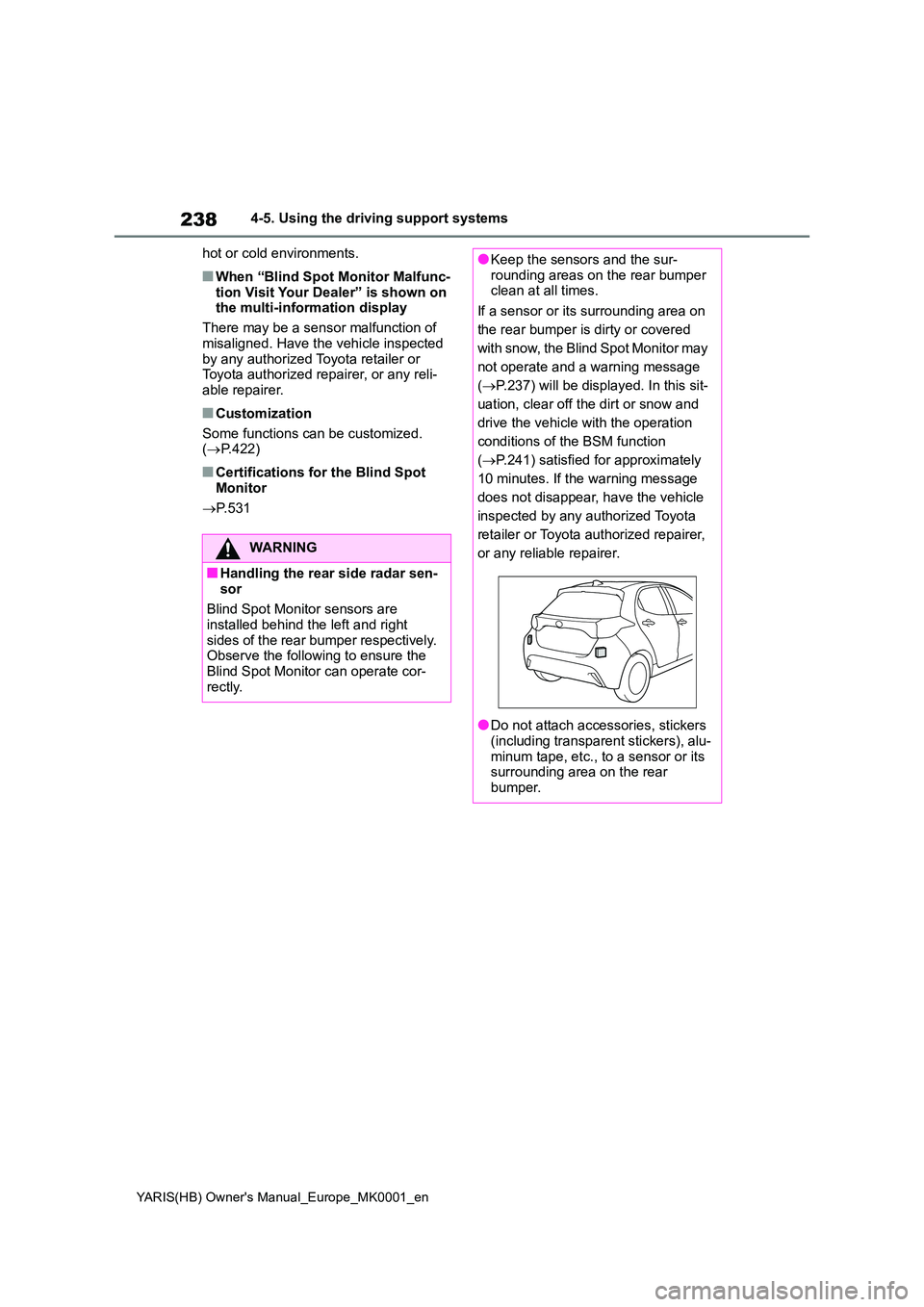
Blind Spot Monitor sensors are installed behind the left and right
sides of the rear bumper respectively. Observe the following to ensure the Blind Spot Monitor can operate cor-
rectly.
●Keep the sensors and the sur- rounding areas on the rear bumper clean at all times.
If a sensor or its surrounding area on
the rear bumper is dirty or covered
with snow, the Blind Spot Monitor may
not operate and a warning message
( →P.237) will be displayed. In this sit-
uation, clear off the dirt or snow and
drive the vehicle with the operation
conditions of the BSM function
( →P.241) satisfied for approximately
10 minutes. If the warning message
does not disappear, have the vehicle
inspected by any authorized Toyota
retailer or Toyota authorized repairer,
or any reliable repairer.
●Do not attach accessories, stickers (including transparent stickers), alu-
minum tape, etc., to a sensor or its surrounding area on the rear bumper.
Page 245 of 568
245
4
YARIS(HB) Owner's Manual_Europe_MK0001_en
4-5. Using the driving support systems
Driving
●There will be a short delay between
object detection and display. Even at low speeds, there is a possibility that the object will come within the sen-
sor’s detection areas before the dis- play is shown and the warning beep sounds.
●It might be difficult to hear the buzzer due to the volume of the audio system
or air flow noise of the air conditioning system.
●It may be difficult to hear the buzzer if buzzers for other systems are sound-ing.
■Conditions under which the func-
tion may not function correctly
Certain vehicle conditions and the sur- rounding environment may affect the
ability of a sensor to correctly detect objects. Particular instances where this may occur are listed below.
●There is dirt, snow, water drops or ice on a sensor. (Cleaning the sensors
will resolve this problem.)
●A sensor is frozen. (Thawing the area
will resolve this problem.) In especially cold weather, if a sensor is frozen the sensor display may be
displayed abnormally, or objects, such as a wall, may not be detected.
●A sensor is covered in any way.
●When a sensor or the area around a
sensor is extremely hot or cold.
●On an extremely bumpy road, on an
incline, on gravel, or on grass.
●The vicinity of the vehicle is noisy due
to vehicle horns, motorcycle engines, air brakes of large vehicles, or other loud noises producing ultrasonic
waves.
●There is another vehicle equipped
with parking assist sensors in the vicinity.
●A sensor is coated with a sheet of spray or heavy rain.
●If a sensor is hit by a large amount of water, such as when driving on a
flooded road.
●If the vehicle is significantly tilted.
●The vehicle is approaching a tall or curved curb.
●If objects draw too close to the sensor.
■Objects which may not be properly detected
The shape of the object may prevent the
sensor from detecting it. Pay particular attention to the following objects:
●Wires, fences, ropes, etc.
●Cotton, snow and other materials that
absorb sound waves
●Sharply-angled objects
●Low objects
●Tall objects with upper sections pro- jecting outwards in the direction of your vehicle
People may not be detected if they are wearing certain types of clothing.
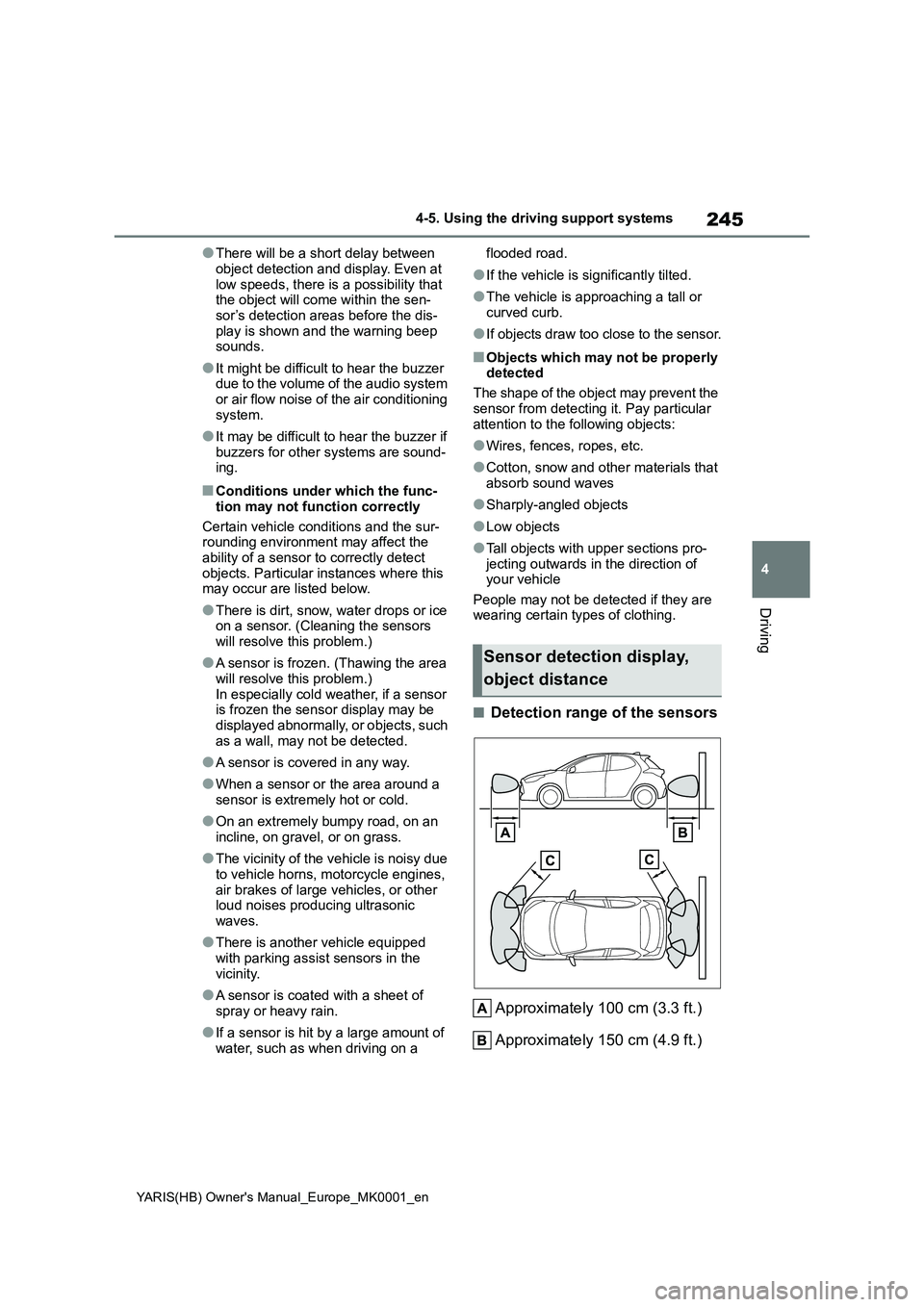
■Detection range of the sensors
Approximately 100 cm (3.3 ft.)
Approximately 150 cm (4.9 ft.)
Sensor detection display,
object distance
Page 258 of 568
258
YARIS(HB) Owner's Manual_Europe_MK0001_en
4-5. Using the driving support systems
■The Parking Support Brake func- tion (static object) will operate
when
The function will operate when the PKSB OFF indicator is not illuminated or
flashing ( →P.83, 84) and all of the fol- lowing conditions are met:
●Engine output restriction control• The Parking Support Brake is enabled.
• The vehicle speed is 15 km/h (9 mph) or less.
WARNING
●Do not replace a sensor with a part other than a genuine part.
●Do not subject a sensor or its sur-rounding area to a strong impact.
●Do not damage the sensors, and always keep them clean.
●If the area around a radar sensor is subjected to an impact, the system
may not operate properly due to a sensor malfunction. Have the vehi-cle inspected by any authorized
Toyota retailer or Toyota authorized repairer, or any reliable repairer.
■Handling the suspension
Do not modify the suspension, as changes to the height or inclination of
the vehicle may prevent the sensors from detecting objects correctly or cause the system to not operate or
operate unnecessarily.
■If the Parking Support Brake
function (static objects) oper- ates unnecessarily, such as at a railroad crossing
In the event that the Parking Support Brake function (static objects) oper-ates unnecessarily, such as at a rail-
road crossing, brake control will be canceled after approximately 2 sec-onds, allowing you to proceed forward
and leave the area, brake control can also be canceled by depressing the brake pedal. Depressing the acceler-
ator pedal after brake control is can- celed will allow you to proceed forward and leave the area.
■Notes when washing the vehicle
Do not apply intensive bursts of water
or steam to the sensor area.
Doing so may result in the sensor malfunctioning.
●When using a high pressure washer to wash the vehicle, do not spray the sensors directly, as doing
so may cause a sensor to malfunc- tion.
●When using steam to clean the vehicle, do not direct steam too close to the sensors as doing so
may cause a sensor to malfunction.
■When to disable the Parking Sup-
port Brake
In the following situations, disable the Parking Support Brake as the system
may operate even though there is no possibility of a collision.
●When inspecting the vehicle using a chassis roller, chassis dynamo or free roller
●When loading the vehicle onto a boat, truck or other transport vessel
●If the suspension has been modi-fied or tires of a size other than
specified are installed
●If the front of the vehicle is raised or
lowered due to the carried load
●When equipment that may obstruct
a sensor is installed, such as a tow- ing eyelet, bumper protector (an additional trim strip, etc.), bicycle
carrier, or snow plow
●When using an automatic car wash
Page 263 of 568
263
4
YARIS(HB) Owner's Manual_Europe_MK0001_en
4-5. Using the driving support systems
Driving
■The Parking Support Brake func- tion (rear-crossing vehicles) will
operate when
The function will operate when the PKSB OFF indicator is not illuminated or
flashing ( →P.83, 84) and all of the fol- lowing conditions are met:
●Engine output restriction control• The Parking Support Brake is enabled.
• The vehicle speed is 15 km/h (9 mph) or less.• Vehicles which are approaching from
the right or left at the rear of the vehi- cle at a traveling speed of less than approximately 8 km/h (5 mph)
• The shift lever is in R. • The Parking Support Brake deter-mines that a stronger than normal
brake operation is necessary to avoid a collision with an approaching vehi-cle.
●Brake control• Engine output restriction control is
operating
• The Parking Support Brake deter-
mines that an emergency brake oper- ation is necessary to avoid a collision with an approaching vehicle.
■The Parking Support Brake func-
tion (rear-crossing vehicles) will stop operating when
The function will stop operating if any of
the following conditions are met:
●Engine output restriction control
• The Parking Support Brake is dis- abled.• The collision becomes avoidable with
normal brake operation. • A vehicle is no longer approaching from the right or left at the rear of the
vehicle.
●Brake control
• The Parking Support Brake is dis- abled.• Approximately 2 seconds have
elapsed since the vehicle was stopped by brake control.• The brake pedal is depressed after
the vehicle is stopped by brake con- trol.• A vehicle is no longer approaching
from the right or left at the rear of the vehicle.
■Detection area of the Parking Sup-port Brake function (rear-crossing
vehicles)
The detection area of the Parking Sup- port Brake function (rear-crossing vehi-
cles) differs from the detection area of the RCTA function ( →P.249). Therefore, even if the RCTA function detects a
vehicle and provides an alert, the Park- ing Support Brake function (rear-cross-ing vehicles) may not start operating.
■Conditions under which the Park-
ing Support Brake function (rear- crossing vehicles) will not detect a vehicle
The Parking Support Brake function (rear-crossing vehicles) is not designed to detect the following types of vehicles
and/or objects:
●Vehicles approaching from directly
WARNING
●Do not modify, disassemble or paint the sensors.
●Do not replace a rear radar sensor with a part other than a genuine
part.
●Do not damage the rear radar sen-
sors, and always keep the radar sensors and their surrounding area on the bumper clean.
●If the area around a rear radar sen-sor is subjected to an impact, the
system may not operate properly due to a sensor malfunction. Have the vehicle inspected by any autho-
rized Toyota retailer or Toyota authorized repairer, or any reliable repairer.
●Observe the rear radar sensor han-dling precautions. ( →P.238)
Page 265 of 568
265
4
YARIS(HB) Owner's Manual_Europe_MK0001_en
4-5. Using the driving support systems
Driving
●When there are spinning objects near
your vehicle such as the fans of an air conditioning unit
●When water is splashed or sprayed toward the rear bumper, such as from a sprinkler
■Situations in which the Parking
Support Brake function (rear-cross- ing vehicles) may not operate prop-erly
In some situations, such as the follow- ing, the radar sensors may not detect an object and this function may not operate
properly
●Stationary objects
●When a sensor or the area around a sensor is extremely hot or cold
●If the rear bumper is covered with ice, snow, dirt, etc.
●When it is raining heavily or water strikes the vehicle
●When the detection area of a radar sensor is obstructed by an adjacent
vehicle
●If the vehicle is significantly tilted
●When equipment that may obstruct a sensor is installed, such as a towing
eyelet, bumper protector (an addi- tional trim strip, etc.), bicycle carrier, or snow plow
●If the suspension has been modified or tires of a size other than specified
are installed
●If the front of the vehicle is raised or
lowered due to the carried load
●If an electronic component, such as a
backlit license plate (especially fluo- rescent type), fog lights, fender pole
or wireless antenna is installed near a
radar sensor
●If the orientation of a radar sensor has
been changed
●When multiple vehicles are approach-
ing with only a small gap between each vehicle
●If a vehicle is approaching the rear of your vehicle rapidly
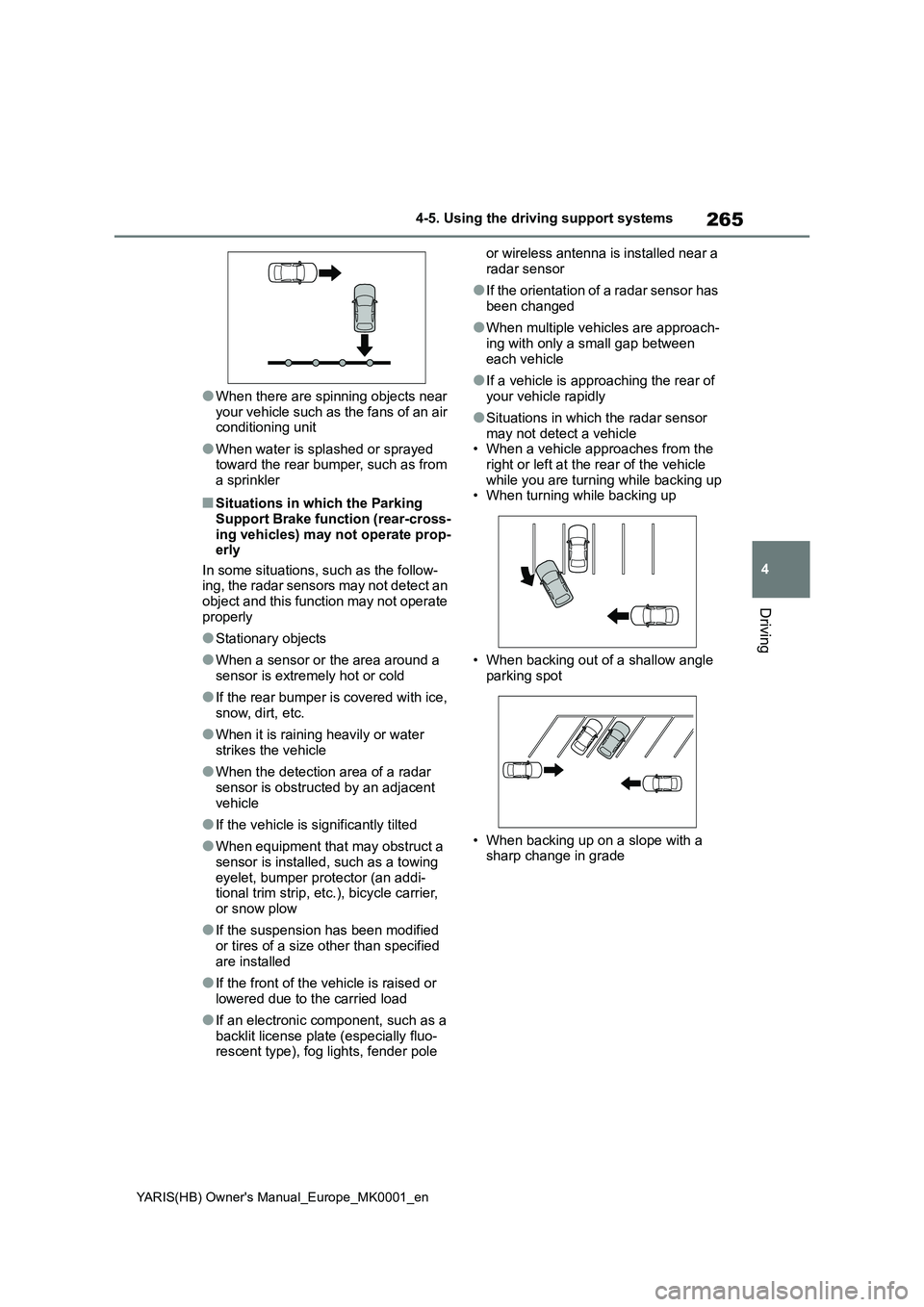
●Situations in which the radar sensor may not detect a vehicle• When a vehicle approaches from the
right or left at the rear of the vehicle while you are turning while backing up• When turning while backing up
• When backing out of a shallow angle parking spot
• When backing up on a slope with a sharp change in grade
Page 267 of 568
267
4
YARIS(HB) Owner's Manual_Europe_MK0001_en
4-5. Using the driving support systems
Driving
teristics and by controlling the operation
of the air conditioning system (heat-
ing/cooling).
When the Eco drive mode is selected,
Eco drive mode indicator comes on.
■Operation of the air conditioning
system in Eco drive mode
Eco drive mode controls the heat-
ing/cooling operations and fan speed of
the air conditioning system to enhance
fuel efficiency. To improve air condition-
ing performance, perform the following
operations:
●Turn off air conditioning eco mode
(vehicles with an automatic air condi-
tioning system) (→P.285)
●Adjust the fan speed (→P.279, 284)
●Turn off Eco drive mode
■Automatic deactivation of power
mode
If the engine switch is turned off after
driving in power mode, the drive mode
will be changed to normal mode.
*: If equipped
■If “Exhaust Filter Full See Owner’s
Manual” is shown on the multi-
information display
●The message may be displayed while
high load driving with particulate mat-
ter accumulating.
●Engine output is restricted while the
message is displayed, however, it is
possible to drive the vehicle unless
the malfunction indicator lamp comes
on.
●Particulate matter can accumulate
more quickly if the vehicle is fre-
quently driven short trips or at low
speeds, or if the engine is regularly
started in an extremely cold environ-
ment. Excessive accumulation of par-
ticulate matter can be prevented by
periodically driving long distances
continuously with intermittent releas-
ing of the accelerator pedal, such as
when driving on highways and free-
ways.
■If the malfunction indicator lamp
comes on or “Engine Maintenance
Required Visit Your Dealer” is
shown on the multi-information
display
The amount of accumulated particulate
matter has exceeded a certain level.
Have the vehicle inspected by any
authorized Toyota retailer or Toyota
GPF (Gasoline Particu-
late Filter) system
*
The GPF system collects par-
ticulate matter in the exhaust
gas by using an exhaust gas
filter.
The system will operate to
regenerate the filter automati-
cally, depending on the vehicle
conditions.