ECU TOYOTA YARIS 2021 Repair Manual
[x] Cancel search | Manufacturer: TOYOTA, Model Year: 2021, Model line: YARIS, Model: TOYOTA YARIS 2021Pages: 568, PDF Size: 110.34 MB
Page 365 of 568
365
7
YARIS(HB) Owner's Manual_Europe_MK0001_en
7-2. Steps to take in an emergency
When trouble arises
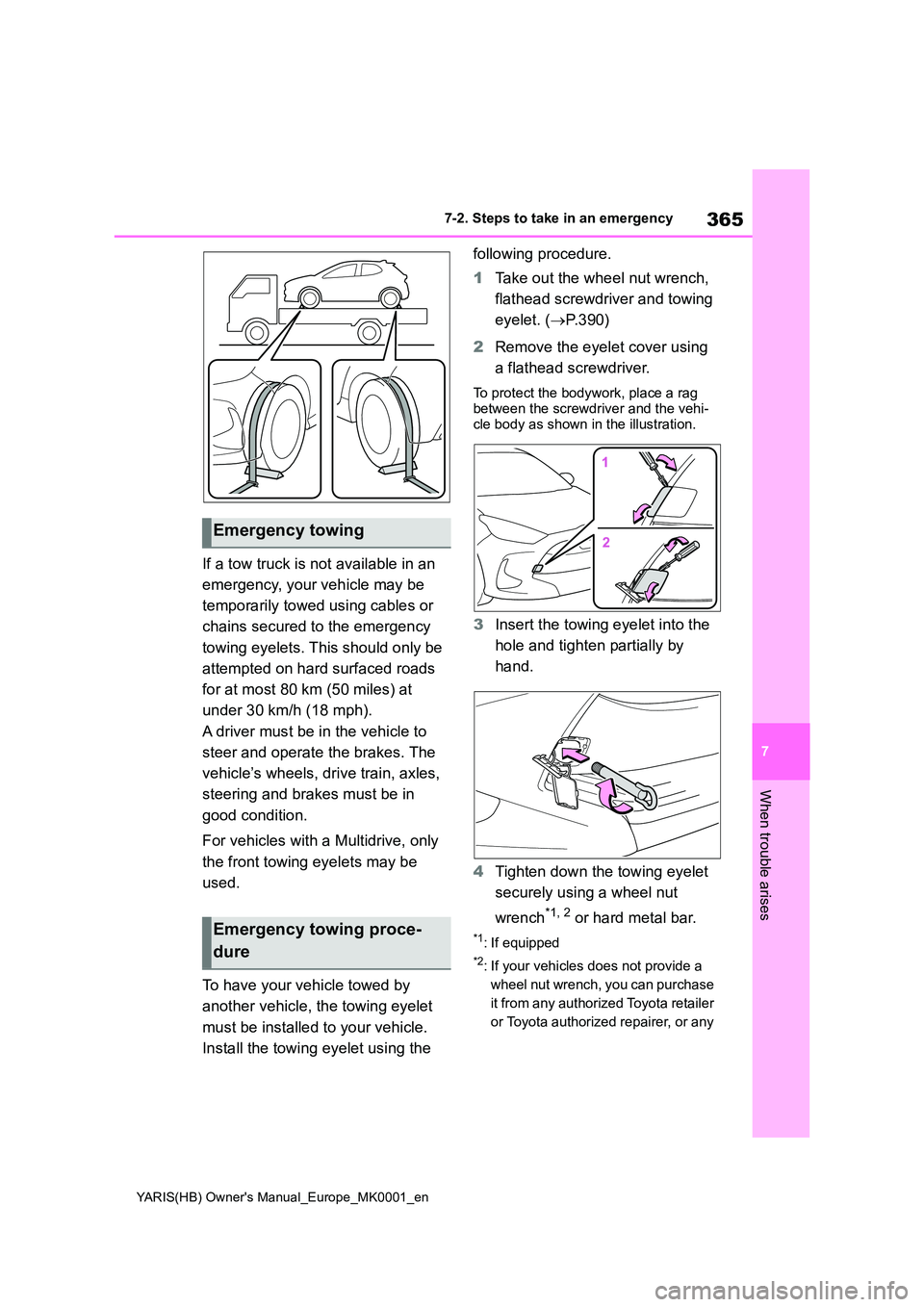
If a tow truck is not available in an
emergency, your vehicle may be
temporarily towed using cables or
chains secured to the emergency
towing eyelets. This should only be
attempted on hard surfaced roads
for at most 80 km (50 miles) at
under 30 km/h (18 mph).
A driver must be in the vehicle to
steer and operate the brakes. The
vehicle’s wheels, drive train, axles,
steering and brakes must be in
good condition.
For vehicles with a Multidrive, only
the front towing eyelets may be
used.
To have your vehicle towed by
another vehicle, the towing eyelet
must be installed to your vehicle.
Install the towing eyelet using the
following procedure.
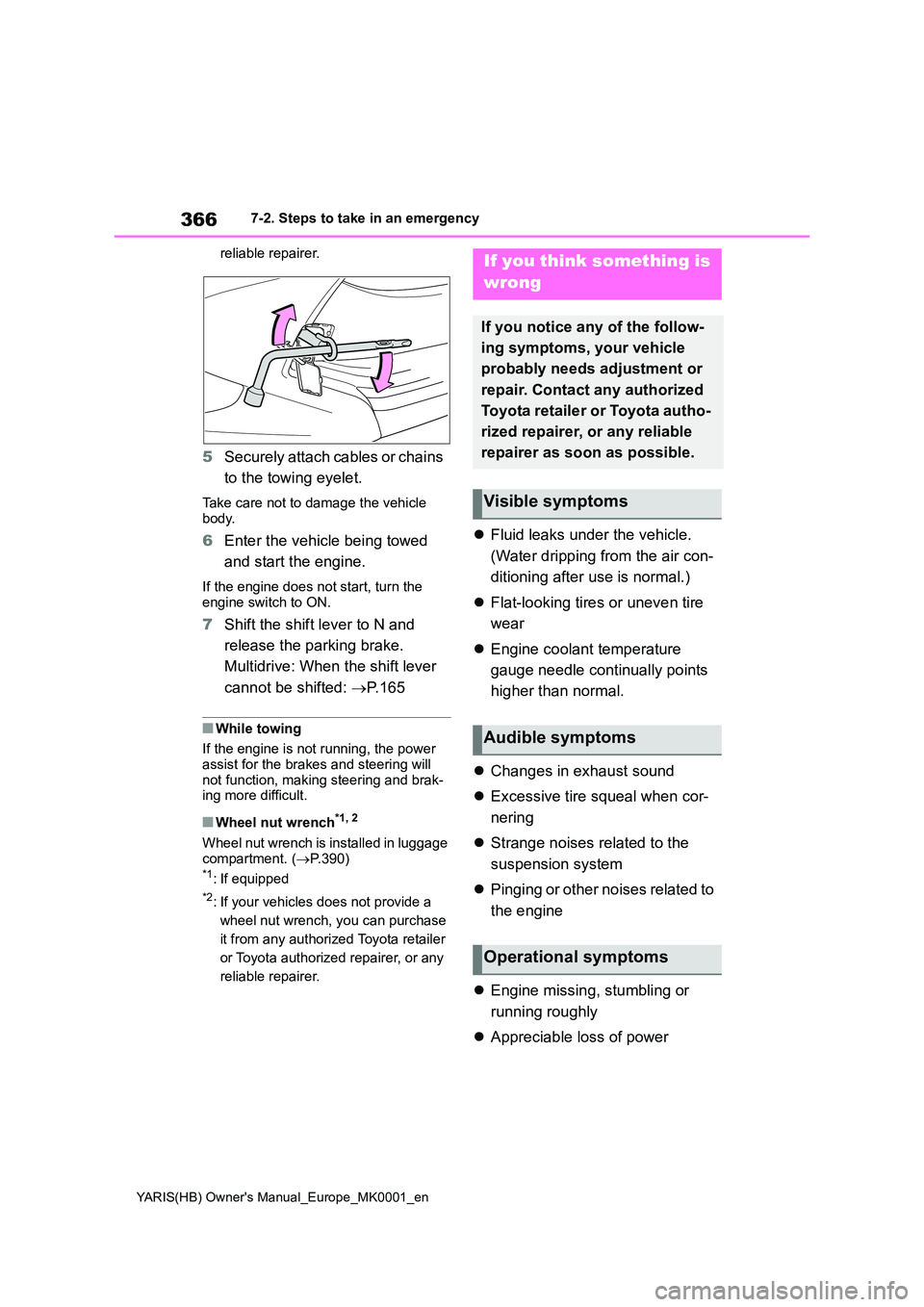
1 Take out the wheel nut wrench,
flathead screwdriver and towing
eyelet. ( →P.390)
2 Remove the eyelet cover using
a flathead screwdriver.
To protect the bodywork, place a rag
between the screwdriver and the vehi- cle body as shown in the illustration.
3 Insert the towing eyelet into the
hole and tighten partially by
hand.
4 Tighten down the towing eyelet
securely using a wheel nut
wrench*1, 2 or hard metal bar.
*1: If equipped
*2: If your vehicles does not provide a
wheel nut wrench, you can purchase
it from any authorized Toyota retailer
or Toyota authorized repairer, or any
Emergency towing
Emergency towing proce-
dure
Page 366 of 568
366
YARIS(HB) Owner's Manual_Europe_MK0001_en
7-2. Steps to take in an emergency
reliable repairer.
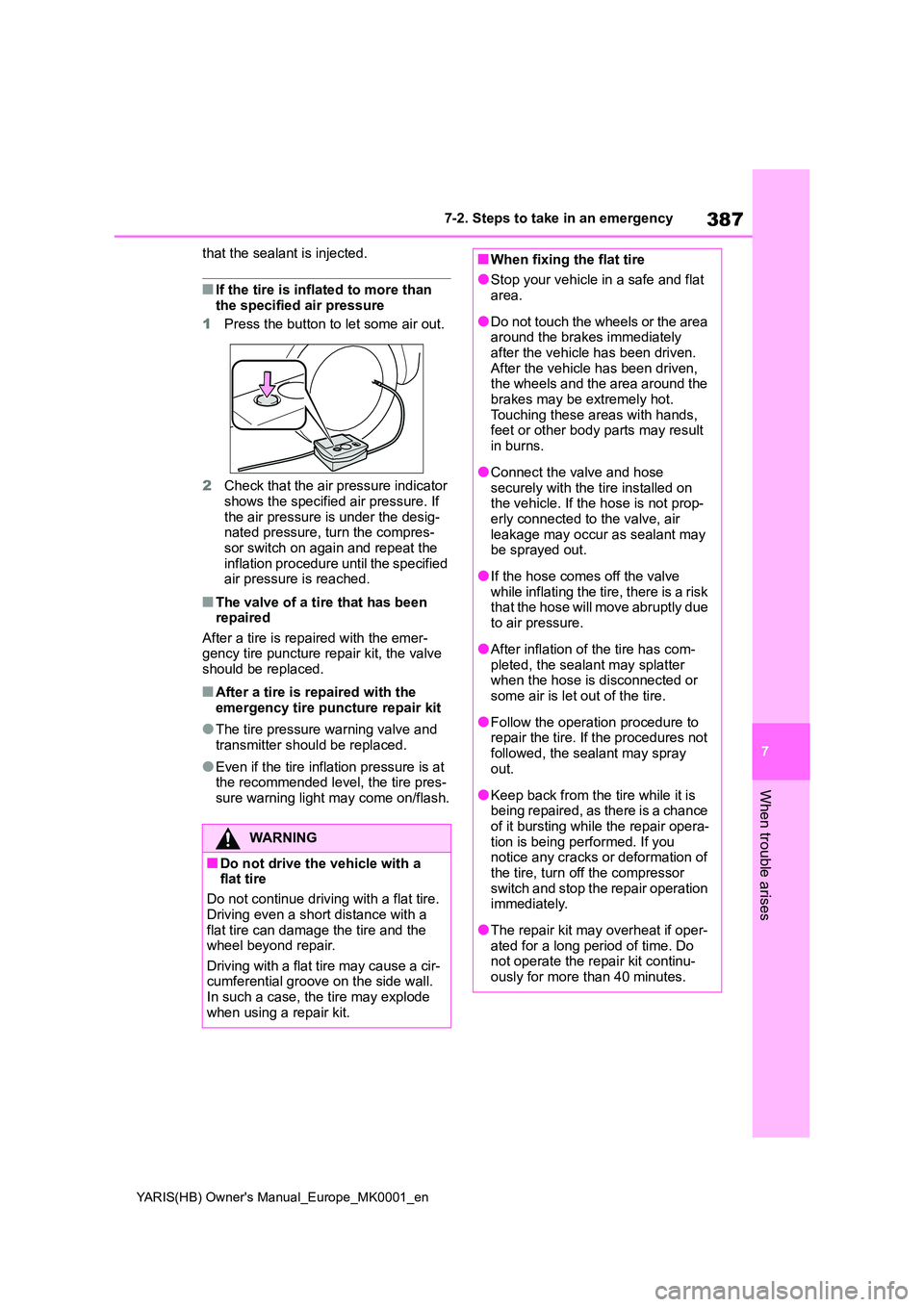
5 Securely attach cables or chains
to the towing eyelet.
Take care not to damage the vehicle body.
6 Enter the vehicle being towed
and start the engine.
If the engine does not start, turn the engine switch to ON.
7 Shift the shift lever to N and
release the parking brake.
Multidrive: When the shift lever
cannot be shifted: →P. 1 6 5
■While towing
If the engine is not running, the power
assist for the brakes and steering will not function, making steering and brak-ing more difficult.
■Wheel nut wrench*1, 2
Wheel nut wrench is installed in luggage
compartment. ( →P.390)*1: If equipped
*2: If your vehicles does not provide a
wheel nut wrench, you can purchase
it from any authorized Toyota retailer
or Toyota authorized repairer, or any
reliable repairer.
z Fluid leaks under the vehicle.
(Water dripping from the air con-
ditioning after use is normal.)
z Flat-looking tires or uneven tire
wear
z Engine coolant temperature
gauge needle continually points
higher than normal.
z Changes in exhaust sound
z Excessive tire squeal when cor-
nering
z Strange noises related to the
suspension system
z Pinging or other noises related to
the engine
z Engine missing, stumbling or
running roughly
z Appreciable loss of power
If you think something is
wrong
If you notice any of the follow-
ing symptoms, your vehicle
probably needs adjustment or
repair. Contact any authorized
Toyota retailer or Toyota autho-
rized repairer, or any reliable
repairer as soon as possible.
Visible symptoms
Audible symptoms
Operational symptoms
Page 387 of 568
387
7
YARIS(HB) Owner's Manual_Europe_MK0001_en
7-2. Steps to take in an emergency
When trouble arises
that the sealant is injected.
■If the tire is inflated to more than the specified air pressure
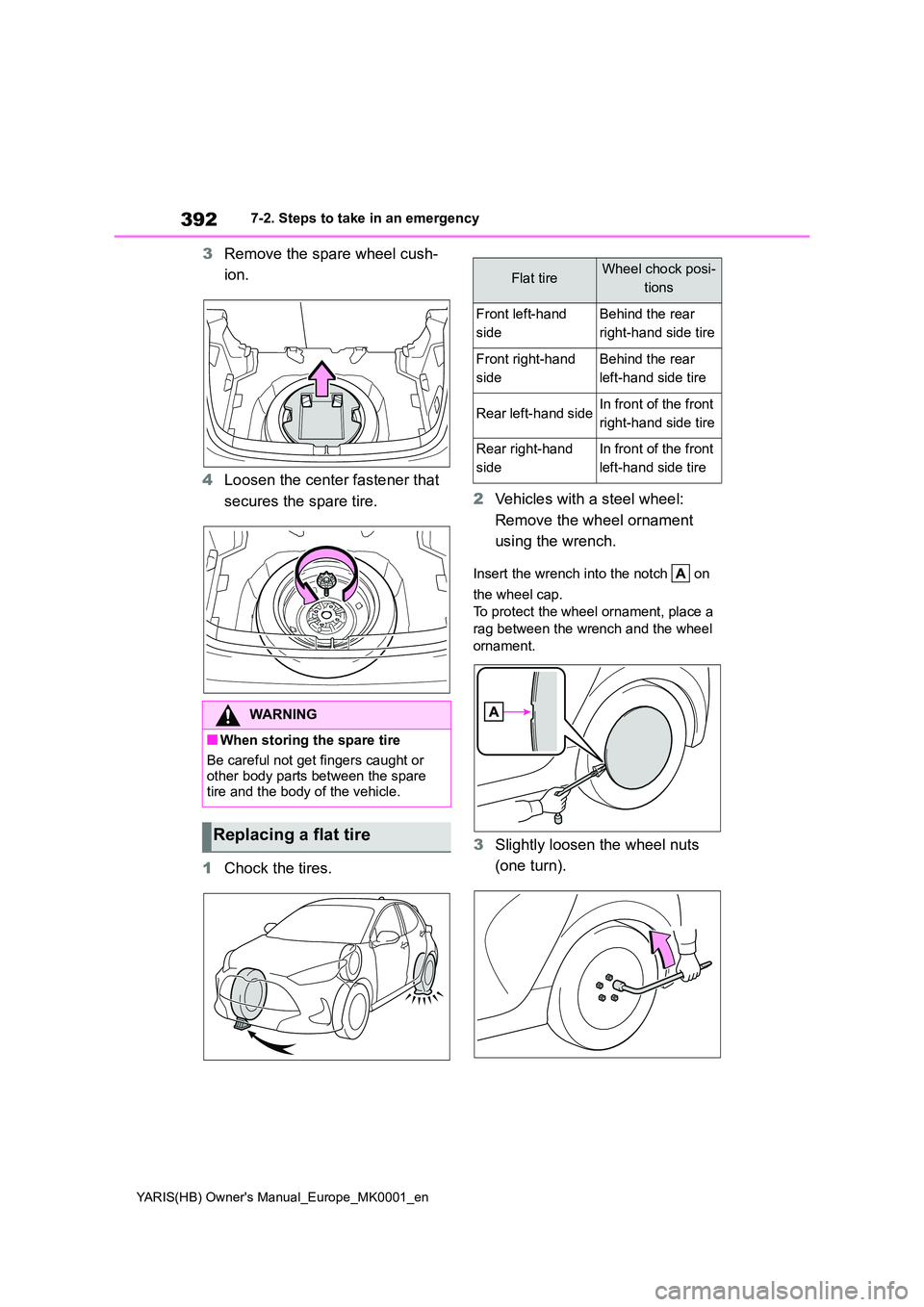
1 Press the button to let some air out.
2 Check that the air pressure indicator shows the specified air pressure. If
the air pressure is under the desig- nated pressure, turn the compres-sor switch on again and repeat the
inflation procedure until the specified air pressure is reached.
■The valve of a tire that has been repaired
After a tire is repaired with the emer- gency tire puncture repair kit, the valve should be replaced.
■After a tire is repaired with the
emergency tire puncture repair kit
●The tire pressure warning valve and
transmitter should be replaced.
●Even if the tire inflation pressure is at the recommended level, the tire pres-sure warning light may come on/flash.
WARNING
■Do not drive the vehicle with a flat tire
Do not continue driving with a flat tire.
Driving even a short distance with a flat tire can damage the tire and the wheel beyond repair.
Driving with a flat tire may cause a cir- cumferential groove on the side wall. In such a case, the tire may explode
when using a repair kit.
■When fixing the flat tire
●Stop your vehicle in a safe and flat area.
●Do not touch the wheels or the area around the brakes immediately
after the vehicle has been driven. After the vehicle has been driven, the wheels and the area around the
brakes may be extremely hot. Touching these areas with hands, feet or other body parts may result
in burns.
●Connect the valve and hose
securely with the tire installed on the vehicle. If the hose is not prop-erly connected to the valve, air
leakage may occur as sealant may be sprayed out.
●If the hose comes off the valve while inflating the tire, there is a risk that the hose will move abruptly due
to air pressure.
●After inflation of the tire has com-
pleted, the sealant may splatter when the hose is disconnected or some air is let out of the tire.
●Follow the operation procedure to repair the tire. If the procedures not
followed, the sealant may spray out.
●Keep back from the tire while it is being repaired, as there is a chance of it bursting while the repair opera-
tion is being performed. If you notice any cracks or deformation of the tire, turn off the compressor
switch and stop the repair operation immediately.
●The repair kit may overheat if oper-ated for a long period of time. Do not operate the repair kit continu-
ously for more than 40 minutes.
Page 392 of 568
392
YARIS(HB) Owner's Manual_Europe_MK0001_en
7-2. Steps to take in an emergency
3Remove the spare wheel cush-
ion.
4 Loosen the center fastener that
secures the spare tire.
1 Chock the tires.
2 Vehicles with a steel wheel:
Remove the wheel ornament
using the wrench.
Insert the wrench into the notch on
the wheel cap.
To protect the wheel ornament, place a
rag between the wrench and the wheel
ornament.
3 Slightly loosen the wheel nuts
(one turn).
WARNING
■When storing the spare tire
Be careful not get fingers caught or other body parts between the spare
tire and the body of the vehicle.
Replacing a flat tire
Flat tireWheel chock posi-
tions
Front left-hand
side
Behind the rear
right-hand side tire
Front right-hand
side
Behind the rear
left-hand side tire
Rear left-hand sideIn front of the front
right-hand side tire
Rear right-hand
side
In front of the front
left-hand side tire
Page 396 of 568
396
YARIS(HB) Owner's Manual_Europe_MK0001_en
7-2. Steps to take in an emergency
WARNING
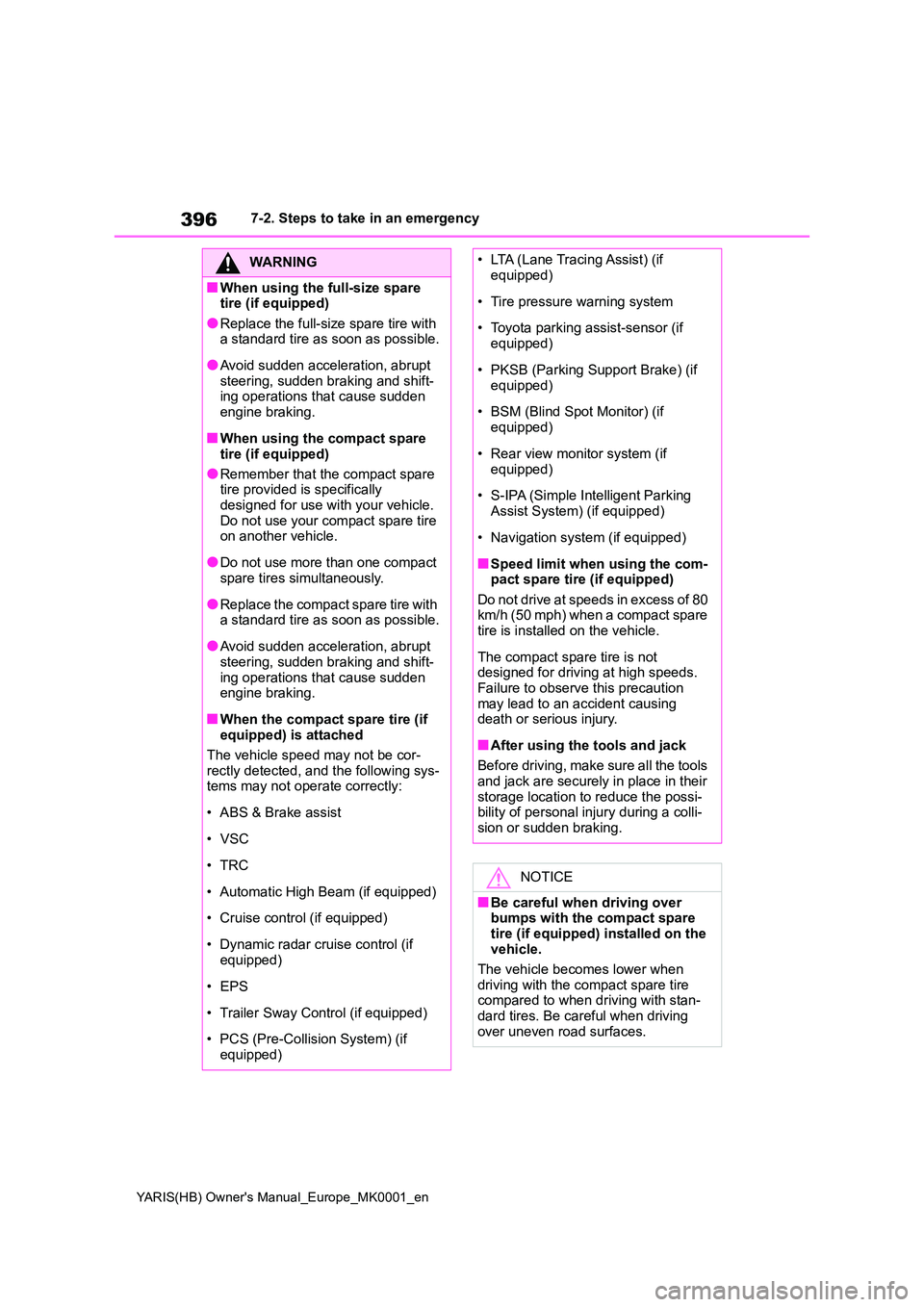
■When using the full-size spare tire (if equipped)
●Replace the full-size spare tire with a standard tire as soon as possible.
●Avoid sudden acceleration, abrupt steering, sudden braking and shift-ing operations that cause sudden
engine braking.
■When using the compact spare
tire (if equipped)
●Remember that the compact spare tire provided is specifically
designed for use with your vehicle. Do not use your compact spare tire on another vehicle.
●Do not use more than one compact spare tires simultaneously.
●Replace the compact spare tire with a standard tire as soon as possible.
●Avoid sudden acceleration, abrupt steering, sudden braking and shift-
ing operations that cause sudden engine braking.
■When the compact spare tire (if equipped) is attached
The vehicle speed may not be cor-
rectly detected, and the following sys- tems may not operate correctly:
• ABS & Brake assist
• VSC
•TRC
• Automatic High Beam (if equipped)
• Cruise control (if equipped)
• Dynamic radar cruise control (if equipped)
• EPS
• Trailer Sway Control (if equipped)
• PCS (Pre-Collision System) (if
equipped)
• LTA (Lane Tracing Assist) (if equipped)
• Tire pressure warning system
• Toyota parking assist-sensor (if
equipped)
• PKSB (Parking Support Brake) (if
equipped)
• BSM (Blind Spot Monitor) (if
equipped)
• Rear view monitor system (if
equipped)
• S-IPA (Simple Intelligent Parking
Assist System) (if equipped)
• Navigation system (if equipped)
■Speed limit when using the com- pact spare tire (if equipped)
Do not drive at speeds in excess of 80 km/h (50 mph) when a compact spare tire is installed on the vehicle.
The compact spare tire is not designed for driving at high speeds.
Failure to observe this precaution may lead to an accident causing death or serious injury.
■After using the tools and jack
Before driving, make sure all the tools
and jack are securely in place in their storage location to reduce the possi-bility of personal injury during a colli-
sion or sudden braking.
NOTICE
■Be careful when driving over bumps with the compact spare
tire (if equipped) installed on the vehicle.
The vehicle becomes lower when
driving with the compact spare tire compared to when driving with stan-dard tires. Be careful when driving
over uneven road surfaces.
Page 403 of 568
403
7
YARIS(HB) Owner's Manual_Europe_MK0001_en
7-2. Steps to take in an emergency
When trouble arises
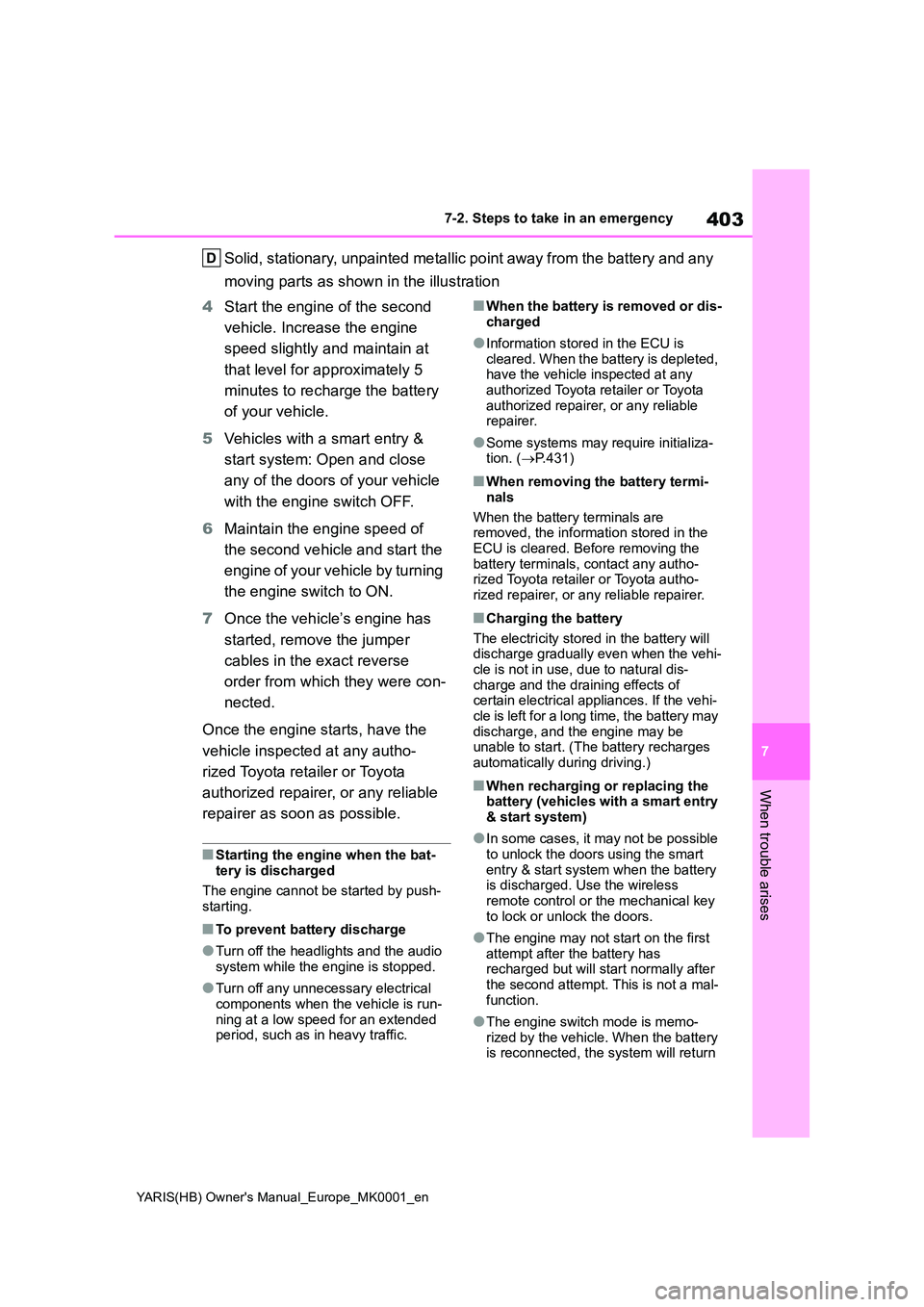
Solid, stationary, unpainted metallic point away from the battery and any
moving parts as shown in the illustration
4 Start the engine of the second
vehicle. Increase the engine
speed slightly and maintain at
that level for approximately 5
minutes to recharge the battery
of your vehicle.
5 Vehicles with a smart entry &
start system: Open and close
any of the doors of your vehicle
with the engine switch OFF.
6 Maintain the engine speed of
the second vehicle and start the
engine of your vehicle by turning
the engine switch to ON.
7 Once the vehicle’s engine has
started, remove the jumper
cables in the exact reverse
order from which they were con-
nected.
Once the engine starts, have the
vehicle inspected at any autho-
rized Toyota retailer or Toyota
authorized repairer, or any reliable
repairer as soon as possible.
■Starting the engine when the bat- tery is discharged
The engine cannot be started by push-
starting.
■To prevent battery discharge
●Turn off the headlights and the audio
system while the engine is stopped.
●Turn off any unnecessary electrical
components when the vehicle is run- ning at a low speed for an extended period, such as in heavy traffic.
■When the battery is removed or dis-charged
●Information stored in the ECU is cleared. When the battery is depleted, have the vehicle inspected at any
authorized Toyota retailer or Toyota authorized repairer, or any reliable repairer.
●Some systems may require initializa-tion. ( →P.431)
■When removing the battery termi-
nals
When the battery terminals are removed, the information stored in the
ECU is cleared. Before removing the battery terminals, contact any autho-rized Toyota retailer or Toyota autho-
rized repairer, or any reliable repairer.
■Charging the battery
The electricity stored in the battery will discharge gradually even when the vehi-
cle is not in use, due to natural dis- charge and the draining effects of certain electrical appliances. If the vehi-
cle is left for a long time, the battery may discharge, and the engine may be unable to start. (The battery recharges
automatically during driving.)
■When recharging or replacing the battery (vehicles with a smart entry & start system)
●In some cases, it may not be possible to unlock the doors using the smart
entry & start system when the battery is discharged. Use the wireless remote control or the mechanical key
to lock or unlock the doors.
●The engine may not start on the first
attempt after the battery has recharged but will start normally after the second attempt. This is not a mal-
function.
●The engine switch mode is memo-
rized by the vehicle. When the battery is reconnected, the system will return
Page 404 of 568
404
YARIS(HB) Owner's Manual_Europe_MK0001_en
7-2. Steps to take in an emergency
to the mode it was in before the bat-
tery was discharged. Before discon- necting the battery, turn the engine switch off.
If you are unsure what mode the engine switch was in before the bat-tery discharged, be especially careful
when reconnecting the battery.
■When replacing the battery
●Use a battery that conforms to Euro-
pean regulations.
●Use a battery that the case size is
same as the previous one, 20 hour rate capacity (20HR) is equivalent or greater, and performance rating
(CCA) is equivalent or greater. Check the label on top of the battery for the battery size and specifications (ex.
LN2, 60Ah, 345A). • If the sizes differ, the battery cannot be properly secured.
• If the 20 hour rate capacity is low, even if the time period where the vehi-cle is not used is a short time, the bat-
tery may discharge and the engine may not be able to start.
●For details, consult any authorized Toyota retailer or Toyota authorized repairer, or any reliable repairer.
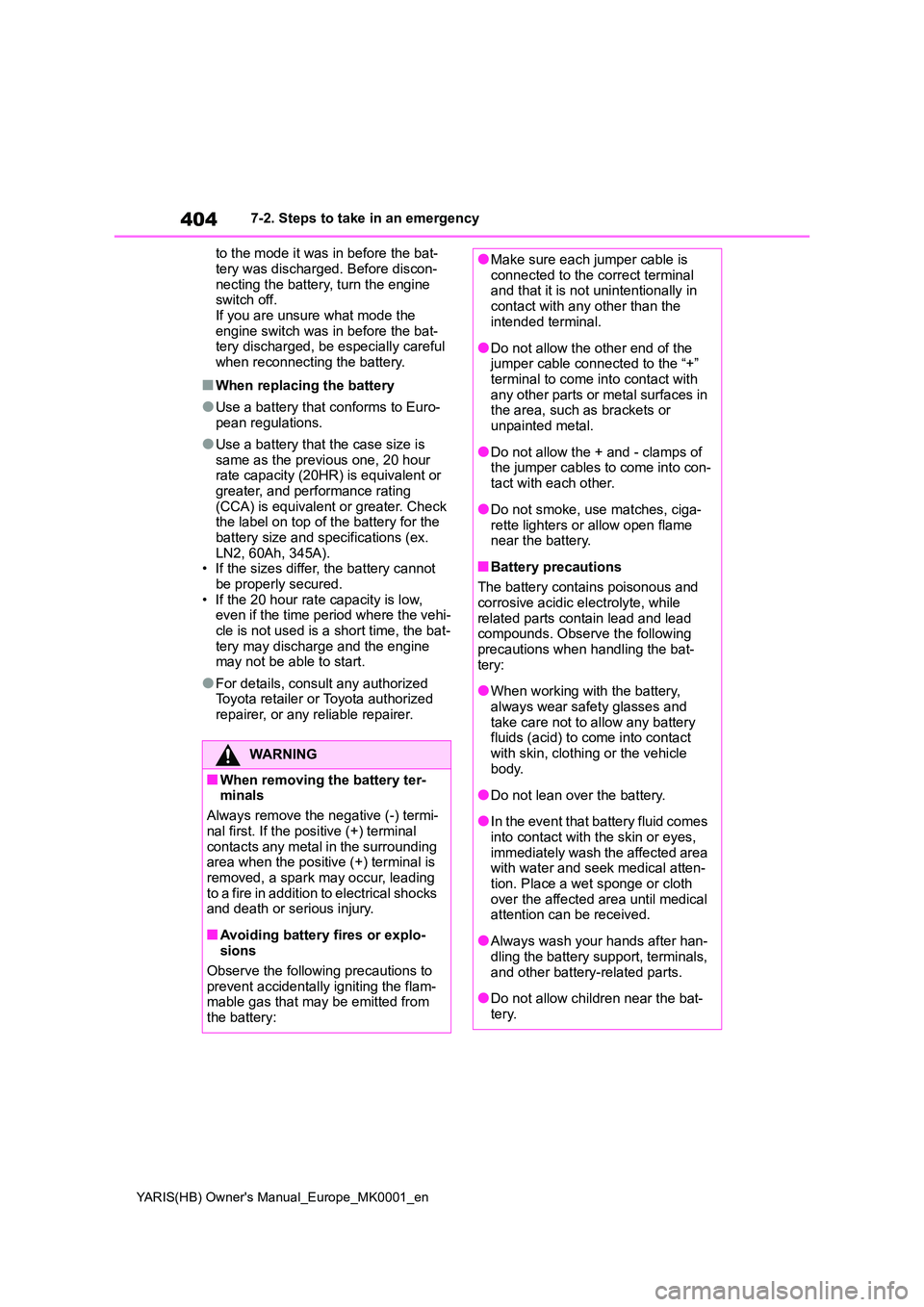
WARNING
■When removing the battery ter-minals
Always remove the negative (-) termi-
nal first. If the positive (+) terminal contacts any metal in the surrounding area when the positive (+) terminal is
removed, a spark may occur, leading to a fire in addition to electrical shocks and death or serious injury.
■Avoiding battery fires or explo-sions
Observe the following precautions to prevent accidentally igniting the flam-mable gas that may be emitted from
the battery:
●Make sure each jumper cable is connected to the correct terminal and that it is not unintentionally in
contact with any other than the intended terminal.
●Do not allow the other end of the jumper cable connected to the “+” terminal to come into contact with
any other parts or metal surfaces in the area, such as brackets or unpainted metal.
●Do not allow the + and - clamps of the jumper cables to come into con-
tact with each other.
●Do not smoke, use matches, ciga-
rette lighters or allow open flame near the battery.
■Battery precautions
The battery contains poisonous and corrosive acidic electrolyte, while
related parts contain lead and lead compounds. Observe the following precautions when handling the bat-
tery:
●When working with the battery,
always wear safety glasses and take care not to allow any battery fluids (acid) to come into contact
with skin, clothing or the vehicle body.
●Do not lean over the battery.
●In the event that battery fluid comes
into contact with the skin or eyes, immediately wash the affected area with water and seek medical atten-
tion. Place a wet sponge or cloth over the affected area until medical attention can be received.
●Always wash your hands after han-dling the battery support, terminals,
and other battery-related parts.
●Do not allow children near the bat-
tery.
Page 425 of 568
425
8
YARIS(HB) Owner's Manual_Europe_MK0001_en
8-2. Customization
Vehicle specifications
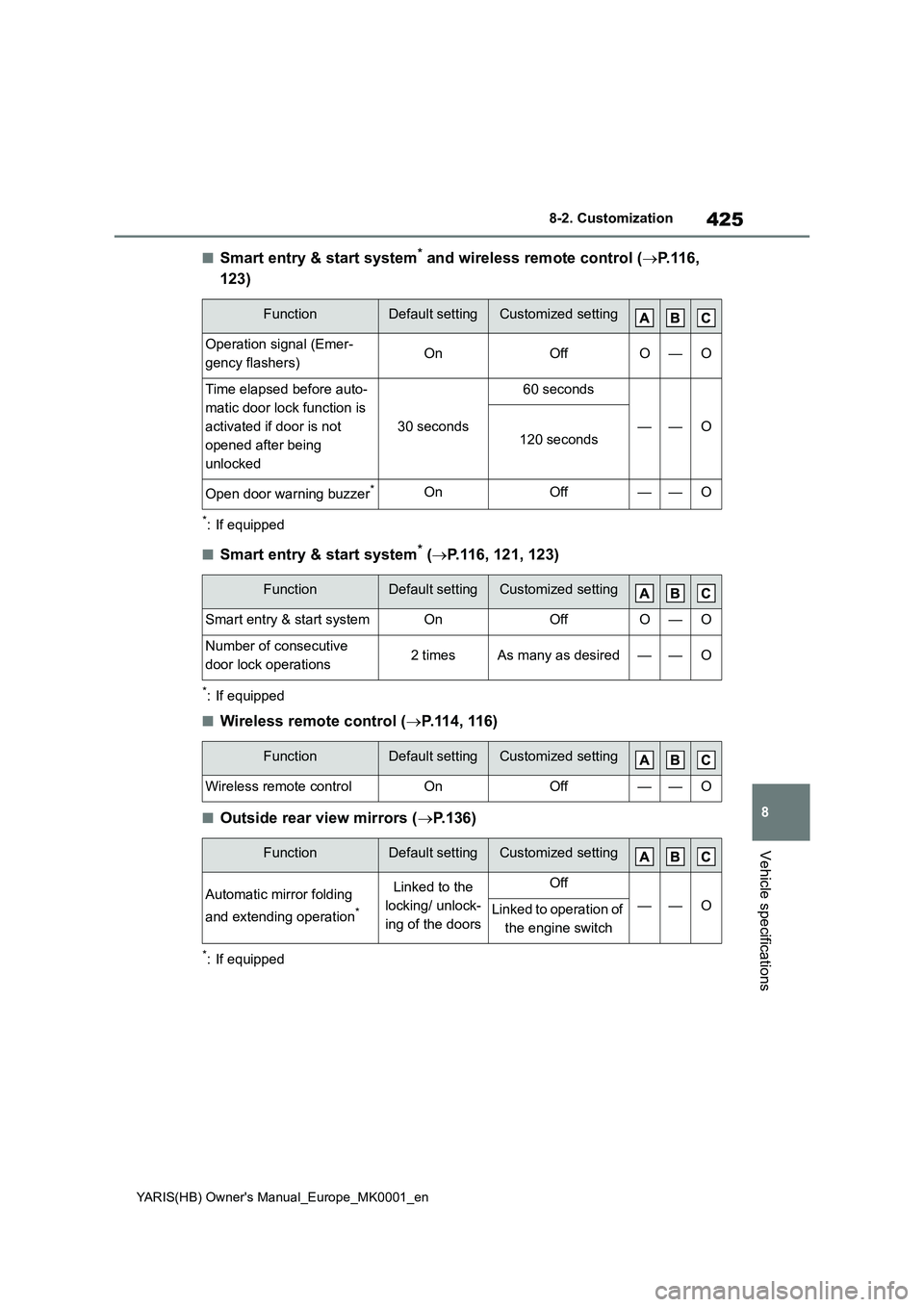
■Smart entry & start system* and wireless remote control (→P.116,
123)
*: If equipped
■Smart entry & start system* (→P.116, 121, 123)
*: If equipped
■Wireless remote control (→P.114, 116)
■Outside rear view mirrors (→P.136)
*: If equipped
FunctionDefault settingCustomized setting
Operation signal (Emer-
gency flashers)OnOffO—O
Time elapsed before auto-
matic door lock function is
activated if door is not
opened after being
unlocked
30 seconds
60 seconds
——O120 seconds
Open door warning buzzer*OnOff——O
FunctionDefault settingCustomized setting
Smart entry & start systemOnOffO—O
Number of consecutive
door lock operations2 timesAs many as desired——O
FunctionDefault settingCustomized setting
Wireless remote controlOnOff——O
FunctionDefault settingCustomized setting
Automatic mirror folding
and extending operation
*
Linked to the
locking/ unlock-
ing of the doorsOff
——OLinked to operation of
the engine switch
Page 509 of 568
509
8
YARIS(HB) Owner's Manual_Europe_MK0001_en
8-4. Certifications
Vehicle specifications
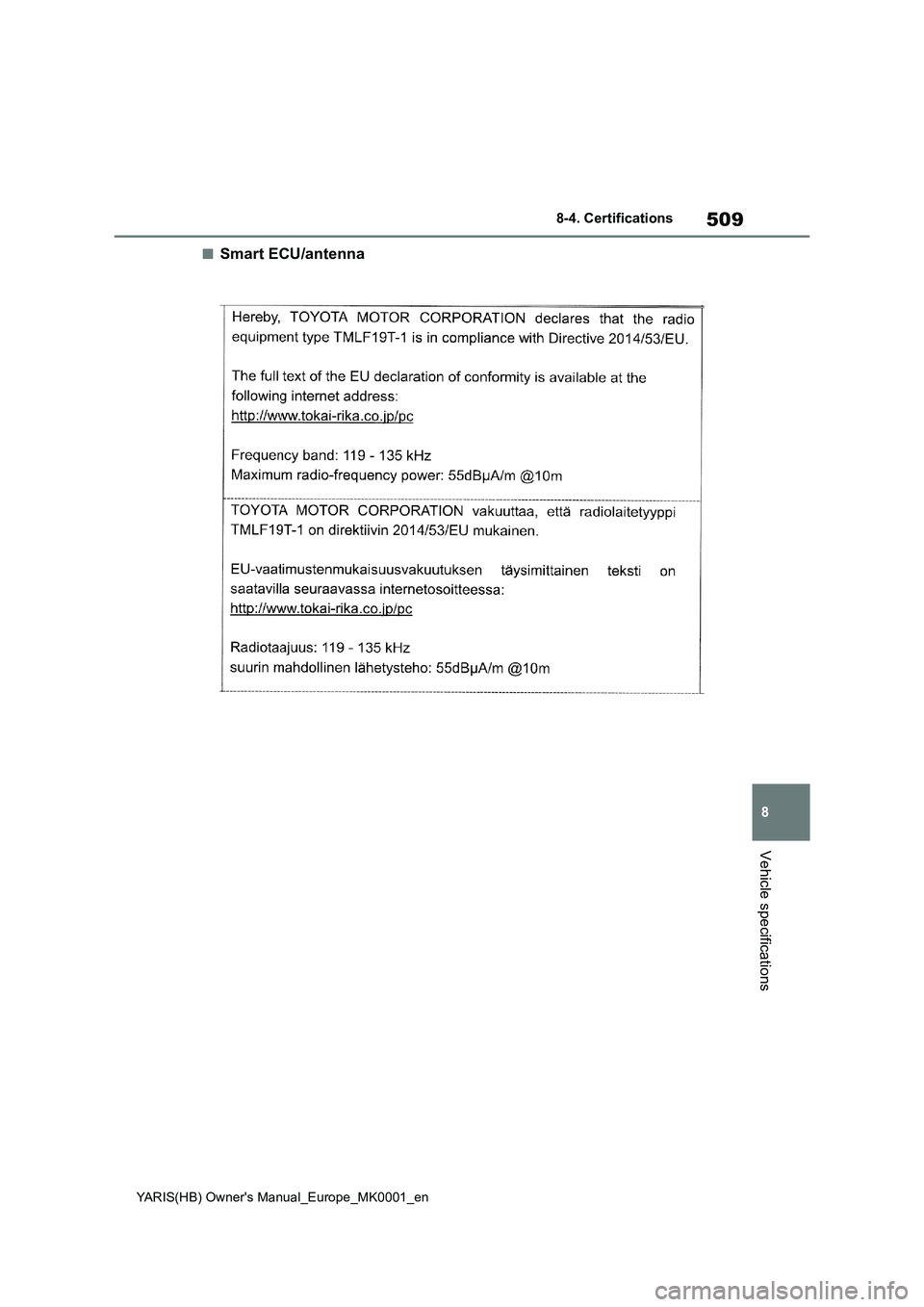
■Smart ECU/antenna