Wheel TOYOTA YARIS 2021 Repair Manual
[x] Cancel search | Manufacturer: TOYOTA, Model Year: 2021, Model line: YARIS, Model: TOYOTA YARIS 2021Pages: 568, PDF Size: 110.34 MB
Page 310 of 568
310
YARIS(HB) Owner's Manual_Europe_MK0001_en
6-1. Maintenance and care
NOTICE
●To prevent the wheels from corrod- ing, remove any dirt and store in a
place with low humidity when stor- ing the wheels.
■Cleaning the exterior lights
●Wash carefully. Do not use organic substances or scrub with a hard
brush. This may damage the surfaces of the lights.
●Do not apply wax to the surfaces of the lights.
Wax may cause damage to the lenses.
■To prevent damage to the wind-shield wiper arms
When lifting the wiper arms away
from the windshield, pull the driver side wiper arm upward first, and repeat for the passenger side. When
returning the wipers to their original position, do so from the passenger side first.
■When using an automatic car wash (vehicles with rain-sensing
windshield wipers)
Set the wiper switch to the off posi- tion. If the wiper switch is in “AUTO”,
the wipers may operate and the wiper blades may be damaged.
■When using a high pressure car wash
●Vehicles with rear view monitor sys-
tem: When washing the vehicle, do not spray the camera or its sur-rounding area directly with a high
pressure washer. Shock applied from high pressure water may cause the device to not operate
normally.
●Do not spray water directly on the
radar which is equipped behind the emblem. Otherwise it may cause the device to be damaged.
●Do not bring the nozzle tip close to boots (rubber or resin manufac-tured cover), connectors or the fol-
lowing parts. The parts may be damaged if they come into contact with high-pressure water.
• Traction related parts
• Steering parts
• Suspension parts
• Brake parts
●Keep the cleaning nozzle at least 30 cm (11.9 in.) away from the vehi-cles body. Otherwise resin section,
such as moldings and bumpers, may be deformed and damaged. Also, do not continuously hold the
nozzle in the same place.
●Do not spray the lower part of the
windshield continuously. If water enters the air conditioning system intake located near the lower part of
the windshield, the air conditioning system may not operate correctly.
Page 331 of 568
331
6
YARIS(HB) Owner's Manual_Europe_MK0001_en
6-3. Do-it-yourself maintenance
Maintenance and care
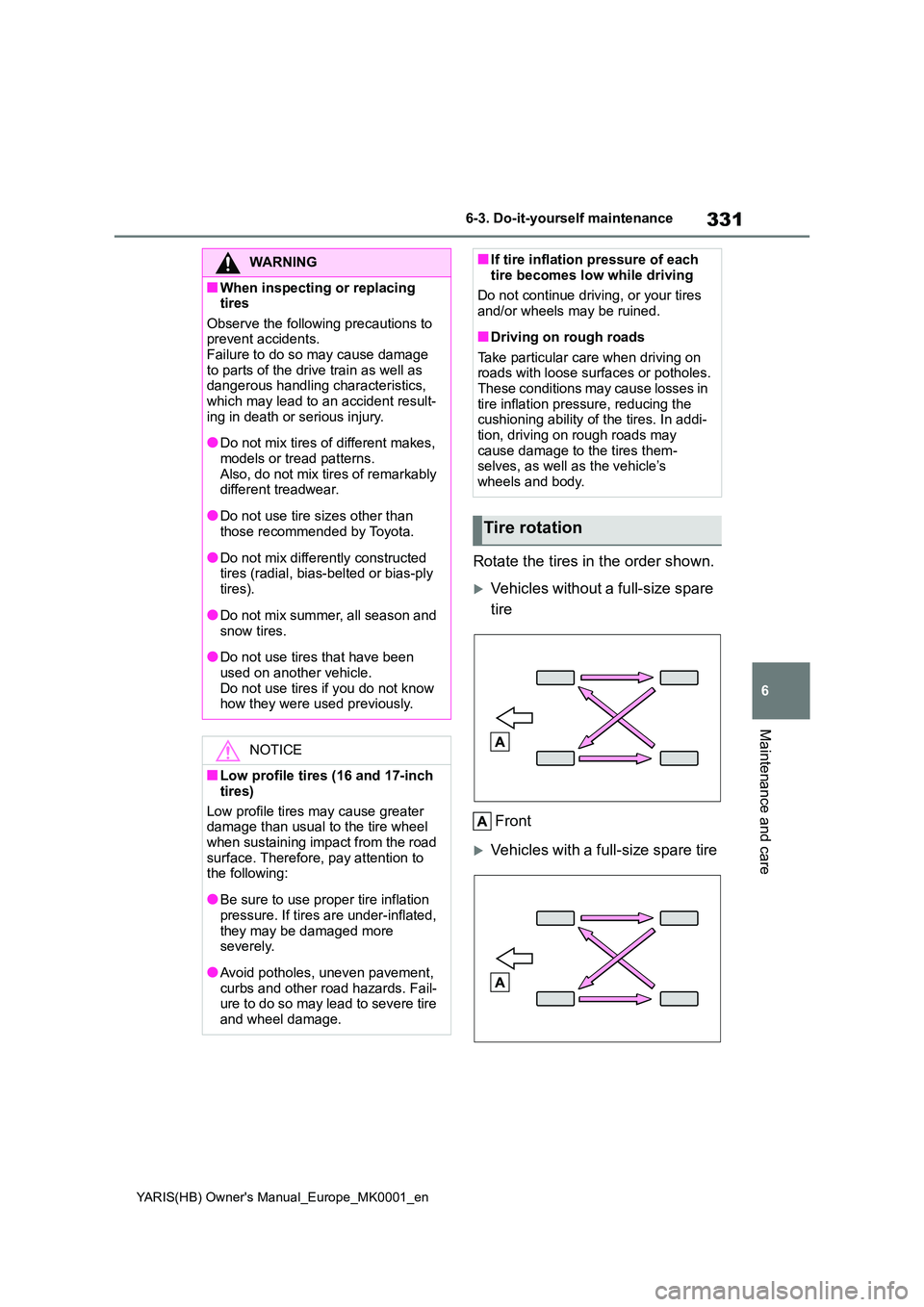
Rotate the tires in the order shown.
Vehicles without a full-size spare
tire
Front
Vehicles with a full-size spare tire
WARNING
■When inspecting or replacing tires
Observe the following precautions to prevent accidents.Failure to do so may cause damage
to parts of the drive train as well as dangerous handling characteristics, which may lead to an accident result-
ing in death or serious injury.
●Do not mix tires of different makes,
models or tread patterns. Also, do not mix tires of remarkably different treadwear.
●Do not use tire sizes other than those recommended by Toyota.
●Do not mix differently constructed tires (radial, bias-belted or bias-ply
tires).
●Do not mix summer, all season and
snow tires.
●Do not use tires that have been
used on another vehicle. Do not use tires if you do not know how they were used previously.
NOTICE
■Low profile tires (16 and 17-inch
tires)
Low profile tires may cause greater damage than usual to the tire wheel
when sustaining impact from the road surface. Therefore, pay attention to the following:
●Be sure to use proper tire inflation pressure. If tires are under-inflated,
they may be damaged more severely.
●Avoid potholes, uneven pavement, curbs and other road hazards. Fail-ure to do so may lead to severe tire
and wheel damage.
■If tire inflation pressure of each tire becomes low while driving
Do not continue driving, or your tires
and/or wheels may be ruined.
■Driving on rough roads
Take particular care when driving on roads with loose surfaces or potholes.These conditions may cause losses in
tire inflation pressure, reducing the cushioning ability of the tires. In addi-tion, driving on rough roads may
cause damage to the tires them- selves, as well as the vehicle’s wheels and body.
Tire rotation
Page 333 of 568
333
6
YARIS(HB) Owner's Manual_Europe_MK0001_en
6-3. Do-it-yourself maintenance
Maintenance and care
5Press / to select “TPWS
setting” and then press .
6Press / to select “Setting
Unit”.
7Press / to select the
desired unit and then press .
■Routine tire inflation pressure
checks
The tire pressure warning system does
not replace routine tire inflation pressure
checks. Make sure to check tire inflation
pressure as part of your routine of daily
vehicle checks.
■Tire inflation pressure
●It may take a few minutes to display
the tire inflation pressure after the
engine switch is turned to ON. It may
also take a few minutes to display the
tire inflation pressure after inflation
pressure has been adjusted.
●Tire inflation pressure changes with
temperature. The displayed values
may also be different from the values
measured using a tire pressure
gauge.
■Situations in which the tire pres-
sure warning system may not oper-
ate properly
●In the following cases, the tire pres-
sure warning system may not operate
properly.
• If non-genuine Toyota wheels are
used.
• A tire has been replaced with a tire
that is not an OE (Original Equipment)
tire.
• A tire has been replaced with a tire
that is not of the specified size.
• Tire chains, etc. are equipped.
• An auxiliary-supported run-flat tire is
equipped.• If a window tint that affects the radio
wave signals is installed.
• If there is a lot of snow or ice on the
vehicle, particularly around the wheels
or wheel housings.
• If the tire inflation pressure is
extremely higher than the specified
level.
• If tires not equipped with tire pressure
warning valves and transmitters are
used.
• If the ID code on the tire pressure
warning valves and transmitters is not
registered in the tire pressure warning
computer.
●Performance may be affected in the
following situations.
• Near a TV tower, electric power plant,
gas station, radio station, large dis-
play, airport or other facility that gen-
erates strong radio waves or electrical
noise.
• When carrying a portable radio, cellu-
lar phone, cordless phone or other
wireless communication device.
●When the vehicle is parked, the time
taken for the warning to start or go off
could be extended.
●When tire inflation pressure declines
rapidly for example when a tire has
burst, the warning may not function.
■Warning performance of the tire
pressure warning system
The warning of the tire pressure warning
system will change in accordance with
driving conditions. For this reason, the
system may give a warning even if the
tire pressure does not reach a low
enough level, or if the pressure is higher
than the pressure that was adjusted to
when the system was initialized.
When replacing tires or wheels, tire
pressure warning valves and trans-
mitters must also be installed.
Installing tire pressure warn-
ing valves and transmitters
Page 334 of 568
334
YARIS(HB) Owner's Manual_Europe_MK0001_en
6-3. Do-it-yourself maintenance
When new tire pressure warning
valves and transmitters are
installed, new ID codes must be
registered in the tire pressure warn-
ing computer and the tire pressure
warning system must be initialized.
Have tire pressure warning valves
and transmitter ID codes regis-
tered any authorized Toyota retailer
or Toyota authorized repairer, or
any reliable repairer. ( →P.336)
■Replacing tires and wheels
If the ID code of the tire pressure warn- ing valve and transmitter is not regis-tered, the tire pressure warning system
will not work properly. After driving for about 10 minutes, the tire pressure warning light blinks for 1 minute and
stays on to indicate a system malfunc- tion.■The tire pressure warning sys-
tem must be initialized in the
following circumstances:
z When rotating front and rear tires
which have different tire inflation
pressures.
z When changing the tire size.
z When the tire inflation pressure
is changed such as when chang-
ing traveling speed or load
weight.
z When changing between two
registered wheel sets.
When the tire pressure warning
system is initialized, the current tire
inflation pressure is set as the
benchmark pressure.
NOTICE
■Repairing or replacing tires,
wheels, tire pressure warning valves, transmitters and tire valve caps
●When removing or fitting the wheels, tires or the tire pressure warning valves and transmitters,
contact any authorized Toyota retailer or Toyota authorized repairer, or any reliable repairer as
the tire pressure warning valves and transmitters may be damaged if not handled correctly.
●Make sure to install the tire valve caps. If the tire valve caps are not
installed, water could enter the tire pressure warning valves and the tire pressure warning valves could
be bound.
●When replacing tire valve caps, do not use tire valve caps other than those specified. The cap may
become stuck.
■To avoid damage to the tire pres-
sure warning valves and trans- mitters
When a tire is repaired with liquid
sealants, the tire pressure warning valve and transmitter may not operate properly. If a liquid sealant is used,
contact any authorized Toyota retailer or Toyota authorized repairer, or any reliable repairer as soon as possible.
Make sure to replace the tire pressure warning valve and transmitter when replacing the tire. ( →P.333)
Initializing the tire pressure
warning system
Page 337 of 568
337
6
YARIS(HB) Owner's Manual_Europe_MK0001_en
6-3. Do-it-yourself maintenance
Maintenance and care
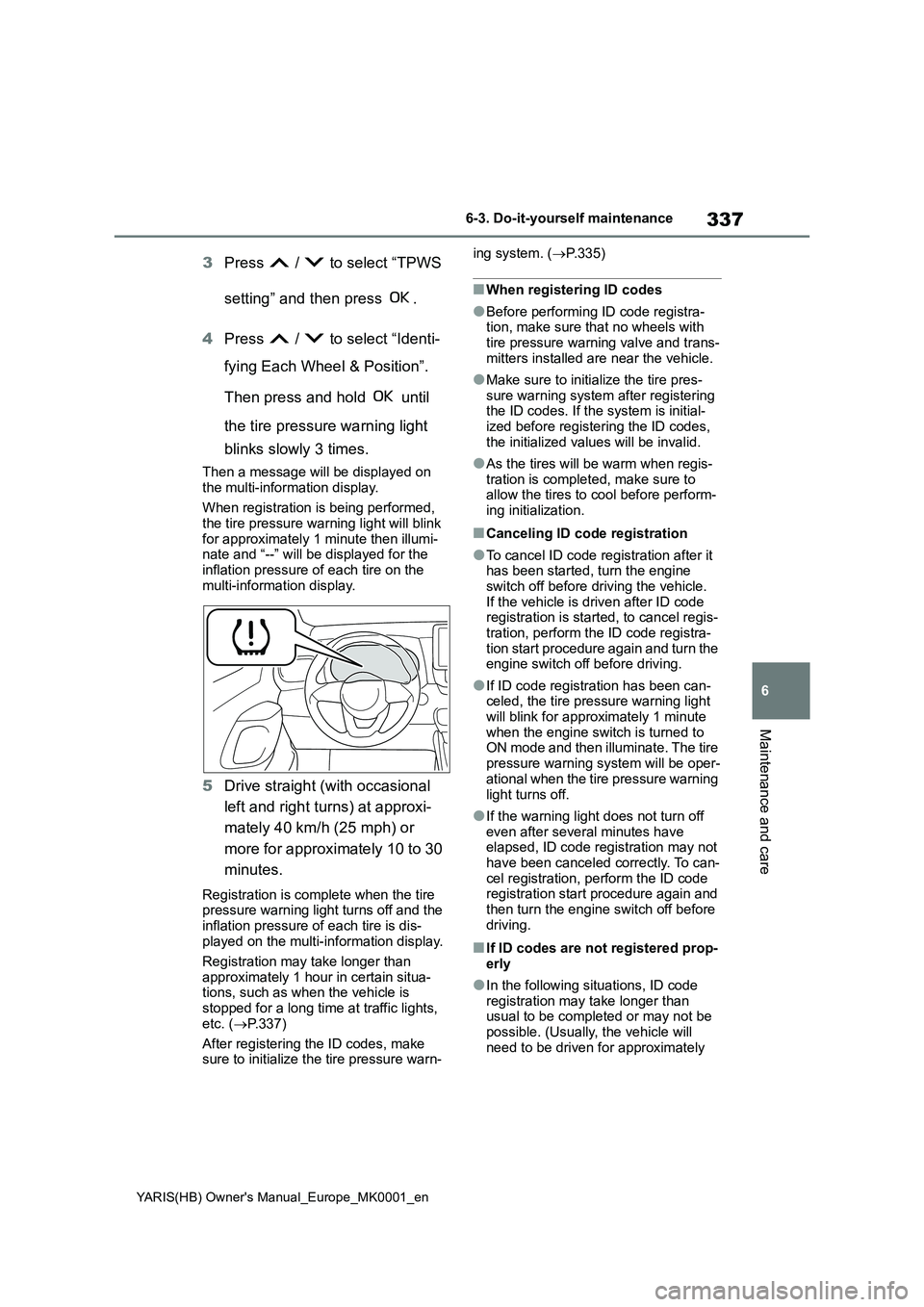
3Press / to select “TPWS
setting” and then press .
4Press / to select “Identi-
fying Each Wheel & Position”.
Then press and hold until
the tire pressure warning light
blinks slowly 3 times.
Then a message will be displayed on
the multi-information display.
When registration is being performed,
the tire pressure warning light will blink
for approximately 1 minute then illumi-
nate and “--” will be displayed for the
inflation pressure of each tire on the
multi-information display.
5Drive straight (with occasional
left and right turns) at approxi-
mately 40 km/h (25 mph) or
more for approximately 10 to 30
minutes.
Registration is complete when the tire
pressure warning light turns off and the
inflation pressure of each tire is dis-
played on the multi-information display.
Registration may take longer than
approximately 1 hour in certain situa-
tions, such as when the vehicle is
stopped for a long time at traffic lights,
etc. (→P.337)
After registering the ID codes, make
sure to initialize the tire pressure warn-ing system. (→P.335)
■When registering ID codes
●Before performing ID code registra-
tion, make sure that no wheels with
tire pressure warning valve and trans-
mitters installed are near the vehicle.
●Make sure to initialize the tire pres-
sure warning system after registering
the ID codes. If the system is initial-
ized before registering the ID codes,
the initialized values will be invalid.
●As the tires will be warm when regis-
tration is completed, make sure to
allow the tires to cool before perform-
ing initialization.
■Canceling ID code registration
●To cancel ID code registration after it
has been started, turn the engine
switch off before driving the vehicle.
If the vehicle is driven after ID code
registration is started, to cancel regis-
tration, perform the ID code registra-
tion start procedure again and turn the
engine switch off before driving.
●If ID code registration has been can-
celed, the tire pressure warning light
will blink for approximately 1 minute
when the engine switch is turned to
ON mode and then illuminate. The tire
pressure warning system will be oper-
ational when the tire pressure warning
light turns off.
●If the warning light does not turn off
even after several minutes have
elapsed, ID code registration may not
have been canceled correctly. To can-
cel registration, perform the ID code
registration start procedure again and
then turn the engine switch off before
driving.
■If ID codes are not registered prop-
erly
●In the following situations, ID code
registration may take longer than
usual to be completed or may not be
possible. (Usually, the vehicle will
need to be driven for approximately
Page 338 of 568
338
YARIS(HB) Owner's Manual_Europe_MK0001_en
6-3. Do-it-yourself maintenance
10 to 30 minutes to complete ID code
registration.)
If ID code registration is not complete
after driving for approximately 30 min-
utes, continue driving for a while.
• If the vehicle is driven on an unpaved
road, it may take longer than normal
to complete registration.
• If the vehicle is backed up while per-
forming registration, data collected
during registration will be cleared, and
it will take longer than normal to com-
plete.
• If the vehicle is driven in heavy traffic
or another situation where other vehi-
cles are driven close by, it may take
time for the system to recognize the
tire pressure warning valve and trans-
mitters of your vehicle over those of
other vehicles.
• If a wheel with a tire pressure warning
valve and transmitter installed is
inside or near the vehicle, registration
of the ID codes for the installed
wheels may not be possible.
If ID registration is not complete after
driving for approximately 1 hour, park
the vehicle in a safe place for approxi-
mately 20 minutes and then perform the
ID code registration procedure again.
●In the following situations, ID code
registration will not be started or was
not completed properly and the sys-
tem will not operate properly. Perform
the ID code registration procedure
again.
• If, when attempting to start ID code
registration, the tire pressure warning
light does not blink slowly 3 times.
• If, when the vehicle has been driven
for about 10 minutes after performing
ID code registration, the tire pressure
warning light blinks for approximately
1 minute and then illuminates.
●If ID code registration cannot be com-
pleted after performing the above pro-
cedure, contact any authorized Toyota
retailer or Toyota authorized repairer,
or any reliable repairer.
Your vehicle is equipped with tire
pressure warning system with the
function to have ID codes regis-
tered for a second wheel set, for
example a winter set, by any autho-
rized Toyota retailer or Toyota
authorized repairer, or any reliable
repairer.
After registration of a second wheel
set, either of these two wheel sets
can be selected for usage with the
tire pressure warning system.
■Operating conditions for the
function
zThis function will perform the
change of wheel set only if a sec-
ond wheel set has been regis-
tered. If no second wheel set has
been registered, no change will
be made when selecting this
function in the menu.
zOnly a change between both
registered wheel set is possible,
mixing between these wheel sets
is not supported.
■How to change between wheel
sets
1Have the vehicle fitted with the
preferred wheel set.
2Press / (vertical display)
or / (horizontal display)
of the meter control switch to
select .
Selecting wheel set
Page 339 of 568
339
6
YARIS(HB) Owner's Manual_Europe_MK0001_en
6-3. Do-it-yourself maintenance
Maintenance and care
3Press / (vertical display)
or / (horizontal display)
to select “Vehicle Settings” and
then press .
4Press / to select “TPWS
setting” and then press .
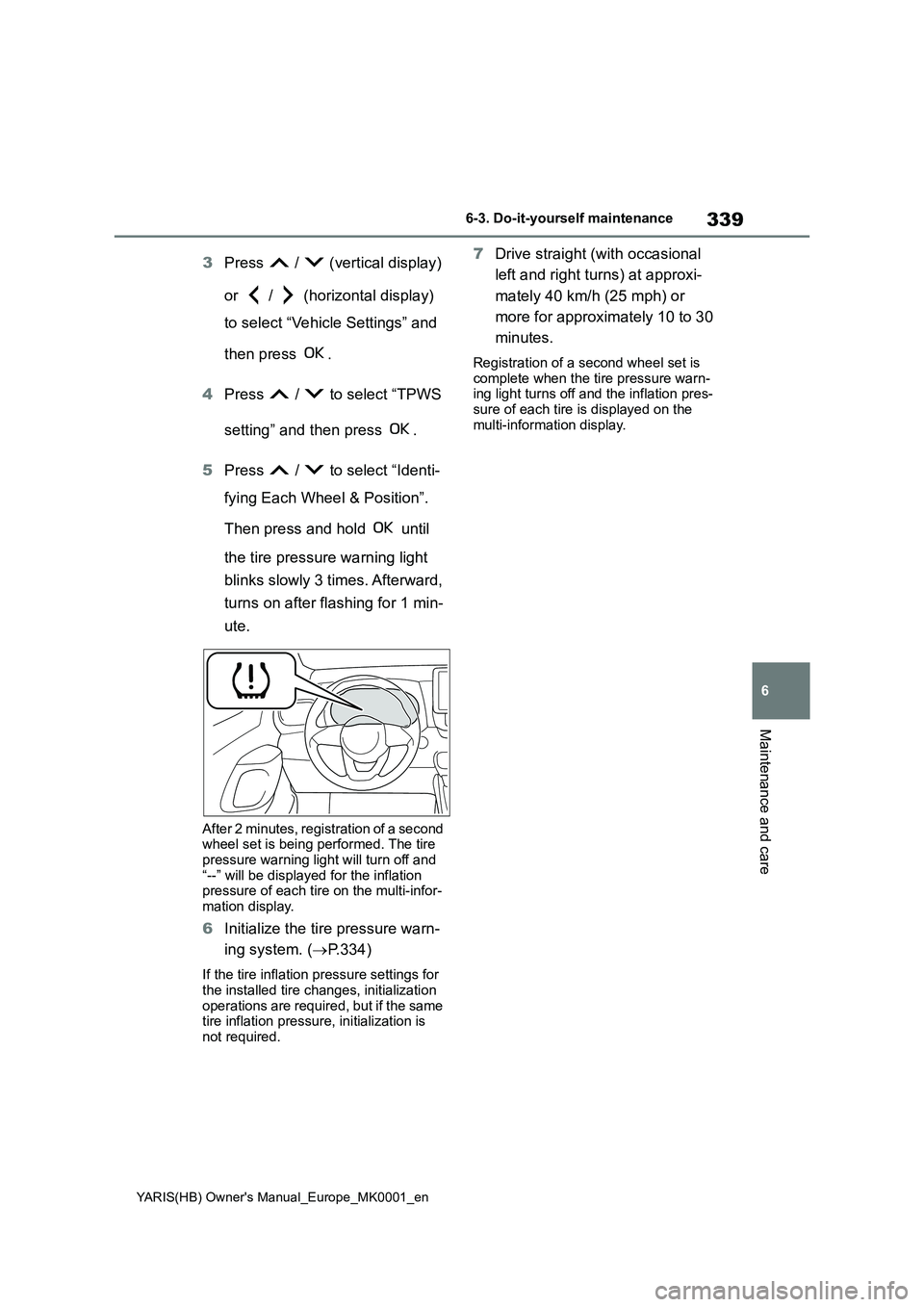
5Press / to select “Identi-
fying Each Wheel & Position”.
Then press and hold until
the tire pressure warning light
blinks slowly 3 times. Afterward,
turns on after flashing for 1 min-
ute.
After 2 minutes, registration of a second
wheel set is being performed. The tire
pressure warning light will turn off and
“--” will be displayed for the inflation
pressure of each tire on the multi-infor-
mation display.
6Initialize the tire pressure warn-
ing system. (→P.334)
If the tire inflation pressure settings for
the installed tire changes, initialization
operations are required, but if the same
tire inflation pressure, initialization is
not required.
7Drive straight (with occasional
left and right turns) at approxi-
mately 40 km/h (25 mph) or
more for approximately 10 to 30
minutes.
Registration of a second wheel set is
complete when the tire pressure warn-
ing light turns off and the inflation pres-
sure of each tire is displayed on the
multi-information display.
Page 341 of 568
341
6
YARIS(HB) Owner's Manual_Europe_MK0001_en
6-3. Do-it-yourself maintenance
Maintenance and care
When replacing wheels, care
should be taken to ensure that they
are equivalent to those removed in
load capacity, diameter, rim width
and inset*.
Replacement wheels are available
at any authorized Toyota retailer or
Toyota authorized repairer, or any
reliable repairer.
*: Conventionally referred to as offset.
Toyota does not recommend using
the following:
z Wheels of different sizes or types
z Used wheels
z Bent wheels that have been
straightened
■When replacing wheels
The wheels of your vehicle are equipped with tire pressure warning valves and
transmitters that allow the tire pressure warning system to provide advance warning in the event of a loss in tire
inflation pressure. Whenever wheels are replaced, the tire pressure warning valves and transmitters must be
installed. ( →P.333)
WARNING
●Uneven wear
●Poor handling
●Possibility of blowouts resulting
from overheated tires
●Air leaking from between tire and
wheel
●Wheel deformation and/or tire dam-
age
●Greater possibility of tire damage
while driving (due to road hazards, expansion joints, sharp edges on the road, etc.)
NOTICE
■When inspecting and adjusting tire inflation pressure
Be sure to put the tire valve caps back
on. If a valve cap is not installed, dirt or moisture may get into the valve and
cause an air leak, resulting in decreased tire inflation pressure.
Wheels
If a wheel is bent, cracked or
heavily corroded, it should be
replaced. Otherwise, the tire
may separate from the wheel
or cause a loss of handling
control.
Wheel selection
Page 342 of 568
342
YARIS(HB) Owner's Manual_Europe_MK0001_en
6-3. Do-it-yourself maintenance
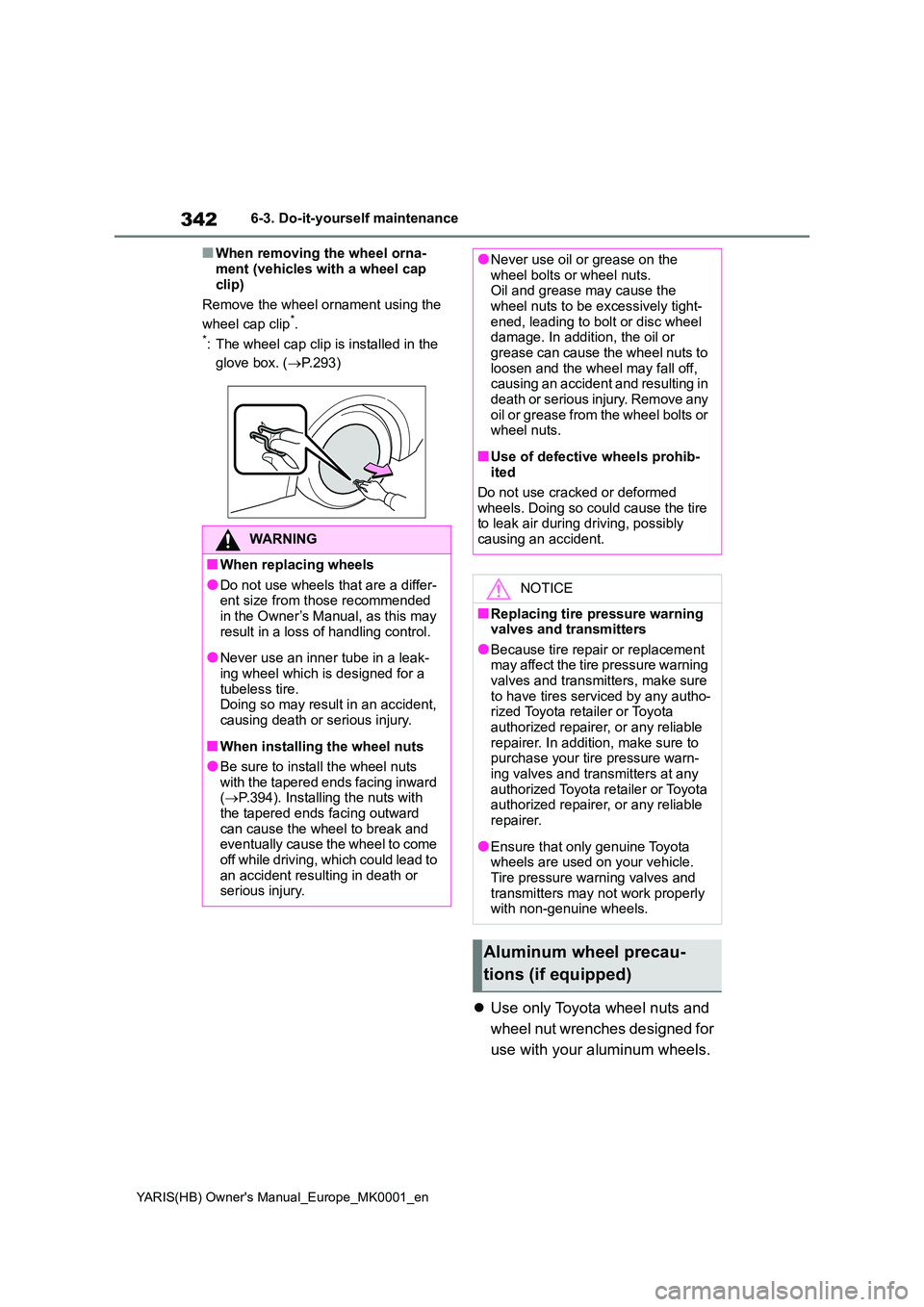
■When removing the wheel orna-
ment (vehicles with a wheel cap clip)
Remove the wheel ornament using the
wheel cap clip*.*: The wheel cap clip is installed in the
glove box. ( →P.293)
zUse only Toyota wheel nuts and
wheel nut wrenches designed for
use with your aluminum wheels.
WARNING
■When replacing wheels
●Do not use wheels that are a differ- ent size from those recommended in the Owner’s Manual, as this may
result in a loss of handling control.
●Never use an inner tube in a leak-
ing wheel which is designed for a tubeless tire.Doing so may result in an accident,
causing death or serious injury.
■When installing the wheel nuts
●Be sure to install the wheel nuts with the tapered ends facing inward ( →P.394). Installing the nuts with
the tapered ends facing outward can cause the wheel to break and eventually cause the wheel to come
off while driving, which could lead to an accident resulting in death or serious injury.
●Never use oil or grease on the wheel bolts or wheel nuts.Oil and grease may cause the
wheel nuts to be excessively tight- ened, leading to bolt or disc wheel damage. In addition, the oil or
grease can cause the wheel nuts to loosen and the wheel may fall off, causing an accident and resulting in
death or serious injury. Remove any oil or grease from the wheel bolts or wheel nuts.
■Use of defective wheels prohib-ited
Do not use cracked or deformed wheels. Doing so could cause the tire to leak air during driving, possibly
causing an accident.
NOTICE
■Replacing tire pressure warning valves and transmitters
●Because tire repair or replacement may affect the tire pressure warning valves and transmitters, make sure
to have tires serviced by any autho- rized Toyota retailer or Toyota authorized repairer, or any reliable
repairer. In addition, make sure to purchase your tire pressure warn-ing valves and transmitters at any
authorized Toyota retailer or Toyota authorized repairer, or any reliable repairer.
●Ensure that only genuine Toyota wheels are used on your vehicle.
Tire pressure warning valves and transmitters may not work properly with non-genuine wheels.
Aluminum wheel precau-
tions (if equipped)
Page 343 of 568
343
6
YARIS(HB) Owner's Manual_Europe_MK0001_en
6-3. Do-it-yourself maintenance
Maintenance and care
zWhen rotating, repairing or
changing your tires, check that
the wheel nuts are still tight after
driving 1600 km (1000 miles).
zBe careful not to damage the
aluminum wheels when using
tire chains.
zUse only Toyota genuine balance
weights or equivalent and a plas-
tic or rubber hammer when bal-
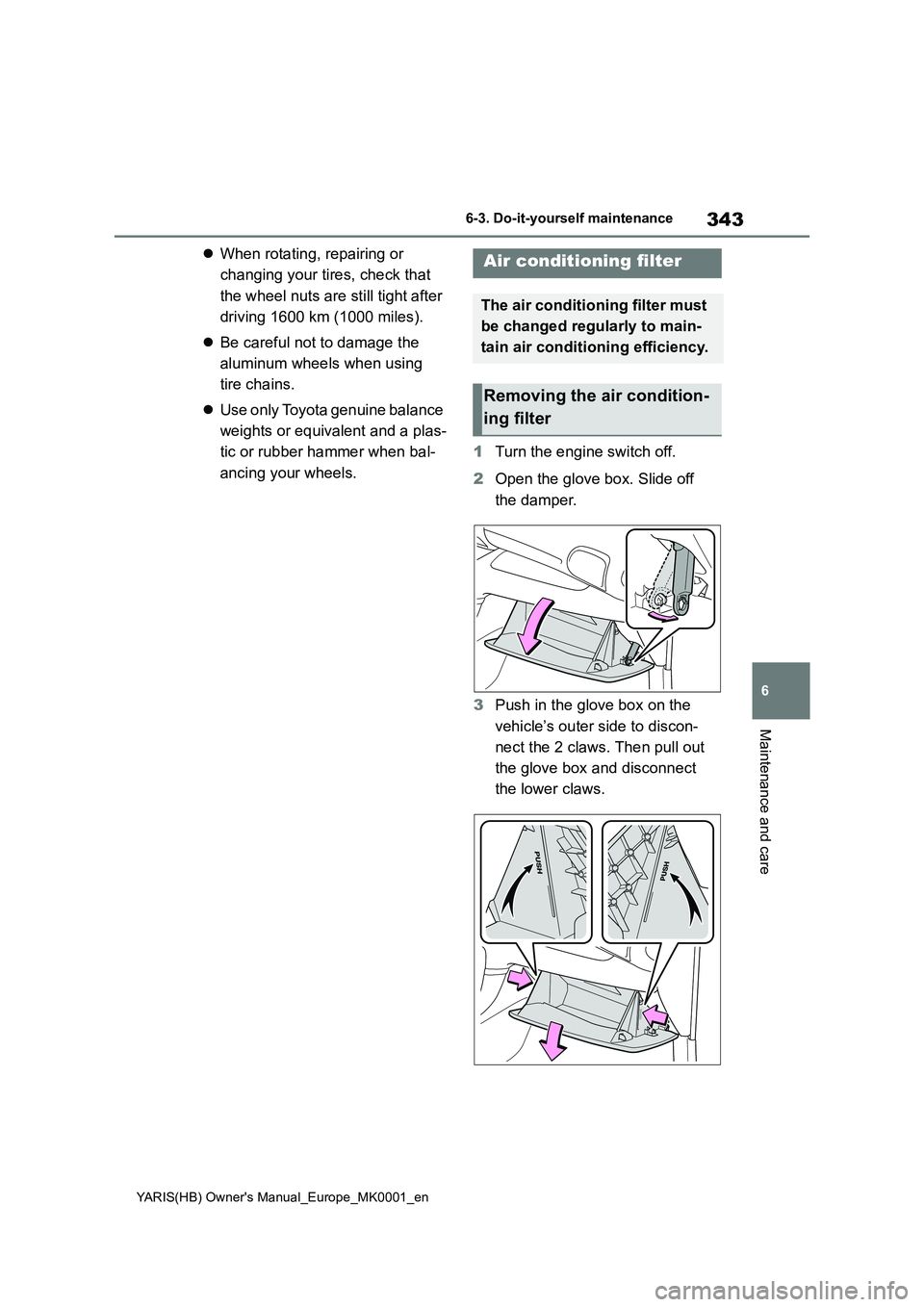
ancing your wheels.1Turn the engine switch off.
2Open the glove box. Slide off
the damper.
3Push in the glove box on the
vehicle’s outer side to discon-
nect the 2 claws. Then pull out
the glove box and disconnect
the lower claws.Air conditioning filter
The air conditioning filter must
be changed regularly to main-
tain air conditioning efficiency.
Removing the air condition-
ing filter