roof TOYOTA YARIS 2022 User Guide
[x] Cancel search | Manufacturer: TOYOTA, Model Year: 2022, Model line: YARIS, Model: TOYOTA YARIS 2022Pages: 590, PDF Size: 128.6 MB
Page 311 of 590
309
5
HV Owner's Manual_Europe_M52N30_en
5-4. Other interior features
Interior features
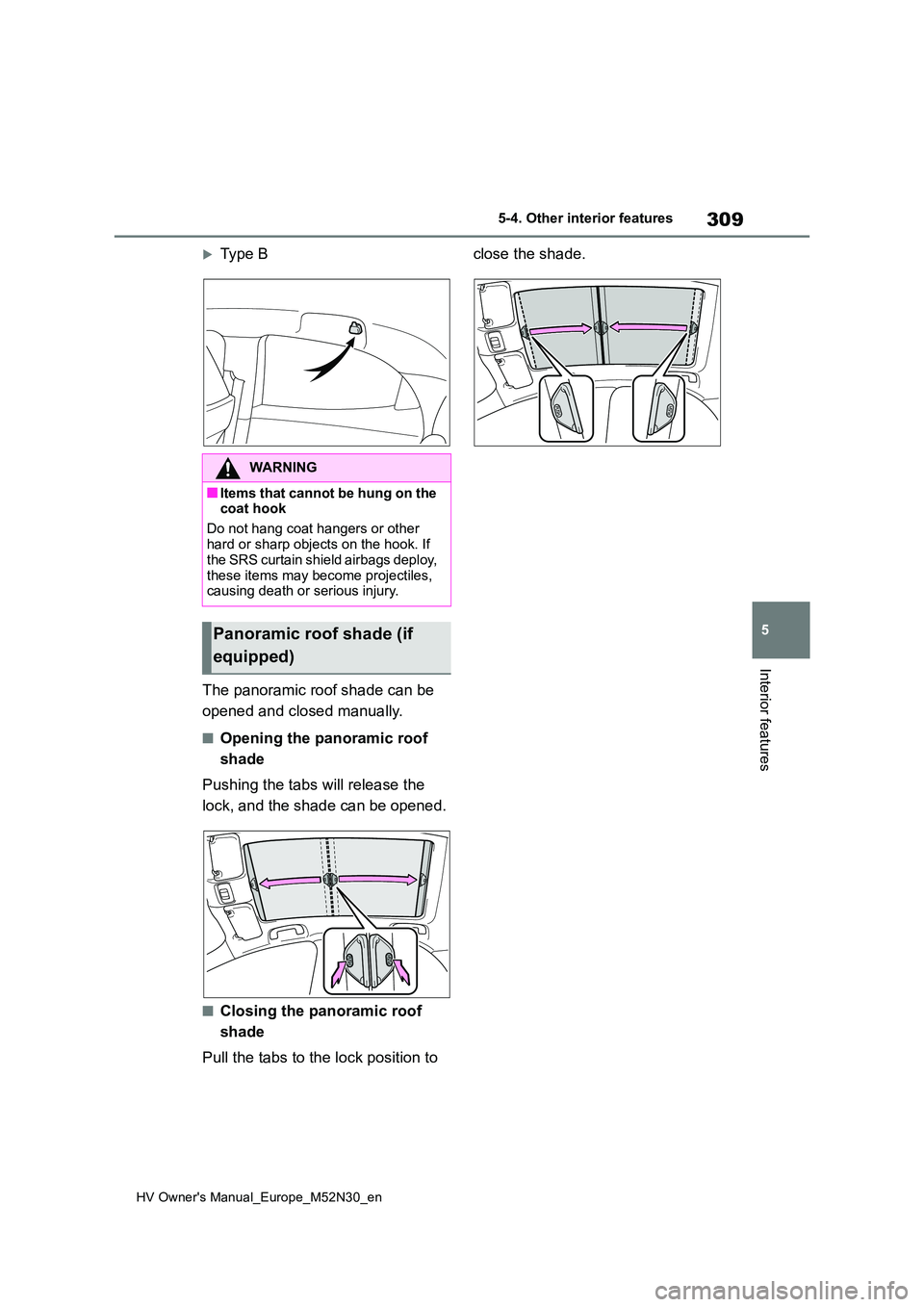
Type B
The panoramic roof shade can be
opened and closed manually.
■Opening the panoramic roof
shade
Pushing the tabs will release the
lock, and the shade can be opened.
■Closing the panoramic roof
shade
Pull the tabs to the lock position to
close the shade.
WARNING
■Items that cannot be hung on the coat hook
Do not hang coat hangers or other
hard or sharp objects on the hook. If the SRS curtain shield airbags deploy,
these items may become projectiles, causing death or serious injury.
Panoramic roof shade (if
equipped)
Page 314 of 590
312
HV Owner's Manual_Europe_M52N30_en
6-1. Maintenance and care
6-1.Mainte nance a nd care
Working from top to bottom, lib-
erally apply water to the vehicle
body, wheel wells and underside
of the vehicle to remove any dirt
and dust.
Wash the vehicle body using a
sponge or soft cloth, such as a
chamois.
For hard-to-remove marks, use
car wash soap and rinse thor-
oughly with water.
Wipe away any water.
Wax the vehicle when the water-
proof coating deteriorates.
If water does not bead on a clean sur-
face, apply wax when the vehicle body
is cool.
■Automatic car washes
●Before washing the vehicle: • Fold the mirrors.
Start washing from the front of the vehi-
cle. Extend the mirrors before driving.
●Brushes used in automatic car washes may scratch the vehicle sur-
face, parts (wheel, etc.) and harm your vehicle’s paint.
●In certain automatic car washes, the rear spoiler (if equipped) may interfere with machine operation. This may pre-
vent the vehicle from being cleaned
properly or result in damage to the
rear spoiler.
■High pressure car washes
As water may enter the cabin, do not bring the nozzle tip near the gaps
around the doors or perimeter of the windows, or spray these areas continu-ously.
■When using a car wash (vehicles
with a smart entry & start system)
If the door handle becomes wet while the electronic key is within the effective
range, the door may lock and unlock repeatedly. In that case, follow the fol-lowing correction procedures to wash
the vehicle:
●Place the key in a position 2 m (6 ft.)
or more separate from the vehicle while the vehicle is being washed. (Take care to ensure that the key is
not stolen.)
●Set the electronic key to battery-sav-
ing mode to disable the smart entry & start system. ( P.141)
■Wheels and wheel ornaments (if equipped)
●Remove any dirt immediately by using a neutral detergent.
●Wash detergent off with water immedi-ately after use.
●To protect the paint from damage, make sure to observe the following
precautions. • Do not use acidic, alkaline or abrasive detergent
• Do not use hard brushes • Do not use detergent on the wheels when they are hot, such as after driv-
ing or parking in hot weather
■Bumpers
Do not scrub with abrasive cleaners.
■Plated portions (if equipped)
If dirt cannot be removed, clean the
parts as follows:
●Use a soft cloth dampened with an
approximately 5% solution of neutral detergent and water to clean the dirt
Cleaning and protecting
the vehicle exterior
Perform cleaning in a manner
appropriate to each compo-
nent and its material.
Cleaning instructions
Page 398 of 590
396
HV Owner's Manual_Europe_M52N30_en
7-2. Steps to take in an emergency
WARNING
●Keep back from the tire while it is
being repaired, as there is a chance
of it bursting while the repair opera-
tion is being performed. If you
notice any cracks or deformation of
the tire, turn (off) the compres-
sor switch and stop the repair oper-
ation immediately.
●The repair kit may overheat if oper- ated for a long period of time. Do
not operate the repair kit continu- ously for more than 40 minutes.
●Parts of the repair kit become hot during operation. Be careful when handling the repair kit during and
after operation. Do not touch the metal part around the connecting area between the bottle and com-
pressor. It will be extremely hot.
●Do not attach the vehicle speed
warning sticker to an area other than the one indicated. If the sticker is attached to an area where an
SRS airbag is located, such as the pad of the steering wheel, it may prevent the SRS airbag from oper-
ating properly.
●To avoid risk of burst or severe
leakage, do not drop or damage the bottle. Visually inspect the bottle before use. Do not use a bottle with
shock, crack, scratch, leakage or any other damage. In such case, immediately replace.
■Driving to spread the liquid seal-
ant evenly
Observe the following precautions to reduce the risk of accidents.
Failing to do so may result in a loss of vehicle control and cause death or serious injury.
●Drive the vehicle carefully at a low speed. Be especially careful when
turning and cornering.
●If the vehicle does not drive straight or you feel a pull through the steer-ing wheel, stop the vehicle and
check the following.
• Tire condition. The tire may have
separated from the wheel.
• Tire inflation pressure. If the tire
inflation pressure is 130 kPa (1.3
kgf/cm2 or bar, 19 psi) or less, the tire may be severely damaged.
NOTICE
■When performing an emergency repair
●A tire should only be repaired with
the emergency tire puncture repair kit if the damage is caused by a sharp object such as nail or screw
passing through the tire tread. Do not remove the sharp object from the tire. Removing the object
may widen the opening and disena- ble emergency repair with the repair kit.
●The repair kit is not waterproof. Make sure that the repair kit is not
exposed to water, such as when it is being used in the rain.
●Do not put the repair kit directly onto dusty ground such as sand at the side of the road. If the repair kit
vacuums up dust etc., a malfunc- tion may occur.
●Do not turn the bottle upside down when using it, as doing so may cause damage to the compressor.
■Precautions for the emergency tire puncture repair kit
●The repair kit power source should be 12 V DC suitable for vehicle use. Do not connect the repair kit to any
other source.
Page 422 of 590
420
HV Owner's Manual_Europe_M52N30_en
8-1. Specifications
8-1.Spec ific ations
*1: Unladen vehicles
*2: Vehicles with panoramic roof shade
*3: Vehicles with 16-inch tires or 17-inch tires
*4: Vehicles with 15-inch tires
*5: Vehicles with towing packages
■Vehicle identification number
The vehicle identification number
(VIN) is the legal identifier for your
vehicle. This is the primary identifi-
cation number for your Toyota. It is
used in registering the ownership of
your vehicle.
This number is stamped under the
right-hand front seat.
Maintenance data (fuel, oil level, etc.)
Dimensions and weights
Overall length3940 mm (155.1 in.)
Overall width1745 mm (68.7 in.)
Overall height*11500 mm (59.1 in.)
1505 mm (59.3 in.)*2
Wheelbase2560 mm (100.8 in.)
Tread
Front1521 mm (59.9 in.)*3
1531 mm (60.3 in.)*4
Rear1518 mm (59.8 in.)*3
1528 mm (60.2 in.)*4
Gross vehicle mass1615 kg (3561.0 lb.)
Maximum permissible axle
capacity
Front900 kg (1984.5 lb.)
Rear840 kg (1852.2 lb.)
Drawbar load*550 kg (110.2 lb.)
Towing capacity*5Without brake450 kg (992.2 lb.)
With brake450 kg (992.2 lb.)
Vehicle identification
Page 584 of 590
582
HV Owner's Manual_Europe_M52N30_en
Alphabetical Index
N
Navigation system-linked display
..................................... 107, 112, 116
O
Odometer ................................ 96, 101
Odometer and trip meter display
Display change button ......... 96, 101
Display items........................ 97, 101
Oil
Engine oil ................................... 423
Opener
Back door ................................... 139
Fuel filler door ............................ 202
Hood .......................................... 322
Outside rear view mirrors
Adjustment ................................. 153
BSM (Blind Spot Monitor) .......... 248
Folding ....................................... 154
Outside rear view mirror defoggers
................................................. 290
RCTA (Rear Crossing Traffic Alert)
................................................. 260
Outside temperature ........ 94, 99, 119
Overheating .................................. 414
P
Panoramic roof shade .................. 309
Parking assist sensors (Toyota park-
ing assist-sensor) ...................... 253
Parking brake ................................ 184
Operation ................................... 184
Parking brake engaged warning
buzzer ...................................... 186
Warning light .............................. 380
Warning message ...................... 186
Parking Support Brake (PKSB) ... 265
Enabling/disabling the Parking Sup-
port Brake ................................ 266
Parking Support Brake function
(rear-crossing vehicles)............273
Parking Support Brake function
(static objects) .......................... 270
Warning lights.............................379
Warning message ...................... 269
PCS (Pre-Collision System) ......... 209
Enabling/disabling the pre-collision
system...................................... 212
Function ..................................... 209
Warning light .............................. 380
Personal lights .............................. 295
Wattage ...................................... 428
PKSB (Parking Support Brake) ... 265
Enabling/disabling the Parking Sup-
port Brake ................................ 266
Parking Support Brake function
(rear-crossing vehicles)............273
Parking Support Brake function
(static objects) .......................... 270
Warning lights.............................379
Warning message ...................... 269
Power control unit .......................... 79
Power control unit coolant .......... 327
Capacity ..................................... 425
Checking .................................... 327
Preparing and checking before win-
ter ............................................. 284
Power mode .................................. 275
Power outlet .................................. 303
Power steering (Electric power
steering system) ......................... 277
Warning light .............................. 377
Power switch ......................... 173, 175
Auto power off function .............. 178
Changing the power switch modes
......................................... 174, 177