battery TOYOTA YARIS 2022 Owners Manual
[x] Cancel search | Manufacturer: TOYOTA, Model Year: 2022, Model line: YARIS, Model: TOYOTA YARIS 2022Pages: 590, PDF Size: 128.6 MB
Page 3 of 590
1
6
5
4
3
2
7
8
HV Owner's Manual_Europe_M52N30_en
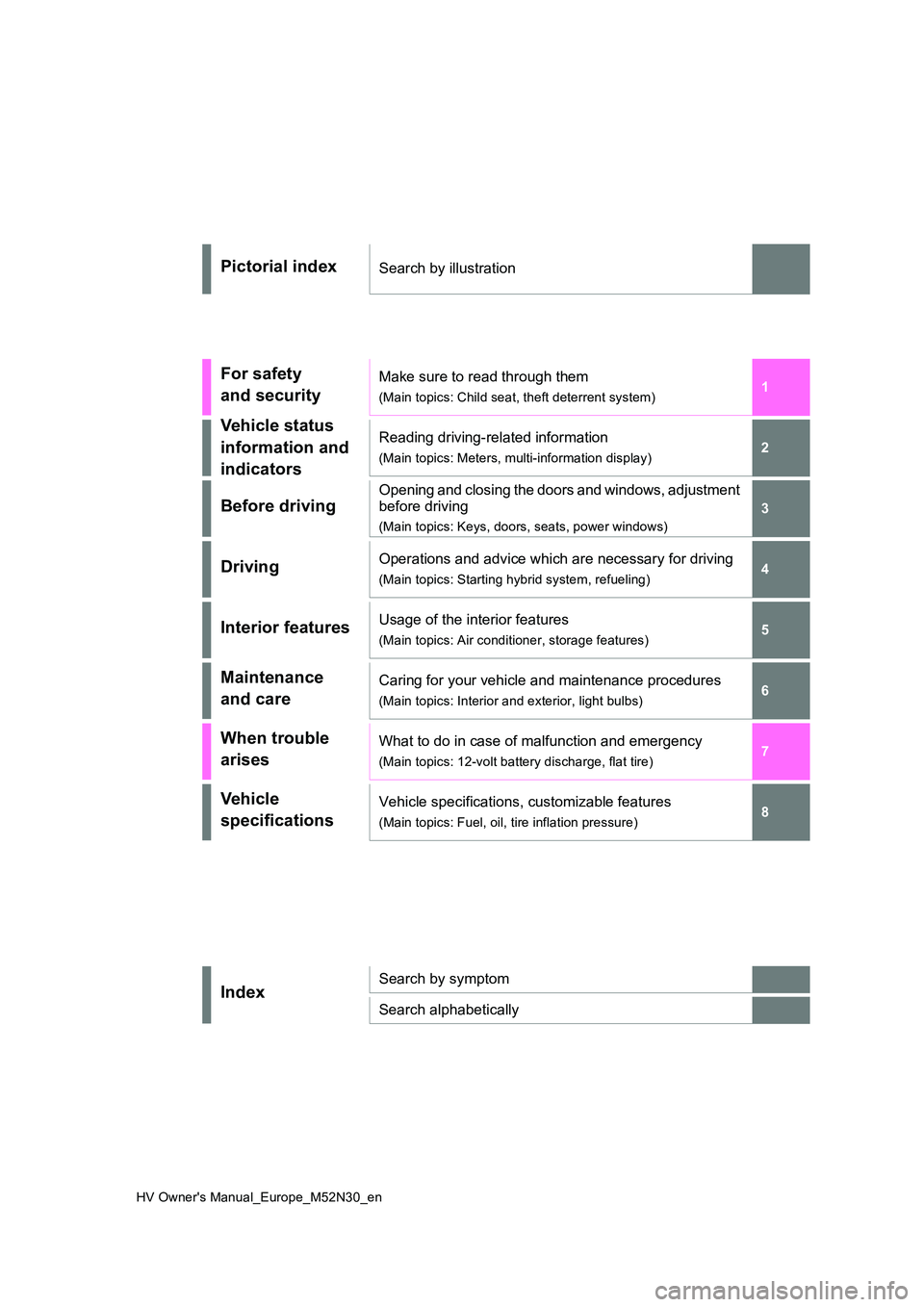
Pictorial indexSearch by illustration
For safety
and security
Make sure to read through them
(Main topics: Child seat, theft deterrent system)
Vehicle status
information and
indicators
Reading driving-related information
(Main topics: Meters, multi-information display)
Before driving
Opening and closing the doors and windows, adjustment
before driving
(Main topics: Keys, doors, seats, power windows)
DrivingOperations and advice which are necessary for driving
(Main topics: Starting hybrid system, refueling)
Interior featuresUsage of the interior features
(Main topics: Air conditioner, storage features)
Maintenance
and care
Caring for your vehicle and maintenance procedures
(Main topics: Interior and exterior, light bulbs)
When trouble
arises
What to do in case of malfunction and emergency
(Main topics: 12-volt battery discharge, flat tire)
Vehicle
specifications
Vehicle specifications, customizable features
(Main topics: Fuel, oil, tire inflation pressure)
IndexSearch by symptom
Search alphabetically
Page 6 of 590
4
HV Owner's Manual_Europe_M52N30_en
TABLE OF CONTENTS
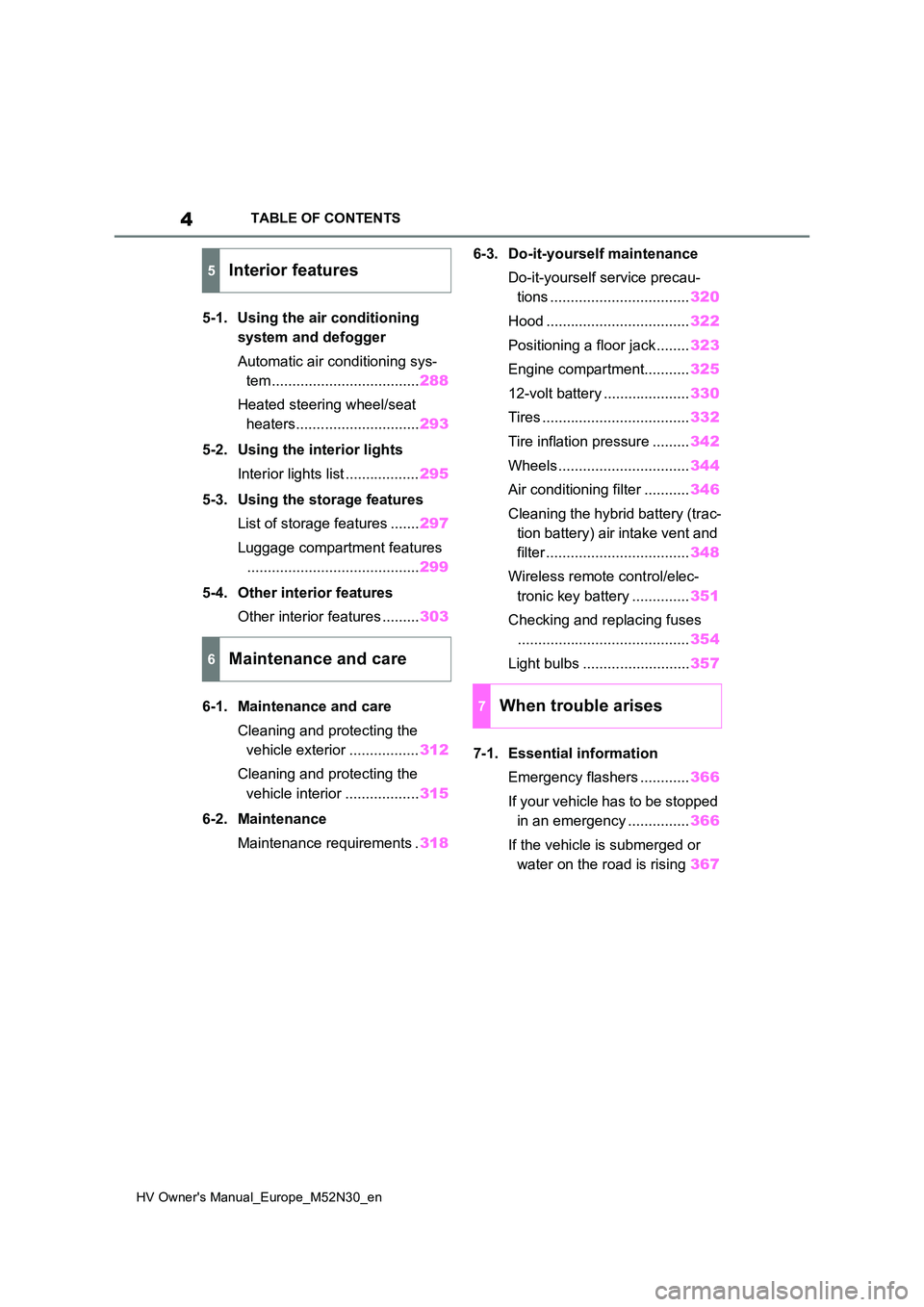
5-1. Using the air conditioning
system and defogger
Automatic air conditioning sys-
tem .................................... 288
Heated steering wheel/seat
heaters.............................. 293
5-2. Using the interior lights
Interior lights list .................. 295
5-3. Using the storage features
List of storage features ....... 297
Luggage compartment features
.......................................... 299
5-4. Other interior features
Other interior features ......... 303
6-1. Maintenance and care
Cleaning and protecting the
vehicle exterior ................. 312
Cleaning and protecting the
vehicle interior .................. 315
6-2. Maintenance
Maintenance requirements . 318
6-3. Do-it-yourself maintenance
Do-it-yourself service precau-
tions .................................. 320
Hood ................................... 322
Positioning a floor jack ........ 323
Engine compartment........... 325
12-volt battery ..................... 330
Tires .................................... 332
Tire inflation pressure ......... 342
Wheels ................................ 344
Air conditioning filter ........... 346
Cleaning the hybrid battery (trac-
tion battery) air intake vent and
filter ................................... 348
Wireless remote control/elec-
tronic key battery .............. 351
Checking and replacing fuses
.......................................... 354
Light bulbs .......................... 357
7-1. Essential information
Emergency flashers ............ 366
If your vehicle has to be stopped
in an emergency ............... 366
If the vehicle is submerged or
water on the road is rising 367
5Interior features
6Maintenance and care
7When trouble arises
Page 7 of 590
5
HV Owner's Manual_Europe_M52N30_en
TABLE OF CONTENTS
1
6
5
4
3
2
8
7
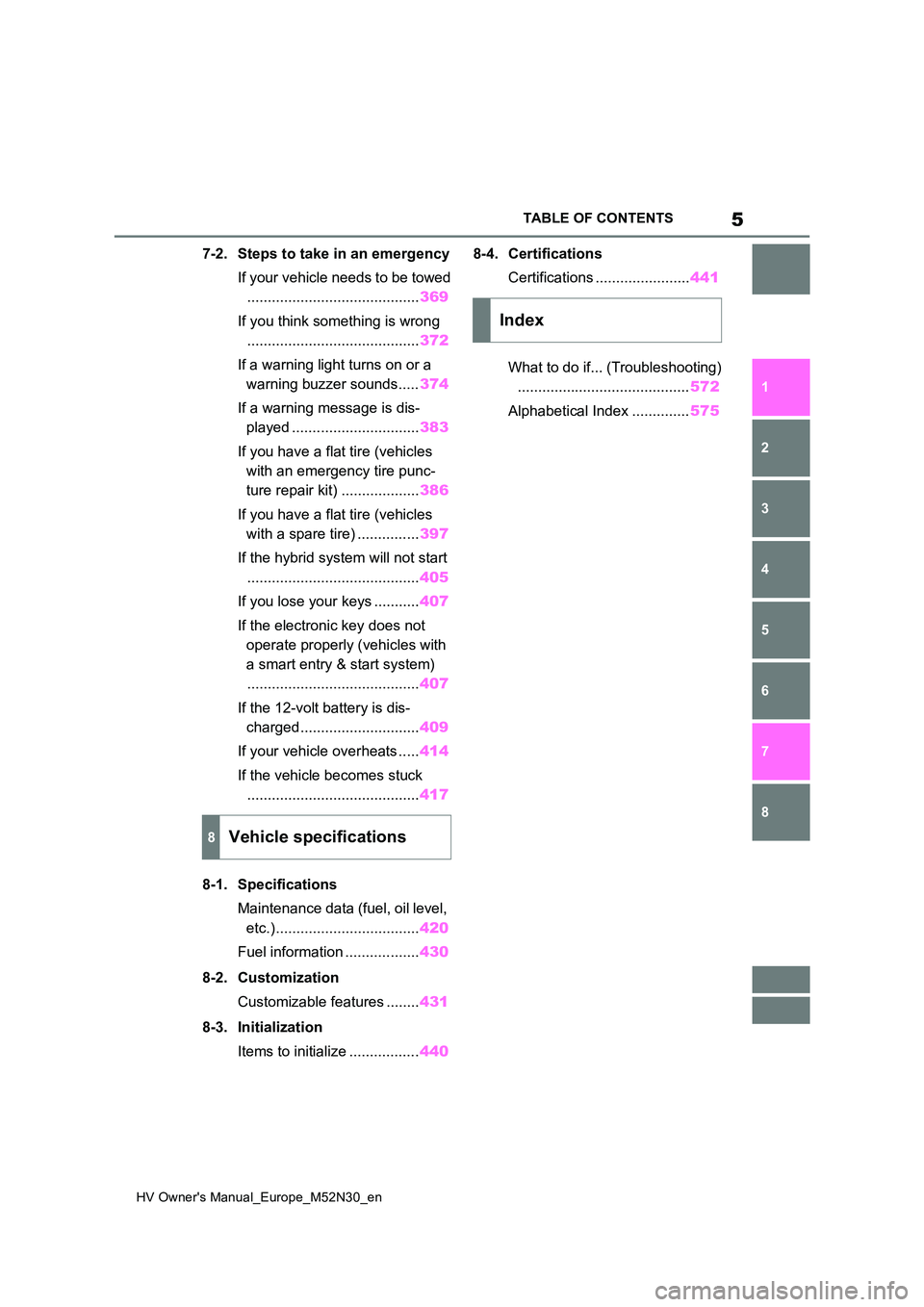
7-2. Steps to take in an emergency
If your vehicle needs to be towed
.......................................... 369
If you think something is wrong
.......................................... 372
If a warning light turns on or a
warning buzzer sounds..... 374
If a warning message is dis-
played ............................... 383
If you have a flat tire (vehicles
with an emergency tire punc-
ture repair kit) ................... 386
If you have a flat tire (vehicles
with a spare tire) ............... 397
If the hybrid system will not start
.......................................... 405
If you lose your keys ........... 407
If the electronic key does not
operate properly (vehicles with
a smart entry & start system)
.......................................... 407
If the 12-volt battery is dis-
charged............................. 409
If your vehicle overheats ..... 414
If the vehicle becomes stuck
.......................................... 417
8-1. Specifications
Maintenance data (fuel, oil level,
etc.)................................... 420
Fuel information .................. 430
8-2. Customization
Customizable features ........ 431
8-3. Initialization
Items to initialize ................. 440
8-4. Certifications
Certifications ....................... 441
What to do if... (Troubleshooting)
.......................................... 572
Alphabetical Index .............. 575
8Vehicle specifications
Index
Page 69 of 590
67
1
HV Owner's Manual_Europe_M52N30_en
1-3. Emergency assistance
For safety and security
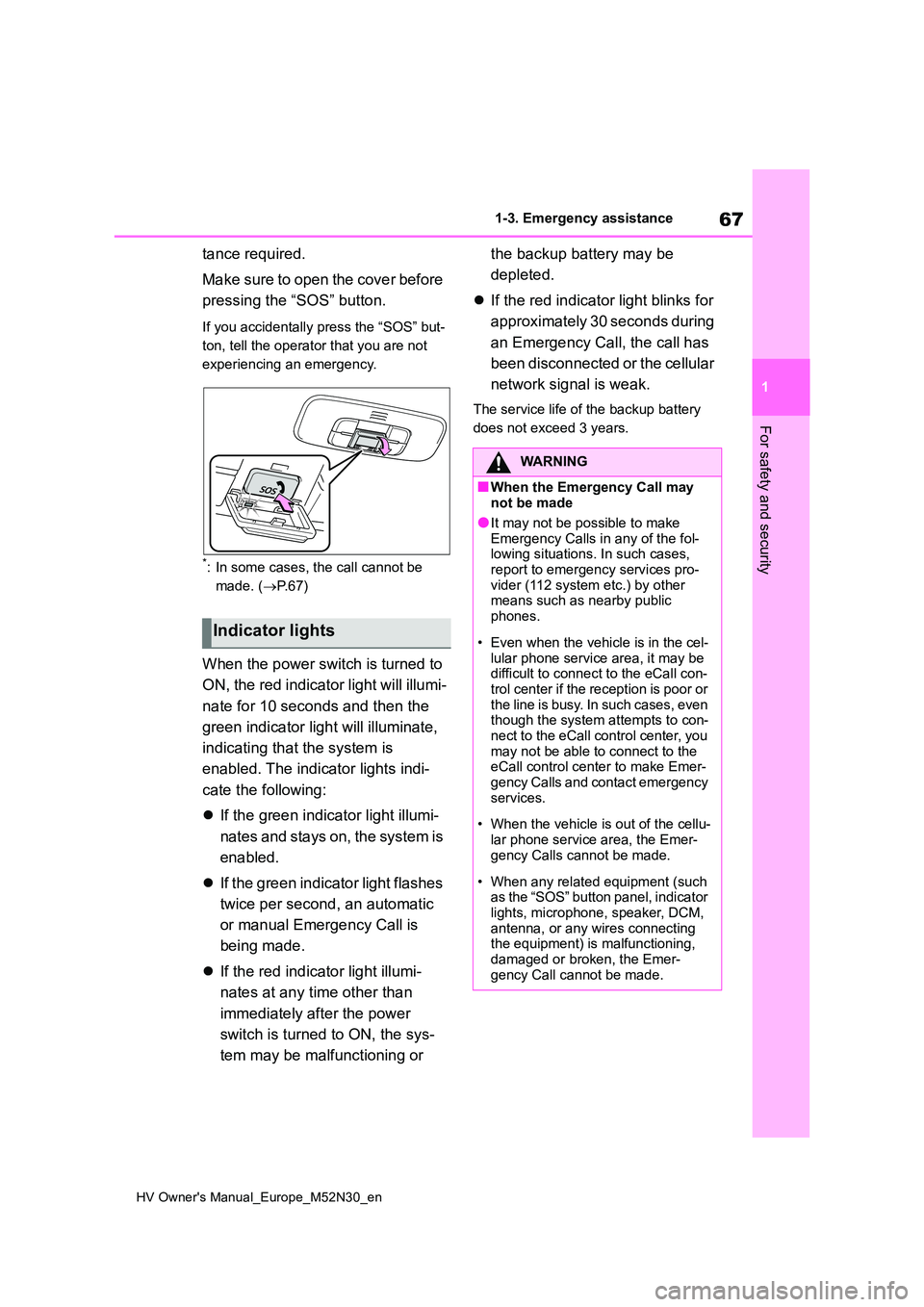
tance required.
Make sure to open the cover before
pressing the “SOS” button.
If you accidentally press the “SOS” but-
ton, tell the operator that you are not
experiencing an emergency.
*: In some cases, the call cannot be
made. ( P. 6 7 )
When the power switch is turned to
ON, the red indicator light will illumi-
nate for 10 seconds and then the
green indicator light will illuminate,
indicating that the system is
enabled. The indicator lights indi-
cate the following:
If the green indicator light illumi-
nates and stays on, the system is
enabled.
If the green indicator light flashes
twice per second, an automatic
or manual Emergency Call is
being made.
If the red indicator light illumi-
nates at any time other than
immediately after the power
switch is turned to ON, the sys-
tem may be malfunctioning or
the backup battery may be
depleted.
If the red indicator light blinks for
approximately 30 seconds during
an Emergency Call, the call has
been disconnected or the cellular
network signal is weak.
The service life of the backup battery
does not exceed 3 years.
Indicator lights
WARNING
■When the Emergency Call may not be made
●It may not be possible to make Emergency Calls in any of the fol-lowing situations. In such cases,
report to emergency services pro- vider (112 system etc.) by other means such as nearby public
phones.
• Even when the vehicle is in the cel-
lular phone service area, it may be difficult to connect to the eCall con-trol center if the reception is poor or
the line is busy. In such cases, even though the system attempts to con-nect to the eCall control center, you
may not be able to connect to the eCall control center to make Emer-gency Calls and contact emergency
services.
• When the vehicle is out of the cellu-
lar phone service area, the Emer- gency Calls cannot be made.
• When any related equipment (such as the “SOS” button panel, indicator lights, microphone, speaker, DCM,
antenna, or any wires connecting the equipment) is malfunctioning, damaged or broken, the Emer-
gency Call cannot be made.
Page 70 of 590
68
HV Owner's Manual_Europe_M52N30_en
1-3. Emergency assistance
WARNING
• During an Emergency Call, the sys- tem makes repeated attempts to
connect to the eCall control center. However, if it cannot connect to the eCall control center due to poor
radio wave reception, the system may not be able to connect to the cellular network and the call may
finish without connecting. The red indicator light will blink for approxi-mately 30 seconds to indicate this
disconnection.
●If the 12-volt battery’s voltage
decreases or there is a disconnec- tion, the system may not be able to connect to the eCall control center.
●The Emergency Call system might not work outside of EU area,
depending on the available infra- structure in the country.
■When the Emergency Call sys-tem is replaced with a new one
The Emergency Call system should
be registered. Contact any authorized Toyota retailer or Toyota authorized repairer, or any reliable repairer.
■For your safety
●Please drive safely.
The function of this system is to assist you in making the Emer-gency Call in case of accidents
such as traffic accidents or sudden medical emergencies, and it does not protect the driver or passengers
in any way. Please drive safely and fasten your seatbelts at all times for your safety.
●In case of an emergency, make lives the top priority.
●If you smell anything burning or other unusual smells, leave the
vehicle and evacuate to a safe area immediately.
●If the airbags deploy when the sys-tem is operating normally, the sys-tem makes emergency call. The
system also makes emergency call when the vehicle is struck from the r e a r o r r ol l s ov er, ev e n i f t h e a ir b a gs
do not deploy.
●For safety, do not make the Emer-
gency Call while driving. Making calls during driving may cause mishandling of the steering
wheel, which may lead to unex- pected accidents.Stop the vehicle and confirm the
safety of your surroundings before making the Emergency Call.
●When changing fuses, please use the specified fuses. Using other fuses may cause ignition or smoke
in the circuit and lead to a fire.
●Using the system while there is
smoke or an unusual smell may cause a fire. Stop using the system immediately and consult any autho-
rized Toyota retailer or Toyota authorized repairer, or any reliable repairer.
NOTICE
■To prevent damage
Do not pour any liquids onto the “SOS” button panel, etc. and do not
impact it.
■If the “SOS” button panel,
speaker or microphone malfunc- tions during an Emergency Call or manual maintenance check
It may not be possible to make Emer- gency Calls, confirm the system sta-tus, or communicate with the eCall
control center operator. If any of the above equipment is damaged, please consult any authorized Toyota retailer
or Toyota authorized repairer, or any reliable repairer.
Page 79 of 590
77
1
HV Owner's Manual_Europe_M52N30_en
1-4. Hybrid system
For safety and security
hybrid battery (traction battery) is
not being charged.
*: When the hybrid battery (traction bat-
tery) requires charging or the engine
is warming up, etc., the gasoline
engine will not automatically stop.
( P. 7 7 )
■During normal driving
The gasoline engine is predomi-
nantly used. The electric motor
(traction motor) charges the hybrid
battery (traction battery) as neces-
sary.
■When accelerating sharply
When the accelerator pedal is
depressed heavily, the power of the
hybrid battery (traction battery) is
added to that of the gasoline engine
via the electric motor (traction
motor).
■When braking (regenerative
braking)
The wheels operate the electric
motor (traction motor) as a power
generator, and the hybrid battery
(traction battery) is charged.
■Regenerative braking
●In the following situations, kinetic energy is converted to electric energy
and deceleration force can be obtained in conjunction with the recharging of the hybrid battery (trac-
tion battery). • The accelerator pedal is released while driving with the shift lever in D or
B. • The brake pedal is depressed while driving with the shift lever in D or B.
●Vehicles with GPF system: While the GPF system ( P.276) is operating to
regenerate the exhaust gas filter, the
hybrid battery (traction battery) may not be recharged.
■EV indicator
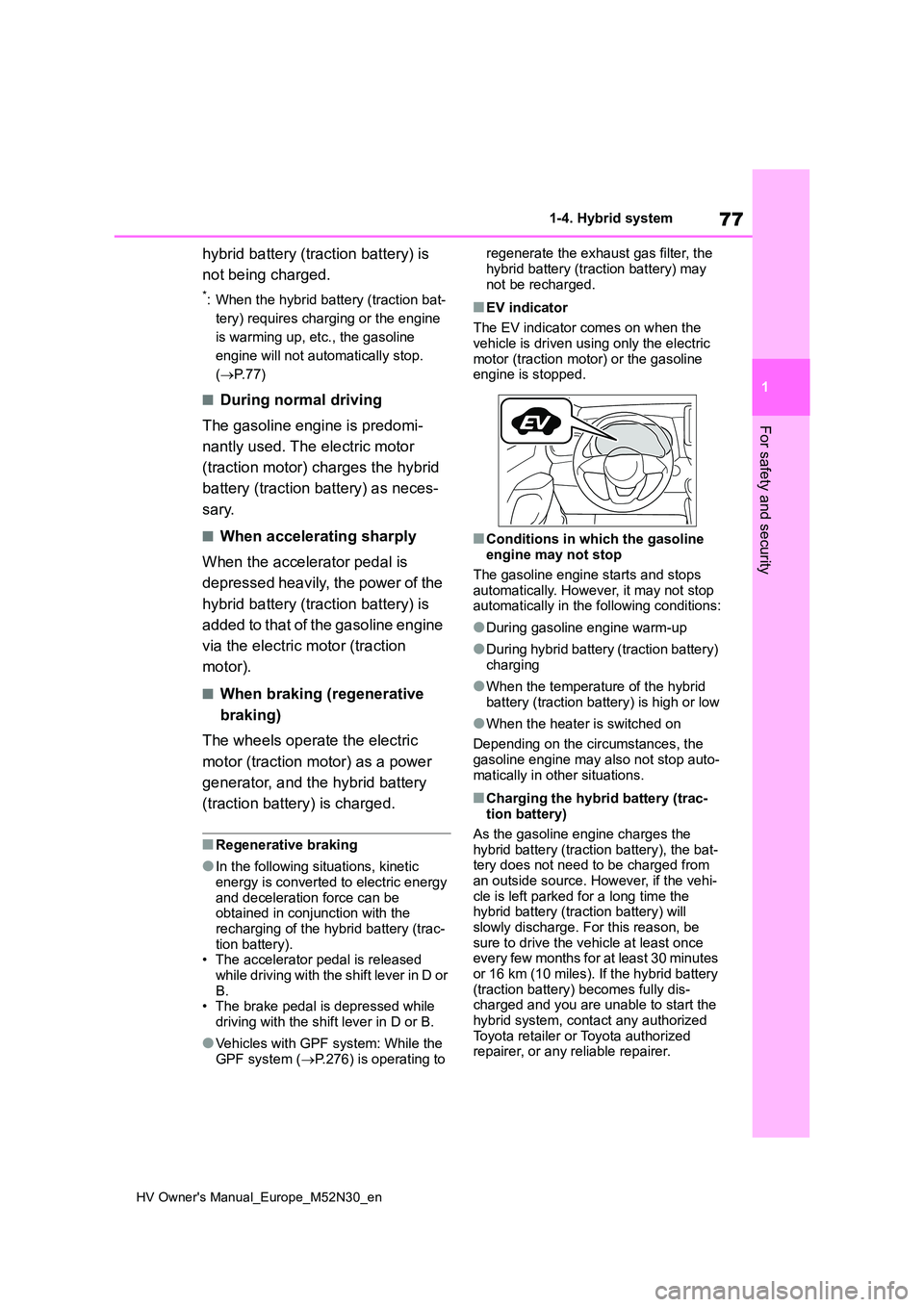
The EV indicator comes on when the
vehicle is driven using only the electric motor (traction motor) or the gasoline engine is stopped.
■Conditions in which the gasoline engine may not stop
The gasoline engine starts and stops automatically. However, it may not stop automatically in the following conditions:
●During gasoline engine warm-up
●During hybrid battery (traction battery) charging
●When the temperature of the hybrid battery (traction battery) is high or low
●When the heater is switched on
Depending on the circumstances, the gasoline engine may also not stop auto-
matically in other situations.
■Charging the hybrid battery (trac- tion battery)
As the gasoline engine charges the
hybrid battery (traction battery), the bat- tery does not need to be charged from an outside source. However, if the vehi-
cle is left parked for a long time the hybrid battery (traction battery) will slowly discharge. For this reason, be
sure to drive the vehicle at least once every few months for at least 30 minutes or 16 km (10 miles). If the hybrid battery
(traction battery) becomes fully dis- charged and you are unable to start the hybrid system, contact any authorized
Toyota retailer or Toyota authorized repairer, or any reliable repairer.
Page 80 of 590
78
HV Owner's Manual_Europe_M52N30_en
1-4. Hybrid system
■Charging the 12-volt battery
P. 4 1 1
■After the 12-volt battery has dis- charged or when the terminal has been removed and installed during
exchange, etc.
The gasoline engine may not stop even if the vehicle is being driven by the
hybrid battery (traction battery). If this continues for a few days, contact any authorized Toyota retailer or Toyota
authorized repairer, or any reliable repairer.
■Sounds and vibrations specific to a hybrid vehicle
There may be no engine sound or vibra- tion even though the vehicle is able to move with the “READY” indicator is illu-
minated. For safety, apply the parking brake and make sure to shift the shift lever to P when parked.
The following sounds or vibrations may occur when the hybrid system is operat-ing and are not a malfunction:
●Motor sounds may be heard from the engine compartment.
●Sounds may be heard from the hybrid battery (traction battery) under the
rear seats when the hybrid system starts or stops.
●Relay operating sounds such as a snap or soft clank will be emitted from the hybrid battery (traction battery),
under the rear seats, when the hybrid system is started or stopped.
●Sounds from the hybrid system may be heard when the back door is open.
●Sounds may be heard from the trans-mission when the gasoline engine starts or stops, when driving at low
speeds, or during idling.
●Engine sounds may be heard when
accelerating sharply.
●Sounds may be heard due to regener-
ative braking when the brake pedal is depressed or as the accelerator pedal is released.
●Vibration may be felt when the gaso-
line engine starts or stops.
●Cooling fan sounds may be heard
from the air intake vent on the side of the lower part of the rear left seat.
■Maintenance, repair, recycling, and disposal
Contact any authorized Toyota retailer or Toyota authorized repairer, or any reli-able repairer regarding maintenance,
repair, recycling and disposal. Do not dispose of the vehicle yourself.
■Customization
Some functions can be customized.
( P.431)
When the gasoline engine is off
while driving, a sound is produced
to warn pedestrians, people riding
bicycles or other people and vehi-
cles in the surrounding area that
the vehicle is approaching. The
pitch of the sound adjusts accord-
ing to vehicle speed. When vehicle
speed is approximately 25 km/h (16
mph) or more, the warning system
turns off.
■Acoustic vehicle alerting system
In the following cases, the acoustic vehi- cle alerting system sound may be diffi-
cult for pedestrians, people riding bicycles or other people and vehicles in the surrounding area to hear:
●When there is a lot of noise in the vicinity
●When it is raining or during strong winds
●When in the area surrounding the rear of the vehicle, rather than in front of
the vehicle
Acoustic vehicle alerting
system
Page 81 of 590
79
1
HV Owner's Manual_Europe_M52N30_en
1-4. Hybrid system
For safety and security
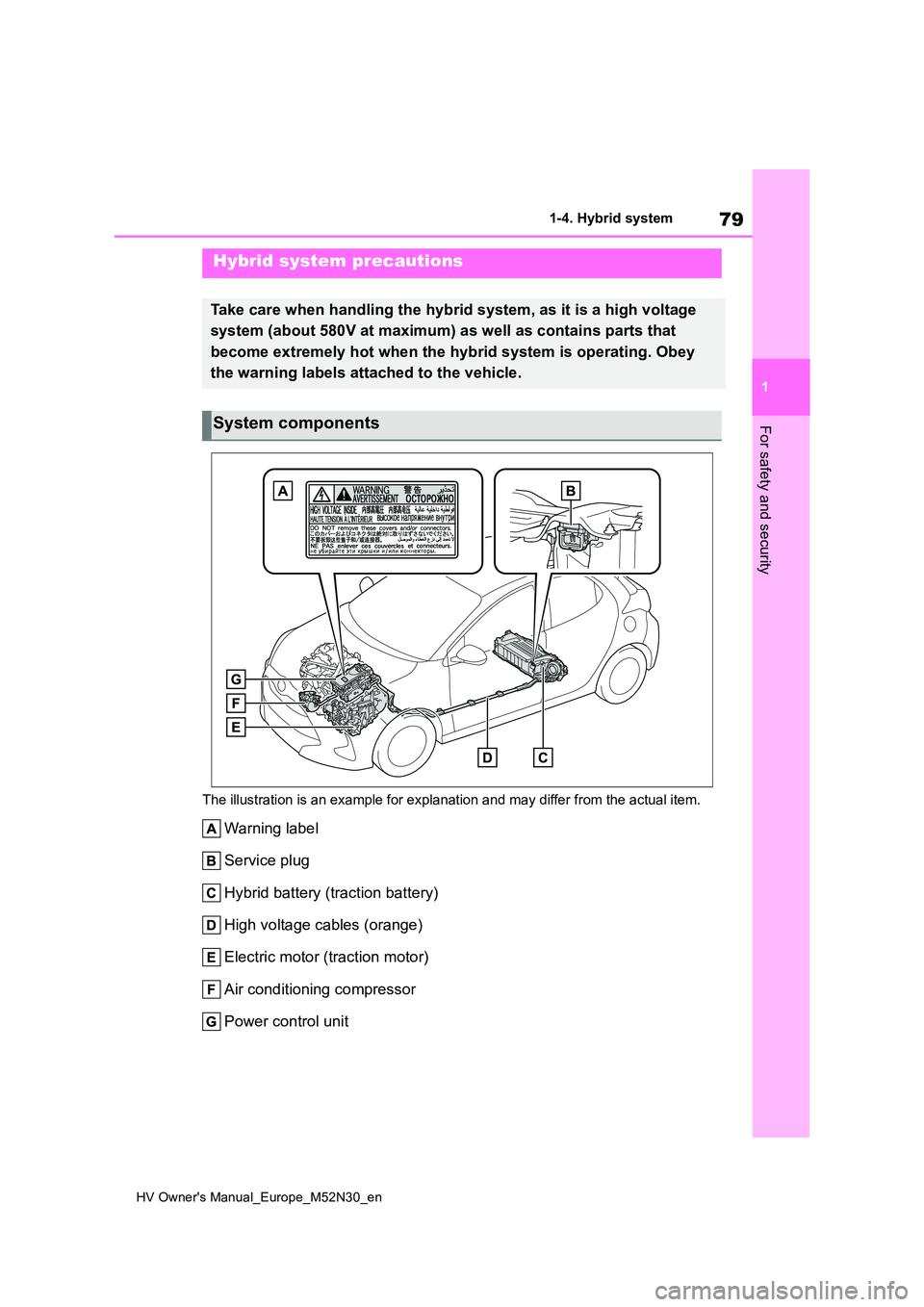
The illustration is an example for explanation and may differ from the actual item.
Warning label
Service plug
Hybrid battery (traction battery)
High voltage cables (orange)
Electric motor (traction motor)
Air conditioning compressor
Power control unit
Hybrid system precautions
Take care when handling the hybrid system, as it is a high volt age
system (about 580V at maximum) as well as contains parts that
become extremely hot when the hybrid system is operating. Obey
the warning labels attached to the vehicle.
System components
Page 82 of 590
80
HV Owner's Manual_Europe_M52N30_en
1-4. Hybrid system
■Running out of fuel
When the vehicle has run out of fuel and
the hybrid system cannot be started, refuel the vehicle with at least enough gasoline to make the low fuel level warn-
ing light ( P.377) go off. If there is only a small amount of fuel, the hybrid sys-tem may not be able to start. (The stan-
dard amount of fuel is about 5.8 L [1.6 gal., 1.3 Imp. gal.] [vehicles without rear wiper] or 6.3 L [1.7 gal., 1.4 Imp. gal.]
[vehicles with rear wiper] when the vehi- cle is on a level surface. This value may vary when the vehicle is on a slope. Add
extra fuel when the vehicle is inclined.)
■Electromagnetic waves
●High voltage parts and cables on
hybrid vehicles incorporate electro- magnetic shielding, and therefore emit approximately the same amount of
electromagnetic waves as conven- tional gasoline powered vehicles or home electronic appliances.
●Your vehicle may cause sound inter-ference in some third party-produced
radio parts.
■Hybrid battery (traction battery)
The hybrid battery (traction battery) has a limited service life. The lifespan of the
hybrid battery (traction battery) can change in accordance with driving style
and driving conditions.
■Starting the hybrid system in an extremely cold environment
When the hybrid battery (traction bat-
tery) is extremely cold (below approxi- mately -30°C [-22°F]) under the influence of the outside temperature, it
may not be possible to start the hybrid system. In this case, try to start the hybrid system again after the tempera-
ture of the hybrid battery increases due to the outside temperature increase etc.
■Declaration of conformity
This model conforms to hydrogen emis-
sions according to regulation ECE100 (Battery electric vehicle safety).
WARNING
■High voltage precautions
This vehicle has high voltage DC and
AC systems as well as a 12-volt sys- tem. DC and AC high voltage is very dangerous and can cause severe
burns and electric shock that may result in death or serious injury.
●Never touch, disassemble, remove or replace the high voltage parts, cables or their connectors.
●The hybrid system will become hot after starting as the system uses
high voltage. Be careful of both the high voltage and the high tempera-ture, and always obey the warning
labels attached to the vehicle.
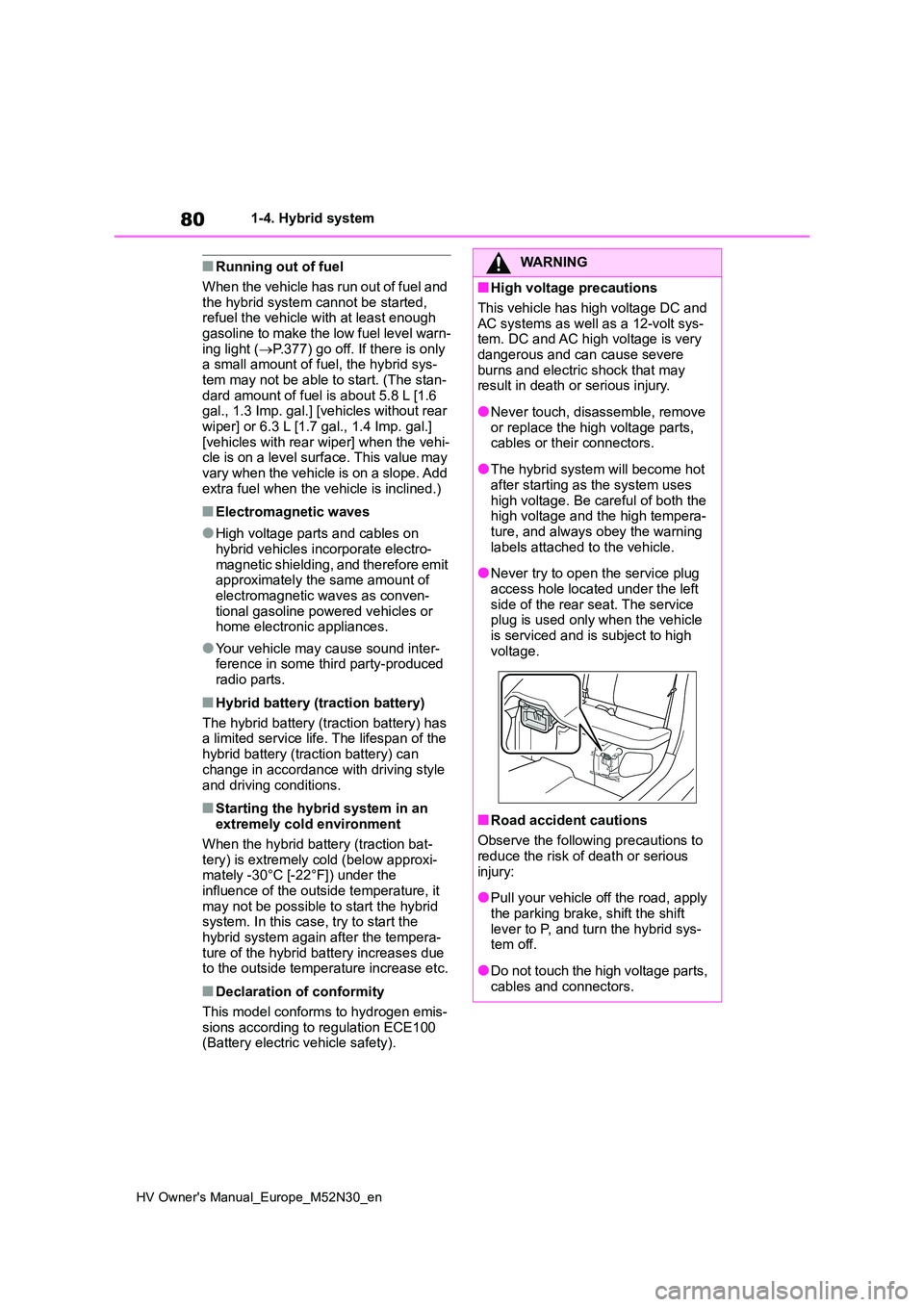
●Never try to open the service plug
access hole located under the left side of the rear seat. The service plug is used only when the vehicle
is serviced and is subject to high voltage.
■Road accident cautions
Observe the following precautions to reduce the risk of death or serious
injury:
●Pull your vehicle off the road, apply
the parking brake, shift the shift lever to P, and turn the hybrid sys-tem off.
●Do not touch the high voltage parts, cables and connectors.
Page 83 of 590
81
1
HV Owner's Manual_Europe_M52N30_en
1-4. Hybrid system
For safety and security
WARNING
●If electric wires are exposed inside or outside your vehicle, an electric
shock may occur. Never touch exposed electric wires.
●If a fire occurs in the hybrid vehicle, leave the vehicle as soon as possi-ble. Never use a fire extinguisher
that is not meant for electric fires. Using even a small amount of water may be dangerous.
●If your vehicle needs to be towed, do so with the front wheels raised. If
the wheels connected to the electric motor (traction motor) are on the ground when towing, the motor may
continue to generate electricity. This may cause a fire. ( P.369)
●Carefully inspect the ground under the vehicle. If you find that liquid has leaked onto the ground, the fuel
system may have been damaged. Leave the vehicle as soon as possi-ble.
●Do not touch the battery if liquid is leaking from or adhering to it. If
electrolyte (carbonate ester-based organic electrolyte) from the hybrid battery (traction battery) comes into
contact with the eyes or skin, it could cause blindness or skin wounds. In the unlikely event that it
comes into contact with the eyes or skin, wash it off immediately with a large amount of water, and seek
immediate medical attention.
●If electrolyte is leaking from the hybrid battery (traction battery), do not approach the vehicle. Even in
the unlikely event that the hybrid battery (traction battery) is dam-aged, the internal construction of
the battery will prevent a large amount of electrolyte from leaking out. However, any electrolyte that
does leak out will give off a vapor. This vapor is an irritant to skin and eyes and could cause acute poi-
soning if inhaled.
●Do not bring burning or high-tem-
perature items close to the electro- lyte. The electrolyte may ignite and cause a fire.
■Hybrid battery (traction battery)
●Your vehicle contains a sealed lith-
ium-ion battery.
●Never resell, hand over or modify
the hybrid battery. To prevent acci- dents, hybrid batteries that have been removed from a disposed
vehicle are collected through any authorized Toyota retailer or Toyota authorized repairer, or any reliable
repairer. Do not dispose of the bat- tery yourself.
Unless the battery is properly col-
lected, the following may occur,
resulting in death or serious injury:
• The hybrid battery may be illegally disposed of or dumped, and it is
hazardous to the environment or someone may touch a high voltage part, resulting in an electric shock.
• The hybrid battery is intended to be used exclusively with your hybrid
vehicle. If the hybrid battery is used outside of your vehicle or modified in any way, accidents such as elec-
tric shock, heat generation, smoke generation, an explosion and elec-trolyte leakage may occur.