inflation pressure TOYOTA YARIS 2022 Owners Manual
[x] Cancel search | Manufacturer: TOYOTA, Model Year: 2022, Model line: YARIS, Model: TOYOTA YARIS 2022Pages: 590, PDF Size: 128.6 MB
Page 3 of 590
1
6
5
4
3
2
7
8
HV Owner's Manual_Europe_M52N30_en
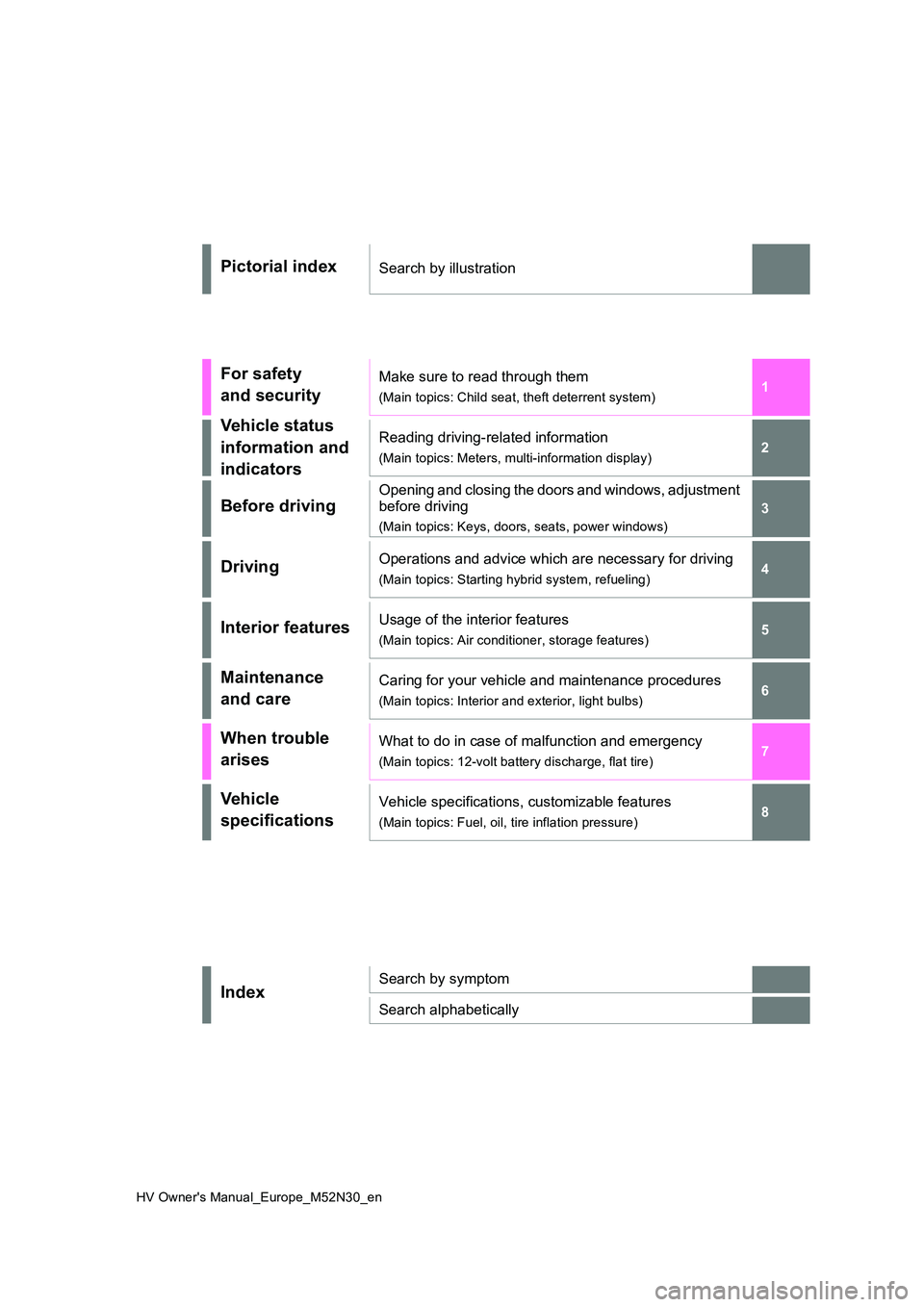
Pictorial indexSearch by illustration
For safety
and security
Make sure to read through them
(Main topics: Child seat, theft deterrent system)
Vehicle status
information and
indicators
Reading driving-related information
(Main topics: Meters, multi-information display)
Before driving
Opening and closing the doors and windows, adjustment
before driving
(Main topics: Keys, doors, seats, power windows)
DrivingOperations and advice which are necessary for driving
(Main topics: Starting hybrid system, refueling)
Interior featuresUsage of the interior features
(Main topics: Air conditioner, storage features)
Maintenance
and care
Caring for your vehicle and maintenance procedures
(Main topics: Interior and exterior, light bulbs)
When trouble
arises
What to do in case of malfunction and emergency
(Main topics: 12-volt battery discharge, flat tire)
Vehicle
specifications
Vehicle specifications, customizable features
(Main topics: Fuel, oil, tire inflation pressure)
IndexSearch by symptom
Search alphabetically
Page 6 of 590
4
HV Owner's Manual_Europe_M52N30_en
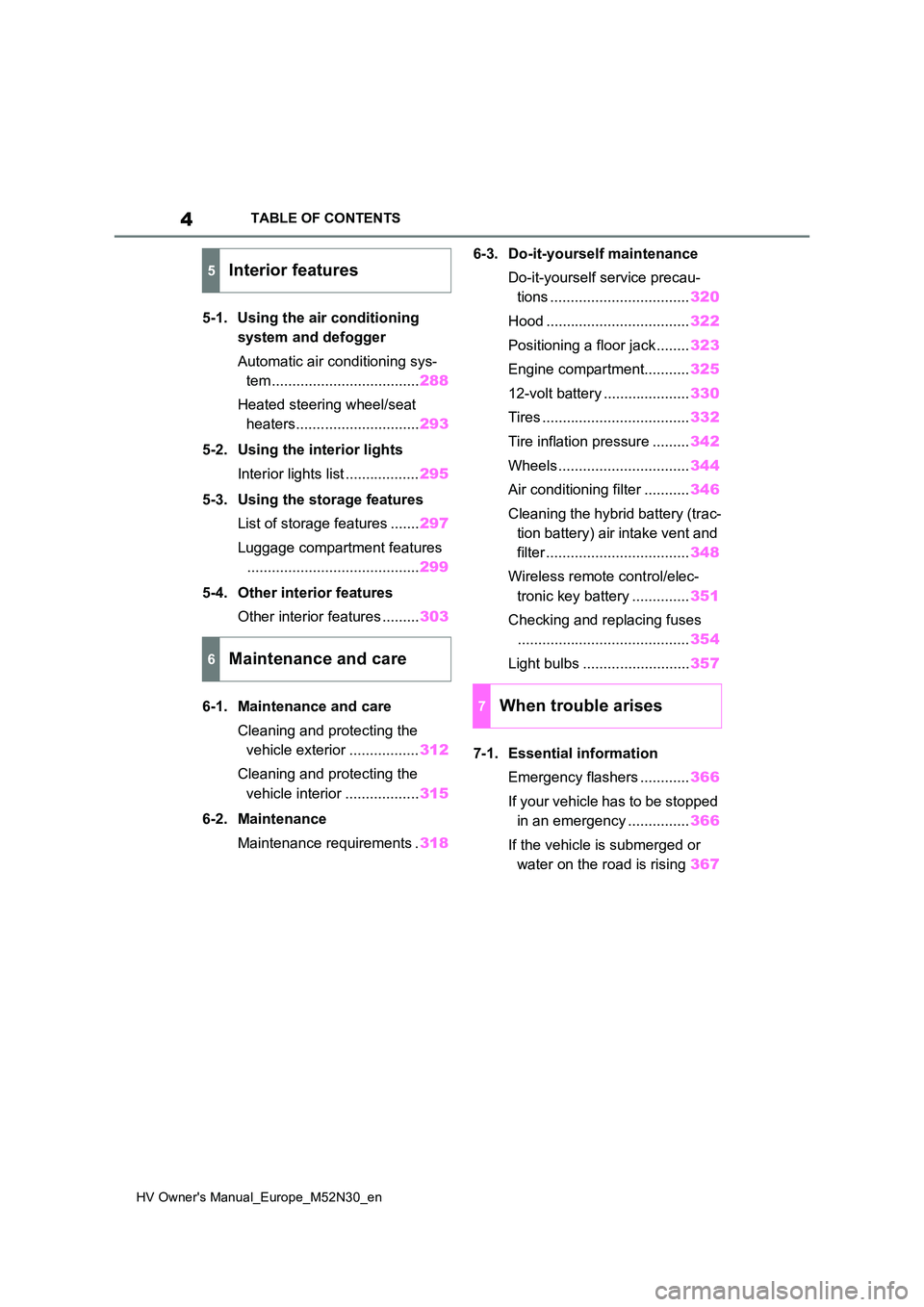
TABLE OF CONTENTS
5-1. Using the air conditioning
system and defogger
Automatic air conditioning sys-
tem .................................... 288
Heated steering wheel/seat
heaters.............................. 293
5-2. Using the interior lights
Interior lights list .................. 295
5-3. Using the storage features
List of storage features ....... 297
Luggage compartment features
.......................................... 299
5-4. Other interior features
Other interior features ......... 303
6-1. Maintenance and care
Cleaning and protecting the
vehicle exterior ................. 312
Cleaning and protecting the
vehicle interior .................. 315
6-2. Maintenance
Maintenance requirements . 318
6-3. Do-it-yourself maintenance
Do-it-yourself service precau-
tions .................................. 320
Hood ................................... 322
Positioning a floor jack ........ 323
Engine compartment........... 325
12-volt battery ..................... 330
Tires .................................... 332
Tire inflation pressure ......... 342
Wheels ................................ 344
Air conditioning filter ........... 346
Cleaning the hybrid battery (trac-
tion battery) air intake vent and
filter ................................... 348
Wireless remote control/elec-
tronic key battery .............. 351
Checking and replacing fuses
.......................................... 354
Light bulbs .......................... 357
7-1. Essential information
Emergency flashers ............ 366
If your vehicle has to be stopped
in an emergency ............... 366
If the vehicle is submerged or
water on the road is rising 367
5Interior features
6Maintenance and care
7When trouble arises
Page 15 of 590
13
HV Owner's Manual_Europe_M52N30_en
Pictorial index
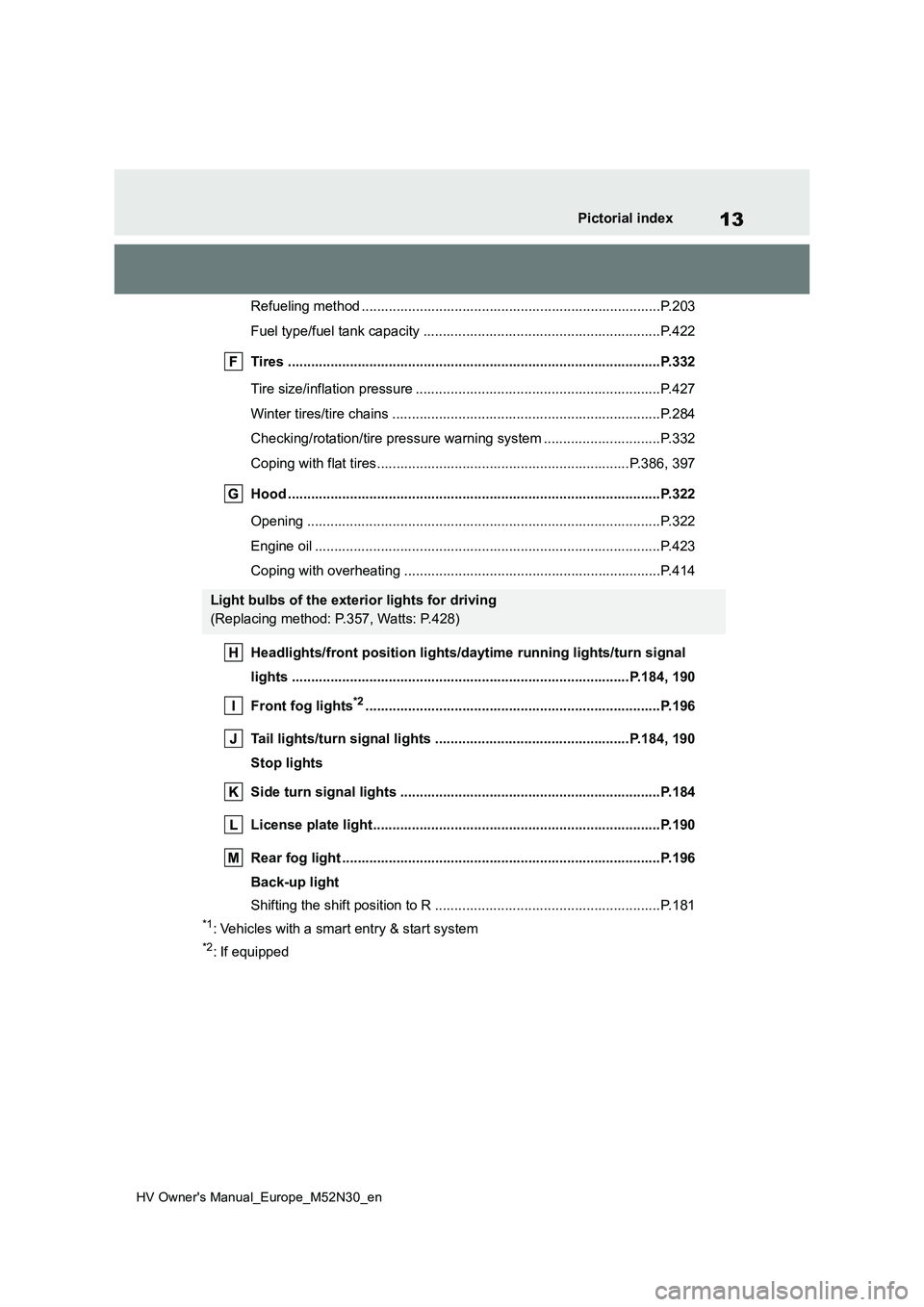
Refueling method .............................................................................P.203
Fuel type/fuel tank capacity ................................... ..........................P.422
Tires .......................................................... ......................................P.332
Tire size/inflation pressure ................................... ............................P.427
Winter tires/tire chains ....................................... ..............................P.284
Checking/rotation/tire pressure warning system ................. .............P.332
Coping with flat tires......................................... ........................P.386, 397
Hood ........................................................... .....................................P.322
Opening ........................................................ ...................................P.322
Engine oil ..................................................... ....................................P.423
Coping with overheating ........................................ ..........................P.414
Headlights/front position lights/daytime running lights/turn si gnal
lights ......................................................... ..............................P.184, 190
Front fog lights*2............................................................... .............P.196
Tail lights/turn signal lights ................................. .................P.184, 190
Stop lights
Side turn signal lights ........................................ ...........................P.184
License plate light............................................ ..............................P.190
Rear fog light ................................................. .................................P.196
Back-up light
Shifting the shift position to R ............................... ...........................P.181
*1: Vehicles with a smart entry & start system
*2: If equipped
Light bulbs of the exterior lights for driving
(Replacing method: P.357, Watts: P.428)
Page 171 of 590
169
4
HV Owner's Manual_Europe_M52N30_en
4-1. Before driving
Driving
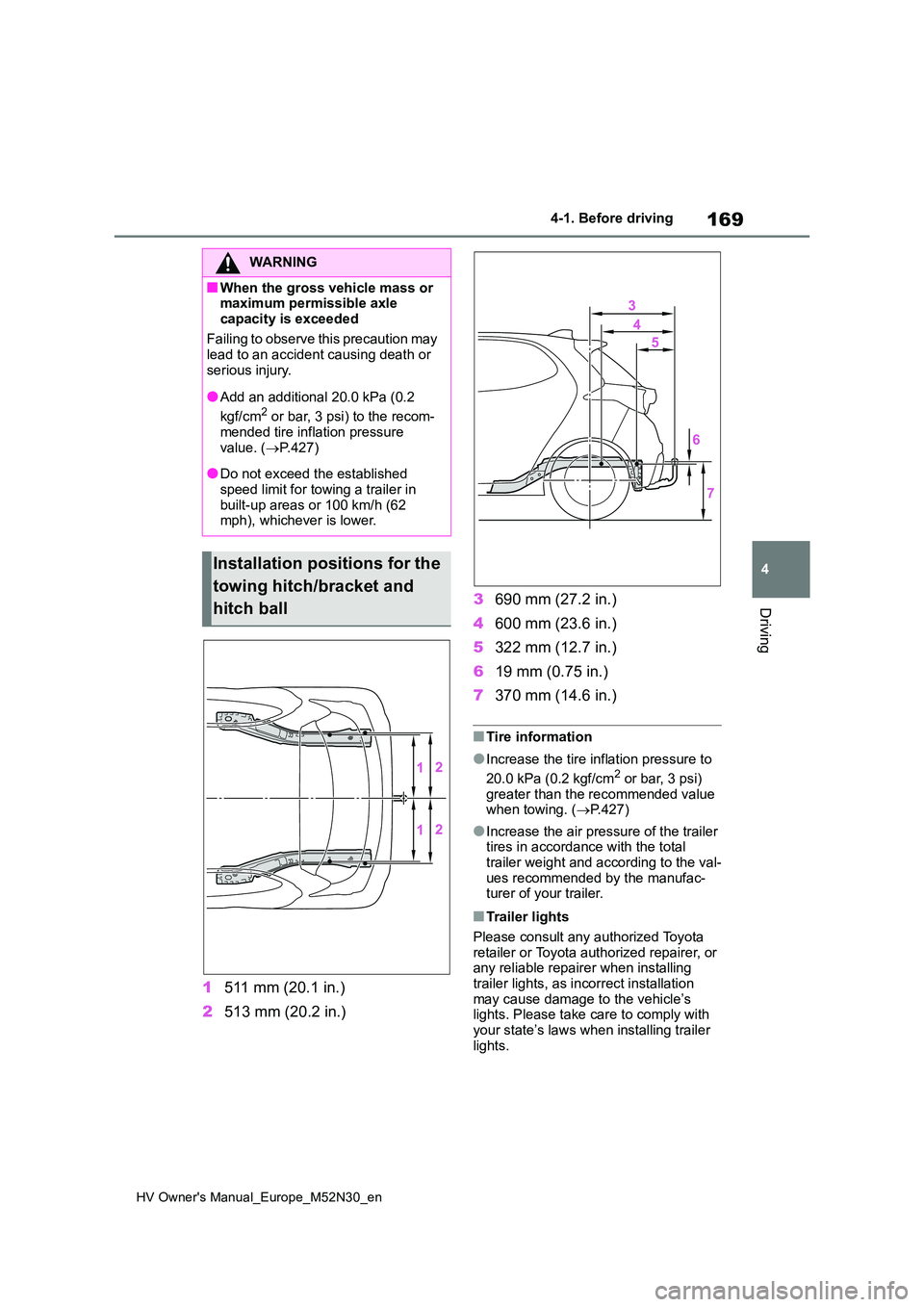
1511 mm (20.1 in.)
2 513 mm (20.2 in.)
3 690 mm (27.2 in.)
4 600 mm (23.6 in.)
5 322 mm (12.7 in.)
6 19 mm (0.75 in.)
7 370 mm (14.6 in.)
■Tire information
●Increase the tire inflation pressure to
20.0 kPa (0.2 kgf/cm2 or bar, 3 psi) greater than the recommended value when towing. ( P.427)
●Increase the air pressure of the trailer tires in accordance with the total
trailer weight and according to the val- ues recommended by the manufac-turer of your trailer.
■Trailer lights
Please consult any authorized Toyota retailer or Toyota authorized repairer, or any reliable repairer when installing
trailer lights, as incorrect installation may cause damage to the vehicle’s lights. Please take care to comply with
your state’s laws when installing trailer lights.
WARNING
■When the gross vehicle mass or maximum permissible axle
capacity is exceeded
Failing to observe this precaution may lead to an accident causing death or
serious injury.
●Add an additional 20.0 kPa (0.2
kgf/cm2 or bar, 3 psi) to the recom- mended tire inflation pressure
value. ( P.427)
●Do not exceed the established
speed limit for towing a trailer in built-up areas or 100 km/h (62 mph), whichever is lower.
Installation positions for the
towing hitch/bracket and
hitch ball
Page 221 of 590
219
4
HV Owner's Manual_Europe_M52N30_en
4-5. Using the driving support systems
Driving
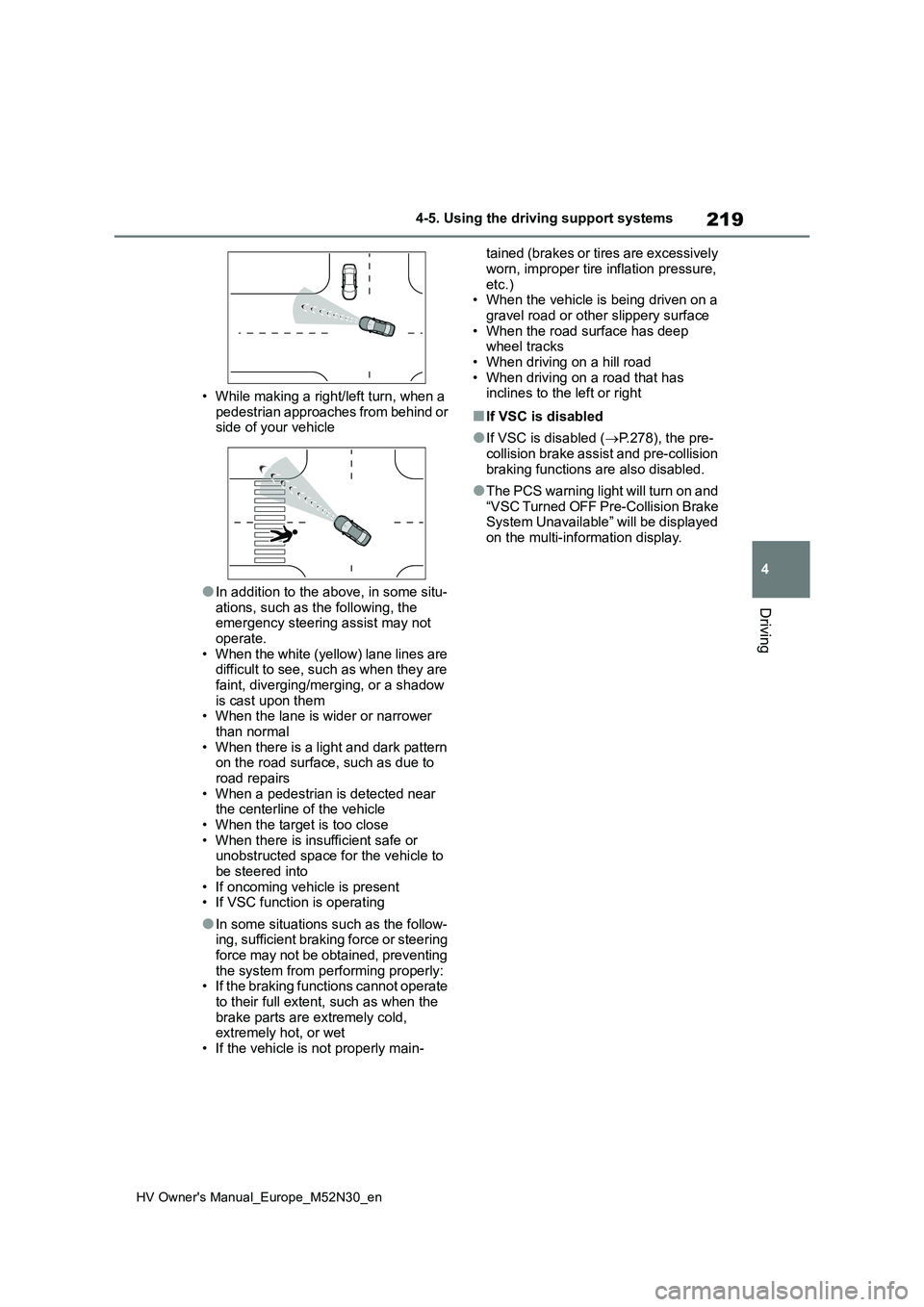
• While making a right/left turn, when a
pedestrian approaches from behind or side of your vehicle
●In addition to the above, in some situ-ations, such as the following, the emergency steering assist may not
operate. • When the white (yellow) lane lines are difficult to see, such as when they are
faint, diverging/merging, or a shadow is cast upon them• When the lane is wider or narrower
than normal • When there is a light and dark pattern on the road surface, such as due to
road repairs • When a pedestrian is detected near the centerline of the vehicle
• When the target is too close • When there is insufficient safe or unobstructed space for the vehicle to
be steered into • If oncoming vehicle is present• If VSC function is operating
●In some situations such as the follow-ing, sufficient braking force or steering
force may not be obtained, preventing the system from performing properly:• If the braking functions cannot operate
to their full extent, such as when the brake parts are extremely cold, extremely hot, or wet
• If the vehicle is not properly main-
tained (brakes or tires are excessively
worn, improper tire inflation pressure, etc.)• When the vehicle is being driven on a
gravel road or other slippery surface • When the road surface has deep wheel tracks
• When driving on a hill road • When driving on a road that has inclines to the left or right
■If VSC is disabled
●If VSC is disabled ( P.278), the pre- collision brake assist and pre-collision
braking functions are also disabled.
●The PCS warning light will turn on and
“VSC Turned OFF Pre-Collision Brake System Unavailable” will be displayed on the multi-information display.
Page 285 of 590
283
4
HV Owner's Manual_Europe_M52N30_en
4-6. Driving tips
Driving
a traffic jam, gently release the
brake pedal to allow the vehicle to
move forward slightly while avoid-
ing overuse of the accelerator
pedal. Doing so can help control
excessive gasoline consumption.
Control and maintain the vehicle at
a constant speed. Before stopping
at a toll booth or similar, allow
plenty of time to release the accel-
erator and gently apply the brakes.
A greater amount of electrical
energy can be regenerated when
slowing down.
Use the air conditioning only when
necessary. Doing so can help
reduce excessive gasoline con-
sumption.
In summer: When the ambient tem-
perature is high, use the recircu-
lated air mode. Doing so will help to
reduce the burden on the air condi-
tioning system and reduce fuel con-
sumption as well.
In winter: Because the gasoline
engine will not automatically cut out
until it and the interior of the vehicle
are warm, it will consume fuel. Also,
fuel consumption can be improved
by avoiding overuse of the heater.
Make sure to check the tire inflation
pressure frequently. Improper tire
inflation pressure can cause poor
fuel economy.
Also, as snow tires can cause large
amounts of friction, their use on dry
roads can lead to poor fuel econ-
omy. Use tires that are appropriate
for the season.
Carrying heavy luggage will lead to
poor fuel economy. Avoid carrying
unnecessary luggage. Installing a
large roof rack will also cause poor
fuel economy.
Since the gasoline engine starts up
and cuts out automatically when
cold, warming up the engine is
unnecessary. Moreover, frequently
driving short distances will cause
the engine to repeatedly warm up,
which can lead to excess fuel con-
sumption.
Highway driving
Air conditioning
Checking tire inflation pres-
sure
Luggage
Warming up before driving
Page 313 of 590
6
311
HV Owner's Manual_Europe_M52N30_en
6
Maintenance and care
Maintenance and care
6-1. Maintenance and care
Cleaning and protecting the
vehicle exterior ............... 312
Cleaning and protecting the
vehicle interior ................ 315
6-2. Maintenance
Maintenance requirements 318
6-3. Do-it-yourself maintenance
Do-it-yourself service precau-
tions ................................ 320
Hood ................................. 322
Positioning a floor jack...... 323
Engine compartment ........ 325
12-volt battery ................... 330
Tires .................................. 332
Tire inflation pressure ....... 342
Wheels.............................. 344
Air conditioning filter ......... 346
Cleaning the hybrid battery
(traction battery) air intake
vent and filter .................. 348
Wireless remote control/elec-
tronic key battery ............ 351
Checking and replacing fuses
....................................... 354
Light bulbs ........................ 357
Page 322 of 590
320
HV Owner's Manual_Europe_M52N30_en
6-3. Do-it-yourself maintenance
6-3.Do-it-y ours elf main ten ance
Do-it-yourself ser vice
precautions
If you perform maintenance by
yourself, be sure to follow the
correct procedure as given in
these sections.
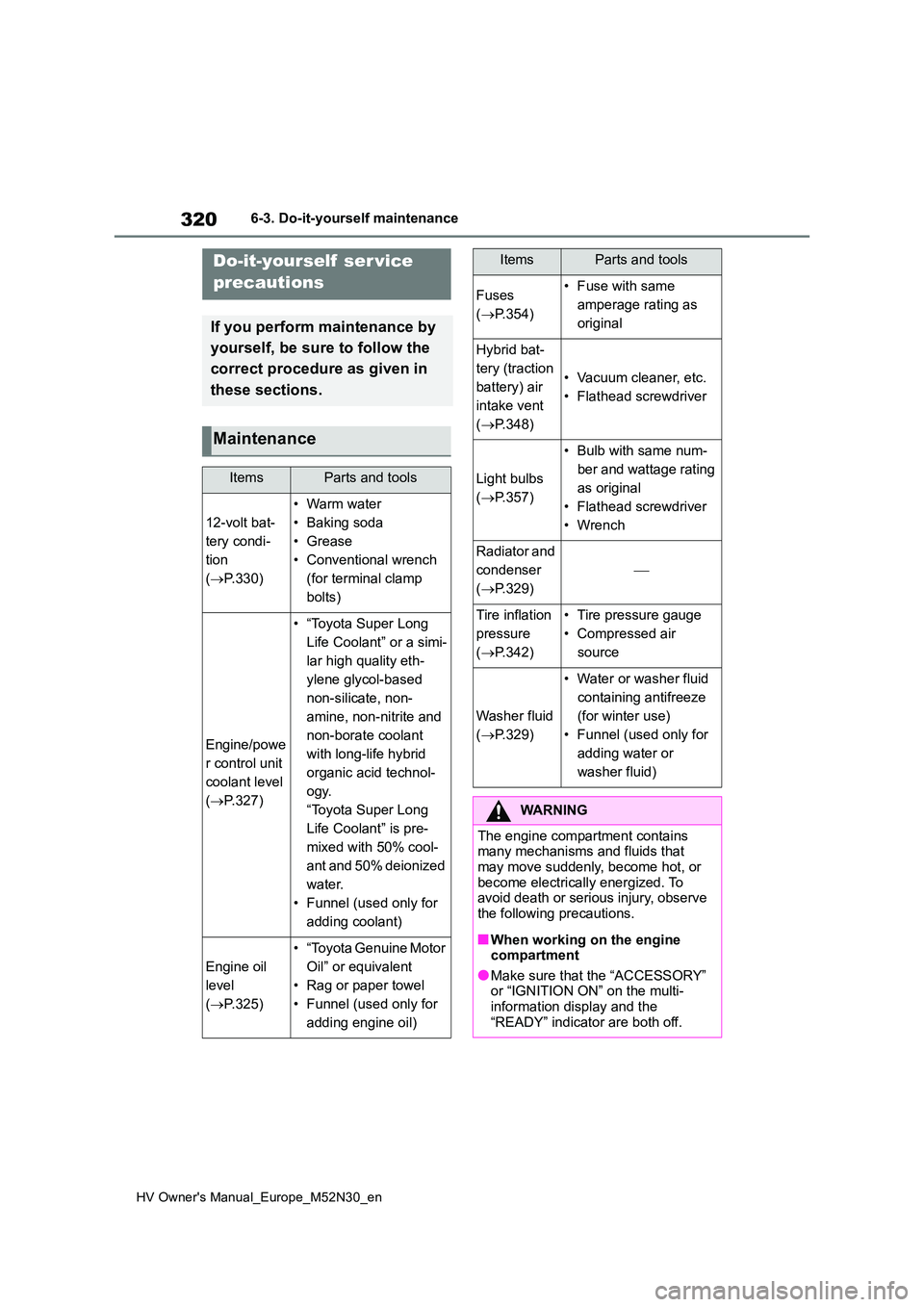
Maintenance
ItemsParts and tools
12-volt bat-
tery condi-
tion
( P.330)
•Warm water
• Baking soda
• Grease
• Conventional wrench
(for terminal clamp
bolts)
Engine/powe
r control unit
coolant level
( P.327)
• “Toyota Super Long
Life Coolant” or a simi-
lar high quality eth-
ylene glycol-based
non-silicate, non-
amine, non-nitrite and
non-borate coolant
with long-life hybrid
organic acid technol-
ogy.
“Toyota Super Long
Life Coolant” is pre-
mixed with 50% cool-
ant and 50% deionized
water.
• Funnel (used only for
adding coolant)
Engine oil
level
( P.325)
• “Toyota Genuine Motor
Oil” or equivalent
• Rag or paper towel
• Funnel (used only for
adding engine oil)
Fuses
( P.354)
• Fuse with same
amperage rating as
original
Hybrid bat-
tery (traction
battery) air
intake vent
( P.348)
• Vacuum cleaner, etc.
• Flathead screwdriver
Light bulbs
( P.357)
• Bulb with same num-
ber and wattage rating
as original
• Flathead screwdriver
•Wrench
Radiator and
condenser
( P.329)
Tire inflation
pressure
( P.342)
• Tire pressure gauge
• Compressed air
source
Washer fluid
( P.329)
• Water or washer fluid
containing antifreeze
(for winter use)
• Funnel (used only for
adding water or
washer fluid)
WARNING
The engine compartment contains many mechanisms and fluids that may move suddenly, become hot, or
become electrically energized. To avoid death or serious injury, observe the following precautions.
■When working on the engine compartment
●Make sure that the “ACCESSORY” or “IGNITION ON” on the multi-information display and the
“READY” indicator are both off.
ItemsParts and tools
Page 335 of 590
333
6
HV Owner's Manual_Europe_M52N30_en
6-3. Do-it-yourself maintenance
Maintenance and care
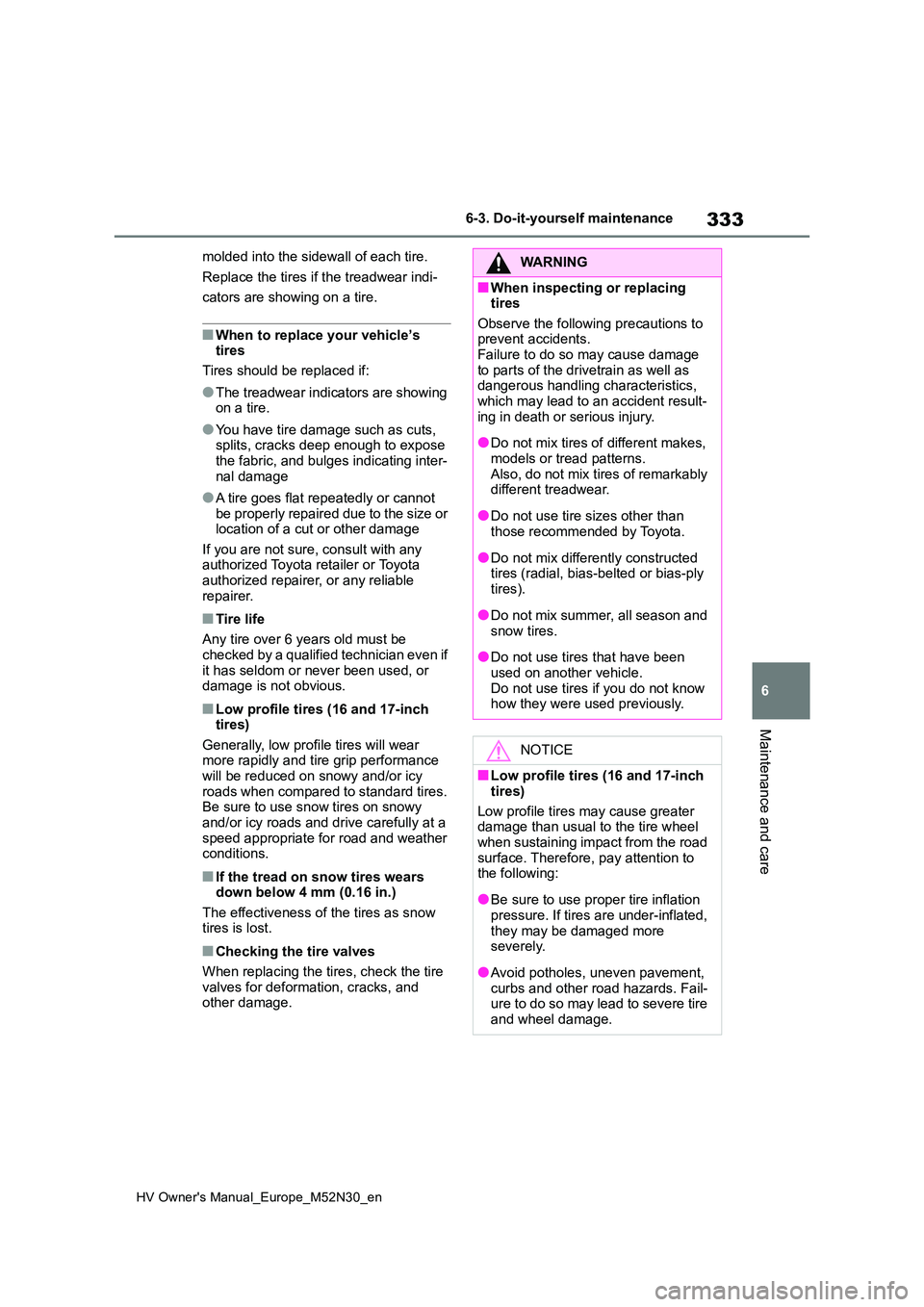
molded into the sidewall of each tire.
Replace the tires if the treadwear indi-
cators are showing on a tire.
■When to replace your vehicle’s tires
Tires should be replaced if:
●The treadwear indicators are showing on a tire.
●You have tire damage such as cuts, splits, cracks deep enough to expose
the fabric, and bulges indicating inter- nal damage
●A tire goes flat repeatedly or cannot be properly repaired due to the size or location of a cut or other damage
If you are not sure, consult with any authorized Toyota retailer or Toyota authorized repairer, or any reliable
repairer.
■Tire life
Any tire over 6 years old must be checked by a qualified technician even if
it has seldom or never been used, or damage is not obvious.
■Low profile tires (16 and 17-inch tires)
Generally, low profile tires will wear more rapidly and tire grip performance will be reduced on snowy and/or icy
roads when compared to standard tires. Be sure to use snow tires on snowy and/or icy roads and drive carefully at a
speed appropriate for road and weather conditions.
■If the tread on snow tires wears down below 4 mm (0.16 in.)
The effectiveness of the tires as snow tires is lost.
■Checking the tire valves
When replacing the tires, check the tire valves for deformation, cracks, and other damage.
WARNING
■When inspecting or replacing tires
Observe the following precautions to prevent accidents.Failure to do so may cause damage
to parts of the drivetrain as well as dangerous handling characteristics, which may lead to an accident result-
ing in death or serious injury.
●Do not mix tires of different makes,
models or tread patterns. Also, do not mix tires of remarkably different treadwear.
●Do not use tire sizes other than those recommended by Toyota.
●Do not mix differently constructed tires (radial, bias-belted or bias-ply
tires).
●Do not mix summer, all season and
snow tires.
●Do not use tires that have been
used on another vehicle. Do not use tires if you do not know how they were used previously.
NOTICE
■Low profile tires (16 and 17-inch
tires)
Low profile tires may cause greater damage than usual to the tire wheel
when sustaining impact from the road surface. Therefore, pay attention to the following:
●Be sure to use proper tire inflation pressure. If tires are under-inflated,
they may be damaged more severely.
●Avoid potholes, uneven pavement, curbs and other road hazards. Fail-ure to do so may lead to severe tire
and wheel damage.
Page 336 of 590
334
HV Owner's Manual_Europe_M52N30_en
6-3. Do-it-yourself maintenance
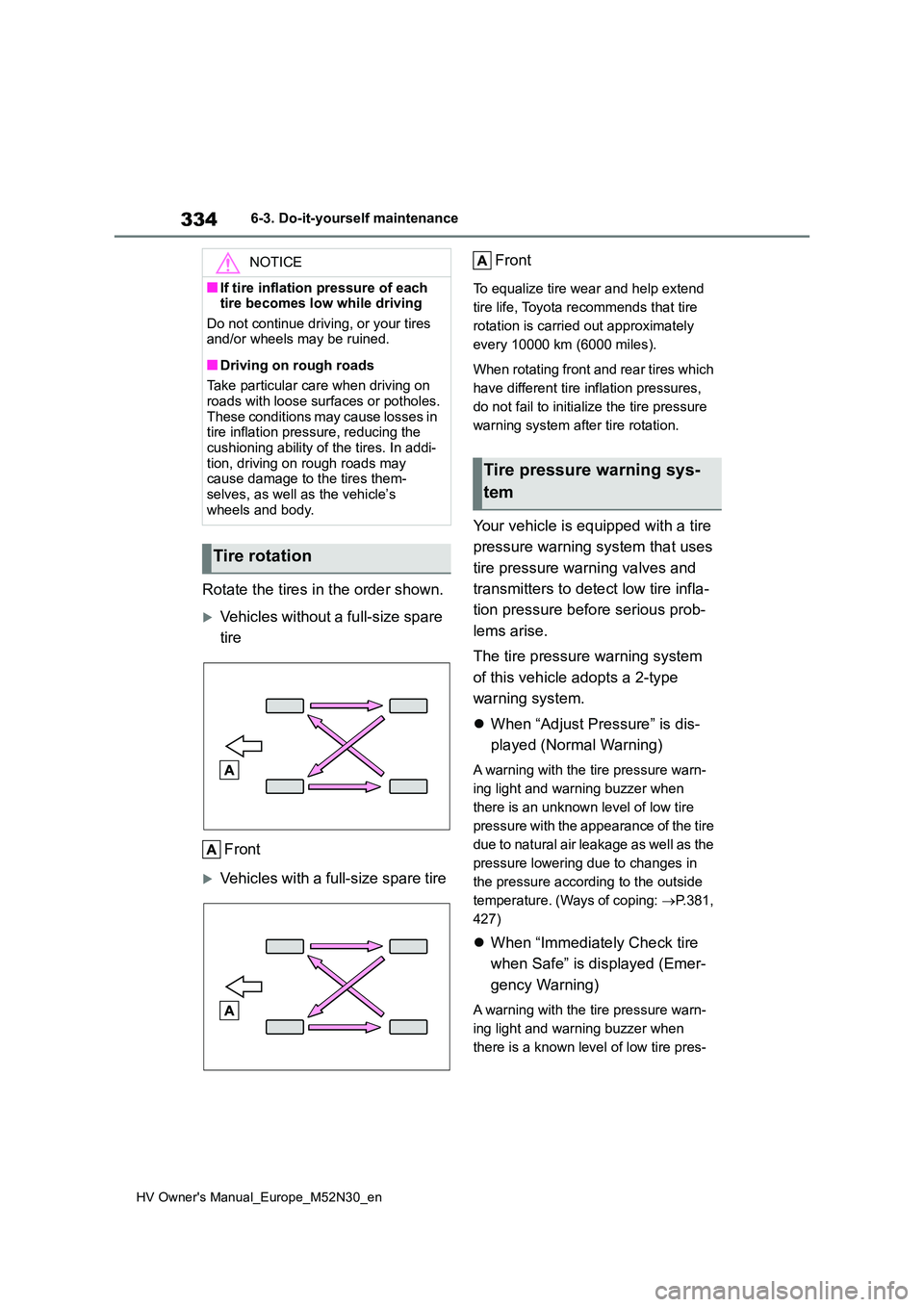
Rotate the tires in the order shown.
Vehicles without a full-size spare
tire
Front
Vehicles with a full-size spare tire
Front
To equalize tire wear and help extend
tire life, Toyota recommends that tire
rotation is carried out approximately
every 10000 km (6000 miles).
When rotating front and rear tires which
have different tire inflation pressures,
do not fail to initialize the tire pressure
warning system after tire rotation.
Your vehicle is equipped with a tire
pressure warning system that uses
tire pressure warning valves and
transmitters to detect low tire infla-
tion pressure before serious prob-
lems arise.
The tire pressure warning system
of this vehicle adopts a 2-type
warning system.
When “Adjust Pressure” is dis-
played (Normal Warning)
A warning with the tire pressure warn-
ing light and warning buzzer when
there is an unknown level of low tire
pressure with the appearance of the tire
due to natural air leakage as well as the
pressure lowering due to changes in
the pressure according to the outside
temperature. (Ways of coping: P.381,
427)
When “Immediately Check tire
when Safe” is displayed (Emer-
gency Warning)
A warning with the tire pressure warn-
ing light and warning buzzer when
there is a known level of low tire pres-
NOTICE
■If tire inflation pressure of each tire becomes low while driving
Do not continue driving, or your tires and/or wheels may be ruined.
■Driving on rough roads
Take particular care when driving on roads with loose surfaces or potholes.
These conditions may cause losses in tire inflation pressure, reducing the cushioning ability of the tires. In addi-
tion, driving on rough roads may cause damage to the tires them-selves, as well as the vehicle’s
wheels and body.
Tire rotation
Tire pressure warning sys-
tem