tow TOYOTA YARIS CROSS 2022 Workshop Manual
[x] Cancel search | Manufacturer: TOYOTA, Model Year: 2022, Model line: YARIS CROSS, Model: TOYOTA YARIS CROSS 2022Pages: 618, PDF Size: 130.77 MB
Page 363 of 618
361
6
CV Owner's Manual_Europe_M52N20_en
6-3. Do-it-yourself maintenance
Maintenance and care
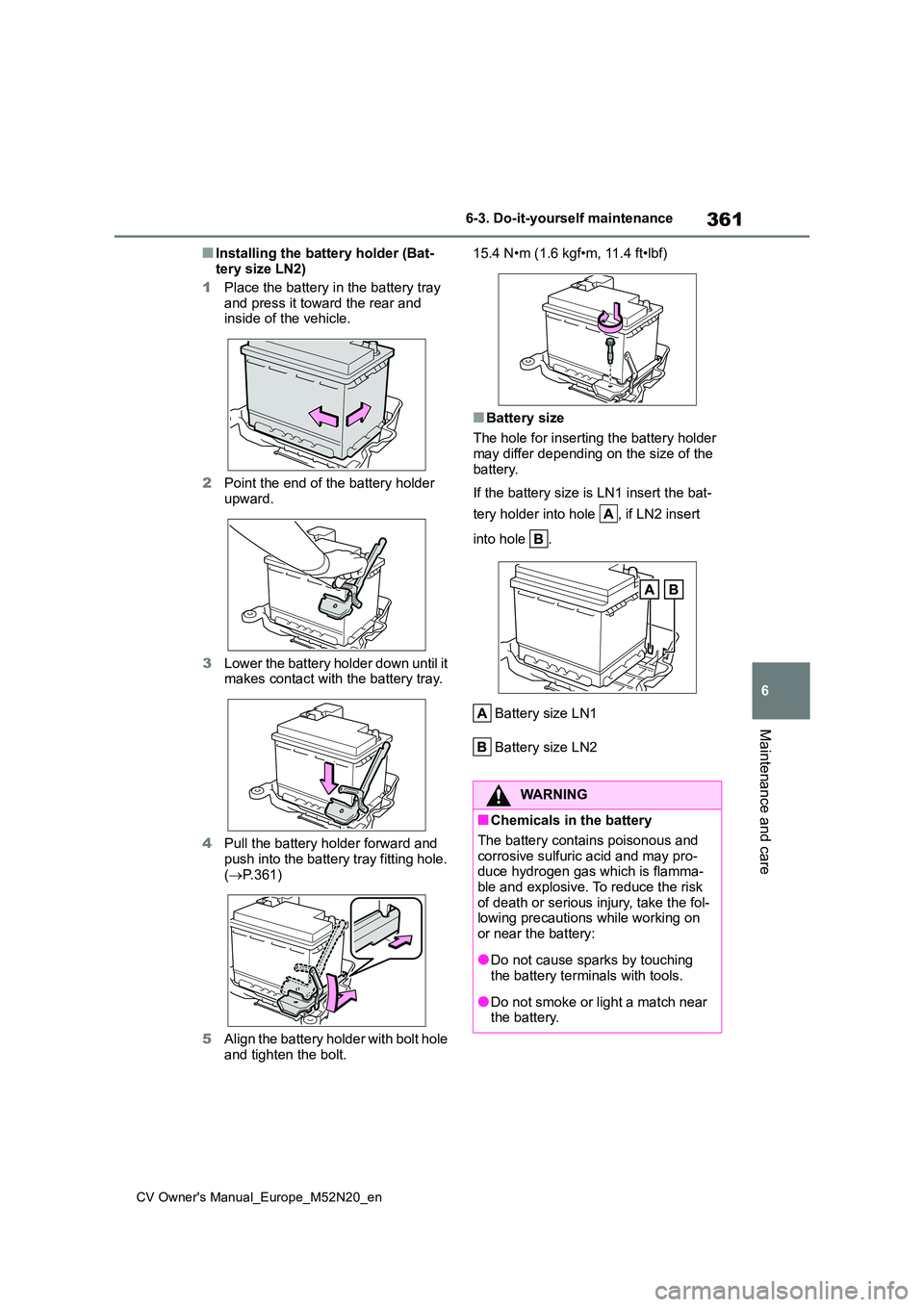
■Installing the battery holder (Bat-
tery size LN2)
1 Place the battery in the battery tray and press it toward the rear and inside of the vehicle.
2 Point the end of the battery holder upward.
3 Lower the battery holder down until it makes contact with the battery tray.
4 Pull the battery holder forward and push into the battery tray fitting hole.
( P.361)
5 Align the battery holder with bolt hole
and tighten the bolt.
15.4 N•m (1.6 kgf•m, 11.4 ft•lbf)
■Battery size
The hole for inserting the battery holder
may differ depending on the size of the battery.
If the battery size is LN1 insert the bat-
tery holder into hole , if LN2 insert
into hole .
Battery size LN1
Battery size LN2
WARNING
■Chemicals in the battery
The battery contains poisonous and corrosive sulfuric acid and may pro-duce hydrogen gas which is flamma-
ble and explosive. To reduce the risk of death or serious injury, take the fol-lowing precautions while working on
or near the battery:
●Do not cause sparks by touching the battery terminals with tools.
●Do not smoke or light a match near the battery.
Page 368 of 618
366
CV Owner's Manual_Europe_M52N20_en
6-3. Do-it-yourself maintenance
■Routine tire inflation pressure checks
The tire pressure warning system does not replace routine tire inflation pressure checks. Make sure to check tire inflation
pressure as part of your routine of daily vehicle checks.
■Tire inflation pressure
●It may take a few minutes to display the tire inflation pressure after the engine switch is turned to ON. It may
also take a few minutes to display the tire inflation pressure after inflation pressure has been adjusted.
●Tire inflation pressure changes with temperature. The displayed values
may also be different from the values measured using a tire pressure gauge.
■Situations in which the tire pres-
sure warning system may not oper- ate properly
●In the following cases, the tire pres-sure warning system may not operate properly.
• If non-genuine Toyota wheels are used.• A tire has been replaced with a tire
that is not an OE (Original Equipment) tire.• A tire has been replaced with a tire
that is not of the specified size. • Tire chains, etc. are equipped.
• An auxiliary-supported run-flat tire is equipped.• If a window tint that affects the radio
wave signals is installed. • If there is a lot of snow or ice on the vehicle, particularly around the wheels
or wheel housings. • If the tire inflation pressure is extremely higher than the specified
level. • If tires not equipped with tire pressure warning valves and transmitters are
used. • If the ID code on the tire pressure warning valves and transmitters is not
registered in the tire pressure warning
computer.
●Performance may be affected in the following situations.
• Near a TV tower, electric power plant, gas station, radio station, large dis-play, airport or other facility that gen-
erates strong radio waves or electrical noise.• When carrying a portable radio, cellu-
lar phone, cordless phone or other wireless communication device.
●When the vehicle is parked, the time taken for the warning to start or go off could be extended.
●When tire inflation pressure declines rapidly for example when a tire has
burst, the not to able detect.
■Warning performance of the tire pressure warning system
The warning of the tire pressure warning
system will change in accordance with driving conditions. For this reason, the system may give a warning even if the
tire pressure does not reach a low enough level, or if the pressure is higher than the pressure that was adjusted to
when the system was initialized.
When replacing tires or wheels, tire
pressure warning valves and trans-
mitters must also be installed.
When new tire pressure warning
valves and transmitters are
installed, new ID codes must be
registered in the tire pressure warn-
ing computer and the tire pressure
warning system must be initialized.
Have tire pressure warning valves
and transmitter ID codes regis-
tered any authorized Toyota retailer
or Toyota authorized repairer, or
Installing tire pressure warn-
ing valves and transmitters
Page 390 of 618
388
CV Owner's Manual_Europe_M52N20_en
6-3. Do-it-yourself maintenance
light is leaking through the mounting.
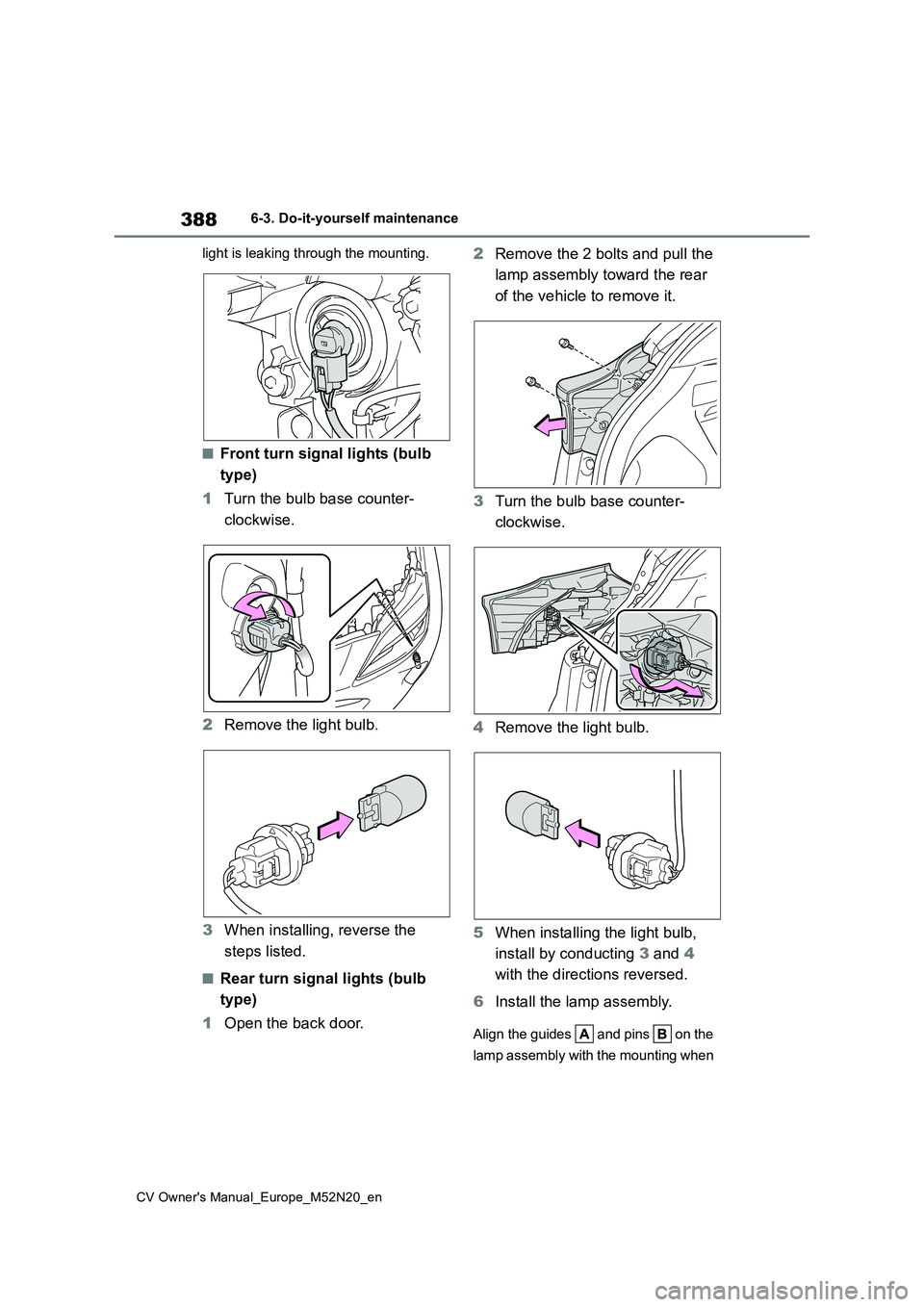
■Front turn signal lights (bulb
type)
1 Turn the bulb base counter-
clockwise.
2 Remove the light bulb.
3 When installing, reverse the
steps listed.
■Rear turn signal lights (bulb
type)
1 Open the back door.
2 Remove the 2 bolts and pull the
lamp assembly toward the rear
of the vehicle to remove it.
3 Turn the bulb base counter-
clockwise.
4 Remove the light bulb.
5 When installing the light bulb,
install by conducting 3 and 4
with the directions reversed.
6 Install the lamp assembly.
Align the guides and pins on the
lamp assembly with the mounting when
Page 395 of 618
7
393
CV Owner's Manual_Europe_M52N20_en
7
When trouble arises
When trouble arises
7-1. Essential information
Emergency flashers .......... 394
If your vehicle has to be
stopped in an emergency 394
If the vehicle is submerged or
water on the road is rising
....................................... 395
7-2. Steps to take in an emer-
gency
If your vehicle needs to be
towed .............................. 397
If you think something is wrong
....................................... 401
Fuel pump shut off system 402
If a warning light turns on or a
warning buzzer sounds... 403
If a warning message is dis-
played ............................. 413
If you have a flat tire (vehicles
with an emergency tire punc-
ture repair kit) ................. 415
If you have a flat tire (vehicles
with a spare tire) ............. 426
If the engine will not start .. 435
If you lose your keys ......... 436
If the electronic key does not
operate properly (vehicles
with a smart entry & start sys-
tem) ................................ 437
If the vehicle battery is dis-
charged .......................... 439
If your vehicle overheats... 442
If the vehicle becomes stuck
....................................... 444
Page 399 of 618
397
7
CV Owner's Manual_Europe_M52N20_en
7-2. Steps to take in an emergency
When trouble arises
7-2.Ste ps to take in an emerg ency
The following may indicate a prob-
lem with your transmission. Contact
any authorized Toyota retailer or
Toyota authorized repairer, or any
reliable repairer or commercial tow-
ing service before towing.
The engine is running but the
vehicle does not move.
The vehicle makes an abnormal
sound.
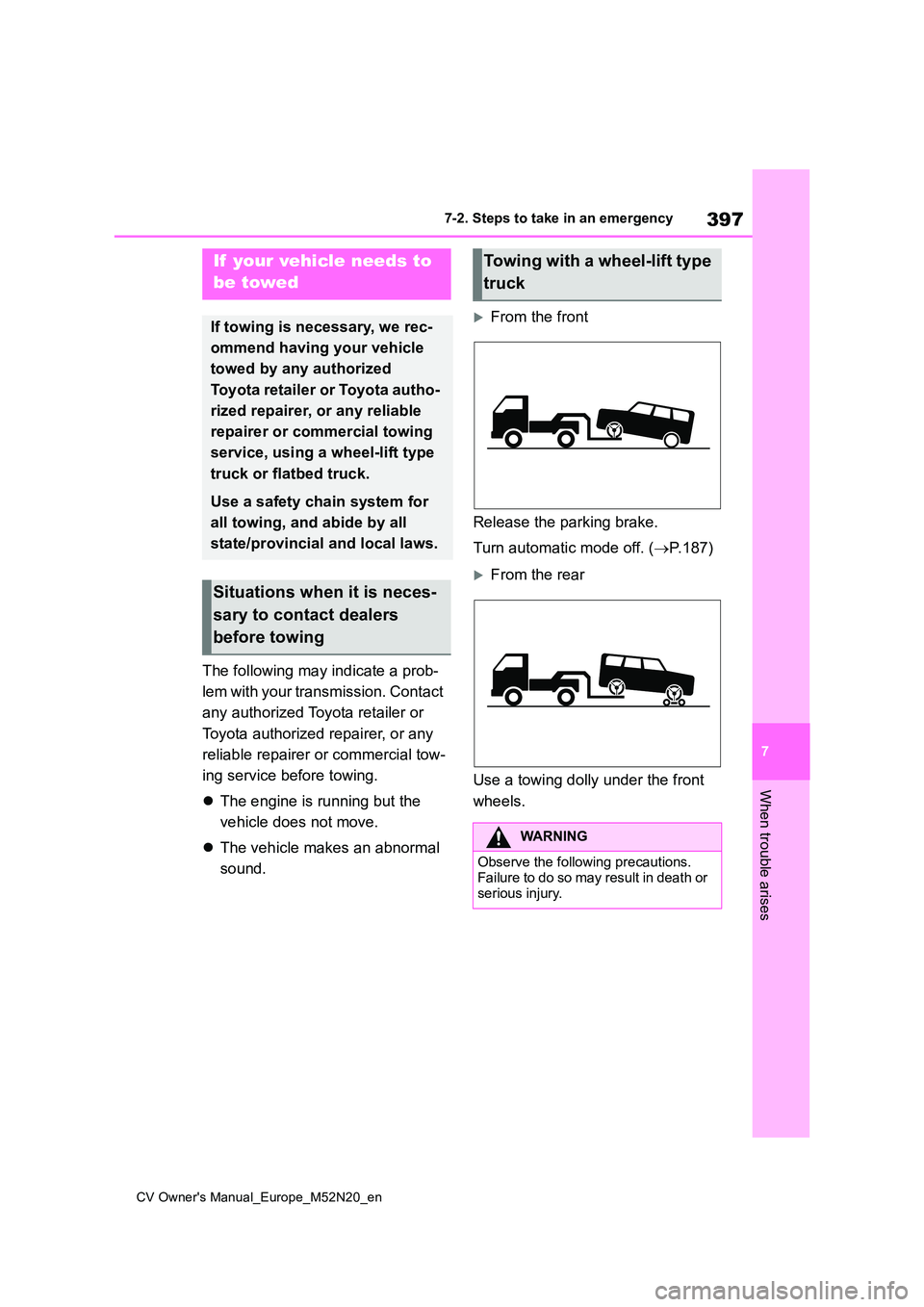
From the front
Release the parking brake.
Turn automatic mode off. ( P.187)
From the rear
Use a towing dolly under the front
wheels.
If your vehicle needs to
be towed
If towing is necessary, we rec-
ommend having your vehicle
towed by any authorized
Toyota retailer or Toyota autho-
rized repairer, or any reliable
repairer or commercial towing
service, using a wheel-lift type
truck or flatbed truck.
Use a safety chain system for
all towing, and abide by all
state/provincial and local laws.
Situations when it is neces-
sary to contact dealers
before towing
Towing with a wheel-lift type
truck
WARNING
Observe the following precautions. Failure to do so may result in death or
serious injury.
Page 400 of 618
398
CV Owner's Manual_Europe_M52N20_en
7-2. Steps to take in an emergency
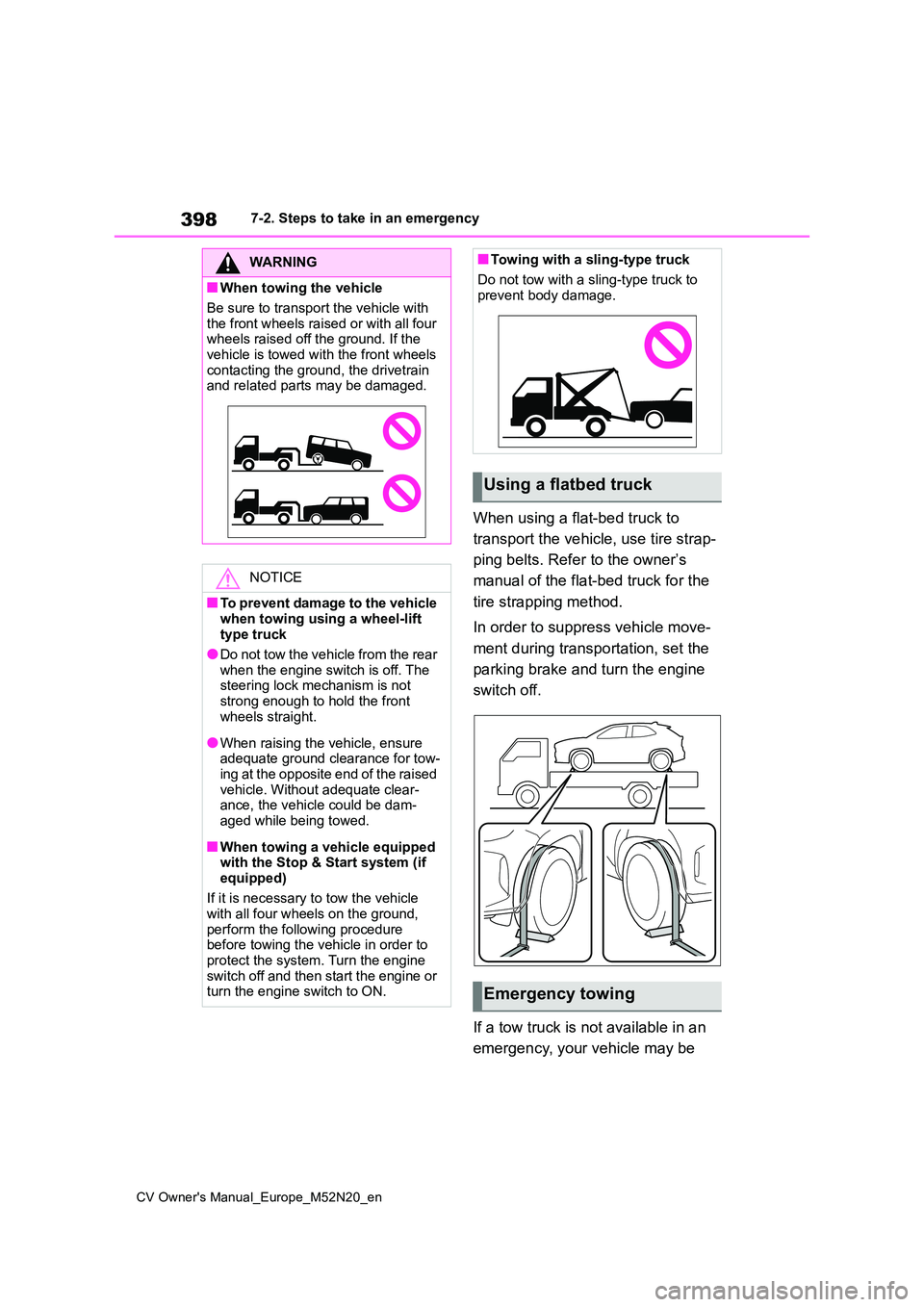
When using a flat-bed truck to
transport the vehicle, use tire strap-
ping belts. Refer to the owner’s
manual of the flat-bed truck for the
tire strapping method.
In order to suppress vehicle move-
ment during transportation, set the
parking brake and turn the engine
switch off.
If a tow truck is not available in an
emergency, your vehicle may be
WARNING
■When towing the vehicle
Be sure to transport the vehicle with
the front wheels raised or with all four wheels raised off the ground. If the vehicle is towed with the front wheels
contacting the ground, the drivetrain and related parts may be damaged.
NOTICE
■To prevent damage to the vehicle
when towing using a wheel-lift type truck
●Do not tow the vehicle from the rear
when the engine switch is off. The steering lock mechanism is not strong enough to hold the front
wheels straight.
●When raising the vehicle, ensure adequate ground clearance for tow-ing at the opposite end of the raised
vehicle. Without adequate clear- ance, the vehicle could be dam-aged while being towed.
■When towing a vehicle equipped with the Stop & Start system (if
equipped)
If it is necessary to tow the vehicle with all four wheels on the ground,
perform the following procedure before towing the vehicle in order to protect the system. Turn the engine
switch off and then start the engine or turn the engine switch to ON.
■Towing with a sling-type truck
Do not tow with a sling-type truck to prevent body damage.
Using a flatbed truck
Emergency towing
Page 401 of 618
399
7
CV Owner's Manual_Europe_M52N20_en
7-2. Steps to take in an emergency
When trouble arises
temporarily towed using cables or
chains secured to the emergency
towing eyelets. This should only be
attempted on hard surfaced roads
for at most 80 km (50 miles) at
under 30 km/h (18 mph).
A driver must be in the vehicle to
steer and operate the brakes. The
vehicle’s wheels, drivetrain, axles,
steering and brakes must be in
good condition.
For vehicles with a Multidrive, only
the front towing eyelets may be
used.
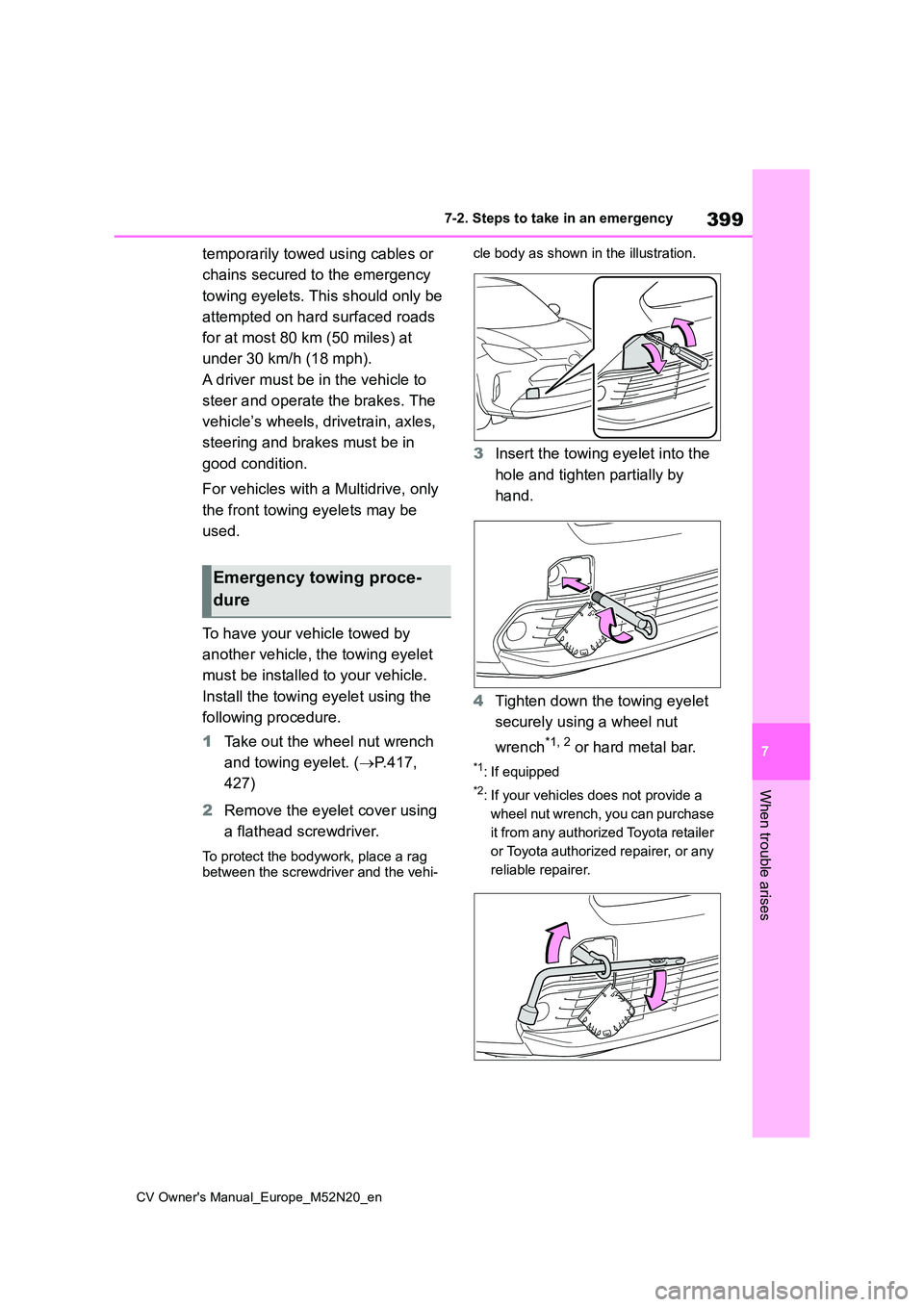
To have your vehicle towed by
another vehicle, the towing eyelet
must be installed to your vehicle.
Install the towing eyelet using the
following procedure.
1 Take out the wheel nut wrench
and towing eyelet. ( P.417,
427)
2 Remove the eyelet cover using
a flathead screwdriver.
To protect the bodywork, place a rag between the screwdriver and the vehi-
cle body as shown in the illustration.
3 Insert the towing eyelet into the
hole and tighten partially by
hand.
4 Tighten down the towing eyelet
securely using a wheel nut
wrench*1, 2 or hard metal bar.
*1: If equipped
*2: If your vehicles does not provide a
wheel nut wrench, you can purchase
it from any authorized Toyota retailer
or Toyota authorized repairer, or any
reliable repairer.
Emergency towing proce-
dure
Page 402 of 618
400
CV Owner's Manual_Europe_M52N20_en
7-2. Steps to take in an emergency
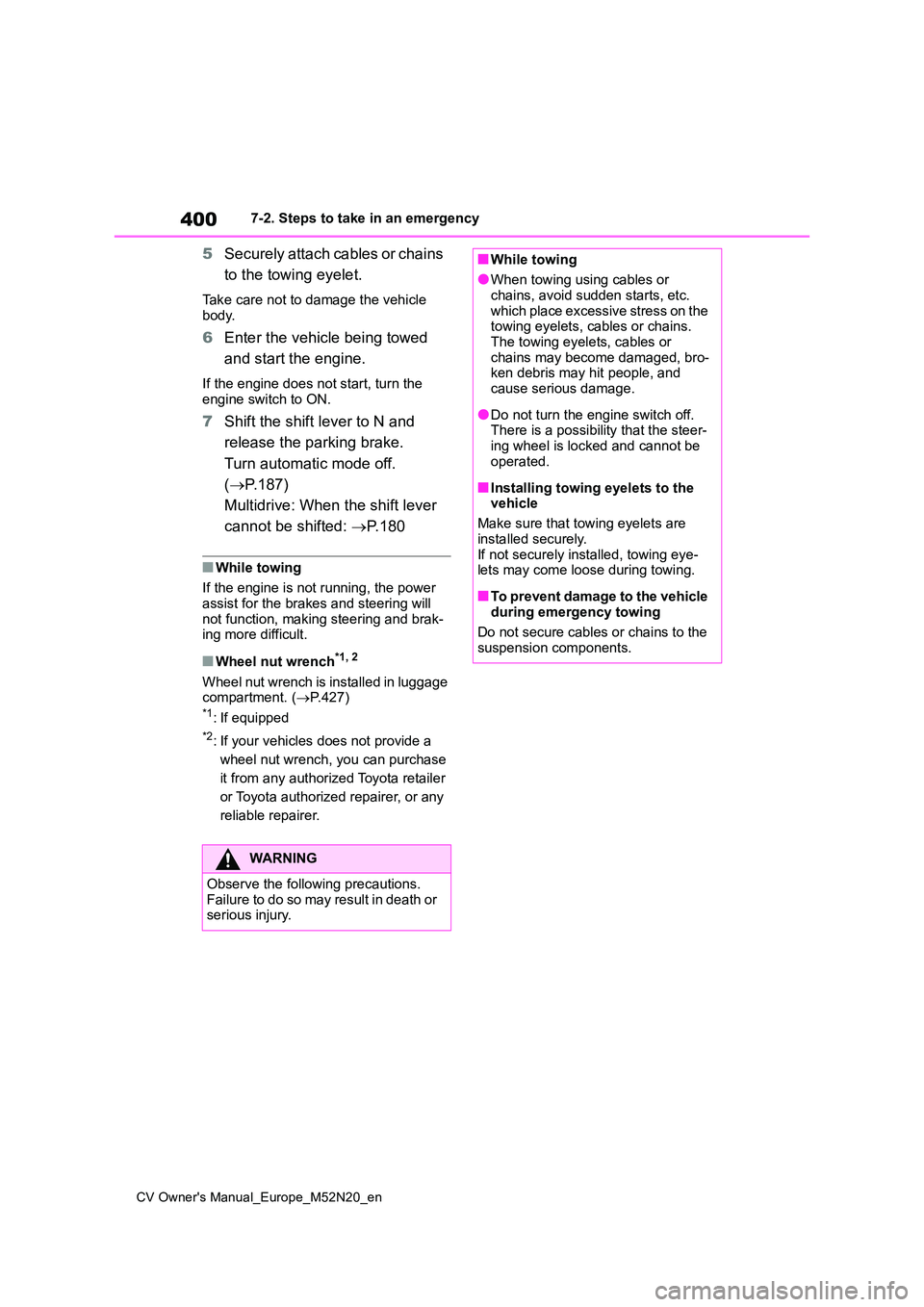
5Securely attach cables or chains
to the towing eyelet.
Take care not to damage the vehicle
body.
6 Enter the vehicle being towed
and start the engine.
If the engine does not start, turn the
engine switch to ON.
7 Shift the shift lever to N and
release the parking brake.
Turn automatic mode off.
( P.187)
Multidrive: When the shift lever
cannot be shifted: P. 1 8 0
■While towing
If the engine is not running, the power assist for the brakes and steering will
not function, making steering and brak- ing more difficult.
■Wheel nut wrench*1, 2
Wheel nut wrench is installed in luggage compartment. ( P.427)*1: If equipped
*2: If your vehicles does not provide a
wheel nut wrench, you can purchase
it from any authorized Toyota retailer
or Toyota authorized repairer, or any
reliable repairer.
WARNING
Observe the following precautions. Failure to do so may result in death or serious injury.
■While towing
●When towing using cables or chains, avoid sudden starts, etc.
which place excessive stress on the towing eyelets, cables or chains. The towing eyelets, cables or
chains may become damaged, bro- ken debris may hit people, and cause serious damage.
●Do not turn the engine switch off.There is a possibility that the steer-
ing wheel is locked and cannot be operated.
■Installing towing eyelets to the vehicle
Make sure that towing eyelets are
installed securely. If not securely installed, towing eye-lets may come loose during towing.
■To prevent damage to the vehicle during emergency towing
Do not secure cables or chains to the suspension components.
Page 419 of 618
417
7
CV Owner's Manual_Europe_M52N20_en
7-2. Steps to take in an emergency
When trouble arises
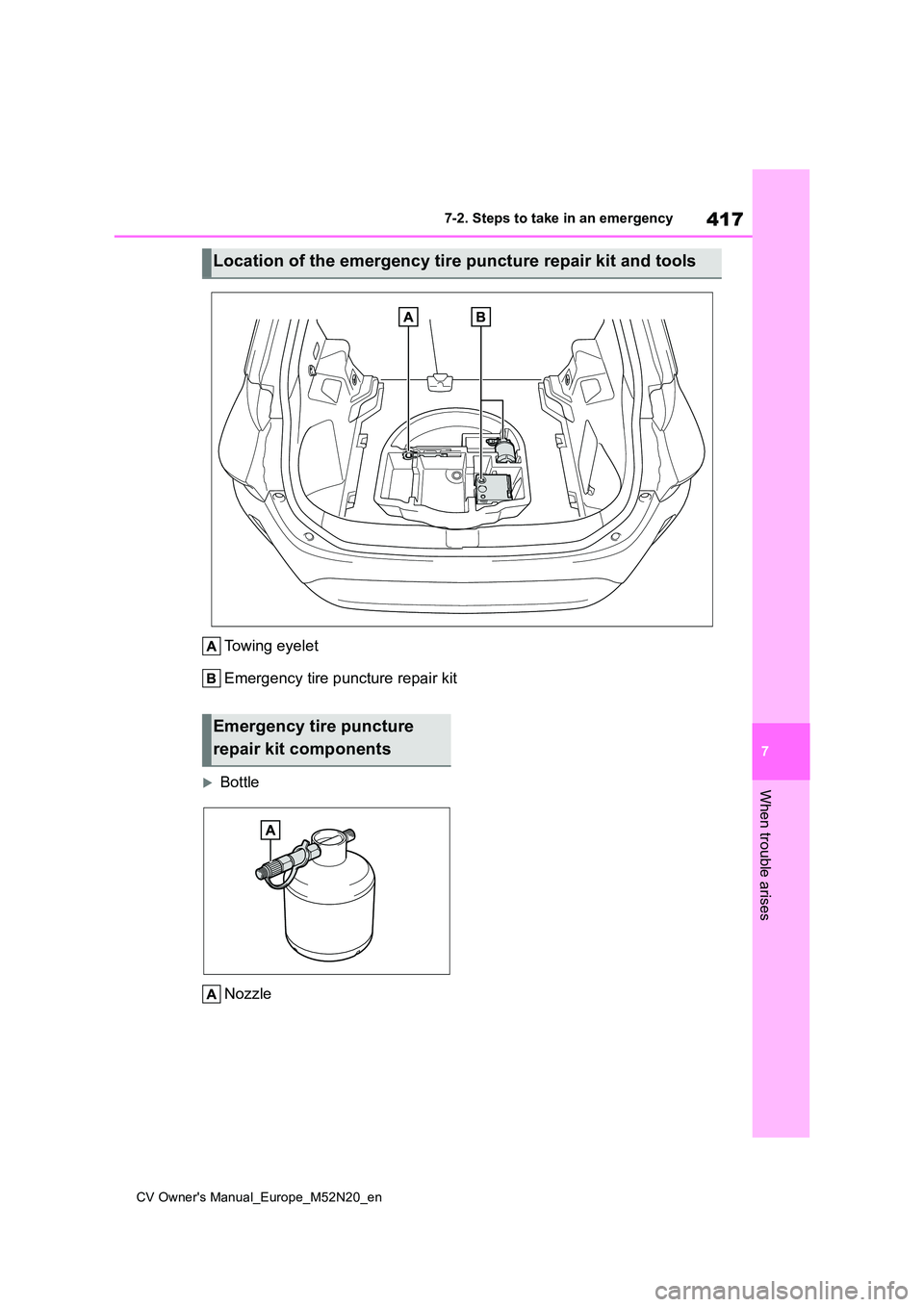
Towing eyelet
Emergency tire puncture repair kit
Bottle
Nozzle
Location of the emergency tire puncture repair kit and tools
Emergency tire puncture
repair kit components
Page 429 of 618
427
7
CV Owner's Manual_Europe_M52N20_en
7-2. Steps to take in an emergency
When trouble arises
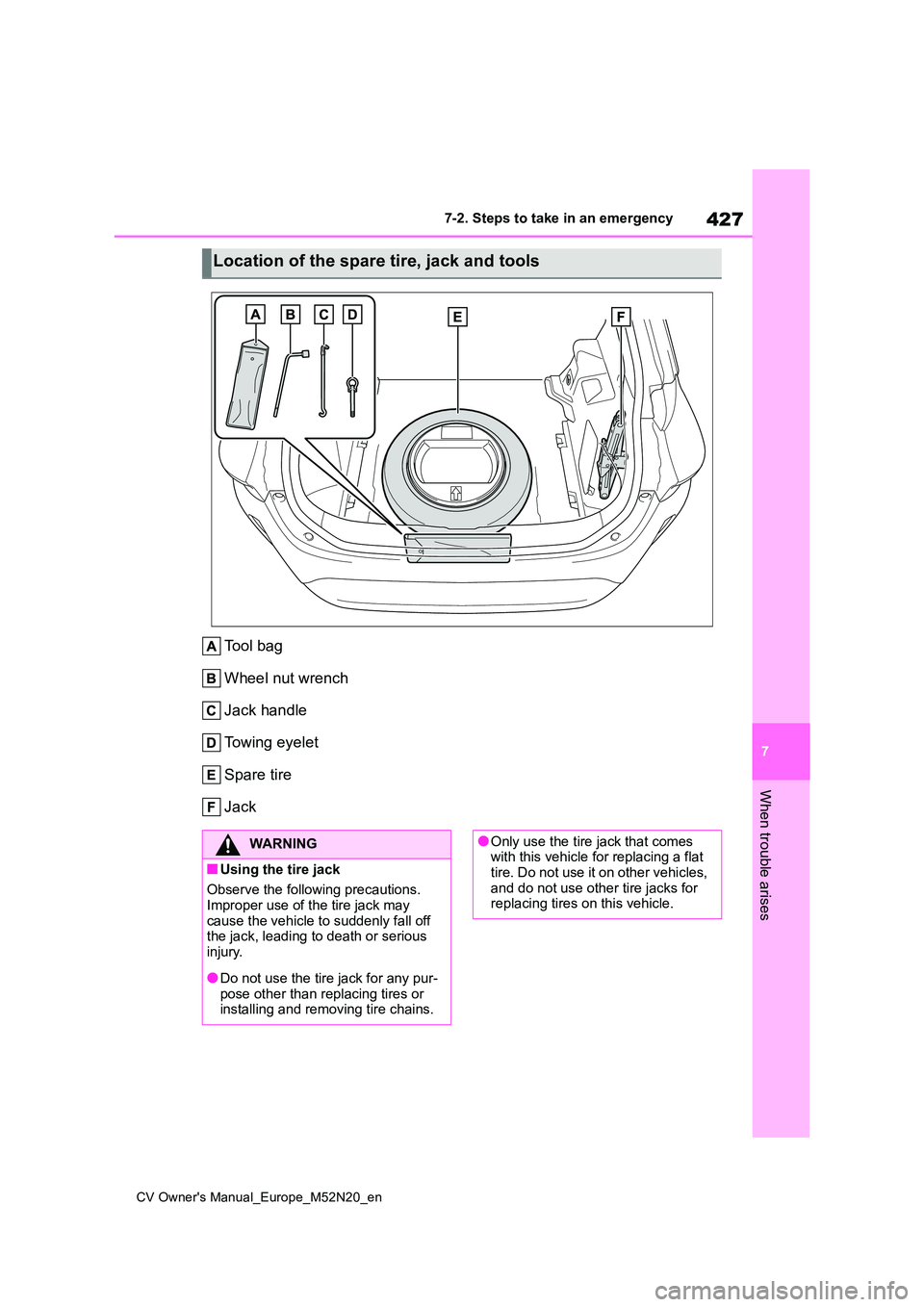
Tool bag
Wheel nut wrench
Jack handle
Towing eyelet
Spare tire
Jack
Location of the spare tire, jack and tools
WARNING
■Using the tire jack
Observe the following precautions.
Improper use of the tire jack may cause the vehicle to suddenly fall off the jack, leading to death or serious
injury.
●Do not use the tire jack for any pur-
pose other than replacing tires or installing and removing tire chains.
●Only use the tire jack that comes with this vehicle for replacing a flat tire. Do not use it on other vehicles,
and do not use other tire jacks for replacing tires on this vehicle.