battery terminals TOYOTA YARIS CROSS 2022 Owners Manual
[x] Cancel search | Manufacturer: TOYOTA, Model Year: 2022, Model line: YARIS CROSS, Model: TOYOTA YARIS CROSS 2022Pages: 618, PDF Size: 130.77 MB
Page 271 of 618
269
4
CV Owner's Manual_Europe_M52N20_en
4-5. Using the driving support systems
Driving
or transmission fluid temperature is
extremely low or high. • When the steering wheel is being operated.
• When the vehicle is being driven in a high altitude area.• When the battery fluid temperature is
extremely low or high. • For a while after the battery terminals have been disconnected and recon-
nected.
●When the engine is stopped by the
S t o p & S t a r t s y s t e m , t h e e n g i n e w i l l b e restarted automatically if any of the following conditions are met:
(To enable the engine to be stopped by
the Stop & Start system again, drive the
vehicle.)
• The air conditioning system is turned on. (vehicles without a manual air conditioning system)
• The windshield defogger is turned on. (vehicles without a manual air condi-tioning system)
• The driver’s seat belt is unfastened. • The driver’s door is opened.• The Stop & Start cancel switch is
pressed. • The steering wheel is operated.• The vehicle starts to roll on an incline.
●When the engine is stopped by the Stop & Start system, the engine may
restart automatically in the following situations: (To enable the engine to be stopped by the Stop & Start system
again, drive the vehicle.) • When the brake pedal is pumped or strongly depressed.
• When the air conditioning system is being used.• When a switch of the air conditioning
system is operated (windshield defog- ger switch, etc.).• If the battery charge becomes low.
■When the hood is opened
●If the hood is opened while the engine is stopped by the Stop & Start system,
the engine will stall and will not be able to be restarted by the automatic engine start function. In this case,
restart the engine using the normal
engine starting procedure. ( P.173, 174)
●If the hood is closed after the engine is started with the hood open, the Stop & Start system will not operate. Close
the hood, turn the engine switch off, wait 30 seconds or more, and then start the engine.
■Air conditioning system operation
while the engine is stopped by the Stop & Start system
Vehicles with an automatic air condition-
ing system: When the air conditioning is in automatic mode and the engine is stopped by the Stop & Start system, the
fan may operate at a low speed in order to prevent the temperature in the cabin from increasing or decreasing or may be
stopped.
To prioritize air conditioning system per- formance when the vehicle is stopped,
disable the Stop & Start system by pressing the Stop & Start cancel switch.
●If the windshield is fogged up
Turn the windshield defogger on.
( P.313, 318)
If the windshield fogs up frequently,
press the Stop & Start cancel switch to
disable the Stop & Start system.
●If an odor is emitted from the air con-
ditioning system • Vehicles with a manual air condition-ing system
If the idling stop time setting is set to
“Extended”, change it to “Standard”. If
an odor is emitted when the idling stop
time setting is set to “Standard”, press
the Stop & Start cancel switch to deacti-
vate the Stop & Start system.
• Vehicles with an automatic air condi- tioning system
Press the Stop & Start cancel switch to
deactivate the Stop & Start system.
Page 273 of 618
271
4
CV Owner's Manual_Europe_M52N20_en
4-5. Using the driving support systems
Driving
“Shift to N and depress clutch”
When the engine is stopped by the
Stop & Start system, the shift lever was
moved to a position other than N without
depressing the clutch pedal.
■The Stop & Start system protection function
●When the volume of the audio system is excessively high, sound output from
the audio system may suddenly be cut off in order to reduce battery con-sumption. To prevent the audio sys-
tem from being cut off, keep the volume of audio system at a moderate level. If the audio system has been cut
off, turn the engine switch off, wait for 3 seconds or more and then turn it to ACC or ON to re-enable the audio
system.
●The audio system may not be acti-
vated if the battery terminals are dis- connected and then reconnected. If this occurs, turn the engine switch off
and then repeat the following opera- tion twice to activate the audio system normally.
• Turn the engine switch to ON and then to off.
■Replacing the battery
P. 4 4 1
■If the Stop & Start cancel indicator
flashes continuously
The system may be malfunctioning. Have the vehicle inspected by any
authorized Toyota retailer or Toyota authorized repairer, or any reliable repairer.
■If “Stop & Start System Malfunction
Visit Your Dealer” is displayed on the multi-information display
The system may be malfunctioning.
Have the vehicle inspected by any authorized Toyota retailer or Toyota authorized repairer, or any reliable
repairer.
WARNING
■When the Stop & Start system is operating
Make sure to disable the Stop & Start system while the vehicle is in a poorly ventilated area.
If not disabled, the engine may be automatically restarted unexpectedly, causing exhaust gases to collect and
enter the vehicle, possibly resulting in death or a serious health hazard.
●Do not leave the vehicle while the
engine is stopped by the Stop & Start system (while the Stop & Start indicator is on). An accident may
occur due to the automatic engine start function.
●Depress the brake pedal and apply the parking brake when necessary while the engine is stopped by the
Stop & Start system (while the Stop & Start indicator is on).
NOTICE
■To ensure the system operates correctly
If any of the following situations occur, the Stop & Start system may not oper-ate correctly. Have your vehicle
inspected by any authorized Toyota retailer or Toyota authorized repairer, or any reliable repairer.
●While the driver’s seat belt is fas-tened, the driver’s and front pas-senger’s seat belt reminder light
flashes.
●Even though the driver’s seat belt is
not fastened, the driver’s and front passenger’s seat belt reminder light does not illuminate.
●Even though the driver’s door is closed, the open door warning light
is illuminated or the interior light is illuminated when the interior light switch is in the door position.
Page 350 of 618
348
CV Owner's Manual_Europe_M52N20_en
6-2. Maintenance
6-2.Mainte nance
■Where to go for maintenance ser-
vice?
In order to maintain your vehicle in the best possible condition, Toyota recom-
mends that maintenance service opera- tions as well as other inspections and repairs be carried out by authorized
Toyota retailers or Toyota authorized repairers, or any reliable repairers. For repairs and services covered by your
warranty, please visit an authorized Toyota retailer or repairer, who will use genuine Toyota parts in repairing any
difficulties you may encounter. There can also be advantages in utilizing authorized Toyota retailers or repairers
for non-warranty repairs and services, as members of the Toyota network will be able to expertly assist you with any
difficulties you may encounter.
Your Toyota retailer or Toyota authorized
repairer, or any reliable repairer will per- form all of the scheduled maintenance on your vehicle reliably and economi-
cally due to their experience with Toyota vehicles.
Scheduled maintenance should be
performed at specified intervals
according to the maintenance
schedule.
For full details of your maintenance
schedule, read the “Toyota Service
Booklet” or “Toyota Warranty Booklet”.
What about do-it-yourself mainte-
nance?
Many of the maintenance items are
easy to do yourself if you have a little
mechanical ability and a few basic
automotive tools.
Note, however, that some maintenance
tasks require special tools and skills.
These are best performed by qualified
technicians. Even if you’re an experi-
enced do-it-yourself mechanic, we rec-
ommend that repairs and maintenance
be conducted by any authorized Toyota
retailer or Toyota authorized repairer, or
any reliable repairer. Any authorized
Toyota retailer or repairer will keep a
record of maintenance, which could be
useful should you ever require War-
ranty Service. Should you choose to
select a qualified and equipped profes-
sional other than an authorized Toyota
repairer to service or maintain your
vehicle, we recommend that you
Maintenance require-
ments
To ensure safe and economical
driving, day-to-day care and
regular maintenance are
essential. Toyota recommends
the maintenance below.
WARNING
■If your vehicle is not properly
maintained
Improper maintenance could result in serious damage to the vehicle and
possible death or serious injury.
■Handling of the battery
Battery posts, terminals and related accessories contain lead and lead
compounds which are known to cause brain damage. Wash your hands after handling. ( P.358)
Scheduled maintenance
Do-it-yourself maintenance
Page 360 of 618
358
CV Owner's Manual_Europe_M52N20_en
6-3. Do-it-yourself maintenance
Check the battery as follows.
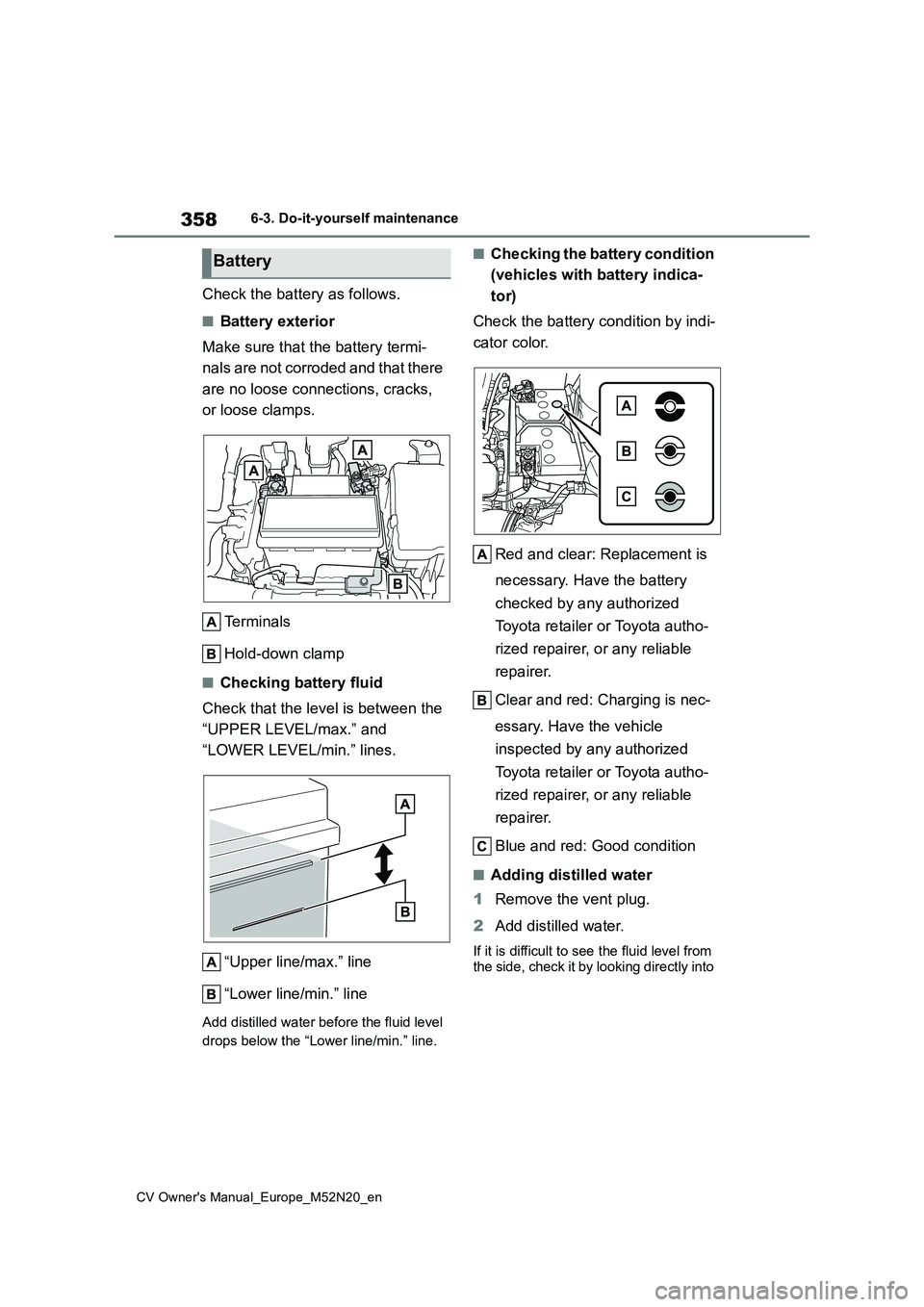
■Battery exterior
Make sure that the battery termi-
nals are not corroded and that there
are no loose connections, cracks,
or loose clamps.
Terminals
Hold-down clamp
■Checking battery fluid
Check that the level is between the
“UPPER LEVEL/max.” and
“LOWER LEVEL/min.” lines.
“Upper line/max.” line
“Lower line/min.” line
Add distilled water before the fluid level
drops below the “Lower line/min.” line.
■Checking the battery condition
(vehicles with battery indica-
tor)
Check the battery condition by indi-
cator color.
Red and clear: Replacement is
necessary. Have the battery
checked by any authorized
Toyota retailer or Toyota autho-
rized repairer, or any reliable
repairer.
Clear and red: Charging is nec-
essary. Have the vehicle
inspected by any authorized
Toyota retailer or Toyota autho-
rized repairer, or any reliable
repairer.
Blue and red: Good condition
■Adding distilled water
1 Remove the vent plug.
2 Add distilled water.
If it is difficult to see the fluid level from
the side, check it by looking directly into
Battery
Page 363 of 618
361
6
CV Owner's Manual_Europe_M52N20_en
6-3. Do-it-yourself maintenance
Maintenance and care
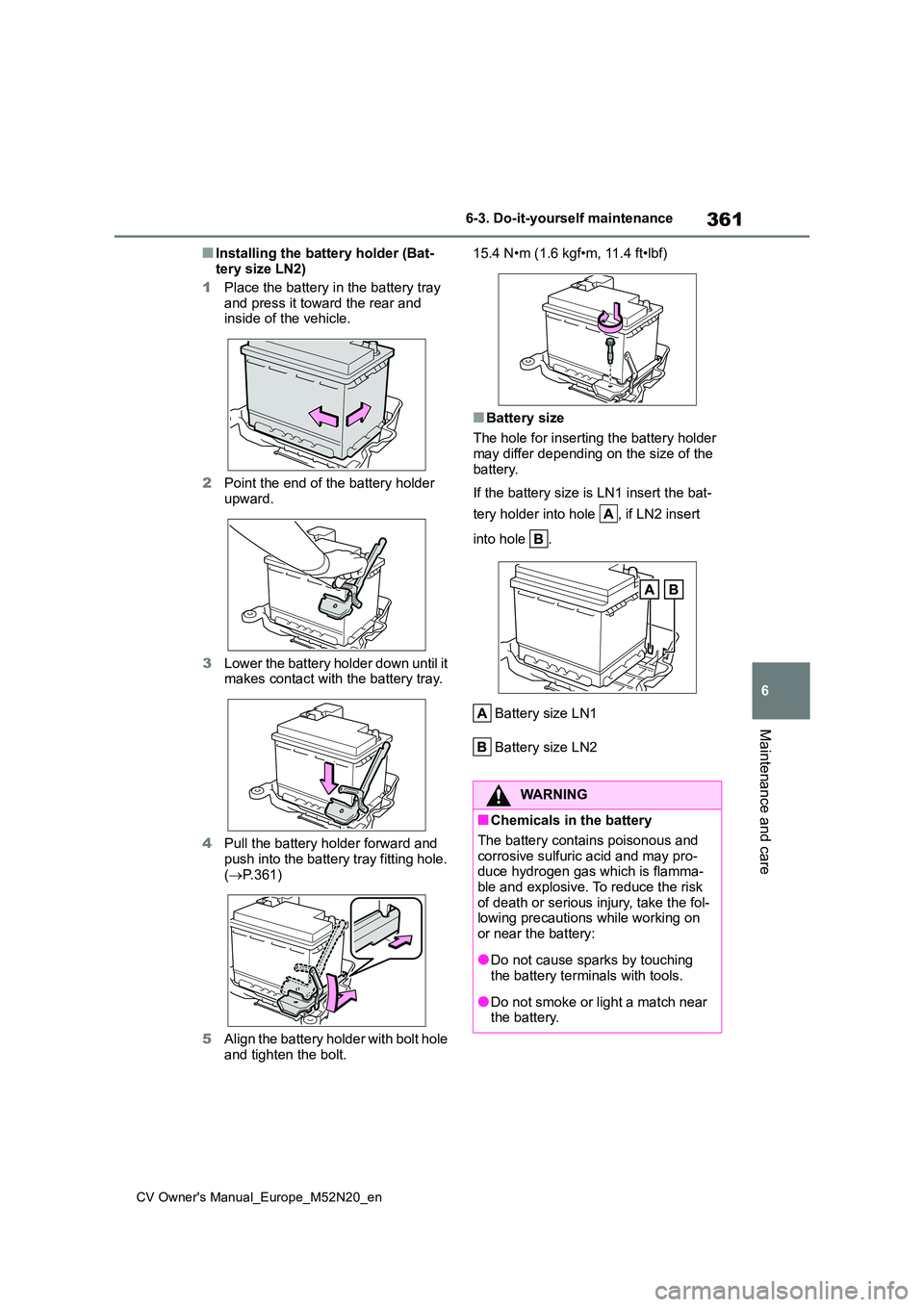
■Installing the battery holder (Bat-
tery size LN2)
1 Place the battery in the battery tray and press it toward the rear and inside of the vehicle.
2 Point the end of the battery holder upward.
3 Lower the battery holder down until it makes contact with the battery tray.
4 Pull the battery holder forward and push into the battery tray fitting hole.
( P.361)
5 Align the battery holder with bolt hole
and tighten the bolt.
15.4 N•m (1.6 kgf•m, 11.4 ft•lbf)
■Battery size
The hole for inserting the battery holder
may differ depending on the size of the battery.
If the battery size is LN1 insert the bat-
tery holder into hole , if LN2 insert
into hole .
Battery size LN1
Battery size LN2
WARNING
■Chemicals in the battery
The battery contains poisonous and corrosive sulfuric acid and may pro-duce hydrogen gas which is flamma-
ble and explosive. To reduce the risk of death or serious injury, take the fol-lowing precautions while working on
or near the battery:
●Do not cause sparks by touching the battery terminals with tools.
●Do not smoke or light a match near the battery.
Page 383 of 618
381
6
CV Owner's Manual_Europe_M52N20_en
6-3. Do-it-yourself maintenance
Maintenance and care
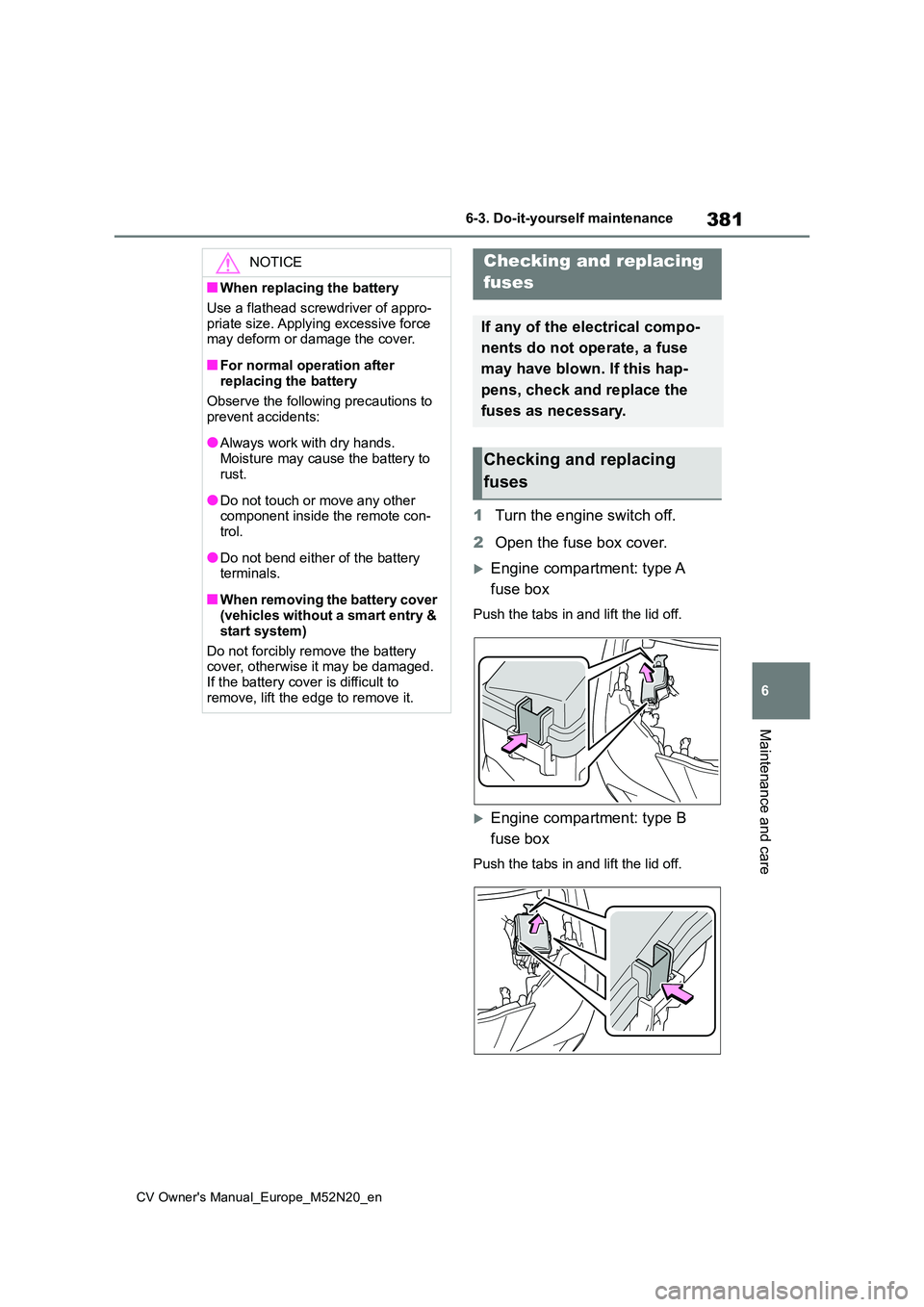
1Turn the engine switch off.
2 Open the fuse box cover.
Engine compartment: type A
fuse box
Push the tabs in and lift the lid off.
Engine compartment: type B
fuse box
Push the tabs in and lift the lid off.
NOTICE
■When replacing the battery
Use a flathead screwdriver of appro-
priate size. Applying excessive force may deform or damage the cover.
■For normal operation after replacing the battery
Observe the following precautions to
prevent accidents:
●Always work with dry hands.
Moisture may cause the battery to rust.
●Do not touch or move any other component inside the remote con-trol.
●Do not bend either of the battery terminals.
■When removing the battery cover (vehicles without a smart entry &
start system)
Do not forcibly remove the battery cover, otherwise it may be damaged.
If the battery cover is difficult to remove, lift the edge to remove it.
Checking and replacing
fuses
If any of the electrical compo-
nents do not operate, a fuse
may have blown. If this hap-
pens, check and replace the
fuses as necessary.
Checking and replacing
fuses
Page 442 of 618
440
CV Owner's Manual_Europe_M52N20_en
7-2. Steps to take in an emergency
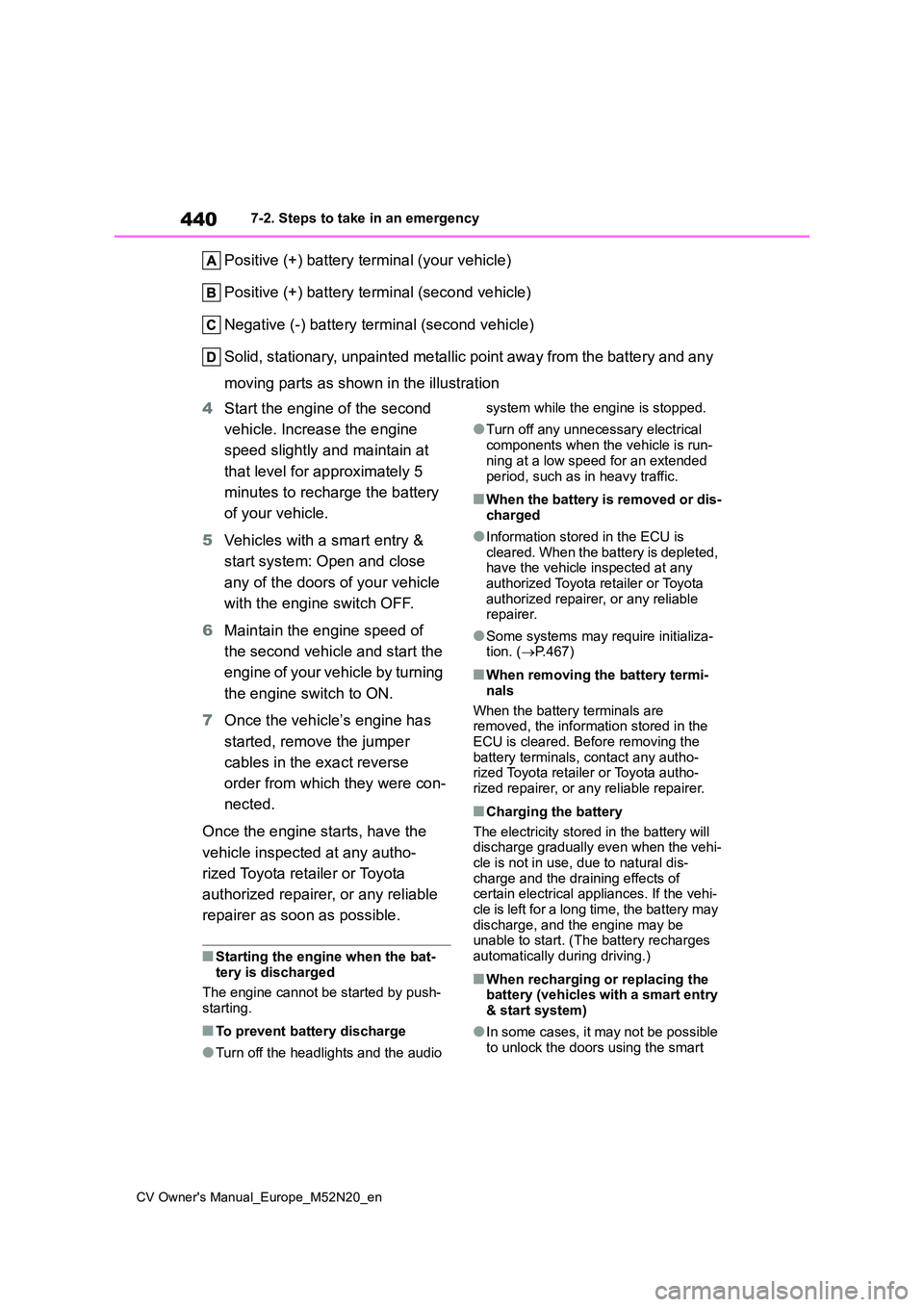
Positive (+) battery terminal (your vehicle)
Positive (+) battery terminal (second vehicle)
Negative (-) battery terminal (second vehicle)
Solid, stationary, unpainted metallic point away from the batte ry and any
moving parts as shown in the illustration
4 Start the engine of the second
vehicle. Increase the engine
speed slightly and maintain at
that level for approximately 5
minutes to recharge the battery
of your vehicle.
5 Vehicles with a smart entry &
start system: Open and close
any of the doors of your vehicle
with the engine switch OFF.
6 Maintain the engine speed of
the second vehicle and start the
engine of your vehicle by turning
the engine switch to ON.
7 Once the vehicle’s engine has
started, remove the jumper
cables in the exact reverse
order from which they were con-
nected.
Once the engine starts, have the
vehicle inspected at any autho-
rized Toyota retailer or Toyota
authorized repairer, or any reliable
repairer as soon as possible.
■Starting the engine when the bat- tery is discharged
The engine cannot be started by push-
starting.
■To prevent battery discharge
●Turn off the headlights and the audio
system while the engine is stopped.
●Turn off any unnecessary electrical
components when the vehicle is run- ning at a low speed for an extended
period, such as in heavy traffic.
■When the battery is removed or dis- charged
●Information stored in the ECU is cleared. When the battery is depleted, have the vehicle inspected at any
authorized Toyota retailer or Toyota authorized repairer, or any reliable repairer.
●Some systems may require initializa-tion. ( P.467)
■When removing the battery termi-
nals
When the battery terminals are removed, the information stored in the
ECU is cleared. Before removing the battery terminals, contact any autho-rized Toyota retailer or Toyota autho-
rized repairer, or any reliable repairer.
■Charging the battery
The electricity stored in the battery will discharge gradually even when the vehi-
cle is not in use, due to natural dis- charge and the draining effects of certain electrical appliances. If the vehi-
cle is left for a long time, the battery may discharge, and the engine may be unable to start. (The battery recharges
automatically during driving.)
■When recharging or replacing the battery (vehicles with a smart entry & start system)
●In some cases, it may not be possible to unlock the doors using the smart
Page 444 of 618
442
CV Owner's Manual_Europe_M52N20_en
7-2. Steps to take in an emergency
1Stop the vehicle in a safe place
and turn off the air conditioning
system, and then stop the
engine.
2 If you see steam: Carefully lift
the hood after the steam sub-
sides.
If you do not see steam: Care-
fully lift the hood.
3 After the engine has cooled
down sufficiently, inspect the
WARNING
●When working with the battery, always wear safety glasses and
take care not to allow any battery fluids (acid) to come into contact with skin, clothing or the vehicle
body.
●Do not lean over the battery.
●In the event that battery fluid comes into contact with the skin or eyes,
immediately wash the affected area with water and seek medical atten-tion. Place a wet sponge or cloth
over the affected area until medical attention can be received.
●Always wash your hands after han-dling the battery support, terminals, and other battery-related parts.
●Do not allow children near the bat-tery.
■When replacing the battery
●When the vent plug and indicator
are close to the hold down clamp, the battery fluid (sulfuric acid) may leak.
●For information regarding battery replacement, contact any autho-
rized Toyota retailer or Toyota authorized repairer, or any reliable repairer.
NOTICE
■When handling jumper cables
When connecting the jumper cables,
ensure that they do not become entangled in the cooling fan or engine drive belt.
If your vehicle overheats
The following may indicate that
your vehicle is overheating.
The engine coolant tempera-
ture gauge ( P.85, 89) is in
the red zone or a loss of
engine power is experienced.
(For example, the vehicle
speed does not increase.)
“Engine Coolant Temp High
Stop in a Safe Place See
Owner’s Manual” is shown on
the multi-information display.
Steam comes out from under
the hood.
Correction procedures