eco TOYOTA YARIS HATCHBACK 2015 Workshop Manual
[x] Cancel search | Manufacturer: TOYOTA, Model Year: 2015, Model line: YARIS HATCHBACK, Model: TOYOTA YARIS HATCHBACK 2015Pages: 540, PDF Size: 34.12 MB
Page 187 of 540
187
4
4-2. Driving procedures
Driving
YARIS_F_WE_52G04E
Engine (ignition) switch (vehicles with a
smar t entr y & start system)
Check that the parking brake is set.
Check that the shift lever is set in P (Multidrive) or N (manual trans-
mission).
Firmly depress the brake pedal (Multidrive) or clutch pedal (manual
transmission).
The smart entry & start system indicator (green) will turn on.
If the indicator light does not turn on, the engine cannot be started.
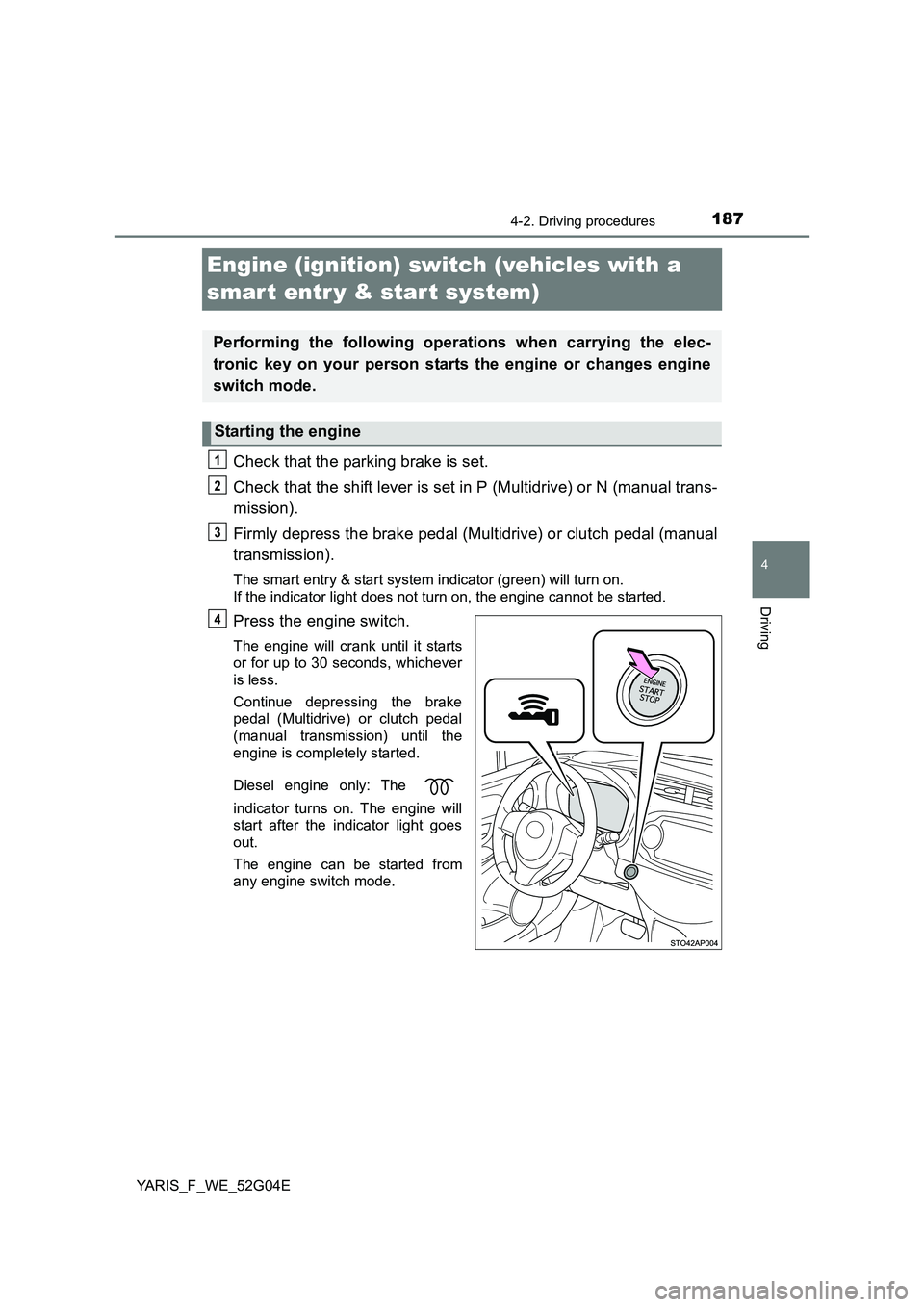
Press the engine switch.
The engine will crank until it starts
or for up to 30 seconds, whichever
is less.
Continue depressing the brake
pedal (Multidrive) or clutch pedal
(manual transmission) until the
engine is completely started.
Diesel engine only: The
indicator turns on. The engine will
start after the indicator light goes
out.
The engine can be started from
any engine switch mode.
Performing the following operations when carrying the elec-
tronic key on your person starts the engine or changes engine
switch mode.
Starting the engine
1
2
3
4
Page 190 of 540
1904-2. Driving procedures
YARIS_F_WE_52G04E
■ If the engine does not start
● The engine immobilizer system may not have been deactivated. (P. 76)
Contact any authorized Toyota dealer or repairer, or another duly qualified
and equipped professional.
■ Steering lock
After turning the engine switch off and opening and closing the doors, the
steering wheel will be locked due to the steering lock function. Operating the
engine switch again automatically cancels the steering lock.
■ When the steering lock cannot be released
Press the engine switch while turning the steering wheel left and right.
■ Steering lock motor overheating prevention
To prevent the steering lock motor from overheating, the motor may be sus-
pended if the engine is turned on and off repeatedly in a short period of time.
In this case, refrain from operating the engine. After about 10 seconds, the
steering lock motor will resume functioning.
■ If the system is malfunctioning
P. 435
■ If the electronic key battery is depleted
P. 394
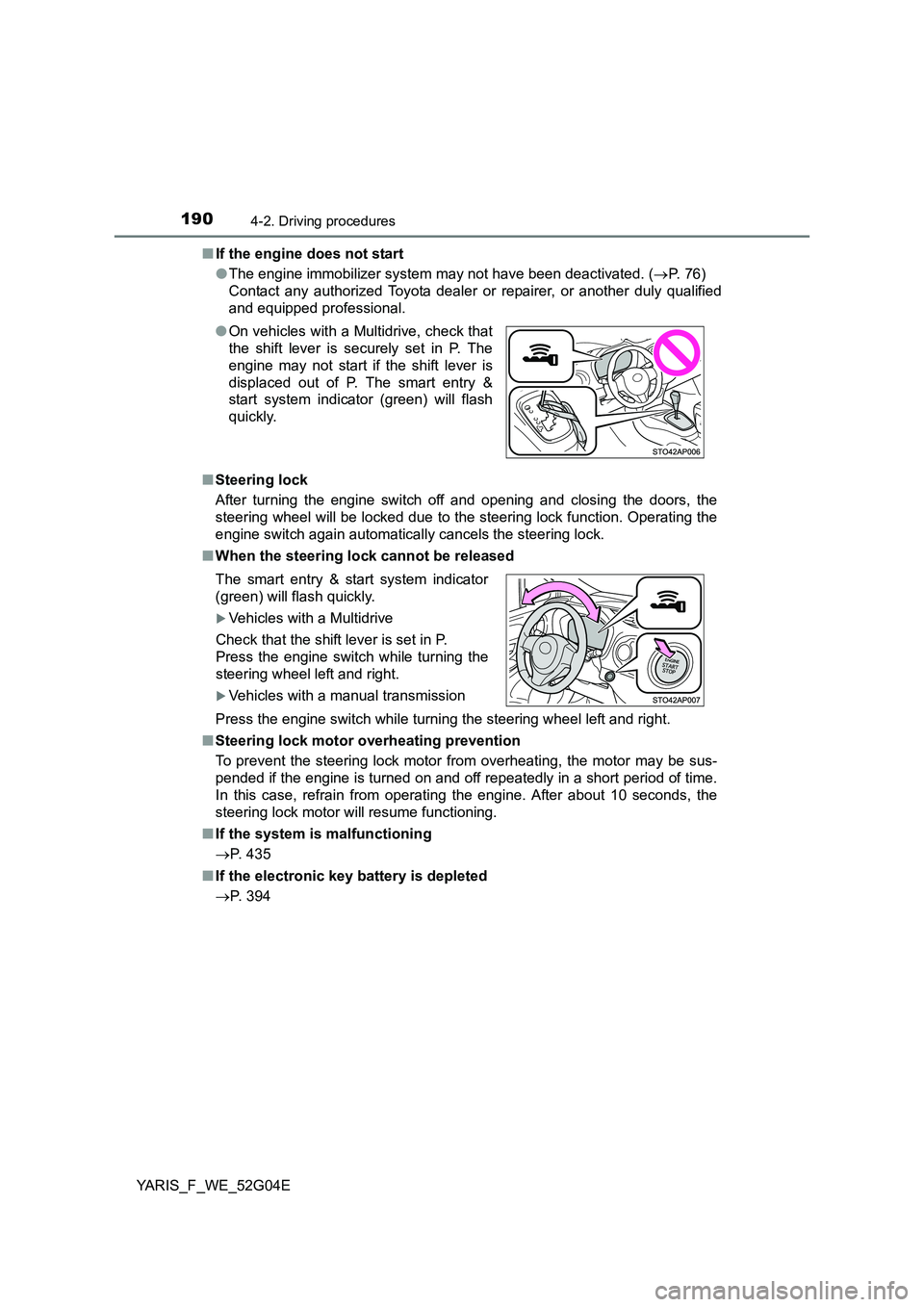
● On vehicles with a Multidrive, check that
the shift lever is securely set in P. The
engine may not start if the shift lever is
displaced out of P. The smart entry &
start system indicator (green) will flash
quickly.
The smart entry & start system indicator
(green) will flash quickly.
Vehicles with a Multidrive
Check that the shift lever is set in P.
Press the engine switch while turning the
steering wheel left and right.
Vehicles with a manual transmission
Page 191 of 540
1914-2. Driving procedures
4
Driving
YARIS_F_WE_52G04E
■ Operation of the engine switch
When operating the engine switch, one short, firm press is enough. If the
switch is pressed improperly, the engi ne may not start or the engine switch
mode may not change. It is not necessary to press and hold the switch.
■ If the smart entry & start system has been deactivated in a customized
setting
P. 516
WARNING
■When starting the engine
Always start the engine while sitting in the driver’s seat. Do not depress the
accelerator pedal while starting the engine under any circumstances.
Doing so may cause an accident resulting in death or serious injury.
■ Caution while driving
If engine failure occurs while the vehicle is moving, do not lock or open the
doors until the vehicle reaches a safe and complete stop. Activation of the
steering lock in this circumstance may lead to an accident, resulting in
death or serious injury.
■ Stopping the engine in an emergency
If you want to stop the engine in an emergency while driving the vehicle,
press and hold the engine switch for more than 3 seconds, or press it briefly
3 times or more in succession. ( P. 421)
However, do not touch the engine switch while driving except in an emer-
gency. Turning the engine switch off while driving will not cause loss of
steering or braking control, but the power assist to these systems will be
lost. This will make it more difficult to steer and brake, so you should pull
over and stop the vehicle as soon as it is safe to do so.
Page 192 of 540
1924-2. Driving procedures
YARIS_F_WE_52G04E
NOTICE
■To prevent battery discharge
● Do not leave the engine switch in ACCESSORY or IGNITION ON mode
for long periods of time without the engine running.
● If the smart entry & start system indicator (green) is illuminated, the engine
switch is not off. When exiting the vehicle, always check that the engine
switch is off.
● On vehicles with a Multidrive, do not stop the engine when the shift lever is
in a position other than P. If the engine is stopped in another shift lever
position, the engine switch will not be turned off but instead be turned to
ACCESSORY mode. If the vehicle is left in ACCESSORY mode, battery
discharge may occur.
■ When starting the engine
● Do not race a cold engine.
● If the engine becomes difficult to start or stalls frequently, have your vehi-
cle checked by any authorized Toyota dealer or repairer, or another duly
qualified and equipped professional immediately.
■ Symptoms indicating a malfunction with the engine switch
If the engine switch seems to be operating somewhat differently than usual,
such as the switch sticking slightly, there may be a malfunction.
Contact any authorized Toyota dealer or repairer, or another duly qualified
and equipped professional immediately.
Page 200 of 540
2004-2. Driving procedures
YARIS_F_WE_52G04E
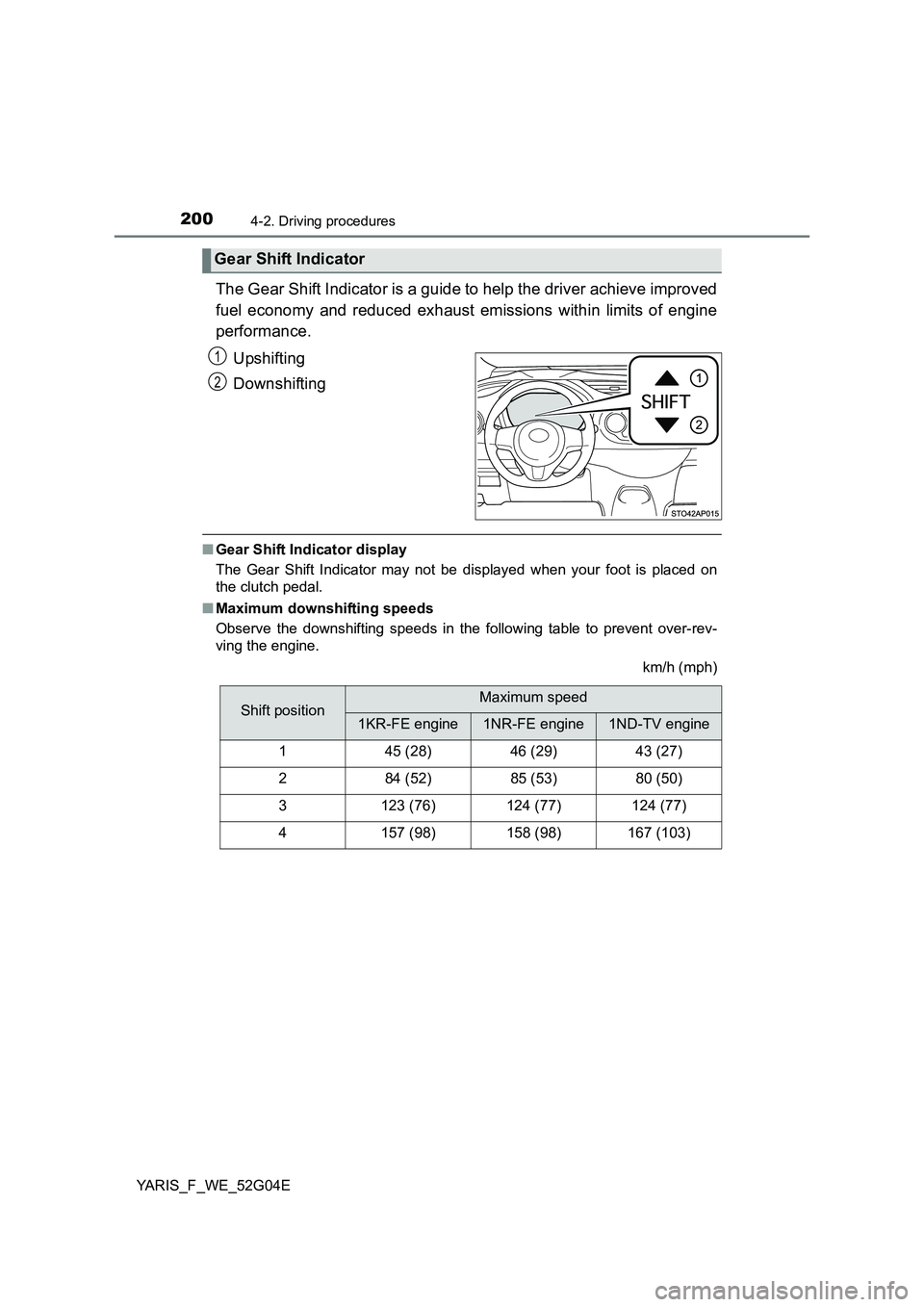
The Gear Shift Indicator is a guide to help the driver achieve improved
fuel economy and reduced exhaust emissions within limits of engine
performance.
Upshifting
Downshifting
■ Gear Shift Indicator display
The Gear Shift Indicator may not be displayed when your foot is placed on
the clutch pedal.
■ Maximum downshifting speeds
Observe the downshifting speeds in the following table to prevent over-rev-
ving the engine.
km/h (mph)
Gear Shift Indicator
1
2
Shift positionMaximum speed
1KR-FE engine1NR-FE engine1ND-TV engine
145 (28)46 (29)43 (27)
284 (52)85 (53)80 (50)
3123 (76)124 (77)124 (77)
4157 (98)158 (98)167 (103)
Page 205 of 540
2054-3. Operating the lights and wipers
4
Driving
YARIS_F_WE_52G04E
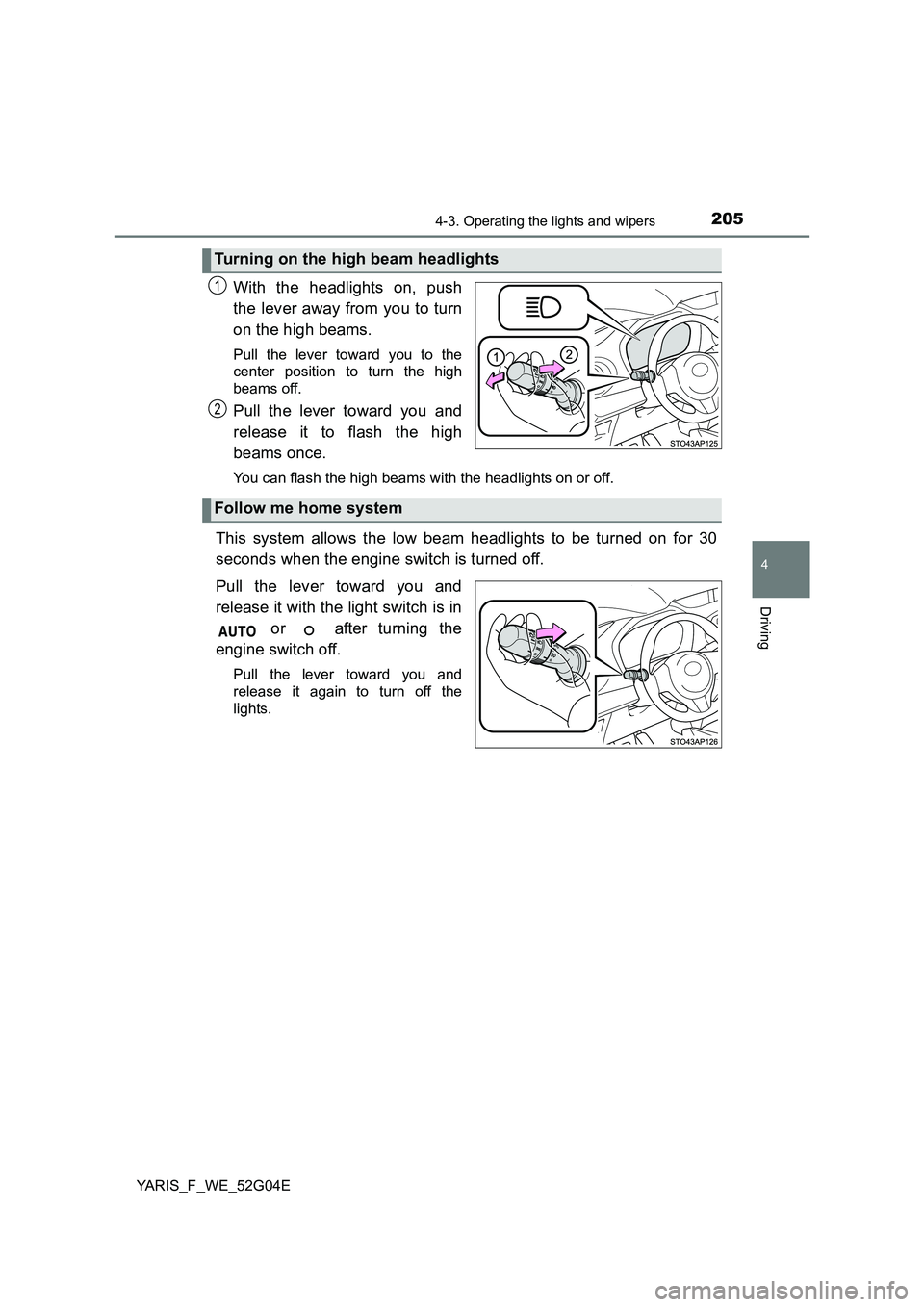
With the headlights on, push
the lever away from you to turn
on the high beams.
Pull the lever toward you to the
center position to turn the high
beams off.
Pull the lever toward you and
release it to flash the high
beams once.
You can flash the high beams with the headlights on or off.
This system allows the low beam headlights to be turned on for 30
seconds when the engine switch is turned off.
Pull the lever toward you and
release it with the light switch is in
or after turning the
engine switch off.
Pull the lever toward you and
release it again to turn off the
lights.
Turning on the high beam headlights
1
2
Follow me home system
Page 215 of 540
2154-3. Operating the lights and wipers
4
Driving
YARIS_F_WE_52G04E
● When the sensor sensitivity ring is turned toward high while in “AUTO”
mode, the wiper will operate once to indicate that the sensor sensitivity is
enhanced.
● If the temperature of the raindrop sensor is 90°C (194°F) or higher, or -15°C
(5°F) or lower, automatic operation may not occur. In this case, operate the
wiper in any mode other than “AUTO” mode.
■ If no windshield washer fluid sprays
Check that the washer nozzle is not blocked, if there is washer fluid in the
windshield washer fluid reservoir.
WARNING
■ Caution regarding the use of windshield wiper in “AUTO” mode (vehi-
cles with a rain-sensing windshield wiper)
The windshield wiper may operate unexpectedly if the sensor is touched or
the windshield is subject to vibration in “AUTO” mode. Take care that your
fingers, etc., do not become caught in the windshield wiper.
■ Caution regarding the use of washer fluid
When it is cold, do not use the washer fluid until the windshield becomes
warm. The fluid may freeze on the windshield and cause low visibility. This
may lead to an accident, resulting in death or serious injury.
NOTICE
■ When the windshield is dry
Do not use the wiper, as they may damage the windshield.
■ When there is no washer fluid spray from the nozzle
Damage to the washer fluid pump may be caused if the lever is pulled
toward you and held continually.
■ When a nozzle becomes blocked
In this case, contact any authorized Toyota dealer or repairer, or another
duly qualified and equipped professional.
Do not try to clear it with a pin or other object. The nozzle will be damaged.
Page 217 of 540
2174-3. Operating the lights and wipers
4
Driving
YARIS_F_WE_52G04E
NOTICE
■When the rear window is dry
Do not use the wiper, as it may damage the rear window.
■ When the washer fluid tank is empty
Do not operate the switch continually as the washer fluid pump may over-
heat.
■ When a nozzle becomes blocked
In this case, contact any authorized Toyota dealer or repairer, or another
duly qualified and equipped professional.
Do not try to clear it with a pin or other object. The nozzle will be damaged.
Page 223 of 540
2234-5. Toyota Safety Sense
4
Driving
YARIS_F_WE_52G04E
The pre-crash safety system is equipped with a sophisticated com-
puter that will record certain data, such as:
• How far (if at all) the driver was depressing the accelerator and/or
brake pedal
• Vehicle speed
• Operation status of the pre-crash safety system functions
• Information (such as the distance and relative speed between your
vehicle and the vehicle ahead or another object)
The pre-crash safety system does not record conversations, sounds
or pictures.
● Data usage
Toyota may use the data recorded in these computers to diagnose
malfunctions, conduct research and development, and improve
quality.
Toyota will not disclose the recorded data to a third party except:
• With the consent of the vehicle owner or with the consent of the
lessee if the vehicle is leased
• In response to an official request by the police, a court of law or a
government agency
• For use by Toyota in a lawsuit
• For research purposes where the data is not tied to a specific
vehicle or vehicle owner
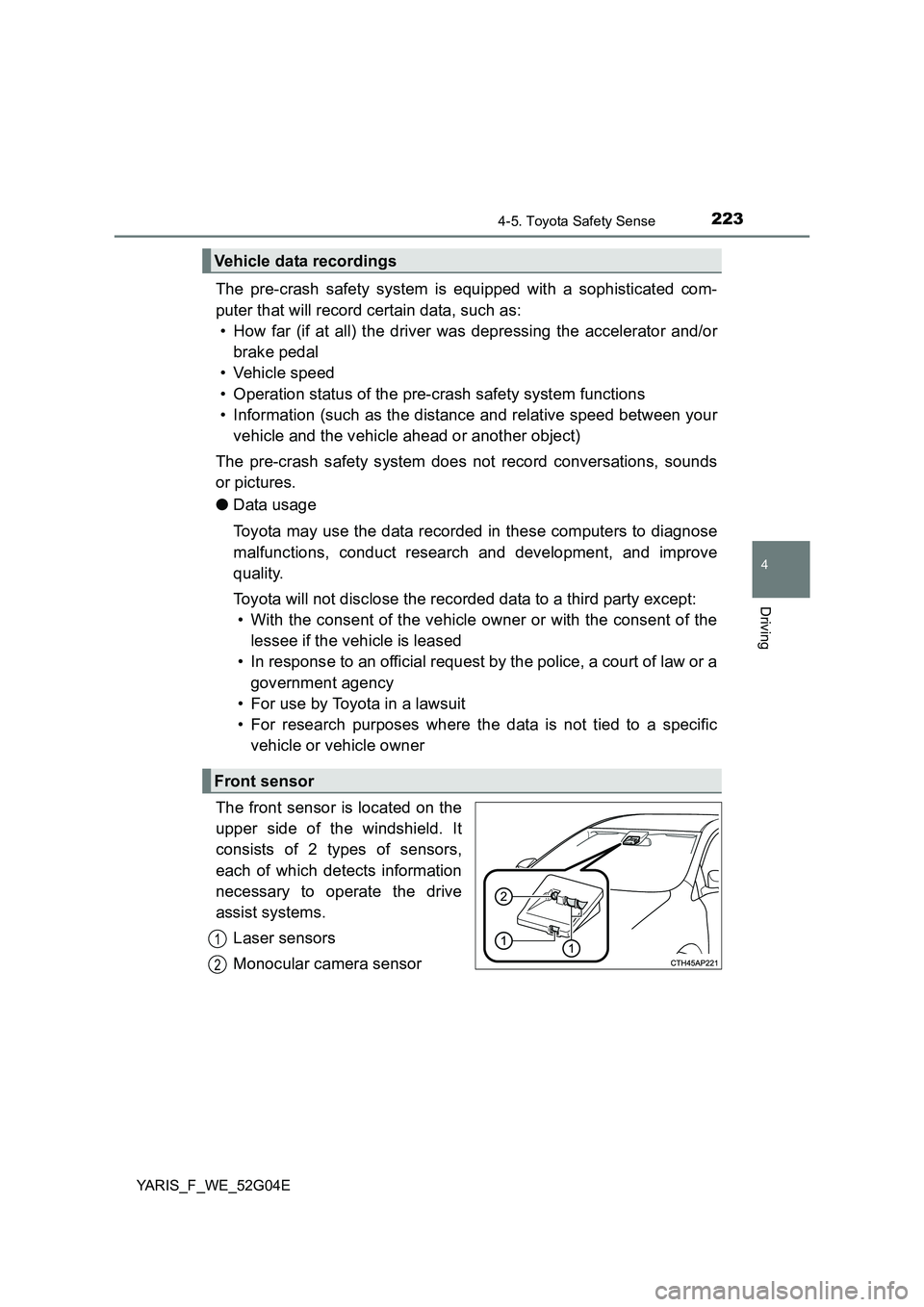
The front sensor is located on the
upper side of the windshield. It
consists of 2 types of sensors,
each of which detects information
necessary to operate the drive
assist systems.
Laser sensors
Monocular camera sensor
Vehicle data recordings
Front sensor
1
2
Page 225 of 540
2254-5. Toyota Safety Sense
4
Driving
YARIS_F_WE_52G04E
NOTICE
■Front sensor
Observe the following to ensure that the sensor operates correctly:
● Do not attach window tinting to the windshield.
● On cold days when there is a large temperature difference between the
vehicle interior and outside air temperatures, the windshield fogs up easily.
If the part of the windshield in front of the front sensor becomes fogged up
or covered with condensation or ice, the system temporarily stops working
and the PCS warning light flashes. In that case, use the front defroster to
remove the fog, condensation, or ice. ( P. 308, 317)
● Keep the windshield clean at all times. Also, even when using a glass
coating agent, if water droplets and so forth form on the windshield, use
the wipers to remove them.
The pre-crash safety system may not function properly if the windshield is
dirty or covered with an oily film, water droplets, snow, etc.
If the inner side of the windshield where the front sensor is installed is dirty,
do not attempt to remove the front sensor. Contact any authorized Toyota
dealer or repairer, or another dul y qualified and equipped professional.
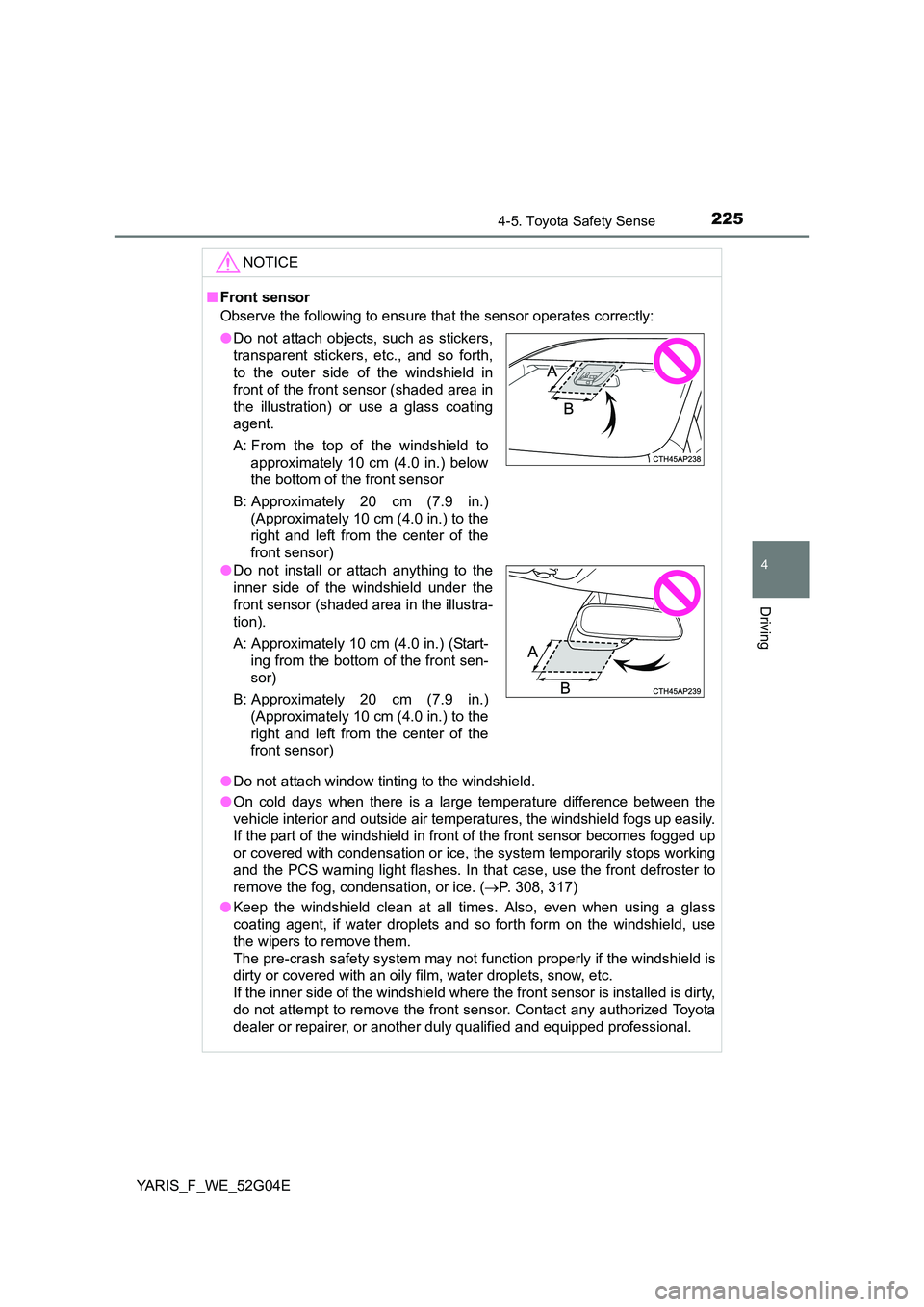
●Do not attach objects, such as stickers,
transparent stickers, etc., and so forth,
to the outer side of the windshield in
front of the front sensor (shaded area in
the illustration) or use a glass coating
agent.
A: From the top of the windshield to
approximately 10 cm (4.0 in.) below
the bottom of the front sensor
B: Approximately 20 cm (7.9 in.)
(Approximately 10 cm (4.0 in.) to the
right and left from the center of the
front sensor)
● Do not install or attach anything to the
inner side of the windshield under the
front sensor (shaded area in the illustra-
tion).
A: Approximately 10 cm (4.0 in.) (Start-
ing from the bottom of the front sen-
sor)
B: Approximately 20 cm (7.9 in.)
(Approximately 10 cm (4.0 in.) to the
right and left from the center of the
front sensor)