wheel TOYOTA YARIS HATCHBACK 2015 Repair Manual
[x] Cancel search | Manufacturer: TOYOTA, Model Year: 2015, Model line: YARIS HATCHBACK, Model: TOYOTA YARIS HATCHBACK 2015Pages: 540, PDF Size: 34.12 MB
Page 427 of 540
4278-2. Steps to take in an emergency
8
When trouble arises
YARIS_F_WE_52G04E
WARNING
Observe the following precautions.
Failure to do so may result in death or serious injury.
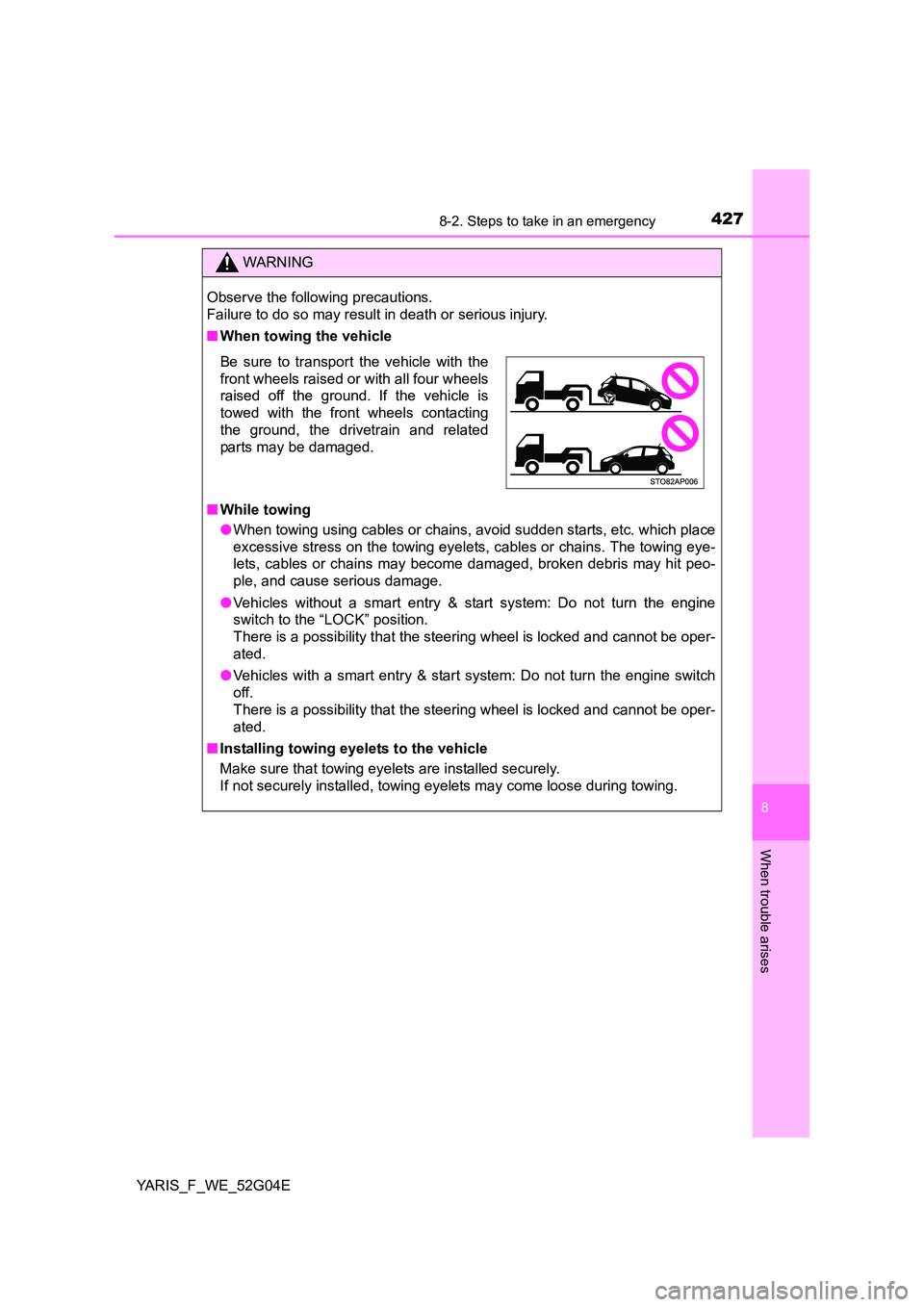
■ When towing the vehicle
■ While towing
● When towing using cables or chains, avoid sudden starts, etc. which place
excessive stress on the towing eyelets, cables or chains. The towing eye-
lets, cables or chains may become damaged, broken debris may hit peo-
ple, and cause serious damage.
● Vehicles without a smart entry & start system: Do not turn the engine
switch to the “LOCK” position.
There is a possibility that the steering wheel is locked and cannot be oper-
ated.
● Vehicles with a smart entry & start system: Do not turn the engine switch
off.
There is a possibility that the steering wheel is locked and cannot be oper-
ated.
■ Installing towing eyelets to the vehicle
Make sure that towing eyelets are installed securely.
If not securely installed, towing eyelets may come loose during towing.
Be sure to transport the vehicle with the
front wheels raised or with all four wheels
raised off the ground. If the vehicle is
towed with the front wheels contacting
the ground, the drivetrain and related
parts may be damaged.
Page 428 of 540
4288-2. Steps to take in an emergency
YARIS_F_WE_52G04E
NOTICE
■To prevent damage to the vehicle when towing using a wheel-lift type
truck
● Vehicles without a smart entry & start system: Do not tow the vehicle from
the rear when the engine switch is in the “LOCK” position or the key is
removed.
The steering lock mechanism is not strong enough to hold the front wheels
straight.
● Vehicles with a smart entry & start system: Do not tow the vehicle from the
rear when the engine switch is off. The steering lock mechanism is not
strong enough to hold the front wheels straight.
● When raising the vehicle, ensure adequate ground clearance for towing at
the opposite end of the raised vehicle. Without adequate clearance, the
vehicle could be damaged while being towed.
■ To prevent damage to the vehicle when towing with a sling-type truck
Do not tow with a sling-type truck, either from the front or rear.
■ To prevent damage to the vehicle during emergency towing
Do not secure cables or chains to the suspension components.
Page 440 of 540
4408-2. Steps to take in an emergency
YARIS_F_WE_52G04E
■ The tire pressure warning light may come on due to natural causes
(vehicles with a tire pressure warning system)
The tire pressure warning light may come on due to natural causes such as
natural air leaks and tire inflation pressure changes caused by temperature.
In this case, adjusting the tire inflation pressure will turn off the warning light
(after a few minutes).
■ When a tire is replaced with a spare tire (vehicles with a tire pressure
warning system)
The spare tire is not equipped with a tire pressure warning valve and trans-
mitter. If a tire goes flat, the tire pressure warning light will not turn off even
though the flat tire has been replaced with the spare tire. Replace the spare
tire with the repaired tire and adjust the tire inflation pressure. The tire pres-
sure warning light will go off after a few minutes.
■ If the tire pressure warning system is not functioning (vehicles with a
tire pressure warning system)
The tire pressure warning system will be disabled in the following conditions:
(When the condition becomes normal, the system will work properly.)
● If tires not equipped with tire pressure warning valves and transmitters are
used
● If the ID code on the tire pressure warning valves and transmitters is not
registered in the tire pressure warning computer
● If the tire inflation pressure is 500 kPa (5.1 kgf/cm2 or bar, 73 psi) or higher
The tire pressure warning system may be disabled in the following conditions:
(When the condition becomes normal, the system will work properly.)
● If electronic devices or facilities using similar radio wave frequencies are
nearby
● If a radio set at a similar frequency is in use in the vehicle
● If a window tint that affects the radio wave signals is installed
● If there is a lot of snow or ice on the vehicle, particularly around the wheels
or wheel housings
● If non-genuine Toyota wheels are used (Even if you use Toyota wheels, the
tire pressure warning system may not work properly with some types of
tires.)
● If tire chains are used
■ If the tire pressure warning light frequently comes on after blinking for 1
minute (vehicles with a tire pressure warning system)
If the tire pressure warning light frequently comes on after blinking for 1
minute when the engine switch is turned on, have it checked by any autho-
rized Toyota dealer or repairer, or another duly qualified and equipped profes-
sional.
Page 441 of 540
4418-2. Steps to take in an emergency
8
When trouble arises
YARIS_F_WE_52G04E
WARNING
■When the electric power steering system warning light comes on
The steering wheel may become extremely heavy.
If the steering wheel becomes heavier than usual when operating, hold
firmly and operate using more force than usual.
■ When driving to clean the DPF catalytic converter
When driving, pay sufficient attention to weather, road conditions, terrain
and traffic conditions, and be sure to observe traffic laws and/or regulations.
Failure to do so may cause an unexpected accident, resulting in death or
serious injury.
■ If the tire pressure warning light comes on (vehicles with a tire pres-
sure warning system)
Be sure to observe the following precautions. Failure to do so could cause a
loss of vehicle control and result in death or serious injury.
● Stop your vehicle in a safe place as soon as possible. Adjust the tire infla-
tion pressure immediately.
● If the tire pressure warning light comes on even after tire inflation pressure
adjustment, it is probable that you have a flat tire. Check the tires. If a tire
is flat, change it with the spare tire and have the flat tire repaired by the
nearest authorized Toyota dealer or repairer, or another duly qualified and
equipped professional.
● Avoid abrupt maneuvering and braking. If the vehicle tires deteriorate, you
could lose control of the steering wheel or the brakes.
■ If a blowout or sudden air leakage should occur (vehicles with a tire
pressure warning system)
The tire pressure warning system may not activate immediately.
Page 445 of 540
4458-2. Steps to take in an emergency
8
When trouble arises
YARIS_F_WE_52G04E
If you have a flat tire (vehicles with a spare
tire)
● Stop the vehicle on a hard, flat surface.
● Set the parking brake.
● Shift the shift lever to P (Multidrive) or R (manual transmission).
● Stop the engine.
● Turn on the emergency flashers. (P. 420)
Your vehicle is equipped with a spare tire. The flat tire can be
replaced with the spare tire.
For details about tires: P. 3 7 3
WARNING
■If you have a flat tire
Do not continue driving with a flat tire.
Driving even a short distance with a flat tire can damage the tire and the
wheel beyond repair, which could result in an accident.
Before jacking up the vehicle
Page 446 of 540
4468-2. Steps to take in an emergency
YARIS_F_WE_52G04E
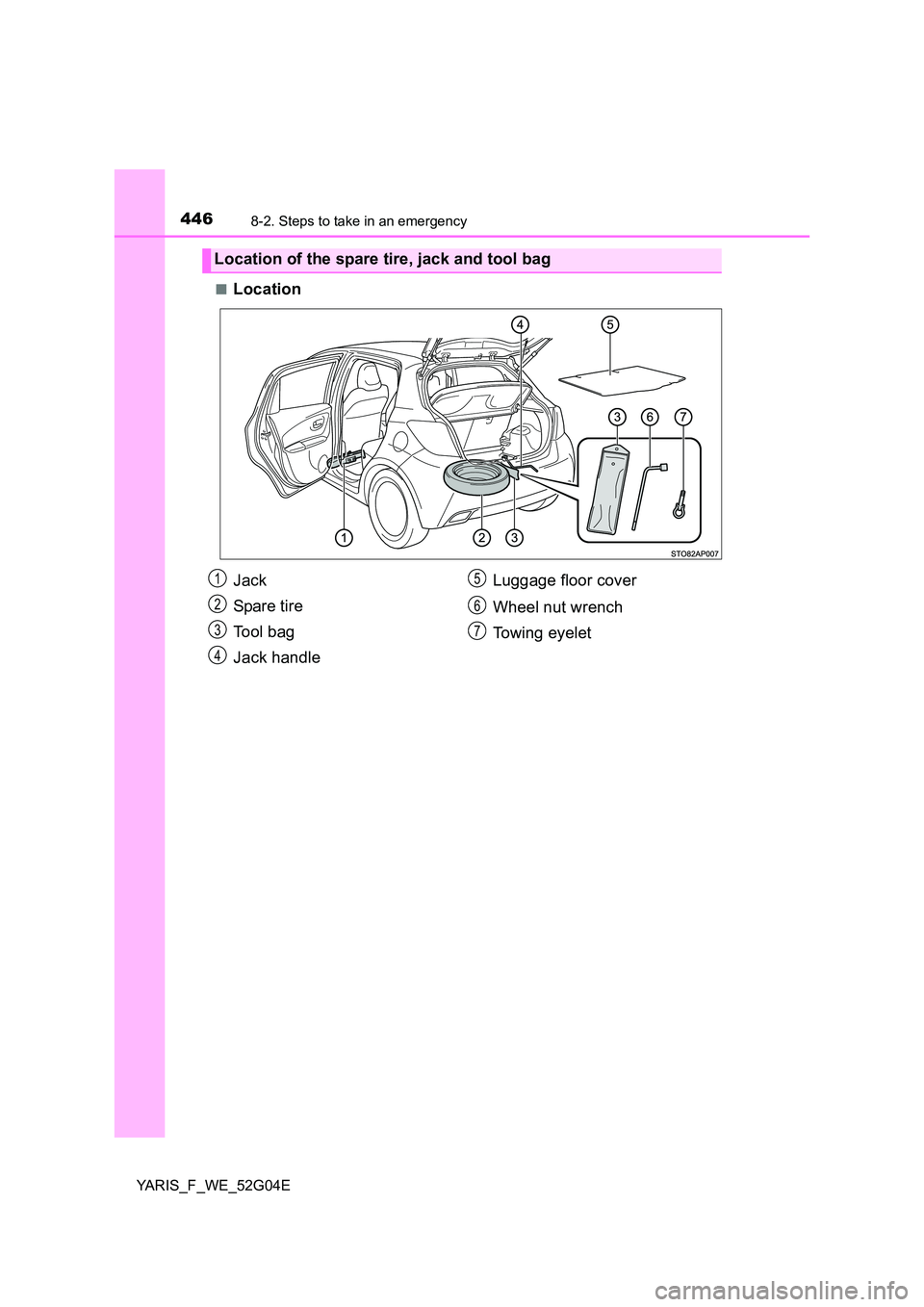
■Location
Location of the spare tire, jack and tool bag
Jack
Spare tire
Tool bag
Jack handle
Luggage floor cover
Wheel nut wrench
Towing eyelet
1
2
3
4
5
6
7
Page 449 of 540
4498-2. Steps to take in an emergency
8
When trouble arises
YARIS_F_WE_52G04E
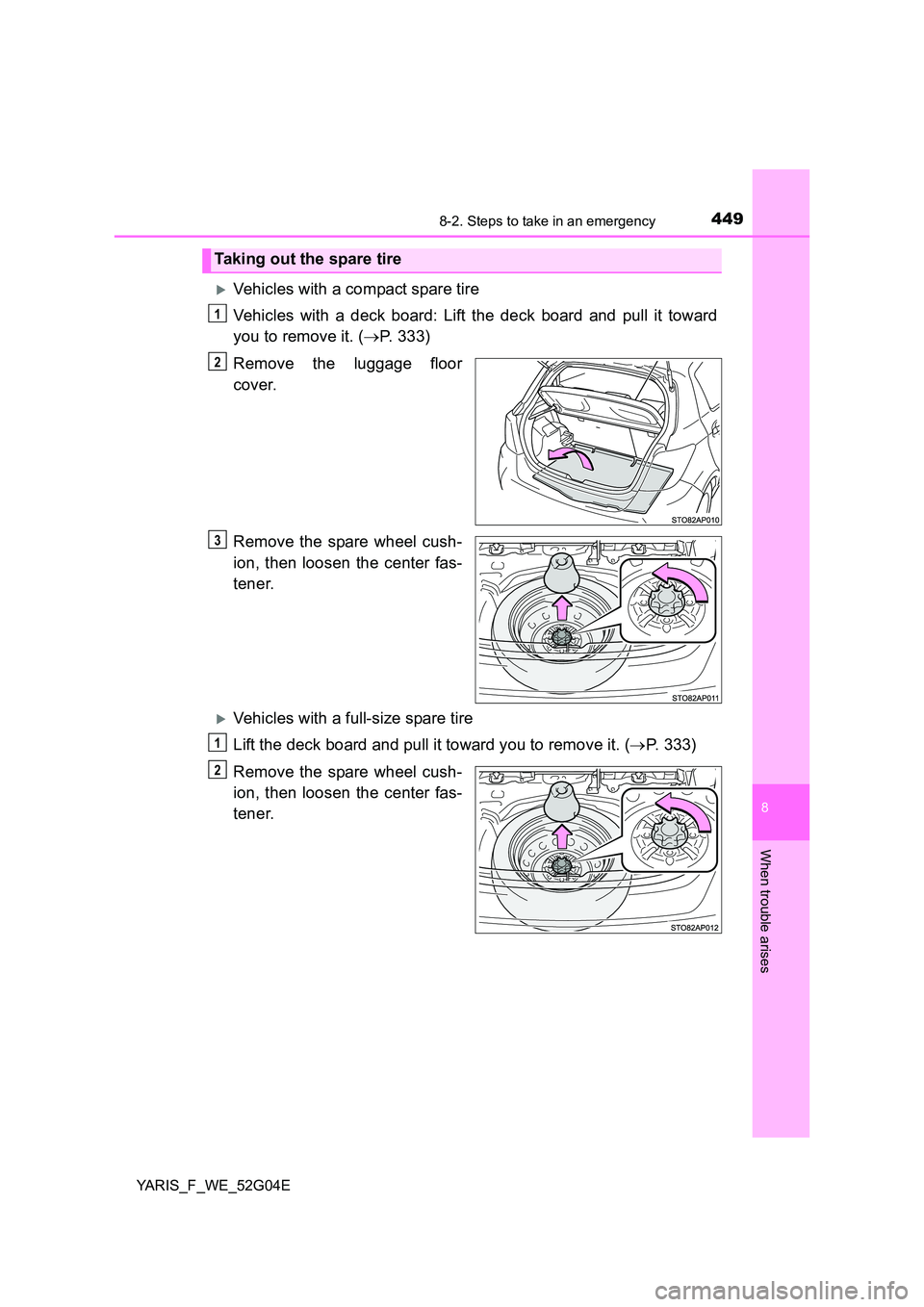
Vehicles with a compact spare tire
Vehicles with a deck board: Lift the deck board and pull it toward
you to remove it. ( P. 333)
Remove the luggage floor
cover.
Remove the spare wheel cush-
ion, then loosen the center fas-
tener.
Vehicles with a full-size spare tire
Lift the deck board and pull it toward you to remove it. ( P. 333)
Remove the spare wheel cush-
ion, then loosen the center fas-
tener.
Taking out the spare tire
1
2
3
1
2
Page 450 of 540
4508-2. Steps to take in an emergency
YARIS_F_WE_52G04E
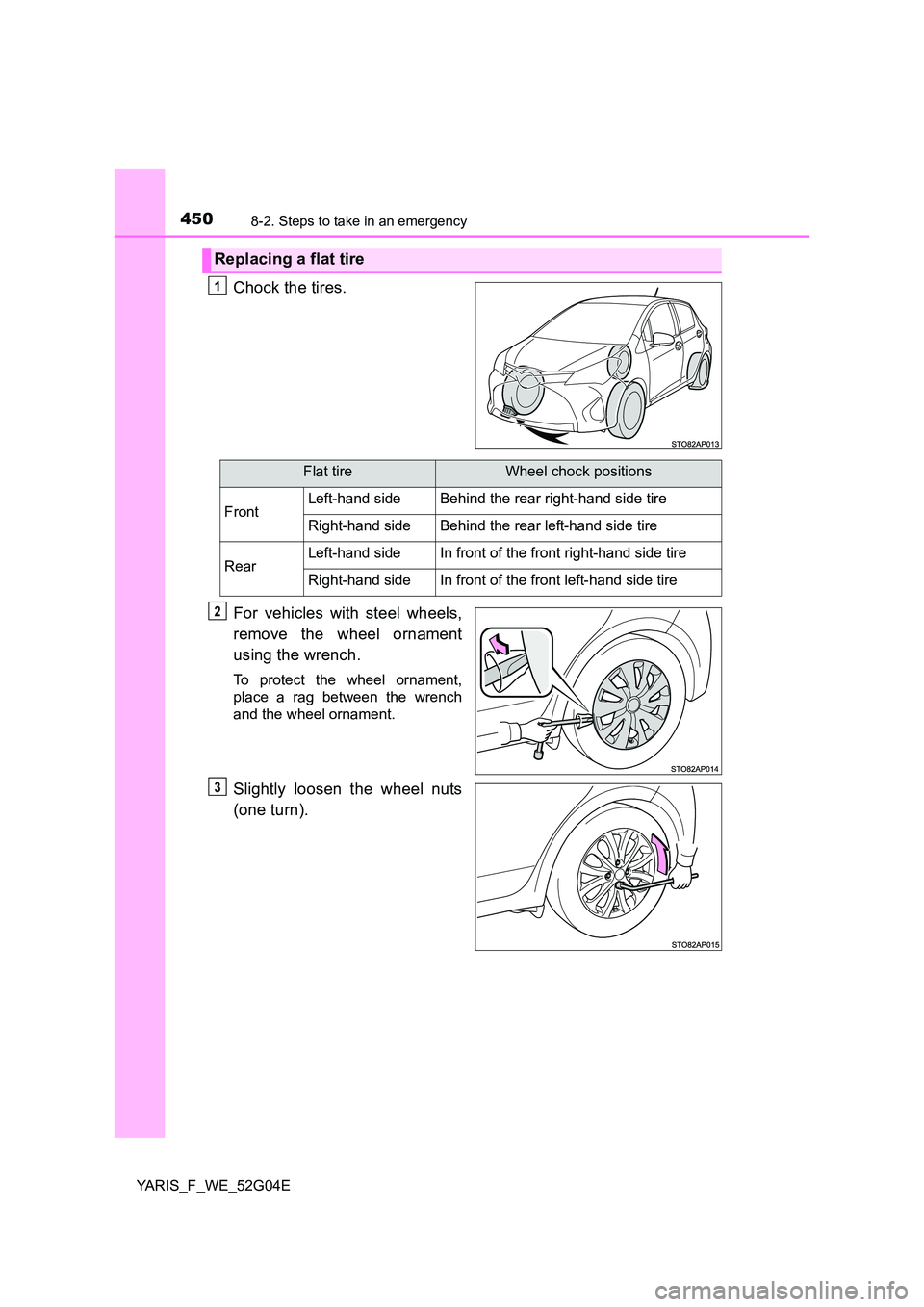
Chock the tires.
For vehicles with steel wheels,
remove the wheel ornament
using the wrench.
To protect the wheel ornament,
place a rag between the wrench
and the wheel ornament.
Slightly loosen the wheel nuts
(one turn).
Replacing a flat tire
1
Flat tireWheel chock positions
FrontLeft-hand sideBehind the rear right-hand side tire
Right-hand sideBehind the rear left-hand side tire
RearLeft-hand sideIn front of the front right-hand side tire
Right-hand sideIn front of the front left-hand side tire
2
3
Page 451 of 540
4518-2. Steps to take in an emergency
8
When trouble arises
YARIS_F_WE_52G04E
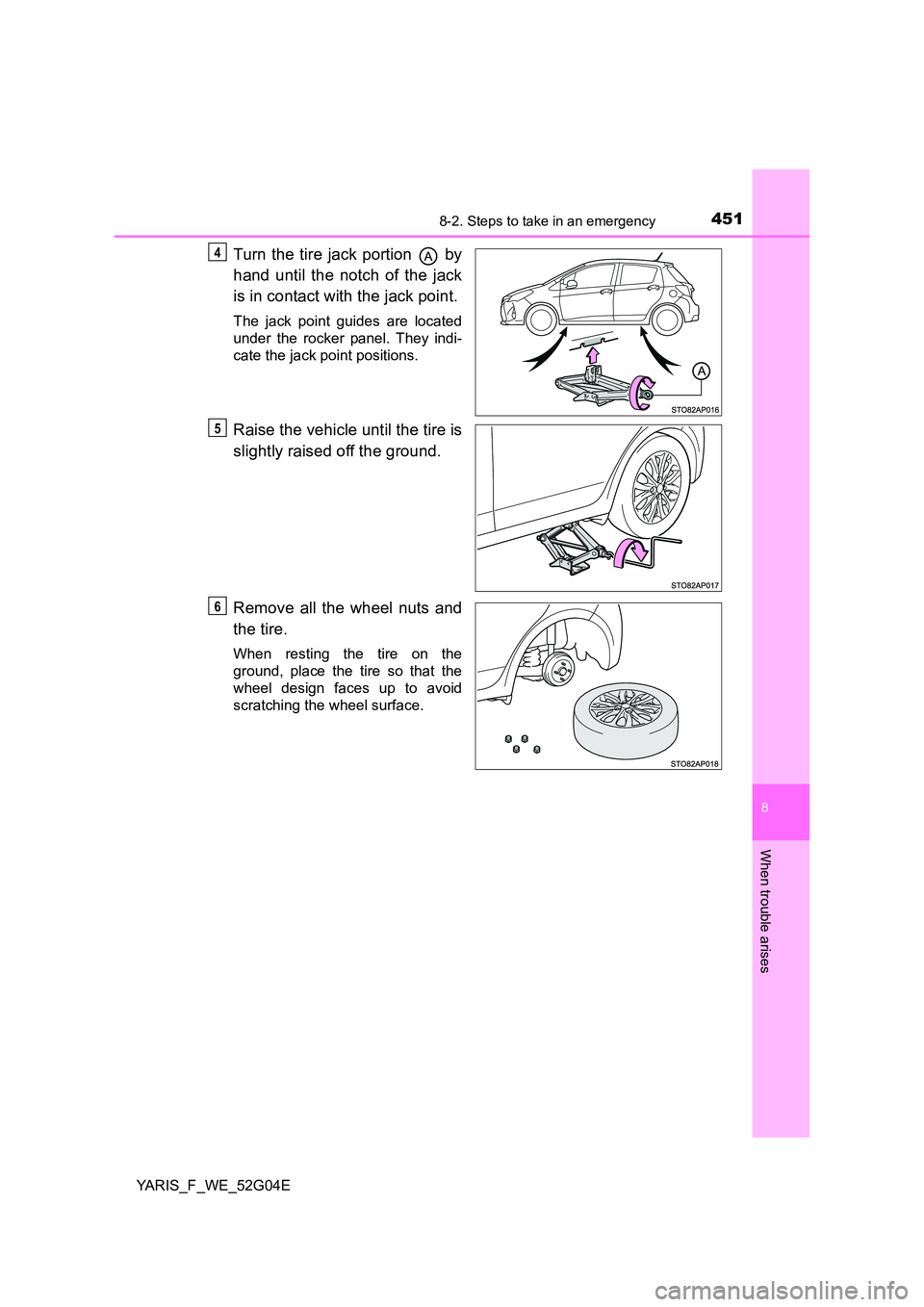
Turn the tire jack portion by
hand until the notch of the jack
is in contact with the jack point.
The jack point guides are located
under the rocker panel. They indi-
cate the jack point positions.
Raise the vehicle until the tire is
slightly raised off the ground.
Remove all the wheel nuts and
the tire.
When resting the tire on the
ground, place the tire so that the
wheel design faces up to avoid
scratching the wheel surface.
4
5
6
Page 452 of 540
4528-2. Steps to take in an emergency
YARIS_F_WE_52G04E
WARNING
■Replacing a flat tire
● Observe the following precautions.
Failure to do so may result in serious injury:
• Do not try to remove the wheel ornament by hand. Take due care in
handling the ornament to avoid unexpected personal injury.
• Do not touch the disc wheels or the area around the brakes immediately
after the vehicle has been driven.
After the vehicle has been driven the disc wheels and the area around
the brakes will be extremely hot. Touching these areas with hands, feet
or other body parts while changing a tire, etc. may result in burns.
● Failure to follow these precautions could cause the wheel nuts to loosen
and the tire to fall off, resulting in death or serious injury.
• Have the wheel nuts tightened with a torque wrench to 103 N·m
(10.5 kgf·m, 76 ft·lbf) as soon as possible after changing wheels.
• When installing a tire, only use wheel nuts that have been specifically
designed for that wheel.
• If there are any cracks or deformations in the bolt screws, nut threads or
bolt holes of the wheel, have the vehicle inspected by any authorized
Toyota dealer or repairer, or another duly qualified and equipped profes-
sional.
• When installing the wheel nuts, be sure to install them with the tapered
ends facing inward. ( P. 390)