wheel TOYOTA YARIS HATCHBACK 2015 Owner's Guide
[x] Cancel search | Manufacturer: TOYOTA, Model Year: 2015, Model line: YARIS HATCHBACK, Model: TOYOTA YARIS HATCHBACK 2015Pages: 540, PDF Size: 34.12 MB
Page 235 of 540
2354-5. Toyota Safety Sense
4
Driving
YARIS_F_WE_52G04E
WARNING
■Cautions regarding the assist functions of the system
By means of warnings and brake control, the pre-crash safety system is intended to assist the driver in avoiding collisions through the process ofLOOK-JUDGE-ACT. There are limits to the degree of assistance the system can provide, so keep in mind the following important points.
● Assisting the driver in watching the road The pre-crash safety system is only able to detect vehicles directly in frontof your vehicle, and only within a limi ted range. It does not allow for care- less or inattentive driving, and is not a system that can assist the driver in low-visibility conditions. It is still necessary for the driver to pay close atten- tion to the vehicle’s surroundings.
● Assisting the driver in making correct judgement When attempting to estimate the possibility of a collision, the only data available to the pre-crash safety system is that from vehicles it has detected directly in front of the vehicle. Therefore, it is absolutely neces-sary for the driver to remain vigila nt and to determine whether or not there is a possibility of collision in any given situation.
● Assisting the driver in taking action The pre-crash brake assist and pre- crash braking functions are designed to help avoid a collision or reduce the severity of a collision, as such theyonly operate when the system has determined that the possibility of a col- lision is high. This system is not capable of automatically avoiding a colli- sion or bringing the vehicle to a stop safely, without appropriate operationsbeing performed by the driver. For this reason, when encountering a dan-gerous situation the driver must take direct and immediate action in order to ensure the safety of all involved.
NOTICE
■ To avoid malfunction of the system
In the following situations, disable the pre-crash safety system. The system may operate even if there is no possibility of a collision.
● When inspecting the vehicle using a drum tester such as a chassis dyna- mometer or speedometer tester, or when using an on vehicle wheel bal-ancer
● When transporting the vehicle via boat, truck, or similar means of transpor- tation
● When the front part of the vehicle is raised or lowered, such as if tires of a different size than specified are used or if the suspension components are modified
● When the vehicle is being towed
Page 240 of 540
2404-5. Toyota Safety Sense
YARIS_F_WE_52G04E
WARNING
■Before using the LDA system
Do not rely solely on the LDA system. The LDA system does not drive the
vehicle automatically, nor does it reduce the amount of care you need to
take. As such, the driver must always assume full responsibility for under-
standing his/her surroundings, for operat ing the steering wheel to correct
the driving line, and for driving safely.
Inappropriate or negligent driving could lead to an accident.
■ To avoid operating the LDA by mistake
Switch the LDA system off using the LDA switch when not in use.
■ Situations unsuitable for LDA system
Do not use the LDA system in any of the following situations.
Otherwise, the system may not function correctly and could result in an
accident.
● When driving with tire chains, a spare tire, or similar equipment
● When there are objects or structures along the roadside that might be mis-
interpreted as lane markers (such as guardrails, a curb, reflector posts,
etc.)
● When driving on snowy roads
● When pavement lane markers are difficult to see due to rain, snow, fog,
sand, dirt, etc.
● When there are visible lines on the pavement from road repairs, or if the
remains of old lane markers are still visible on the road
● When driving on a road with lane closures due to maintenance, or when
driving in a temporary lane
NOTICE
■ To prevent damage to or incorrect operation of the LDA system
● Do not modify the headlights or attach stickers to the surface of the lights.
● Do not modify the suspension. If your suspension needs repairs, contact
any authorized Toyota dealer or repairer, or another duly qualified and
equipped professional.
● Do not install or place anything on the hood or the grille. Also, do not install
a grille guard (bull bars, kangaroo bar etc.).
Page 243 of 540
2434-5. Toyota Safety Sense
4
Driving
YARIS_F_WE_52G04E
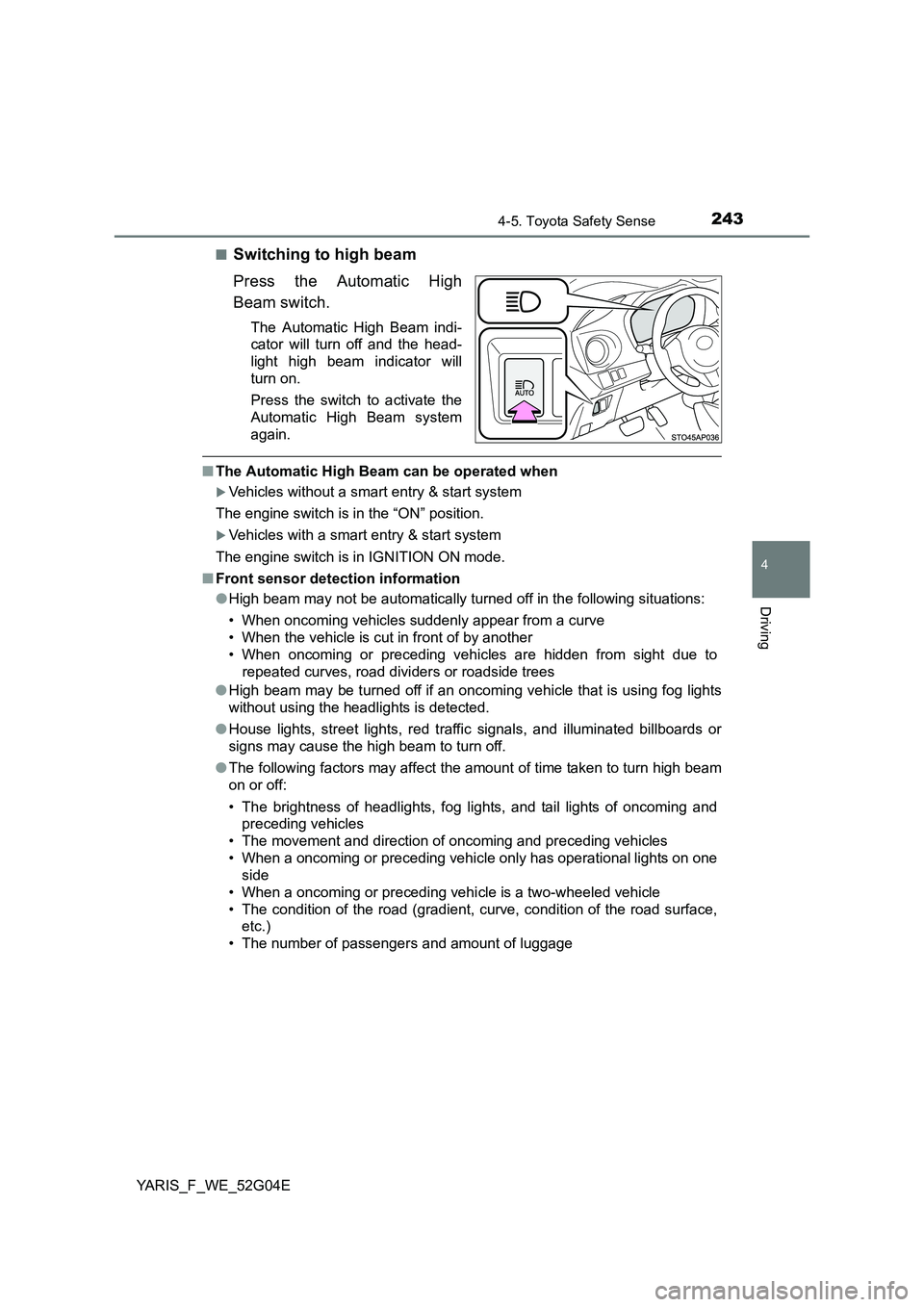
■Switching to high beam
Press the Automatic High
Beam switch.
The Automatic High Beam indi-
cator will turn off and the head-
light high beam indicator will
turn on.
Press the switch to activate the
Automatic High Beam system
again.
■ The Automatic High Beam can be operated when
Vehicles without a smart entry & start system
The engine switch is in the “ON” position.
Vehicles with a smart entry & start system
The engine switch is in IGNITION ON mode.
■ Front sensor detection information
● High beam may not be automatically turned off in the following situations:
• When oncoming vehicles suddenly appear from a curve
• When the vehicle is cut in front of by another
• When oncoming or preceding vehicles are hidden from sight due to
repeated curves, road divi ders or roadside trees
● High beam may be turned off if an oncoming vehicle that is using fog lights
without using the headlights is detected.
● House lights, street lights, red traffic signals, and illuminated billboards or
signs may cause the high beam to turn off.
● The following factors may affect the amount of time taken to turn high beam
on or off:
• The brightness of headlights, fog lights, and tail lights of oncoming and
preceding vehicles
• The movement and direction of oncoming and preceding vehicles
• When a oncoming or preceding vehicle only has operational lights on one
side
• When a oncoming or preceding vehi cle is a two-wheeled vehicle
• The condition of the road (gradient, curve, condition of the road surface,
etc.)
• The number of passengers and amount of luggage
Page 260 of 540
2604-6. Using the driving support systems
YARIS_F_WE_52G04E
Driving assist systems
◆ABS (Anti-lock Brake System)
Helps to prevent wheel lock when the brakes are applied suddenly,
or if the brakes are applied while driving on a slippery road surface
◆Brake assist
Generates an increased level of braking force after the brake pedal
is depressed when the system detects a panic stop situation
◆VSC (Vehicle Stability Control) (if equipped)
Helps the driver to control skidding when swerving suddenly or
turning on slippery road surfaces
◆TRC (Traction Control) (if equipped)
Helps to maintain drive power and prevent the drive wheels from
spinning when starting the vehicle or accelerating on slippery roads
◆EPS (Electric Power Steering)
Employs an electric motor to reduce the amount of effort needed to
turn the steering wheel
◆PCS (Pre-Crash Safety system) (if equipped)
P. 2 2 7
◆Emergency brake signal
When the brakes are applied suddenly, the emergency flashers
automatically flash to alert the vehicle behind.
To help enhance driving safety and performance, the following
systems operate automatically in response to various driving
situations. Be aware, however, that these systems are supple-
mentary and should not be relied upon too heavily when operat-
ing the vehicle.
Page 261 of 540
2614-6. Using the driving support systems
4
Driving
YARIS_F_WE_52G04E
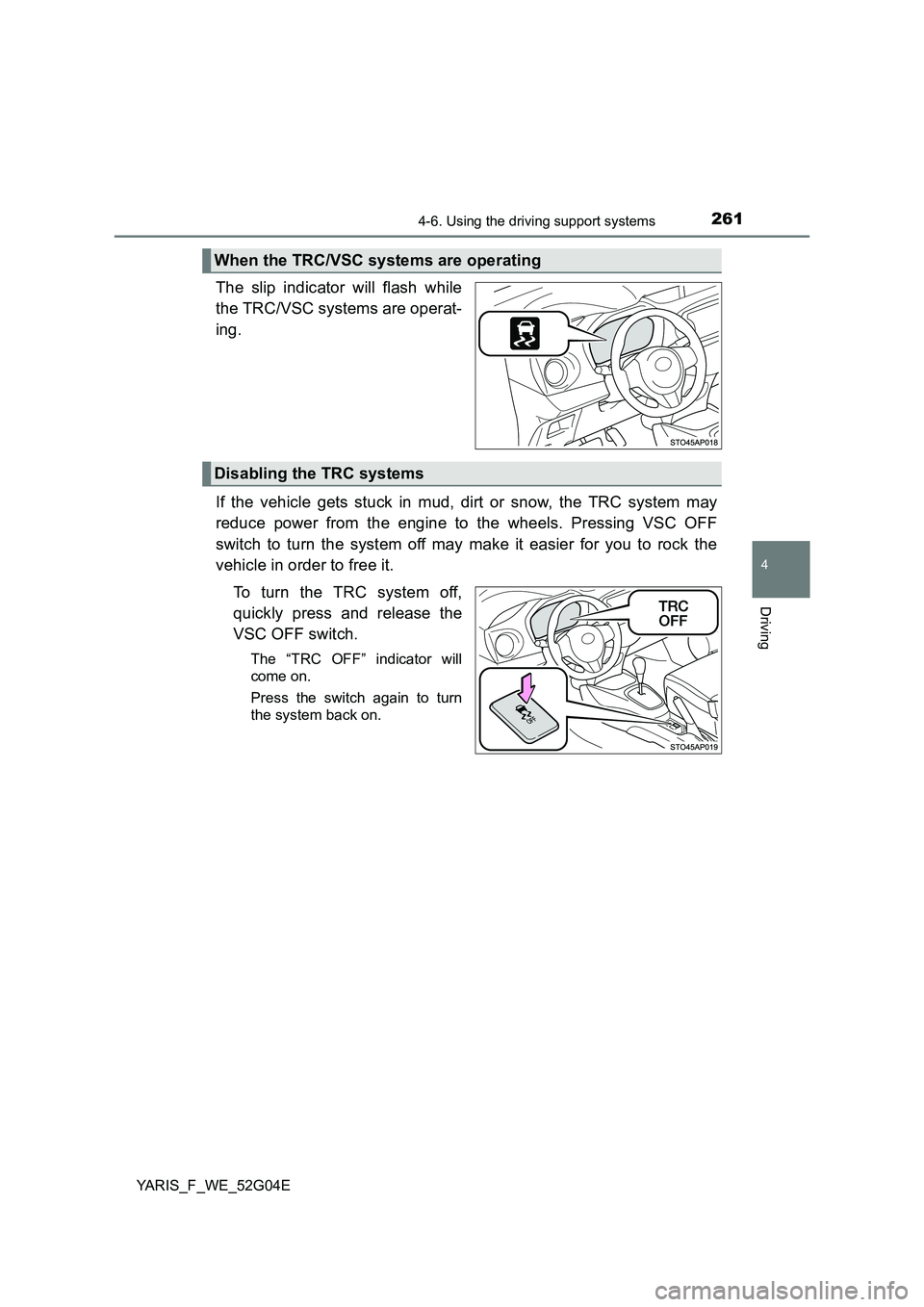
The slip indicator will flash while
the TRC/VSC systems are operat-
ing.
If the vehicle gets stuck in mud, dirt or snow, the TRC system may
reduce power from the engine to the wheels. Pressing VSC OFF
switch to turn the system off may make it easier for you to rock the
vehicle in order to free it.
To turn the TRC system off,
quickly press and release the
VSC OFF switch.
The “TRC OFF” indicator will
come on.
Press the switch again to turn
the system back on.
When the TRC/VSC systems are operating
Disabling the TRC systems
Page 262 of 540
2624-6. Using the driving support systems
YARIS_F_WE_52G04E
■Turning off both TRC and VSC systems
To turn TRC and VSC systems off, press and hold the VSC OFF switch for
more than 3 seconds while the vehicle is stopped.
The “TRC OFF” indicator and the VSC OFF indicator will come on.
Press the switch again to turn the systems back on.
On vehicles with pre-crash safety system, pre-crash brake assist and pre-
crash braking will also be disabled. The PCS warning light will come on.
( P. 233)
■ When the “TRC OFF” indicator comes on even if the VSC OFF switch
has not been pressed
TRC cannot be operated. Contact any authorized Toyota dealer or repairer, or
another duly qualified and equipped professional.
■ Sounds and vibrations caused by the ABS, brake assist, TRC and VSC
systems
● A sound may be heard from the engine compartment when the brake pedal
is depressed repeatedly, when the engine is started or just after the vehicle
begins to move. This sound does not indicate that a malfunction has
occurred in any of these systems.
● Any of the following conditions may occur when the above systems are
operating. None of these indicates that a malfunction has occurred.
• Vibrations may be felt through the vehicle body and steering.
• A motor sound may be heard after the vehicle comes to a stop.
• The brake pedal may pulsate slightly after the ABS is activated.
• The brake pedal may move down slightly after the ABS is activated.
■ EPS operation sound
When the steering wheel is operated, a motor sound (whirring sound) may be
heard. This does not indicate a malfunction.
■ Automatic reactivation of TRC and VSC systems
After turning the TRC and VSC systems off, the systems will be automatically
re-enabled in the following situations:
● When the engine switch is turned to the “LOCK” position
● If only the TRC system is turned off, the TRC will turn on when vehicle
speed increases
If both the TRC and VSC systems are turned off, automatic re-enabling will
not occur when vehicle speed increases.
■ Reduced effectiveness of the EPS system
The effectiveness of the EPS system is reduced to prevent the system from
overheating when there is frequent steering input over an extended period of
time. The steering wheel may feel heavy as a result. Should this occur, refrain
from excessive steering input or stop the vehicle and turn the engine off. The
EPS system should return to normal within 10 minutes.
Page 264 of 540
2644-6. Using the driving support systems
YARIS_F_WE_52G04E
WARNING
■When the VSC is activated
The slip indicator flashes. Always drive carefully. Reckless driving may
cause an accident. Exercise particular care when the indicator light flashes.
■ When the TRC/VSC systems are turned off
Be especially careful and drive at a speed appropriate to the road condi-
tions. As these are the systems to help ensure vehicle stability and driving
force, do not turn the TRC/VSC systems off unless unnecessary.
■ Replacing tires
Make sure that all tires are of the specified size, brand, tread pattern and
total load capacity. In addition, make sure that the tires are inflated to the
recommended tire inflation pressure level.
The ABS, TRC and VSC systems will not function correctly if different tires
are installed on the vehicle.
Contact any authorized Toyota dealer or repairer, or another duly qualified
and equipped professional for further in formation when replacing tires or
wheels.
■ Handling of tires and the suspension
Using tires with any kind of problem or modifying the suspension will affect
the driving assist systems, and may cause a system to malfunction.
Page 268 of 540
2684-7. Driving tips
YARIS_F_WE_52G04E
Accelerate the vehicle slowly, keep a safe distance between you and
the vehicle ahead, and drive at a reduced speed suitable to road con-
ditions.
Park the vehicle and move the shift lever to P (Multidrive) 1 or R (man-
ual transmission) without setting the parking brake. The parking brake
may freeze up, preventing it from being released. If necessary, block
the wheels to prevent inadvertent sliding or creeping.
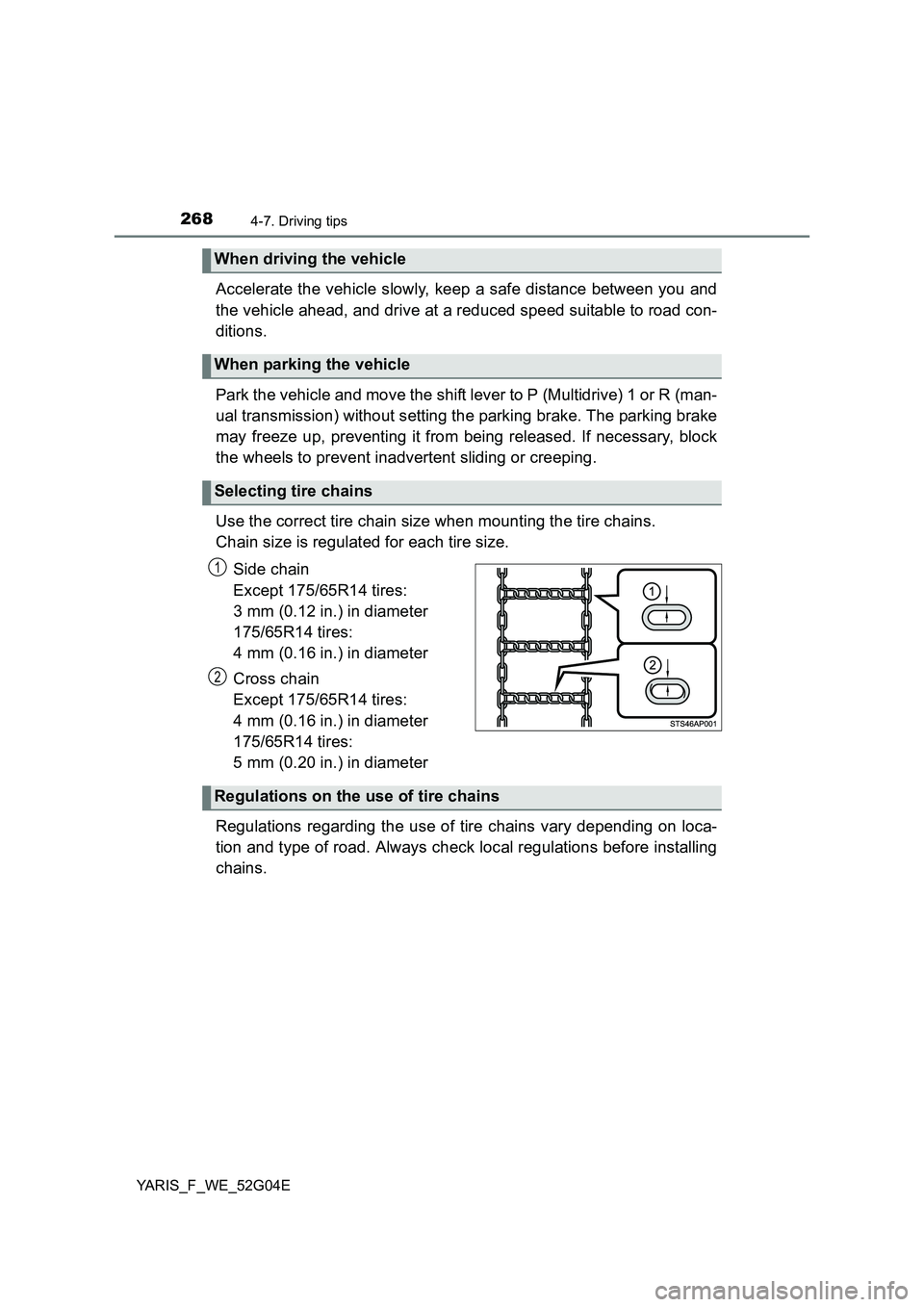
Use the correct tire chain size when mounting the tire chains.
Chain size is regulated for each tire size.
Side chain
Except 175/65R14 tires:
3 mm (0.12 in.) in diameter
175/65R14 tires:
4 mm (0.16 in.) in diameter
Cross chain
Except 175/65R14 tires:
4 mm (0.16 in.) in diameter
175/65R14 tires:
5 mm (0.20 in.) in diameter
Regulations regarding the use of tire chains vary depending on loca-
tion and type of road. Always check local regulations before installing
chains.
When driving the vehicle
When parking the vehicle
Selecting tire chains
1
2
Regulations on the use of tire chains
Page 269 of 540
2694-7. Driving tips
4
Driving
YARIS_F_WE_52G04E
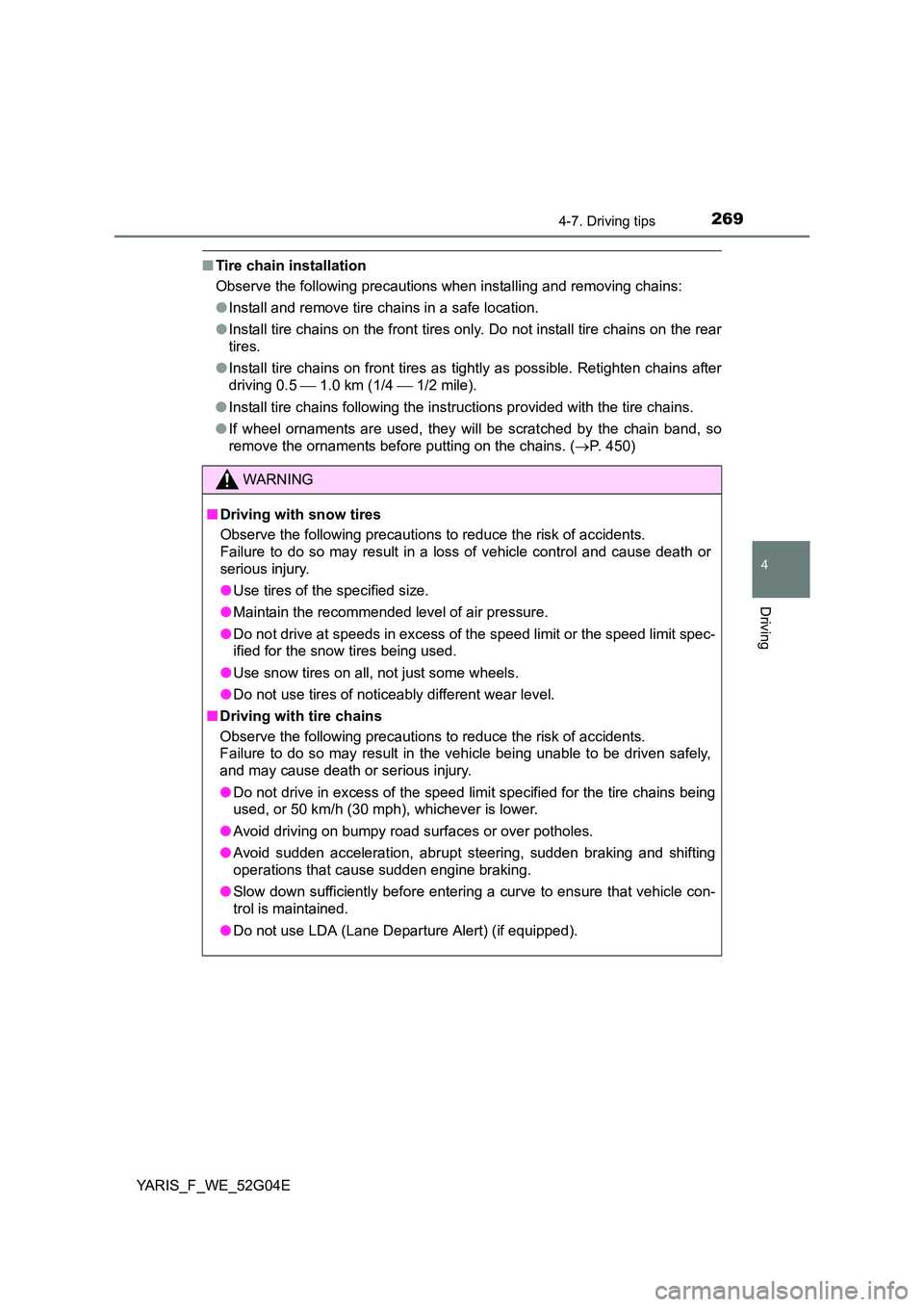
■Tire chain installation
Observe the following precautions when installing and removing chains:
● Install and remove tire chains in a safe location.
● Install tire chains on the front tires only. Do not install tire chains on the rear
tires.
● Install tire chains on front tires as tightly as possible. Retighten chains after
driving 0.5 1.0 km (1/4 1/2 mile).
● Install tire chains following the instructions provided with the tire chains.
● If wheel ornaments are used, they will be scratched by the chain band, so
remove the ornaments before putting on the chains. ( P. 450)
WARNING
■Driving with snow tires
Observe the following precautions to reduce the risk of accidents.
Failure to do so may result in a loss of vehicle control and cause death or
serious injury.
● Use tires of the specified size.
● Maintain the recommended level of air pressure.
● Do not drive at speeds in excess of the speed limit or the speed limit spec-
ified for the snow tires being used.
● Use snow tires on all, not just some wheels.
● Do not use tires of noticeably different wear level.
■ Driving with tire chains
Observe the following precautions to reduce the risk of accidents.
Failure to do so may result in the vehicle being unable to be driven safely,
and may cause death or serious injury.
● Do not drive in excess of the speed limit specified for the tire chains being
used, or 50 km/h (30 mph), whichever is lower.
● Avoid driving on bumpy road surfaces or over potholes.
● Avoid sudden acceleration, abrupt steering, sudden braking and shifting
operations that cause sudden engine braking.
● Slow down sufficiently before entering a curve to ensure that vehicle con-
trol is maintained.
● Do not use LDA (Lane Departure Alert) (if equipped).
Page 271 of 540
271
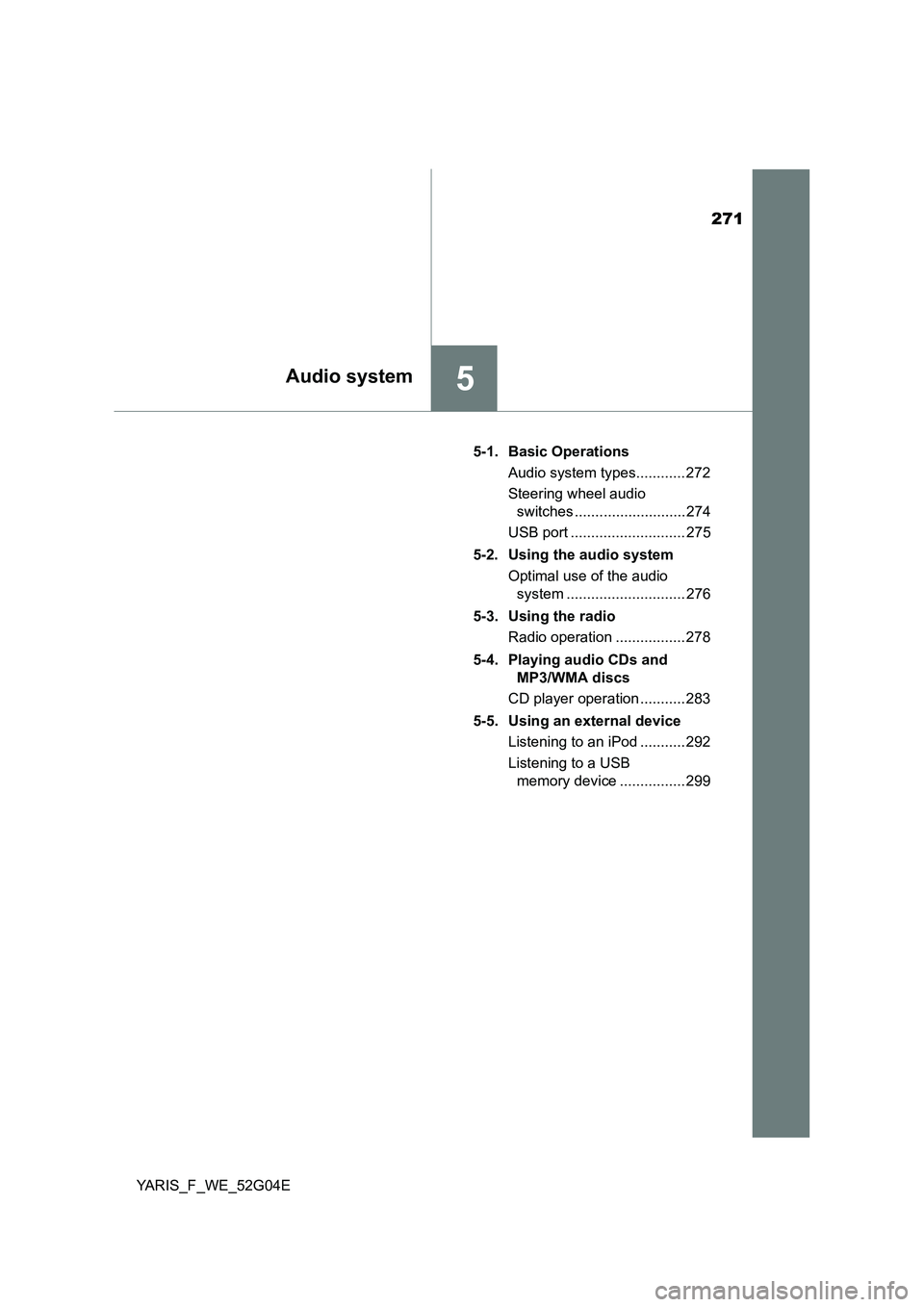
5Audio system
YARIS_F_WE_52G04E
5-1. Basic Operations
Audio system types............ 272
Steering wheel audio
switches ........................... 274
USB port ............................ 275
5-2. Using the audio system
Optimal use of the audio
system ............................. 276
5-3. Using the radio
Radio operation ................. 278
5-4. Playing audio CDs and
MP3/WMA discs
CD player operation ........... 283
5-5. Using an external device
Listening to an iPod ........... 292
Listening to a USB
memory device ................ 299