wheel TOYOTA YARIS HATCHBACK 2016 Repair Manual
[x] Cancel search | Manufacturer: TOYOTA, Model Year: 2016, Model line: YARIS HATCHBACK, Model: TOYOTA YARIS HATCHBACK 2016Pages: 368, PDF Size: 7.86 MB
Page 286 of 368
2867-2. Steps to take in an emergency
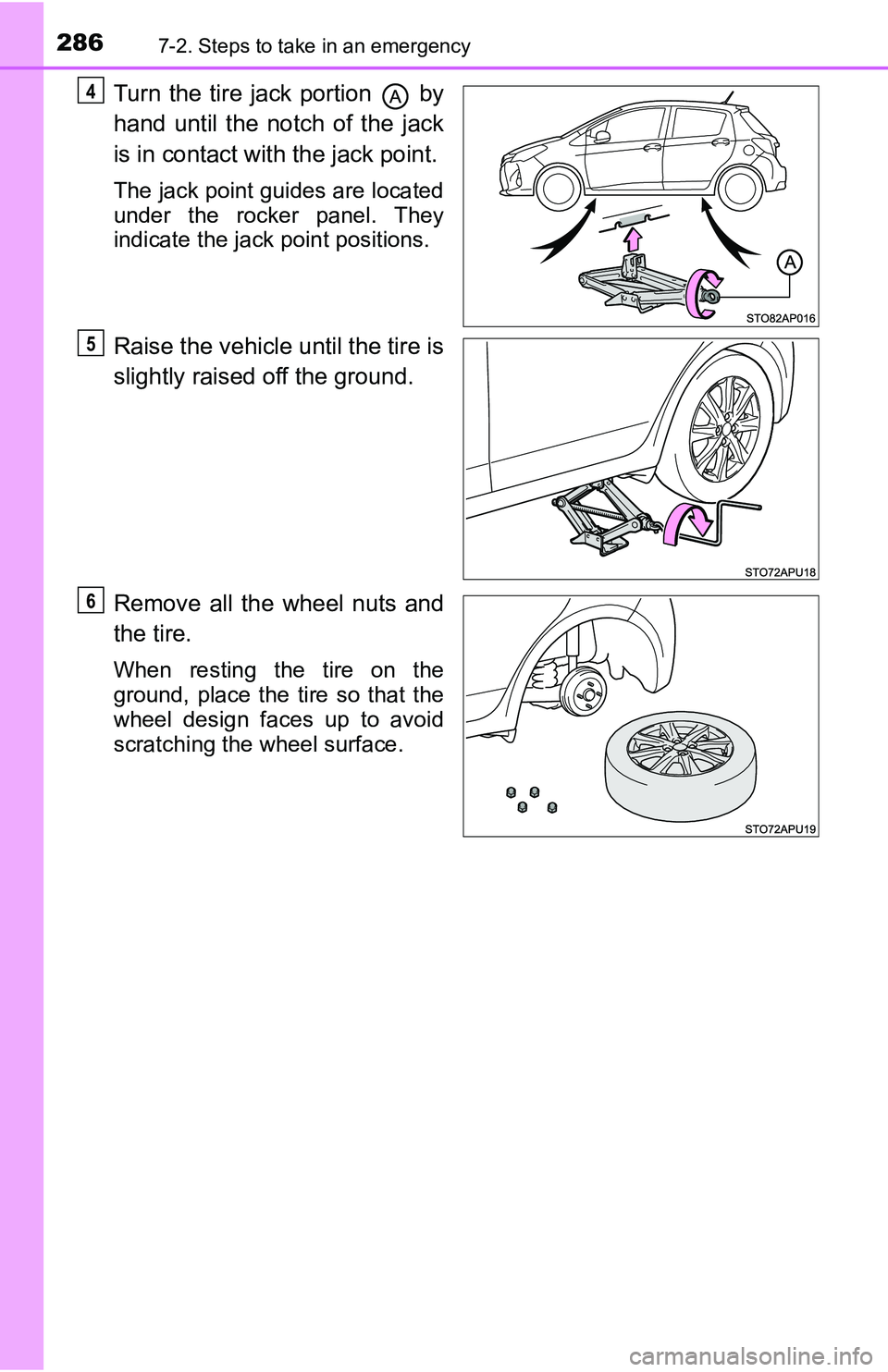
Turn the tire jack portion by
hand until the notch of the jack
is in contact with the jack point.
The jack point guides are located
under the rocker panel. They
indicate the jack point positions.
Raise the vehicle until the tire is
slightly raised off the ground.
Remove all the wheel nuts and
the tire.
When resting the tire on the
ground, place the tire so that the
wheel design faces up to avoid
scratching the wheel surface.
4
5
6
Page 287 of 368
2877-2. Steps to take in an emergency
7
When trouble arises
WARNING
■Replacing a flat tire
●Observe the following precautions.
Failure to do so may result in serious injury:
• Do not try to remove the wheel ornament by hand. Take due care in handling the ornament to avoi d unexpected personal injury.
• Do not touch the disc wheels or the area around the brakes immedi- ately after the vehicle has been driven.
After the vehicle has been driven the disc wheels and the area
around the brakes will be extremely hot. Touching these areas with
hands, feet or other body parts while changing a tire, etc., may
result in burns.
●Failure to follow these precautions could cause the wheel nuts to
loosen and the tire to fall off, resulting in death or serious injury.
• Have the wheel nuts tightened with a torque wrench to 76 ft·lbf
(103 N·m, 10.5 kgf·m) as soon as possible after changing wheels.
• When installing a tire, only use wh eel nuts that have been specifi-
cally designed for that wheel.
• If there are any cracks or deforma tions in the bolt screws, nut threads
or bolt holes of the wheel, have the vehicle inspected by your Toyota
dealer.
• When installing the wheel nuts, be sure to install them with the tapered ends facing inward. ( P. 236)
Page 288 of 368
2887-2. Steps to take in an emergency
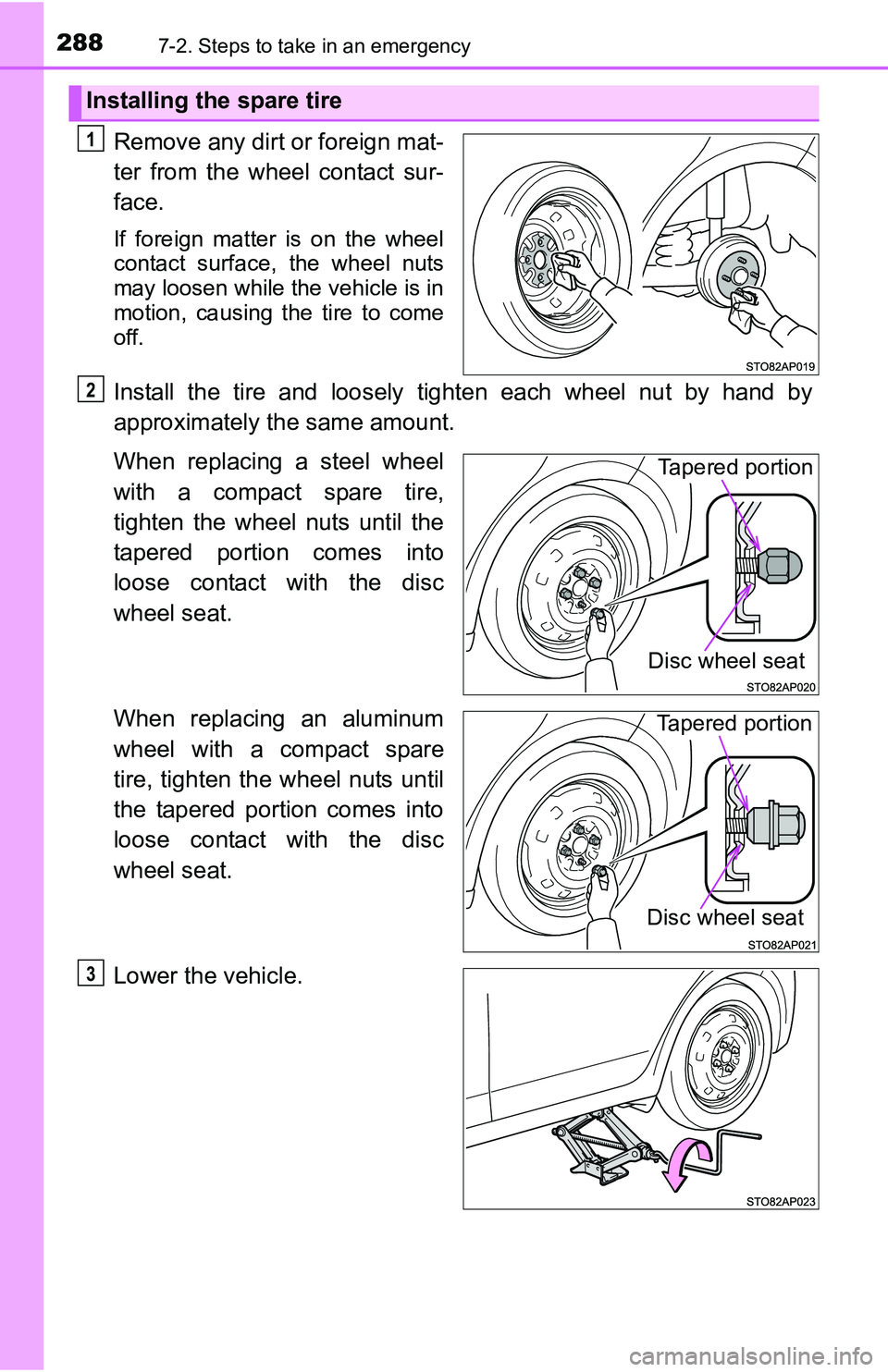
Remove any dirt or foreign mat-
ter from the wheel contact sur-
face.
If foreign matter is on the wheel
contact surface, the wheel nuts
may loosen while the vehicle is in
motion, causing the tire to come
off.
Install the tire and loosely tighten each wheel nut by hand by
approximately the same amount.
When replacing a steel wheel
with a compact spare tire,
tighten the wheel nuts until the
tapered portion comes into
loose contact with the disc
wheel seat.
When replacing an aluminum
wheel with a compact spare
tire, tighten the wheel nuts until
the tapered portion comes into
loose contact with the disc
wheel seat.
Lower the vehicle.
Installing the spare tire
1
2
Tapered portion
Disc wheel seat
Tapered portion
Disc wheel seat
3
Page 289 of 368
2897-2. Steps to take in an emergency
7
When trouble arises
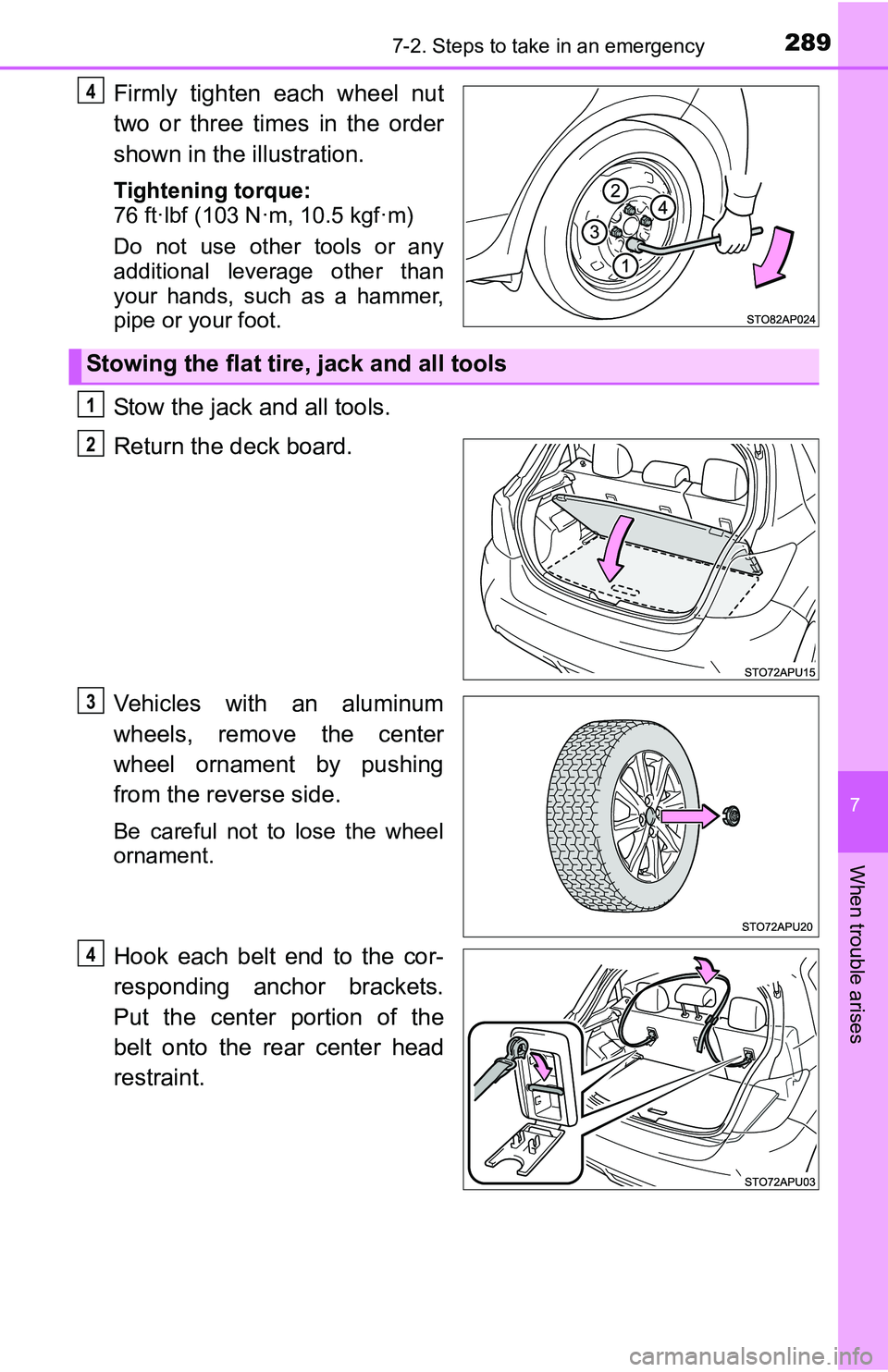
Firmly tighten each wheel nut
two or three times in the order
shown in the illustration.
Tightening torque:
76 ft·lbf (103 N·m, 10.5 kgf·m)
Do not use other tools or any
additional leverage other than
your hands, such as a hammer,
pipe or your foot.
Stow the jack and all tools.
Return the deck board.
Vehicles with an aluminum
wheels, remove the center
wheel ornament by pushing
from the reverse side.
Be careful not to lose the wheel
ornament.
Hook each belt end to the cor-
responding anchor brackets.
Put the center portion of the
belt onto the rear center head
restraint.
4
Stowing the flat tire, jack and all tools
1
2
3
4
Page 290 of 368
2907-2. Steps to take in an emergency
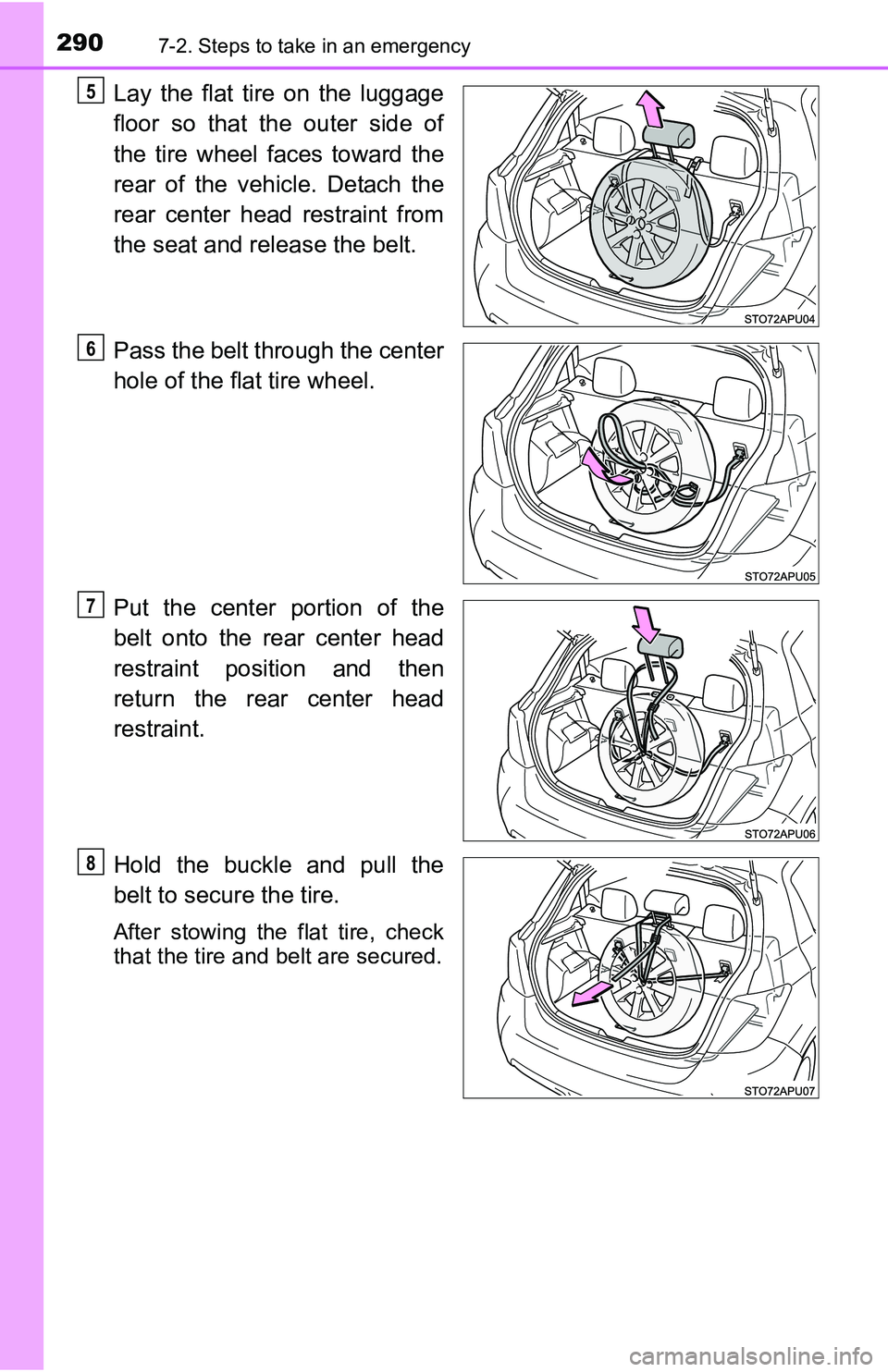
Lay the flat tire on the luggage
floor so that the outer side of
the tire wheel faces toward the
rear of the vehicle. Detach the
rear center head restraint from
the seat and release the belt.
Pass the belt through the center
hole of the flat tire wheel.
Put the center portion of the
belt onto the rear center head
restraint position and then
return the rear center head
restraint.
Hold the buckle and pull the
belt to secure the tire.
After stowing the flat tire, check
that the tire and belt are secured.
5
6
7
8
Page 291 of 368
2917-2. Steps to take in an emergency
7
When trouble arises
■The compact spare tire
●The compact spare tire is identified by the label “TEMPORARY USE
ONLY” on the tire sidewall.
Use the compact spare tire temporarily, and only in an emergency.
●Make sure to check the tire inflatio n pressure of the compact spare tire.
( P. 315)
■After completing the tire change (vehicles with a tire pressure warn-
ing system)
The tire pressure warning system must be reset. ( P. 224)
■When using the compact spare tire (vehicles with a tire pressure
warning system)
As the compact spare tire is not equipped with a tire pressure warning
valve and transmitter, lo w inflation pressure of the spare tire will not be
indicated by the tire pressure warning system. Also, if you replace the
compact spare tire after the tire pressure warning light comes on, the light
remains on.
■If you have a flat front tire on a road covered with snow or ice
Install the compact spare tire on one of the rear wheels of the vehicle.
Perform the following steps and fit tire chains to the front tires:
Replace a rear tire with the compact spare tire.
Replace the flat front tire with the tire removed from the rear of the
vehicle.
Fit tire chains to the front tires.
1
2
3
Page 293 of 368
2937-2. Steps to take in an emergency
7
When trouble arises
NOTICE
■Do not drive the vehicle with a flat tire
Do not continue driving with a flat tire.
Driving even a short distance with a flat tire can damage the tire and the
wheel beyond repair.
■Be careful when driving over bumps with the compact spare tire
installed on the vehicle
The vehicle becomes lower when driving with the compact spare tire
compared to when driving with standard tires. Be careful when driving
over uneven road surfaces.
■Driving with tire chains and the compact spare tire
Do not fit tire chains to the compact spare tire.
Tire chains may damage the vehicle body and adversely affect driving
performance.
■When replacing the tires (vehicles with a tire pressure warning sys-
tem)
When removing or fitting the wheels, tires or the tire pressure warning
valve and transmitter, contact your Toyota dealer as the tire pressure
warning valve and transmitter may be damaged if not handled correctly.
■To avoid damage to the tire pressure warning valves and transmit-
ters (vehicles with a tire pressure warning system)
When a tire is repaired with liquid sealants, the tire pressure warning
valve and transmitter may not operate properly. If a liquid sealant is
used, contact your Toyota dealer or other qualified service shop as soon
as possible. Make sure to replace the tire pressure warning valve and
transmitter when replacing the tire. ( P. 224)
Page 303 of 368
303
7
When trouble arises
7-2. Steps to take in an emergency
If the vehicle becomes stuck
Stop the engine. Set the parking brake and shift the shift lever to P
(automatic transmission) or N (manual transmission).
Remove the mud, snow or sand from around the front wheels.
Place wood, stones or some othe r material under the front wheels
to help provide traction.
Restart the engine.
Shift the shift lever to D or R (automatic transmission) or 1 or R
(manual transmission) and release the parking brake. Then, while
exercising caution, depre ss the accelerator pedal.
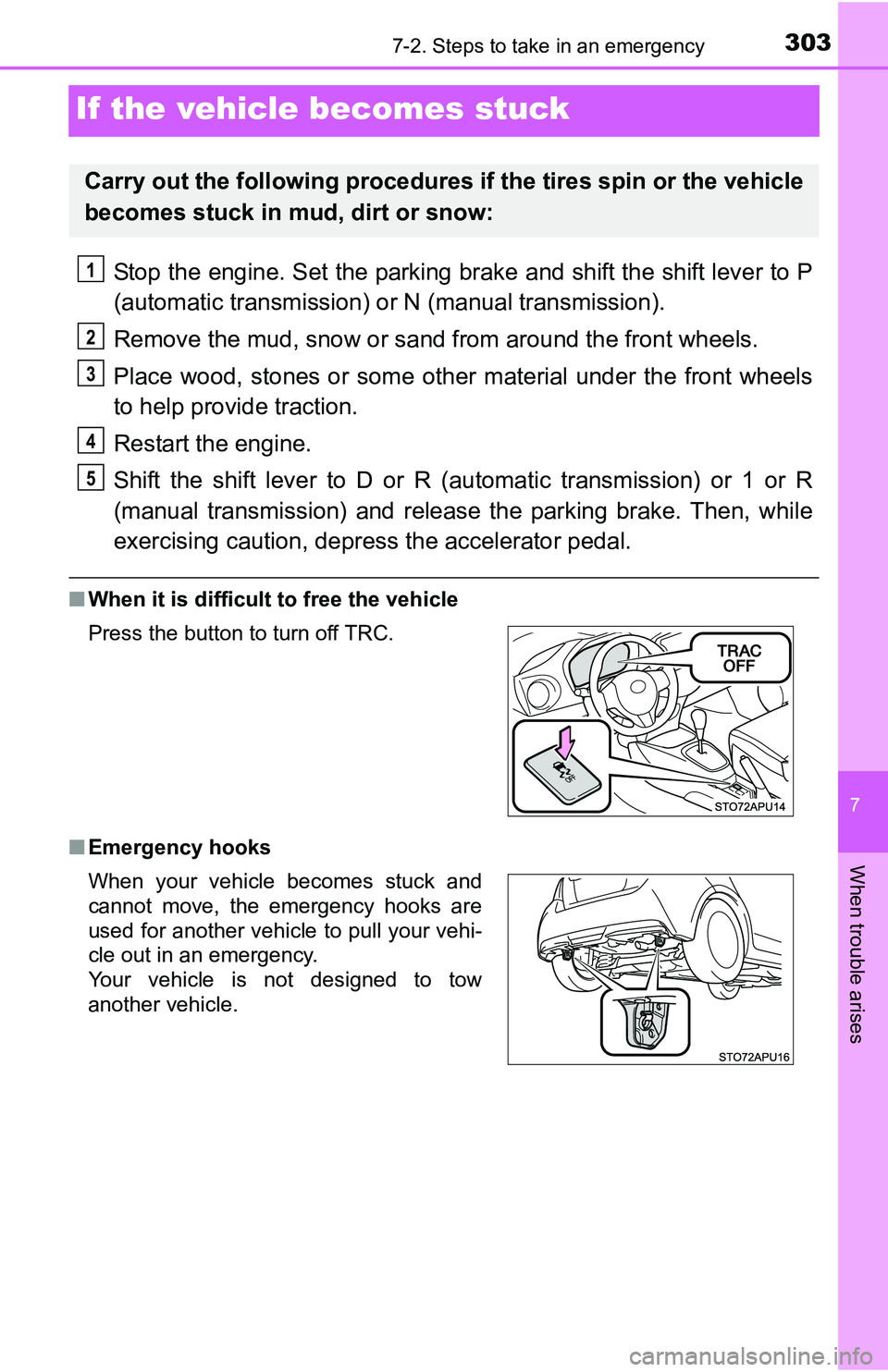
■When it is difficult to free the vehicle
■ Emergency hooks
Carry out the following procedures if the tires spin or the vehicle
becomes stuck in mud, dirt or snow:
Press the button to turn off TRC.
When your vehicle becomes stuck and
cannot move, the emergency hooks are
used for another vehicle to pull your vehi-
cle out in an emergency.
Your vehicle is not designed to tow
another vehicle.
1
2
3
4
5
Page 304 of 368
3047-2. Steps to take in an emergency
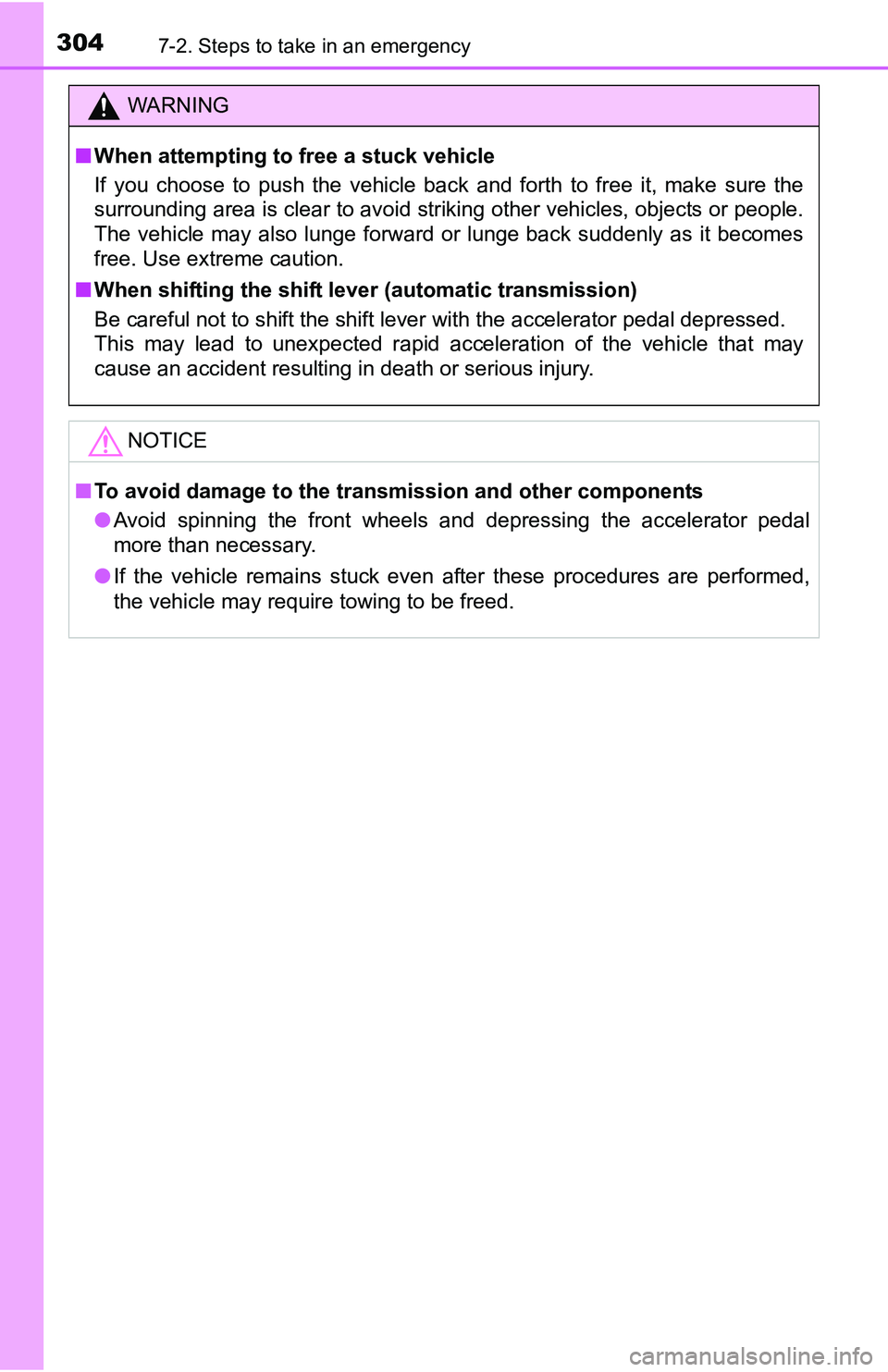
WARNING
■When attempting to free a stuck vehicle
If you choose to push the vehicle back and forth to free it, make sure the
surrounding area is clear to avoid striking other vehicles, objects or people.
The vehicle may also lunge forward or lunge back suddenly as it becomes
free. Use extreme caution.
■ When shifting the shift lever (automatic transmission)
Be careful not to shift the shift lever with the accelerator pedal depressed.
This may lead to unexpected rapid acceleration of the vehicle that may
cause an accident resulting in death or serious injury.
NOTICE
■ To avoid damage to the tran smission and other components
● Avoid spinning the front wheels and depressing the accelerator pedal
more than necessary.
● If the vehicle remains stuck even after these procedures are performed,
the vehicle may require towing to be freed.
Page 306 of 368
3068-1. Specifications
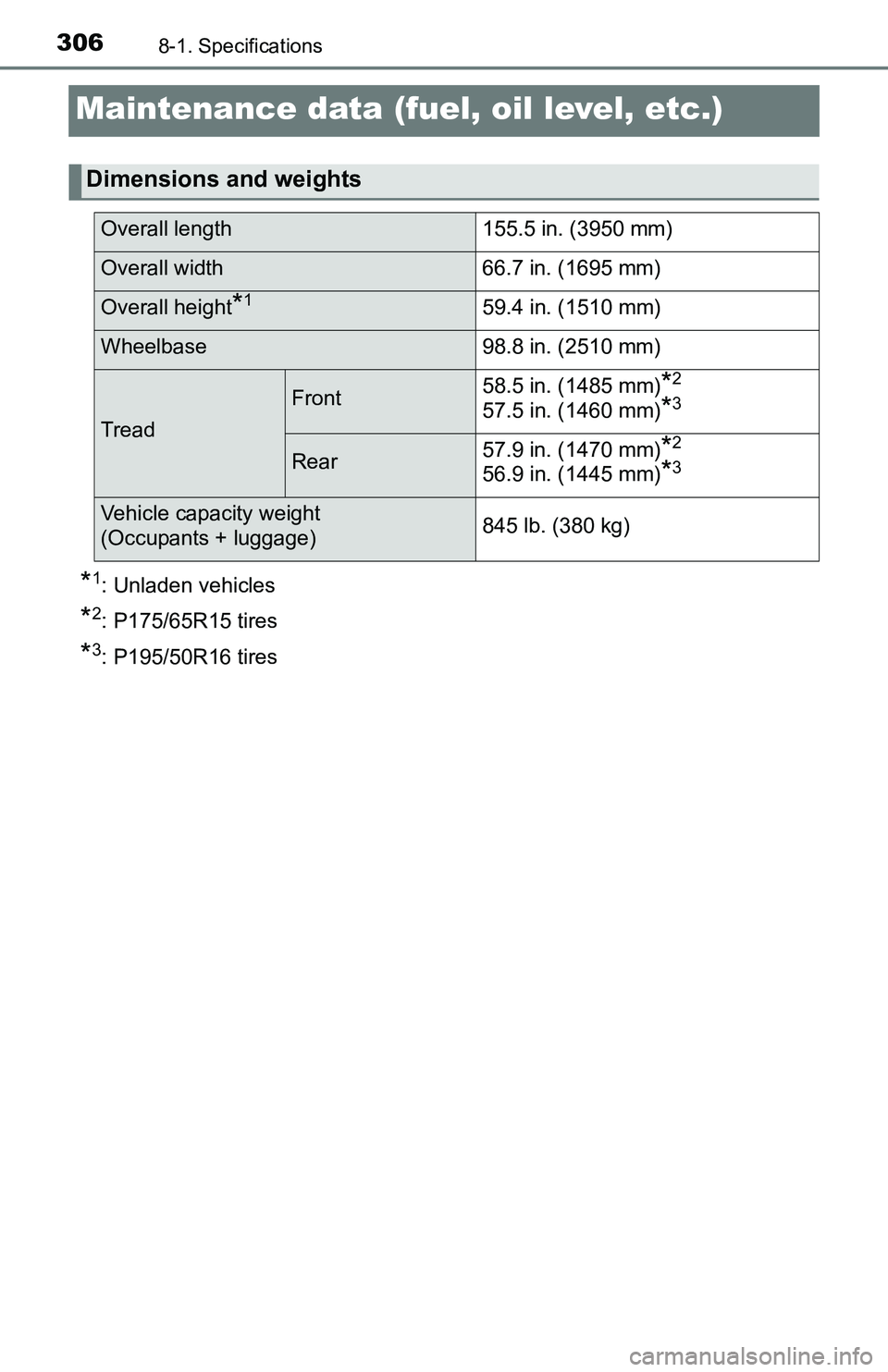
Maintenance data (fuel, oil level, etc.)
*1: Unladen vehicles
*2: P175/65R15 tires
*3: P195/50R16 tires
Dimensions and weights
Overall length155.5 in. (3950 mm)
Overall width 66.7 in. (1695 mm)
Overall height*159.4 in. (1510 mm)
Wheelbase98.8 in. (2510 mm)
Tread
Front58.5 in. (1485 mm)*2
57.5 in. (1460 mm)*3
Rear57.9 in. (1470 mm)*2
56.9 in. (1445 mm)*3
Vehicle capacity weight
(Occupants + luggage) 845 lb. (380 kg)