belt TOYOTA YARIS HATCHBACK 2018 Service Manual
[x] Cancel search | Manufacturer: TOYOTA, Model Year: 2018, Model line: YARIS HATCHBACK, Model: TOYOTA YARIS HATCHBACK 2018Pages: 520, PDF Size: 8.69 MB
Page 71 of 520
711-2. Child safety
1
For safety and security
If the child restraint has a top tether strap, follow the child
restraint manufacturer’s operation manual regarding the installa-
tion, using the top tether strap to latch onto the top tether strap
anchor. (→ P. 7 2 )
After installing the child restraint system, rock it back and forth to
ensure that it is installed securely. ( →P. 68)
■Laws and regulations pertaining to anchors
The LATCH system conforms to FMVSS225 or CMVSS210.2.
Child restraint systems conforming to FMVSS213 or CMVSS213 specifica-
tions can be used.
This vehicle is designed to conform to SAE J1819.
WARNING
■When installing a child restraint system
Observe the following precautions.
Failure to do so may result in death or serious injury.
● When using the LATCH anchors, be sure that there are no foreign objects
around the anchors and that the seat belt is not caught behind the child
restraint system.
● Follow all installation instructions provided by the child restraint system
manufacturer.
● When securing some types of child restraint systems in rear seats, it may
not be possible to properly use the seat belts in positions next to the child
restraint without interfering with it or affecting seat belt effectiveness. Be
sure your seat belt fits snugly across your shoulder and low on your hips. If
it does not, or if it interferes with the child restraint, move to a different
position. Failure to do so may result in death or serious injury.
3
4
Page 72 of 520
721-2. Child safety
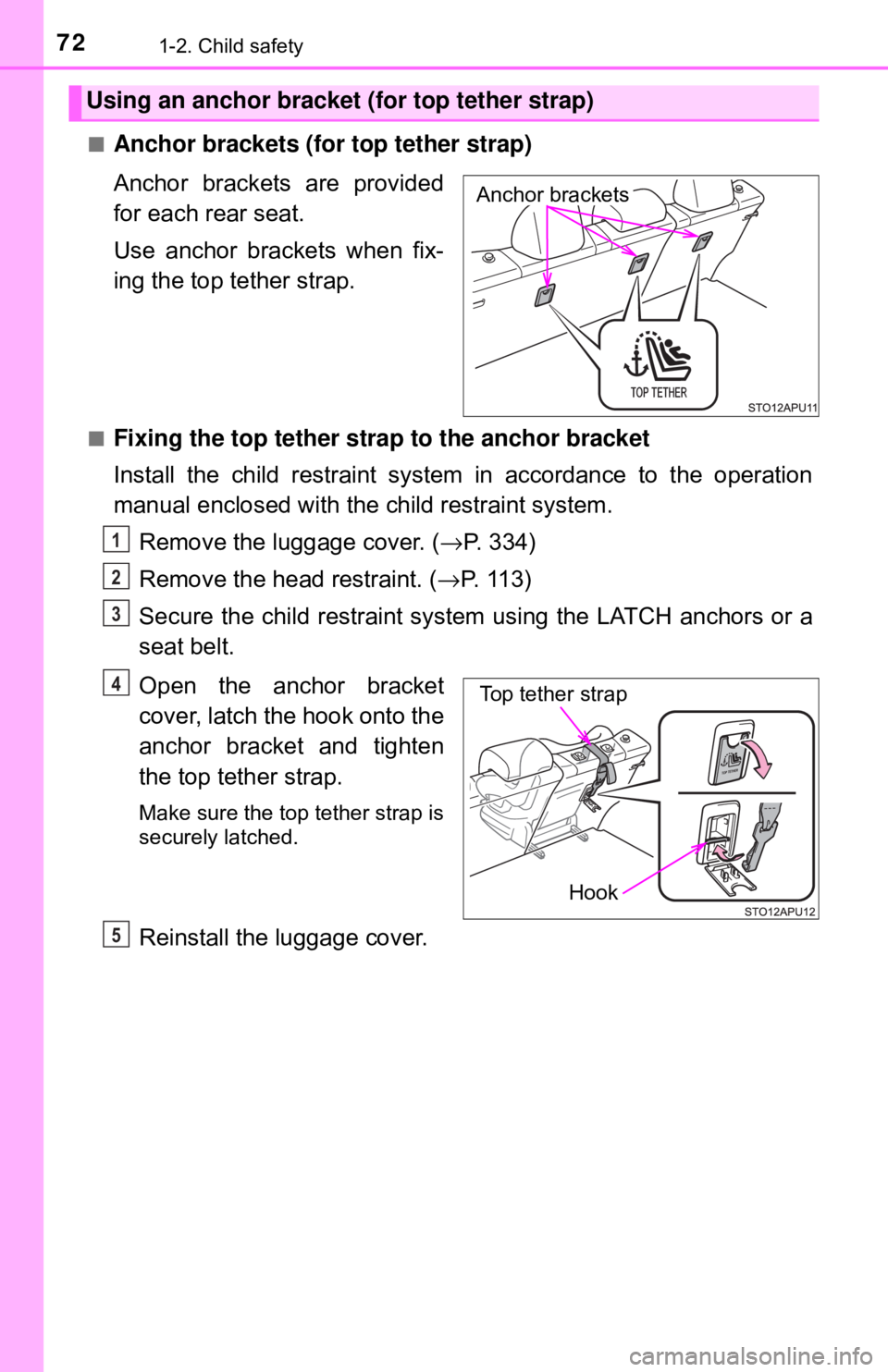
■Anchor brackets (for top tether strap)
Anchor brackets are provided
for each rear seat.
Use anchor brackets when fix-
ing the top tether strap.
■Fixing the top tether strap to the anchor bracket
Install the child restraint system in accordance to the operation
manual enclosed with the child restraint system.Remove the luggage cover. ( →P. 334)
Remove the head restraint. ( →P. 1 1 3 )
Secure the child restraint syst em using the LATCH anchors or a
seat belt.
Open the anchor bracket
cover, latch the hook onto the
anchor bracket and tighten
the top tether strap.
Make sure the top tether strap is
securely latched.
Reinstall the luggage cover.
Using an anchor bracket (for top tether strap)
Anchor brackets
1
2
3
Top tether strap
Hook
4
5
Page 73 of 520
731-2. Child safety
1
For safety and security
■Laws and regulations pertaining to anchors
The LATCH system conforms to FMVSS225 or CMVSS210.2.
Child restraint systems conforming to FMVSS213 or CMVSS213 specifica-
tions can be used.
This vehicle is designed to conform to SAE J1819.
WARNING
■When installing a child restraint system
Observe the following precautions.
Failure to do so may result in death or serious injury.
● Firmly attach the top tether strap and make sure that the belt is not twisted.
● Do not attach the top tether strap to anything other than the anchor
bracket.
● After securing a child restraint system, never adjust the seat.
● Follow all installation instructions provided by the child restraint system
manufacturer.
● When a child restraint system with a top tether strap is installed, do not
install the head restraint. The head restraint may interfere with the top
tether strap preventing secure installation of the child restraint system.
● Make sure to properly store the removed head restraint in a secure place
when you use the child restraint system on the rear seat.
NOTICE
■Anchor brackets (for top tether strap)
When not in use, make certain to close the lid. If it remains open, the lid
may be damaged.
Page 79 of 520
792. Instrument cluster
2
Instrument cluster
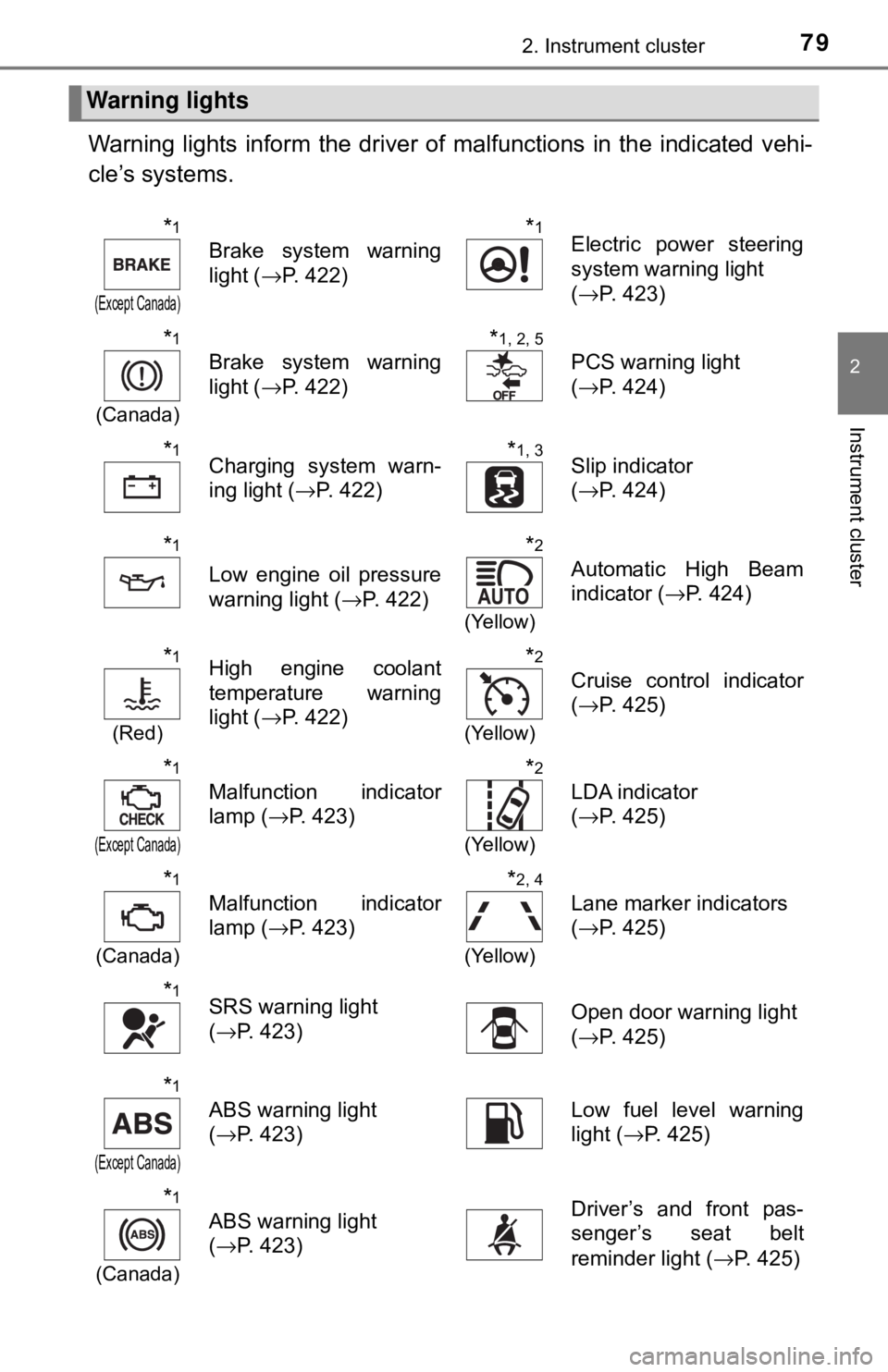
Warning lights inform the driver of malfunctions in the indicated vehi-
cle’s systems.
Warning lights
*1
(Except Canada)
Brake system warning
light ( →P. 422)
*1Electric power steering
system warning light
(→P. 423)
*1
(Canada)
Brake system warning
light ( →P. 422)
*1, 2, 5
PCS warning light
(→P. 424)
*1Charging system warn-
ing light ( →P. 422)*1, 3Slip indicator
(→P. 424)
*1
Low engine oil pressure
warning light ( →P. 422)
*2
(Yellow)
Automatic High Beam
indicator ( →P. 424)
*1
(Red)
High engine coolant
temperature warning
light ( →P. 422)*2
(Yellow)
Cruise control indicator
(→P. 425)
*1
(Except Canada)
Malfunction indicator
lamp ( →P. 423)
*2
(Yellow)
LDA indicator
(→P. 425)
*1
(Canada)
Malfunction indicator
lamp ( →P. 423)
*2, 4
(Yellow)
Lane marker indicators
(→P. 425)
*1SRS warning light
(→P. 423)Open door warning light
(→P. 425)
*1
(Except Canada)
ABS warning light
(→P. 423)Low fuel level warning
light ( →P. 425)
*1
(Canada)
ABS warning light
(→P. 423)Driver’s and front pas-
senger’s seat belt
reminder light ( →P. 425)
Page 100 of 520
1003-2. Opening, closing and locking the doors
WARNING
■To prevent an accident
Observe the following precautions while driving the vehicle.
Failure to do so may result in a door opening and an occupant falling out,
resulting in death or serious injury.
● Always use a seat belt.
● Always lock all the doors.
● Ensure that all the doors are properly closed.
● Do not pull the inside handle of the doors while driving.
The doors may be opened and the passengers are thrown out of the vehi-
cle and it may result in serious injury or death.
Be especially careful for the front doors, as the doors may be opened
even if the inside lock buttons are in locked position.
● 5-door models only: Set the rear door child-protector locks when children
are seated in the rear seats.
Page 108 of 520
1083-3. Adjusting the seats
WARNING
■When adjusting the seat position
● Take care when adjusting the seat position to ensure that other passen-
gers are not injured by the moving seat.
● Do not put your hands under the seat or near the moving parts to avoid
injury.
Fingers or hands may become jammed in the seat mechanism.
■ Seat adjustment
● Be careful that the seat does not hit passenger or luggage.
● To reduce the risk of sliding under the lap belt during a collision, do not
recline the seat more than necessary.
If the seat is too reclined, the lap belt may slide past the hips and apply
restraint forces directly to the abdomen, or your neck may contact the
shoulder belt, increasing the risk of death or serious injury in the event of
an accident.
Adjustments should not be made while driving as the seat may unexpect-
edly move and cause the driver to lose control of the vehicle.
● After adjusting the seat, make sure that the seat is locked in position.
● Never allow anyone to touch seatback lock release levers while the vehi-
cle is moving.
● If anyone is in the vicinity, make sure they are clear of the seat back path
and let them know that the seat is about to move.
■ After returning the seatback to the upright position
Make sure the seatback is securely locked by pushing it forward and rear-
ward. Failure to do so may result in death or serious injury.
NOTICE
■ To prevent the seat lock mechanism malfunction
Do not use the seatback angle adjustment lever and seatback lock release
lever at the same time. If they are used together, the seat lock mechanism
may be damaged.
Page 109 of 520
1093-3. Adjusting the seats
3
Operation of each component
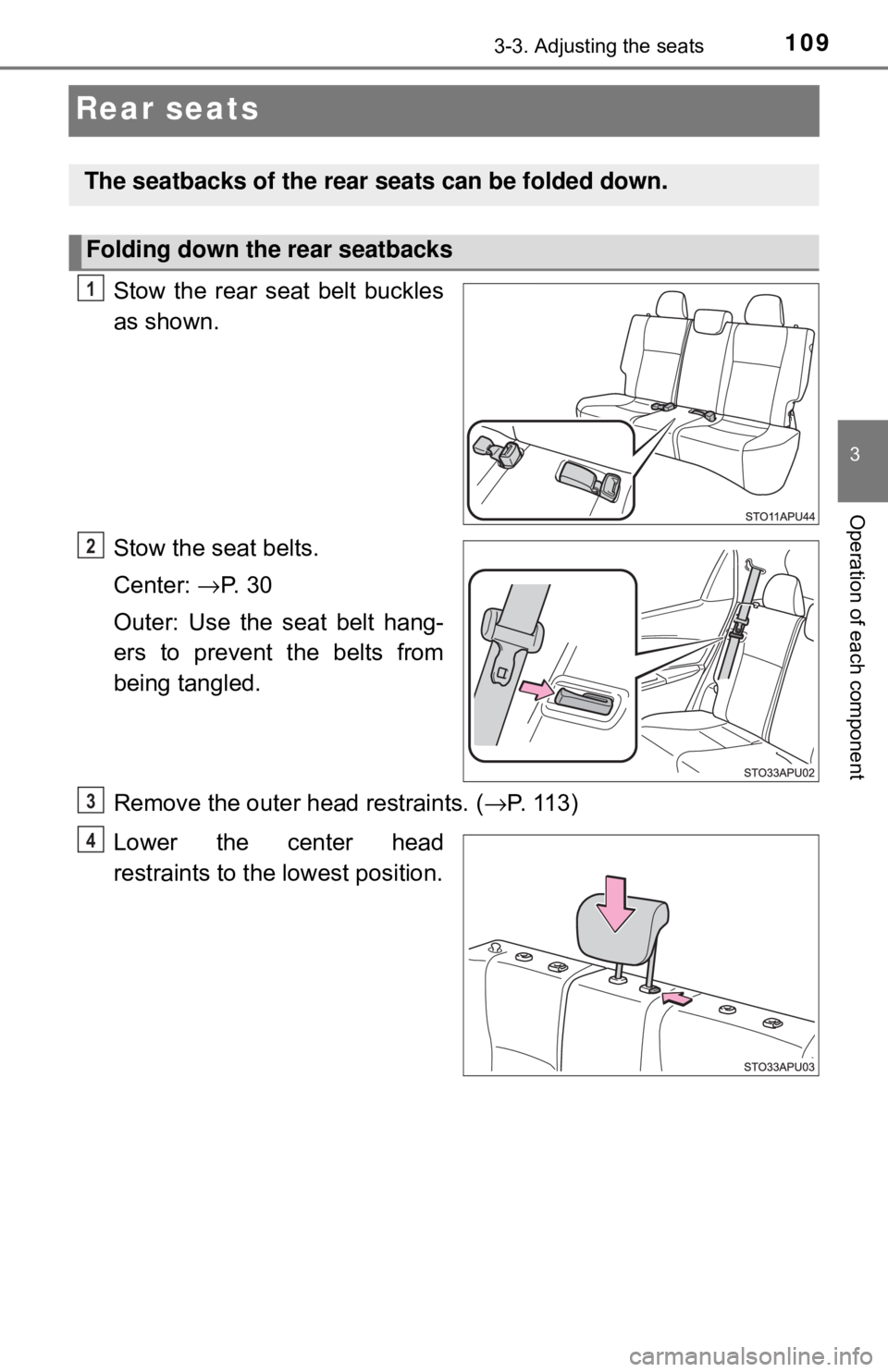
Rear seats
Stow the rear seat belt buckles
as shown.
Stow the seat belts.
Center: →P. 3 0
Outer: Use the seat belt hang-
ers to prevent the belts from
being tangled.
Remove the outer head restraints. ( →P. 113)
Lower the center head
restraints to the lowest position.
The seatbacks of the rear seats can be folded down.
Folding down the rear seatbacks
1
2
3
4
Page 110 of 520
1103-3. Adjusting the seats
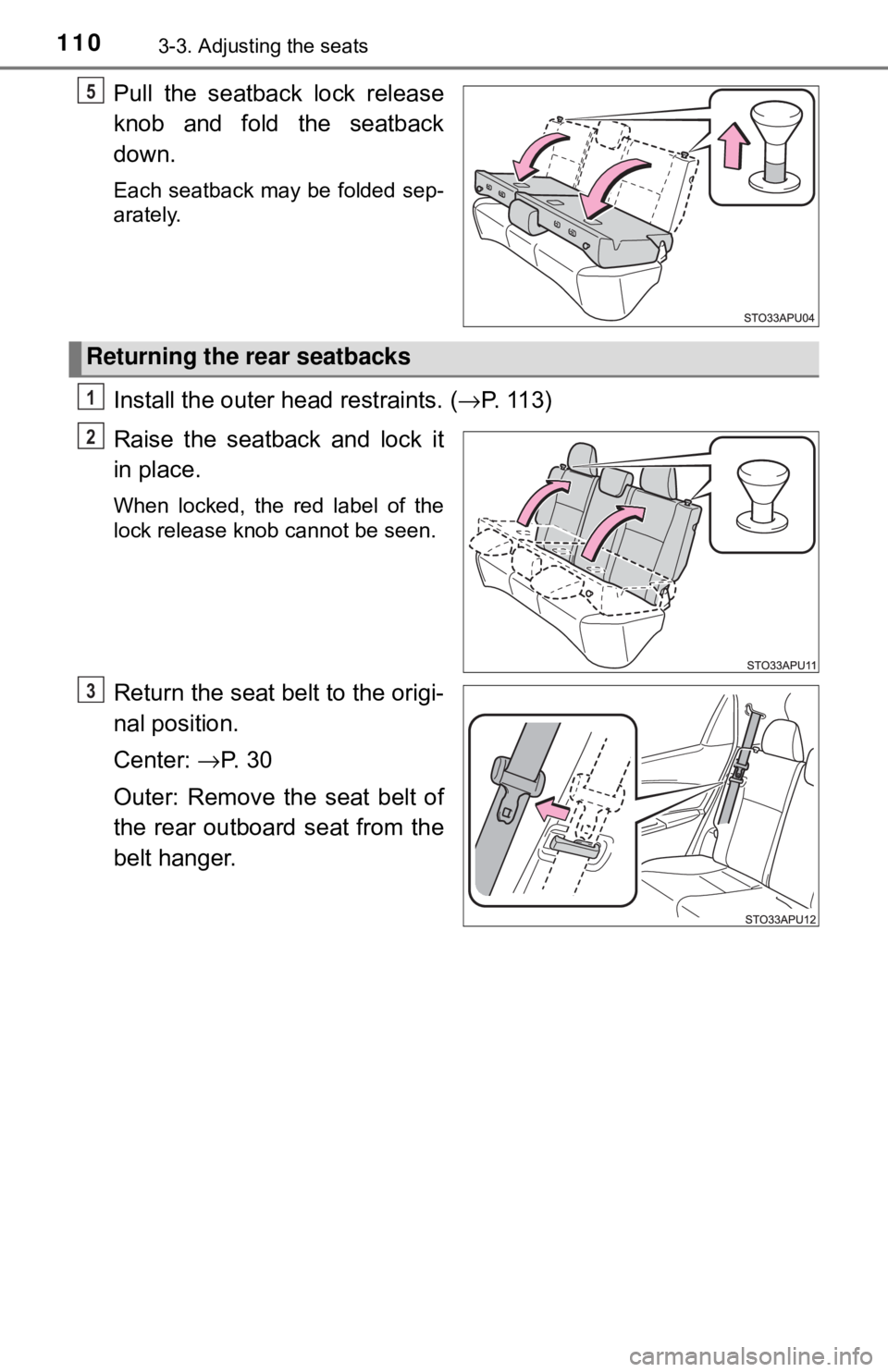
Pull the seatback lock release
knob and fold the seatback
down.
Each seatback may be folded sep-
arately.
Install the outer head restraints. (→P. 1 1 3 )
Raise the seatback and lock it
in place.
When locked, the red label of the
lock release knob cannot be seen.
Return the seat belt to the origi-
nal position.
Center: → P. 3 0
Outer: Remove the seat belt of
the rear outboard seat from the
belt hanger.
5
Returning the rear seatbacks
1
2
3
Page 111 of 520
1113-3. Adjusting the seats
3
Operation of each component
WARNING
■When folding the rear seatbacks down
Observe the following precautions. Failure to do so may result in death or
serious injury.
● Do not fold the seatbacks down while driving.
● Stop the vehicle on level ground, set the parking brake and shift the shift
lever to P (automatic transmission) or N (manual transmission).
● Do not allow anyone to sit on a folded seatback or in the luggage compart-
ment while driving.
● Do not allow children to enter the luggage compartment.
● Do not allow anyone to sit on the rear center seat if the rear right seat is
folded down, as the seat belt buckle for the rear center seat belt is th\
en
concealed under the folded seat and cannot be used.
● Be careful not to catch your hand when folding the rear seatbacks.
● If it is necessary to detach the head restraints, remove it from the vehicle
or store it securely in the luggage compartment. This will prevent it from
injuring passengers in the event of sudden braking, sudden swerving or an
accident.
● Depending on the position of the front seat, it may interfere when trying to
fold down the rear seatbacks. If this happens, adjust the position of the
front seat.
Page 112 of 520
1123-3. Adjusting the seats
WARNING
■After returning the rear seat back to the upright position
Observe the following precautions. Failure to do so may result in death or
serious injury.
● Check that the seat belts are not twisted or caught in the seatback.
NOTICE
■Stowing the seat belts
The seat belts and the buckles must be stowed before you fold down the
rear seatbacks.
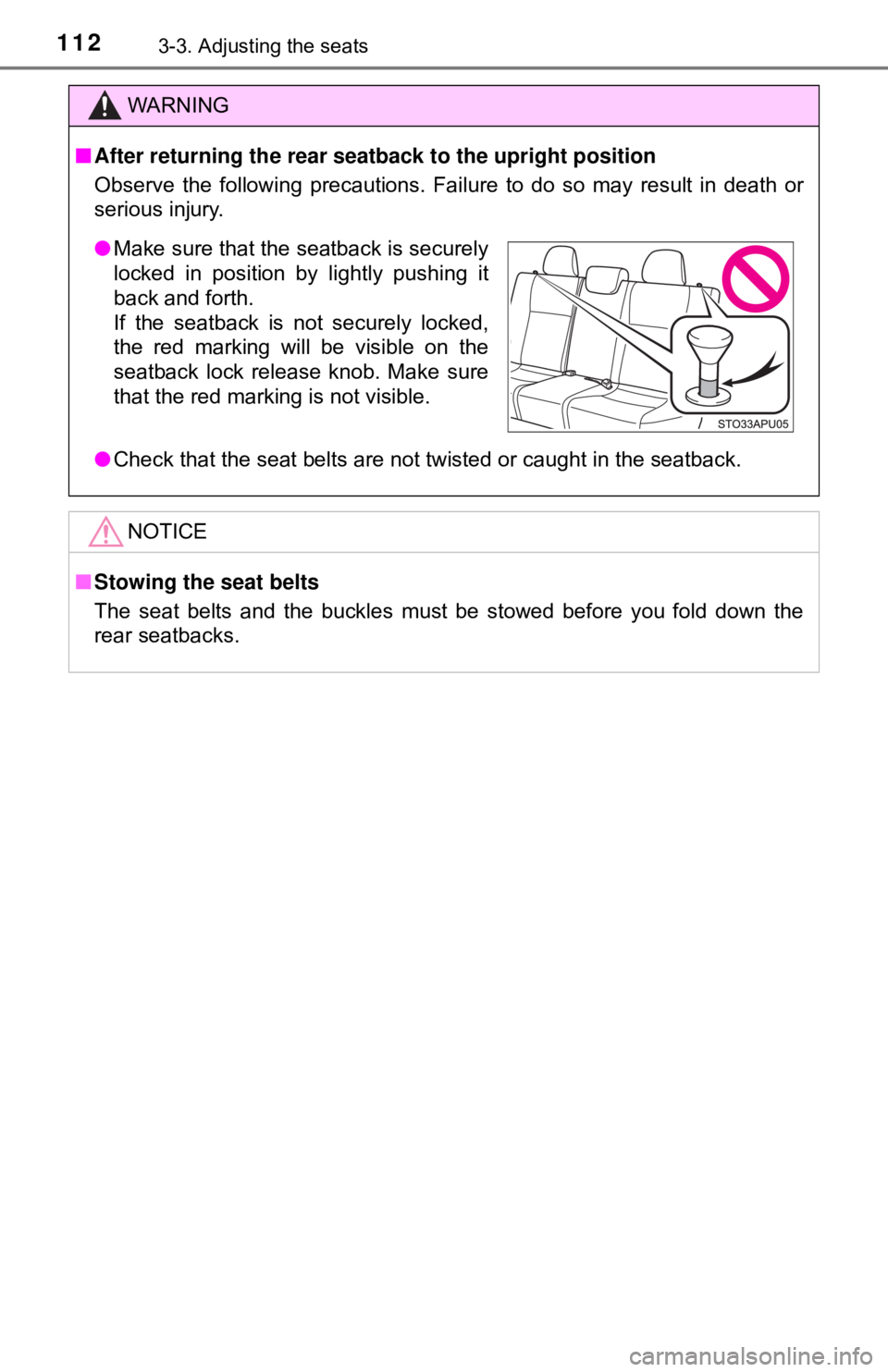
● Make sure that the seatback is securely
locked in position by lightly pushing it
back and forth.
If the seatback is not securely locked,
the red marking will be visible on the
seatback lock release knob. Make sure
that the red marking is not visible.