steering TOYOTA YARIS HATCHBACK 2019 Workshop Manual
[x] Cancel search | Manufacturer: TOYOTA, Model Year: 2019, Model line: YARIS HATCHBACK, Model: TOYOTA YARIS HATCHBACK 2019Pages: 692, PDF Size: 68.71 MB
Page 587 of 692
5878-2. Steps to take in an emergency
8
When trouble arises
YARIS_F_OM_Europe_OM52A54E
■Passenger detection sensor and passenger seat belt reminder
● If luggage is placed on a passenger seat, the passenger detection sensor
may cause the warning light to flash even if a passenger is not sitting in the
seat.
● If a cushion is placed on the seat, the sensor may not detect a passenger,
and the warning light may not operate properly.
■ Warning light operations for unfastened rear passenger seat belts
● When opening and closing the rear door, the warning light comes on for
approximately 34 seconds.
● When any of the rear seat belts are unfastened, the warning light comes on.
When the rear doors are opened and closed while the warning light is on,
the warning light will turn off after approximately 34 seconds.
■ If the malfunction indicator lamp comes on while driving
For some models, the malfunction indicator lamp will come on if the fuel tank
becomes completely empty. If the fuel tank is empty, refuel the vehicle imme-
diately. The malfunction indicator lamp will go off after several trips.
If the malfunction indicator lamp does not go off, contact any authorized
Toyota retailer or Toyota authorized repai rer, or any reliable repairer as soon
as possible.
■ Warning buzzer
In some cases, the buzzer may not be heard because of noisy place or an
audio sound.
■ Electric power steering system warning light (warning buzzer)
When the battery charge becomes insufficient or the voltage temporarily
drops, the electric power steering system warning light may come on and the
warning buzzer may sounds.
Page 589 of 692
5898-2. Steps to take in an emergency
8
When trouble arises
YARIS_F_OM_Europe_OM52A54E
WARNING
■If both the ABS and the brake system warning lights remain on
Stop your vehicle in a safe place immediately and contact any authorized
Toyota retailer or Toyota authorized r epairer, or any reliable repairer. The
vehicle will become extremely unstable during braking, and the ABS system
may fail, which could cause an accident resulting in death or serious injury.
■ When the electric power steering system warning light comes on
The steering wheel may become extremely heavy.
If the steering wheel becomes heavier than usual when operating, hold
firmly and operate using more force than usual.
■ If the tire pressure warning light comes on (vehicles with a tire pres-
sure warning system)
Be sure to observe the following precautions. Failure to do so could cause a
loss of vehicle control and result in death or serious injury.
● Stop your vehicle in a safe place as soon as possible. Adjust the tire infla-
tion pressure immediately.
● Vehicles with spare tire: If the tire pressure warning light comes on even
after tire inflation pressure adjustment, it is probable that you have a flat
tire. Check the tires. If a tire is flat, change it with the spare tire and have
the flat tire repaired by the nearest authorized Toyota retailer or Toyota
authorized repairer, or any reliable repairer.
● Vehicles with emergency tire puncture repair kit: If the tire pressure warn-
ing light comes on even after tire inflat ion pressure adjustment, it is proba-
ble that you have a flat tire. Check the tire s. If a tire is flat, repair the flat tire
by using emergency tire puncture repair kit. ( P. 596)
● Avoid abrupt maneuvering and braking. If the vehicle tires deteriorate, you
could lose control of the steering wheel or the brakes.
■ If a blowout or sudden air leakage should occur (vehicles with a tire
pressure warning system)
The tire pressure warning system may not activate immediately.
NOTICE
■ To ensure the tire pressure warning system operates properly (vehi-
cles with a tire pressure warning system)
Do not install tires with different specif ications or makers, as the tire pres-
sure warning system may not operate properly.
Page 591 of 692
5918-2. Steps to take in an emergency
8
When trouble arises
YARIS_F_OM_Europe_OM52A54E
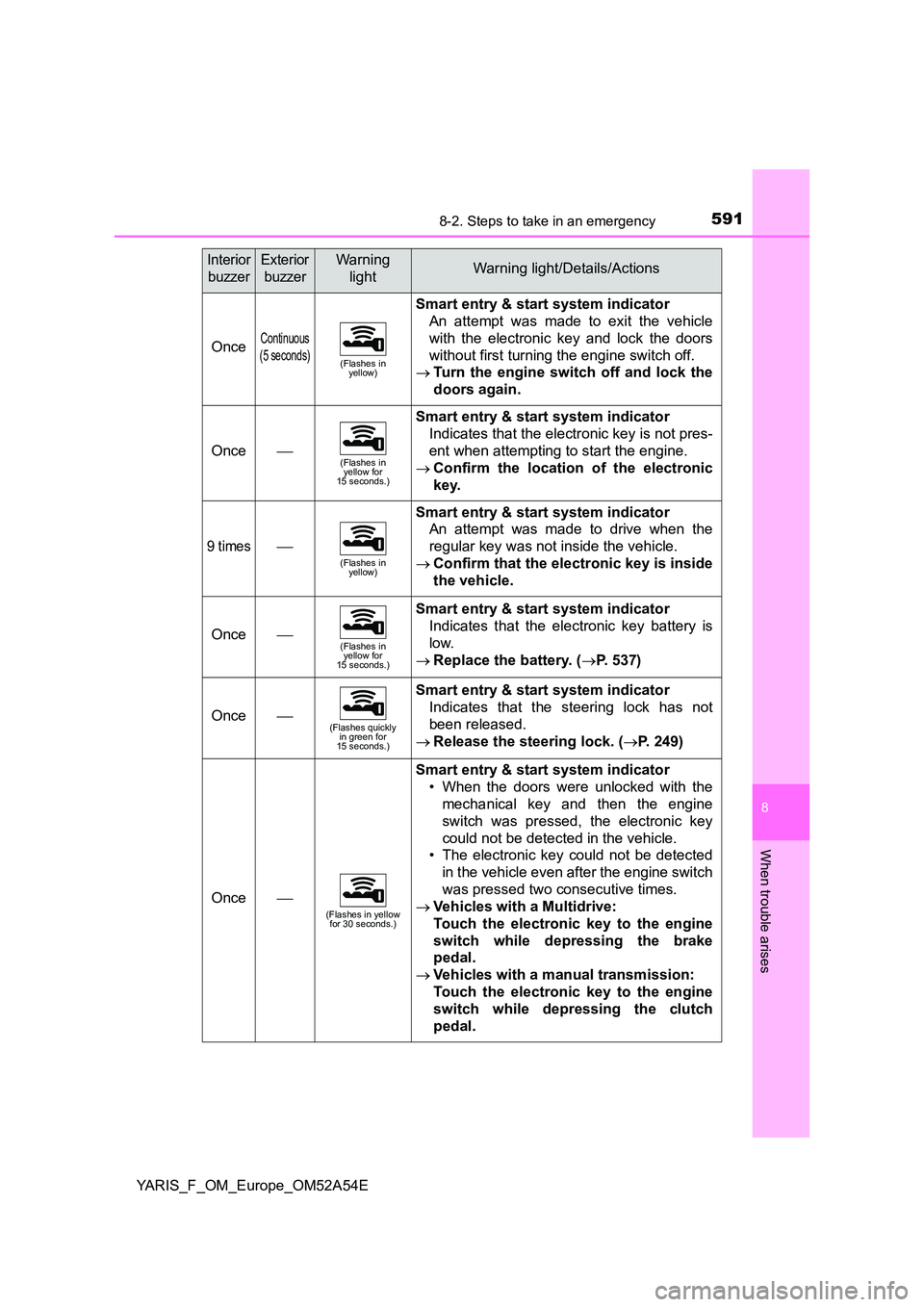
OnceContinuous
(5 seconds)(Flashes in yellow)
Smart entry & start system indicator
An attempt was made to exit the vehicle
with the electronic key and lock the doors
without first turning the engine switch off.
Turn the engine switch off and lock the
doors again.
Once(Flashes in yellow for 15 seconds.)
Smart entry & start system indicator
Indicates that the electronic key is not pres-
ent when attempting to start the engine.
Confirm the location of the electronic
key.
9 times(Flashes in yellow)
Smart entry & start system indicator
An attempt was made to drive when the
regular key was not inside the vehicle.
Confirm that the electronic key is inside
the vehicle.
Once(Flashes in yellow for 15 seconds.)
Smart entry & start system indicator
Indicates that the electronic key battery is
low.
Replace the battery. (P. 537)
Once(Flashes quickly in green for 15 seconds.)
Smart entry & start system indicator
Indicates that the steering lock has not
been released.
Release the steering lock. (P. 249)
Once(Flashes in yellow for 30 seconds.)
Smart entry & start system indicator
• When the doors were unlocked with the
mechanical key and then the engine
switch was pressed, the electronic key
could not be detected in the vehicle.
• The electronic key could not be detected
in the vehicle even after the engine switch
was pressed two consecutive times.
Vehicles with a Multidrive:
Touch the electronic key to the engine
switch while depressing the brake
pedal.
Vehicles with a manual transmission:
Touch the electronic key to the engine
switch while depressing the clutch
pedal.
Interior
buzzer
Exterior
buzzer
Warning
lightWarning light/Details/Actions
Page 611 of 692
6118-2. Steps to take in an emergency
8
When trouble arises
YARIS_F_OM_Europe_OM52A54E
WARNING
■When fixing the flat tire
● Stop your vehicle in a safe and flat area.
● Do not touch the wheels or the area around the brakes immediately after
the vehicle has been driven.
After the vehicle has been driven, the wheels and the area around the
brakes may be extremely hot. Touching these areas with hands, feet or
other body parts may result in burns.
● To avoid risk of burst or severe leakage, do not drop or damage the bottle.
Visually inspect the bottle before use. Do not use a bottle with shock,
crack, scratch, leakage or any other damage. In such case, immediately
replace.
● Connect the valve and hose securely with the tire installed on the vehicle.
If the hose is not properly connected to the valve, air leakage may occur
as sealant may be sprayed out.
● If the hose comes off the valve while inflating the tire, there is a risk that
the hose will move abruptly due to air pressure.
● After inflation of the tire has completed, the sealant may splatter when the
hose is disconnected or some air is let out of the tire.
● Follow the operation procedure to repair the tire. If the procedures not fol-
lowed, the sealant may spray out.
● Keep back from the tire while it is being repaired, as there is a chance of it
bursting while the repair operation is being performed. If you notice any
cracks or deformation of the tire, turn off the compressor switch and stop
the repair operation immediately.
● The repair kit may overheat if operated for a long period of time. Do not
operate the repair kit continuously for more than 40 minutes.
● Parts of the repair kit become hot during operation. Be careful when han-
dling the repair kit during and after operation. Do not touch the metal part
around the connecting area between the bottle and compressor. It will be
extremely hot.
● Do not attach the vehicle speed warning sticker to an area other than the
one indicated. If the sticker is attached to an area where an SRS airbag is
located, such as the pad of the steering wheel, it may prevent the SRS
airbag from operating properly.
Page 612 of 692
6128-2. Steps to take in an emergency
YARIS_F_OM_Europe_OM52A54E
WARNING
■Driving to spread the liquid sealant evenly
Observe the following precautions to reduce the risk of accidents.
Failing to do so may result in a loss of vehicle control and cause death or
serious injury.
● Drive the vehicle carefully at a low speed. Be especially careful when turn-
ing and cornering.
● If the vehicle does not drive straight or you feel a pull through the steering
wheel, stop the vehicle and check the following.
• Tire condition. The tire may have separated from the wheel.
• Tire inflation pressure. If the tire inflation pressure is 130 kPa (1.3 kgf/cm2
or bar, 19 psi) or less, the tire may be severely damaged.
Page 627 of 692
6278-2. Steps to take in an emergency
8
When trouble arises
YARIS_F_OM_Europe_OM52A54E
WARNING
■When using the full-size spare tire (if equipped)
● On vehicles with a tire pressure warning system: Replace the full-size
spare tire with a standard tire as soon as possible.
● Avoid sudden acceleration, abrupt steering, sudden braking and shifting
operations that cause sudden engine braking.
■ When using the compact spare tire (if equipped)
● Remember that the compact spare tire provided is specifically designed
for use with your vehicle. Do not use your compact spare tire on another
vehicle.
● Do not use more than one compact spare tire simultaneously.
● Replace the compact spare tire with a standard tire as soon as possible.
● Avoid sudden acceleration, abrupt steering, sudden braking and shifting
operations that cause sudden engine braking.
■ When storing the spare tire (if equipped)
Be careful not to catch fingers or other body parts between the spare tire
and the body of the vehicle.
■ After using the tools and jack
Before driving, make sure all the tools and jack are securely in place in their
storage location to reduce the possibility of personal injury during a collision
or sudden braking.
■ When the compact spare tire is attached (if equipped)
The vehicle speed may not be correctly detected, and the following systems
may not operate correctly:
■ Speed limit when using the compact spare tire (if equipped)
Do not drive at speeds in excess of 80 km/h (50 mph) when a compact
spare tire is installed on the vehicle.
The compact spare tire is not designed for driving at high speeds. Failure to
observe this precaution may lead to an accident causing death or serious
injury.
• ABS & Brake assist
• VSC*
•TRC*
• EPS
• Automatic High Beam*
*: If equipped
• PCS (Pre-Crash Safety system)*
• LDA (Lane Departure Alert)*
• Cruise control*
• Navigation system*
Page 630 of 692
6308-2. Steps to take in an emergency
YARIS_F_OM_Europe_OM52A54E
One of the following may be the cause of the problem:
● One or both of the battery terminals may be disconnected.
● The battery may be discharged. (P. 634)
● There may be a malfunction in the steering lock system (vehicles
with a smart entry & start system).
Contact any authorized Toyota retailer or Toyota authorized repairer, or any
reliable repairer if the problem cannot be repaired, or if repair procedures
are unknown.
When the engine does not start, the following steps can be used as an
interim measure to start the engine if the engine switch is functioning
normally:
Set the parking brake.
Shift the shift lever to P (Multidrive) or N (manual transmission).
Turn the engine switch to ACCESSORY mode.
Press and hold the engine switch for about 15 seconds while
depressing the brake pedal (Multidrive) or brake pedal and clutch
pedal (manual transmission) firmly.
Even if the engine can be started using the above steps, the system
may be malfunctioning. Have the vehicle inspected by any authorized
Toyota retailer or Toyota authorized repairer, or any reliable repairer.
The starter motor does not turn over, the interior lights and head-
lights do not turn on, or the horn does not sound.
Emergency start function (vehicles with a smart entry & start
system)
1
2
3
4
Page 658 of 692
6589-1. Specifications
YARIS_F_OM_Europe_OM52A54E
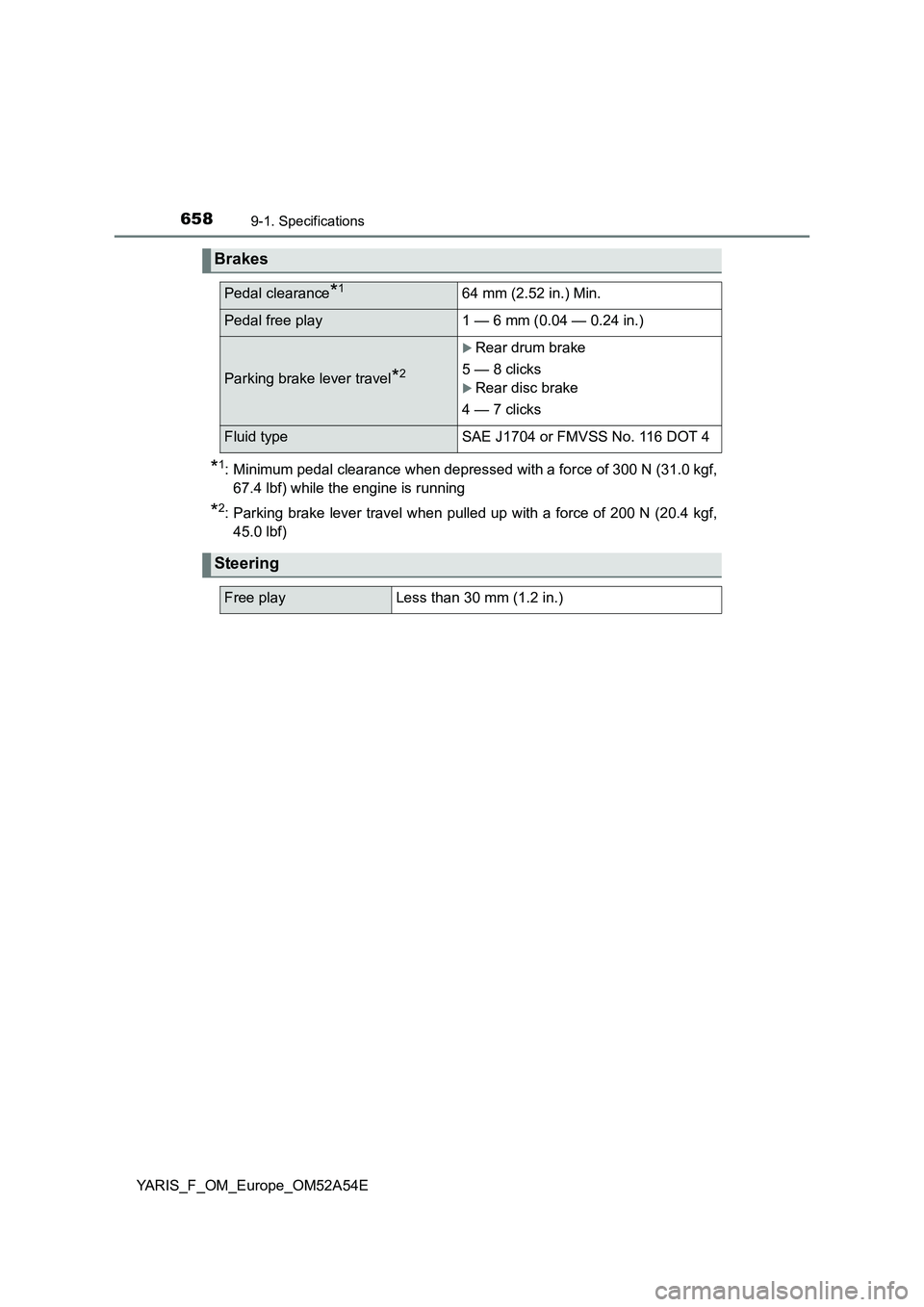
*1: Minimum pedal clearance when depressed with a force of 300 N (31.0 kgf,
67.4 lbf) while the engine is running
*2: Parking brake lever travel when pulled up with a force of 200 N (20.4 kgf,
45.0 lbf)
Brakes
Pedal clearance*164 mm (2.52 in.) Min.
Pedal free play1 — 6 mm (0.04 — 0.24 in.)
Parking brake lever travel*2
Rear drum brake
5 — 8 clicks
Rear disc brake
4 — 7 clicks
Fluid typeSAE J1704 or FMVSS No. 116 DOT 4
Steering
Free playLess than 30 mm (1.2 in.)
Page 660 of 692
6609-1. Specifications
YARIS_F_OM_Europe_OM52A54E
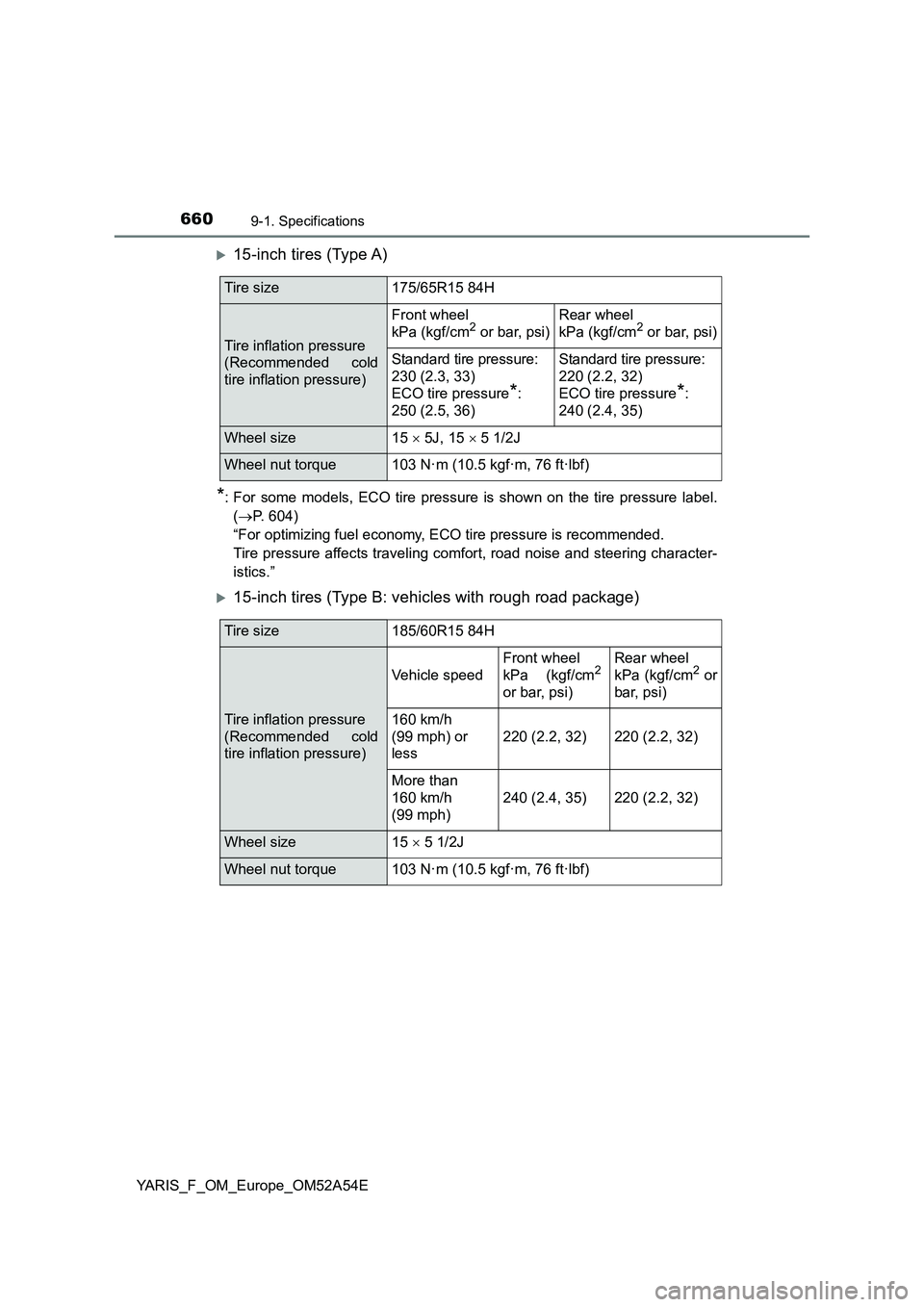
15-inch tires (Type A)
*: For some models, ECO tire pressure is shown on the tire pressure label.
(P. 604)
“For optimizing fuel economy, ECO tire pressure is recommended.
Tire pressure affects traveling comfort, road noise and steering character-
istics.”
15-inch tires (Type B: vehicles with rough road package)
Tire size175/65R15 84H
Tire inflation pressure
(Recommended cold
tire inflation pressure)
Front wheel
kPa (kgf/cm2 or bar, psi)
Rear wheel
kPa (kgf/cm2 or bar, psi)
Standard tire pressure:
230 (2.3, 33)
ECO tire pressure
*:
250 (2.5, 36)
Standard tire pressure:
220 (2.2, 32)
ECO tire pressure
*:
240 (2.4, 35)
Wheel size15 5J, 15 5 1/2J
Wheel nut torque103 N·m (10.5 kgf·m, 76 ft·lbf)
Tire size185/60R15 84H
Tire inflation pressure
(Recommended cold
tire inflation pressure)
Vehicle speed
Front wheel
kPa (kgf/cm2
or bar, psi)
Rear wheel
kPa (kgf/cm2 or
bar, psi)
160 km/h
(99 mph) or
less
220 (2.2, 32)220 (2.2, 32)
More than
160 km/h
(99 mph)
240 (2.4, 35)220 (2.2, 32)
Wheel size15 5 1/2J
Wheel nut torque103 N·m (10.5 kgf·m, 76 ft·lbf)
Page 661 of 692
6619-1. Specifications
9
Vehicle specifications
YARIS_F_OM_Europe_OM52A54E
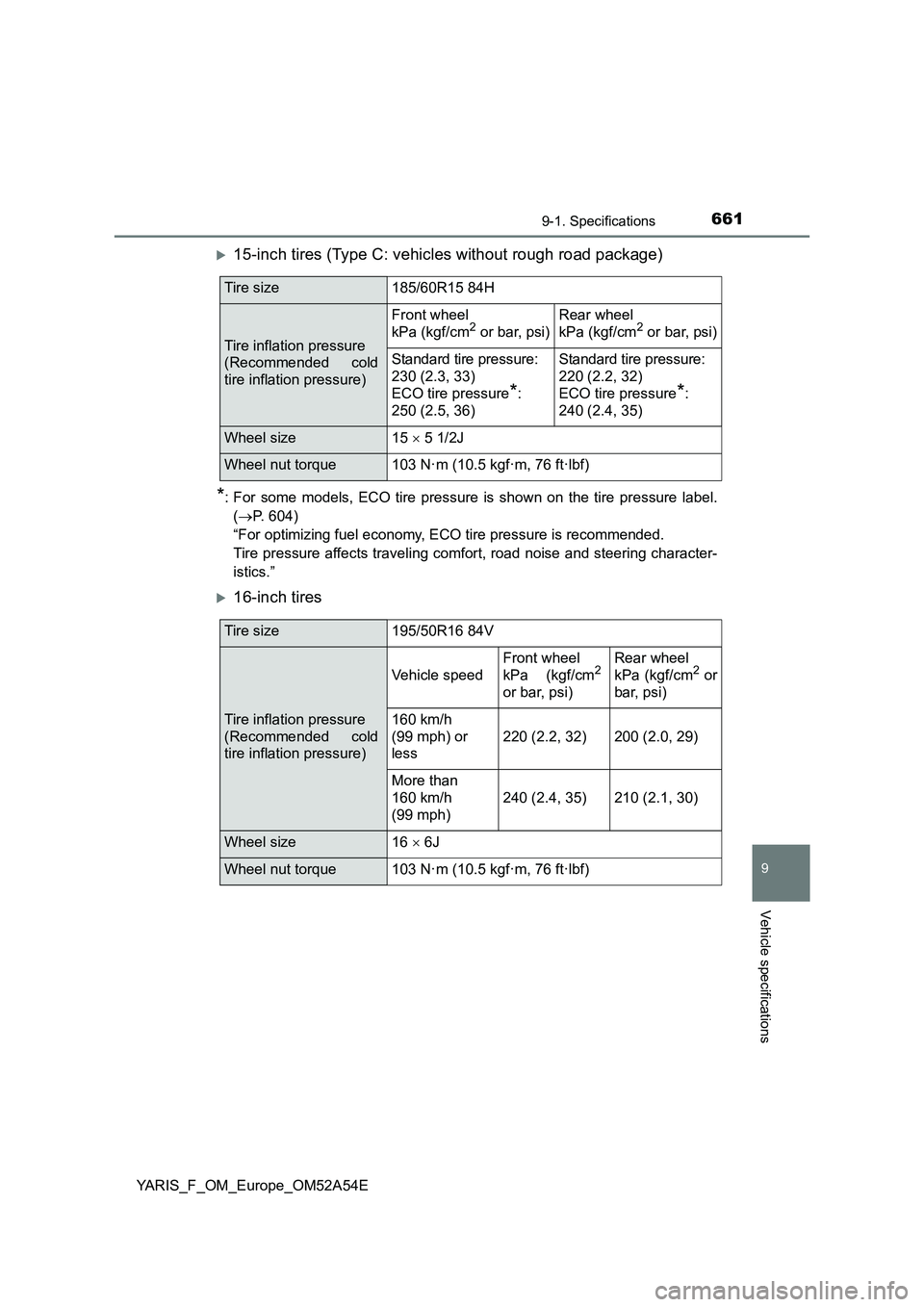
15-inch tires (Type C: vehicles without rough road package)
*: For some models, ECO tire pressure is shown on the tire pressure label.
(P. 604)
“For optimizing fuel economy, ECO tire pressure is recommended.
Tire pressure affects traveling comfort, road noise and steering character-
istics.”
16-inch tires
Tire size185/60R15 84H
Tire inflation pressure
(Recommended cold
tire inflation pressure)
Front wheel
kPa (kgf/cm2 or bar, psi)
Rear wheel
kPa (kgf/cm2 or bar, psi)
Standard tire pressure:
230 (2.3, 33)
ECO tire pressure
*:
250 (2.5, 36)
Standard tire pressure:
220 (2.2, 32)
ECO tire pressure
*:
240 (2.4, 35)
Wheel size15 5 1/2J
Wheel nut torque103 N·m (10.5 kgf·m, 76 ft·lbf)
Tire size195/50R16 84V
Tire inflation pressure
(Recommended cold
tire inflation pressure)
Vehicle speed
Front wheel
kPa (kgf/cm2
or bar, psi)
Rear wheel
kPa (kgf/cm2 or
bar, psi)
160 km/h
(99 mph) or
less
220 (2.2, 32)200 (2.0, 29)
More than
160 km/h
(99 mph)
240 (2.4, 35)210 (2.1, 30)
Wheel size16 6J
Wheel nut torque103 N·m (10.5 kgf·m, 76 ft·lbf)