engine TOYOTA YARIS HYBRID 2014 Owner's Manual
[x] Cancel search | Manufacturer: TOYOTA, Model Year: 2014, Model line: YARIS HYBRID, Model: TOYOTA YARIS HYBRID 2014Pages: 464, PDF Size: 23.4 MB
Page 215 of 464

2154-5. Using the driving support
4
Driving
Turning off both TRC and VSC systems
To turn the TRC and VSC systems off, press and hold the VSC OFF switch
for more than 3 seconds while the vehicle is stopped.
The “TRC OFF” indicator and the VSC OFF indicator will come on.
Press the switch again to turn the systems back on.
Sounds and vibrations caused by the ABS, brake assist, TRC, VSC and
hill-start assist control systems
Any of the following conditions may occur when the above systems are oper-
ating. None of these indicates that a malfunction has occurred.
Vibrations may be felt through the vehicle body and steering.
A motor sound may be heard after the vehicle comes to a stop.
The brake pedal may pulsate slightly after the ABS is activated.
The brake pedal may move down slightly after the ABS is activated.
ECB operating sound
ECB operating sound may be heard in the following cases, but it does not
indicate that a malfunction has occurred.
Operating sound heard from the engine compartment when the brake pedal
is operated.
Motor sound of the brake system heard from the front part of the vehicle
when the driver’s door is opened.
Operating sound heard from the engine compartment when one or two min-
utes passed after the stop of the hybrid system.
EPS operation sound
When the steering wheel is operated, a motor sound (whirring sound) may be
heard. This does not indicate a malfunction.
Automatic reactivation of TRC and VSC systems
After turning the TRC and VSC systems off, the systems will be automatically
reactivated in the following situations:
When the power switch is turned off
If only the TRC system is turned off, the TRC will turn on when vehicle
speed increases
If both the TRC and VSC systems are turned off, automatic reactivation will
not occur when vehicle speed increases.
Page 219 of 464
219
4
4-6. Driving tips
Driving
Hybrid vehicle driving tips
Using Eco drive mode
When using Eco drive mode, the torque corresponding to the accel-
erator pedal depression amount can be generated more smoothly
than it is in normal conditions. In addition, the operation of the air
conditioning system (heating/cooling) will be minimized, improving
the fuel economy. (P. 189)
Use of Hybrid System Indicator
The Eco-friendly driving is possible by keeping the indicate of
Hybrid System Indicator within Eco area. (P. 97)
Shift lever operation
Shift the shift lever to D when stopped at a traffic light, or driving in
heavy traffic etc. Shift the shift lever to P when parking. When using
the N, there is no positive effect on fuel consumption. In the N, the
gasoline engine operates but electricity cannot be generated. Also,
when using the air conditioning system, etc., the hybrid battery
(traction battery) power is consumed.
For economical and ecological driving, pay attention to the fol-
lowing points:
Page 220 of 464

2204-6. Driving tips
Acceleration pedal/brake pedal operation
Drive your vehicle smoothly. Avoid abrupt acceleration and
deceleration. Gradual acceleration and deceleration will make
more effective use of the electric motor (traction motor) without
having to use gasoline engine power.
Avoid repeated acceleration. Repeated acceleration consumes
hybrid battery (traction battery) power, resulting in poor fuel con-
sumption. Battery power can be restored by driving with the
accelerator pedal slightly released.
When braking
Make sure to operate the brakes gently and in a timely manner. A
greater amount of electrical energy can be regenerated when slow-
ing down.
Delays
Repeated acceleration and deceleration, as well as long waits at
traffic lights, will lead to bad fuel economy. Check traffic reports
before leaving and avoid delays as much as possible. When driving
in a traffic jam, gently release the brake pedal to allow the vehicle to
move forward slightly while avoiding overuse of the accelerator
pedal. Doing so can help control excessive gasoline consumption.
Highway driving
Control and maintain the vehicle at a constant speed. Before stop-
ping at a toll booth or similar, allow plenty of time to release the
accelerator and gently apply the brakes. A greater amount of elec-
trical energy can be regenerated when slowing down.
Page 221 of 464

2214-6. Driving tips
4
Driving
Air conditioning
Use the air conditioning only when necessary. Doing so can help
reduce excessive gasoline consumption.
In summer: When the ambient temperature is high, use the recircu-
lated air mode. Doing so will help to reduce the burden on the air
conditioning system and reduce fuel consumption as well.
In winter: Because the gasoline engine will not automatically cut out
until it and the interior of the vehicle are warm, it will consume fuel.
Also, fuel consumption can be improved by avoiding overuse of the
heater.
Checking tire inflation pressure
Make sure to check the tire inflation pressure frequently. Improper
tire inflation pressure can cause poor fuel economy.
Also, as snow tires can cause large amounts of friction, their use on
dry roads can lead to poor fuel economy. Use tires that are appro-
priate for the season.
Luggage
Carrying heavy luggage will lead to poor fuel economy. Avoid carry-
ing unnecessary luggage. Installing a large roof rack will also cause
poor fuel economy.
Warming up before driving
Since the gasoline engine starts up and cuts out automatically
when cold, warming up the engine is unnecessary. Moreover, fre-
quently driving short distances will cause the engine to repeatedly
warm up, which can lead to excess fuel consumption.
Page 222 of 464
2224-6. Driving tips
Winter driving tips
Use fluids that are appropriate to the prevailing outside tempera-
tures.
• Engine oil
• Engine/power control unit coolant
• Washer fluid
• Power control unit coolant (hybrid system)
Have a service technician inspect the condition of the 12-volt bat-
tery.
Have the vehicle fitted with four snow tires or purchase a set of tire
chains for the front tires.
Ensure that all tires are the same size and brand, and that their wear
level is not noticeably different with each other. Also make sure that
chains match the size of the tires.
Perform the following according to the driving conditions:
Do not try to forcibly open a window or move a wiper that is frozen.
Pour warm water over the frozen area to melt the ice. Wipe away
the water immediately to prevent it from freezing.
To ensure proper operation of the climate control system fan,
remove any snow that has accumulated on the air inlet vents in
front of the windshield.
Check for and remove any excess ice or snow that may have accu-
mulated on the exterior lights, vehicle’s roof, chassis, around the
tires or on the brakes.
Remove any snow or mud from the bottom of your shoes before
getting in the vehicle.
Carry out the necessary preparations and inspections before
driving the vehicle in winter. Always drive the vehicle in a man-
ner appropriate to the prevailing weather conditions.
Preparation for winter
Before driving the vehicle
Page 224 of 464

2244-6. Driving tips
Tire chain installation
Observe the following precautions when installing and removing chains:
Install and remove tire chains in a safe location.
Install tire chains on the front tires only. Do not install tire chains on the rear
tires.
Install tire chains on front tires as tightly as possible. Retighten chains after
driving 0.5 1.0 km (1/4 1/2 mile).
Install tire chains following the instructions provided with the tire chains.
If wheel ornaments are used, they will be scratched by the chain band, so
remove the ornaments before putting on the chains. (P. 384)
WARNING
Driving with snow tires
Observe the following precautions to reduce the risk of accidents.
Failure to do so may result in a loss of vehicle control and cause death or
serious injury.
Use tires of the specified size.
Maintain the recommended level of air pressure.
Do not drive at speeds in excess of the speed limit or the speed limit spec-
ified for the snow tires being used.
Use snow tires on all, not just some wheels.
Do not use tires of noticeably different wear level.
Driving with tire chains
Observe the following precautions to reduce the risk of accidents.
Failure to do so may result in the vehicle being unable to be driven safely,
and may cause death or serious injury.
Do not drive in excess of the speed limit specified for the tire chains being
used, or 50 km/h (30 mph), whichever is lower.
Avoid driving on bumpy road surfaces or over potholes.
Avoid sudden acceleration, abrupt steering, sudden braking and shifting
operations that cause sudden engine braking.
Slow down sufficiently before entering a curve to ensure that vehicle con-
trol is maintained.
Page 285 of 464

285
7Maintenance and care
7-1. Maintenance and care
Cleaning and protecting
the vehicle exterior .......... 286
Cleaning and protecting
the vehicle interior ........... 289
7-2. Maintenance
Maintenance
requirements.................... 2927-3. Do-it-yourself maintenance
Do-it-yourself service
precautions ...................... 295
Hood .................................. 298
Positioning a floor jack ....... 300
Engine compartment.......... 302
12-volt battery .................... 309
Tires ................................... 315
Tire inflation pressure ........ 328
Wheels ............................... 330
Air conditioning filter .......... 333
Wireless remote control/
electronic key battery....... 335
Checking and replacing
fuses ................................ 339
Light bulbs ......................... 344
Page 287 of 464
2877-1. Maintenance and care
7
Maintenance and care
Aluminum wheels (if equipped)
Remove any dirt immediately by using a neutral detergent. Do not use hard
brushes or abrasive cleaners. Do not use strong or harsh chemical clean-
ers.
Use the same mild detergent and wax as used on the paint.
Do not use detergent on the wheels when they are hot, for example after
driving for long distance in the hot weather.
Wash detergent from the wheels immediately after use.
To preserve the wheels luster, do not allow hot water, such as from steam
cleaning, to contact them directly.
Bumpers
Do not scrub with abrasive cleaners.
WARNING
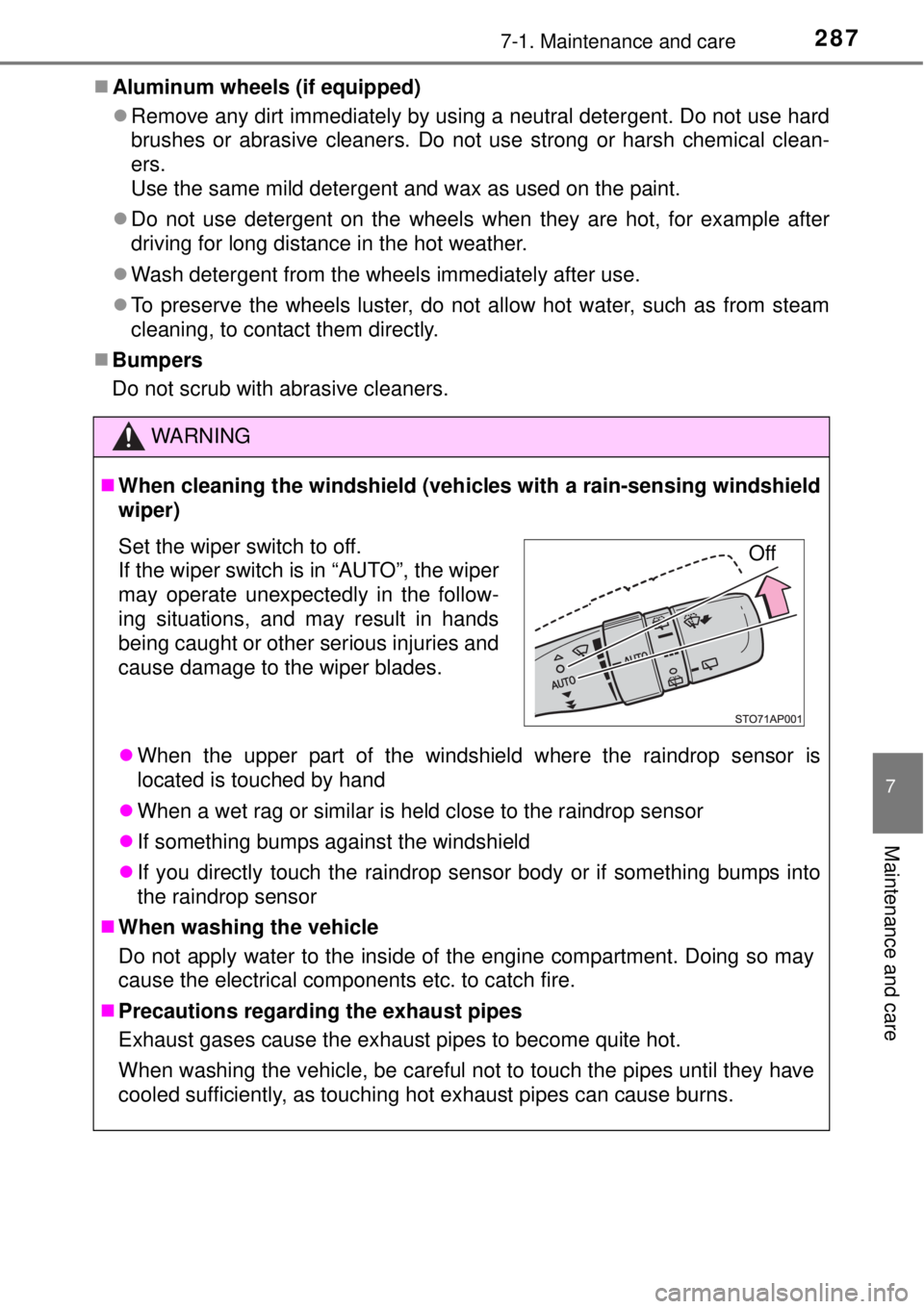
When cleaning the windshield (vehicles with a rain-sensing windshield
wiper)
When the upper part of the windshield where the raindrop sensor is
located is touched by hand
When a wet rag or similar is held close to the raindrop sensor
If something bumps against the windshield
If you directly touch the raindrop sensor body or if something bumps into
the raindrop sensor
When washing the vehicle
Do not apply water to the inside of the engine compartment. Doing so may
cause the electrical components etc. to catch fire.
Precautions regarding the exhaust pipes
Exhaust gases cause the exhaust pipes to become quite hot.
When washing the vehicle, be careful not to touch the pipes until they have
cooled sufficiently, as touching hot exhaust pipes can cause burns.
Set the wiper switch to off.
If the wiper switch is in “AUTO”, the wiper
may operate unexpectedly in the follow-
ing situations, and may result in hands
being caught or other serious injuries and
cause damage to the wiper blades.Off
Page 293 of 464

2937-2. Maintenance
7
Maintenance and care
Where to go for the maintenance service?
In order to maintain your vehicle in the best possible condition, Toyota recom-
mends that all repairs and service operations be carried out by authorized
Toyota dealers or repairers or other duly qualified and equipped profession-
als. For repairs and services covered by your warranty, please visit an autho-
rized Toyota dealer or repairer, who will use genuine Toyota parts in repairing
any difficulties you may encounter. There can also be advantages in utilizing
authorized Toyota dealers or repairers for non-warranty repairs and services,
as members of the Toyota network will be able to expertly assist you with any
difficulties you may encounter.
Your Toyota dealer or repairer, or another duly qualified and equipped profes-
sional will perform all of the scheduled maintenance on your vehicle reliably
and economically due to their experience with Toyota vehicles.
Does your vehicle need repairs?
Be on the alert for changes in performance and sounds, and visual tip-offs
that indicate service is needed. Some important clues are:
Engine misfire, stumbling or pinging
Appreciable loss of power
Strange engine noises
A fluid leak under the vehicle (However, water dripping from the air condi-
tioning system after use is normal.)
Change in exhaust sound (This may indicate a dangerous carbon monoxide
leak. Drive with the windows open and have the exhaust system checked
immediately.)
Flat-looking tires, excessive tire squeal when cornering, uneven tire wear
Vehicle pulls to one side when driven straight on a level road
Strange noises related to suspension movement
Loss of brake effectiveness, spongy feeling brake pedal, pedal almost
touches the floor, vehicle pulls to one side when braking
Engine coolant temperature continually higher than normal
If you notice any of these clues, take your vehicle to any authorized Toyota
dealer or repairer, or another duly qualified and equipped professional as
soon as possible. Your vehicle may need adjustment or repair.
Page 295 of 464
2957-3. Do-it-yourself maintenance
7
Maintenance and care
Do-it-yourself ser vice precautions
If you perform maintenance by yourself, be sure to follow the
correct procedure as given in these sections.
ItemsParts and tools
12-volt battery
condition
(P. 309)•Grease
• Conventional wrench (for terminal clamp bolts)
Engine/power
control unit
coolant level
(P. 306)
• “Toyota Super Long Life Coolant” or a similar high
quality ethylene glycol-based non-silicate, non-
amine, non-nitrite and non-borate coolant with long-
life hybrid organic acid technology
“Toyota Super Long Life Coolant” is pre-mixed with
50% coolant and 50% deionized water.
• Funnel (used only for adding coolant)
Engine oil level
(P. 303)• “Toyota Genuine Motor Oil” or equivalent
• Rag or paper towel
• Funnel (used only for adding engine oil)
Fuses
(P. 339)• Fuse with same amperage rating as original
Light bulbs
(P. 344)
• Bulb with same number and wattage rating as origi-
nal
• Phillips-head screwdriver
• Flathead screwdriver• Wrench
Radiator and
condenser
(P. 307)
Tire inflation
pressure
(P. 328)• Tire pressure gauge
• Compressed air source
Washer fluid
(P. 308)• Water or washer fluid containing antifreeze (for win-
ter use)
• Funnel (used only for adding water or washer fluid)