fuse TOYOTA YARIS HYBRID 2014 Owners Manual
[x] Cancel search | Manufacturer: TOYOTA, Model Year: 2014, Model line: YARIS HYBRID, Model: TOYOTA YARIS HYBRID 2014Pages: 464, PDF Size: 23.4 MB
Page 4 of 464

TABLE OF CONTENTS4
6-1. Using the air conditioning sys-
tem and defogger
Automatic air conditioning sys-
tem...................................260
Seat heaters ......................269
6-2. Using the interior lights
Interior lights list .................271
• Interior light ....................271
• Personal lights ...............272
6-3. Using the storage features
List of storage features ......273
• Glove box ......................274
• Cup holders ...................275
• Bottle holders ................276
• Auxiliary box ..................276
Luggage compartment fea-
tures.................................277
6-4. Using the other interior fea-
tures
Other interior features ........280
• Sun visors ......................280
• Vanity mirrors ................280
• Portable ashtray ............281
• Cigarette lighter .............281
• Power outlet ..................282
• Armrest ..........................283
• Panoramic roof shade ...283
• Assist grips ....................2847-1. Maintenance and care
Cleaning and protecting the
vehicle exterior ................ 286
Cleaning and protecting the
vehicle interior ................. 289
7-2. Maintenance
Maintenance requirements 292
7-3. Do-it-yourself maintenance
Do-it-yourself service precau-
tions ................................ 295
Hood.................................. 298
Positioning a floor jack ...... 300
Engine compartment ......... 302
12-volt battery ................... 309
Tires .................................. 315
Tire inflation pressure........ 328
Wheels .............................. 330
Air conditioning filter .......... 333
Wireless remote control/elec-
tronic key battery............. 335
Checking and replacing
fuses................................ 339
Light bulbs ......................... 344
6Interior features7Maintenance and care
Page 285 of 464

285
7Maintenance and care
7-1. Maintenance and care
Cleaning and protecting
the vehicle exterior .......... 286
Cleaning and protecting
the vehicle interior ........... 289
7-2. Maintenance
Maintenance
requirements.................... 2927-3. Do-it-yourself maintenance
Do-it-yourself service
precautions ...................... 295
Hood .................................. 298
Positioning a floor jack ....... 300
Engine compartment.......... 302
12-volt battery .................... 309
Tires ................................... 315
Tire inflation pressure ........ 328
Wheels ............................... 330
Air conditioning filter .......... 333
Wireless remote control/
electronic key battery....... 335
Checking and replacing
fuses ................................ 339
Light bulbs ......................... 344
Page 295 of 464
2957-3. Do-it-yourself maintenance
7
Maintenance and care
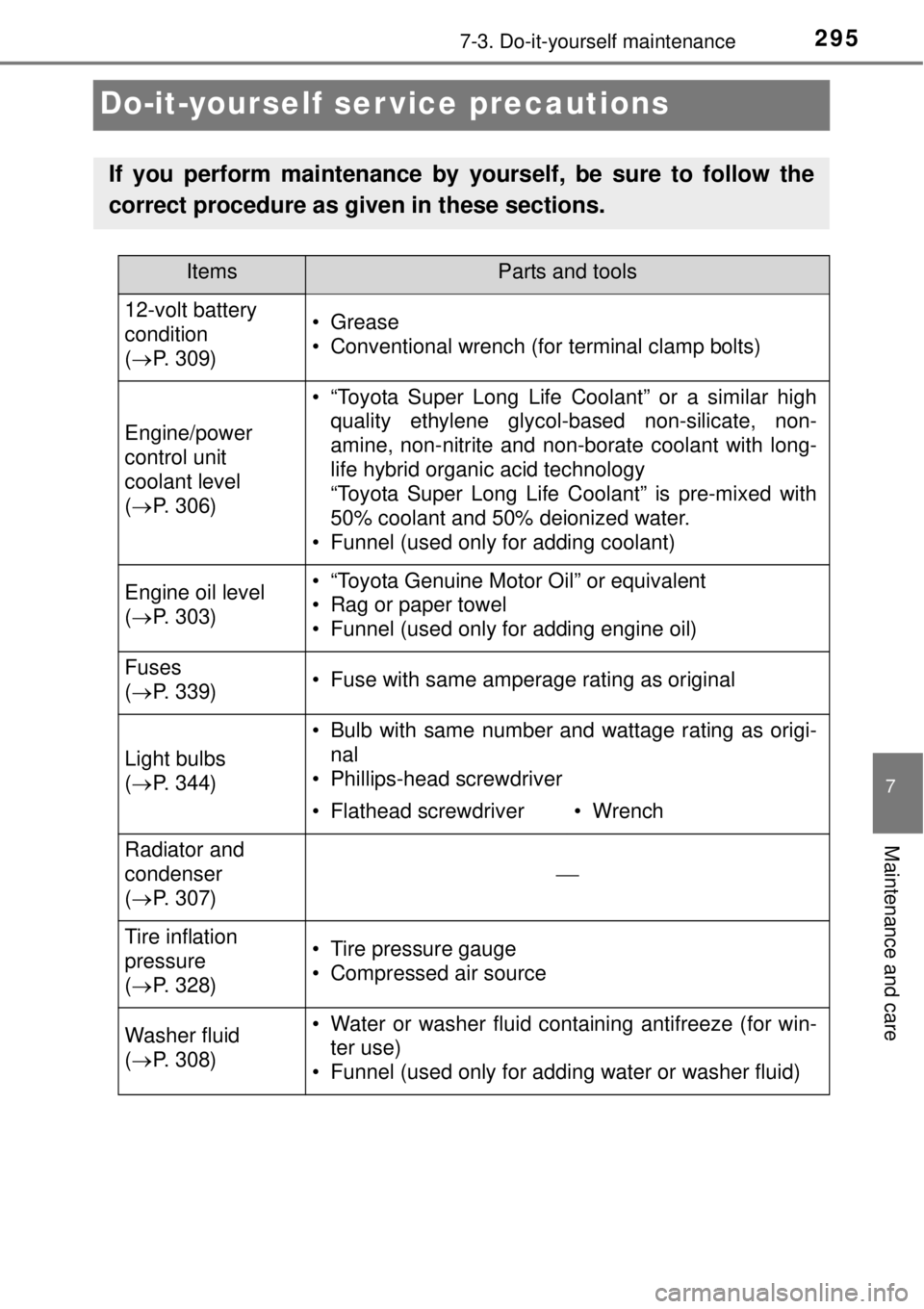
Do-it-yourself ser vice precautions
If you perform maintenance by yourself, be sure to follow the
correct procedure as given in these sections.
ItemsParts and tools
12-volt battery
condition
(P. 309)•Grease
• Conventional wrench (for terminal clamp bolts)
Engine/power
control unit
coolant level
(P. 306)
• “Toyota Super Long Life Coolant” or a similar high
quality ethylene glycol-based non-silicate, non-
amine, non-nitrite and non-borate coolant with long-
life hybrid organic acid technology
“Toyota Super Long Life Coolant” is pre-mixed with
50% coolant and 50% deionized water.
• Funnel (used only for adding coolant)
Engine oil level
(P. 303)• “Toyota Genuine Motor Oil” or equivalent
• Rag or paper towel
• Funnel (used only for adding engine oil)
Fuses
(P. 339)• Fuse with same amperage rating as original
Light bulbs
(P. 344)
• Bulb with same number and wattage rating as origi-
nal
• Phillips-head screwdriver
• Flathead screwdriver• Wrench
Radiator and
condenser
(P. 307)
Tire inflation
pressure
(P. 328)• Tire pressure gauge
• Compressed air source
Washer fluid
(P. 308)• Water or washer fluid containing antifreeze (for win-
ter use)
• Funnel (used only for adding water or washer fluid)
Page 302 of 464
3027-3. Do-it-yourself maintenance
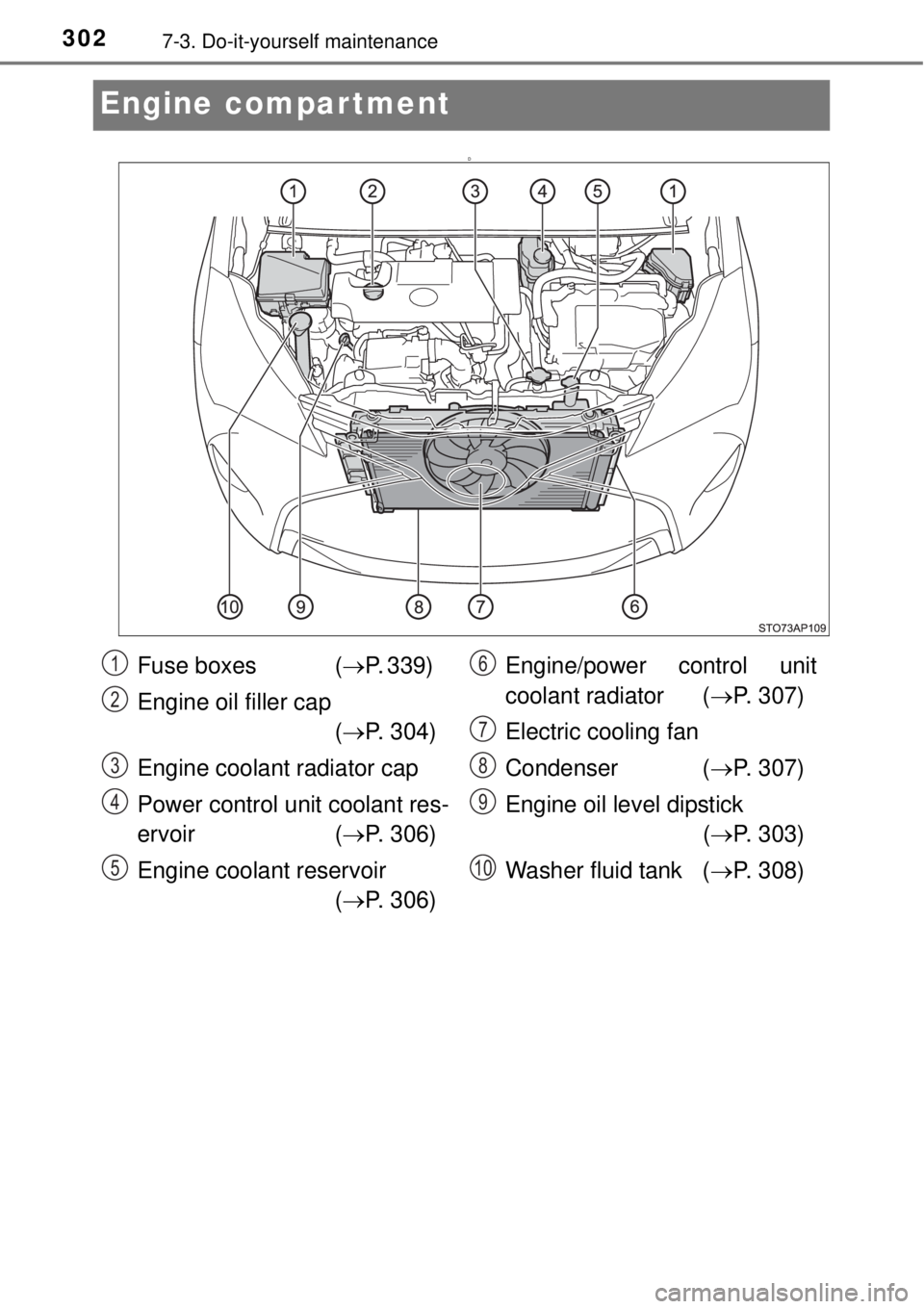
Engine compartment
D
Fuse boxes (P. 339)
Engine oil filler cap
(P. 304)
Engine coolant radiator cap
Power control unit coolant res-
ervoir (P. 306)
Engine coolant reservoir
(P. 306)Engine/power control unit
coolant radiator (P. 307)
Electric cooling fan
Condenser (P. 307)
Engine oil level dipstick
(P. 303)
Washer fluid tank (P. 308)1
2
3
4
5
6
7
8
9
10
Page 339 of 464
3397-3. Do-it-yourself maintenance
7
Maintenance and care
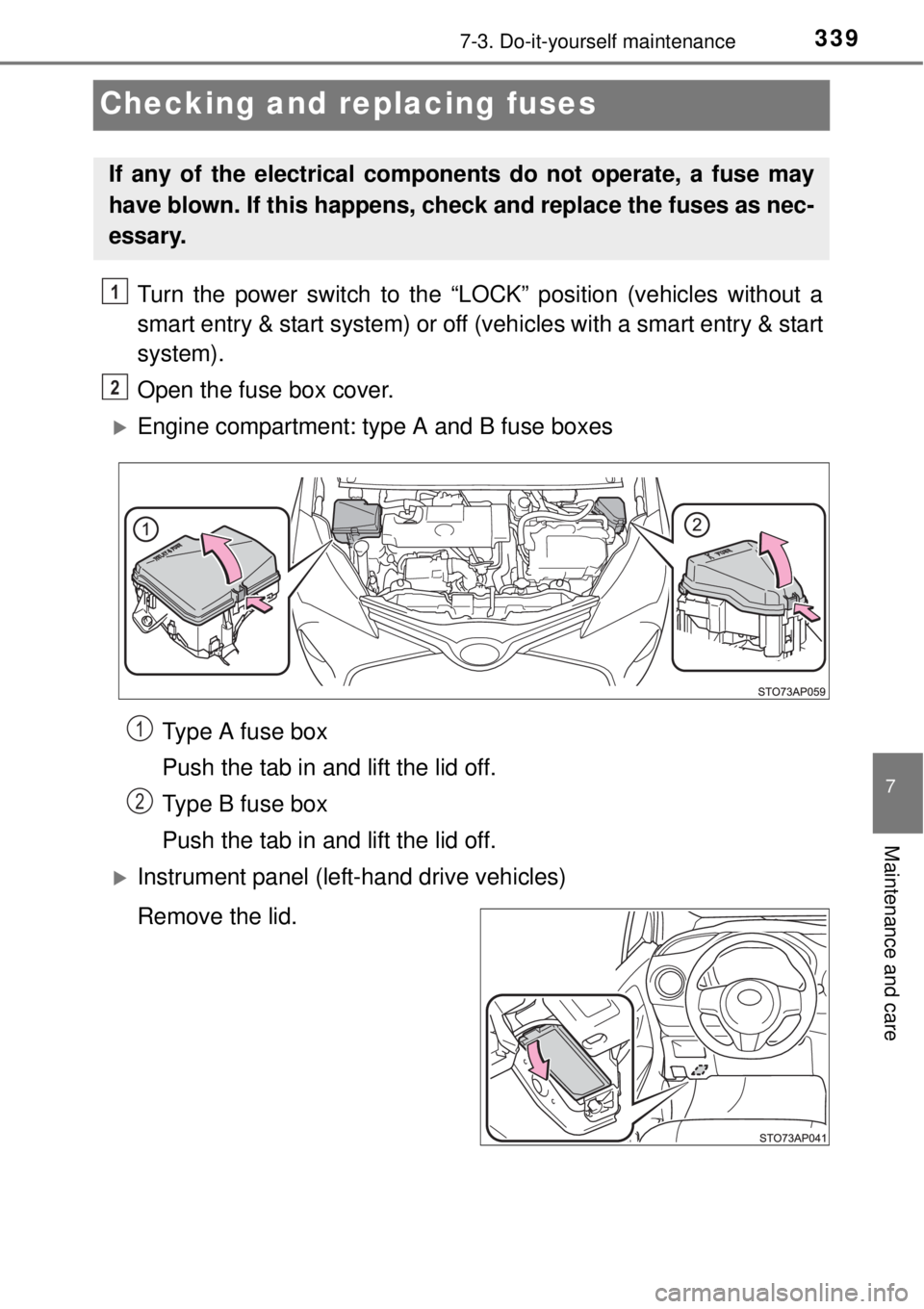
Checking and replacing fuses
Turn the power switch to the “LOCK” position (vehicles without a
smart entry & start system) or off (vehicles with a smart entry & start
system).
Open the fuse box cover.
Engine compartment: type A and B fuse boxes
Type A fuse box
Push the tab in and lift the lid off.
Type B fuse box
Push the tab in and lift the lid off.
Instrument panel (left-hand drive vehicles)
Remove the lid.
If any of the electrical components do not operate, a fuse may
have blown. If this happens, check and replace the fuses as nec-
essary.
1
2
1
2
Page 340 of 464
3407-3. Do-it-yourself maintenance
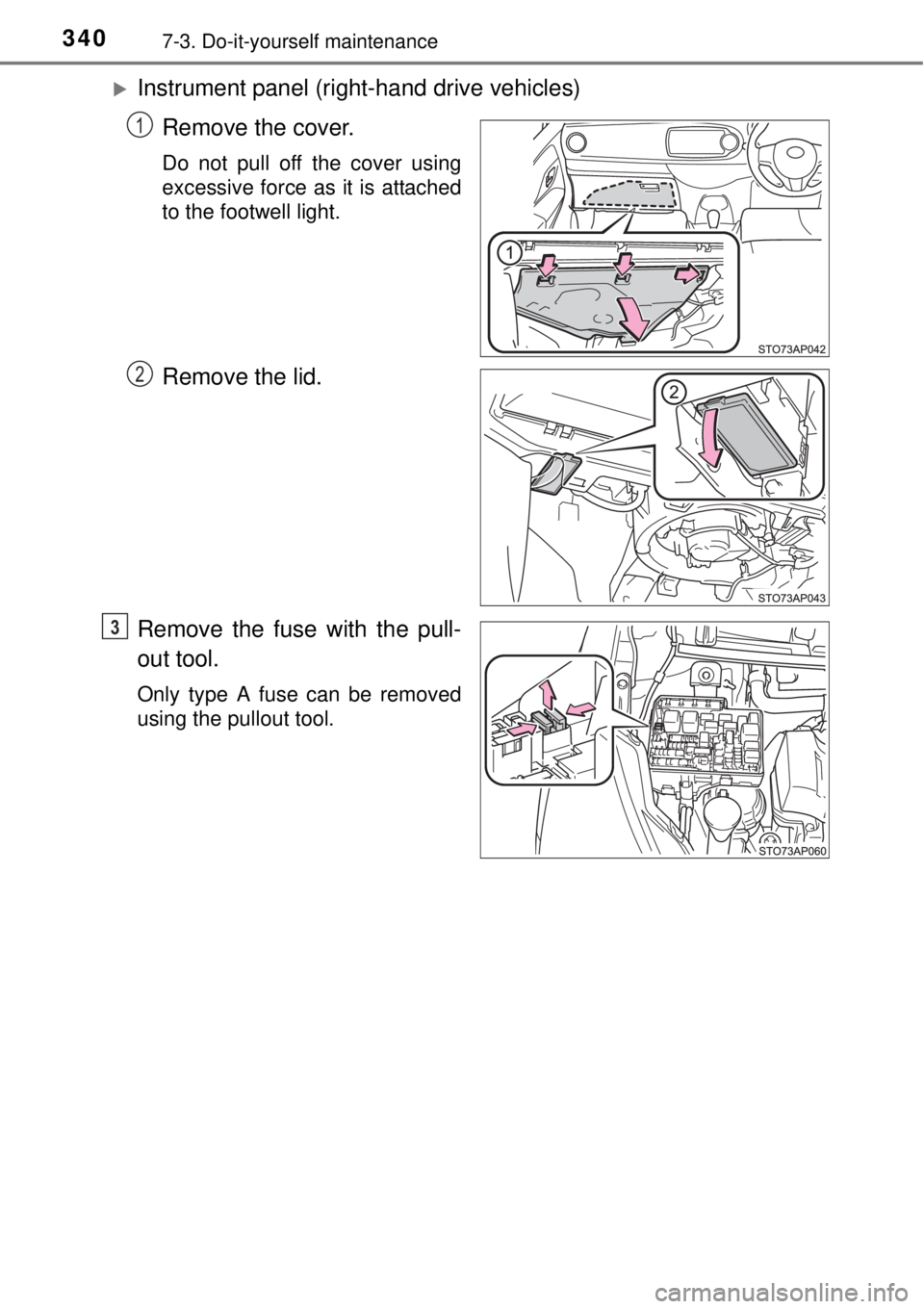
Instrument panel (right-hand drive vehicles)
Remove the cover.
Do not pull off the cover using
excessive force as it is attached
to the footwell light.
Remove the lid.
Remove the fuse with the pull-
out tool.
Only type A fuse can be removed
using the pullout tool.
1
2
3
Page 341 of 464
3417-3. Do-it-yourself maintenance
7
Maintenance and care
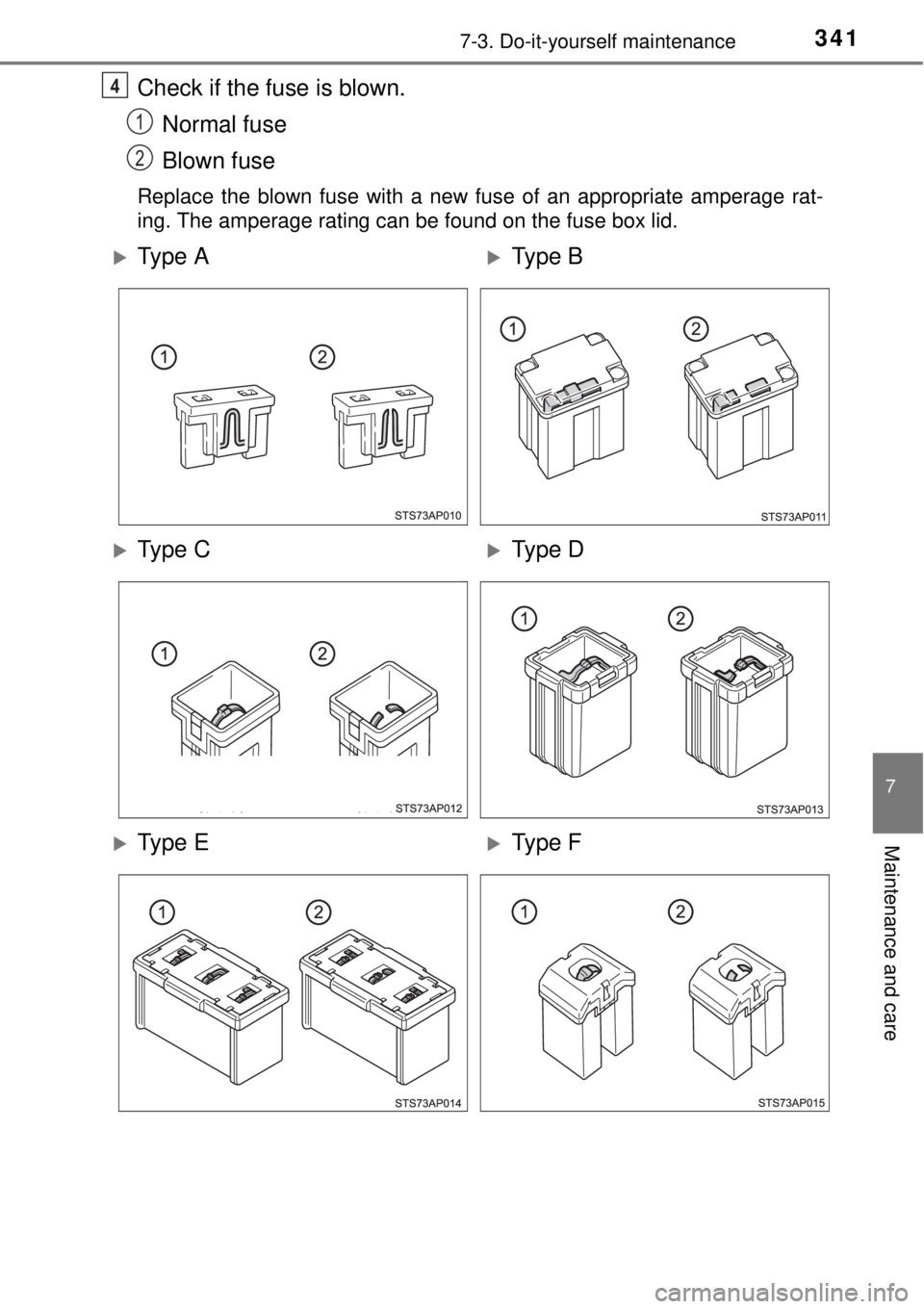
Check if the fuse is blown.
Normal fuse
Blown fuse
Replace the blown fuse with a new fuse of an appropriate amperage rat-
ing. The amperage rating can be found on the fuse box lid.
4
1
2
Ty p e AType B
Ty p e CType D
Ty p e EType F
Page 342 of 464
3427-3. Do-it-yourself maintenance
After a fuse is replaced
If the lights do not turn on even after the fuse has been replaced, a bulb may
need replacement. (P. 344)
If the replaced fuse blows again, have the vehicle inspected by any autho-
rized Toyota dealer or repairer, or another duly qualified and equipped pro-
fessional.
If there is an overload in a circuit
The fuses are designed to blow, protecting the wiring harness from damage.
When replacing light bulbs
Toyota recommends that you use genuine Toyota products designed for this
vehicle. Because certain bulbs are connected to circuits designed to prevent
overload, non-genuine parts or parts not designed for this vehicle may be
unusable.
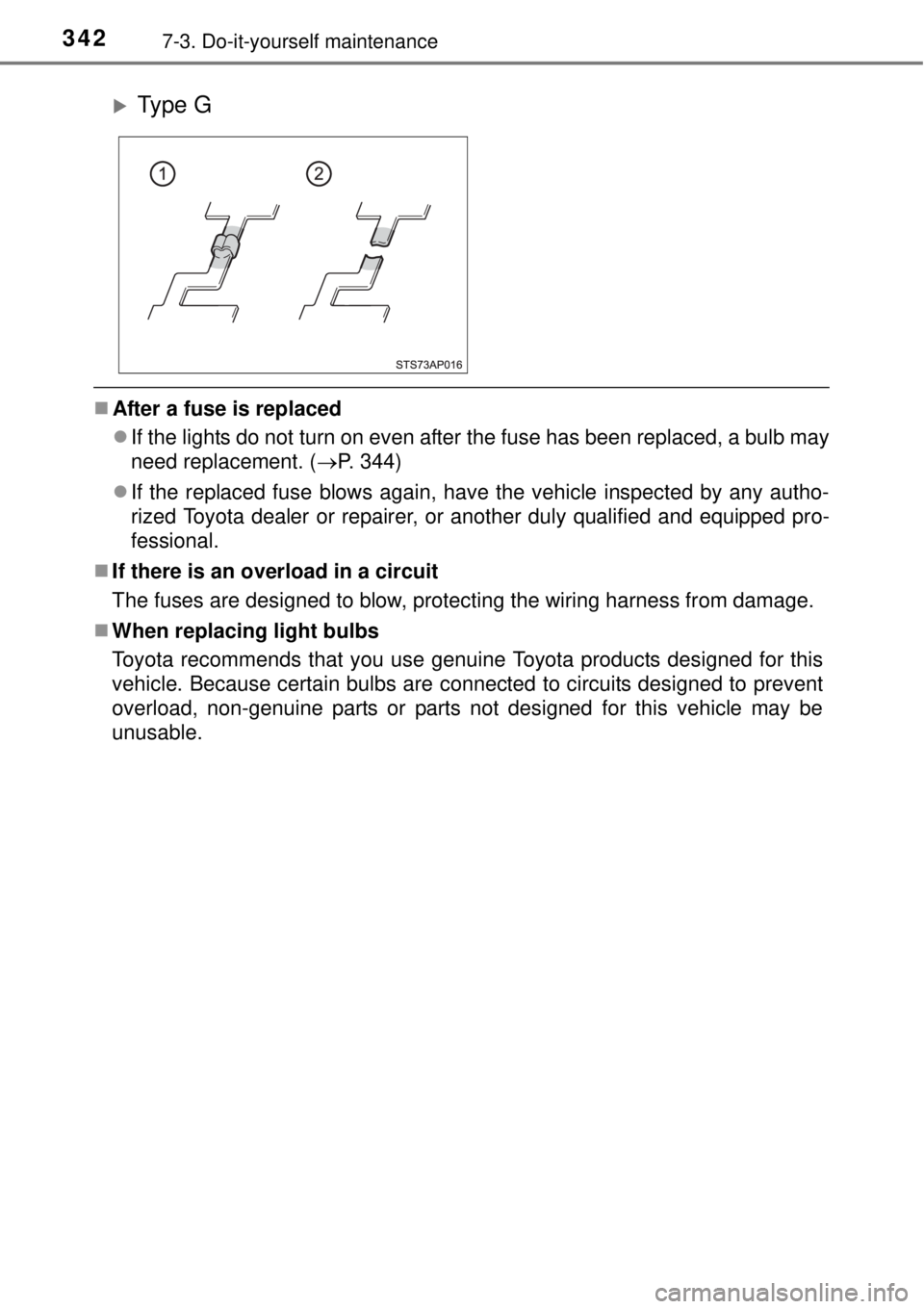
Ty p e G
Page 343 of 464
3437-3. Do-it-yourself maintenance
7
Maintenance and care
WARNING
To prevent system breakdowns and vehicle fire
Observe the following precautions.
Failure to do so may cause damage to the vehicle, and possibly a fire or
injury.
Never use a fuse of a higher amperage rating than that indicated, or use
any other object in place of a fuse.
Always use a genuine Toyota fuse or equivalent.
Never replace a fuse with a wire, even as a temporary fix.
Do not modify the fuses or fuse boxes.
Fuse box near the power control unit
Never check or replace the fuses as there are high voltage parts and wiring
near the fuse box.
Doing so may cause electric shock, resulting in death or serious injury.
NOTICE
Before replacing fuses
Have the cause of electrical overload determined and repaired by any
authorized Toyota dealer or repairer, or another duly qualified and equipped
professional as soon as possible.
Page 410 of 464

4108-2. Steps to take in an emergency
If the hybrid system will not star t
One of the following may be the cause of the problem:
Vehicles with a smart entry & start system: The electronic key may
not be functioning properly. (P. 414)
There may not be sufficient fuel in the vehicle’s tank.
Refuel the vehicle. (P. 206)
There may be a malfunction in the immobilizer system. (P. 8 2 )
There may be a malfunction in the steering lock system.
The hybrid system may be malfunctioning due to an electrical prob-
lem such as electronic key battery depletion or a blown fuse. How-
ever, depending on the type of malfunction, an interim measure is
available to start the hybrid system. (P. 411)
One of the following may be the cause of the problem:
The 12-volt battery may be discharged. (P. 415)
The 12-volt battery terminal connections may be loose or corroded.
(P. 310)
Reasons for the hybrid system not starting vary depending on
the situation. Check the following and perform the appropriate
procedure:
The hybrid system will not start even though the correct starting
procedure is being followed. (P. 176, 180)
The interior lights and headlights are dim, or the horn does not
sound or sounds at a low volume.