repair TOYOTA YARIS iA 2017 Owners Manual (in English)
[x] Cancel search | Manufacturer: TOYOTA, Model Year: 2017, Model line: YARIS iA, Model: TOYOTA YARIS iA 2017Pages: 576, PDF Size: 8.9 MB
Page 38 of 576

38
YARIS iA_OM_OM99N89z_(U)
1-2. Seat Belt Systems
WARNING
■Wear seat belts only as recommended in this owner’s manual
Incorrect positioning of the driver and front passenger seat belts is danger-
ous. Without proper positioning, the pretensioner and load limiting systems
cannot provide adequate protection in an accident and this could result in
serious injury. For more details about wearing seat belts, refer to “Fastening
the seat belts” (→P. 34).
■ Have your seat belts changed immediately if the pretensioner or load
limiter has been expended
Always have your Toyota dealer immediately inspect the seat belt preten-
sioners and air bags after any collision. Like the air bags, the seat belt pre-
tensioners and load limiters will only function once and must be replaced
after any collision that caused them to deploy. A seat belt with an expended
pretensioner or load limiter is still better than wearing no seat belt at all;
however, if the seat belt pretensioners and load limiters are not replaced,
the risk of injury in a collision will increase.
■ Do not modify the components or wiring, or use electronic testing
devices on the pretensioner system
Modifying the components or wiring of the pretensioner system, including
the use of electronic testing devices is dangerous. You could accidentally
activate it or make it inoperable which would prevent it from activating in an
accident. The occupants or repairers could be seriously injured.
■ Properly dispose of th e pretensioner system
Improper disposal of the pretensioner system or a vehicle with non-deacti-
vated pretensioners is dangerous. Unless all safety procedures are fol-
lowed, injury could result. Have your Toyota dealer safely dispose of the
pretensioner system or scrap a pretensioner system equipped vehicle.
Page 67 of 576

YARIS iA_OM_OM99N89z_(U)
671-4. SRS Air Bags
1
Essential Safety Equipment
WARNING
■Do not modify a front door or l eave any damage unrepaired. Always
have your Toyota dealer inspect a damaged front door
Modifying a front door or leaving any damage unrepaired is dangerous.
Each front door has a side crash sensor as a component of the supplemen-
tal restraint system. If holes are drilled in a front door, a door speaker is left
removed, or a damaged door is left unrepaired, the sensor could be
adversely affected causing it to not detect the pressure of an impact cor-
rectly during a side collision. If a sensor does not detect a side impact cor-
rectly, the side and curtain air bags and the front seat belt pretensioner may
not operate normally which could result in serious injury to occupants.
■ Do not modify the supplemental restraint system
Modifying the components or wiring of the supplemental restraint system is
dangerous. You could accidentally activate it or make it inoperable. Do not
make any modifications to the supplemental restraint system. This includes
installing trim, badges, or anything else over the air bag modules. It also
includes installing extra electrical equipment on or near system components
or wiring. Your Toyota dealer can provide the special care needed in the
removal and installation of front seats. It is important to protect the air bag
wiring and connections to assure that the bags do not accidentally deploy,
and that the front passenger occupant classification system and the seats
retain an undamaged air bag connection.
■ Do not place luggage or other objects under the front seats
Placing luggage or other objects under the front seats is dangerous. The
components essential to the supplemental restraint system could be dam-
aged, and in the event of a side collision, the appropriate air bags may not
deploy, which could result in death or serious injury. To prevent damage to
the components essential to the supplemental restraint system, do not
place luggage or other objects under the front seats.
■ Do not operate a vehicle with damaged air bag/seat belt pretensioner
system components
Expended or damaged air bag/seat belt pretensioner system components
must be replaced after any collision which caused them to deploy or dam-
age them. Only a trained Authorized Toyota Dealer can fully evaluate these
systems to see that they will work in any subsequent accident. Driving with
an expended or damaged air bag or pretensioner unit will not afford you the
necessary protection in the event of any subsequent accident which could
result in serious injury or death.
Page 122 of 576
122
YARIS iA_OM_OM99N89z_(U)
2-7. Security System
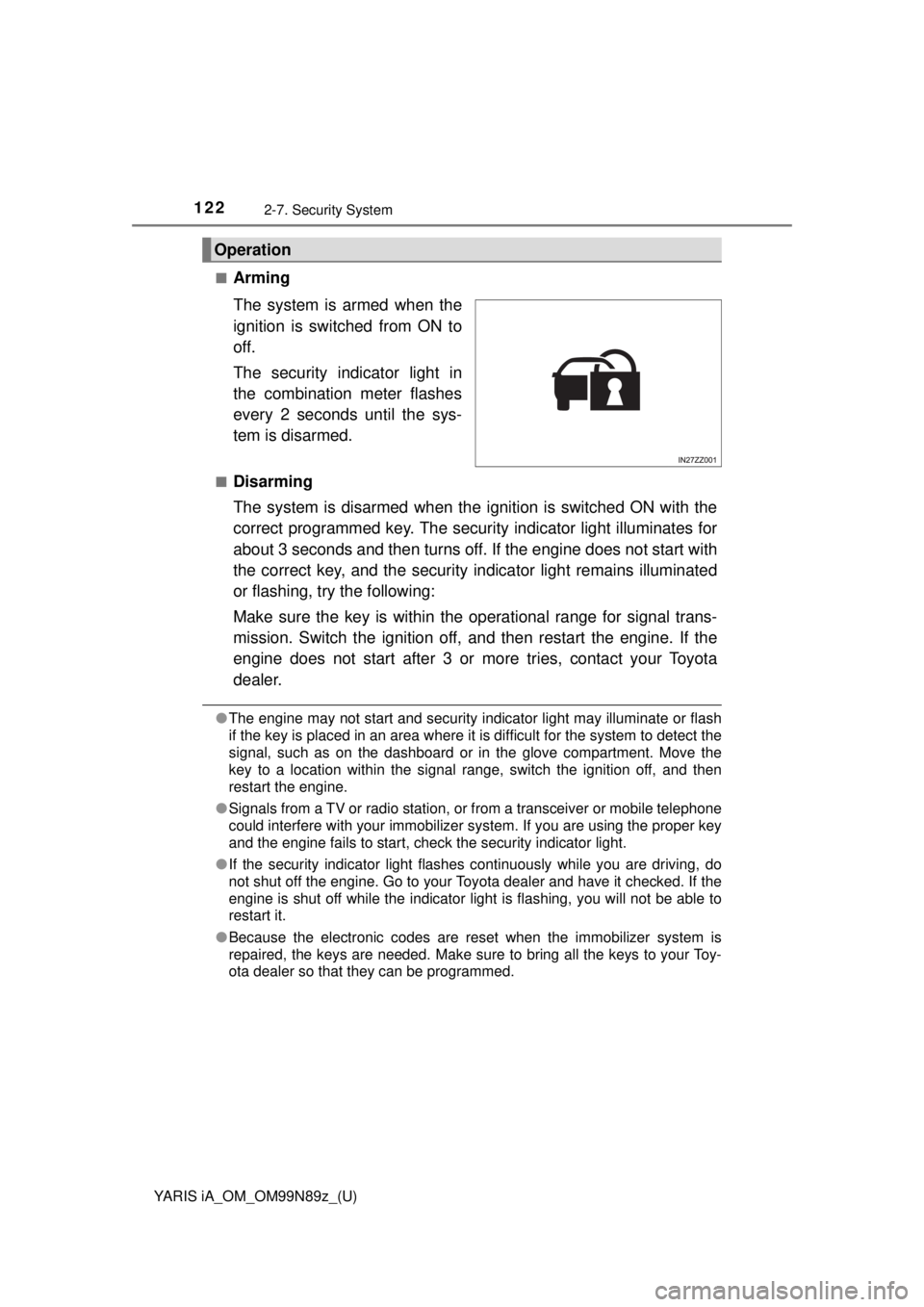
■Arming
The system is armed when the
ignition is switched from ON to
off.
The security indicator light in
the combination meter flashes
every 2 seconds until the sys-
tem is disarmed.
■Disarming
The system is disarmed when the ignition is switched ON with the
correct programmed key. The security indicator light illuminates for
about 3 seconds and then turns of f. If the engine does not start with
the correct key, and th e security indicator light remains illuminated
or flashing, try the following:
Make sure the key is within the operational range for signal trans-
mission. Switch the ignition off, and then restart the engine. If the
engine does not start after 3 or more tries, contact your Toyota
dealer.
● The engine may not start and security indicator light may illuminate or flash
if the key is placed in an area where it is difficult for the system to detect the
signal, such as on the dashboard or in the glove compartment. Move the
key to a location within the signal range, switch the ignition off, and then
restart the engine.
● Signals from a TV or radio station, or from a transceiver or mobile telephone
could interfere with your immobilizer system. If you are using the proper key
and the engine fails to start, check the security indicator light.
● If the security indicator light flashes continuously while you are driving, do
not shut off the engine. Go to your Toyota dealer and have it checked. If the
engine is shut off while the indicator light is flashing, you will not be able to
restart it.
● Because the electronic codes are reset when the immobilizer system is
repaired, the keys are needed. Make sure to bring all the keys to your Toy-
ota dealer so that they can be programmed.
Operation
Page 219 of 576

YARIS iA_OM_OM99N89z_(U)
2193-12. Tire Pressure Monitoring System
3
When Driving
Because this system detects slight ch anges in tire conditions, the timing
of the warning may be faster or slower in the following cases:
●The size, manufacturer, or the type of tires is different from the specifica-
tion.
●The size, manufacturer, or the type of a tire is different from the others,
or the level of tire wear is excessively different between them.
●A run-flat tire, studless tire, snow tire, or tire chains are used.
●An emergency tire is used (The tire pressure monitoring system warning
light may flash and then continue illuminating).
●A tire is repaired using the emergency flat tire repair kit.
●The tire pressure is excessively hi gher than the specified pressure, or
the tire pressure is suddenly lowered for some reason such as a tire
burst during driving.
●The vehicle speed is lower than about 9.3 mph (15 km/h) (including
when the vehicle is stopped), or t he drive period is shorter than 5 min-
utes.
●The vehicle is driven on an extremely rough road or a slippery, icy road.
●Hard steering and rapid acceleration/deceleration are repeated such as
during aggressive driving on a winding road.
●Load on the vehicle is applied to a tire such as by loading heavy luggage
to one side of the vehicle.
●System initialization has not been im plemented with the specified tire
pressure.
Page 412 of 576

412
YARIS iA_OM_OM99N89z_(U)
5-1. Essential Information
Introduction
Be extremely careful and prevent injury to yourself and others or dam-
age to your vehicle when using this manual for inspection and mainte-
nance.
If you are unsure about any procedure it describes, we strongly urge
you to have a reliable and qualified service shop perform the work,
preferably your Toyota dealer.
Factory-trained Toyota technicians and genuine Toyota parts are best
for your vehicle. Without this expe rtise and the parts that have been
designed and made especially for your Toyota, inadequate, incom-
plete, and insufficient servicing may result in problems. This could
lead to vehicle damage or an accident and injuries.
For expert advice and quality service, consult your Toyota dealer.
To continue warranty eligibility and to protect your investment, it is
your responsibility to pr operly maintain your vehicle according to fac-
tory recommended schedul es outlined in this manual. Keep a copy of
the repair order. It proves that the maintenance that has been per-
formed is under warranty coverage. If any problem should arise while
your vehicle is under warranty, your Toyota dealer will promptly take
care of it.
This evidence may consist of the following: • The Maintenance Log, found within the Warranty and Maintenance Guide, must be completely filled out showing mileage, repair order
number, date for each service, and signed by a qualified automotive
service technician who service vehicles.
• Original copies of repair orders or other receipts that include the mileage and date the vehicle was serviced. Each receipt should be
signed by a qualified automot ive service technician.
• For self maintenance, a statemen t that you completed the mainte-
nance yourself, displaying mileag e and the date the work was per-
formed. Also, receipts for the replac ement parts (fluid, filters, etc.)
indicating the date and mileage mu st accompany this statement.
Page 413 of 576

YARIS iA_OM_OM99N89z_(U)
4135-1. Essential Information
5
Maintenance and Care
Claims against the warranty resulting from lack of maintenance, as
opposed to defective materials or authorized Toyota workmanship, will
not be honored.
Any auto repair shop using parts equivalent to your Toyota’s original
equipment may perform maintenance. But we recommend that it
always be done by your Toyota dealer using genuine Toyota parts.
Selecting “Maintenance Monitor” enables the system to notify you of
your vehicle’s approaching inspection/servicing period (→P. 414).
If you elect to perform maintenance yourself or have your vehicle serviced at
a location other than your Toyota dealer, Toyota requires that all fluids, parts
and materials must meet Toyota standards for durability and performance as
described in this manual.
Page 423 of 576
YARIS iA_OM_OM99N89z_(U)
4235-3. Owner Maintenance
5
Maintenance and Care
After replacing the engine oil, have a repair shop such as your Toyota
dealer perform the initialization (engine oil data resetting) of the
recorded value. If the value recorded by the computer is not initialized,
the wrench indicator light may not turn off or it may turn on earlier than
normal.
● This procedure is intended for vehicles with the engine oil flexible mainte-
nance setting selected.
● The initialization (engine oil data resetting) of the recorded value can be per-
formed using the following procedure:
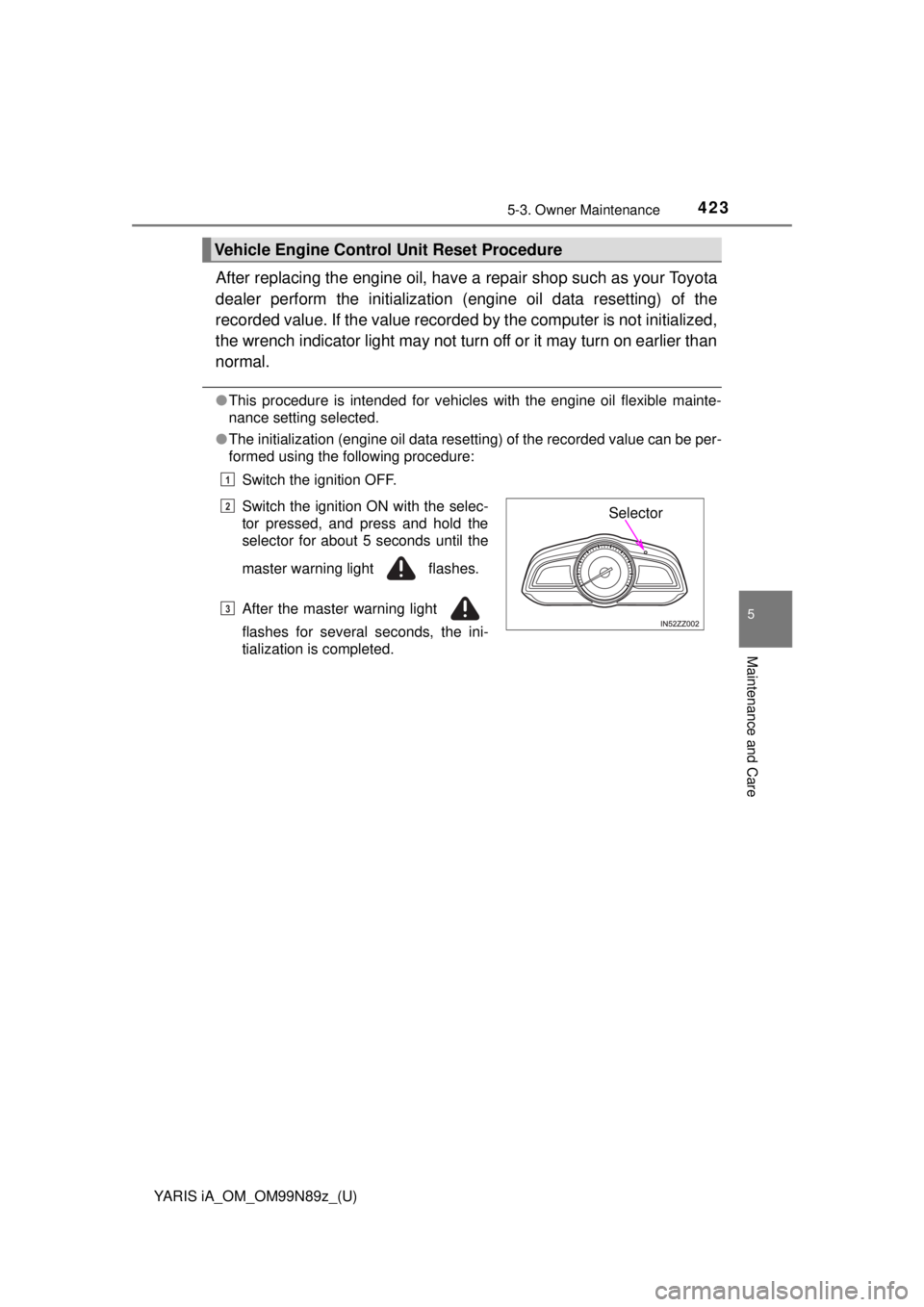
Switch the ignition OFF.
Vehicle Engine Control Unit Reset Procedure
Switch the ignition ON with the selec-
tor pressed, and press and hold the
selector for about 5 seconds until the
master warning light flashes.
After the master warning light
flashes for several seconds, the ini-
tialization is completed.
1
2
3
Selector
Page 443 of 576
YARIS iA_OM_OM99N89z_(U)
4435-3. Owner Maintenance
5
Maintenance and Care
Inspect the temporary spare tire at least monthly to make sure it is
properly inflated and stored.
The temporary spare tire is easier to handle because of its construc-
tion which is lighter and smaller than a conventional tire. This tire
should be used only for an emergen cy and only for a short distance.
Use the temporary spare tire only until the conventional tire is
repaired, which should be as soon as possible.
Refer to Tires on P. 558.
●The temporary spare tire condition gradually deteriorates even if it has
not been used.
●Tires degrade over time, even when they are not being used on the
road. It is recommended that tires gen erally be replaced when they are
6 years or older. Heat caused by ho t climates or frequent high loading
conditions can accelerate the aging process. You should replace the
spare tire when you replace the other road tires due to the aging of the
spare tire. The period in which the tire was manufactured (both week
and year) is indicated by a 4-digit number.
Refer to Tire Labeling on P. 530.
Proper tire balancing provides the best riding comfort and helps
reduce tread wear. Out-of-balance tires can cause vibration and
uneven wear, such as cupping and flat spots.
When replacing a wheel, make sure the new one is the same as the orig-
inal factory wheel in diameter, rim width, and offset (inset/outset).
For details, contact your Toyota dealer.
Temporary Spare Tire
NOTICE
●Do not use your temporary spare tire rim with a snow tire or a conven-
tional tire. Neither will properly fit and could damage both tire and rim.
●The temporary spare tire has a tread life of less than 3,000 miles
(5,000 km). The tread life may be shorter depending on driving condi-
tions.
●The temporary spare tire is for limited use, however, if the tread wear
solid-band indicator appears, replace the tire with the same type of
temporary spare (→P. 443).
Replacing a Wheel
Page 464 of 576

4645-4. Appearance Care
YARIS iA_OM_OM99N89z_(U)
■Paint Chipping
●The paint chipping zone varies with the speed of the vehicle. For example,
when traveling at 56 mph (90 km/h), the paint chipping zone is 164 ft.
(50 m).
● In low temperatures a vehicle’s finish hardens. This increases the chance of
paint chipping.
● Chipped paint can lead to rust forming on your Toyota. Before this happens,
repair the damage by using Toyota touch-up paint according to the instruc-
tions in this section. Failure to repair the affected area could lead to serious
rusting and expensive repairs.
■
Washing
To help protect the finish from rust and deterioration, wash your
Toyota thoroughly and frequently, at least once a month, with luke-
warm or cold water.
If the vehicle is washed impro perly, the paint surface could be
scratched. Here are some examples of how scratching could occur.
Scratches occur on the paint surface when: • The vehicle is washed without fi rst rinsing off dirt and other for-
eign matter.
• The vehicle is washed with a rough, dry, or dirty cloth.
• The vehicle is washed at a car wash that uses brushes that are
dirty or too stiff.
• Cleansers or wax containing abrasives are used.
To minimize scratches on the vehicle’s paint finish: • Rinse off any dirt or other foreign matter using lukewarm or cold water before washing.
• Use plenty of lukewarm or cold water and a soft cloth when washing the vehicle. Do not use a nylon cloth.
• Rub gently when washing or drying the vehicle.
• Take your vehicle only to a car wash that keeps its brushes well maintained.
• Do not use abrasive cleansers or wax that contain abrasives.
Pay special attention to removing salt, dirt, mud, and other foreign
material from the underside of the fenders, and make sure the drain
holes in the lower edges of the doors and rocker panels are clean.
Maintaining the Finish
Page 467 of 576
YARIS iA_OM_OM99N89z_(U)
4675-4. Appearance Care
5
Maintenance and Care
Deep scratches or chips on the finish should be repaired promptly.
Exposed metal quickly rusts and can lead to major repairs.• Use tar remover to remove road tar and insects. Never do this with a knife or similar tool.
• To prevent corrosion on bright-metal surfaces, apply wax or chrome preservative and rub it to a high luster.
• During cold weather or in coasta l areas, cover bright-metal parts
with a coating of wax or preservative heavier than usual. It would
also help to coat them with noncorrosive petroleum jelly or some
other protective compound.
Repairing Damage to the Finish
NOTICE
If your Toyota is damaged and needs metal parts repaired or replaced,
make sure the body shop applies anti-corrosion materials to all parts, both
repaired and new. This will prevent them from rusting.
Bright-Metal Maintenance
NOTICE
Do not use steel wool, abrasive cleaners, or strong detergents containing
highly alkaline or caustic agents on chrome-plated or anodized aluminum
parts. This may result in damage to the protective coating and cause discol-
oration or paint deterioration.