Rear VAUXHALL ADAM 2015 Repair Manual
[x] Cancel search | Manufacturer: VAUXHALL, Model Year: 2015, Model line: ADAM, Model: VAUXHALL ADAM 2015Pages: 225, PDF Size: 6.81 MB
Page 167 of 225
Vehicle care165
Fit light assembly with theretaining pins into the recesses of
the vehicle body and tighten the
securing nut from inside the load compartment. Pull the circular
gasket over the recess in the lamp housing.
Close cover and engage.
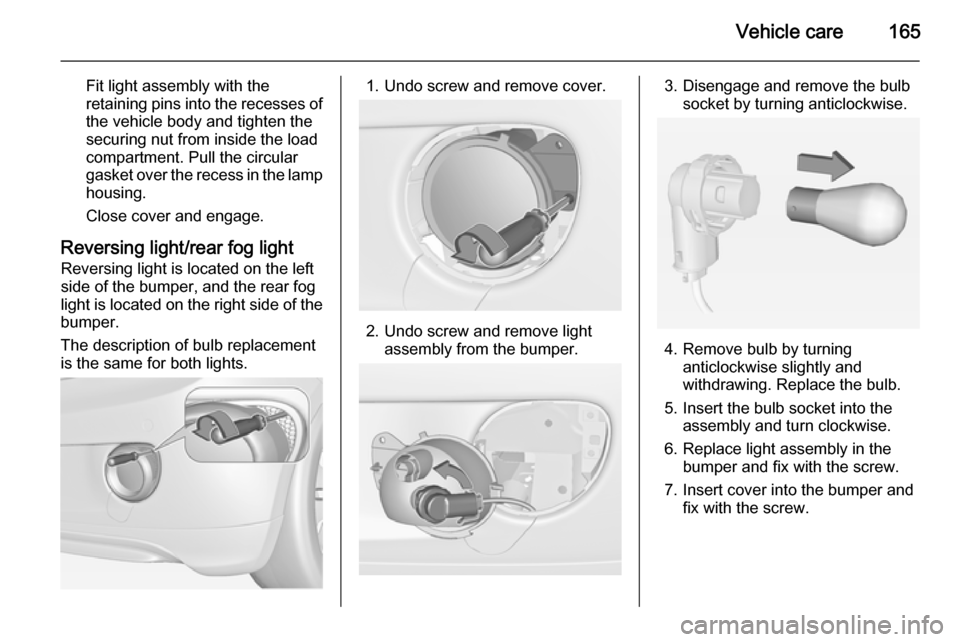
Reversing light/rear fog light Reversing light is located on the left
side of the bumper, and the rear fog
light is located on the right side of the
bumper.
The description of bulb replacement
is the same for both lights.1. Undo screw and remove cover.
2. Undo screw and remove light assembly from the bumper.
3. Disengage and remove the bulbsocket by turning anticlockwise.
4. Remove bulb by turninganticlockwise slightly and
withdrawing. Replace the bulb.
5. Insert the bulb socket into the assembly and turn clockwise.
6. Replace light assembly in the bumper and fix with the screw.
7. Insert cover into the bumper and fix with the screw.
Page 172 of 225

170Vehicle care
No.Circuit1–2exterior mirror switch3body control module4foldable sunroof, Chassis
control module5ABS6daytime running light left7–8body control module9vehicle battery sensor10headlamp levelling, TPMS, fold‐ able sunroof11rear wiper12window defog13daytime running light right14mirror defog15–No.Circuit16chassis control module,
LPG system17interior mirror18engine control module19fuel pump20–21injection coil22–23injection system24washer system25lighting system26engine control module27–28engine control module29engine control module30–31left headlampNo.Circuit32right headlamp33engine control module34horn35clutch36–
Page 175 of 225

Vehicle care173
No.Circuit35–36–37rear wiper38cigarette lighter39–40–Vehicle toolsTools
Vehicles with tyre repair kit
Some tools and the towing eye are
located together with the tyre repair
kit in a tool box in the load
compartment below the floor cover.
On version with storage box, remove
box first 3 64.
On versions with rear carrier system
or liquid gas engine, the tools are
located together with the towing eye
and tyre repair kit in a suitcase, fixed
with a strap at the left sidewall in the
load compartment.
Page 176 of 225
174Vehicle care
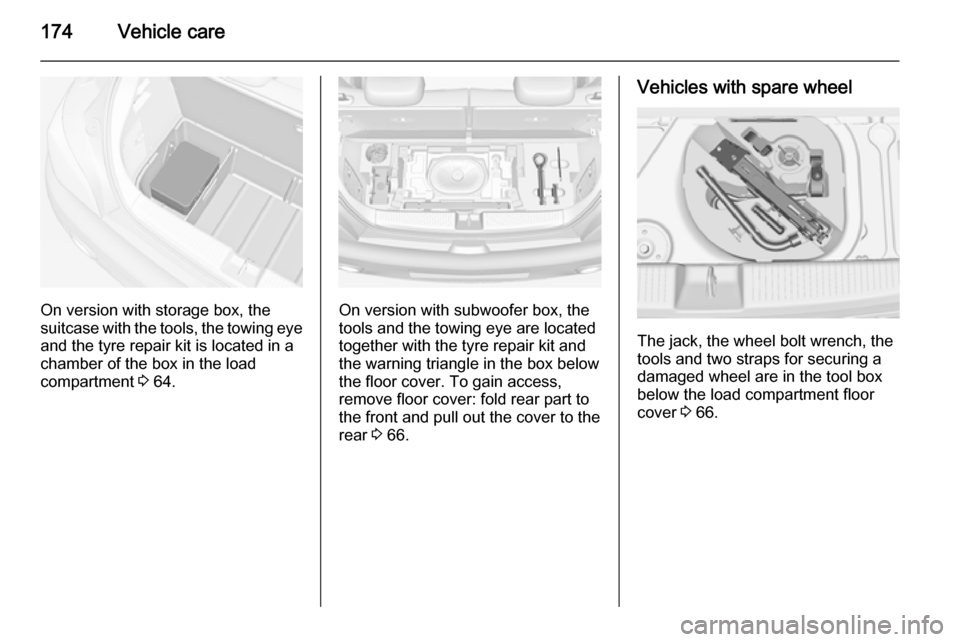
On version with storage box, the
suitcase with the tools, the towing eye
and the tyre repair kit is located in a
chamber of the box in the load
compartment 3 64.On version with subwoofer box, the
tools and the towing eye are located
together with the tyre repair kit and
the warning triangle in the box below
the floor cover. To gain access,
remove floor cover: fold rear part to
the front and pull out the cover to the
rear 3 66.
Vehicles with spare wheel
The jack, the wheel bolt wrench, the
tools and two straps for securing a
damaged wheel are in the tool box below the load compartment floor
cover 3 66.
Page 177 of 225

Vehicle care175Wheels and tyresTyre condition, wheel condition
Drive over edges slowly and at right
angles if possible. Driving over sharp
edges can cause tyre and wheel
damage. Do not trap tyres on the kerb
when parking.
Regularly check the wheels for
damage. Seek the assistance of a
workshop in the event of damage or
unusual wear.
We recommend not swapping the
front wheels with the rear wheels and vice versa, as this can affect vehicle
stability. Always use less worn tyres
on the rear axle.
Winter tyres Winter tyres improve driving safety attemperatures below 7 °C and shouldtherefore be fitted on all wheels.
In accordance with country-specific
regulations, affix the speed sticker in
the driver's field of view.Tyre designations
E.g. 195/55 R 16 95 H195=tyre width, mm55=cross-section ratio (tyre height
to tyre width), %R=belt type: RadialRF=type: RunFlat16=wheel diameter, inches95=load index e.g. 95 is equivalent
to 690 kgH=speed code letter
Speed code letter:
Q=up to 100 mphS=up to 112 mphT=up to 118 mphH=up to 130 mphV=up to 150 mphW=up to 168 mph
Directional tyres
Directional tyres must be mounted so
that they rotate in the correct
direction. The proper rotation
direction is indicated by a symbol (e.g. an arrow) on the sidewall.
Tyre pressure
Check the pressure of cold tyres at
least every 14 days and before any
long journey. Do not forget the spare
wheel.
This also applies to vehicles with tyre pressure monitoring system.
Unscrew the valve cap.
Tyre pressure 3 214.
The tyre pressure information label
on the right door frame indicates the original equipment tyres and the
correspondent tyre pressures.
Page 180 of 225
178Vehicle care
The use of commercially-availableliquid tyre repair kits can impair the
function of the system. Factory-
approved repair kits can be used.
External high-power radio equipment
could disrupt the tyre pressure
monitoring system.
Each time the tyres are replaced, tyre pressure monitoring system sensors
must be dismounted and serviced.
For the screwed sensor; replace
valve core and sealing ring. For the
clipped sensor; replace complete
valve stem.
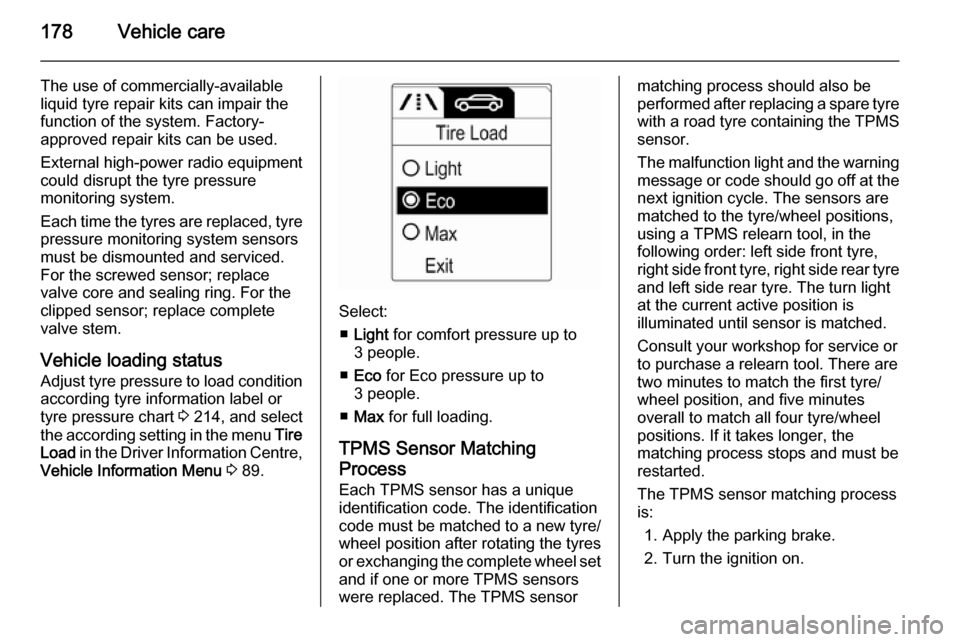
Vehicle loading status Adjust tyre pressure to load condition according tyre information label or
tyre pressure chart 3 214, and select
the according setting in the menu Tire
Load in the Driver Information Centre,
Vehicle Information Menu 3 89.
Select:
■ Light for comfort pressure up to
3 people.
■ Eco for Eco pressure up to
3 people.
■ Max for full loading.
TPMS Sensor Matching
Process
Each TPMS sensor has a unique
identification code. The identification
code must be matched to a new tyre/
wheel position after rotating the tyres
or exchanging the complete wheel set
and if one or more TPMS sensors
were replaced. The TPMS sensor
matching process should also be
performed after replacing a spare tyre with a road tyre containing the TPMS
sensor.
The malfunction light and the warning
message or code should go off at the
next ignition cycle. The sensors are
matched to the tyre/wheel positions,
using a TPMS relearn tool, in the
following order: left side front tyre,
right side front tyre, right side rear tyre and left side rear tyre. The turn light
at the current active position is
illuminated until sensor is matched.
Consult your workshop for service or
to purchase a relearn tool. There are
two minutes to match the first tyre/
wheel position, and five minutes
overall to match all four tyre/wheel
positions. If it takes longer, the
matching process stops and must be
restarted.
The TPMS sensor matching process is:
1. Apply the parking brake.
2. Turn the ignition on.
Page 181 of 225

Vehicle care179
3. Use the MENU button on the turn
signal lever to select the Vehicle
Information Menu in the Driver
Information Centre (DIC).
4. Turn the adjuster wheel to scroll to
the tyre pressure menu.
5. Press the SET/CLR button to
begin the sensor matching
process. A message requesting
acceptance of the process should
display.
6. Press the SET/CLR button again
to confirm the selection. The horn sounds twice to signal the
receiver is in relearn mode.
7. Start with the left side front tyre.
8. Place the relearn tool against the tyre sidewall, near the valve stem.Then press the button to activate
the TPMS sensor. A horn chirp
confirms that the sensor
identification code has been
matched to this tyre and wheel
position.
9. Proceed to the right side front tyre,
and repeat the procedure in
Step 8.10. Proceed to the right side rear tyre,
and repeat the procedure in
Step 8.
11. Proceed to the left side rear tyre, and repeat the procedure in
Step 8. The horn sounds twice to
indicate the sensor identification
code has been matched to the left
side rear tyre, and the TPMS
sensor matching process is no
longer active.
12. Turn off the ignition.
13. Set all four tyres to the recommended air pressure level
as indicated on the tyre pressure
label.
14. Ensure the tyre loading status is set according selected pressure
3 89.
Temperature dependency Tyre pressure depends on the
temperature of the tyre. During
driving tyre temperature and pressure increase.The tyre pressure value displayed in
the Driver Information Centre shows
the actual tyre pressure. Therefore it
is important to check tyre pressure
with cold tyres.
Tread depth
Check tread depth at regular
intervals.
Tyres should be replaced for safety
reasons at a tread depth of 2-3 mm
(4 mm for winter tyres).
For safety reasons it is recommended that the tread depth of the tyres on
one axle should not vary by more than
2 mm.
Page 184 of 225
182Vehicle care
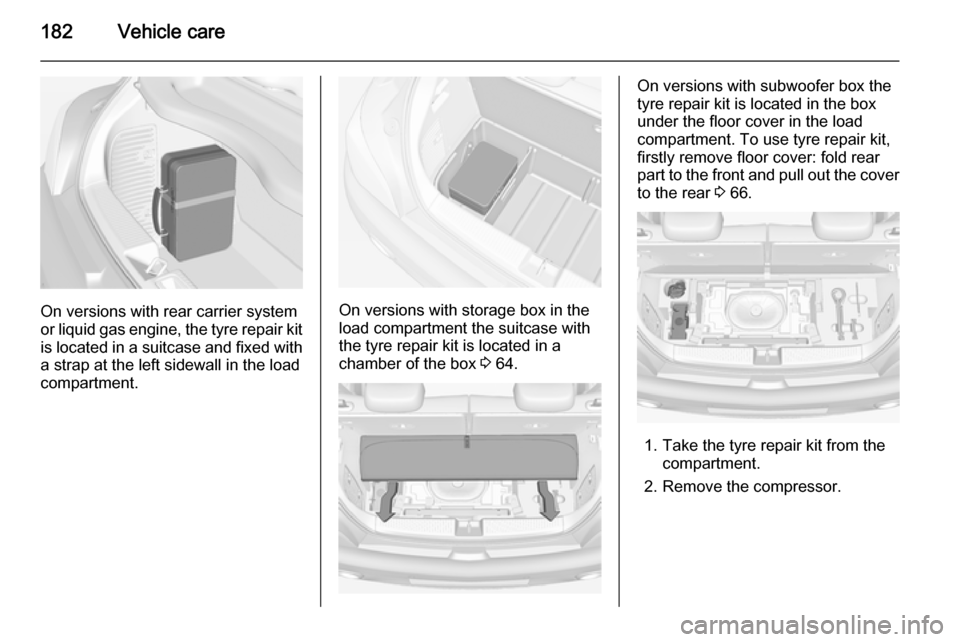
On versions with rear carrier system
or liquid gas engine, the tyre repair kit is located in a suitcase and fixed with a strap at the left sidewall in the load
compartment.On versions with storage box in the
load compartment the suitcase with
the tyre repair kit is located in a
chamber of the box 3 64.
On versions with subwoofer box the
tyre repair kit is located in the box
under the floor cover in the load
compartment. To use tyre repair kit,
firstly remove floor cover: fold rear
part to the front and pull out the cover to the rear 3 66.
1. Take the tyre repair kit from the
compartment.
2. Remove the compressor.
Page 186 of 225
184Vehicle care
12. All of the sealant is pumped intothe tyre. Then the tyre is inflated.
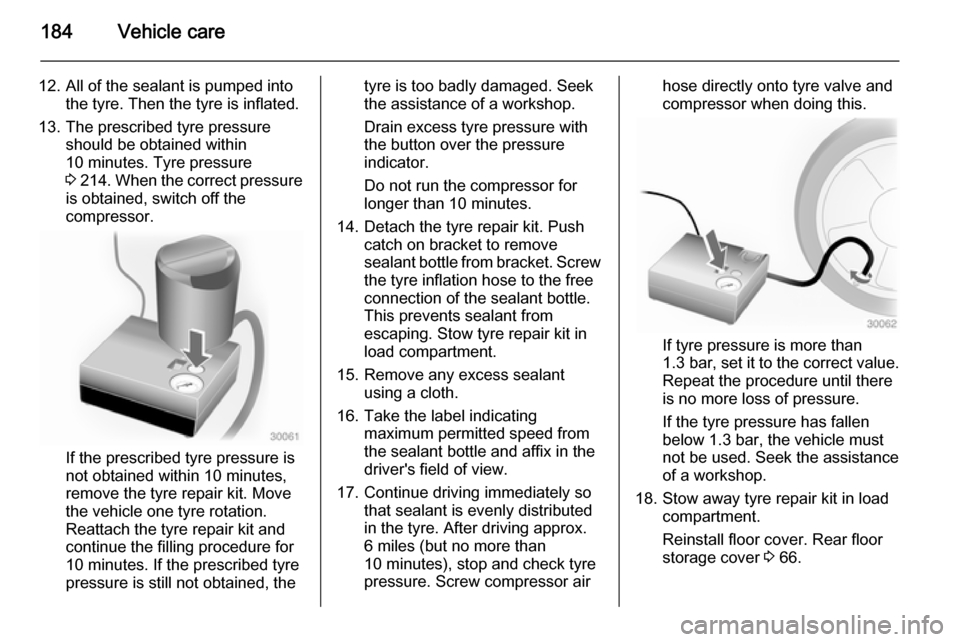
13. The prescribed tyre pressure should be obtained within
10 minutes. Tyre pressure
3 214 . When the correct pressure
is obtained, switch off the
compressor.
If the prescribed tyre pressure is
not obtained within 10 minutes,
remove the tyre repair kit. Move
the vehicle one tyre rotation.
Reattach the tyre repair kit and
continue the filling procedure for
10 minutes. If the prescribed tyre
pressure is still not obtained, the
tyre is too badly damaged. Seek
the assistance of a workshop.
Drain excess tyre pressure with
the button over the pressure indicator.
Do not run the compressor for
longer than 10 minutes.
14. Detach the tyre repair kit. Push catch on bracket to remove
sealant bottle from bracket. Screw
the tyre inflation hose to the free
connection of the sealant bottle.
This prevents sealant from
escaping. Stow tyre repair kit in
load compartment.
15. Remove any excess sealant using a cloth.
16. Take the label indicating maximum permitted speed from
the sealant bottle and affix in the
driver's field of view.
17. Continue driving immediately so that sealant is evenly distributedin the tyre. After driving approx.
6 miles (but no more than 10 minutes), stop and check tyre
pressure. Screw compressor airhose directly onto tyre valve and
compressor when doing this.
If tyre pressure is more than
1.3 bar , set it to the correct value.
Repeat the procedure until there
is no more loss of pressure.
If the tyre pressure has fallen
below 1.3 bar, the vehicle must
not be used. Seek the assistance
of a workshop.
18. Stow away tyre repair kit in load compartment.
Reinstall floor cover. Rear floor
storage cover 3 66.
Page 190 of 225
188Vehicle care
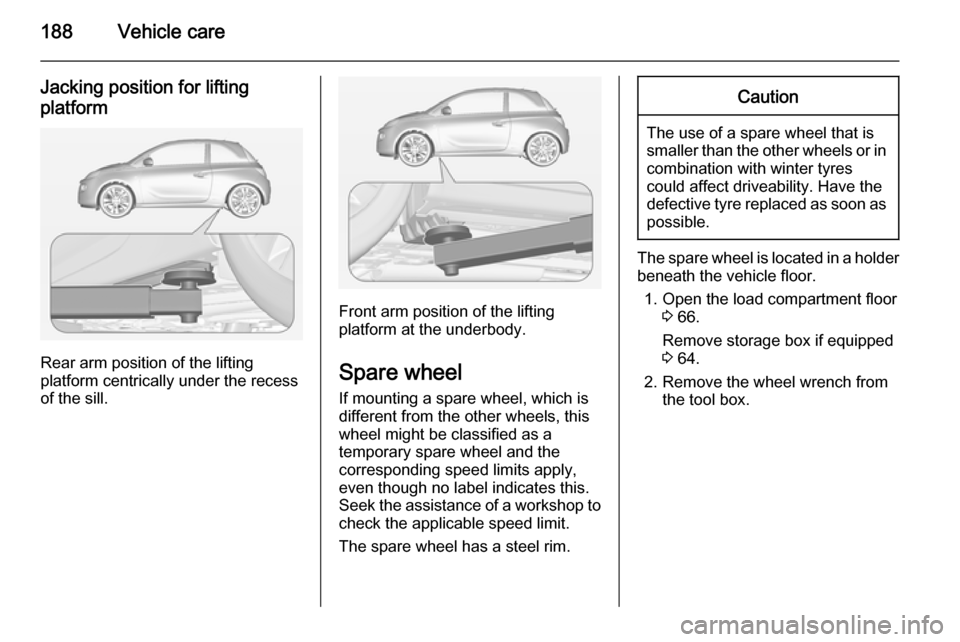
Jacking position for liftingplatform
Rear arm position of the lifting
platform centrically under the recess
of the sill.
Front arm position of the lifting
platform at the underbody.
Spare wheel If mounting a spare wheel, which is
different from the other wheels, this
wheel might be classified as a
temporary spare wheel and the
corresponding speed limits apply,
even though no label indicates this.
Seek the assistance of a workshop to
check the applicable speed limit.
The spare wheel has a steel rim.
Caution
The use of a spare wheel that is smaller than the other wheels or in combination with winter tyres
could affect driveability. Have the defective tyre replaced as soon as
possible.
The spare wheel is located in a holder
beneath the vehicle floor.
1. Open the load compartment floor 3 66.
Remove storage box if equipped
3 64.
2. Remove the wheel wrench from the tool box.