ESP VAUXHALL ASTRA J 2015.75 Owner's Guide
[x] Cancel search | Manufacturer: VAUXHALL, Model Year: 2015.75, Model line: ASTRA J, Model: VAUXHALL ASTRA J 2015.75Pages: 337, PDF Size: 10.17 MB
Page 200 of 337

198Driving and operating
Deactivation
The rear parking assist automatically
switches off when reverse gear is
disengaged.
The front parking assist is deactivated
automatically at a speed above
7 mph.
Manual deactivation is possible by
pressing r or D briefly.
When the system is deactivated, the
LED in the button extinguishes.
Additionally, Park Assist Off pops-up
in the DIC when the system is
deactivated manually.
After a manual deactivation, the front
parking assist is activated again if
r or D is pressed or if reverse
gear is engaged.
Fault In the event of a fault in the system orif the system does not work due to
temporary conditions, e.g. ice
covered sensors, control indicator
r illuminates or a message is
displayed in the DIC.
Vehicle messages 3 125.
Control indicator r 3 115.
Advanced parking assist9 Warning
The driver bears full responsibility
for accepting the parking slot
suggested by the system and the
parking manoeuvre.
Always check the surrounding
area in all directions when using
advanced parking assist.
The advanced parking assist system manoeuvres the driver into a parkingslot by giving instructions in the DIC
and acoustic signals. The driver must
control acceleration, braking, steering and gear shifting.
The system uses the sensors of the
front-rear parking assist in
combination with two additional
sensors on both sides of the front and rear bumper.
Page 204 of 337

202Driving and operatingcorrect distance indication in the
upper part of these vehicles
cannot be guaranteed.
Objects with a very small reflection
cross-section, e.g. objects of
narrow size or soft materials, may
not be detected by the system.
Parking assist systems do not
detect objects outside the
detection range.
Notice
The parking assist system can be
activated and deactivated by
changing the settings in the
Info-Display. If a trailer coupling is
attached, it must be selected in the
menu.
Vehicle personalisation 3 131.
Notice
The parking assist system
automatically detects factory-fitted
towing equipment. It is deactivated
when the connector is plugged in.
It is possible that the sensor detects
a non-existing object (echo
disturbance) caused by external acoustical or mechanic
disturbances.
Advanced parking assist system
may not respond to changes in the
parking space after initiating a
parallel parking manoeuvre.
Notice
If engaging a forward gear and
exceeding a certain speed, the rear
parking assist will be deactivated
when the rear carrier system is
extended.
If engaging reverse at first, the
parking assist will detect the rear
carrier system and provide a buzzing
sound. Press r or D briefly to
deactivate the parking assist.
Notice
After use the advanced parking
assist requires a calibration. For
optimal parking guidance, a driving distance of at least 22 miles,
including a number of bends, is
required.Side blind spot alert
The Side blind spot alert system
detects and reports objects on either
side of the vehicle, within a specified
"blind spot" zone. The system alerts
visually in each exterior mirror, when
detecting objects that may not be
visible in the interior and exterior
mirrors.
The system's sensors are located in
the bumper on the left and right side
of the vehicle.9 Warning
Side blind spot alert does not
replace driver vision.
The system does not detect: ■ vehicles outside the side blind zones which may be rapidly
approaching
■ pedestrians, cyclists or animals
Before changing a lane, always
check all mirrors, look over the
shoulder and use the turn signal.
Page 211 of 337
Driving and operating209
■ There are adverse environmentalconditions, e.g. heavy rain, snow,
direct sunlight or shadows. In this
case No Traffic Sign Detection due
to Weather is indicated on the
display.
■ Traffic signs are incorrectly mounted or damaged.
■ Traffic signs do not comply with the
Vienna Convention on traffic signs
(Wiener Übereinkommen über
Straßenverkehrszeichen).Caution
The system is intended to help the driver within a defined speed
range to discern certain traffic
signs. Do not ignore traffic signs
which are not displayed by the
system.
The system does not discern any other than the conventional traffic
signs that might give or end a
speed limit.
Do not let this special feature
tempt you into taking risks when
driving.
Always adapt speed to the road
conditions.
The driver assistance systems do not relieve the driver from full
responsibility for vehicle
operation.
Lane departure warning
The lane departure warning systemobserves the lane markings between
which the vehicle is driving via a front camera. The system detects lane
changes and warns the driver in the
event of an unintended lane change
via visual and acoustic signals.
Criteria for the detection of an
unintended lane change are:
■ No operation of turn signals.
■ No brake pedal operation.
■ No active accelerator operation or speeding-up.
■ No active steering.
If the driver is active, no warning will
be issued.
Activation
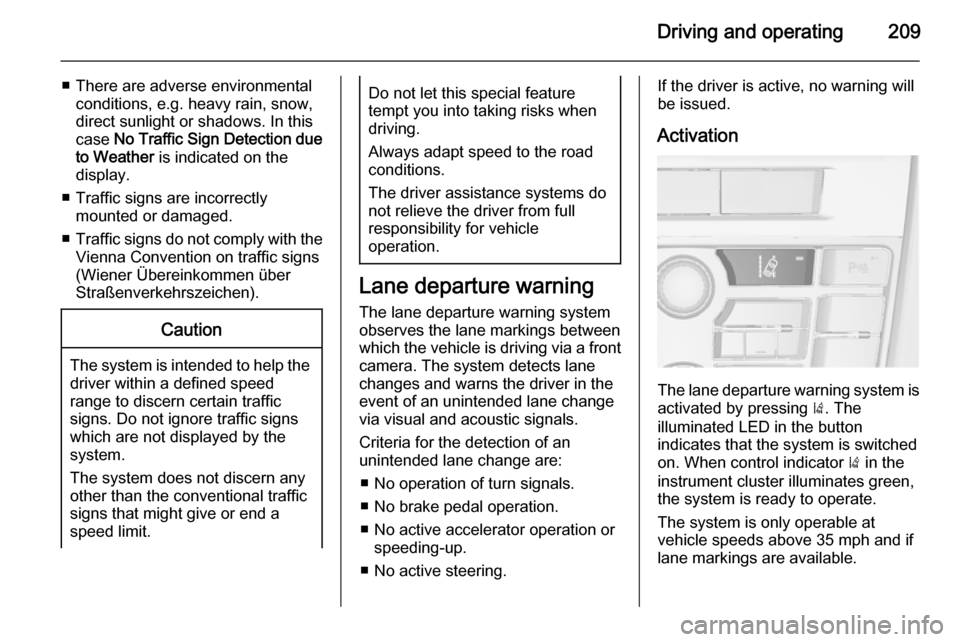
The lane departure warning system is activated by pressing ). The
illuminated LED in the button
indicates that the system is switched
on. When control indicator ) in the
instrument cluster illuminates green, the system is ready to operate.
The system is only operable at
vehicle speeds above 35 mph and if
lane markings are available.
Page 220 of 337
218Driving and operatingTrailer towingTrailer loads
The permissible trailer loads are
vehicle and engine-dependent
maximum values which must not be
exceeded. The actual trailer load is
the difference between the actual
gross weight of the trailer and the
actual coupling socket load with the
trailer coupled.
The permissible trailer loads are
specified in the vehicle documents. In
general, they are valid for gradients
up to max. 12 %.
The permitted trailer load applies up
to the specified incline and up to an
altitude of 1000 metres above sea
level. Since engine power decreases
as altitude increases due to the air
becoming thinner, therefore reducing
climbing ability, the permissible gross train weight also decreases by 10 %
for every 1000 metres of additional
altitude. The gross train weight does
not have to be reduced when driving
on roads with slight inclines (less than
8 %, e.g. motorways).The permissible gross train weight
must not be exceeded. This weight is
specified on the identification plate
3 287.
Vertical coupling load
The vertical coupling load is the load
exerted by the trailer on the coupling
ball. It can be varied by changing the
weight distribution when loading the
trailer.
The maximum permissible vertical
coupling load (75 kg) is specified on
the towing equipment identification
plate and in the vehicle documents.
Always aim for the maximum load,
especially in the case of heavy
trailers. The vertical coupling load
should never fall below 25 kg.Rear axle load
When the trailer is coupled and the
towing vehicle fully loaded, the
permissible rear axle load (see
identification plate or vehicle
documents) may be exceeded by
60 kg , the gross vehicle weight rating
may be exceeded by 60 kg. If the
permissible rear axle load is
exceeded, a maximum speed of
60 mph applies.
Towing equipmentCaution
When operating without a trailer,
remove the coupling ball bar.
Page 228 of 337
226Vehicle care
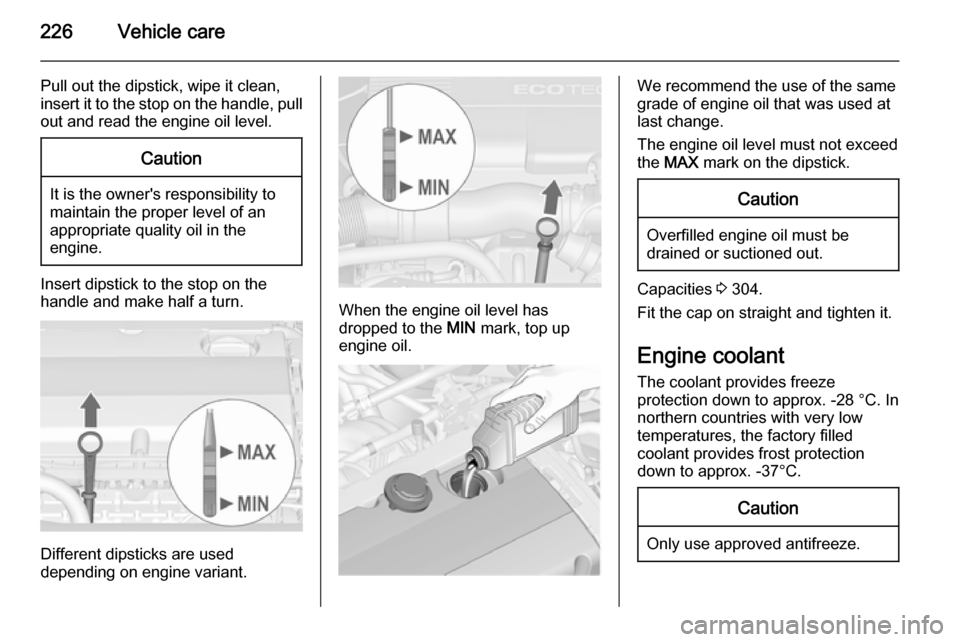
Pull out the dipstick, wipe it clean,insert it to the stop on the handle, pull
out and read the engine oil level.Caution
It is the owner's responsibility to
maintain the proper level of an
appropriate quality oil in the
engine.
Insert dipstick to the stop on the
handle and make half a turn.
Different dipsticks are used
depending on engine variant.
When the engine oil level has
dropped to the MIN mark, top up
engine oil.
We recommend the use of the same
grade of engine oil that was used at
last change.
The engine oil level must not exceed
the MAX mark on the dipstick.Caution
Overfilled engine oil must be
drained or suctioned out.
Capacities 3 304.
Fit the cap on straight and tighten it.
Engine coolant The coolant provides freeze
protection down to approx. -28 °C. In
northern countries with very low
temperatures, the factory filled
coolant provides frost protection
down to approx. -37°C.
Caution
Only use approved antifreeze.
Page 243 of 337
Vehicle care241Tail lights5-door hatchback
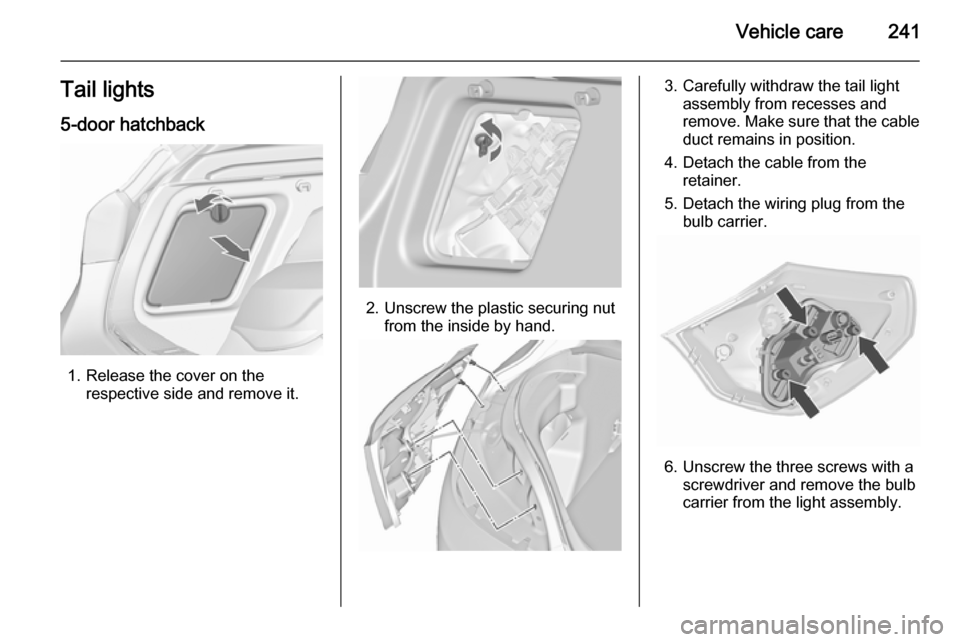
1. Release the cover on the respective side and remove it.
2. Unscrew the plastic securing nutfrom the inside by hand.
3. Carefully withdraw the tail lightassembly from recesses and
remove. Make sure that the cable duct remains in position.
4. Detach the cable from the retainer.
5. Detach the wiring plug from the bulb carrier.
6. Unscrew the three screws with a screwdriver and remove the bulb
carrier from the light assembly.
Page 244 of 337
242Vehicle care
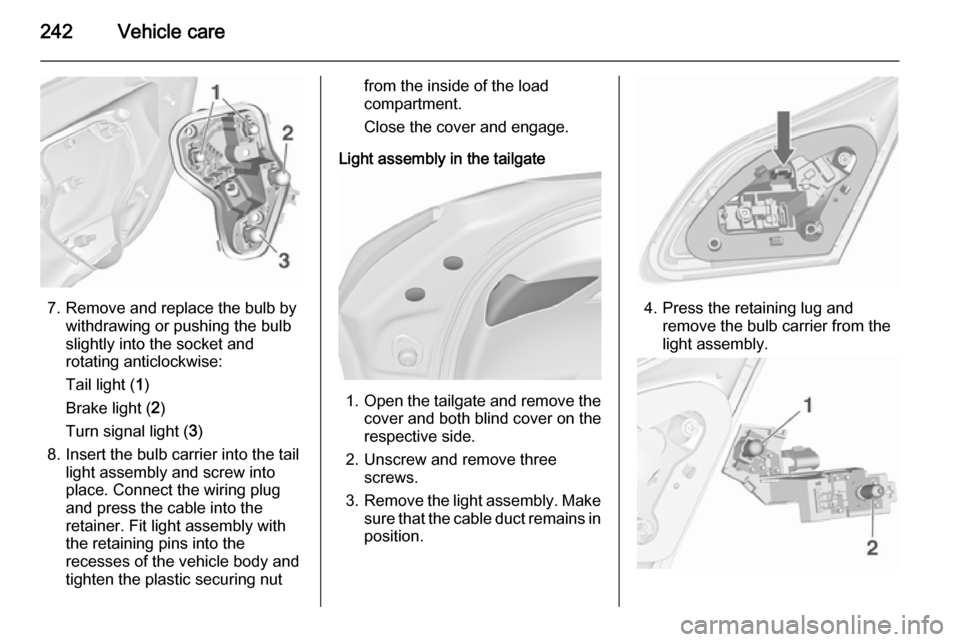
7. Remove and replace the bulb bywithdrawing or pushing the bulb
slightly into the socket and rotating anticlockwise:
Tail light ( 1)
Brake light ( 2)
Turn signal light ( 3)
8. Insert the bulb carrier into the tail light assembly and screw into
place. Connect the wiring plug
and press the cable into the
retainer. Fit light assembly with
the retaining pins into the
recesses of the vehicle body and
tighten the plastic securing nut
from the inside of the load
compartment.
Close the cover and engage.
Light assembly in the tailgate
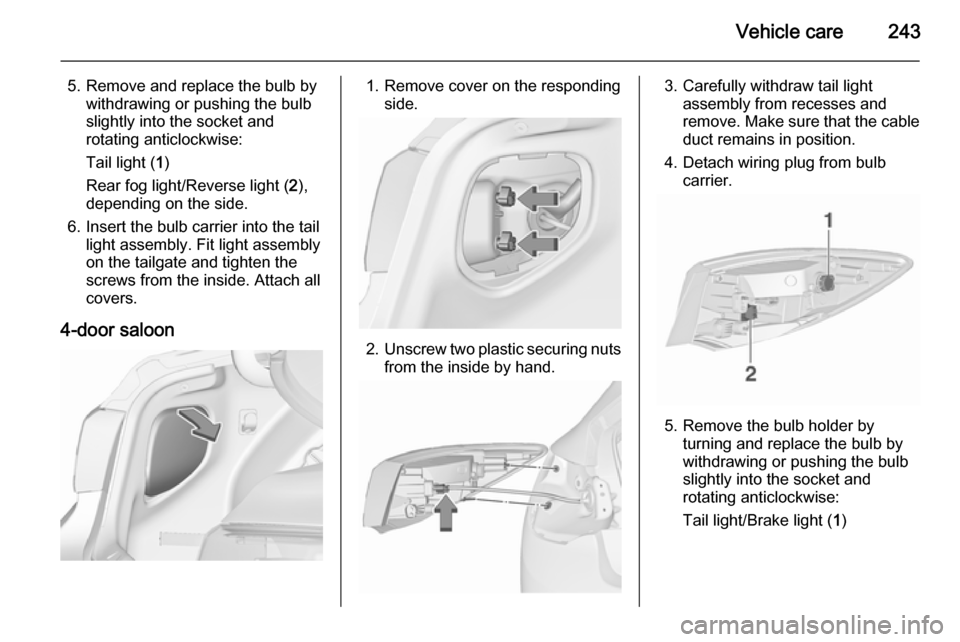
1. Open the tailgate and remove the
cover and both blind cover on the
respective side.
2. Unscrew and remove three screws.
3. Remove the light assembly. Make
sure that the cable duct remains in
position.
4. Press the retaining lug and remove the bulb carrier from the
light assembly.
Page 245 of 337
Vehicle care243
5. Remove and replace the bulb bywithdrawing or pushing the bulb
slightly into the socket and
rotating anticlockwise:
Tail light ( 1)
Rear fog light/Reverse light ( 2),
depending on the side.
6. Insert the bulb carrier into the tail light assembly. Fit light assembly
on the tailgate and tighten the
screws from the inside. Attach all
covers.
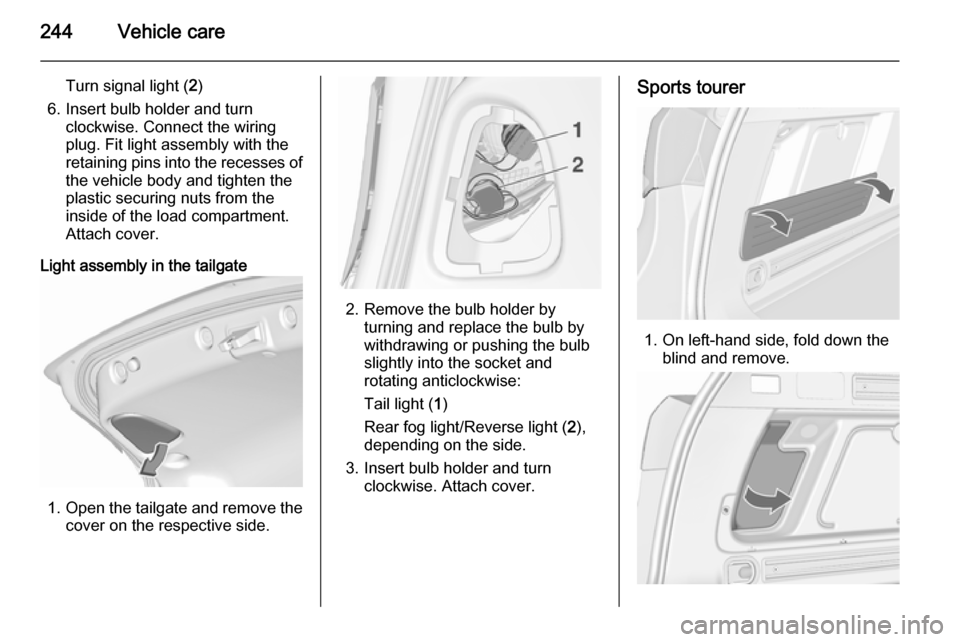
4-door saloon1. Remove cover on the responding side.
2.Unscrew two plastic securing nuts
from the inside by hand.
3. Carefully withdraw tail light assembly from recesses and
remove. Make sure that the cable duct remains in position.
4. Detach wiring plug from bulb carrier.
5. Remove the bulb holder by turning and replace the bulb by
withdrawing or pushing the bulb
slightly into the socket and rotating anticlockwise:
Tail light/Brake light ( 1)
Page 246 of 337
244Vehicle care
Turn signal light (2)
6. Insert bulb holder and turn clockwise. Connect the wiring
plug. Fit light assembly with the
retaining pins into the recesses of
the vehicle body and tighten the
plastic securing nuts from the
inside of the load compartment.
Attach cover.
Light assembly in the tailgate
1. Open the tailgate and remove the
cover on the respective side.
2. Remove the bulb holder by turning and replace the bulb by
withdrawing or pushing the bulb
slightly into the socket and
rotating anticlockwise:
Tail light ( 1)
Rear fog light/Reverse light ( 2),
depending on the side.
3. Insert bulb holder and turn clockwise. Attach cover.
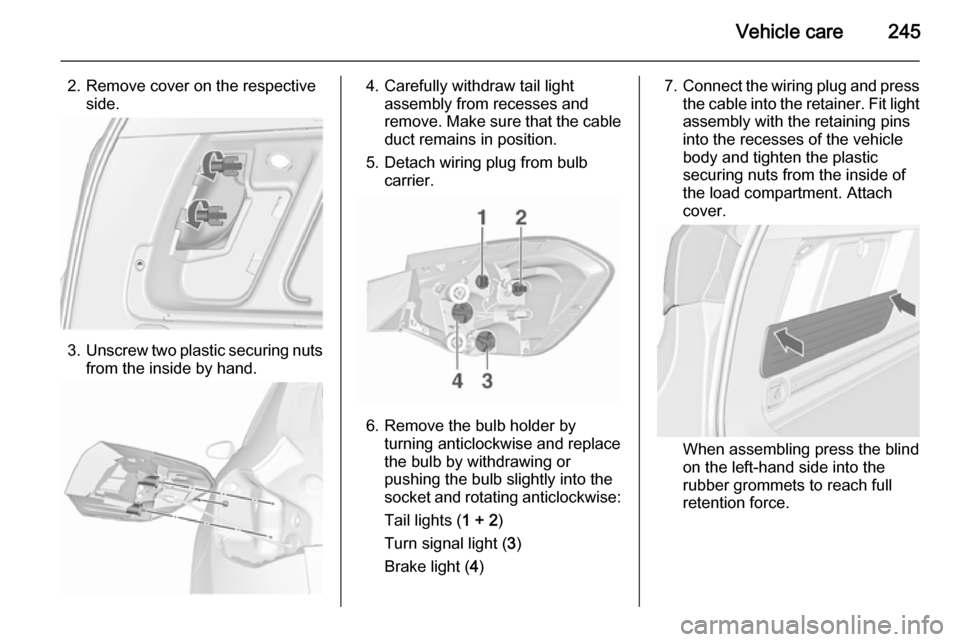
Sports tourer
1. On left-hand side, fold down the blind and remove.
Page 247 of 337
Vehicle care245
2. Remove cover on the respectiveside.
3. Unscrew two plastic securing nuts
from the inside by hand.
4. Carefully withdraw tail light assembly from recesses and
remove. Make sure that the cable duct remains in position.
5. Detach wiring plug from bulb carrier.
6. Remove the bulb holder by turning anticlockwise and replace
the bulb by withdrawing or
pushing the bulb slightly into the
socket and rotating anticlockwise:
Tail lights ( 1 + 2)
Turn signal light ( 3)
Brake light ( 4)
7. Connect the wiring plug and press
the cable into the retainer. Fit light assembly with the retaining pins
into the recesses of the vehicle
body and tighten the plastic
securing nuts from the inside of
the load compartment. Attach
cover.
When assembling press the blind
on the left-hand side into the
rubber grommets to reach full
retention force.