warning VAUXHALL CASCADA 2015.5 User Guide
[x] Cancel search | Manufacturer: VAUXHALL, Model Year: 2015.5, Model line: CASCADA, Model: VAUXHALL CASCADA 2015.5Pages: 255, PDF Size: 7.56 MB
Page 35 of 255
Keys, doors and windows33
Override safety function
In the event of closing difficulties due
to frost or the like, switch on the
ignition, then pull the switch to the first
detent and hold. The window moves
up with safety function disabled. To
stop movement, release the switch.
Comfort operating with the
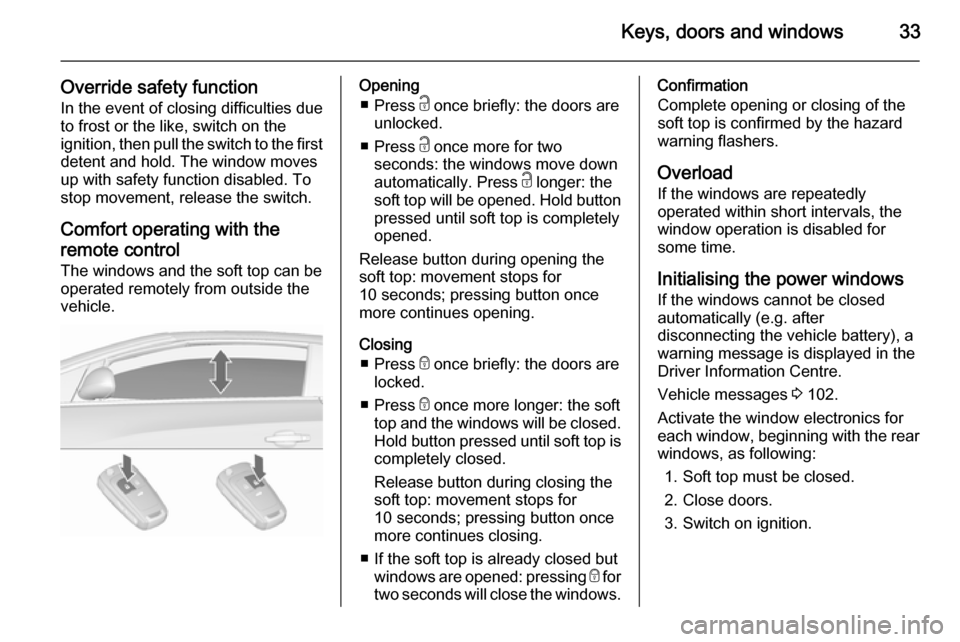
remote control The windows and the soft top can be
operated remotely from outside the
vehicle.Opening
■ Press c once briefly: the doors are
unlocked.
■ Press c once more for two
seconds: the windows move down
automatically. Press c longer: the
soft top will be opened. Hold button
pressed until soft top is completely
opened.
Release button during opening the
soft top: movement stops for
10 seconds; pressing button once
more continues opening.
Closing ■ Press e once briefly: the doors are
locked.
■ Press e once more longer: the soft
top and the windows will be closed.
Hold button pressed until soft top is completely closed.
Release button during closing the
soft top: movement stops for
10 seconds; pressing button once
more continues closing.
■ If the soft top is already closed but windows are opened: pressing e for
two seconds will close the windows.Confirmation
Complete opening or closing of the
soft top is confirmed by the hazard
warning flashers.
Overload If the windows are repeatedly
operated within short intervals, the
window operation is disabled for
some time.
Initialising the power windowsIf the windows cannot be closed
automatically (e.g. after
disconnecting the vehicle battery), a
warning message is displayed in the
Driver Information Centre.
Vehicle messages 3 102.
Activate the window electronics for
each window, beginning with the rear
windows, as following:
1. Soft top must be closed.
2. Close doors.
3. Switch on ignition.
Page 36 of 255

34Keys, doors and windows
4. Pull switch to the second detentuntil the window starts to close,
and hold pulled for an additional
4 seconds.
5. Push switch to the second detent until the window starts to open
automatically.
6. Repeat for each window.
Heated rear window
Operated by pressing the Ü button.
The LED in the button indicates
activation.
Heating works with the engine
running and is switched off
automatically after a short time.
Heated rear window is deactivated
when the soft top is opened.
Sun visors The sun visors can be folded down orswivelled to the side to prevent
dazzling.
If the sun visors have integral mirrors, the mirror covers should be closed
when driving.
A ticket holder is located on the
backside of the sun visor.Roof
Soft top9 Warning
Take care when operating the soft
top. Risk of injury. Monitor the
action zone above, to the side and to the rear of the vehicle during
operation.
Make sure that no body parts or
objects could get pinched. Make
sure that people stay clear of the
action zone of the soft top or soft
top lid. Risk of injury.
Check the height, length and width of the available space before
operating the soft top, e.g. in a
garage, parking garage or when a
bicycle rack is fitted.
Vehicle passengers should be
informed accordingly.
Before leaving the vehicle, remove the ignition key in order to prevent
unauthorised operation of the
windows and the soft top.
Page 38 of 255

36Keys, doors and windows
Close soft top
Hold e pressed until the soft top, the
soft top lid and the windows are
completely closed. All windows will be opened at first during this operation.
Confirmation of operation
Complete opening or closing of the
soft top with the remote control is
confirmed by the hazard warning
flashers.
Safety stop
The button on the remote control or
the switch in the centre console must
be actuated until the soft top is in its
respective end position. Releasing
the button or the switch during
operation stops soft top movement
immediately. The soft top remains in
intermediate position only for a
certain time. After this time a warning chime sounds, the hydraulic pressure
in the system decreases and the soft
top can start to move by itself.
Actuating button or switch once more
continues operation.
Requirements for operation ■ Vehicle is stationary or driving with a speed up to 31 mph.
■ Load compartment partition isfolded out, pass-through flap isclosed 3 72.
■ Soft top lid is engaged in closed position.
■ Boot lid is completely closed.
■ Outside temperature is not lower than -7 °C for opening and -10 °C
for closing.
■ Vehicle battery voltage is sufficient.
■ The system is not overloaded by repeated operation (max. 5
complete cycles in succession).
Page 39 of 255

Keys, doors and windows37
If any of these requirements are not
fulfilled, a warning chime sounds
and a message appears in the
Driver Information Centre (DIC)
when the switch is actuated and the soft top will not open or close.
■ There must be no objects in front of
the rear window or in the pivot area of the soft top and the soft top lid.
If the automatic drive is not
operational when the soft top is open,
execute a manual closing process,
see the following instructions in
"Manual closing in the event of a
system fault".
General hints
Notice■ Always actuate the operation switch until the acoustic signal
sounds or the hazard warning
flashers illuminate, to ensure that
the soft top is completely opened
or closed.
■ The soft top can be held in an intermediate position to facilitate
cleaning of hood spaces and
gaskets. Release the switch in the
centre console during operation to
stop soft top movement in
intermediate position for a
maximum of 7 minutes when
ignition is on. After this time a warning chime sounds, the
hydraulic pressure in the system
decreases and the soft top can
start to move by itself.
■ Do not open the soft top if it is wet,
frozen or dirty.
■ Activating the soft top on uneven ground can lead to malfunctions
and damage.
■ Vehicle care 3 225.Manual closing in the event of a
system fault In case of malfunction of the electro-
hydraulic actuation, the opened soft
top can be closed manually.
A warning chime sounds and a
message appears in the DIC.
Page 46 of 255

44Keys, doors and windowsRollover protection system
The rollover protection system
consists of a reinforced windscreen
frame and anti-roll bars under covers
behind the rear head restraints.
In the event of a vehicle rollover,
head-on collision or side impact, the
anti-roll bars deploy upwards
automatically within milliseconds.
They also deploy together with the
front and side airbag systems.
Notice
Do not place any objects on the
covers of the anti-roll bars behind
the head restraints.
The airbag control indicator v
illuminates if the anti-roll bars have
been deployed.
The system deploys with the soft top
opened or closed.
The soft top must not be operated if
the anti-roll bars have been deployed.
A continuous warning will sound and
a message appears in the Driver
Information Centre if the switch is
actuated.
Page 47 of 255
Seats, restraints45Seats, restraintsHead restraints............................ 45
Front seats ................................... 47
Seat belts ..................................... 54
Airbag system .............................. 57
Child restraints ............................. 63Head restraints
Position9 Warning
Only drive with the head restraint
set to the proper position.
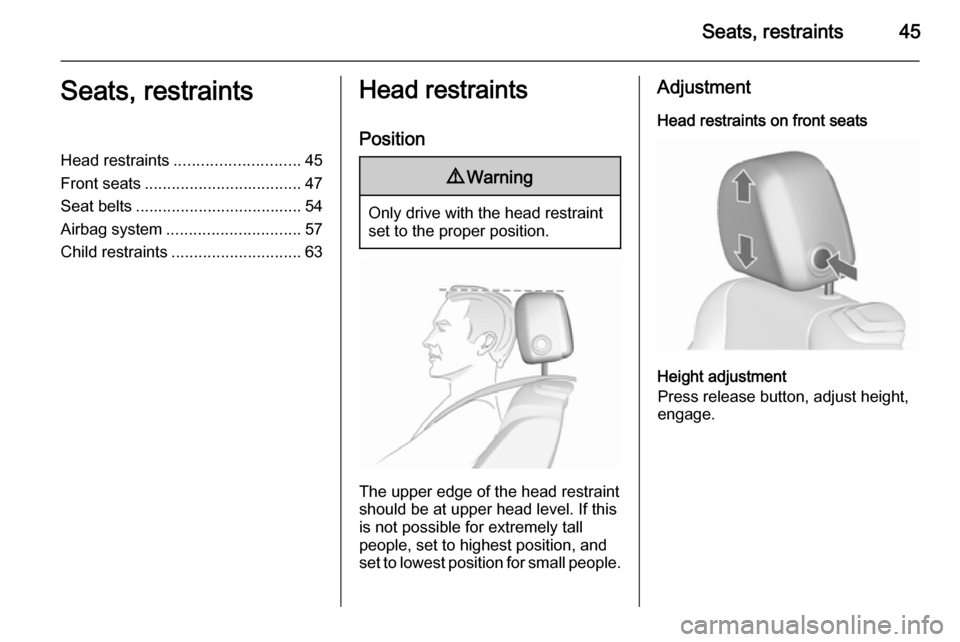
The upper edge of the head restraint
should be at upper head level. If this
is not possible for extremely tall
people, set to highest position, and
set to lowest position for small people.
Adjustment
Head restraints on front seats
Height adjustment
Press release button, adjust height,
engage.
Page 49 of 255
Seats, restraints47
Notice
Approved accessories may only be
attached if the seat is not in use.Front seats
Seat position9 Warning
Only drive with the seat correctly
adjusted.
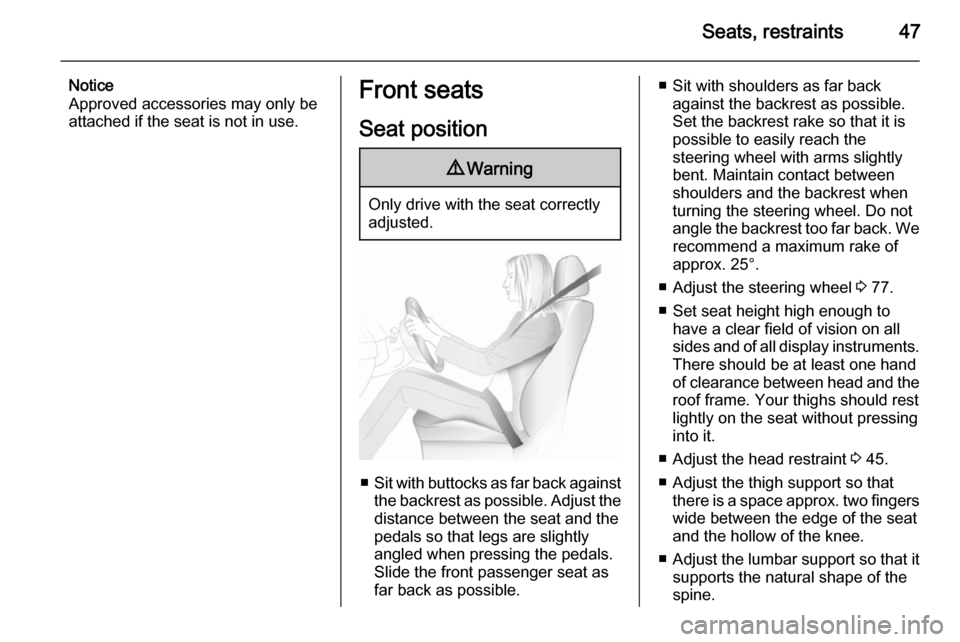
■ Sit with buttocks as far back against
the backrest as possible. Adjust the distance between the seat and the
pedals so that legs are slightly
angled when pressing the pedals.
Slide the front passenger seat as
far back as possible.
■ Sit with shoulders as far back against the backrest as possible.
Set the backrest rake so that it is possible to easily reach the
steering wheel with arms slightly bent. Maintain contact between
shoulders and the backrest when
turning the steering wheel. Do not
angle the backrest too far back. We recommend a maximum rake of
approx. 25°.
■ Adjust the steering wheel 3 77.
■ Set seat height high enough to have a clear field of vision on allsides and of all display instruments.
There should be at least one hand
of clearance between head and the
roof frame. Your thighs should rest
lightly on the seat without pressing
into it.
■ Adjust the head restraint 3 45.
■ Adjust the thigh support so that there is a space approx. two fingers
wide between the edge of the seat
and the hollow of the knee.
■ Adjust the lumbar support so that it
supports the natural shape of the
spine.
Page 50 of 255

48Seats, restraintsSeat adjustment9Danger
Do not sit nearer than 25 cm from
the steering wheel, to permit safe
airbag deployment.
9 Warning
Never adjust seats while driving as
they could move uncontrollably.
Drive only with engaged seats and
backrests.
Seat lengthwise adjustment
Pull handle, slide seat, release
handle. Try to move the seat back and forth to ensure that the seat is locked
in place.
Seat backrest
Turn lever to the rear, adjust
inclination and release lever. Allow
the backrest to engage audibly.
Page 52 of 255

50Seats, restraints
Adjustable thigh support
Pull the lever and slide the thigh
support.
Seat folding
9 Warning
Passengers on rear seats should
take care not to be trapped by the
adjustment mechanism when the
seat moves back to its original
position.
Caution
When seat height is in highest
position, push head restraints
down and lift up sun visors before
folding backrest forwards.
Seat folding on manual
operated seats
Lift release lever and fold backrest
forwards, then slide seat forwards to
the stop.
To restore, slide the seat backwards
to the stop. Lift backrest to upright
position without operating any lever.
Ensure backrest engages.9 Warning
When folding up, ensure that the
seat is securely locked in position
before driving. Failure to do so
may result in personal injury in the event of heavy braking or collision.
When fully engaged the seat will be in
original position again.
Do not operate backrest inclination
lever while backrest is folded forward.
Page 53 of 255
Seats, restraints51
Seat folding on power seats
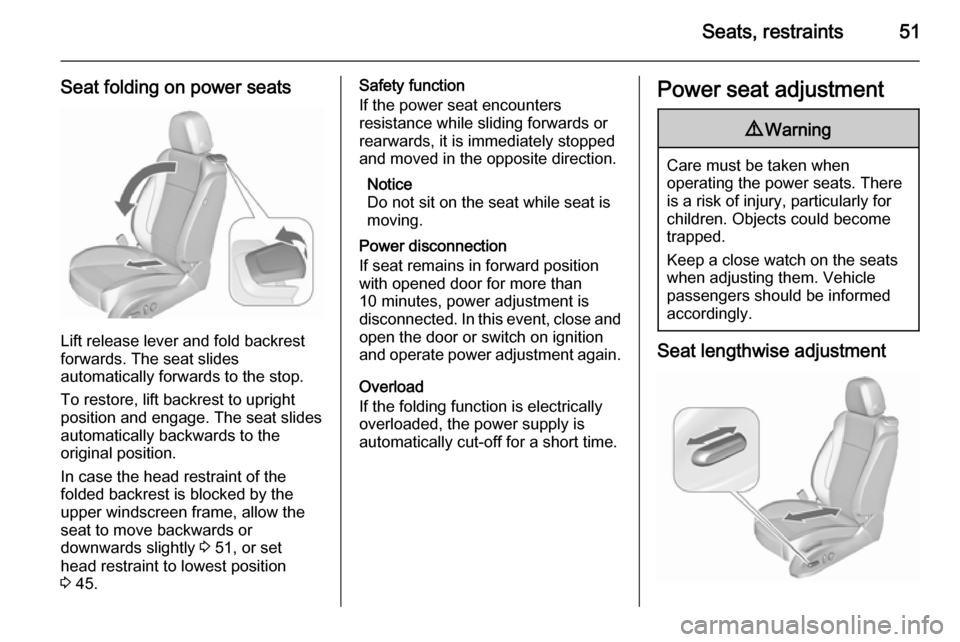
Lift release lever and fold backrest
forwards. The seat slides
automatically forwards to the stop.
To restore, lift backrest to upright
position and engage. The seat slides
automatically backwards to the
original position.
In case the head restraint of the
folded backrest is blocked by the
upper windscreen frame, allow the
seat to move backwards or
downwards slightly 3 51, or set
head restraint to lowest position
3 45.
Safety function
If the power seat encounters
resistance while sliding forwards or
rearwards, it is immediately stopped
and moved in the opposite direction.
Notice
Do not sit on the seat while seat is
moving.
Power disconnection
If seat remains in forward position
with opened door for more than
10 minutes, power adjustment is
disconnected. In this event, close and
open the door or switch on ignition
and operate power adjustment again.
Overload
If the folding function is electrically
overloaded, the power supply is
automatically cut-off for a short time.Power seat adjustment9 Warning
Care must be taken when
operating the power seats. There
is a risk of injury, particularly for
children. Objects could become
trapped.
Keep a close watch on the seats
when adjusting them. Vehicle
passengers should be informed
accordingly.
Seat lengthwise adjustment