display VAUXHALL MOVANO_B 2016 Owner's Guide
[x] Cancel search | Manufacturer: VAUXHALL, Model Year: 2016, Model line: MOVANO_B, Model: VAUXHALL MOVANO_B 2016Pages: 233
Page 109 of 233
Climate control107If no cooling or drying is required
press AC OFF to switch the cooling
system off, thus saving fuel.
" AC OFF " appears in the display.
Manual air recirculation mode Press u. LED illuminates and u
appears in the display.9 Warning
The exchange of fresh air is
reduced in air recirculation mode.
In operation without cooling the air humidity increases, so the
windows may mist up. The quality
of the passenger compartment air
deteriorates, which may cause the vehicle occupants to feel drowsy.
To return to automatic mode: press
u or AUTO .
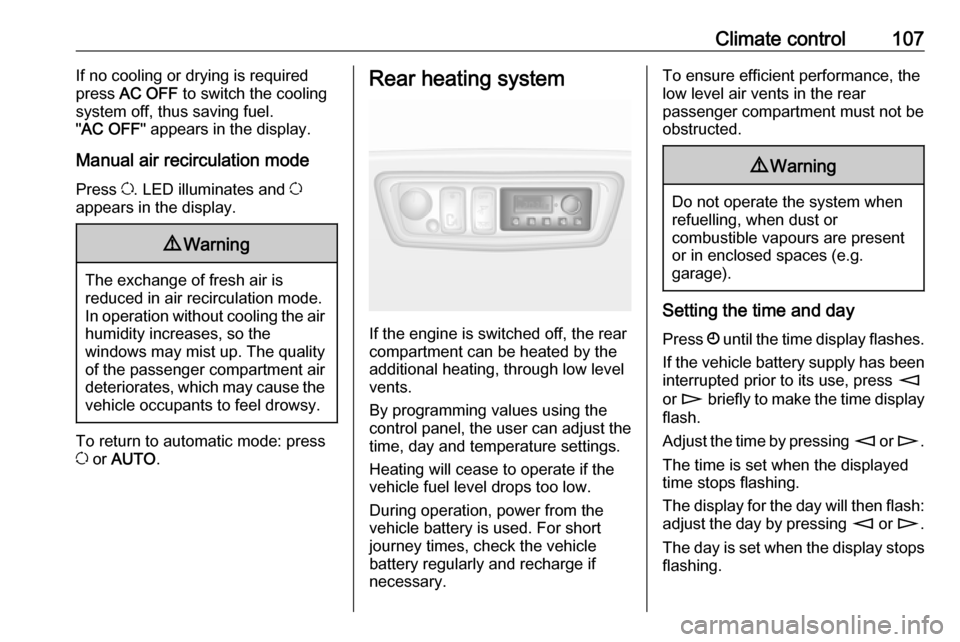
Rear heating system
If the engine is switched off, the rear
compartment can be heated by the
additional heating, through low level
vents.
By programming values using the
control panel, the user can adjust the
time, day and temperature settings.
Heating will cease to operate if the
vehicle fuel level drops too low.
During operation, power from the
vehicle battery is used. For short
journey times, check the vehicle
battery regularly and recharge if
necessary.
To ensure efficient performance, the
low level air vents in the rear
passenger compartment must not be
obstructed.9 Warning
Do not operate the system when
refuelling, when dust or
combustible vapours are present
or in enclosed spaces (e.g.
garage).
Setting the time and day
Press Ö until the time display flashes.
If the vehicle battery supply has been
interrupted prior to its use, press m
or n briefly to make the time display
flash.
Adjust the time by pressing m or n .
The time is set when the displayed
time stops flashing.
The display for the day will then flash: adjust the day by pressing m or n .
The day is set when the display stops
flashing.
Page 110 of 233
108Climate controlThe display will remain illuminated forapprox. 15 seconds after the ignition
is switched off.
Operating the rear compartment
additional heating
Press Y to operate heating. Y will
appear in the display to indicate that
the heating is operating.
Changing the period for which
heating is operating
With the heating switched off ( Y
extinguished in display), press m for
approx. 3 seconds until the time
period for which heating is provided
flashes in the display.
Press m or n to adjust the heating
duration. The duration is set when the
display extinguishes.
Programming the heating mode
It is possible to store up to three
programmes which allow the heating
to be switched on.
Press P the appropriate number of
times to select the desired stored programme.Press m or n briefly; the
programming time flashes in the
display.
Press m or n to adjust to the
desired time, then, as soon as the
time display stops flashing, adjust the day by pressing m or n .
The time and day are set when the
display stops flashing and the clock is displayed.
Recalling a programming mode
To activate a stored programme,
press P the appropriate number of
times until the corresponding number appears on the display.
Neutral position or no stored
programme activated
Press P until there is no stored
programme number visible in the
display.
Adjusting the temperature To adjust the temperature of the
heating, turn the rotary knob located
on the control panel.turn clockwise:increase
temperatureturn anti-clock‐
wise:decrease
temperature
Rear air conditioning
system
The rear air conditioning system is
actuated in conjunction with the front
passenger compartment air
conditioning system.
Bus
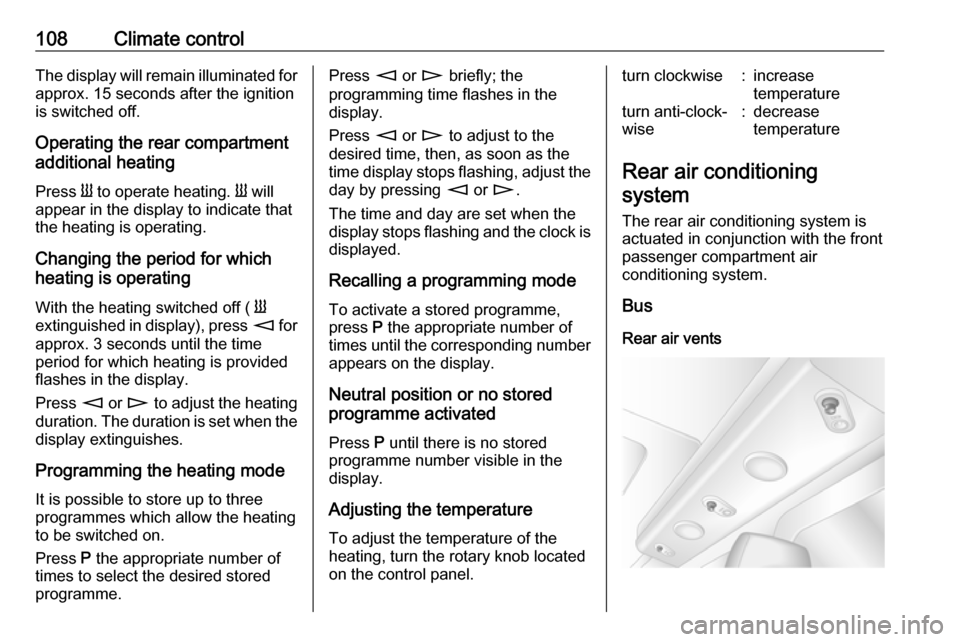
Rear air vents
Page 112 of 233
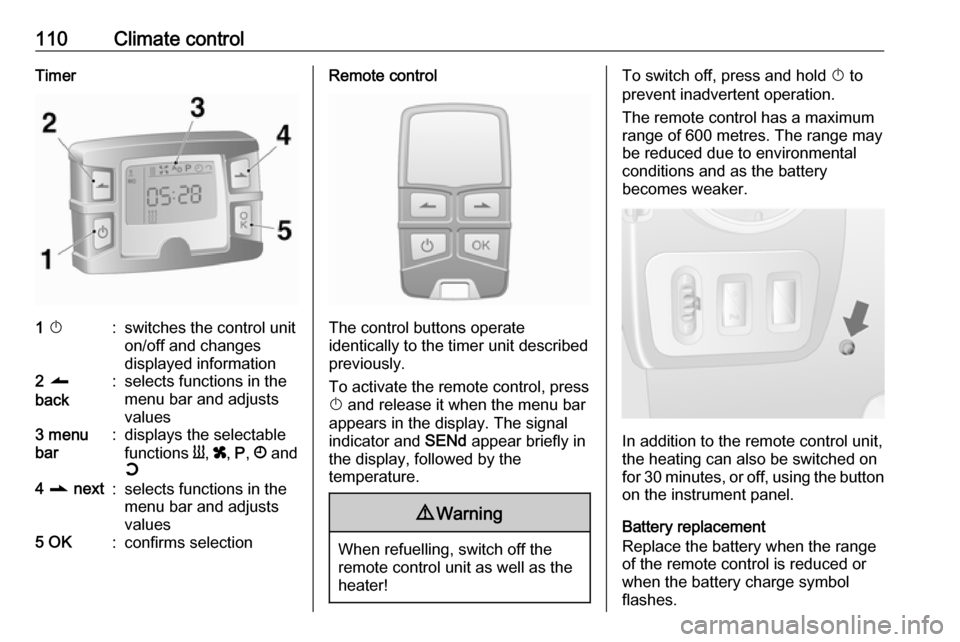
110Climate controlTimer1 X:switches the control unit
on/off and changes
displayed information2 q
back:selects functions in the
menu bar and adjusts
values3 menu
bar:displays the selectable
functions Y, x , P , Ö and
Y4 r next:selects functions in the
menu bar and adjusts
values5 OK:confirms selectionRemote control
The control buttons operate
identically to the timer unit described
previously.
To activate the remote control, press X and release it when the menu bar
appears in the display. The signal
indicator and SENd appear briefly in
the display, followed by the
temperature.
9 Warning
When refuelling, switch off the
remote control unit as well as the
heater!
To switch off, press and hold X to
prevent inadvertent operation.
The remote control has a maximum
range of 600 metres. The range may
be reduced due to environmental
conditions and as the battery
becomes weaker.
In addition to the remote control unit,
the heating can also be switched on
for 30 minutes, or off, using the button
on the instrument panel.
Battery replacement
Replace the battery when the range
of the remote control is reduced or when the battery charge symbol
flashes.
Page 113 of 233

Climate control111Open the cover using a coin and
replace the battery (CR 2430 or
equivalent), ensuring the new battery
is correctly installed with the positive
( < ) side facing the positive terminals.
Replace the cover securely.
Dispose of old batteries in
accordance with environmental
regulations.
Batteries do not belong in household
waste. They must be disposed of at
an appropriate recycling collection
point.
Remote control fault displays
cobA:poor signal –
adjust positionconP:no signal – move closerbALo:battery low –
change batteryErr:system error –
consult workshopAdd,
AddE:system in learning mode
Teach remote control
If the vehicle battery is reconnected,
the LED in the instrument panel
button illuminates and the system
configures the remote control menu
automatically. If the LED flashes,
press OK on remote control, select
Add or AddE and confirm.
Additional remote control units may
also be configured. Press the button
until LED flashes, switch on the
remote control, select Add and
confirm.
AddE teaches the current remote
control unit exclusively and blocks all
previously configured units. Add
teaches up to 4 remote control units,
but only one unit can operate the
system at any one time.
Operation
Heating Y
Select Y in the menu bar and confirm.
The predetermined heating duration,
e.g. L 30, flashes in the display. The
factory setting is 30 minutes.
To temporarily adjust the heating
duration, adjust with q or r and
confirm. The value can be set from 10 to 120 minutes. Due to the power
consumption, note the heating
duration.
To switch off, select Y in the menu bar
again and confirm.
Ventilation x
Select x in the menu bar and confirm.
The ventilation duration can be
accepted or adjusted. The duration
shown is accepted without
confirmation.
To switch off, select x in the menu bar
again and confirm.
Programming P
Up to 3 preset departure times can be programmed, either during one day or
over one week.
Page 114 of 233

112Climate control● Select P in the menu bar and
confirm.
● Select desired preset memory number 1, 2 or 3 and confirm.
● Select day and confirm.
● Select hour and confirm.
● Select minutes and confirm.
● Select Y or x and confirm.
● If necessary, adjust the runtime duration prior to departure and
confirm.
The next preset memory number to
be activated is underlined and the
weekday is displayed. Repeat the
procedure to programme the other
preset memory numbers.
Pressing X during the procedure will
exit without storing programme
adjustments.
To delete a preset departure time,
follow the steps for programming until
heating symbol Y flashes. Press q
or r until oFF appears in the display
and confirm.
Heating stops automatically
5 minutes after the programmed departure time.Notice
The remote control system features
a temperature sensor which
calculates the runtime according to
the ambient temperature and the desired heating level (ECO or
HIGH). The system starts
automatically between 5 and
60 minutes prior to the programmed
departure time.
Set weekday, time and heating
duration Ö
If the vehicle battery is disconnected or its voltage is too low, the unit will
need to be reset.
● Select Ö and confirm.
● Select weekday and confirm.
● Change hours and confirm.
● Change minutes and confirm. ● Change the default heating duration and confirm.
Heating level Y
The preferred heating level for
programmed departure times can be set to either ECO or HIGH.Select Y and confirm. ECO or HIGH
flashes in the display. Adjust using
q or r and confirm.
Page 117 of 233

Driving and operating115Driving and
operatingDriving hints ............................... 116
Driving economically ...............116
Control of the vehicle ...............116
Steering ................................... 116
Starting and operating ...............117
New vehicle running-in ............117
Ignition switch positions ...........117
Starting the engine ..................118
Idle speed control ....................118
Overrun cut-off ........................ 119
Stop-start system ....................119
Parking .................................... 121
Air suspension ......................... 122
Engine exhaust .......................... 124
Diesel particle filter ..................124
Catalytic converter ...................124
AdBlue ..................................... 125
Manual transmission ..................130
Manual transmission automa‐ ted .............................................. 130
Transmission display ...............130
Starting the engine ..................131
Selector lever .......................... 131Manual mode........................... 132
Electronic driving programmes 132
Fault ........................................ 133
Interruption of power supply ....134
Brakes ........................................ 134
Antilock brake system .............134
Parking brake .......................... 135
Brake assist ............................. 136
Hill start assist ......................... 136
Ride control systems .................136
Traction Control system ..........136
Electronic stability program .....137
Driver assistance systems .........139
Cruise control .......................... 139
Speed limiter ........................... 142
Parking assist .......................... 142
Rear view camera ...................144
Lane departure warning ..........146
Fuel ............................................ 148
Fuel for diesel engines ............148
Refuelling ................................ 148
Fuel consumption - CO 2-
Emissions .............................. 149
Trailer hitch ................................ 150
General information .................150
Driving characteristics and towing tips .............................. 150
Trailer towing ........................... 150Towing equipment ...................151
Trailer stability assist ...............151
Auxiliary features .......................152
Power take-off ......................... 152
Page 128 of 233
126Driving and operatingAdblue gauge
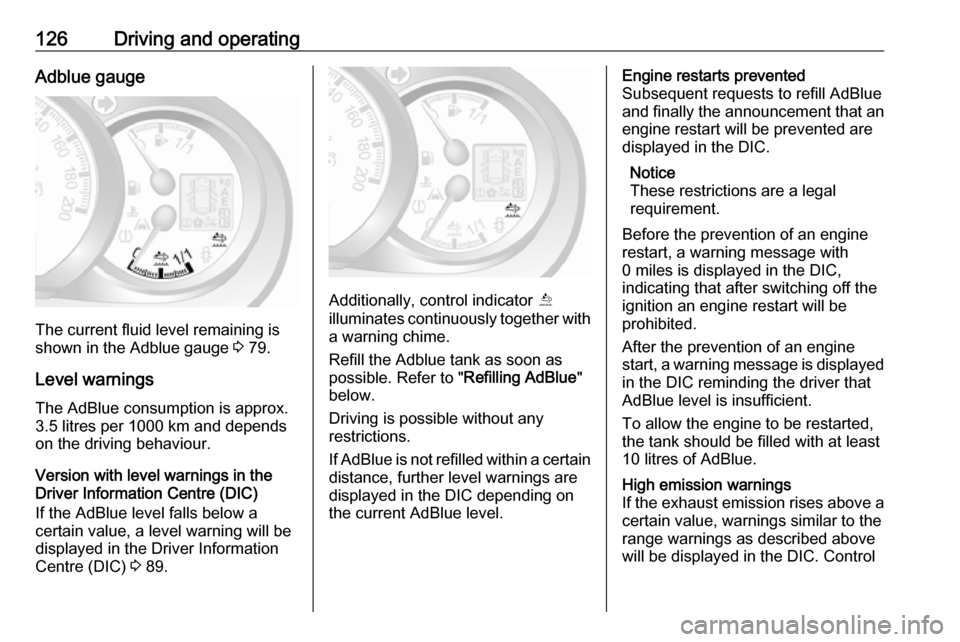
The current fluid level remaining is
shown in the Adblue gauge 3 79.
Level warnings
The AdBlue consumption is approx.
3.5 litres per 1000 km and depends
on the driving behaviour.
Version with level warnings in the
Driver Information Centre (DIC)
If the AdBlue level falls below a
certain value, a level warning will be
displayed in the Driver Information
Centre (DIC) 3 89.
Additionally, control indicator Õ
illuminates continuously together with a warning chime.
Refill the Adblue tank as soon as
possible. Refer to " Refilling AdBlue"
below.
Driving is possible without any
restrictions.
If AdBlue is not refilled within a certain
distance, further level warnings are
displayed in the DIC depending on the current AdBlue level.
Engine restarts prevented
Subsequent requests to refill AdBlue
and finally the announcement that an engine restart will be prevented are
displayed in the DIC.
Notice
These restrictions are a legal
requirement.
Before the prevention of an engine
restart, a warning message with
0 miles is displayed in the DIC,
indicating that after switching off the
ignition an engine restart will be
prohibited.
After the prevention of an engine
start, a warning message is displayed in the DIC reminding the driver that
AdBlue level is insufficient.
To allow the engine to be restarted,
the tank should be filled with at least
10 litres of AdBlue.High emission warnings
If the exhaust emission rises above a
certain value, warnings similar to the
range warnings as described above
will be displayed in the DIC. Control
Page 129 of 233
Driving and operating127indicator Õ illuminates continuously
together with A 3 85 and a warning
chime.
Requests to have the exhaust system
checked and finally the
announcement that an engine restart
with be prevented are displayed in the DIC.
Notice
These restrictions are a legal
requirement.
At an AdBlue range of approx.
680 miles, a warning message is
displayed in the DIC showing the
remaining distance the vehicle can
travel before engine restarts are
prevented. This warning message is
repeated approx. every 60 miles.
Seek the assistance of a workshop as
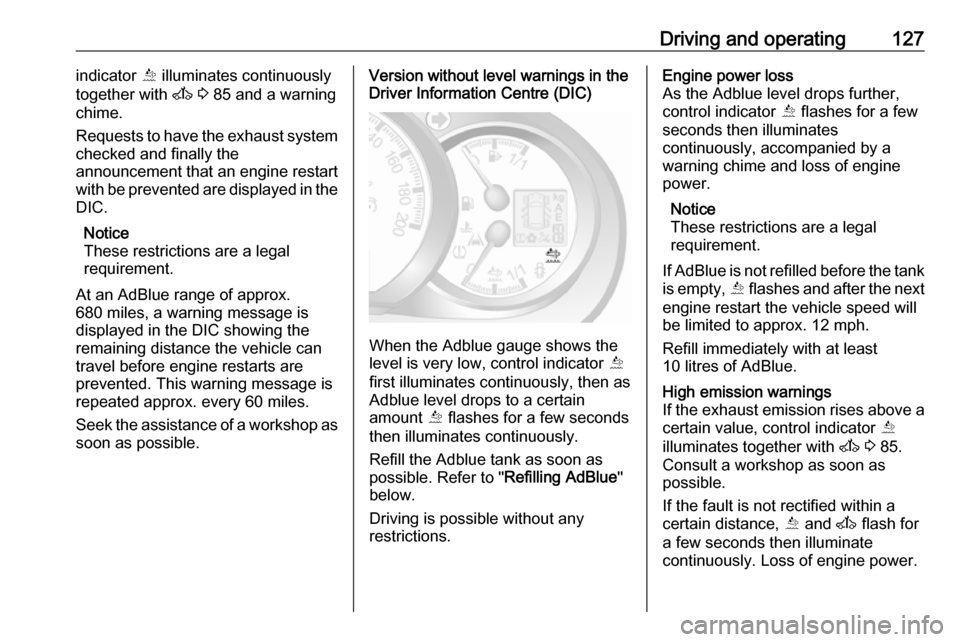
soon as possible.Version without level warnings in the Driver Information Centre (DIC)
When the Adblue gauge shows the
level is very low, control indicator Õ
first illuminates continuously, then as
Adblue level drops to a certain
amount Õ flashes for a few seconds
then illuminates continuously.
Refill the Adblue tank as soon as
possible. Refer to " Refilling AdBlue"
below.
Driving is possible without any
restrictions.
Engine power loss
As the Adblue level drops further,
control indicator Õ flashes for a few
seconds then illuminates
continuously, accompanied by a
warning chime and loss of engine
power.
Notice
These restrictions are a legal
requirement.
If AdBlue is not refilled before the tank
is empty, Õ flashes and after the next
engine restart the vehicle speed will
be limited to approx. 12 mph.
Refill immediately with at least
10 litres of AdBlue.High emission warnings
If the exhaust emission rises above a
certain value, control indicator Õ
illuminates together with A 3 85.
Consult a workshop as soon as
possible.
If the fault is not rectified within a
certain distance, Õ and A flash for
a few seconds then illuminate
continuously. Loss of engine power.
Page 132 of 233
130Driving and operatingManual transmission
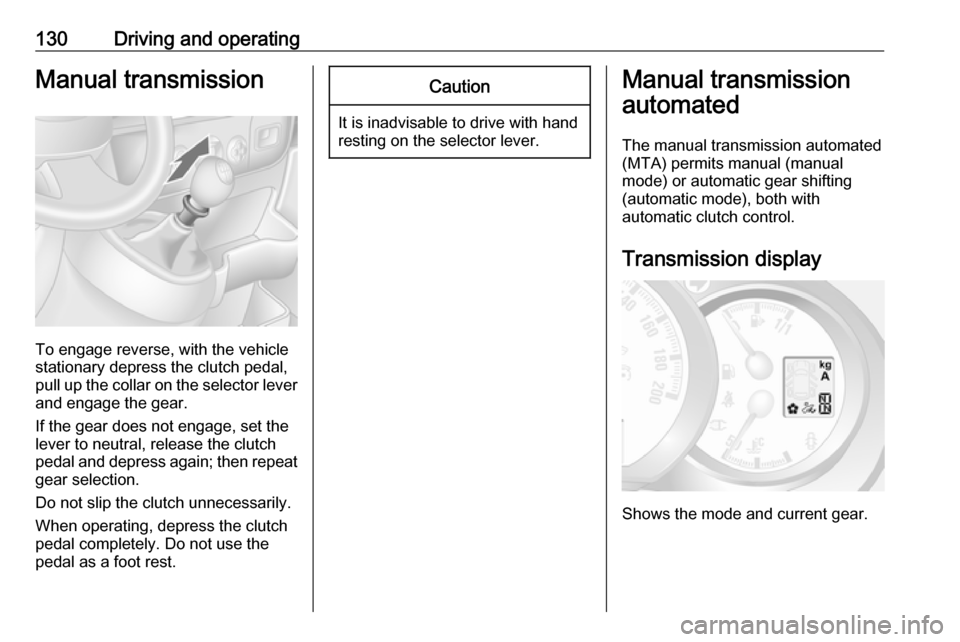
To engage reverse, with the vehicle
stationary depress the clutch pedal, pull up the collar on the selector lever
and engage the gear.
If the gear does not engage, set the
lever to neutral, release the clutch
pedal and depress again; then repeat
gear selection.
Do not slip the clutch unnecessarily.
When operating, depress the clutch pedal completely. Do not use the
pedal as a foot rest.
Caution
It is inadvisable to drive with hand
resting on the selector lever.
Manual transmission
automated
The manual transmission automated (MTA) permits manual (manual
mode) or automatic gear shifting
(automatic mode), both with
automatic clutch control.
Transmission display
Shows the mode and current gear.
Page 133 of 233
Driving and operating131Starting the engine
Depress the brake pedal when
starting the engine. If the brake pedal
is not depressed, T illuminates in the
transmission display and the engine
cannot be started.
When the brake pedal is depressed,
the transmission automatically shifts
to N (neutral); "N" appears in the
transmission display and the engine
can be started. There may be a slight delay.
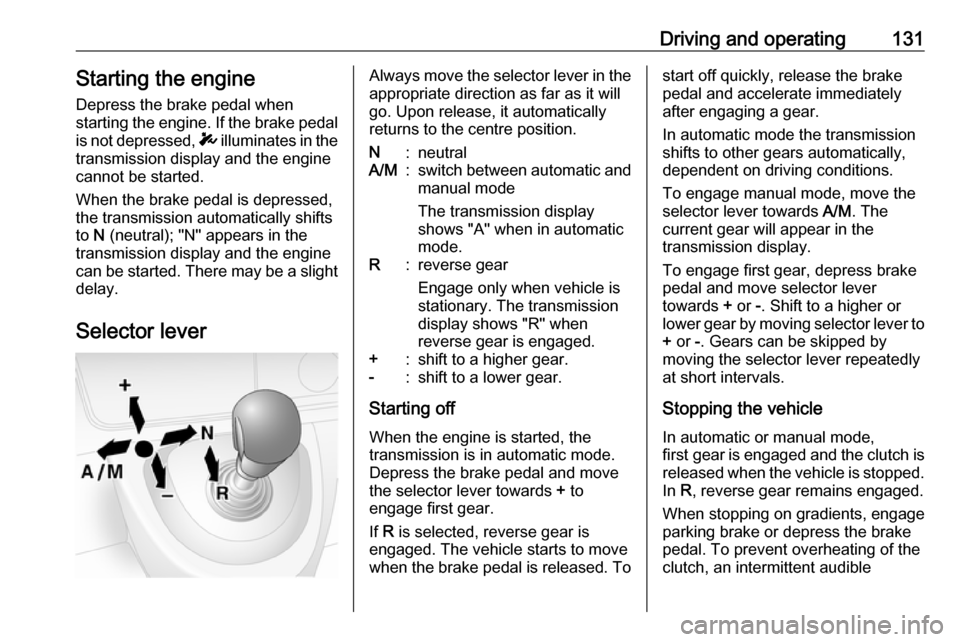
Selector leverAlways move the selector lever in the
appropriate direction as far as it will
go. Upon release, it automatically
returns to the centre position.N:neutralA/M:switch between automatic and manual mode
The transmission display
shows "A" when in automatic
mode.R:reverse gear
Engage only when vehicle is
stationary. The transmission
display shows "R" when
reverse gear is engaged.+:shift to a higher gear.-:shift to a lower gear.
Starting off
When the engine is started, the
transmission is in automatic mode. Depress the brake pedal and move
the selector lever towards + to
engage first gear.
If R is selected, reverse gear is
engaged. The vehicle starts to move
when the brake pedal is released. To
start off quickly, release the brake pedal and accelerate immediately
after engaging a gear.
In automatic mode the transmission
shifts to other gears automatically,
dependent on driving conditions.
To engage manual mode, move the
selector lever towards A/M. The
current gear will appear in the
transmission display.
To engage first gear, depress brake
pedal and move selector lever
towards + or -. Shift to a higher or
lower gear by moving selector lever to + or -. Gears can be skipped by
moving the selector lever repeatedly
at short intervals.
Stopping the vehicle In automatic or manual mode,
first gear is engaged and the clutch is
released when the vehicle is stopped.
In R, reverse gear remains engaged.
When stopping on gradients, engage
parking brake or depress the brake
pedal. To prevent overheating of the
clutch, an intermittent audible