engine VAUXHALL VIVARO 2016.5 Owner's Guide
[x] Cancel search | Manufacturer: VAUXHALL, Model Year: 2016.5, Model line: VIVARO, Model: VAUXHALL VIVARO 2016.5Pages: 211, PDF Size: 5 MB
Page 91 of 211

Instruments and controls89Illuminates when the engine is
running
If control indicator I illuminates
when the engine is running (together
with control indicator C and a
warning chime): Stop, switch off
engine.Caution
Engine lubrication may be
interrupted. This may result in
damage to the engine and/or
locking of the drive wheels.
1. Depress clutch.
2. Select neutral gear (or move selector lever to N).
3. Move out of the flow of traffic as quickly as possible without
impeding other vehicles.
4. Switch off ignition.
9 Warning
When the engine is off,
considerably more force is needed
to brake and steer.
Do not remove key until vehicle is stationary, otherwise the steeringwheel lock could engage
unexpectedly.
Check oil level before seeking
assistance of a workshop 3 147.
Fuel economy mode
ECO illuminates green when ECO
mode is engaged to reduce fuel
consumption.
ECO mode, driving economically
3 114.
Low fuel Y illuminates yellow.
Illuminates briefly when the ignition is
switched on.
Illuminates when level in fuel tank is
low (range of approx. 30 miles); refuel immediately 3 141.
Catalytic converter 3 123.
Bleeding the diesel fuel system
3 152.
Autostop D illuminates when engine is in an
Autostop.
\ illuminates when an Autostop is
inhibited when certain conditions are
not fulfilled.
Stop-start system 3 119.
Exterior light
9 illuminates green.
Illuminated when the headlights are
on.
8 illuminates green.
Illuminated when the sidelights are
on.
Lighting 3 96.
High beam
P illuminates blue.
Illuminated when high beam is on and during headlight flash 3 97.
Page 93 of 211

Instruments and controls91Info-display
The central display in the
Infotainment system displays the time and Infotainment system information.
For further information, refer to the
Infotainment system manual.
Vehicle messages
Messages are displayed in the Driver
Information Centre (DIC) and may be
accompanied by illumination of
control indicator F or C in the
instrument cluster.
Information messages
Information messages regarding, e.g. engine starting conditions, stop-start
system, parking brake application,
central locking, steering wheel lock
etc. provide the current status of
certain vehicle functions and
instructions for use.
Fault messages
Fault messages regarding, e.g. fuel
filter, airbags, exhaust emissions etc. are displayed together with control
indicator F. Drive with caution and
seek the assistance of a workshop as
soon as possible.
To remove fault messages, e.g.
" CHECK INJECTION ", from the
display, press button on end of wiper
lever. After a few seconds themessage may disappear
automatically and F remains
illuminated. The fault will then be
stored in the on board system.
Warning messages
Warning messages regarding, e.g.
engine, battery or brake system
failure, are displayed together with
control indicator C and may be
accompanied by a warning chime.
Stop engine immediately and seek
the assistance of a workshop.
Warning messages, e.g. " BATTERY
CHARGING FAULT " disappear from
the display automatically when the cause of the fault has been remedied.
Fuel economy messages Fuel economy messages provide tips
to improve fuel efficiency. Journeys
can be saved in the system memory,
enabling you to compare
performances.
Refer to Infotainment system manual
for further information.
Fuel economy rating 3 93.
Page 94 of 211

92Instruments and controlsWarning chimesOnly one warning chime will sound at a time.
A corresponding message may also
appear in the Driver Information
Centre (DIC) when a warning chime
is sounded.
When starting the engine or whilst driving:
● If seat belt is not fastened 3 49.
● During operation of the turn and lane-change signals 3 99.
● During illumination of certain control indicators.
● If the parking assist detects an object 3 136.
● If the vehicle speed briefly exceeds a set limit 3 133,
3 136.
● If a door or the bonnet is not properly closed when vehicle
exceeds a certain speed.
● If there is a fault in the brake system 3 86.● If the vehicle battery is not
charging 3 86.
● If engine lubrication is interrupted
3 88.
● If AdBlue needs to be refilled or a
fault is present 3 123.
● If the electronic key is outside of the detection range.
Electronic key system 3 22,
Power button 3 116.
When the vehicle is parked and/or
the driver's door is opened:
● If the key has been left in the ignition.
● If the electronic key has been left
in the card reader.
Electronic key system 3 22,
Power button 3 116.
● If the vehicle is in an Autostop. Stop-start system 3 119.
● If the exterior lights are on.Engine oil level
If the minimum engine oil level is
reached, a message is displayed in
the Driver Information Centre (DIC)
3 90 for 30 seconds after the engine
is started.
Check oil level 3 147.
Page 96 of 211

94Instruments and controlsAverage speedThe value is displayed after driving a
distance of 0.25 miles.
The average speed since the last
reset is displayed.
The measurement can be restarted at
any time.
Interruptions in the journey with the
ignition off are not included in the
calculations.
Reset trip computer information
To reset the trip computer, select one of its functions then press and hold
the button on the end of the wiper
lever.
The following trip computer
information will be reset:
● fuel used
● average consumption
● trip odometer
● average speed
The trip computer will reset
automatically when the maximum
value of any of the parameters is
exceeded.Fuel economy rating (ecoScoring)
If equipped, a rating of 0 to 100 is
shown in the Info-Display to help
evaluate fuel efficiency, based on your driving style.
Higher ratings indicate better fuel economy.
Tips to improve fuel economy are also given in the Info-Display. Journeys
can be saved in the system memory,
enabling you to compare
performances. Refer to Infotainment
system manual for further
information.
Vehicle messages 3 91.
Journey record
When the engine is switched off, a record of the last journey is shown in
the Info-Display.
The following information is
displayed:
● average fuel consumption
● total fuel consumption
● trip odometer
● fuel saved in milesUnit of measurement
To change the unit of measurementfor the duration of a journey:
Vehicles with power button:
With ignition off, simultaneously press and hold button on end of wiper lever
and press the power button 3 116;
the central display flashes for approx.
10 seconds until the new unit is
displayed. Release button on end of
wiper lever when the display stops
flashing.
Vehicles without power button:
With ignition off, simultaneously press and hold button on end of wiper lever
and switch on the ignition; the central display flashes for approx.
10 seconds until the new unit is
displayed. Release button on end of
wiper lever when the display stops
flashing.
When the engine is switched off, the
trip computer automatically returns to
the original unit of measurement.
Page 99 of 211
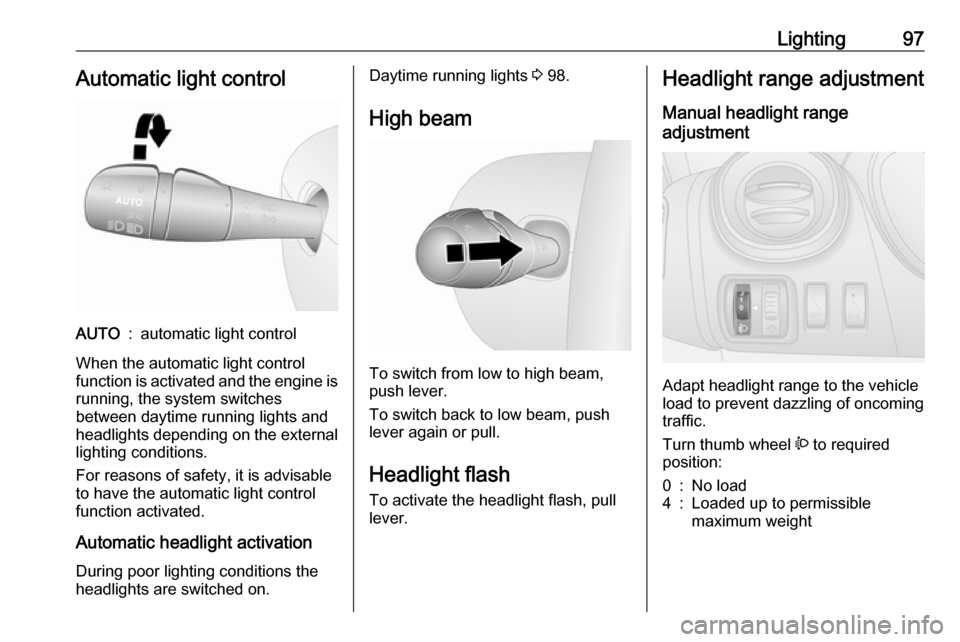
Lighting97Automatic light controlAUTO:automatic light control
When the automatic light control
function is activated and the engine is running, the system switches
between daytime running lights and headlights depending on the external lighting conditions.
For reasons of safety, it is advisable
to have the automatic light control
function activated.
Automatic headlight activation During poor lighting conditions the
headlights are switched on.
Daytime running lights 3 98.
High beam
To switch from low to high beam,
push lever.
To switch back to low beam, push
lever again or pull.
Headlight flash To activate the headlight flash, pull
lever.
Headlight range adjustment
Manual headlight range
adjustment
Adapt headlight range to the vehicle
load to prevent dazzling of oncoming
traffic.
Turn thumb wheel ? to required
position:
0:No load4:Loaded up to permissible
maximum weight
Page 101 of 211
Lighting99In the event of hard braking, the
hazard warning flashers may turn on automatically. Switch off by pressing
the ¨ button.
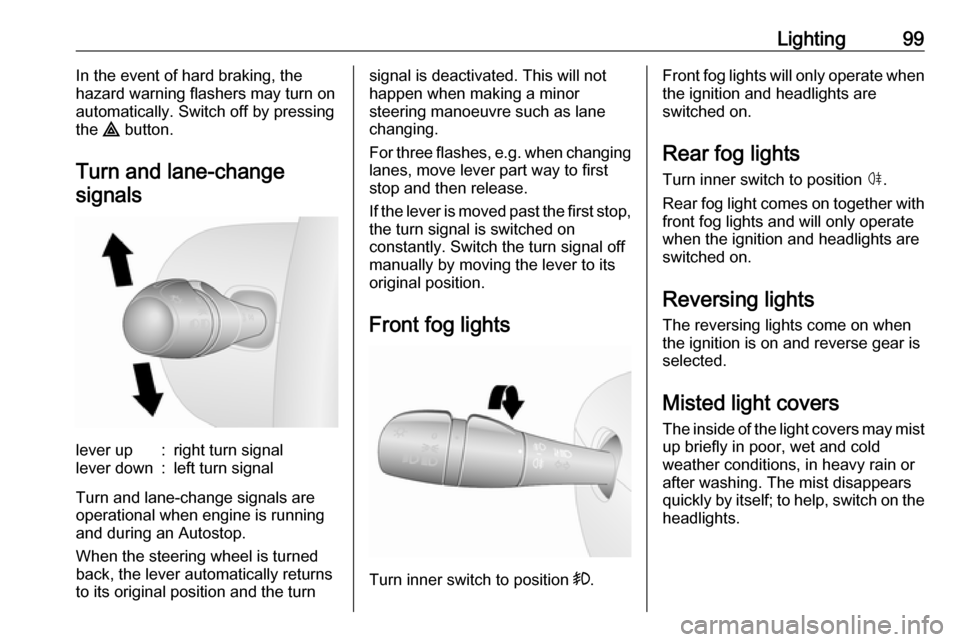
Turn and lane-change signalslever up:right turn signallever down:left turn signal
Turn and lane-change signals are
operational when engine is running
and during an Autostop.
When the steering wheel is turned
back, the lever automatically returns
to its original position and the turn
signal is deactivated. This will not
happen when making a minor
steering manoeuvre such as lane
changing.
For three flashes, e.g. when changing lanes, move lever part way to first
stop and then release.
If the lever is moved past the first stop, the turn signal is switched on
constantly. Switch the turn signal off
manually by moving the lever to its
original position.
Front fog lights
Turn inner switch to position >.
Front fog lights will only operate when
the ignition and headlights are
switched on.
Rear fog lights
Turn inner switch to position ø.
Rear fog light comes on together with front fog lights and will only operate
when the ignition and headlights are
switched on.
Reversing lights The reversing lights come on when
the ignition is on and reverse gear is
selected.
Misted light covers
The inside of the light covers may mist up briefly in poor, wet and cold
weather conditions, in heavy rain or
after washing. The mist disappears
quickly by itself; to help, switch on the headlights.
Page 105 of 211
Climate control103Climate controlClimate control systems.............103
Heating and ventilation system 103
Air conditioning system ...........104
Electronic climate control system .................................... 105
Rear heating system ...............107
Rear air conditioning system ...107
Auxiliary heater ........................108
Air vents ..................................... 112
Adjustable air vents .................112
Fixed air vents ......................... 112
Glovebox cooler ......................112
Maintenance .............................. 113
Air intake ................................. 113
Pollen filter ............................... 113
Air conditioning regular operation ................................ 113
Service .................................... 113Climate control systems
Heating and ventilation system
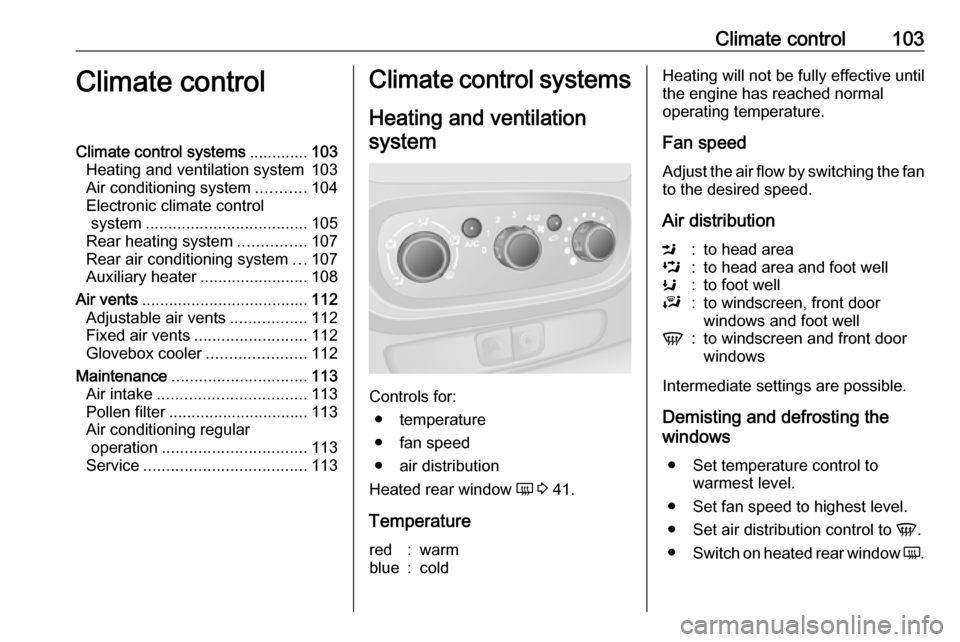
Controls for: ● temperature
● fan speed
● air distribution
Heated rear window Ü 3 41.
Temperature
red:warmblue:coldHeating will not be fully effective until
the engine has reached normal
operating temperature.
Fan speed
Adjust the air flow by switching the fan
to the desired speed.
Air distributionM:to head areaL:to head area and foot wellK:to foot wellJ:to windscreen, front door
windows and foot wellV:to windscreen and front door
windows
Intermediate settings are possible.
Demisting and defrosting the
windows
● Set temperature control to warmest level.
● Set fan speed to highest level.
● Set air distribution control to V.
● Switch on heated rear window Ü.
Page 106 of 211

104Climate control● Open side air vents as requiredand direct them towards door
windows.
● For simultaneous warming of the
foot well, set air distribution
control to J.
Heated rear window 3 41.
Air conditioning system
In addition to the heating and
ventilation system, the air
conditioning system has controls for:
A/C:cooling4:air recirculation
Heated seats 3 46.
Cooling (A/C)
Press A/C to switch on cooling.
Activation is indicated by illumination
of the LED in the button. Cooling is
only functional when the engine is running and climate control fan is
switched on.
Press A/C again to switch off cooling.
The air conditioning system cools and
dehumidifies (dries) the air when
outside temperature is above a
specific level. Therefore
condensation may form and drip from under the vehicle.
If no cooling or drying is required,
switch off the cooling system for fuel
saving reasons. Activated cooling
may inhibit an Autostop.
Stop-start system 3 119.
Notice
Air conditioning performance is
reduced when ECO mode has been
activated 3 114.
Air recirculation system 4
Press 4 to activate air recirculation
mode. Activation is indicated by
illumination of the LED in the button.Press 4 again to deactivate air
recirculation mode.9 Warning
The exchange of fresh air is
reduced in air recirculation mode.
In operation without cooling, the
air humidity increases, so the
windows may mist up from inside.
The quality of the passenger
compartment air deteriorates,
which may cause the vehicle
occupants to feel drowsy.
In warm and very humid ambient air conditions, the windscreen might mist up from outside when cold air is
directed towards it. If windscreen
mists up from outside, activate
windscreen wiper and avoid the use
of air distribution settings J and V.
Maximum cooling
Briefly open the windows so that hot air can disperse quickly.
● Cooling A/C on.
● Air recirculation system 4 on.
● Set air distribution control to M.
Page 107 of 211
Climate control105● Set temperature control tocoldest level.
● Set fan speed to highest level.
● Open all air vents.
Demisting and defrosting the
windows
● Set temperature control to warmest level.
● Set fan speed to highest level.
● Set air distribution control to V.
● Switch cooling A/C on.
● Switch on heated rear window Ü.
● Open side air vents as required and direct them towards door
windows.
● For simultaneous warming of the
foot well, set air distribution
control to J.
Heated rear window 3 41.Electronic climate control
system
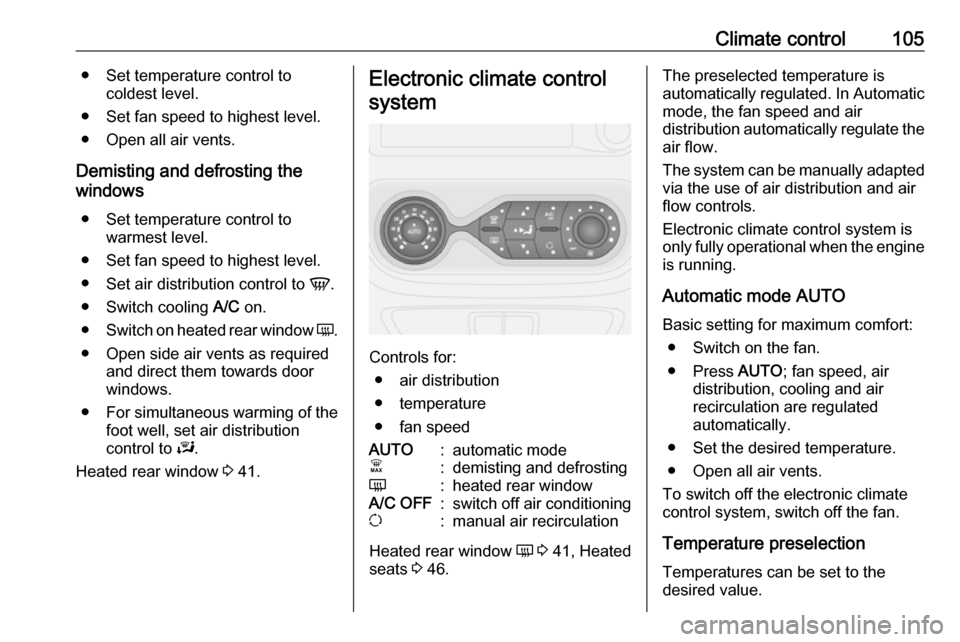
Controls for: ● air distribution
● temperature
● fan speed
AUTO:automatic modeÊ:demisting and defrostingÜ:heated rear windowA/C OFF:switch off air conditioningu:manual air recirculation
Heated rear window Ü 3 41, Heated
seats 3 46.
The preselected temperature is
automatically regulated. In Automatic
mode, the fan speed and air
distribution automatically regulate the air flow.
The system can be manually adapted
via the use of air distribution and air
flow controls.
Electronic climate control system is
only fully operational when the engine is running.
Automatic mode AUTO Basic setting for maximum comfort: ● Switch on the fan.
● Press AUTO; fan speed, air
distribution, cooling and air
recirculation are regulated
automatically.
● Set the desired temperature. ● Open all air vents.
To switch off the electronic climate
control system, switch off the fan.
Temperature preselection Temperatures can be set to the
desired value.
Page 108 of 211

106Climate controlIf the minimum temperature is set, the
climate control system runs at
maximum cooling.
If the maximum temperature is set, the climate control system runs at
maximum heating.
Demisting and defrosting the
windows
● Press Ê; LED illuminates in the
button when activated.
● Temperature, air distribution and cooling are regulated
automatically and the fan runs at
high speed.
● Switch on heated rear window Ü
3 41.
To return to Automatic mode: press
Ê or AUTO .
Notice
If Ê is pressed while the engine is
running, an Autostop will be inhibited until Ê is pressed again.
If Ê is pressed while the engine is in
an Autostop, the engine will restart
automatically.
Stop-start system 3 119.Manual settings
Manually changing any of the
following settings will deactivate
Automatic mode:
Fan speed Z
Adjust the air flow manually by
switching the fan to the desired
speed.
If the fan is switched off, the air
conditioning is also deactivated.
Air distribution M
Press appropriate button for desired
adjustment. LED illuminates in the
button when activated.R:to windscreen and front door
windowsM:to head areaS:to foot well
Combinations of settings are possible
by pressing two buttons until both
LEDs are illuminated.
To return to Automatic mode: Press
AUTO button.
Cooling A/C
The air conditioning system cools and dehumidifies (dries) the air when
outside temperature is above a
specific level. Therefore
condensation may form and drip from
under the vehicle.
Notice
Air conditioning performance is
reduced when ECO mode has been
activated 3 114.
If no cooling or drying is required
press A/C OFF to switch the cooling
system off, thus saving fuel. LED
illuminates in the button.
To return to Automatic mode: Press
AUTO button.
Air recirculation mode u
Activate or deactivate manual air recirculation mode with u. LED
illuminates in the button when
activated.