lock VAUXHALL ZAFIRA 2014 Workshop Manual
[x] Cancel search | Manufacturer: VAUXHALL, Model Year: 2014, Model line: ZAFIRA, Model: VAUXHALL ZAFIRA 2014Pages: 217, PDF Size: 7.85 MB
Page 171 of 217
Vehicle care169
No.Circuit28Transmission electronics29Transmission electronics30Engine electronics31Adaptive forward fighting, head‐light range adjustment32Brake system, air conditioning
system, clutch switch33Adaptive forward lighting, head‐
light range adjustment, light
switch34Steering column control unit35Infotainment system36Mobile telephone, Infotainment
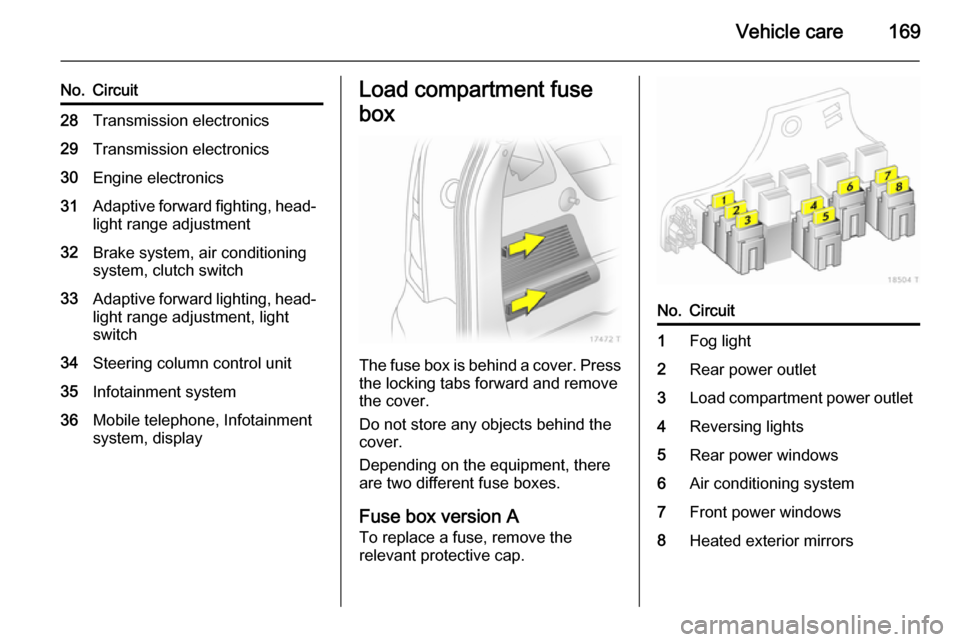
system, displayLoad compartment fuse
box
The fuse box is behind a cover. Press
the locking tabs forward and remove
the cover.
Do not store any objects behind the
cover.
Depending on the equipment, there
are two different fuse boxes.
Fuse box version A
To replace a fuse, remove the
relevant protective cap.
No.Circuit1Fog light2Rear power outlet3Load compartment power outlet4Reversing lights5Rear power windows6Air conditioning system7Front power windows8Heated exterior mirrors
Page 173 of 217
Vehicle care171
No.Circuit29Cigarette lighter, front power
outlet30Rear power outlet31–32–33Open&Start system34–35Rear power outlet36Socket for towing equipment37–38Central locking system, terminal
3039Left seat heating40Right seat heating41–42–No.Circuit43–44–Vehicle tools
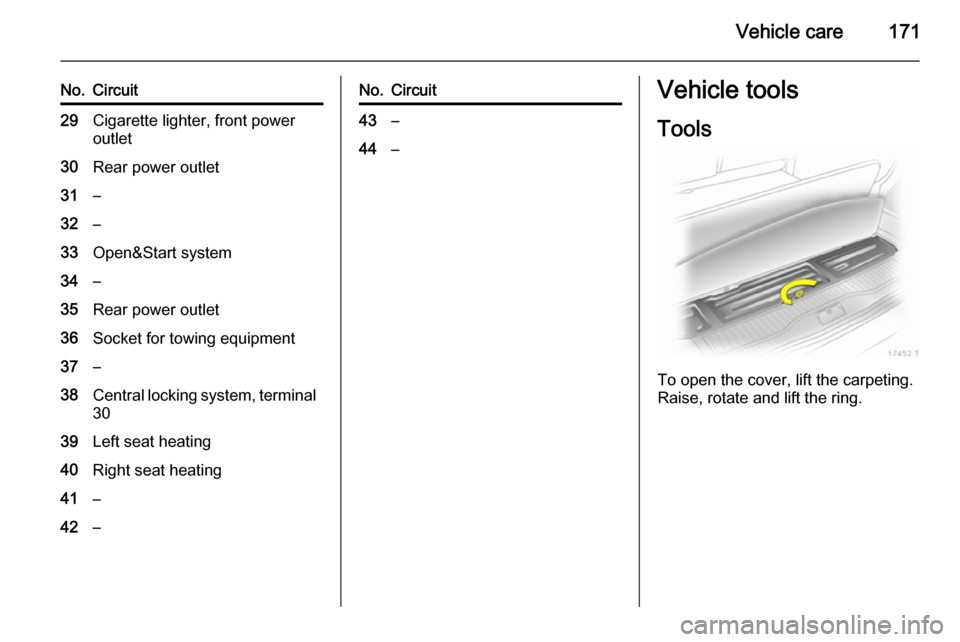
Tools
To open the cover, lift the carpeting.
Raise, rotate and lift the ring.
Page 174 of 217
172Vehicle care
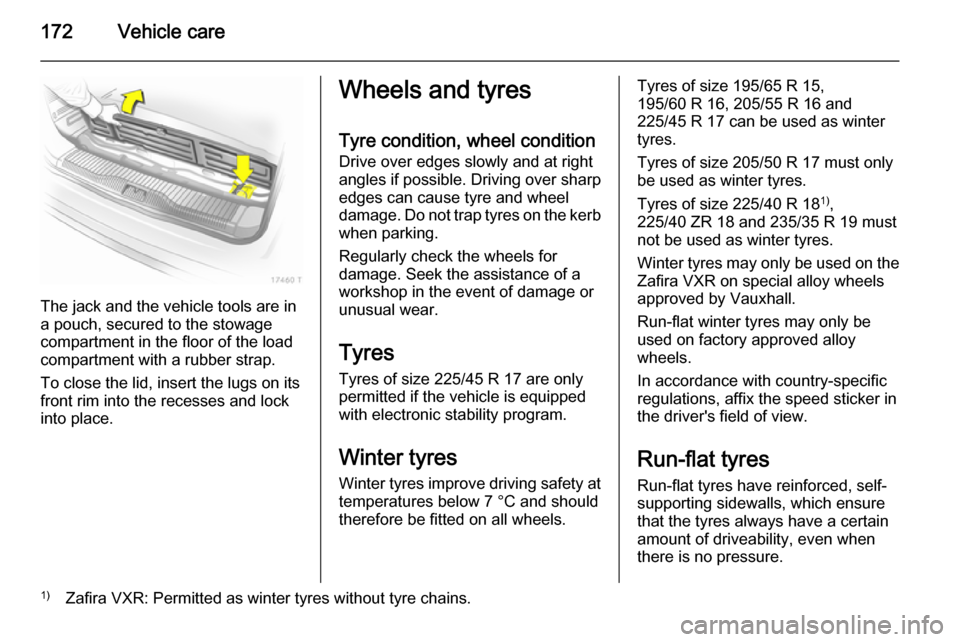
The jack and the vehicle tools are in
a pouch, secured to the stowage
compartment in the floor of the load
compartment with a rubber strap.
To close the lid, insert the lugs on its
front rim into the recesses and lock
into place.
Wheels and tyres
Tyre condition, wheel condition
Drive over edges slowly and at right
angles if possible. Driving over sharp
edges can cause tyre and wheel
damage. Do not trap tyres on the kerb when parking.
Regularly check the wheels for
damage. Seek the assistance of a
workshop in the event of damage or
unusual wear.
Tyres
Tyres of size 225/45 R 17 are only permitted if the vehicle is equipped
with electronic stability program.
Winter tyres
Winter tyres improve driving safety at temperatures below 7 °C and should
therefore be fitted on all wheels.Tyres of size 195/65 R 15,
195/60 R 16, 205/55 R 16 and
225/45 R 17 can be used as winter
tyres.
Tyres of size 205/50 R 17 must only
be used as winter tyres.
Tyres of size 225/40 R 18 1)
,
225/40 ZR 18 and 235/35 R 19 must not be used as winter tyres.
Winter tyres may only be used on the
Zafira VXR on special alloy wheels
approved by Vauxhall.
Run-flat winter tyres may only be
used on factory approved alloy
wheels.
In accordance with country-specific
regulations, affix the speed sticker in
the driver's field of view.
Run-flat tyres Run-flat tyres have reinforced, self-
supporting sidewalls, which ensure
that the tyres always have a certain
amount of driveability, even when
there is no pressure.1) Zafira VXR: Permitted as winter tyres without tyre chains.
Page 179 of 217
Vehicle care177Tyre chains
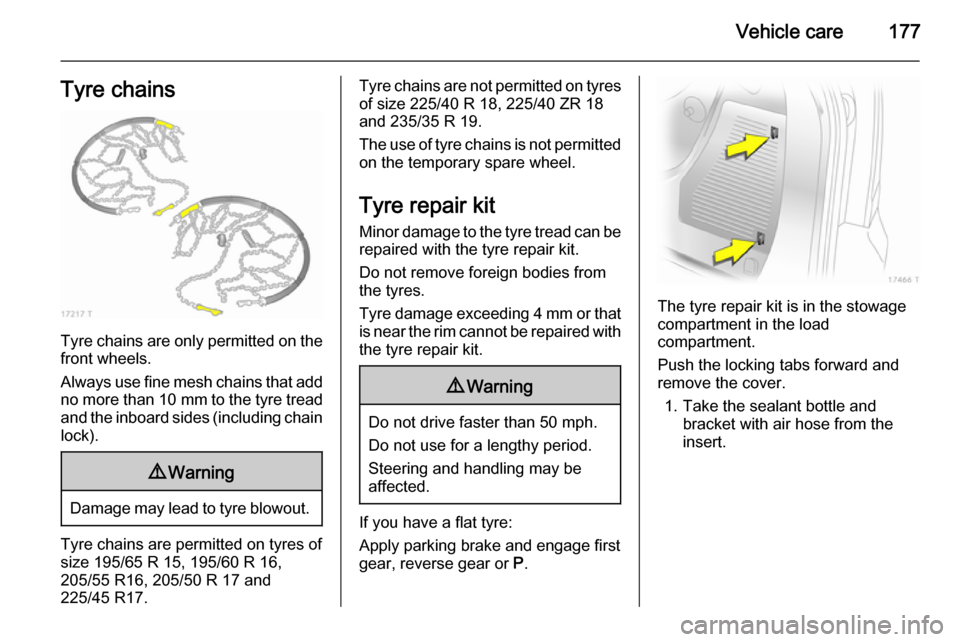
Tyre chains are only permitted on the
front wheels.
Always use fine mesh chains that add no more than 10 mm to the tyre tread
and the inboard sides (including chain lock).
9 Warning
Damage may lead to tyre blowout.
Tyre chains are permitted on tyres of
size 195/65 R 15, 195/60 R 16,
205/55 R16, 205/50 R 17 and
225/45 R17.
Tyre chains are not permitted on tyres of size 225/40 R 18, 225/40 ZR 18
and 235/35 R 19.
The use of tyre chains is not permitted on the temporary spare wheel.
Tyre repair kit
Minor damage to the tyre tread can be
repaired with the tyre repair kit.
Do not remove foreign bodies from
the tyres.
Tyre damage exceeding 4 mm or that
is near the rim cannot be repaired with the tyre repair kit.9 Warning
Do not drive faster than 50 mph.
Do not use for a lengthy period.
Steering and handling may be
affected.
If you have a flat tyre:
Apply parking brake and engage first
gear, reverse gear or P.
The tyre repair kit is in the stowage
compartment in the load
compartment.
Push the locking tabs forward and
remove the cover.
1. Take the sealant bottle and bracket with air hose from the
insert.
Page 185 of 217
Vehicle care183
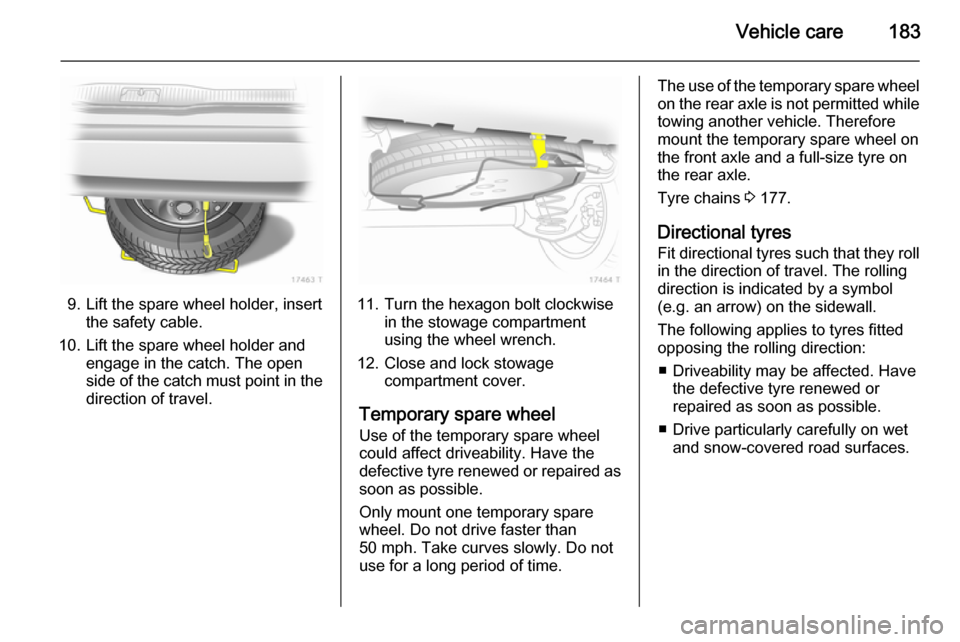
9. Lift the spare wheel holder, insertthe safety cable.
10. Lift the spare wheel holder and engage in the catch. The open
side of the catch must point in the
direction of travel.11. Turn the hexagon bolt clockwise in the stowage compartment
using the wheel wrench.
12. Close and lock stowage compartment cover.
Temporary spare wheel
Use of the temporary spare wheel
could affect driveability. Have the
defective tyre renewed or repaired as soon as possible.
Only mount one temporary spare
wheel. Do not drive faster than
50 mph. Take curves slowly. Do not
use for a long period of time.
The use of the temporary spare wheel
on the rear axle is not permitted while towing another vehicle. Therefore
mount the temporary spare wheel on
the front axle and a full-size tyre on
the rear axle.
Tyre chains 3 177.
Directional tyres Fit directional tyres such that they rollin the direction of travel. The rolling
direction is indicated by a symbol
(e.g. an arrow) on the sidewall.
The following applies to tyres fitted
opposing the rolling direction:
■ Driveability may be affected. Have the defective tyre renewed or
repaired as soon as possible.
■ Drive particularly carefully on wet and snow-covered road surfaces.
Page 187 of 217
Vehicle care185
3. Connect the black lead to thenegative terminal of the booster
battery.
4. Connect the other end of the black
lead to a vehicle grounding point,
such as the engine block or an
engine mounting bolt. Connect as far away from the discharged
battery as possible, however at
least 60 cm.
Route the leads so that they cannot
catch on rotating parts in the engine
compartment.
To start the engine: 1. Start the engine of the vehicle providing the jump.
2. After 5 minutes, start the other engine. Start attempts should be
made for no longer than
15 seconds at an interval of
1 minute.
3. Allow both engines to idle for approx. 3 minutes with the leads
connected.4. Switch on electrical consumers (e.g. headlights, heated rear
window) of the vehicle receiving
the jump start.
5. Reverse above sequence exactly when removing leads.Towing
Towing the vehicle
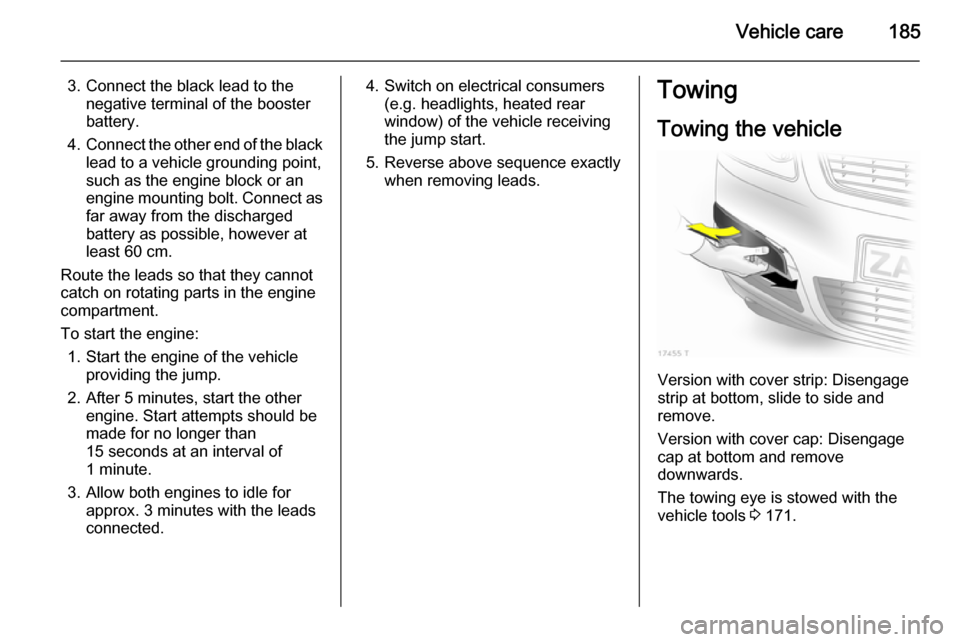
Version with cover strip: Disengage
strip at bottom, slide to side and
remove.
Version with cover cap: Disengage
cap at bottom and remove
downwards.
The towing eye is stowed with the vehicle tools 3 171.
Page 188 of 217
186Vehicle care
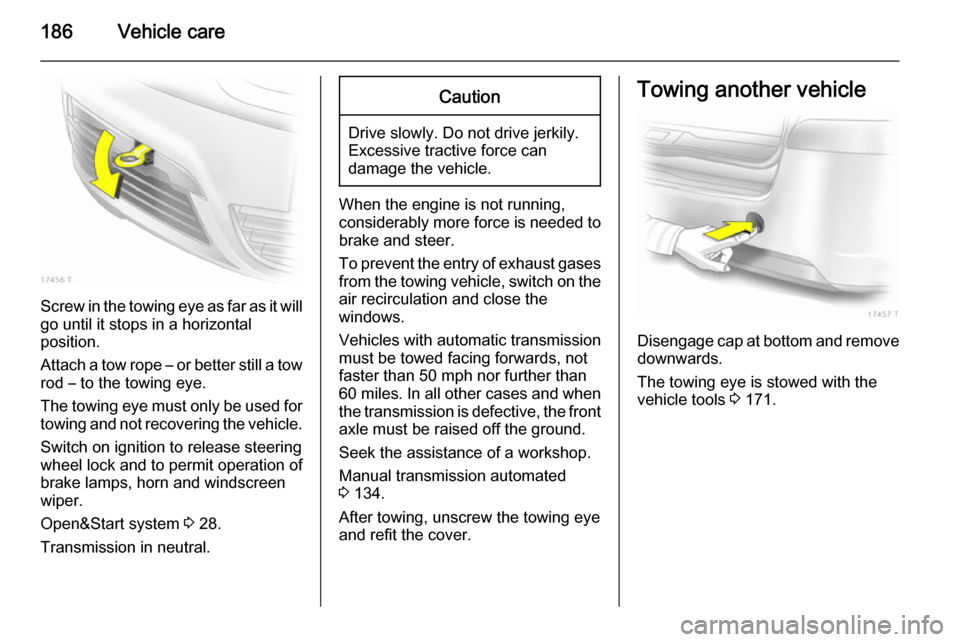
Screw in the towing eye as far as it will
go until it stops in a horizontal
position.
Attach a tow rope – or better still a tow
rod – to the towing eye.
The towing eye must only be used for towing and not recovering the vehicle.
Switch on ignition to release steering
wheel lock and to permit operation of
brake lamps, horn and windscreen
wiper.
Open&Start system 3 28.
Transmission in neutral.
Caution
Drive slowly. Do not drive jerkily.
Excessive tractive force can
damage the vehicle.
When the engine is not running,
considerably more force is needed to
brake and steer.
To prevent the entry of exhaust gases from the towing vehicle, switch on the
air recirculation and close the
windows.
Vehicles with automatic transmission
must be towed facing forwards, not faster than 50 mph nor further than
60 miles . In all other cases and when
the transmission is defective, the front
axle must be raised off the ground.
Seek the assistance of a workshop.
Manual transmission automated
3 134.
After towing, unscrew the towing eye
and refit the cover.
Towing another vehicle
Disengage cap at bottom and remove
downwards.
The towing eye is stowed with the
vehicle tools 3 171.
Page 189 of 217
Vehicle care187
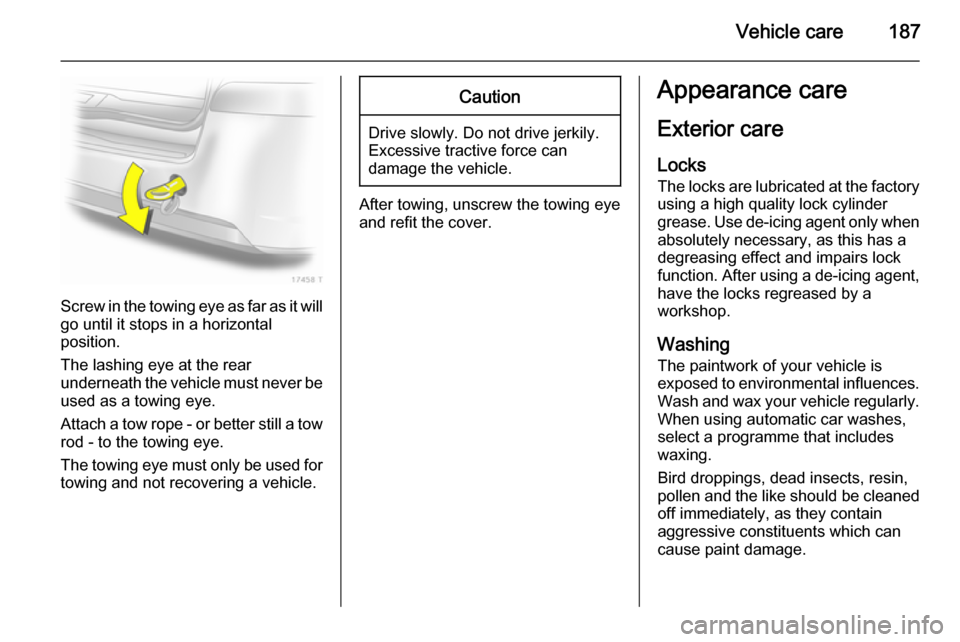
Screw in the towing eye as far as it will
go until it stops in a horizontal
position.
The lashing eye at the rear
underneath the vehicle must never be used as a towing eye.
Attach a tow rope - or better still a tow
rod - to the towing eye.
The towing eye must only be used for towing and not recovering a vehicle.
Caution
Drive slowly. Do not drive jerkily.
Excessive tractive force can
damage the vehicle.
After towing, unscrew the towing eye and refit the cover.
Appearance care
Exterior care
Locks The locks are lubricated at the factoryusing a high quality lock cylinder
grease. Use de-icing agent only when absolutely necessary, as this has a
degreasing effect and impairs lock
function. After using a de-icing agent,
have the locks regreased by a
workshop.
Washing The paintwork of your vehicle is
exposed to environmental influences.
Wash and wax your vehicle regularly.
When using automatic car washes,
select a programme that includes
waxing.
Bird droppings, dead insects, resin,
pollen and the like should be cleaned
off immediately, as they contain
aggressive constituents which can
cause paint damage.
Page 191 of 217

Vehicle care189
Wheels and tyresDo not use high-pressure jet
cleaners.
Clean rims with a pH-neutral wheel
cleaner.
Rims are painted and can be treated
with the same agents as the body.
Paintwork damageRectify minor paintwork damage witha touch-up pen before rust forms.
Have more extensive damage or rust
areas repaired by a workshop.
Underbody Some areas of the vehicle underbody
have a PVC undercoating while other critical areas have a durable
protective wax coating.
After the underbody is washed, check
the underbody and have it waxed if
necessary.
Bitumen/rubber materials could
damage the PVC coating. Have
underbody work carried out by a
workshop.Before and after winter, wash the
underbody and have the protective
wax coating checked.
Engine compartment
Areas of the engine compartment that
are painted in the same colour as the vehicle must be looked after like any
other painted surface.
It is advisable to wash the engine
compartment before and after winter
and preserve it with wax. Protect the
alternator and brake fluid reservoir
with plastic sheets before washing
the engine.
When washing the engine with a
steam-jet cleaner, do not direct the
steam jet towards components of the
antilock brake system, air
conditioning system or the belt drive
and its components.
After an engine wash, have all engine
room components preserved
thoroughly by a workshop using
protective wax.
Do not use high-pressure jet
cleaners.Towing equipment
Do not clean the coupling ball bar with
a steam-jet or high-pressure jet
cleaner.
Interior care Interior and upholsteryOnly clean the vehicle interior,
including the instrument panel fascia
and panelling, with a dry cloth or
interior cleaner.
Clean the leather upholstery with
clear water and a soft cloth. In case of
heavy soiling, use leather care.
The instrument cluster and the
displays should only be cleaned using
a soft damp cloth. If necessary use a
weak soap solution.
Clean fabric upholstery with a
vacuum cleaner and brush. Remove
stains with an upholstery cleaner.
Page 211 of 217

Customer information209
■ Vehicle reactions in particulardriving situations (e.g. inflation of
an airbag, activation of the stability
regulation system)
■ Environmental conditions (e.g. temperature)
These data are exclusively technical
and help identifying and correcting
errors as well as optimizing vehicle
functions.
Motion profiles indicating travelled
routes cannot be created with these
data.
If services are used (e.g. repair
works, service processes, warranty cases, quality assurance),
employees of the service network
(manufacturer included) are able to
read out this technical information
from the event and error data storage
modules applying special diagnostic
devices. If required, you will receive
further information at these
workshops. After an error has been
corrected, the data are deleted from
the error storage module or they are
constantly overwritten.When using the vehicle, situations
may occur in which these technical
data related to other information
(accident report, damages on the
vehicle, witness statements etc.) may be associated with a specific person -
possibly, with the assistance of an
expert.
Additional functions contractually
agreed upon with the client (e.g.
vehicle location in emergency cases)
allow the transmission of particular vehicle data from the vehicle.Radio Frequency
Identification (RFID) RFID technology is used in somevehicles for functions such as tyre
pressure monitoring and ignition
system security. It is also used in
connection with conveniences such
as radio remote controls for door
locking/unlocking and starting, and in-
vehicle transmitters for garage door
openers. RFID technology in
Vauxhall vehicles does not use or
record personal information or link with any other Vauxhall system
containing personal information.