technical specifications VOLKSWAGEN CORRADO 1993 Repair Manual
[x] Cancel search | Manufacturer: VOLKSWAGEN, Model Year: 1993, Model line: CORRADO, Model: VOLKSWAGEN CORRADO 1993Pages: 920, PDF Size: 6.92 MB
Page 388 of 920

AA - USING THIS SECTION (GENERAL HELP INFORMATION)
Article Text (p. 2)
1993 Volkswagen Corrado
For Volkswagen Technical Site: http://vw.belcom.ru
Copyright © 1998 Mitchell Repair Information Company, LLC
Wednesday, March 22, 2000 08:49PM
If you want "TUNE-UP" type information, see D - ADJUSTMENTS
for the adjustment procedures. If you are familiar with the
procedures, but need a quick way to find the specification, go to C -
TUNE-UP SPECS or C - SPECIFICATIONS for the specifications pertaining
to the vehicle.
When diagnosing driveability problems, first go to F - BASIC
TESTING. This article is here to help eliminate wasted diagnostic
time. If the basic systems are working properly, go to G - TESTS W/
CODES.
If the vehicle still is having a driveability problem or if
the vehicle has no self-diagnostic system, go to H - TESTS W/O CODES.
This article will help you diagnose the problem by symptom, locate the
symptom exhibited by the vehicle, and inspect or test the items which
may be causing the problem.
After finding which specific system or component requires
testing, use the I - SYS/COMP TESTS article to tests the systems and
components. We have also included (when available) pin voltage charts
and sensor range charts. These can be found in J - PIN VOLTAGE CHARTS
and K - SENSOR RANGE CHARTS.
Also included in this section are wiring diagrams and vacuum
diagrams. These can be found in L - WIRING DIAGRAMS and M - VACUUM
DIAGRAMS.
When all diagnostic tests have been performed and the problem
has been discovered, it may be necessary to replace or overhaul the
defective part. This information can be found in
N - REMOVE/INSTALL/OHAUL.
The content of each of these articles is outlined below. As a
summary of the driveability diagnosis, see ROUTINE OUTLINE in this
article.
A - ENGINE/VIN ID
This article shows how to identify the model and engine by
its Vehicle Identification Number (VIN). A model coverage chart shows
each model and engine, the fuel system, ignition system and engine
code. The engine serial number locations are also included in this
article.
B - EMISSION APPLICATION
These charts identify the emission systems and sub-systems
applicable to each model and engine combination.
C - TUNE-UP SPECS
This is a collection of quick-reference type specifications.
This article is helpful when you are familiar with proper adjustment
procedures and only need specifications. Included in this section are:
* Battery specifications.
* Fluid capacities.
Page 389 of 920

AA - USING THIS SECTION (GENERAL HELP INFORMATION)
Article Text (p. 3)
1993 Volkswagen Corrado
For Volkswagen Technical Site: http://vw.belcom.ru
Copyright © 1998 Mitchell Repair Information Company, LLC
Wednesday, March 22, 2000 08:49PM
* Replacement intervals.
* Belt adjustment.
* Engine Compression.
* Valve clearance.
* Valve Arrangement.
* Ignition coil specifications.
* High tension wire resistance.
* Spark plug type and gap.
* Firing order.
* Ignition timing.
* Fuel pump performance and injector resistance specifications
* Slow and fast idle speed and mixture specifications.
* Carbon monoxide (CO) level specifications.
* Throttle position sensor/switch specifications.
C - SPECIFICATIONS
This is a collection of quick-reference type specifications.
This article is helpful when you are familiar with proper adjustment
procedures and only need specifications. Included in this section are:
* Battery specifications.
* Fluid capacities.
* Replacement intervals.
* Belt adjustment.
* Engine Compression.
* Valve clearance.
* Valve Arrangement.
* Ignition coil specifications.
* High tension wire resistance.
* Spark plug type and gap.
* Firing order.
* Ignition timing.
* Fuel pump performance and injector resistance specifications
* Slow and fast idle speed and mixture specifications.
* Carbon monoxide (CO) level specifications.
* Throttle position sensor/switch specifications.
D - ADJUSTMENTS
This article contains the information that use to be included
in the TUNE-UP section. Checking and adjusting valves, spark plugs,
spark plug wires, base ignition timing and idle speed are found in
this section. Use this article for routine maintenance. Also, if you
have a driveability problem, ensure all on-vehicle adjustments are
correct before proceeding with any diagnosis.
E - THEORY/OPERATION
Page 391 of 920

AA - USING THIS SECTION (GENERAL HELP INFORMATION)
Article Text (p. 5)
1993 Volkswagen Corrado
For Volkswagen Technical Site: http://vw.belcom.ru
Copyright © 1998 Mitchell Repair Information Company, LLC
Wednesday, March 22, 2000 08:49PM
sensor is out of calibration. A sensor that is out of calibration may
not set a trouble code, but it will cause driveability problems.
L - WIRING DIAGRAMS
Use these WIRING DIAGRAMS to identify and trace component
circuits, locate shorts and opens in circuits, and understand how
individual circuits function as part of a system. The diagrams in this
article are only for fuel, ignition and emission systems
M - VACUUM DIAGRAMS
The VACUUM DIAGRAMS will assist you in finding incorrectly
routed vacuum hoses which may cause driveability problems or computer
indicated malfunctions.
N - REMOVE/INSTALL/OHAUL
N - REMOVE/INSTALL/OHAUL contains information found in the
sub-headings of REMOVAL, OVERHAUL & INSTALLATION. These are procedures
and specifications required to remove, overhaul (if possible) and
install components related to engine performance.
WHERE TO START
PERFORM BASIC INSPECTION
1) Verify customer complaint.
2) Perform visual inspection. See F - BASIC TESTING.
3) Test engine sub-system to determine that the following
systems are functioning properly. See F- BASIC TESTING.
* Mechanical conditions (compression)
* Ignition output
* Fuel Delivery
4) Check air induction system for leaks.
5) Check & adjust basic engine settings listed below to
ensure they are to specification. See D - ADJUSTMENTS.
* Ignition timing
* Idle speed
CHECK FOR TROUBLE CODES
1) If equipped with self-diagnostics, check for trouble
codes. Refer to G - TESTS W/ CODES.
2) Repair causes of trouble code(s).
3) Clear control unit memory.
SYMPTOM DIAGNOSIS
Page 392 of 920

AA - USING THIS SECTION (GENERAL HELP INFORMATION)
Article Text (p. 6)
1993 Volkswagen Corrado
For Volkswagen Technical Site: http://vw.belcom.ru
Copyright © 1998 Mitchell Repair Information Company, LLC
Wednesday, March 22, 2000 08:49PM
1) If no self-diagnostics available, or no trouble codes
present, identify symptom.
2) See trouble shooting procedure to repair complaint. See H
- TESTS W/O CODES
TEST SYSTEM
1) Perform necessary systems and component tests. See I -
SYS/COMP TESTS.
2) Verify that complaint is repaired.
SAFETY PRECAUTIONS
* Always refer to Engine Tune-Up Decal in engine compartment before
performing tune-up. If manual and decal differ, always use decal
specifications.
* DO NOT allow or create a condition of misfire in more than one
cylinder for an extended period of time. Damage to converter may
occur due to loading converter with unburned air/fuel mixture.
* Always turn ignition off and disconnect negative battery cable
BEFORE disconnecting or connecting computer or other electrical
components.
* DO NOT drop or shock electrical components such as computer,
airflow meter, etc.
* DO NOT use fuel system cleaning compounds that are not
recommended by the manufacturer. Damage to gaskets, diaphragm
materials and catalytic converter may result.
* Before performing a compression test or cranking engine using a
remote starter switch, disconnect coil wire from distributor and
secure it to a good engine ground, or disable ignition.
* Before disconnecting any fuel system component, ensure fuel
system pressure is released.
* Use a shop towel to absorb any spilled fuel to prevent fire.
* DO NOT create sparks or have an open flame near battery.
* If any EFI components such as hoses or clamps are replaces,
ensure they are replaced with components designed for EFI use.
* Always reassemble throttle body components with new gaskets, "O"
rings and seals.
* If equipped with an inertia switch, DO NOT reset switch until
fuel system has been inspected for leaks.
* Wear safety goggles when drilling or grinding.
* Wear proper clothing which protects against chemicals and other
hazards.
END OF ARTICLE
Page 409 of 920

ANTI-LOCK BRAKE SAFETY PRECAUTIONS
Article Text
1993 Volkswagen Corrado
For Volkswagen Technical Site: http://vw.belcom.ru
Copyright © 1998 Mitchell Repair Information Company, LLC
Wednesday, March 22, 2000 08:57PM
ARTICLE BEGINNING
GENERAL INFORMATION
Anti-Lock Brake Safety Precautions
* PLEASE READ THIS FIRST *
This article is intended for general information purposes
only. This information may not apply to all makes and models. If
vehicle is equipped with Anti-Lock Brake System (ABS), refer to
appropriate ANTI-LOCK BRAKE SYSTEM article in the BRAKES section for
description, operation, depressurizing, testing, system bleeding,
trouble shooting and servicing of specific system.
WARNING: Failure to depressurize ABS could lead to physical injury.
ANTI-LOCK BRAKE SAFETY PRECAUTIONS
WARNING: Failure to depressurize ABS could lead to physical injury.
* NEVER open a bleeder valve or loosen a hydraulic line
while ABS is pressurized.
* NEVER disconnect or reconnect any electrical connectors
while ignition is on. Damage to ABS control unit may result.
* DO NOT attempt to bleed hyudarulic system without first
referring to the appropriate ANTI-LOCK BRAKE SYSTEM article
in the BRAKES section.
* Only use specially designed brake hoses/lines on ABS equipped
vehicles.
* DO NOT tap on speed sensor components (sensor, sensor rings).
Sensor rings must be pressed into hubs, NOT hammered into
hubs. Striking these components can cause demagnetization or
a loss of polarization, affecting the accuracy of the speed
signal returning to the ABS control unit.
* DO NOT mix tire sizes. Increasing the width, as long as tires
remain close to the original diameter, is acceptable. Rolling
diameter must be identical for all 4 tires. Some
manufacturers recommend tires of the same brand, style and
type. Failure to follow this precaution may cause inaccurate
wheel speed readings.
* DO NOT contaminate speed sensor components with grease. Only
use recommended coating, when system calls for an
anti-corrosion coating.
* When speed sensor components have been removed, ALWAYS check
sensor-to-ring air gaps when applicable. These specifications
can be found in each appropriate article.
* ONLY use rocommended brake fluids. DO NOT use silicone brake
fluids in an ABS equipped vehicle.
* When instlling transmittion devices (CB's, telephones, etc.)
on ABS equipped vehicles, DO NOT locate the antenna near the
ABS control unit (or any control unit).
Page 411 of 920

ANTI-LOCK BRAKE SYSTEM
Article Text
1993 Volkswagen Corrado
For Volkswagen Technical Site: http://vw.belcom.ru
Copyright © 1998 Mitchell Repair Information Company, LLC
Wednesday, March 22, 2000 08:57PM
ARTICLE BEGINNING
1993 BRAKES
Volkswagen Anti-Lock
Corrado SLC
ANTI-LOCK BRAKE SAFETY PRECAUTIONS
* NEVER open a bleeder valve or loosen a hydraulic line while
ABS is pressurized
* NEVER disconnect or reconnect any electrical connectors while
ignition is on. Damage to ABS control unit may result.
* DO NOT attempt to bleed hydraulic system without first
referring to the appropriate article.
* Only use specially designed brake hoses/lines on ABS-equipped
vehicles.
* DO NOT tap on speed sensor components (sensor, sensor rings).
Speed rings must be pressed, NOT hammered into hubs. Striking
these components can cause demagnetization or a loss of
polarization, affecting the accuracy of the speed signal
returning to the ABS control unit.
* DO NOT mix tire sizes. Increasing the width, as long as tires
remain close to the original diameter, is acceptable. Rolling
diameter must be identical for all 4 tires. Some
manufacturers recommend tires of the same brand, style and
type. Failure to follow this precaution may cause inaccurate
wheel speed readings.
* DO NOT contaminate speed sensor components with grease. Only
use recommended anti-corrosion coating.
* When speed sensor components have been removed, ALWAYS check
sensor-to-ring air gaps when applicable. These specifications
can be found in each appropriate article.
* ONLY use recommended brake fluids. DO NOT use silicone brake
fluids in an ABS-equipped vehicle.
* When installing transmitting devices (CB's, telephones, etc.)
on ABS-equipped vehicles, DO NOT locate the antenna near the
ABS control unit (or any control unit).
* Disconnect all on-board computers, when using electric
welding equipment.
* DO NOT expose the ABS control unit to prolonged periods of
high heat (185øF/85øC for 2 hours is generally considered a
maximum limit).
DESCRIPTION
A Teves Anti-Lock Brake System (ABS) is used. See Fig. 1.
This system reduces the chance of wheel lock-up during heavy braking.
The system consists of 4 wheel speed sensors, Electronic Control Unit
(ECU), hydraulic modulator/pump and solenoid valves, ANTILOCK and
BRAKE warning lights. There are 2 relays located at fuse/relay panel,
Page 421 of 920

ANTI-LOCK BRAKE SYSTEM
Article Text (p. 11)
1993 Volkswagen Corrado
For Volkswagen Technical Site: http://vw.belcom.ru
Copyright © 1998 Mitchell Repair Information Company, LLC
Wednesday, March 22, 2000 08:57PM
Connect a jumper wire ECU between ECU connector terminals No.
2, 16 and 35. See Fig. 2. Depress brake pedal. Left front wheel should
be locked up. Turn ignition on. Left front wheel should rotate. If
wheel does not rotate, replace hydraulic modulator. Turn ignition off.
REMOVAL & INSTALLATION
HYDRAULIC MODULATOR/PUMP
Removal & Installation
1) Depressurize brake system. See DEPRESSURIZING BRAKE
SYSTEM. Disconnect negative battery cable. Unplug all electrical
connectors from hydraulic modulator/pump. Identify and disconnect all
hydraulic lines from hydraulic modulator/pump. Plug all line openings.
2) From inside passenger compartment, remove push rod clevis
pin. Remove hydraulic modulator/pump retaining nuts. Remove hydraulic
modulator/pump. To install, reverse removal procedure. Tighten all
fittings to specification. See TORQUE SPECIFICATIONS table. Bleed
brake system. See BLEEDING BRAKE SYSTEM.
WHEEL SPEED SENSORS
NOTE: To protect magnetic part of sensor, always leave new wheel
speed sensor in special packaging until ready for
installation.
Removal & Installation
Remove bolt retaining wheel speed sensor. Unplug connector.
Remove wheel speed sensor. To install, apply Lubricant (G-000-650) to
sensor. Install sensor, and tighten retaining bolt to 84 INCH lbs. (10
N.m).
TORQUE SPECIFICATIONS
TORQUE SPECIFICATIONS TABLEÄÄÄÄÄÄÄÄÄÄÄÄÄÄÄÄÄÄÄÄÄÄÄÄÄÄÄÄÄÄÄÄÄÄÄÄÄÄÄÄÄÄÄÄÄÄÄÄÄÄÄÄÄÄÄÄÄÄÄÄÄÄÄÄÄÄÄÄÄÄApplications Ft. Lbs. (N.m)
Brake Lines-To-Hydraulic Modulator/Pump .................... 11 (15)
Hydraulic Modulator/Pump Retaining Nuts .................... 18 (25)
INCH Lbs. (N.m)
Wheel Sensor Retaining Bolt ................................ 89 (10)
ÄÄÄÄÄÄÄÄÄÄÄÄÄÄÄÄÄÄÄÄÄÄÄÄÄÄÄÄÄÄÄÄÄÄÄÄÄÄÄÄÄÄÄÄÄÄÄÄÄÄÄÄÄÄÄÄÄÄÄÄÄÄÄÄÄÄÄÄÄÄ WIRING DIAGRAMS
Page 427 of 920

AXLE SHAFTS
Article Text
1993 Volkswagen Corrado
For Volkswagen Technical Site: http://vw.belcom.ru
Copyright © 1998 Mitchell Repair Information Company, LLC
Wednesday, March 22, 2000 08:57PM
ARTICLE BEGINNING
1993-94 DRIVE AXLES
Volkswagen Axle Shafts - FWD
Corrado SLC, Passat
TROUBLE SHOOTING
Refer to TROUBLE SHOOTING - BASIC PROCEDURES article in the
GENERAL TROUBLE SHOOTING section.
REMOVAL, DISASSEMBLY, REASSEMBLY & INSTALLATION
NOTE: Clean bolts and nuts to ensure tightening torque is correct.
AXLE SHAFT
Removal
1) Remove axle shaft nut. Remove wheel. Remove brake caliper,
and secure aside. Remove tie rod end bolts.
2) Remove 2 bolts attaching spindle assembly to strut
assembly. Remove lower ball joint bolt or nut if necessary. Remove
spindle assembly. Loosen inner CV joint from transaxle flange. On
models with V6 engine, use Axle Press (3283) to press axle from wheel
housing. Clean old locking compound from splines. Remove axle shaft
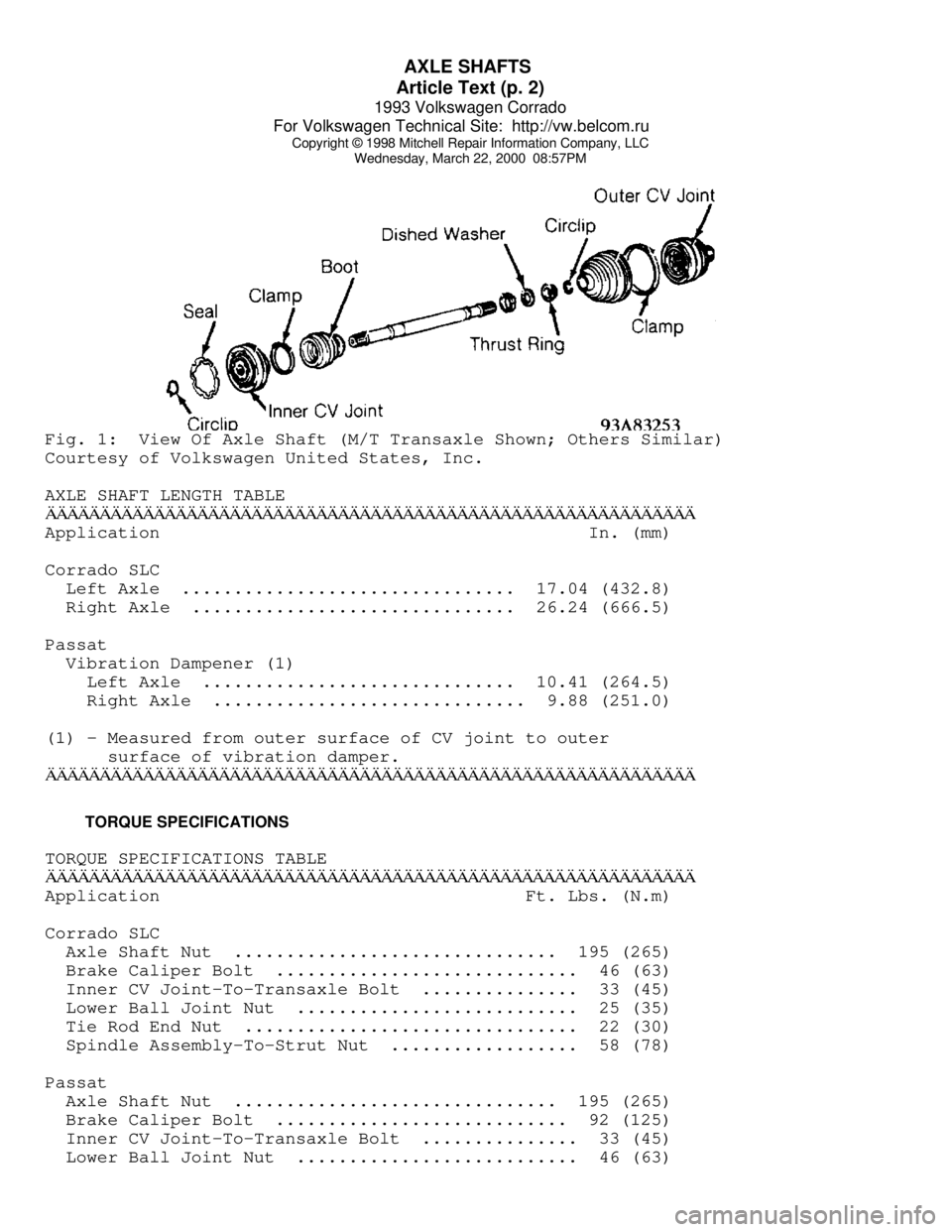
assembly. See Fig. 1.
Disassembly & Reassembly
1) Remove axle shaft boot(s). Using a drift, remove
protective cap from CV joint. Remove circlip from inner CV joint.
Support CV joint with axle assembly on Support Stand (VW 402).
2) Using Driver (VW 408A), press inner CV joint off axle
shaft. DO NOT disassemble inner CV joint, replace complete unit. To
remove outer CV joint, use a driver and hammer to drive CV joint off
axle shaft.
3) Rotate inner race and remove balls. Inspect for galling or
wear. Cover balls with grease and reinstall in race.
4) To reassemble, reverse disassembly procedure. Refer to the
AXLE SHAFT LENGTH table. Use new circlips and boot clamps during
assembly.
Installation
To install, reverse removal procedure. Install new axle shaft
nut. On models with V6 engine, apply locking compound to splines. See
the TORQUE SPECIFICATIONS table.
Page 428 of 920
AXLE SHAFTS
Article Text (p. 2)
1993 Volkswagen Corrado
For Volkswagen Technical Site: http://vw.belcom.ru
Copyright © 1998 Mitchell Repair Information Company, LLC
Wednesday, March 22, 2000 08:57PMFig. 1: View Of Axle Shaft (M/T Transaxle Shown; Others Similar)
Courtesy of Volkswagen United States, Inc.
AXLE SHAFT LENGTH TABLEÄÄÄÄÄÄÄÄÄÄÄÄÄÄÄÄÄÄÄÄÄÄÄÄÄÄÄÄÄÄÄÄÄÄÄÄÄÄÄÄÄÄÄÄÄÄÄÄÄÄÄÄÄÄÄÄÄÄÄÄApplication In. (mm)
Corrado SLC
Left Axle ................................ 17.04 (432.8)
Right Axle ............................... 26.24 (666.5)
Passat
Vibration Dampener (1)
Left Axle .............................. 10.41 (264.5)
Right Axle .............................. 9.88 (251.0)
(1) - Measured from outer surface of CV joint to outer
surface of vibration damper.
ÄÄÄÄÄÄÄÄÄÄÄÄÄÄÄÄÄÄÄÄÄÄÄÄÄÄÄÄÄÄÄÄÄÄÄÄÄÄÄÄÄÄÄÄÄÄÄÄÄÄÄÄÄÄÄÄÄÄÄÄ TORQUE SPECIFICATIONS
TORQUE SPECIFICATIONS TABLE
ÄÄÄÄÄÄÄÄÄÄÄÄÄÄÄÄÄÄÄÄÄÄÄÄÄÄÄÄÄÄÄÄÄÄÄÄÄÄÄÄÄÄÄÄÄÄÄÄÄÄÄÄÄÄÄÄÄÄÄÄApplication Ft. Lbs. (N.m)
Corrado SLC
Axle Shaft Nut ............................... 195 (265)
Brake Caliper Bolt ............................. 46 (63)
Inner CV Joint-To-Transaxle Bolt ............... 33 (45)
Lower Ball Joint Nut ........................... 25 (35)
Tie Rod End Nut ................................ 22 (30)
Spindle Assembly-To-Strut Nut .................. 58 (78)
Passat
Axle Shaft Nut ............................... 195 (265)
Brake Caliper Bolt ............................ 92 (125)
Inner CV Joint-To-Transaxle Bolt ............... 33 (45)
Lower Ball Joint Nut ........................... 46 (63)
Page 440 of 920

BRAKE SYSTEM
Article Text (p. 9)
1993 Volkswagen Corrado
For Volkswagen Technical Site: http://vw.belcom.ru
Copyright © 1998 Mitchell Repair Information Company, LLC
Wednesday, March 22, 2000 08:57PM
TORQUE SPECIFICATIONS
TORQUE SPECIFICATIONS TABLEÄÄÄÄÄÄÄÄÄÄÄÄÄÄÄÄÄÄÄÄÄÄÄÄÄÄÄÄÄÄÄÄÄÄÄÄÄÄÄÄÄÄÄÄÄÄÄÄÄÄÄÄÄÄÄÄÄÄÄÄApplication Ft. Lbs. (N.m)
Caliper Mounting Bolts (1) ........................ 26 (35)
Pad Carrier Mounting Bolt
Front .......................................... 92 (125)
Rear ............................................ 48 (65)
Rear Backing Plate-To-Flange Bolt ................ 44 (60)
Wheel Lug Nut .................................... 81 (110)
INCH Lbs. (N.m)
Wheel Cylinder Bolt ............................... 80 (9)
(1) - Always replace all self-locking bolts.
ÄÄÄÄÄÄÄÄÄÄÄÄÄÄÄÄÄÄÄÄÄÄÄÄÄÄÄÄÄÄÄÄÄÄÄÄÄÄÄÄÄÄÄÄÄÄÄÄÄÄÄÄÄÄÄÄÄÄÄÄ DISC BRAKE SPECIFICATIONS
DISC BRAKE SPECIFICATIONS TABLE (1)
ÄÄÄÄÄÄÄÄÄÄÄÄÄÄÄÄÄÄÄÄÄÄÄÄÄÄÄÄÄÄÄÄÄÄÄÄÄÄÄÄÄÄÄÄÄÄÄÄÄÄÄÄÄÄÄÄÄÄÄÄApplication In. (mm)
Front
Disc Diameter .............................. 11.02 (280)
Original Thickness ........................... .866 (22)
Wear Limit ................................... .787 (20)
Rear
Original Thickness ........................... .394 (10)
Wear Limit .................................... .315 (8)
(1) - Lateral runout is .002" (.05 mm).
ÄÄÄÄÄÄÄÄÄÄÄÄÄÄÄÄÄÄÄÄÄÄÄÄÄÄÄÄÄÄÄÄÄÄÄÄÄÄÄÄÄÄÄÄÄÄÄÄÄÄÄÄÄÄÄÄÄÄÄÄEND OF ARTICLE