light VOLKSWAGEN GOLF 1993 1H / 3.G Service Manual
[x] Cancel search | Manufacturer: VOLKSWAGEN, Model Year: 1993, Model line: GOLF, Model: VOLKSWAGEN GOLF 1993 1H / 3.GPages: 156, PDF Size: 6.36 MB
Page 81 of 156
Downloaded from www.Manualslib.com manuals search engine DRIVING TIPS
Driving a four-wheel drive vehicle*
The drive concept
-h e syncro is equipped with a four-wheel
dri ve whi ch automatically distributes the
jnve force to the front and rear wheels by
eans of a viscous coupling.
n e distribution of the drive
is so regulated
- at in normal driving conditions the front
• heels alway s receive slightly more drive
' h an the
rear wheels.
owever , on very slippery surfaces when
-'l e grip at the front wheels is not adequate
t ransfer the drive to the road , the viscous
:ou pling automatically diverts more drive to
-'le rear wheels.
e four-wheel drive remains
in operation in 'ev erse gear.
Attention The style of driving must always be adapted to suit road surface and traffic conditions. The increased safety offered by this type of vehicle must not encourage one to take unnecessary risks.
In particular, one must always remember that the braking ability is limited by the adhesion of the tyres on the road surface and no different from a two-wheel drive vehicle. For this reason, one should never be tempted by the good acceleration capabilities, even on slippery road surfaces, into driving too fast. It should be noted that the front wheels can aquaplane when driving at high speeds on wet road. When this happens -contrary to vehicles with front wheel drive only -the start of the aquaplaning is not indicated by a sudden revving up of the engine. For this reason, do not drive too fast, always adapt the speed to the existing road conditions.
What else should be noted?
Using winter tyres
With the four-wheel drive the vehicle has
good traction in winter road conditions even
with the standard tyres. However the use of
winter/all-we ather tyres on
all four wheels is recommended to further improve handl
ing and braking.
Using snow chains
Snow chains must also be used on vehicles
with four wheel drive when snow chains are
obligatory . F urther details about using
snow chai ns are given on page 109
Renewing wheels/tyres
On the syncro all four wheels must always have the same rolling circumference. For
further information see page 107.
Output testing
If any time an output test is to be carried out
on a sin gle axle test stand the propshaft
must be detached
at the front
79
Page 84 of 156
Downloaded from www.Manualslib.com manuals search engine GENERAL MAINTENANCE
Fuel
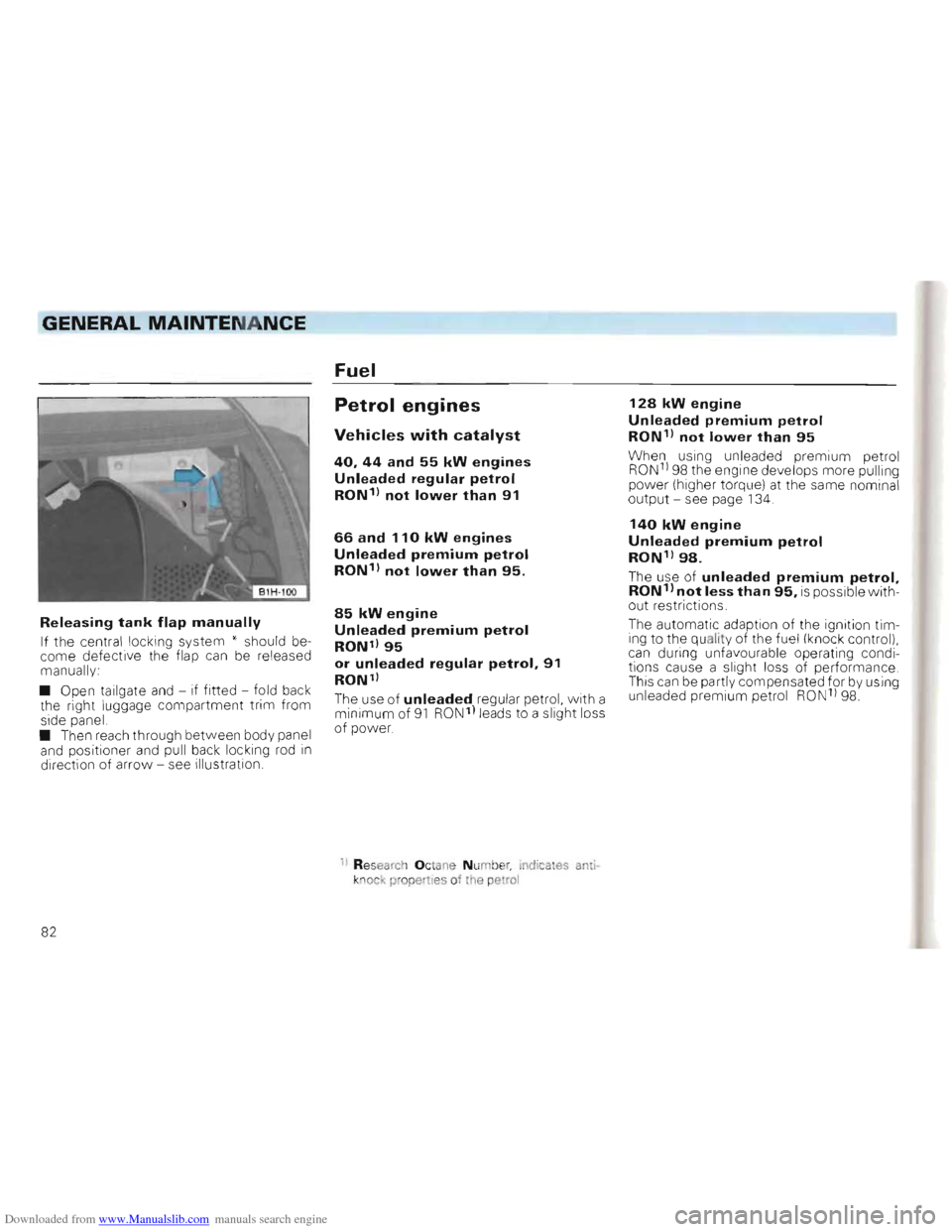
Releasing tank flap manually
If the central locking system * should become defective the flap can be released
manually :
• Open tailgate and -if
fitted -fold back
t he righ t luggage compartment trim from
side panel.
• Then reach through bet
ween body panel
and positioner and pull back loc king rod In directio n of arrow - see Illustration .
Petrol engines
Vehicles with catalyst
40. 44 and 55 kW engines
Unleaded regular petrol
RON1) not lower than 91
66 and 110 kW engines
Unleaded premium petrol
RON1) not lower than 95.
85 kW engine
Unleaded premium petrol
RON') 95
or unleaded regular petrol. 91
RON')
The use of unleaded regular petrol, with a
min imum of 91 RON ') leads to a slight loss
o f power
11 Re se arch O ctane Num b r, indicates anti
k nock properties of the pe rol
128 kW engine
Unleaded premium petrol
RON1) not lower than 95
When u sing un leaded premium petrol RON1) 98 the engine develops more pulling power (higher torque) at the same nominal output -see page 134.
140 kW engine
Unleaded premium petrol
RON') 98.
The use
of unleaded premium petrol. RON1) not less than 95. is possible without restrictions.
The automatic adaption
of the ignition tim
ing to the quality of the fuel (knock control),
can during unfavou rable operating condi
tions cause a s
light loss of performance
This can be partly compensated for by uS ing
un lead ed prem ium petro l RONlI 98 .
82
Page 85 of 156
Downloaded from www.Manualslib.com manuals search engine GENERAL MAINTENANCE
Vehicles without catalytic
converter
44 and 55 kW engines
un leaded or leaded regular petrol
RON') not lower t han 91
66 kW engine
Unleaded or leaded premium petrol
RON') not lower than 95
85 kW engine
Premium petrol unleaded or leaded
RON') 95
or regular petrol unleaded or l eaded . RON1) 91.
The use of u n leaded regular petrol, with a
m inimum of 91 RON1) leads to a slight loss of power .
Research Octane Num ber , indicate s anti
knock properties o f the petrol.
Notes
• Unleaded petrol must comp ly with DIN21 51 607 and leaded petrol with DIN 51 600.
• If i n an emergency the octane rating of
the available petrol is lower than that required by the engine only drive with me
dium engine speeds and low engine load
ing. High engine loading with full throttle or high revs can cause engine dam ag e. Fill tank with petrol of the
correct rating as soon as possible &.., On vehicles with catalytic con
~verter only unleaded petrol may
be used.
Even a single tank of leaded petrol
will reduce the effectiveness of the
catalytic converter.
In the interests of the environment,
unleaded petrol should always be
preferred to leaded fuel. even on ve
hicles without a catalytic converter.
21 Stan dards issued by th e G rman Standards inslltu\l on
Petrol additives
The quality of the fuel has a decisive influ
ence upon the running behaviour, perform
ance and ser v ice life of the engine. The addi
ti ves which are mixed into the petrol are of particular sign ificance. One is advised
theref ore only to use good quality petrol containing additives.
If such fu el is not available, or if eng ine troubles such as starting difficulties, stall ing during idling, vibratio n and loss of power
occur, the approp riate additives should be mixed with the petro l w hen filling the tank.
These additives have an anti-corrosion ef
f ect, clean the fuel system and prevent de
posits building up in the engine.
Petrol additives available
in accessory
outlets have not all shown themsel ves to be effective. Ther efore additives which have been tested for Volkswagen engines are
available from Volkswagen dealers in Germany and in many export countries . The Volks wagen dealers are also informed with
r e gard to the use of additives , and they
kno w what to do in cases where deposits have already built up.
83
Page 88 of 156
Downloaded from www.Manualslib.com manuals search engine GENERAL MAINTENANCE
W ashing the vehicle by hand
~In the interests ofe n vironmental ~protection the vehicle s hould only be washed in specially provided wash bays. In some districts, washing cars elsewhere may even be forbidden .
First soften the dirt
with plenty of water and
rinse off as well as possible.
Th en clean the car with a soft sponge, glove
or brush starting on the roof and going from
t o p to bottom using only slight pressure.
Pain t sham poo should only be used for very
p ersis tent dirt.
Rinse the s ponge or glove out thoroughly at
s l
lort intervals.
Wheels and sill panels should be cleaned
last, using a different sponge if possible.
After clea nin g the vehicle, rinse thoroughly
with water and leather it off.
Notes
• The vehicle should not be washed In strong sunshine.
• If the vehicle
is rinsed with a hose, do not
direct the jet of water at the lock cylinders
- they can freeze up in the winter.
Washing vehicle with high pressure
cleaner
• The operating instructions for the high
pressure cleaner must be followed closely
- particularly with regard to pressu re and working distance.
•
Do not use a concentrated Jet. • The water temperature must not be
above 60°e.
Attention
Tyres must never be cleaned with
a concentrated jet! Even at a rela
tively large working distance and
a very short spraying time, dam
age can occur.
Waxing
A good coat of "vax pro tects the vehicle
paintwork to a large extent again st the envi
ronmental influences listed under "Washing" on the previous page an d even against
light mechanical damage
At the latest
when water on th e clean paint
does not form small drops an d roll off, the
vehicle should be protec te d b y applying a
coat of good hard wax. Even when a wax
solution
is used regular ly in the washing water it is advisable to prote ct th e paint vVlth a coat of hard wax at least twice a year.
Polishing
Should only be done if paint has lost its
shine and gloss cannot be brought back
with wax. If the polish used does not con
tain preservative compounds, th~ pain t must be waxed afterwards.
Note
Matt painted and plastic parts should
not be treated with pol is h or hard wax.
86
Page 89 of 156
Downloaded from www.Manualslib.com manuals search engine GENERAL MAINTENANCE
Paint damage
Small marks in the paint su ch as scratches
or stone damage should be touched up im
mediately with paint (Vol kswagen touch-up
stick or spray can) before the meta l starts to
rust.
H
owever, should rust be fou nd at any time it must be remo ved thoroughly and then the
area treated first with an ant i-corrosion
p rimer and then the correct pain t applied .
Y
ou can of course have this work done by a
V olkswagen dealer.
T he number of the original vehicl e paint
is given on the data sticke r (see page 147 )
Windows
Remov e sno w and ice from w indows and mirrors with a p lastic scraper only To avoid
s cratches due to dirt on the glass , the
s c raper should only be pushed in one direc
t ion and not moved to and fro.
Traces of rubber , oil, grease or silicone can
b e remo ved with a window cleaning solution or a si lic one remover.
- he
windows sho uld also be cleaned on the
n side at regular intervals.
0 0 not dry the w
indows with the leather
u sed for the paintwork because traces of paint cleaner wil l cause streaks to appear on the glass.
To avoid damaging the heating element wires in the rear window do not put
stickers over the wires on the inside.
Door, boot and window
weatherstrips
The w eatherstrips will rema in fle xible and last longer if the y are rubbed lightly with a
rubb er protec tive compound from time to
time . This will also stop the weatherstrips
from freezing on in the w inter.
Plastic parts and leatherette
Exterior plastic parts are cleaned with normal w ashing and interior parts wit h a damp
cloth. If this is not suff ic ient. these parts and
leatherette may only be cleaned with special solvent-free plastic cleaners.
Upholstery cloth and textile
trim
Upho ls tery cloth and textile trim on door
panels, parcel shelv es, lu ggage compart
ment co vers , h eadlining ete.
must be cleaned with special cleane rs or dry foam
and a soft brush .
Leather
Le athe r shou ld, depe nding on usage, be
treated from time to tim e in ac cordance with the follo wing instruc tions. It mus t be
not ed t hat on no account may solvents,
f loor w ax, shoe polish, spot remo vers and similar products be used for this purpose.
For the norma l clean ing of leather covered
steering wheels, seat upholstery etc . a cot
ton or woollen cloth lightly moistened
with w ater should be used to clean dirty leath er
surfaces. Dirtie r areas can be cleaned with a mild soap solution (2 dess er t spoonfuls of
a neutral soap to 1 litre of water) . It is essen
t ia l to note that the leather must not be made too wet and that no water seeps
th roug h th e seams . After cleaning, wipe dry with a soft cloth .
F u rthermore we recomme nd th a
t. w ith nor
mal usage, the leat her is treat ed at half
y ear ly interva ls with a special leather care
age nt which can be obtained from Volkswagen dealers. This age nt is to be app lied
very sparingly. After it has dried in, wipe w ith a soft cloth.
87
Page 91 of 156
Downloaded from www.Manualslib.com manuals search engine GENERAL MAINTENANCE
w hen corrosion protected parts are reewed.
dih Because when washing the en~gine petrol, grease and oil deposits are washed off, the dirty water must be cleaned by an oil separator. For this reason engine washing should only be carried out in a workshop or filling station.
\folkswagen dealers have stocks of the
h igh-quality cleaning and prese rvation ma
te rials re commended by the factory and
have the equipment ne cessary to appl y them .
Underseal
The under side of the vehicle is coated with a special compound to protect It from cor
rosion and damage .
H ow ever,
as this protective layer becomes
a m aged when the ve hicle is in use , the
p rotecti ve coating under the body and on
t h e runn ing gear should be examined at de
fi ned inter vals -prefer ably befo re and after the winter season -and any damage made
g ood. Volksw
agen dealers have stocks of the cor
rect compound,
have the necessary equip
ment and are famil iar w ith th e application
proc edure . We advise you ther efore to have
the patching up or additional coating done by a Vol ksw agen dealer.
Note for vehicles with a catalytic
converter
Due to the high temperatures which occur in the afterburning process, additional heat
shi elds are fitted over the catalytic con
v e rter. Underbodysealant must not
be applied to the se shields, the catal ytic con
v erter or the exhaust pies. Remo val of the
heat shields is also not permissible .
Cavity preservation
All cavities on the vehicle which could be susceptible to corros ion are given perma
nent protect ion at the factory.
This coating does not need check i
ng or any
subsequent treatment. Should a small
amount
of wa x run out of the cavities at high
ambient te mperatures it can be re moved
with a plastic scraper and some white spirit.
Note
On no account allow the tail lights to com e
Into contact with dry cleaning solvent.
If the wax which has run out is removed with clean petrol, heed the safety and environmental protection regulations.
89
Page 92 of 156
Downloaded from www.Manualslib.com manuals search engine GENERAL MAINTENANCE
Bonnet
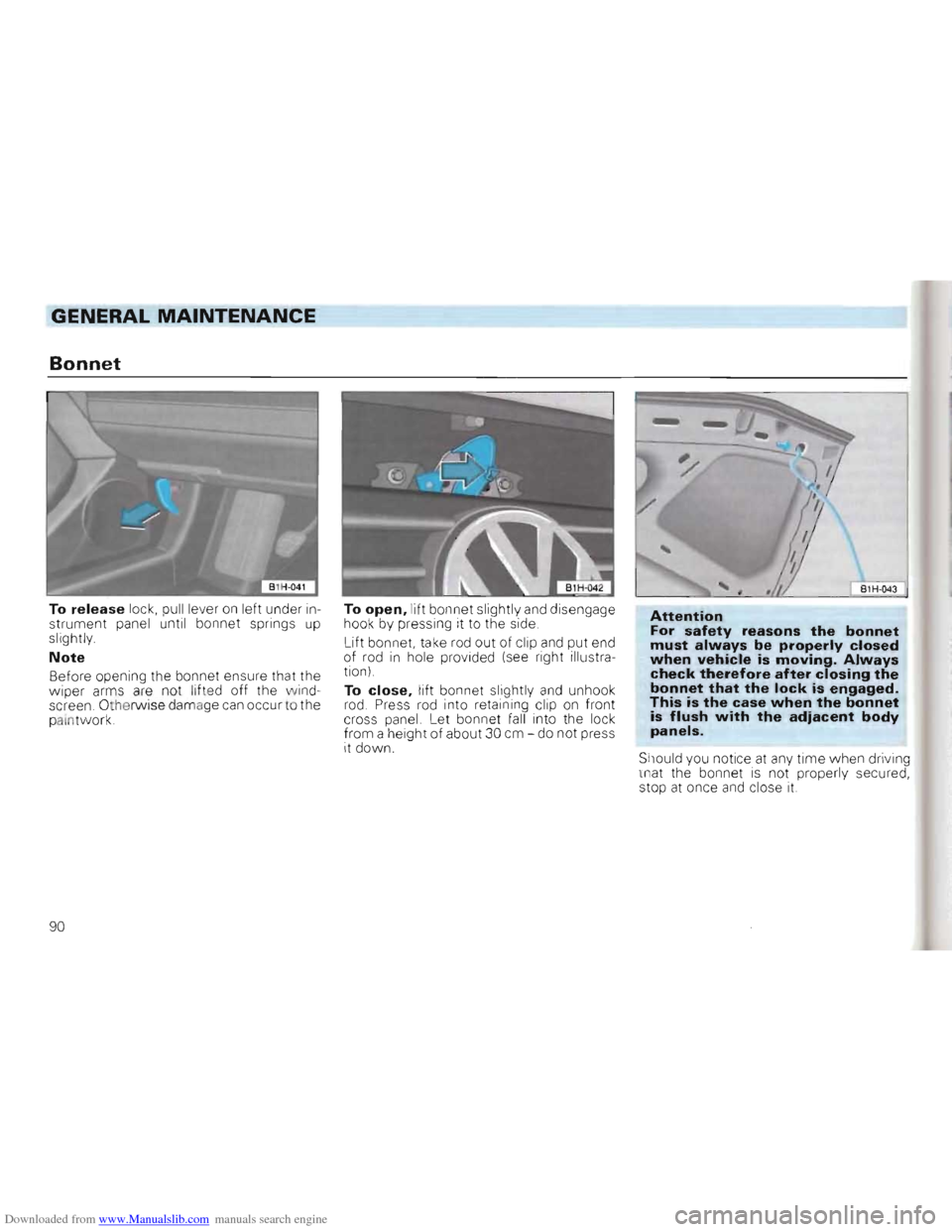
To release lock, pull lever on left under in
strument panel until bonnet springs up slightly.
Note
Before opening the bo nnet ensure that the
wiper arms are not lifted off the wind
screen. Othe rwise damage can occur to the
palntwork. To
open, lift
bonnet slightly and disengage
hook by pressing it to the side.
Lift bonnet, take rod out of
clip
and put end
of rod in hole provided (see right illustra
tion)
To
close, lift bonnet slightly and unhoo k
rod. Press rod into retaining cl ip on front
cross panel. Let bonnet fall into the lock
from a height of about 30 cm -do not press
it down.
B1H -043
Attention For safety reasons the bonnet must always be properly closed when vehicle is moving. Always check therefore after closing the bonnet that the lock is engaged. This is the case when the bonnet is flush with the adiacent body panels.
Should you notice at any time when driving
that the bonnet is not properly secured,
stop at once and close it.
90
Page 99 of 156
Downloaded from www.Manualslib.com manuals search engine GENERAL MAINTENANCE
Cooling system
The cooling system is filled at the factory with a perman ent coolant whic h is not
changed . The coo lant consists of w ater and a 40 % concent ration of our coolant additive
G 11 V8B (anti-f reeze on glycol basi s with
anti-corrosion additives). Thi s mi xture not
only gives the necessary frost prot ection
down to -25°C but also pro te cts the allo y
parts in the cooling system against cor
rosion. In add it ion it pr event s scal ing and raises the boiling point of the coo lant
The concentr atio n of the co olant therefore
must not be reduce d in the summer or in
wa rm countries, by tOPPing up with plain
w ater. The coolant additive proportion must be at least 40 %.
If greater protection against frost is re
qu ired, th e propor tion of G 11 V8B additive
c a n be increased, but onl y up to 60 % (Irost
prot ection to appr ox. -40 Cl. oth erwise the
a n ti-freeze prot ection is red uced and fur
t h ermore the cool ing effec t is im paired .
Vehicles for expor t to cold cou ntries usually
h ave frost protection down to -35°C.
Only our G 11 V8B or an addi tive with the specification TL-VW 774 B (ma rked on container ) should be added to the coolant.
The ad dit ive s can be obtained from Volks
w ag
en dealer s.
Other additives c a n b e very detrimental to the anti·corrosion effect in particular.
The subsequent corro sion damage can lead to coolant loss resulting in major engine damage.
Checking coolant level
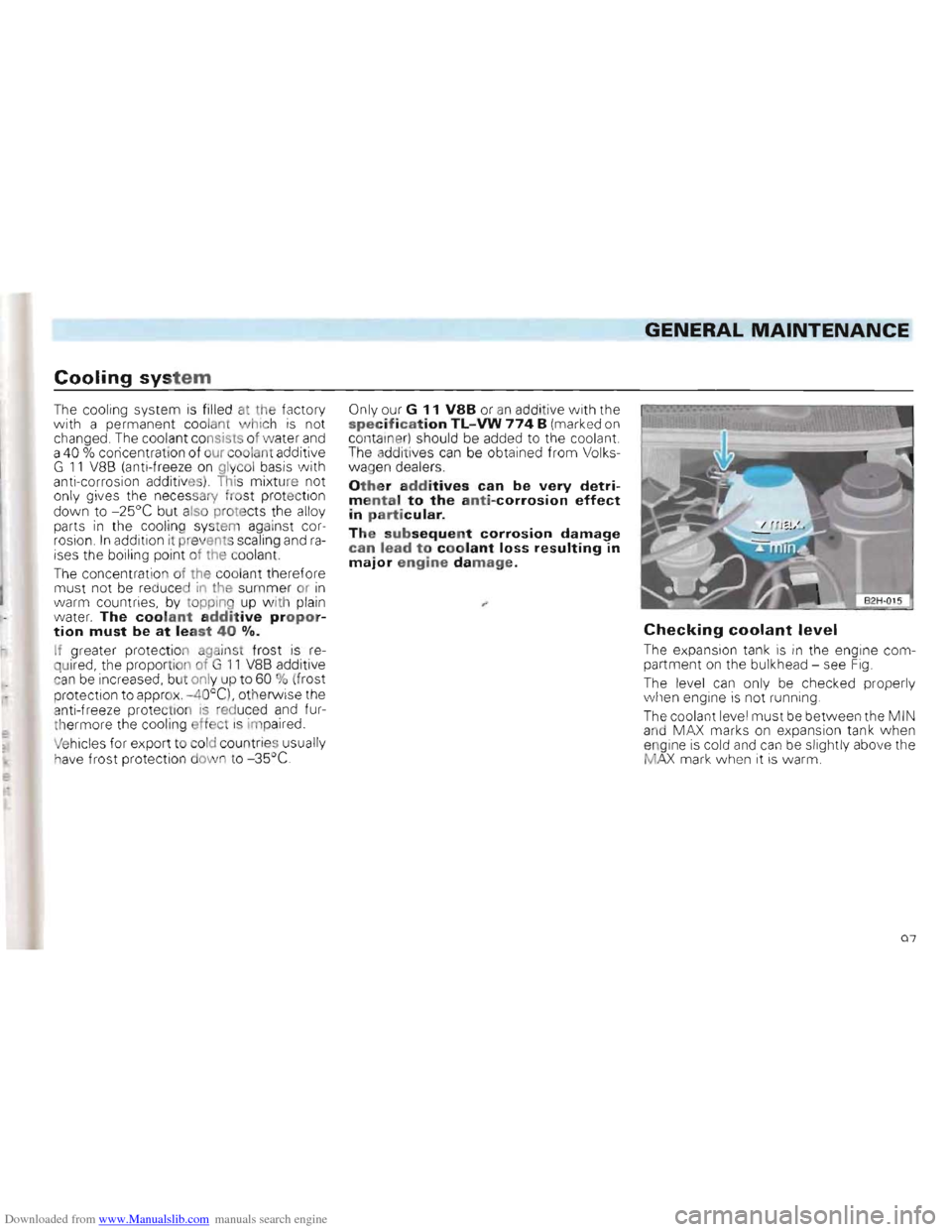
The expansion tank is in the engine com
p artm ent on the bulkhead -see Fig
The level can o nly be checked properly
w he n engin e is not running .
The coo lant level must be bet ween the MIN
and Mt>,X marks on e xpansion tank when
engine is cold and can be slightly above the
MAX mark when it is warm .
07
Page 100 of 156
Downloaded from www.Manualslib.com manuals search engine GENERAL MAINTENANCE
Coolant losses
Coolant loss normally indicates leaks in the
system . In this case the cooling system
should be checked by a Volkswagen dealer
w it h out delay . It is not sufficient merely to
add coolant.
Ii'! ~ ~MI~d ~v~t~m IMMS canonly occur if the boiling point of the coolant is exceeded as a result of overheating, and coolant is forced out of the system.
Topping up coolant
Switch engine off and let it cool down . Then
cover expansion tank cap with a cloth and
turn cap carefully
to the left
and remove.
Attention Do not remove expansion tank cap when engine is hot -Danger of scalding. System is under pressure.
If, in an emergency only water can be added the correct mixture concentration
must be restored with the specified coolant
additive (see previous page) as soon as possible. If
a lot of coolant has been lost.
on l y add cold
coolant after the engine has cooled down.
This will prevent engine damage.
Do not fill above the MAX. mark.
The excess coolant will be forced out
through the pressure rel ief valve in the cap
when engine becomes hot.
Screw cap on again tightly.
Attention The coolant additive and the coolant are a danger to health. The additive must therefore only be stored in the original container well out of reach of children. If the coolant has to be drained at any time it must be caught and also stored in a safe place.
dih Drained coolant should not nor~mally be reused, it must be disposed of, bearing in mind environmental protection regulations.
Fan
The radiator fan is driven electrically and controlled by a thermoswitch from the cool
ant temperature (also from the engine com
partment temperature
on some models).
Attention After the engine has been stopped the fan can continue running for a while -even with the engine switched off -(up to about 10 minutes). It can also start to run again suddenly after a short time if -the coolant temperature increases due to heat build-up
when engine is hot and the engine compartment is heated additionally by strong sunlight.
Special care must therefore be taken when working in the engine compartment.
98
Page 101 of 156
Downloaded from www.Manualslib.com manuals search engine GENERAL MAINTENANCE
Brake fluid
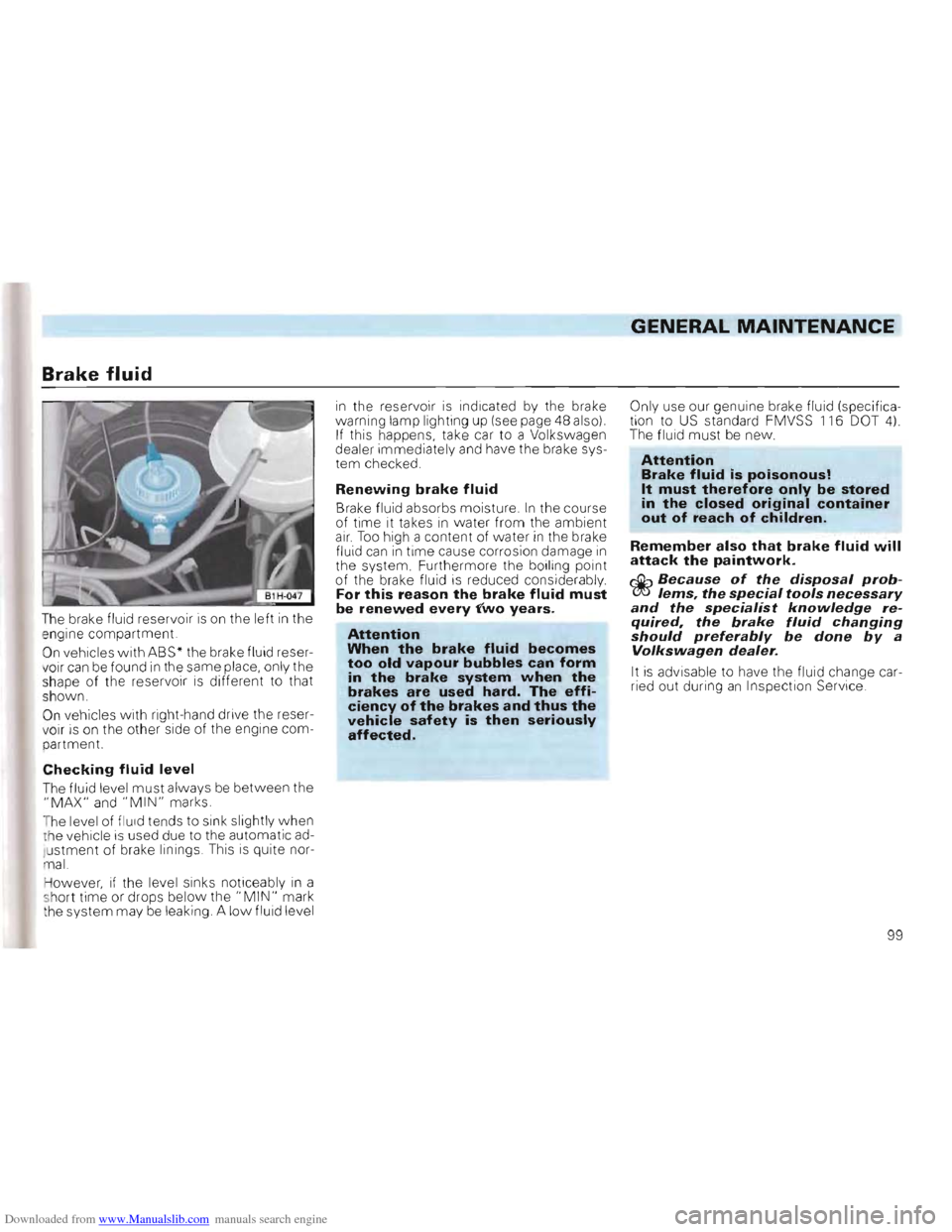
The brake fluid reservoir is on the left in the
e ngine compartment.
O n vehicles with ABS* the brake fluid reser
voir
can be found in the same place, only the
s hape of the reserv oir is different to that
s hown .
O n
vehicles with right-hand drive the reser
voir is on the other side of the engine com
p artment.
Checking fluid level
T he fluid level must always be between the
" MAX" and "MIN" marks.
T he
level of flu id tends to sin k slightly when the vehicle is used due to the automatic adJu stment of brake linings . This IS quite nor
mal.
H owever, if the level sinks noticeably in a
s h ort time or drops below the" MIN" mark
t h e system may be leaking. A low fluid level
in the reservoir is indicated by the brake
wa rning lamp lighting up (see page 48 also)
If this happens, take car to a Volkswagen
dealer immediately and have the brake sys
tem checked.
Renewing brake fluid
Brake fluid absorbs moisture. In the course
of time it takes in water from the ambient air. Too high a content of wa ter in the brake
fluid can In time cause corrosion damage in the system Furthermore the boiling point
of the brake fluid IS reduced considerably. For this reason the brake fluid must be renewed every f'wo years.
Attention When the brake fluid becomes too old vapour bubbles can form in the brake system when the brakes are used hard. The efficiency of the brakes and thus the vehicle safety is then seriously affected.
Only use our genuine brake fluid (spec ifica
tion to US standard FMVSS 116 DOT 4). The fluid must be new.
Attention Brake fluid is poisonous! It must therefore only be stored in the closed original container out of reach of children.
Remember also that brake fluid will attack the paintwork.
,.Q,., Because of the disposal prob
~lems, the special tools necessary
and the specialist knowledge re
quired, the brake fluid changing should preferably be done by a Vo/kswagen dealer.
It is advisable to have the fluid change car
ried out during an Inspection Service.
99