air VOLKSWAGEN GOLF MK6 2012 Owner's Manual
[x] Cancel search | Manufacturer: VOLKSWAGEN, Model Year: 2012, Model line: GOLF MK6, Model: VOLKSWAGEN GOLF MK6 2012Pages: 516, PDF Size: 105.12 MB
Page 111 of 516
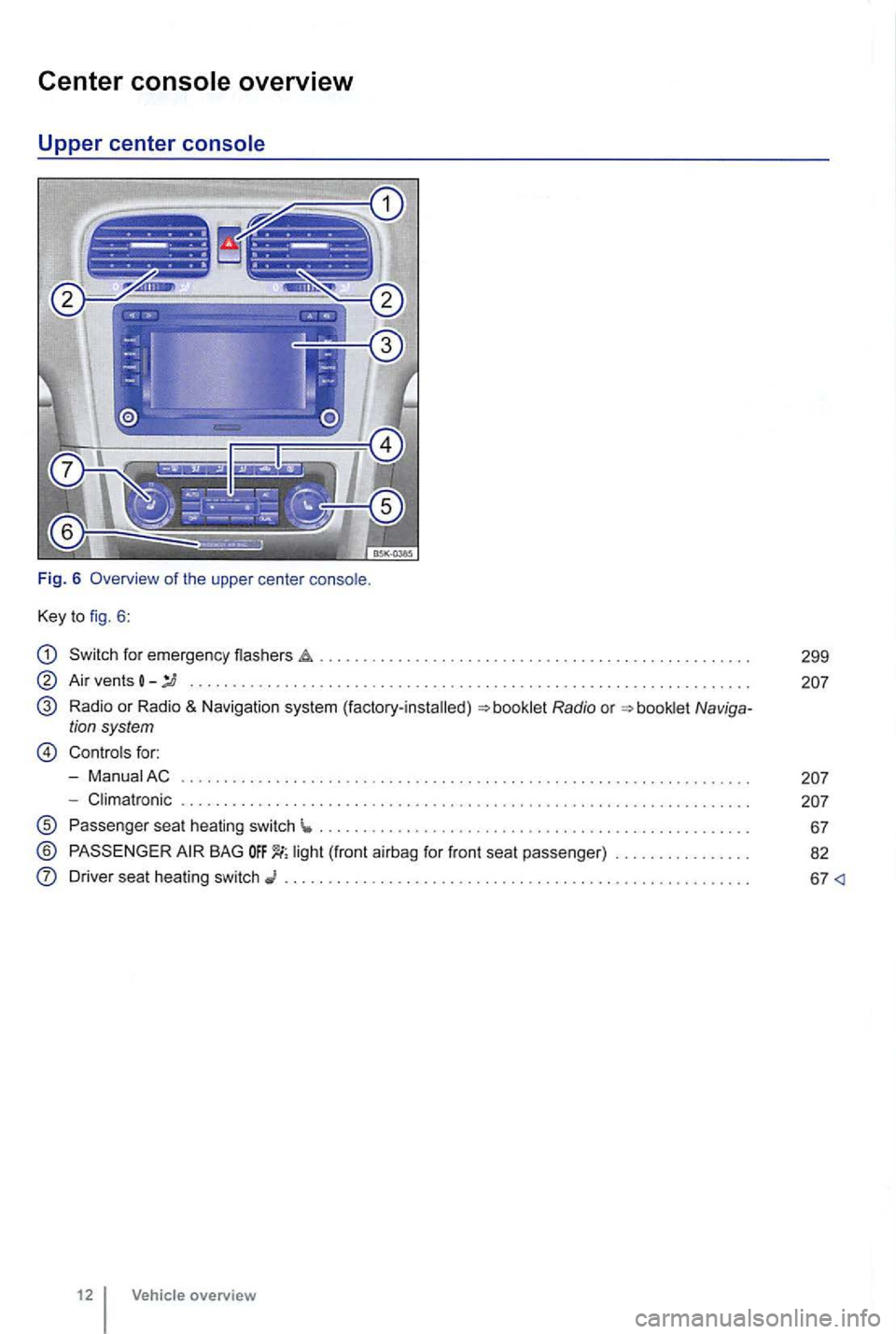
Center
Key to fig. 6 :
Switch for emergency flashers
Air vents -........... ... ..................... .... .. ............ .......... . .
Radio or Radio & Navigation system (factory-installed)
Controls for:
- ManuaiAC
- Climatronic . . . . .
............................................ .
Passenger seat heating switch ...... ........................................ ... .
® BAG
Driver seat heating switch ......................................... .
12 Vehicle overview
299
Page 113 of 516
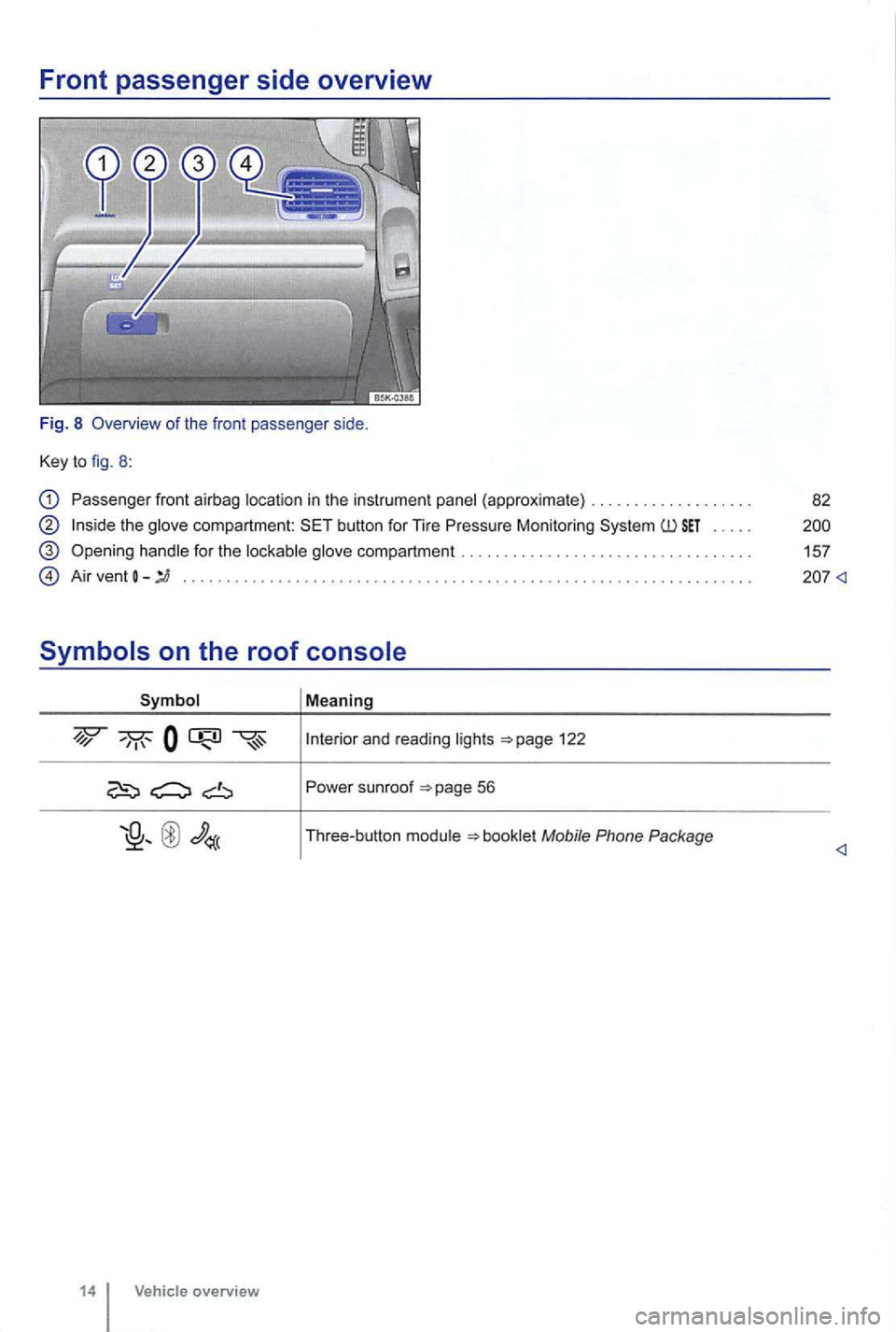
Front passenger side overview
Fig. 8 Overview of the fron t passenger side.
Key to fig. 8 :
Passenger front airbag location in the instrument panel (approxima te) .... .............. .
the glove compartment: button for Tire Pressure Monitoring .....
handle for the lockable glove compartment .
A ir vent
Symbol Mea ning
and read ing lights 122
Po wer sunroof
Page 115 of 516
Refer to
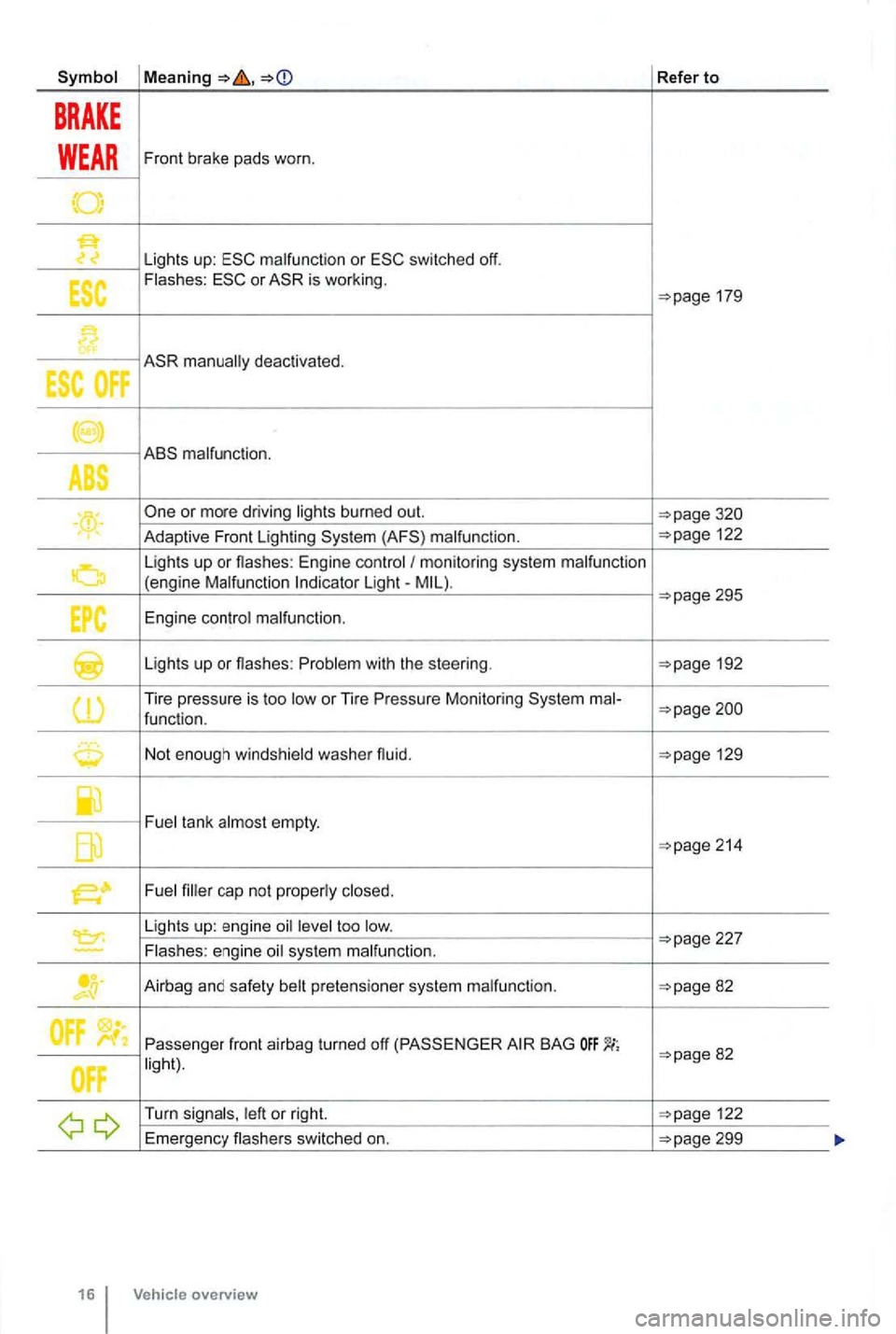
BRAKE
WEAR Front brake pads worn.
Lights up: switched off. or is working.
deactivated.
. 122
Lights up or flashes : Engine monitoring system Light-
Lights up or flashes: with the steering . 192
Tire pressure is too or Tire Pressure Monitoring function.
Not enough 129
tank
cap not
Lights up: engine too 227 -system malfunction .
Airbag and safety
Passenger front airbag turned off BAG
Turn
299
overview
Page 120 of 516
Park the
etc.
Roads and bridges may be dangerously icy
even if the outside air temperature is above freezing .
you use the outside temperature
remember : even
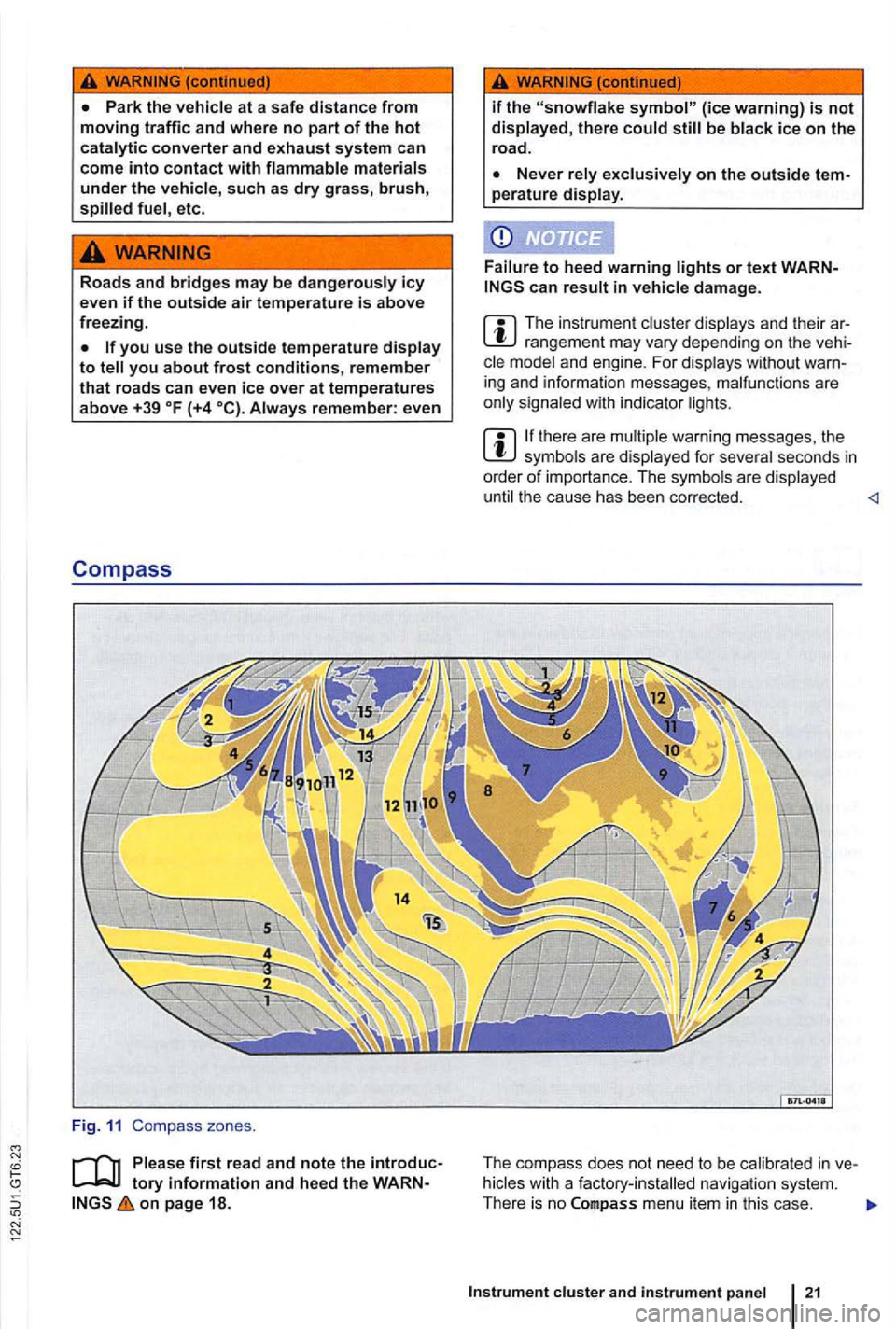
Compass
Fig . 11 Compass zones .
on page 18.
if the be
perature display .
to heed warning or text can in damage .
The ins trum ent rangeme nt may vary depending on the and engine . F or displays without
ther e are warning messages , th e are displayed for
the ca use ha s bee n co rrected.
T he re is no
Instrument cluster and instrument panel 21
Page 136 of 516
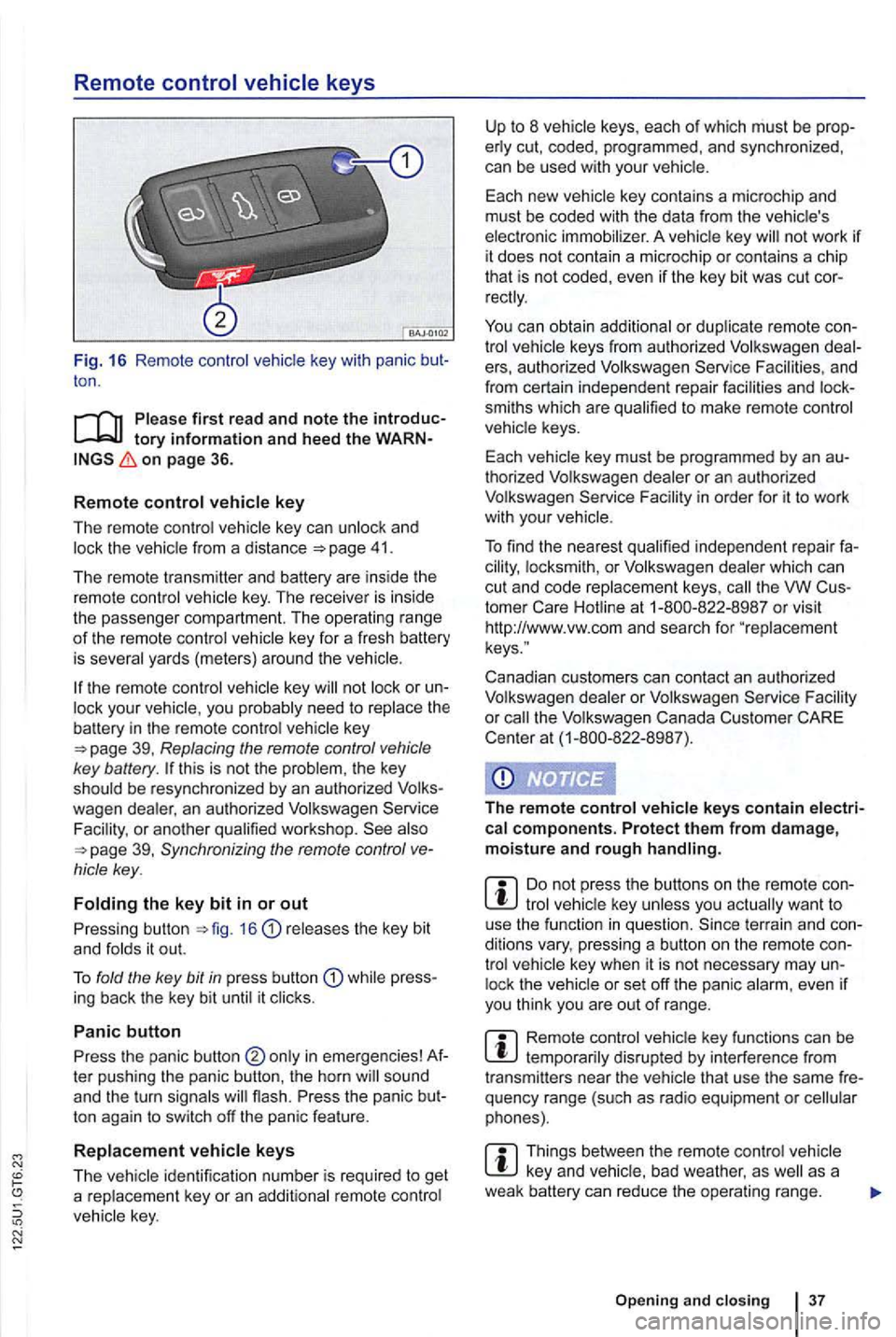
Remote control vehicle keys
Fig. 16 Remote contro l key with panic ton .
on page 36.
R
emot e control key
The remote control vehicle key can unlock and 41.
The remote transmitter and battery are ins ide the
remot e control vehicle key . The receiver is inside
the passenger compartment. The operating ra
nge of th e remote control key for a fresh battery
is severa l yards (meter s) around the
key or your vehic le , you probably need to rep lace the battery in the remote control key
this is not the problem , the key
should be resynchronized by an authorized
39, Synchronizing the remote control
releases the key bit
and fo lds it out.
T o fold the key
bit in press butt on while press
ing back the key bit until it clicks .
Panic button
Press the panic button ter pushing the panic button , the horn
ton again to switch off the panic feature .
R
eplacement vehicle keys
The
not work if it does not contain a microchip or contai ns a chip
th at is not coded, even if the key bit was cut
keys from authorized Volkswagen e rs, au thorized Volkswagen Service and
from certain independent repair facilities and
smiths which are qualified to make remote control
vehicle keys.
Each vehicle key must be programmed by an
thorized Volkswagen dealer or an au thorized
Volkswagen Service
th e VW
Canadian customers can contact an authorized
Volkswagen dealer or Volkswagen Service
the Volkswagen Canada Customer CARE
Center at (1-800-822 -8987).
The r
emote control vehicle keys contain electrical components. Protect them from damage, moisture and rough handling.
tro l lock the
Remote control disrupted by interferenc e from
transmitters near the vehicle that use the same
Things between the remo te control vehicle as a
weak battery can re duce the opera ting range.
Open ing and clo sin g 3 7
Page 157 of 516
Adjusting the seating position
Introduction
this section find inf ormation about:
Examp les
of improper seat ing pos itions . . . 59
Pr ope r seating position . . . . . . . . . . . . .
Manual contr ols on the driver and passe nger
seat . . . . . . . . . . . . . . . . . . . . . . . . . . . . . . . . . . . 61 Ele ctrica l co ntr ols o n the driver and front
passenger seats . . . . . . . . . . . . . . . . . . . . . . . . 62
Adj ustin g
the head restra ints . . . . . . . . . . . . . 63
R emoving and re in stalling head restraints . . . 64
Adj usting the stee
ring whee l position . . . . . . . 65
Cen te r armrest . . . . . . . . . . . . . . . . . . . . . . . . . . 66
Number of seats
Th e vehicle
has a t otal of 5 seat ing posit ions: 2 in front and 3 in the rea r. Eac h seating pos ition has a
safety belt.
More information:
funct ions 67
page 69
Ai r ba g syste m 82
safety and child restraints
WARNING
Improper seat ing pos itions increase the risk of severe or fatal injuries in a crash or other accidents,
times .
Never
Always secure children in the vehicle with a n approved and suitable restraint system appropriate for their age, weight, and height 82 .
Always keep your feet on the in front of the seat. Never rest them on the seat,
Always adjust seat , safety belts, and head straints properly before driving and make sure that
inches (25 em) betw een the front pa ssenger' s breastbone and the in strument panel.
ches (25 em) between your breastbone and the steering wheel.
Adjust the driver's seat so that you can push the pedals while keeping your knee(s) slightly bent. The
di stance to the instrument panel in the knee
a rea must be at least 4 inche s
these requirements cannot be met for physical reason s, contact an authorized
Volk swagen dealer or an auth orized gen Facility to see whether adaptive equipment is avai la bl e.
Always hold the steering wheel on the side of the steering wheel rim with your hands at the 9 o'clock and 3 o'clock positions to help reduce the risk of personal injury if the driver's airbag inflates .
Never hold the steering whee l a t the
12 o'clock position or with your hands at e r places inside the steering whee l rim or on the steering wheel hub. Holding the steering wheel the wrong way can cause serious rie s to the hand s, arm s, and head if the
Pointing the steer ing whe el t oward your face dec reases the of the driver's bag to h elp protect you in a
Never drive with backrest s reclined or ed back farthe r than necessary to drive
Page 158 of 516
ment area is clear .
on page 58.
No t wea ring or imp rope
rly fastening safety belts creases the risk of seve re o r fatal injuries . Safety
be lts can work only w hen they are p roperly tioned on th e body . An improper seating pos itio n
significan tly impai rs the protection provided by safety belts. Thi s can cause severe or even fatal
inj uries . seating positions also increase
the ris k of ser iou s in jury o r de ath when an airbag
dep loys and strikes an occ upant who is not in the
proper seating position. The driver is respo nsible
f or all passengers
and espec ially c hildren riding in th e vehicle.
T he following are only some examples
of seating
posi tions that will increase the risk of s eri ous injury or death.
Therefore, whenever the vehicle is moving:
Never sit on the edge of the seat.
Never sit sideways.
Contact with parts of the vehicle interior can cause serious personal injury in a crash.
Page 159 of 516
first rea d and note the introductory information and hee d the WARNon page 58.
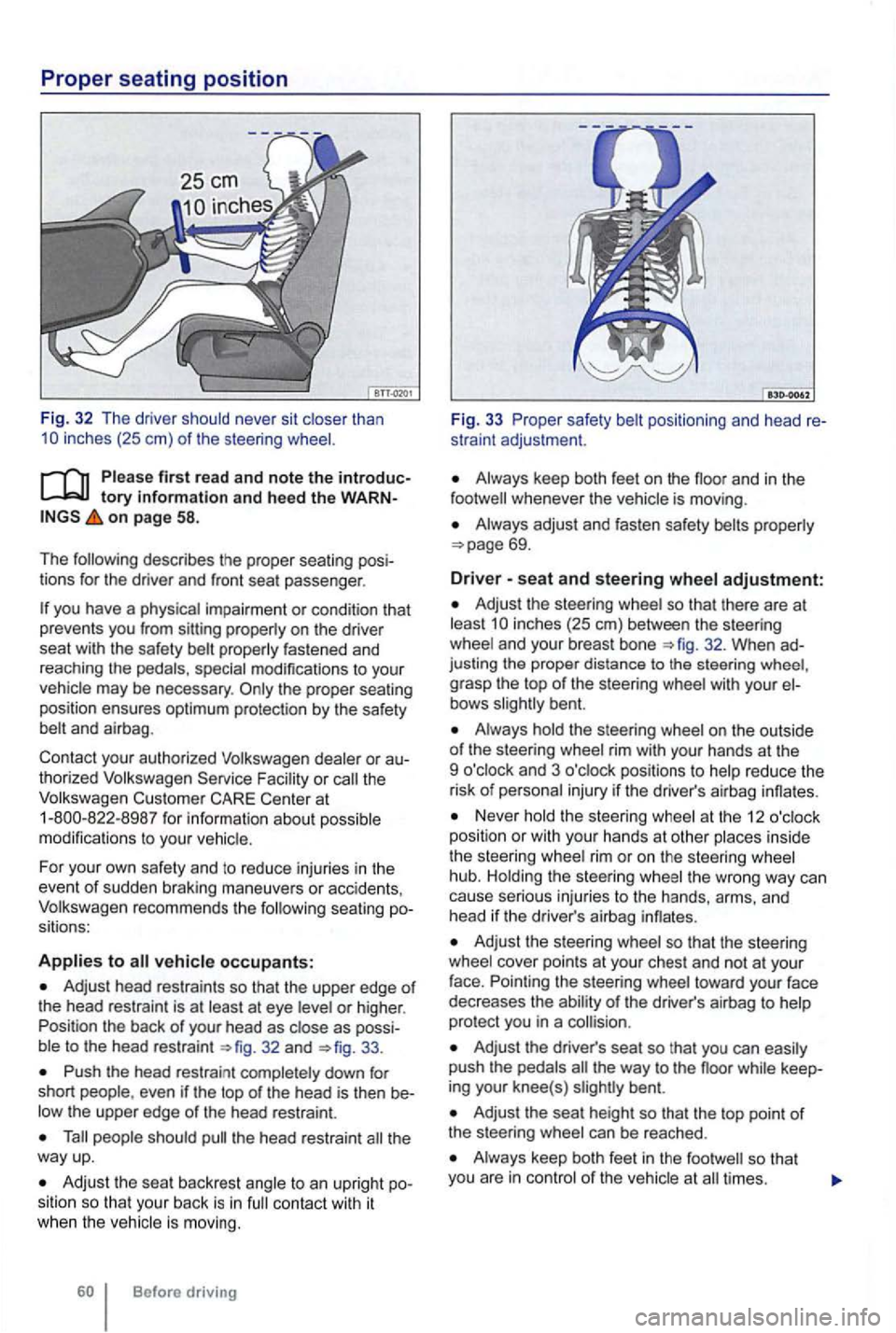
The following describes the proper seating posi
tions for the driver and front seat passenger .
special modifications to your
vehicle may be necessary .
to
Adjust head restraints so that the upper edge of the head restraint is at least at eye
32 and 33.
Push the head restrai nt completely down for
short even if the top of the head is then be
people should the head restraint the way up.
Adjust the sea t backrest angle to an upright position so that your back is in contact with it when the veh icle is moving.
Before driving
Fig. 33 P roper safety
Always keep both feet on the whenever the vehicle is moving .
Always adjust and fasten safety belts properly
adjustment:
Adjust the steering whe el so that there are at least inches (25 em) between the steeri ng
wheel and your breast bone
grasp the top of the steering wheel with your bent.
Always hold the steering wheel on the outside of the steering wheel rim with your hands at the
9 o'clock and 3 o'clock positions to help reduce the
risk
of personal injury if the driver's airbag innates.
Never hold the steering wheel at the 12
and
head if th e driver's airbag innates.
Adjust the steering wheel so that the steering
wheel cover points at your chest and not at your
face. Pointing the steer ing wheel toward your face
dec reases the ability
of the driver's airbag to help
protec t you in a
Adjust the driver's seat so tha t you can easily push the pedals the way to the noor while keep
ing your knee(s) bent.
Adjust the seat height so that the top point o f
the steering wheel can be reached .
Always keep both feet in the times.
Page 164 of 516
Driving without head restraints or with properly adjusted head restraints increases
the risk of serious injuries in a
tory information and heed the on page 58.
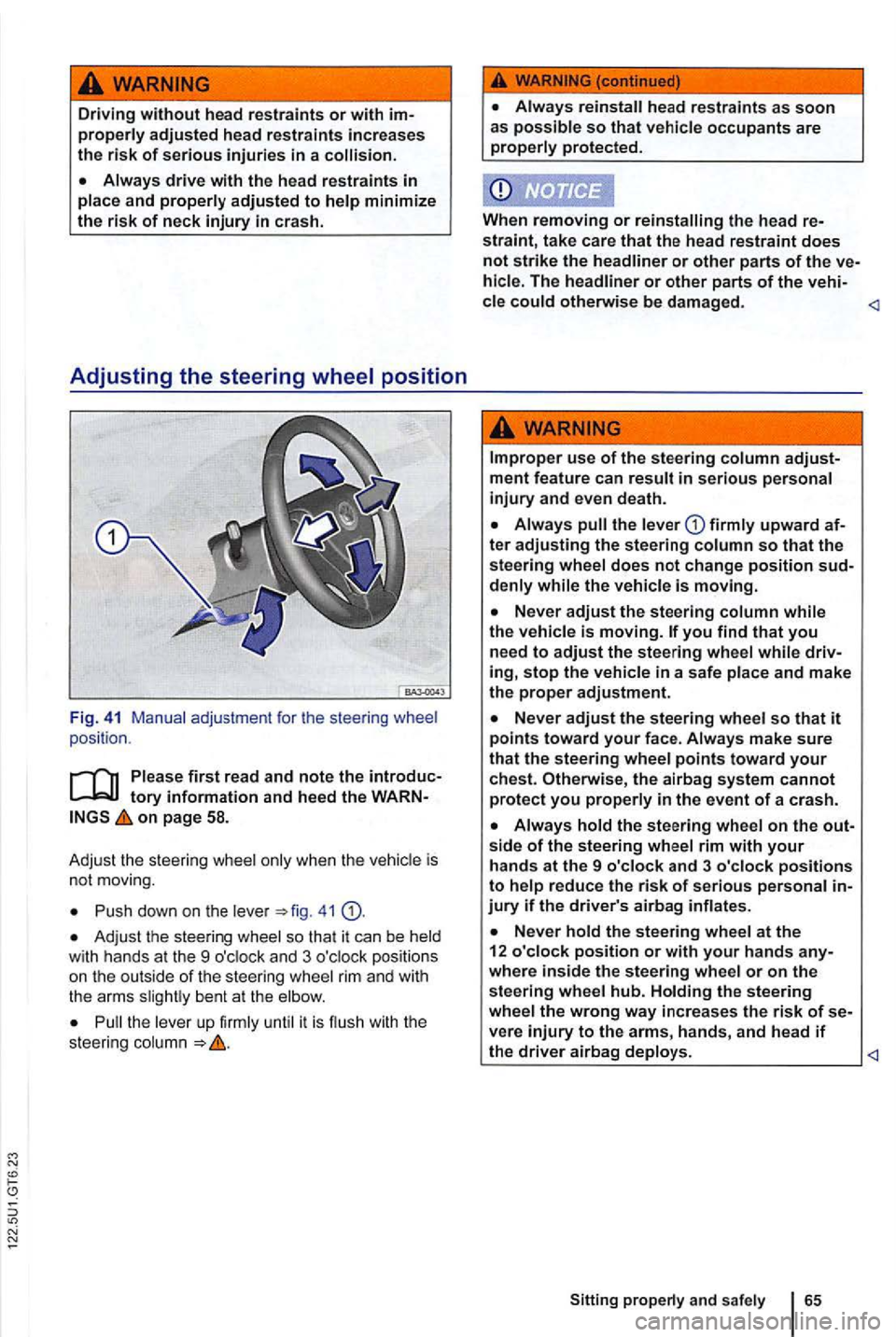
Adju st the steerin g whee l only w he n the veh icl e is
no t m ovi ng.
Push dow n o n the leve r 41
Adj ust th e steering whee l so th a t it ca n b e held w ith hands at the 9 o'cloc k and 3 o 'clock positio ns
o n the out side of the steering wheel rim and with
t he arms slightl y b ent at the elbow .
Pull the leve r up firml y until it is flu sh with th e
stee ring colum n
the lever
denly while the vehicle is moving.
Never adjust the steering wheel so that it points toward your face . Always make sure that the steering wheel points toward your chest. Otherwise, the airbag system cannot protect you properly in the event of a crash.
side of the steering wheel rim with your hands at the 9 o'clock and 3 o'clock positions to help reduce the risk of serious personal
where inside the steering wheel or on the steering wheel hub. Holding the steering wheel the wrong way increases the risk of vere injury to the arms, hands, and head if the driver airbag deploys.
Page 166 of 516
this section find information about:
. . . 67
More information:
Adjusting the seating position 58
69
Airbag system page 82
safety and restraints
Outside mirrors 134
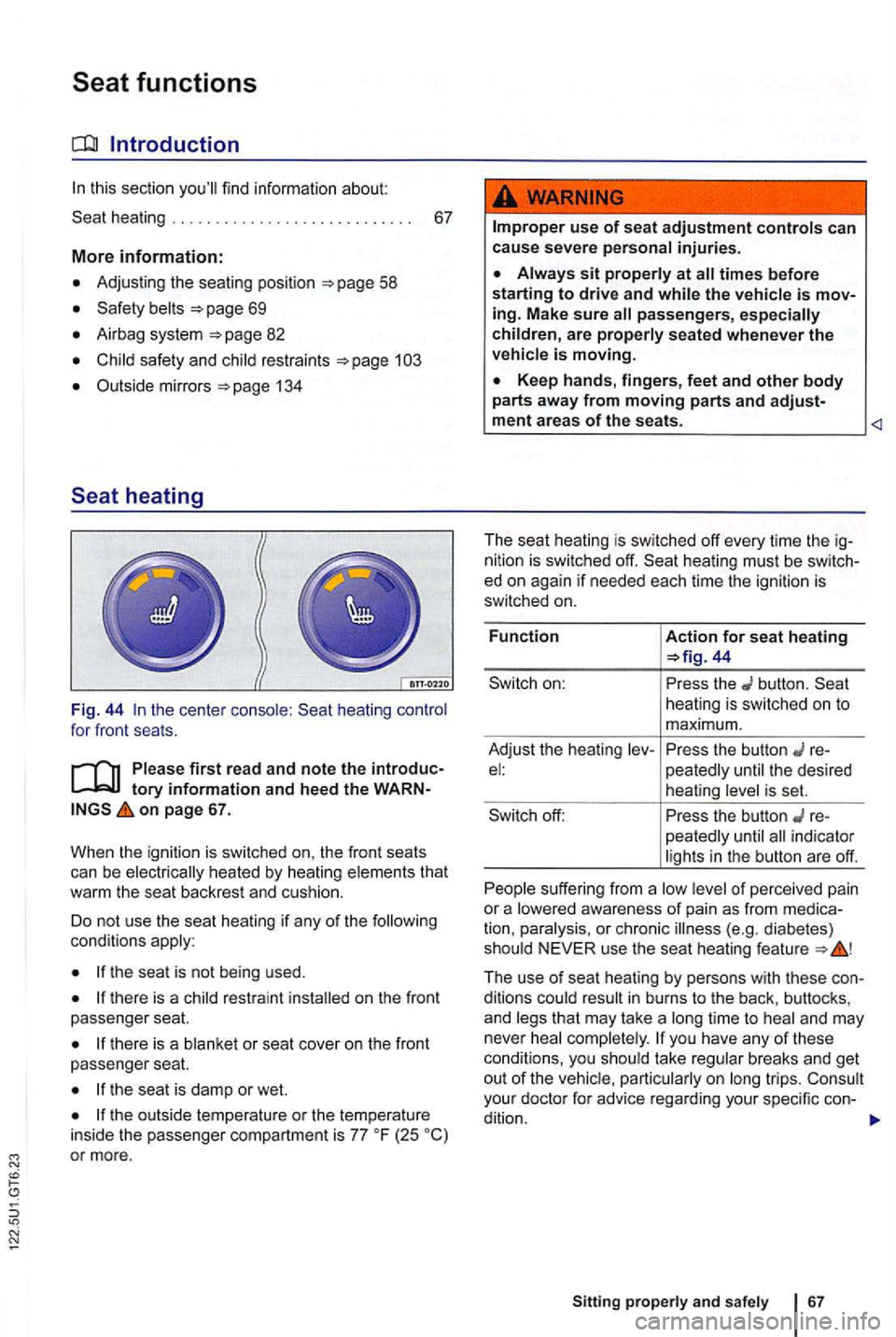
the cente r heating for front seats.
on page 67.
When the igni
tion is sw itched on, the front seats
can be that
wa rm the seat backrest and cush ion .
Do not use the seat heating
if any of the cond itions
the sea t is not being used.
on the front
passenger seat.
there is a or seat cover on the front
passenger seat.
the seat is damp or wet.
(25 or more .
use of seat adjustment controls can
cause severe personal injuries.
passengers, especially
children, are properly seated whenever the
44
button. heating is sw itched on to
m aximum.
Adjust the hea ting
re-the desired
heating
the button re
peatedly indicator
s uff ering from a of perce ived pain
or a
The use of seat heating by persons with these conditions time to and may
never
take breaks and get out of the trips. your docto r fo r advice rega rding your specific con-
dition.
Sitting a nd 67