lock VOLKSWAGEN GOLF PLUS 2004 Owner's Manual
[x] Cancel search | Manufacturer: VOLKSWAGEN, Model Year: 2004, Model line: GOLF PLUS, Model: VOLKSWAGEN GOLF PLUS 2004Pages: 541, PDF Size: 98.86 MB
Page 59 of 541
Prope r sea ting posit ion
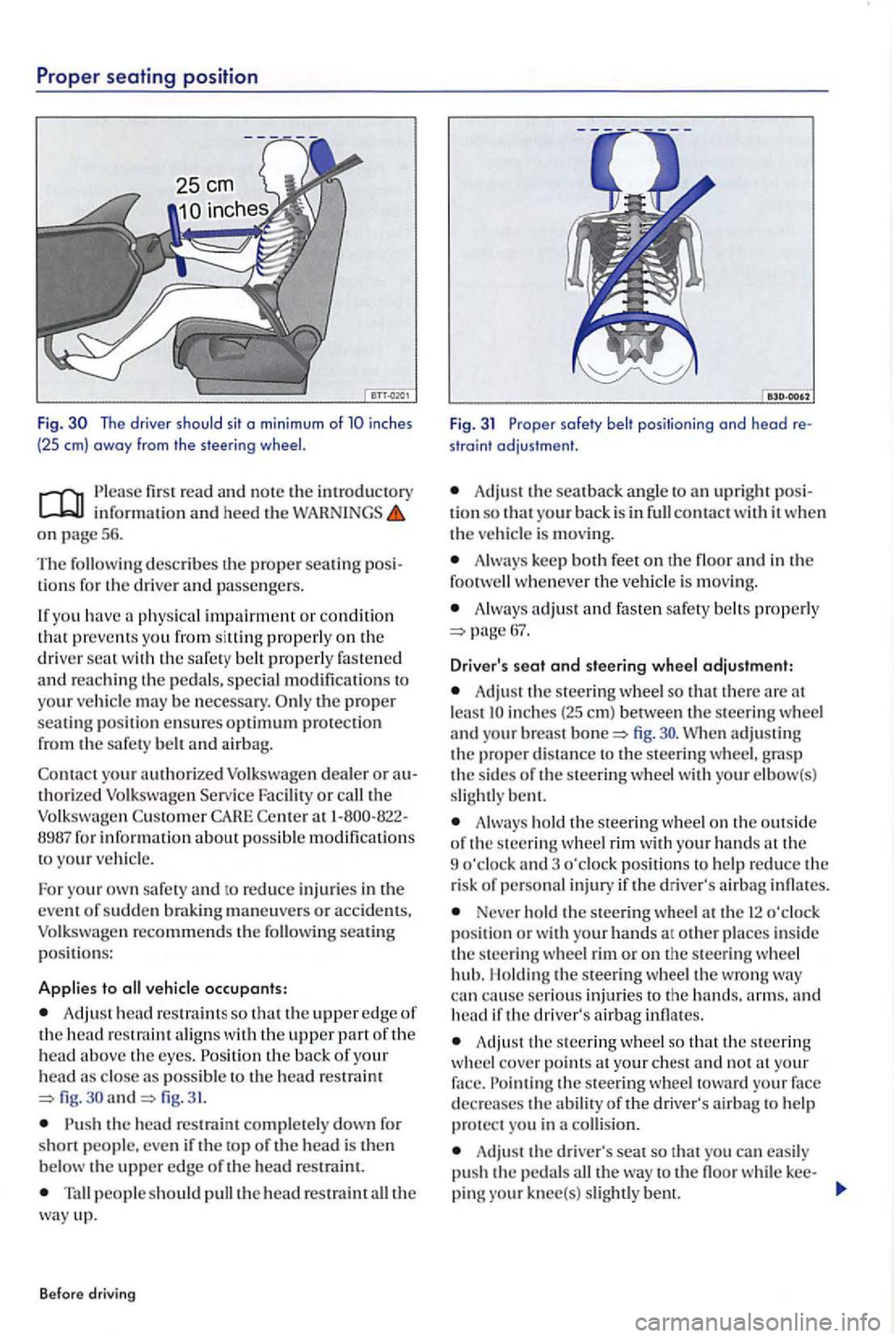
Fig. The driver should sit o min imum of inches
(25 em) away from the steering
first read and note the introductory information an d heed the WARNINGS on page 5 6.
Th e
describes th e proper sea tin g lio ns for the driver and passengers .
If yo u hav e
physical impairment or condition that preve nts you from siltin g properly on the driver wit h the safe ty belt properly fastened and re a ching th e pedals, special modificatio ns to
your ve hicle may be necessary. p roper seating positi on ensures optimum protection from the safety belt and airbag.
Con t
act yo ur authorized Volkswagen dealer o r authorized Volk swage n Serv ice Facility or the Volkswagen Custo m er CAHE Cente r 1-800-822-
8987 fo r informati on about poss ible modification s
t o your ve hicl e.
F o r yo u r
own safety and to reduce inj urie s in the
event of sudde n brakin g maneuve rs or accid ents, Volkswagen recommends the seating p o siti ons:
Applies to vehicle occupants:
Adj ust head re straint s so that the upper edge of the head restraint aligns with the upper part of the head above th e eyes . the ba ck of your head close as poss ible fig. and fig. 31.
the head re straint completely down fo r
short people. eve n if the top of th e head is the n
b elow the uppe r edge o f the head re strai nt.
people s ho uld pull the head restraint the way up.
Before driving
Fig. 31 Proper safety belt positioning ond head re
straint adjustment.
Adjust the sea t back ang le to upri ght posi
tion so that your back is in conta ct w ith it w he n the vehicle is moving.
Alw ays keep both feet on th e floor a nd in the
foot whenever the vehicl e is mov in g.
A lway s adjust a nd fasten safety belt s pro perly
A dju st the steering wheel so that the re are lea st fig .
Always ho ld th e s teering wheel o n the out sid e
o f th e s teerin g wheel rim with your hands the
9 o'cloc k and 3 o'cloc k pos ition s to help re duce the
r is k of personal injury if the driver' s airb ag infl ates.
Never ho ld the steering wheel a t th e 12 o'clock position or w ith your hands at ot her places in side the steerin g wheel rim or o n the steerin g whee l
hub. l lo ldin g the steerin g w hee l the wro ng can cause se rious injurie s to the arms. and head if the driver's airbag infl ates.
Adju st the s teerin g wheel so that the s teerin g
w heel cove r points the ste erin g wh ee l toward your face
d ecrea ses the abilit y of the driver's airba g to help protect you in a collision.
Adju st the driver's seat so that you can easily
pu sh the pedal s the way to th e floo r while kee-
pin g knee(s) slightl y bent.
Page 63 of 541
Removing and head restraints
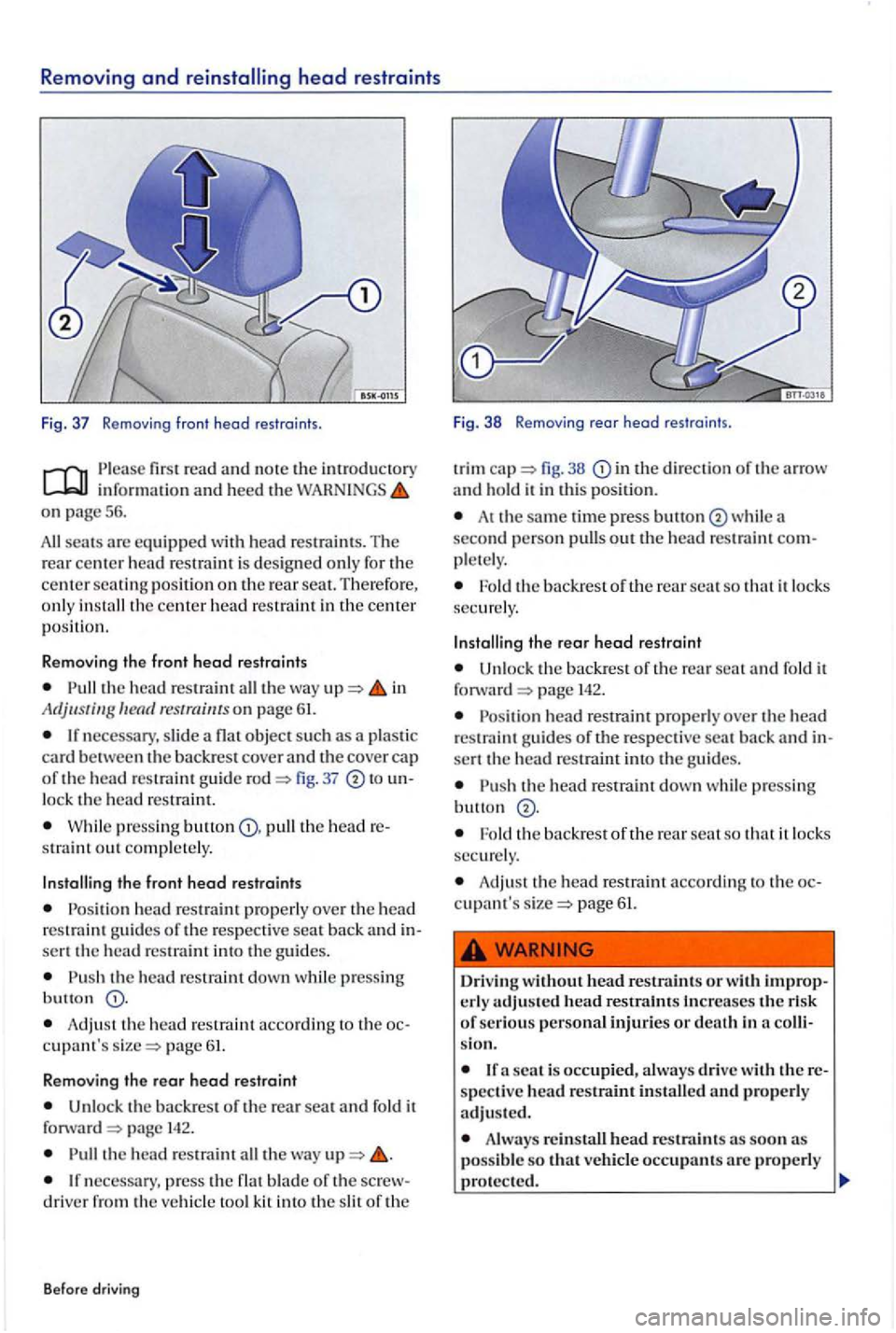
Fig. 37 Removi ng fro nt head restr aints.
read and note the introduc tory informat ion and heed the on page 56 .
scats arc equipped with head restrain ts . The rear c e nt er h ead restrai nt is des igned onl y fo r the ce nter seat ing positi on on th e rear sea t. Th erefo re ,
o nl y
the head re straint the wa y in Adjustin g res traints on page 61.
necessary , slide object su ch a s a pla sti c
ca rd be tween the backre st cover and the co ver cap
of the head restraint g uid e 37
W hil e pres sing pull the head straint out compl ete ly .
the front head restraints
P o sition head restrain t prop erly ove r th e head
r e s tr ain t gu ides of th e respective seat back and sert the head rc s trai m into th e g uid es.
the hea d restraim down whil e pressin g
but to n
Adjust the h ead re strai nt acco rding to the c upant's page 61.
Removing the rear head restraint
Unlock the backrest o f th e re a r seat and fold it
f orward p age
th e head re straint th e wa y
necess ary, pre s s th e flat blade of th e drive r from th e ve hicle too l kit into the s lit of th e
B efore driving Fig
. 38 Remov ing r
ear hea d restra in ts .
trim in the direction o f th e arrow and hold it in thi s posit ion.
At th e same time press bullon second person pull s out th e head restraint
th e backrest of th e rear scat so that it lock s
secure ly.
the rear head restraint
Un lock the backrest of the re a r scat fo ld it
f o rward page 14 2.
h ead restraint prop erly ove r th e head restra int guides of th e re spective sca t back and sert the head restraint into the g uide s.
the head res traint down whil e p ressin g
Fold the backres t of the rear seat so that it lo cks secure ly.
Adju st th e head re straint a ccord in g to the page 61.
Driving without head restraints or wit.h crly adjusted head restra .lnts Increases the ri sk of seriou s personal injuries or death in co
scat is occupied, always drive with
Always reinstall head r estraints as soon possib le so that veh icle occupan ts properl y
Page 64 of 541
Note
When removin g or reinstalling the head restrai nt,
take car e t ha t head restraint does not strik e the headliner or the back of the front seat. T he
headlin er or oth er parts of the vehicle could erw ise be
position
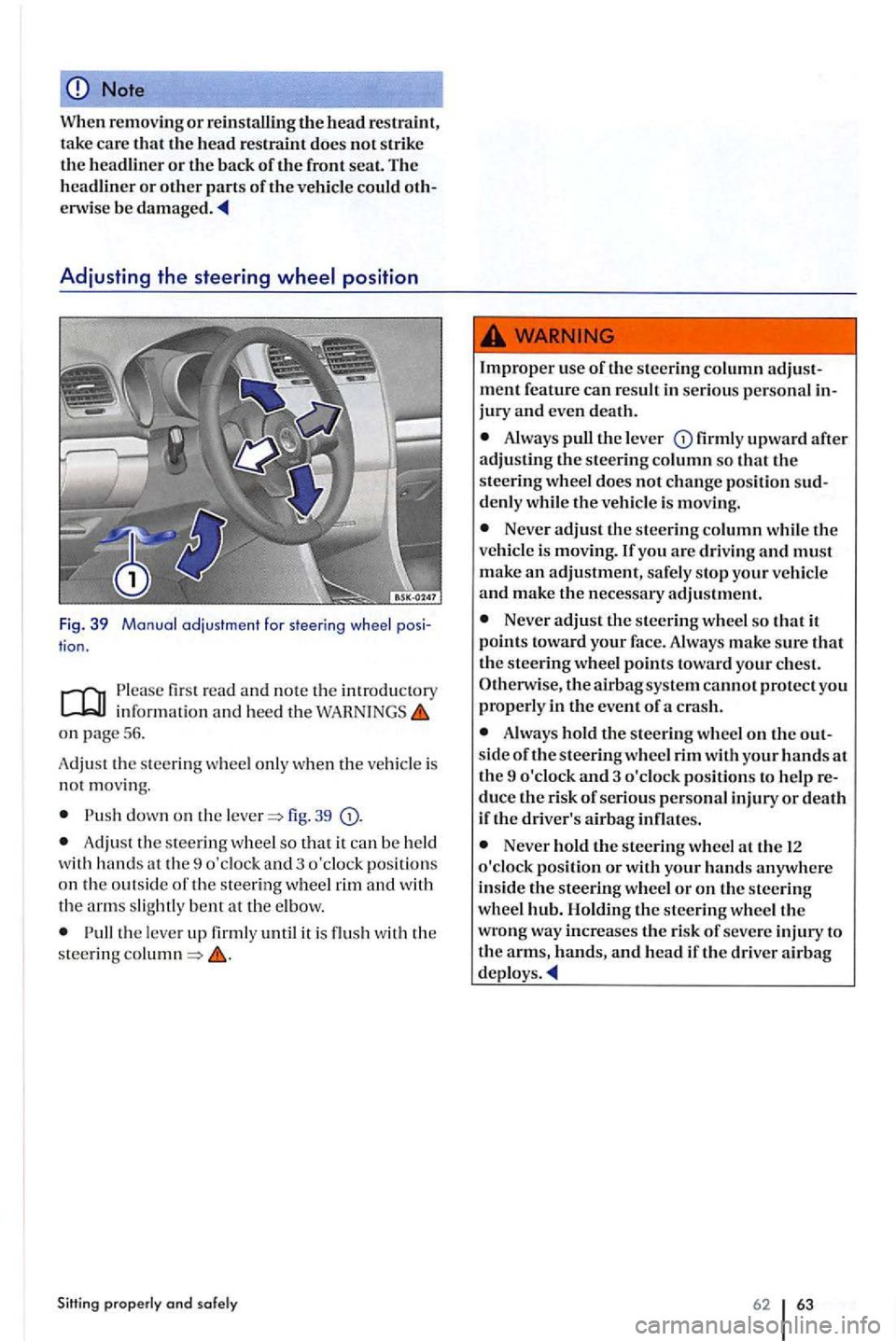
Fig. 39 Manual adjustment far steering whee l pos i
tion.
firs t read and note the introd ucto ry
on page 56.
A dju st th e
steering wheel only when the vehicle is not movin g.
fig. 39
Adju st th e steerin g w hee l so th a t it ca n be held
w ith hands at th e 9 o'clock and 3 o'clock pos itions on the ou ts ide of the stee ring whee l rim and w ith
the arm s slight ly at the e lb ow.
the lever up firmly until it is flu sh with the steering
Always puLl the lever firml y upward after adjustin g th e steering column so that th e
s teering wheel does not ch ange positi on sud
d enl y whil e U1e vehicl e is movin g.
Neve r adjust the stee rin g column w hile the ve hicl e is moving. you are driving and must make an adjustment, safely s top you r vehicle and make the necessary adjustment.
Neve r adjust the steerin g wheel so that it points toward your fac e. Alway s make sure th at
Alwa ys hold U1e steering w hee l o n th e out side of th e steering wheel rim with your hands at
th e 9 o'clo ck and 3 o'clock positions to h elp
Neve r hold the steering w heel at the 12 o'clock position or with your hands anywhere
in side the s teering wheel o r on th e steering
w hee l hub. Holdin g th e stee rin g wheel the wro ng way increases the r isk of seve re injury to the arms, hands, and head if th e driver airb ag
62 63
Page 73 of 541
Using safety
P lease first read and note the introductory information and heed the on page 67.
the condition of all safety belts regul arly .
Keep safety belts clean .
Keep objects and liquid s away from belt webbing, buckle tongue and buckle la tch and opening .
Do not pinch or damage the safety belt or buckle tongue (e.g . w he n closing a door) .
Never modify, disassemble or try to repair safety belt s and safety belt anchorages .
Always faste n your safety belt properly before driving and keep it fastened whenever the ve hicle is moving.
Twisted safety belt
I f it is diffic ult to
pull the safety belt out from th e belt guide. it may be that it is twi sted insi de the side trim because it retracted too q ui ckly when it was take n off.
Holding the safety belt to ng ue, slowl y and fully pull safety belt all the way out.
Fa cility.
Lockable safety belt
Th e re tractors for th e rear seat safety belts and the fron t passenger safety be lt have a swit chable locking feature for child rest raints in addition to the emergency locking fea ture. a c hild
restraint is installed w ith a sa fety belt , the safety belt must be locked so that th e belt webbing cannot unreel. The switchable lockin g feature lets
Bef ore driving
you lock the belt so that a child restra int can be properly installe d and, for example, so that it can't tip to the side when the vehicl e goes around a page
To see whether a safety belt is lockable, pull the
safety belt n llrh e wnyout of the safety belt tr actor. should then hear a
th e switch able locking feature is active, you
s hould no lo nger be able to pull the belt out o f the retractor.
Improper use and care of safety belts increases th e risk of severe personal or death.
Regu larly check safety belt s and rela ted parts for damage.
A lways keep safety belts clean.
Neve r catch, damage or chafe belt webbing on sharp edges.
Always keep objects and liquids away from the belt buckle and buckle opening.
Page 74 of 541
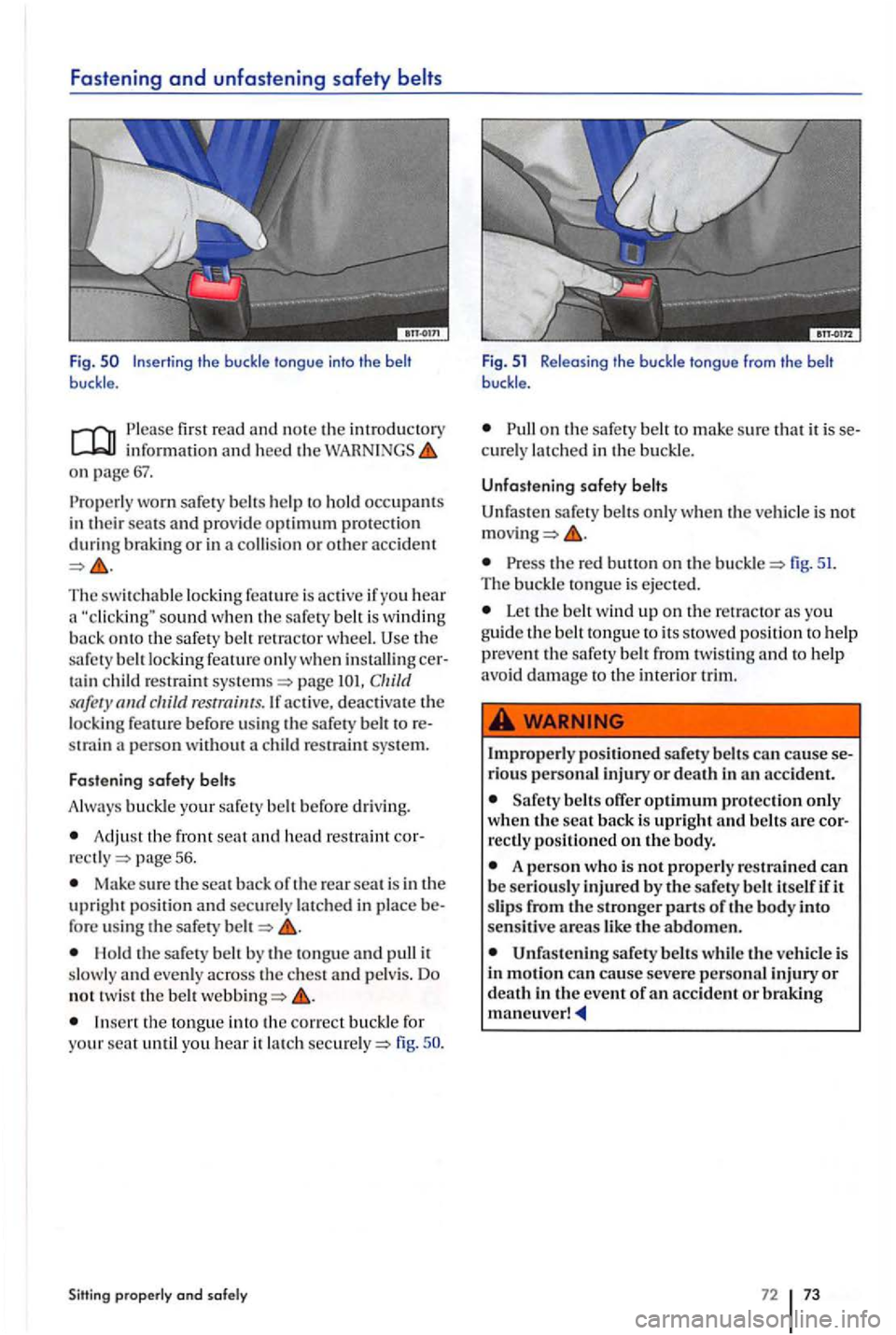
Fasten ing and unfa ste ning safety
buckle.
fir st read and note th e introductory information and heed the on page
worn safet y belts he lp to hold occupants
in their s ea ts and provid e optimum protection during braking or in a collision or othe r a ccide nt
The switchable locking feature is ac tive if you hear
a
the sa fety belt lock ing feature only whe n in sta llin g tain chil d restraint page
stra in person without a child restraint sys te m .
Fastening safety
Always buck le your safety b elt b efo re driving .
Adju st the front seat and head restraint page 56.
Make sure the seat back of th e rear seat is in the uprig ht position and secure ly la tc hed in pla ce fo re usin g the safety
Hold the sa fety belt b y th e tongue and pull it slowly and eve nly acros s th e c hest and pelv is. Do not twist th e belt
the tongue into th e correct buckle for
your seat until you hear it latch fig.
Sitting properly and safely
Fig. 51 Releasin g th e buckle tongue from the
sa fe ty belts only when th e ve hicle is not
the re d button on the fig. 51. The buckl e tongue is e jec te d.
Le t th e belt wind up on th e re tracto r a s yo u
g uid e th e belt tongue to its s to wed position to help
prev ent the safe ty belt from twisting and to help avo id d amage to the interior trim .
Improperly positioned safety belts can cause rious personal injury or death in an accident.
belt s offer optimum protection only when the seat back is upright and belts are
A person who is not properl y re strained can be seriously injured by the safe ty b elt itself if it
s lip s from the stronger parts of th e body into sensitive areas like the abdomen.
Unfastening safety belts while the vehicle is
in motion ca n cause severe personal injury or death in the event of an acc ident or
72
Page 77 of 541
Safety extender
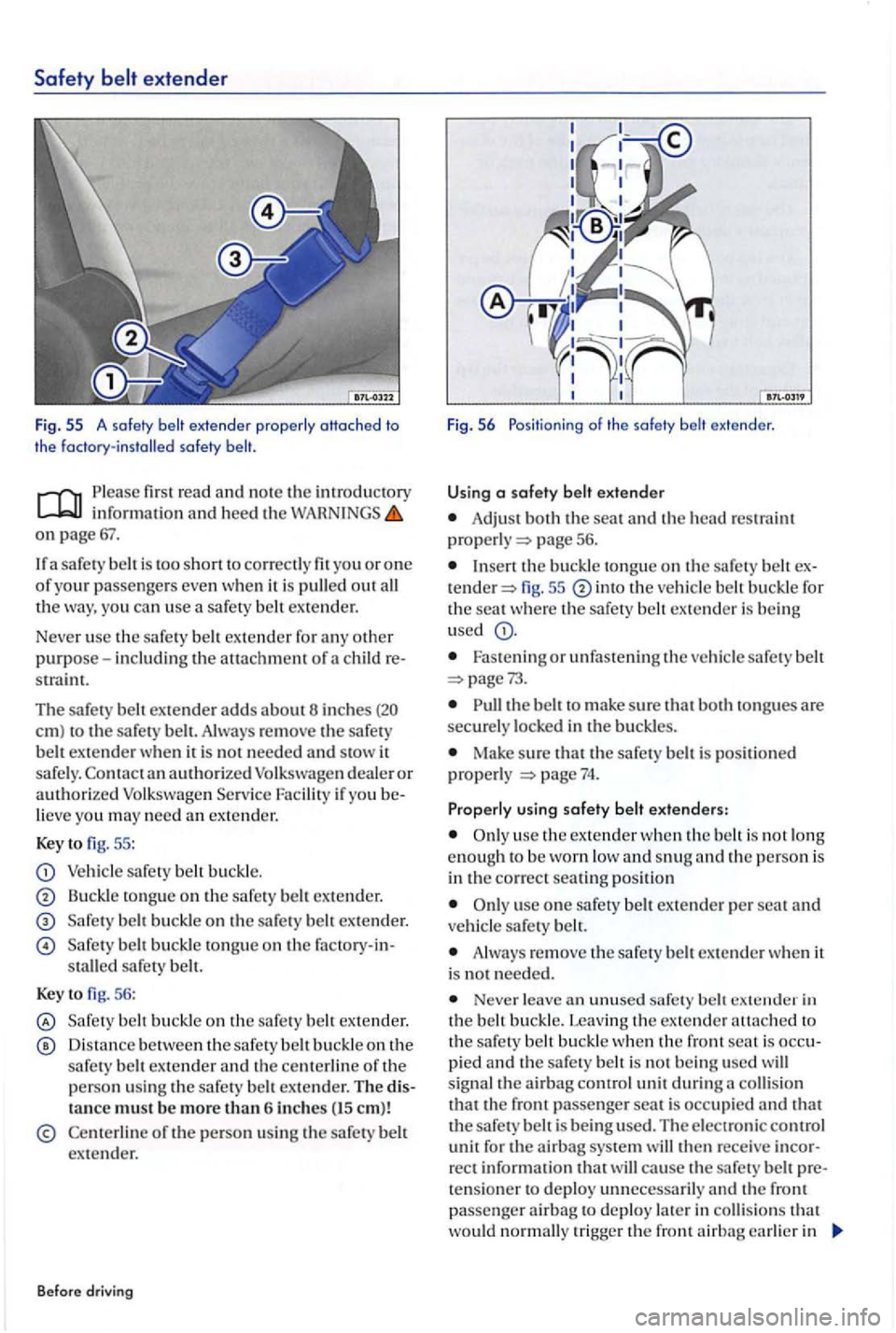
Fig. 55 A safety belt
fir st read and no te the in troducto ry in formatio n and heed th e on page 67.
a safet y is too shonto correctly fit you or one of your passe nge rs eve n whe n ou t th e way . yo u can use a safety ex te nder.
Never u
se the safe ty belt extender fo r any other purpose-in cludin g the of child
Th e extender adds about 8 inches em) the safe ty re move the safe ty ex te nd er w he n safe ly. an authori zed dealer or authorized if yo u you may need an extender.
Key fig. 55:
buckle.
Buck le tong ue on the safety ex tender.
b uckle o n th e safety
buckle to ngu e on the fac tory-i n-safe ty bell.
K
ey t o fig . 56 :
buckle on the safe ty belt extender.
Dista nce between th e safe ty buckle on the safe ty ex tende r and th e of the person u sin g safety belt extende r. The tance mus t b e more than 6 inches (15 em)!
ex tender.
Befor e dri ving
Fig. 56 Positionin g of th e safety ex tender.
Using a s
afety extender
Adjust b oth the seat and the head restraint page 56 .
se n the buckle to ngue on the sa fe ty fig. 55 buckle for the seat w he re the safety extender is bein g
used
Fas tening o r unfa stening the
make s u re bo th to ngues are securely locke d in the buckles.
Make sure safe ty is position ed properly 74.
u se the ex tend er w he n the
use one ex te nder p er seat and
A lway s re move th e safet y extende r w he n is no t needed .
Neve r leave an unused safe ty ex tende r in th e b uckle. Lea vin g the scat is pi ed and the sa fe ty sig nal the airb ag d urin g that the front passenge r seat is occupi ed and that the sa fe ty then r ece ive rec t inform ation that cause the safety ten sio ne r d eploy in w ould tri gge r the airba g ea rlier in
Page 79 of 541
information an d h eed the on page
The safety belts in the ve hicl e are part of th e 86 and have the lowin g important features:
Automatic safety
th e safe ty belt is pull ed out slowly , the s h o ulder b elt will extend to l et yo u m ove freely under normal
driv in g condition s. The auto m atic safe ty belt tra cto r locks th e belt when the belt is pull ed ou t fast, d uring hard brakin g and in collision. T he
b elt may also lock when you dri ve up or down steep hill o r th rou gh a sharp cu rve.
informatio n and heed the on page
The prete nsione rs are part o f th e safe ty belt s stalled at th e fro n t in your ve hicle . I nstallin g.
r e mov in g, serv ic ing, or rep airin g of sa fe ty belt ten sio ne rs c an damag e th e s afety belt sys te m
tion properly.
Th ere are some import ant things yo u have to kn ow
to m ake sure that th e effective ness o f th e system w ill not be impair ed and that discar ded nents do n ot ca use inj ury or pollut e the men t. Undeployed safet y belt pre te nsio n ers and air b ag mod ules co ntain explos ive mate ria ls can cause seri o us injuries to the ge neral public
and t o people
in are sc rapp ed. Und ep lo ye d safet y belt pre tensio ne rs
a n d airba g m odules can also pollut e th e en vir on -
B efore driving
s ion ers.
Th e pr eten sio ne rs
are activated by the e le ctronic
c ontrol unit for the airbag system in front, s id e, and rea r collisions. tight ening the s afet y belt , the prete nsio ner reduces th e occupan t's fonvard
m ove ment or movement towards th e point of pact. T he belt pr ete nsioner wo rks toge ther with
th e airbag syste m ; its fun ction is monito red by a
wa rning ligh t. Th e belt prete n sione r will not
va te d .
A
dus t b e re leased upon a ct iva tion. This
i s no rmal and is no t caused by a in th e vehicle .
load l imiter
The front and rear safe ty belt s also have load iters to help reduce the fo rces applie d to the b o d y
in
m ent. Neve r abandon vehicles or vehicl e pa rt s. If
your veh icle mu st be scrapp ed, please make sure
that it i s done safe ly , re sp o nsibly, and in
swage n Fac ility familiar with these
'
Impro per handli ng, care, servici ng, and re pa ir
p rocedures can increase th e risk of p erson al ju ry and death by prev ent in g a bel t p re te nsioner from act iv ating w he n n eeded or by ca usi ng it to
a c ti vate unex pec tedly.
Neve r repair, adjust, or c hange pretensioners or any o ther part of th e s afety belt syste m strongly recom mend that you have any work on th e safety belt sy ste m perform ed by a n
a uth o riz ed
page
Page 94 of 541
Always make sure that the statu s signaled
b y the BAG light is correct
for the way that the front passenger seat is bein g
u sed.
The fine dust c reated when airbags deploy can cause breathing problems for people with asthma or other breathing conditions .
To reduce the risk of breathing probl ems , those wit h asthma or tion s should get fres h air right away by getting
o ut of th e ve hicl e or opening windows or doors.
If yo u are in a c ollision in which airbags de
ploy, wash your hands and face with mild soap and wate r b efor e eating.
Be careful not to get the dust int o your eye s, or int o any cut s or sc ratch es.
If the residue should ge t into your eyes, them with water.
Airbags that have deployed in a cras h must
b e replac ed.
Use only original equipment airbag s appro
ved by Volkswagen and installed by a train ed
technician who has the necessary tools and diagnosti c equipment to properl y re plac e any airbag on your veh icle and assure sys te m eff ec
ti ve ness in a cra sh.
Neve r pe rmit salvage d or recy cled airb ags t o
be install ed in your vehicle .
Advanced Airbag System components
first re a d and note th e introductory information and heed the
on pag e
vehicles equipped with the Adva nced Airbag Syste m , th e front passe nge r seat contains a who le
array of important Advanced Airbag compo nents
page 82. Because the front passe nger seat contains important Advanced Airbag System components. you must
take ca re to prevent it from bein g damaged . Damage to th e sea t may pre vent the Adva nced Airbag Syste m for the front passenger sea t from
doing its job in a cras h.
S ittin g properly ond solely
Alwa ys hold the s teering wheel with hands on outsid e of th e steerin g wheel rim at the 9 o 'clock and 3 o'clock positions to help re
duce
Neve r hold the steeri ng wheel at the 12 o'clock position or with your hands anywhere
inside
s ioner s are cla ssified as Material -special handlin g ma y apply.
applicable legal requir ements when
scra pping the vehicle or o f it s restraint sys tem, including airbag modules and safe ty belts
wit h pretensioner s. Auth orized Volkswage n
dealers and authorized Volksw agen Serv ice ties are familiar with the require ments, an d we rec
ommend that you have them p erform this serv ice for
The front Advanced Airbag System also includes:
sensors in the front of th e ve hicl e th at
m eas ure vehicle acce lera tion and dece leration to
p rovide informat io n to th e Advan ced Airb ag
System about the seve rity o f a crash.
An elec troni c co ntrol unit, with int egra ted
cras h sensors for front and sid e im pac ts. The con
trol unit w heth er or n ot to fire just the front air bag s ba sed on the information received
from the crash sen so rs. Th e control unit also whether the safety belt pre te n si oners
s hould be activate d.
A n Adva nced Air b ag. with gas genera tor, ins id e the steering wheel hub for th e driver.
An Adva nced Airbag. with ga s gene rator, in sid e the ins trum ent pan e l for th e front passe nger.
A we ig ht-sen sing mat unde r the upho ls tery paddin g of th e front passenge r seat cushion that
m eas ures the to tal weight on the sear. The infor
m atio n regi stered is sent co nti nuo usly to the elec-
92 93
Page 106 of 541
To reduce th e risk of serious injury, make sure
t hat the PASSENGER BAG ligh t comes on and stays on w hen ever a is stalled o n th e front passenger seat and th e tion is swit ched on.
Take the child off the front sen ge r seat and install it properly
does not stay on.
Have the airbag system inspected by your auU1orized Volkswagen dealer or author ized Volkswagen service facility
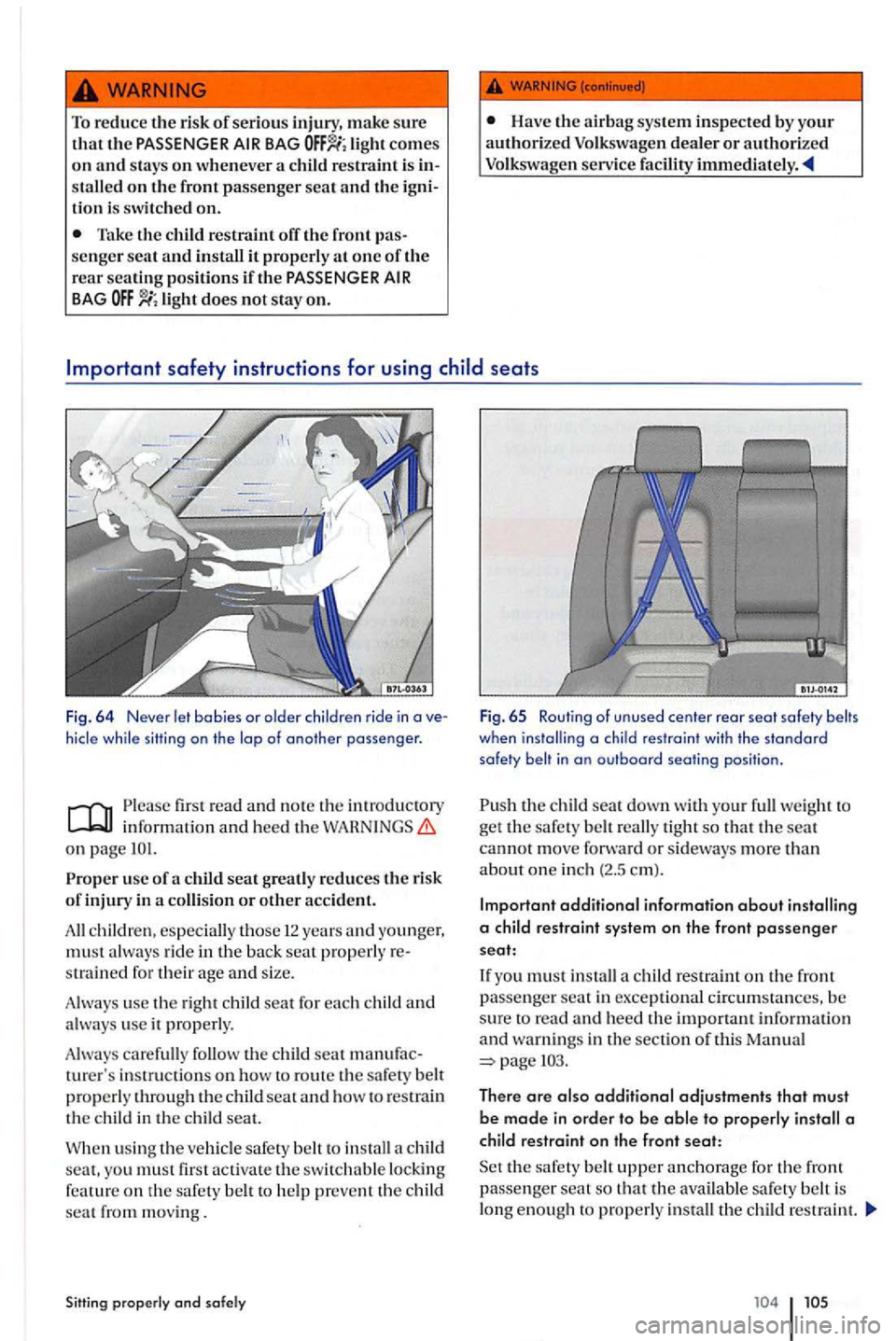
hicle while sitting on the lap of another passenger .
first read and note th e intr oductory information and hee d th e on page
rid e in the back seat properly s tr ain ed for their age and size.
A lwa ys u
se the right child seat for ea c h chi ld and always use it properly.
Always carefully follow the child seat ture r's instru ction s on how to ro ut e th e safety belt
properly through the child seal a nd how to restrain
th e child in the chiJd seat.
When using th e veh icle safety
to a child seat , you mus t firs t activate the switch able locking
featur e on the safety belt to help p revelll the c hild seal from movin g.
Sitting
really tight so tha t
additional information about
a child restraint syste m on the front passenger seat:
If you must in stall a child restraim on th e passe nger seat in excep tional circum stan ces, be
sure to read and heed th e importan t info rmation and warnings in the section of thi s Manual
There are additional adjustments that must
be made in order to be
the safety upper a nchorag e for the fron t passenge r seal so that the availabl e safely belt is
l o ng enough to pro p erly in stall the child restraint.
Page 109 of 541
Using a
the introductory inform at io n and hee d the on page
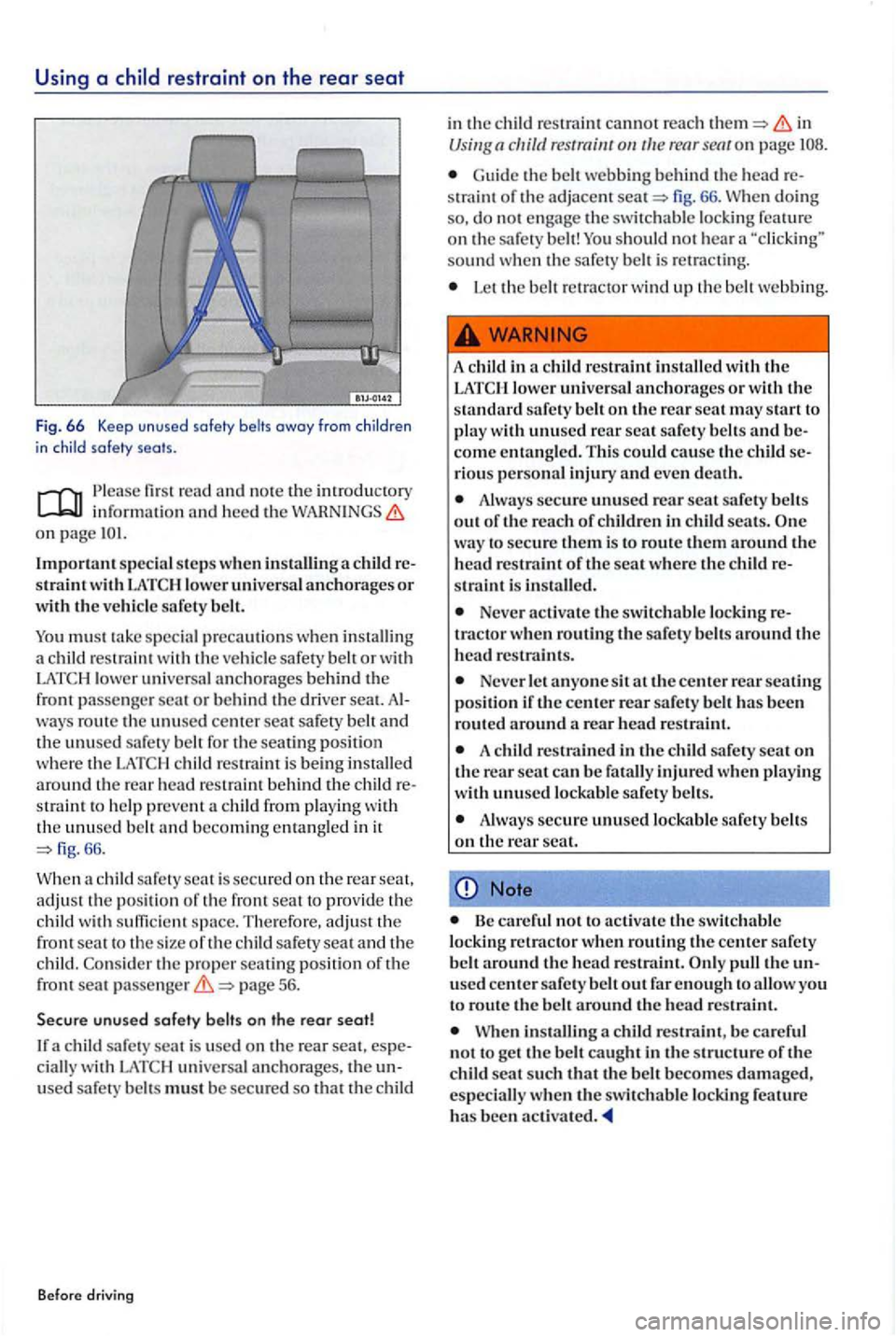
Important s p ecia l steps when installin g a c hild restraint with
special precautions when in stalli ng
a ch ild restra int with th e ve hicl e safety belt o r with lowe r univer sal an ch o rages behind th e passe nge r scat o r b ehind the driver sea t. Al
ways route th e unused center seat sa fety belt and th e unused sa fe ty belt fo r th e seatin g position
where the chil d restraint is bein g in stalle d
around t h e rea r head restraint behind th e child re
s traint h elp preve nt a child fro m play ing with
th e un use d belt and beco ming entangle d in it
ad ju st th e pos ition of th e fron t to pro vide th e
c hild with s p ace. The re for e, adju st t he seat to th e s ize of th e c hild safety sea t a nd t he
c hild . the proper seatin g positio n of th e
f ront seat passenger
on the rear seat!
a child safe ty seat is used on th e rear
in restraint rear seat on page
Guide the belt webbing behind th e head refig. 66 . When doin g
so. do n ot en gage the switchabl e locking feature on th e safety belt! You should not hea r a th e s afet y belt is re tra ctin g.
Lett h e belt retractor wind up the belt webbing.
A c hild
in a child restrai nt installe d with th e
LATCH lowe r uni versal a n chorage s o r
A lways secure unused rear seat safety b elt s out o f th e reach of chi ldren in chi ld seat s. way to secure them is to route them around h ead re stra int of the seat w he re th e child re
s traint is ins talle d.
Neve r activate the swi tc hable locki ng re
tractor w he n routing the safe ty belts around the h ea d re straints.
Never let anyo ne si t a t the center rear seatin g
p os ition if the center rear safety belt has been rout ed around a rear head restraint.
A child restrained in the c hild safe ty scat o n
th e rear scat ca n be fatall y in jured whe n playi ng with unuse d lockab le safe ty belts.
A lways secure unused lockable safe ty belts
o n th e rear scat.
Note
Be careful no t t o activa te the switc h a bl e lockin g re tra ctor when routing the center safety
b elt around th e head re straint. pull the unuse d center safe ty belt out far eno ugh to allow you
to route the belt around th e head restraint.
W hen installing a chil d re straint, b e ca re ful
nat t o ge t th e belt caug ht in the stru c tu re of the
c hild scat su ch that th e belt becomes switchable lockin g feature
h as bee n activa te d .