lock VOLKSWAGEN GOLF PLUS 2004 Workshop Manual
[x] Cancel search | Manufacturer: VOLKSWAGEN, Model Year: 2004, Model line: GOLF PLUS, Model: VOLKSWAGEN GOLF PLUS 2004Pages: 541, PDF Size: 98.86 MB
Page 183 of 541
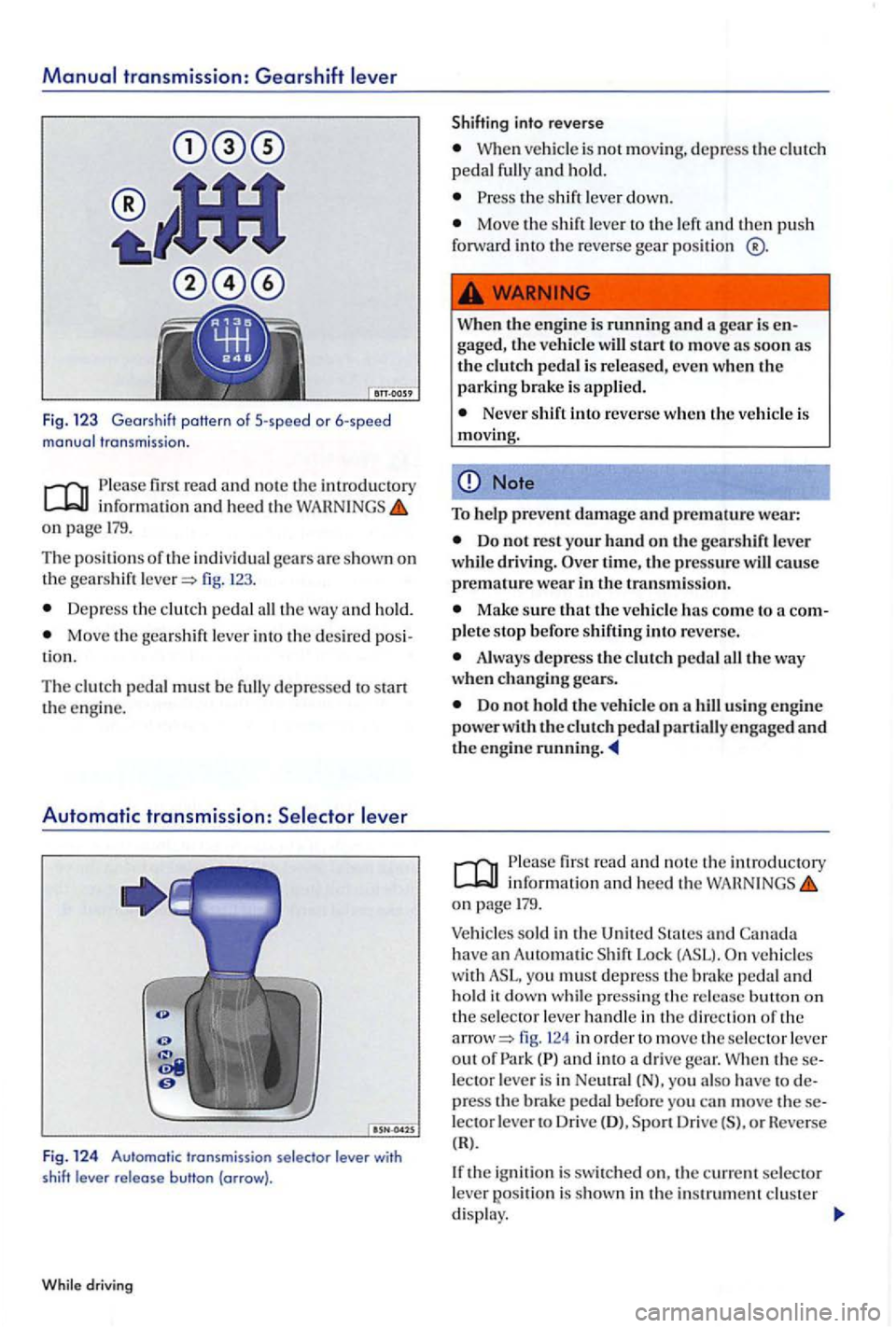
first rea d and not e the introductory informatio n and heed the on page
The pos ition s of the indiv idual gea rs are s hown on th e gea rs h ift fig.
Dep ress the pedal th e way and ho ld.
Move the lev er in to the des ired tion.
Th e clut ch
pedal mus t be depresse d to stan the eng ine.
Automatic transmission :
Fig . 124 Au tom atic transmissio n selector lever with
shift
When vehicle is not m ovin g. depress th e and ho ld.
th e shift le ve r d own.
Move the leve r to the and th en push
forwar d int o the reverse gear position
When the engine running and a gear gaged , th e vehicle will start to mov e as soon as the pedal is released, even when the parking brake is appli ed.
Never shift into reve rse when th e vehicle is
moving.
Note
T o h elp prevent damage and premature wear:
Do not re st your hand on the gear shift leve r
whil e dri ving.
Make sure th at the vehicle has come to a
Always depress th e pedal
Do not hold the ve hicl e on a
fir st rea d and no te t he int roduc tory information and hee d th e on page
sold in the United and have an Automatic Lock ve hicles with you must depress the brake pedal and ho ld it d ow n whil e press ing th e rclense
fig. in ord er to move th e selec to r leve r
o ut of and int o drive gea r. W hen lector leve r is in Ne utral (N). you also have to press th e brak e pedal before you can move lecto r leve r to Dr ive (D ), Drive o r neverse (R).
If th e ignition is switched on. the c urrent selec tor lever
Page 184 of 541
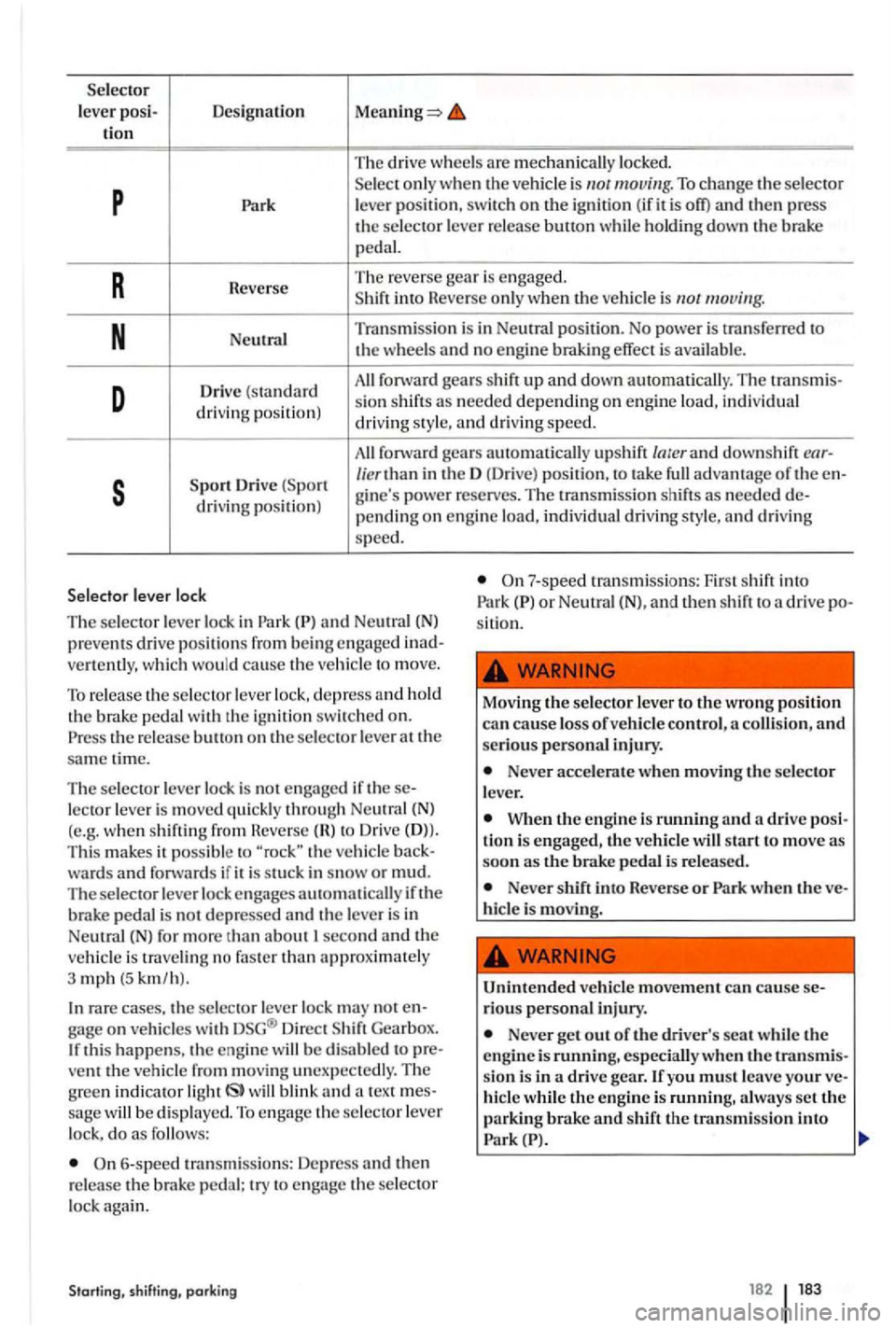
Selector lever posi- Designation tion
The drive wheels are mecha nica lly locked.
p Se le c t only when the ve hicle is
N Neutral Tran
smissio n i s in Ne utral positi on. No power is tra nsferre d to
th e wheels and no e ng in e brakin g effect is available.
D Driv e (standard All forwa rd gears shift up and d ow n automatically. The tran smi s-
dri vin g pos ition) s
ion shift s as nee ded dep endin g on engin e load , indiv idual dri vin g sty le, and dri ving speed.
A
ll f orwa rd gea rs aut omatically up shift/aterand dow nshift ear-
s Sport Dri ve
leve r lock
Th e
selector leve r lo ck in
the re le ase button on th e selec tor leve r a t th e sam e time .
Th e se lec to r leve r l
ock is no t e ngaged if these
(R) to Dri ve (D)).
T hi s makes it possibl e to
second and th e
ve hicl e is tra velin g no faste r than approx imate ly
3 mph (5 km /h).
ra re cases. the Dir ect Gea rbox. thi s ha ppens, th e eng ine w ill be disab led to pre
ve nt the vehicle from m oving unexpec te dly. Th e
gree n ind ica tor light will blink and text mes
sage will be di sp layed. To e n gage th e selec tor lever lock, do as follows:
6-speed trans missions: Depress and then re le a se the brak e pedal; try to e ngage th e se lector l oc k again.
Starting, shifting, parking
Never accelerate when m ovi ng the selector lever.
Whe n the en gin e is running and a drive positio n is engaged, the ve hicle will start to move as soon as the brake pedal is re leased.
Never shift into Reverse or
Never get out of the driver's seat whil e the engine is running, especially when the tra nsmi s
s ion is in a drive gear. lfyou m ust leave your ve
hicl e while the engi ne is running, alwa ys set the
p a rkin g brake and shift the transmi ssio n into (P).
182
Page 189 of 541
Braking, stopping, and parking
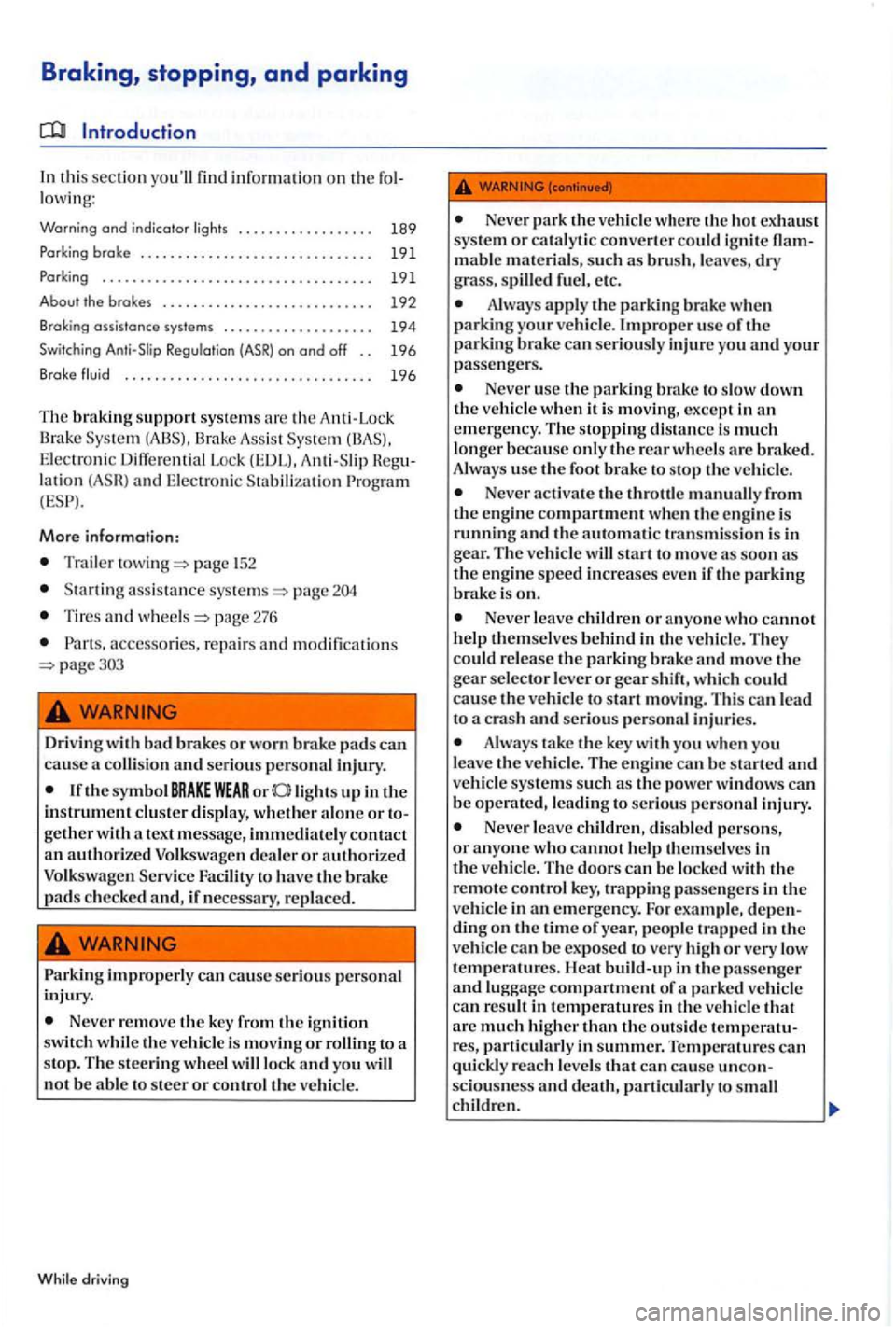
Introduction
In this section yo u'll find inform ation on fo l
lowi ng:
Warning and indicator lights . . . . . . . . . . . . . . . . . 189
Park in g brake . . . . . . . . . . . . . . . . . . . . . . . . . . . .
.. . . . . . . . . . . . . . . 19 1
About t
he brakes . . . . . . . . .. . . . . . . . . . . . .. . . . 192
Bra king assistance sys tem s . . . . . . . . . . . . . . . . . . . . 194
Switching Anti-Slip Regulation (ASR) on ond off . . 196
Brake fluid . . . . . . . . . . . . . . . . . . . . . . . . . . . . . . . . . 196
T he brakin g support syste ms are Brake A ss is t E lec tro nic Differ e n tial Loc k (EDL). Anti-Slip
M ore information:
Trail er page
pag e
Tires and page 276
acce ssories, r epa ir s and modifi catio ns
brakes or worn brake pads can
ca use colli sio n and serious personal inju ry.
light s up in the
in strument cluste r di splay, w heth er a lo n e or to
ge ther with tex t message, immediat ely conta ct an authorized Volk swage n dea ler or authorized
Volkswag en Se rvi ce Faci lity to have th e brake pad s ch ecke d and , if necessary, re pl aced.
WARNING
improperly can cause se riou s pe rso nal
injury .
Never re m ove key from the ignition switch while vehicl e is m ov ing or ro llin g to a
s top. The steering w heel w ill lock and you not be
Never park the vehicle w here the ho t ex ha ust
syste m or catalyti c convert er could ignit e flam
mabl e mater ia ls, su ch as brus h , leaves , dry grass, spilled fue l, e tc .
Always apply th e parki ng brake whe n
p a rki ng your veh icle. Imprope r u sc of th e
p a rking bra ke can se rio usly injur e you and your passe nge rs.
Never use the
e m ergency . The stopping dista n ce is muc h
longer b ec au se onl y the wheels arc braked . use the foot brake to sto p the vehicle .
Never the throttl e from
th e e ng in e
th e automati c transmission is in gear. The ve hicle will start t o move as soon the e ngine speed ev en i f th e brake is on.
Never leave childr en or anyo ne w ho canno t
h elp them se lve s beh in d in the vehicl e. They could re leas e the brak e move the gear selector leve r or shift , wh ic h could cause th e vehicle to start m ov ing. Thi s ca n lea d
to a cras h and seri ous personal injuri es.
Always take the key with you when yo u
leave th e ve hicle . The engine ca n be started and ve hicl e sys te m s s uch as the power wind ows can
b e operate d , le ad ing to seri ous perso nal injury.
Neve r leave childr en , di sabled perso ns, or a nyon e who cannot h elp them se lves in the vehicl e. T he doors can b e lo cke d wit h the re mote contro l ke y, trapping passe nge rs in the
ve hicle in an emerge ncy. For exa mpl e, dep ending on th e tim e of year, people trappe d in the
ve hicle can be ex pose d to very high or very temperatures. Heat build -up in the passenger and parked vehicl e result in temperatu res in the ve hicl e th at arc much hi gher than the outsid e tempe mtu
res, partic ul arl y in summer. T emperatures ca n
qui ckly reac h le v e ls that can cause uncon
scio usn ess ch ildr en.
Page 191 of 541
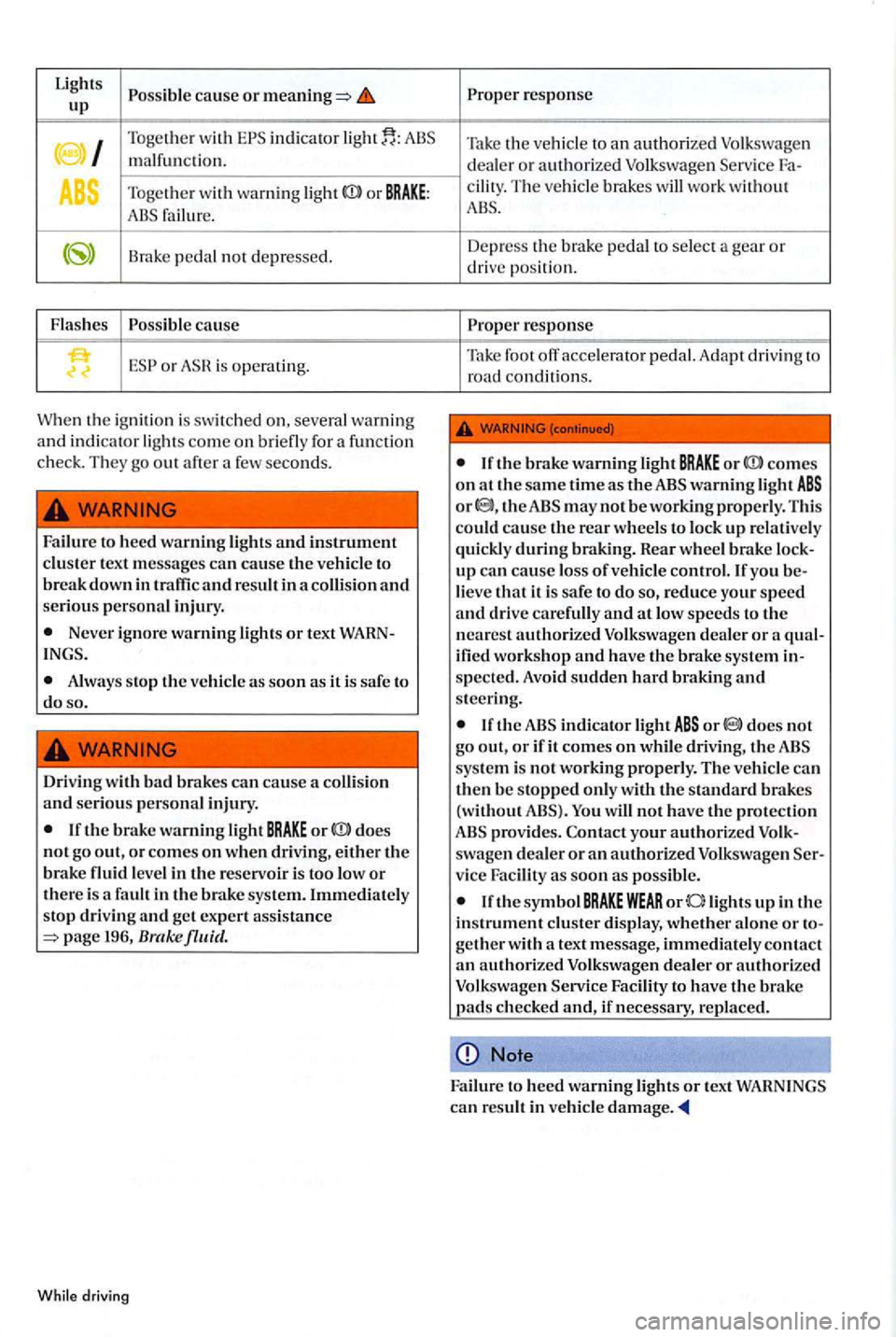
Lights cause or up
I
Together w ith indicator
m alfun ction.
T oge th
er with warning light
cause
or is opera ting.
W hen the ig nition
is sw itched on,
light s and instrument cluster text messages can cause the vehicl e to
break down in traffic and result in a collision and serious personal injury.
Never ignore warning light s or text WARN
Always stop the vehicl e as soon as it is safe to
do so.
Driving
with bad brake s can cause a collision and serious p ersonal injury .
does
not go out, or co mes on w hen driving, either the brak e fluid leve l in the reservoir is too low or there is a fault in the brake sys tem. Immediately
s top driving and get expert assista nce
response
Take the veh icle to an authori zed Volkswage n
d ealer or authori zed Volkswagen Service Fa-The ve hicl e brake s will work without
response
foot off accelerator pedal. Adapt driving to road conditi ons.
If the brake warnin g light BRAKE or co mes on at the same time as the warning light or th eABS may not be working properly. Thi s
could cause th e rear whee ls to lock up re latively
quickly during braking. Rear wheel brake lock
u p can cause loss of veh icle control. If yo u be
lieve that it is safe to do so, reduce your speed and d ri ve carefully and at low speeds to the neares t authorized Volkswagen dealer or a qual
the indicator light or does not go out , or if it comes on driving, the sys tem is not workin g properly. The vehicle can th en be stopped onl y with the standard brake s
(wi thout ABS). w ill not have the protection provides. Contact your authorized Volk
swage n dealer or an authorized Volkswagen vice Facility as soon as possib le.
lights up in the
in strument cluster display, whether alo ne or to gether with a te xt message, immediately contact an authorized Volkswagen dealer or authorized Volkswage n Facility to have the brake pad s ch ecked and, if necessary, replaced.
Note
Failure to heed warning lights or text WARNINGS can re sult in vehicle damage
Page 192 of 541
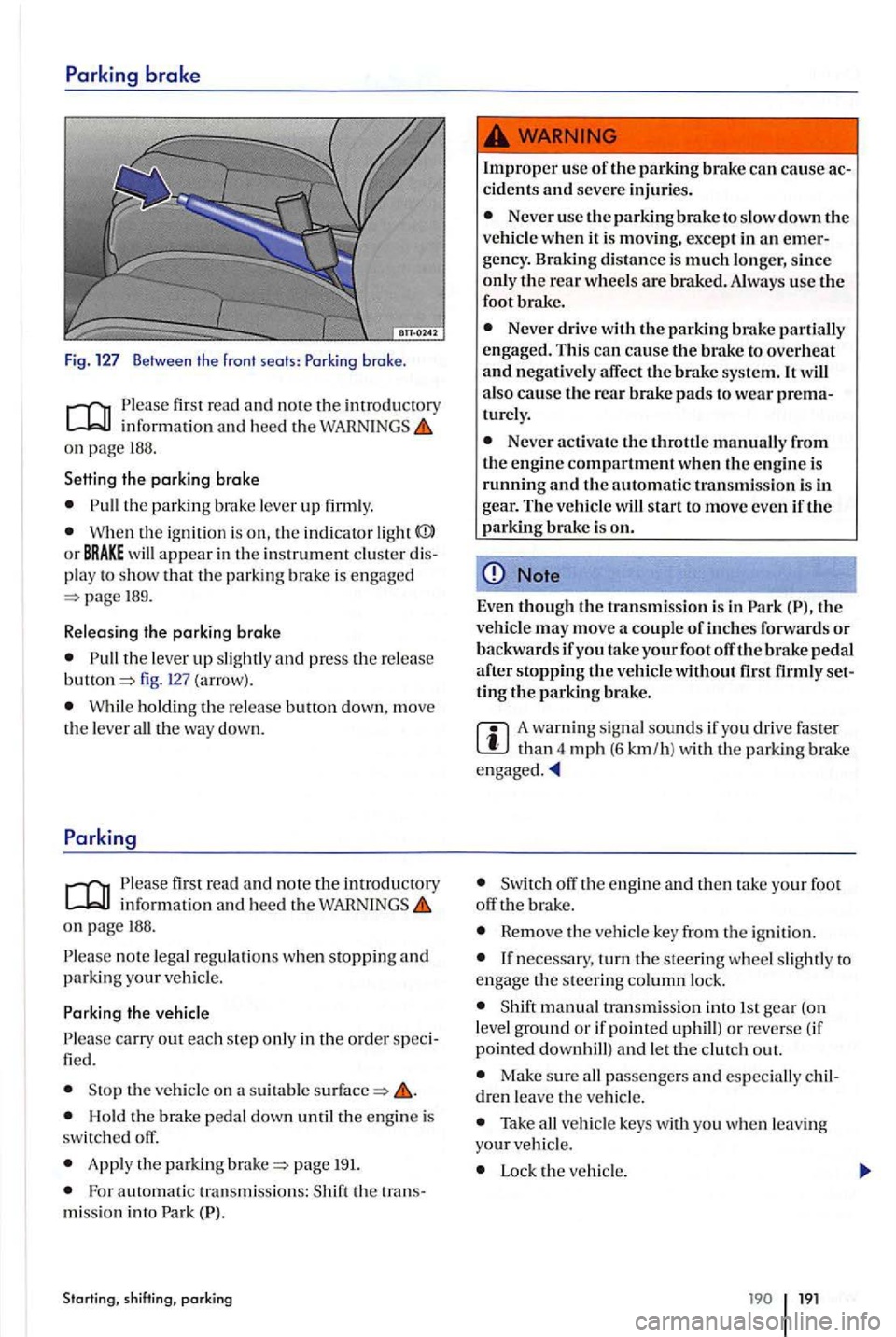
first read and note the imrod uctory
on pag e 188.
Setting the parking brake
the parkin g br ake lever up firml y.
Wh en th e ignitio n is on, the in dicator light
189.
R e leasing the parking
brake
the lever up slightl y and press the release fig. (arrow).
W hil e ho ldin g th e re lease butt on down, move
t h e leve r all th e way down.
info rmatio n and hee d th e on page 188.
n o te lega l regulations when stopping and parking your veh icle.
th e vehicle on a suitabl e
Hold th e brak e pedal dow n until the engin e is
switc h ed off.
App ly the parking page 191.
Fo r a utomatic tra nsmiss ions: th e tra ns
mi ssio n in to Park
Starting, shift ing, parking
Improper use of the parking brake ca n cause ac cidents and seve re injurie s.
Never use the pa rkin g brake to slow down the ve hicl e when it is moving , except in an emer
gency . Braking distance is much longe r, since only the rear wheels are brak ed. Always use the
foot brake.
Never drive with the parking brake partiall y
engage d. Thi s can cause the brake to overheat and negatively affect the brake syste m. It also cause the rea r brake pads to wea r prematurely.
Never acti va te t he throttl e manually from
th e e ngin e compartment when th e engine is running and the automatic tra n smissio n is in gear. The ve h icl e w ill start to move eve n iftl1 e parking brake is on.
Note
Even t11ough the transmi ssio n is in th e
ve hicl e may move a couple of inches forward s or backwar ds if you take your foot off the brake pedal after s toppin g the vehicle without set
ting tl1e parking brake.
A wa rning sig nal sounds if yo u driv e faste r th an 4 mph (6 km/h ) w ith th e parking brake
off the engin e and th en tak e yo ur foot
off brak e.
Rem ove the veh icle ke y from th e ign ition .
manual transm iss ion in to 1 st gea r (on
l evel ground or if pointed uphill) o r re ve rse (if
point ed
Make sure all passengers and esp ecially children leave th e ve hicle.
Take all ve h icle keys with you w he n le a vin g your ve hicl e.
Lock the ve hicl e.
19 1
Page 195 of 541
Braking assistance system s
fir st read and n o te the introductory information and heed the
on page
T he and EDL braking tance system s work onl y w he n th e engine is ning. These sys te m s can sig nificantl y improve
vehicle namics to help reduce the probability of skidding and loss o f vehicl e control. works only w hen the engine is running. driving situations, including w hen the veh icle is beginning to spin (yaw) out of control.
gin e power and by providing steering assistance to help hold the ve hicle on the driver's intended
course.
has limitation s.
will not always be able to help out under all tions you m ay come up against. For example, may no t a lways be able to hel p you mas te r tions w he re there is sudde n change in the
cannot perform the sa me
way it would on a dry surface. the vehicl e
cornering. ularly on winding road s, cannot always deal as
e ffectiv ely wi th diffi cult drivin g situations it can
a t lower speed s. When towin g a is not able to help you regain control as it would if yo u were not towing a trailer.
Alway s
adjust your speed bility, road, cannot overcome the laws of phys ics, increa se the available
stead, improves the possibil ity o f keeping th e
vehi cle under control and o n th e road during treme maneuvers b y using th e driver's s teerin g puts to help keep the vehicle going in the int ended direction .lf you a re tra velin g at a speed that causes yo u to run off th e road before can provide any
EDL , and XDL syste m s (sec be lo w). is switc hed on all the tim e. certain situati ons
w he n you need less traction or additional tract ion cannot be achieved, you can swit ch off by pressing page 196, fig. l28. B e
s
ure to switch ASR on again when you no longer
need less traction.
Anti-lock
brake system (ABS)
ABS helps to keep the wheels from l ocking up and helps to maintain t h e driver's ability to steer and control the vehicle . Thi s means the vehicle is less lik ely to skid, even during hard
th e brake pedal down hard
Do not the brake pedal or letup on it!
S teer the vehicl e while pushing down hard on the brake pedal.
ABS sto ps working if you re lease or let up on th e brake.
When is doing i t s job, you will notice
noise. T he stopping di stance may even be lo nger, for instance, when dri ving on
pin g distances.lfyou press the pedal very quickly, BAS detects an e m ergency situ ation.
pedal! BAS
s w itches off automaticall y as soon
reduces en gine power d irected to spinning wheels and adjus ts power to the road conditions.
Eve n under poor ro ad conditions,
Page 196 of 541
can be swi tched on or off
196.
Electr onic differential lock (EDL ond XDL)
EDL is applied during regular straight-li ne at ion. brake s a drive wheel that has lost
trac tio n (sp inn ing) and r edi rects the drive force to
o th er drive whee ls. In ext re m e cases, EDL from h eating. As soon
loss of contro l a nd result in serious sonal inju ry for yo u and yo ur passe ngers.
A lw ays adjust your s peed and driv in g s ty le to
road, traffic,
r is ks.
B rakin g ass istance syste m s cannot come th e laws of p h ys ics an d always prevent loss
o f vehi cle control. Slipp ery and wet roads are
s till da ngero us eve n with
te ms!
D rivin g to o fast on wet roads cause th e
w heels to lose contact w ith the road and A vehicl e that h as los t road contact
canno t b e brake d, steered , or controlled .
Start ing, sh ifti ng, parkin g
These syste ms cannot red uce th e risk of
Althoug h th ese syste m s a re very eff ec tive
a nd can h elp yo u control tile ve hicle in man y
diffi cult situatio ns, always remember th at your vehicle
W hen acce le ra tin g o n a slippery surface, fo r
exam ple o n icc and sn ow, depress the
''
can b e sig nificantl y duced if other components and sys tems that
ti onin g.
A lways re m ember th at ve hicl e
syste m s.
Cha nging the vehi cle su sp ens io n or using an unapproved tire w heel combinati on ca n
c h a ngethewayth eABS, EDL, and syste ms work and reduce their effecti ve ness.
T he effective ness of page 276 .
All fo ur w hee ls must b e equip ped with tic a l tir es in order for to wo rk
properly. Differences in th e
g ine powe r w he n it is not expected.
I f is not working, and EDL will also not work.
active.
Page 197 of 541
Switching
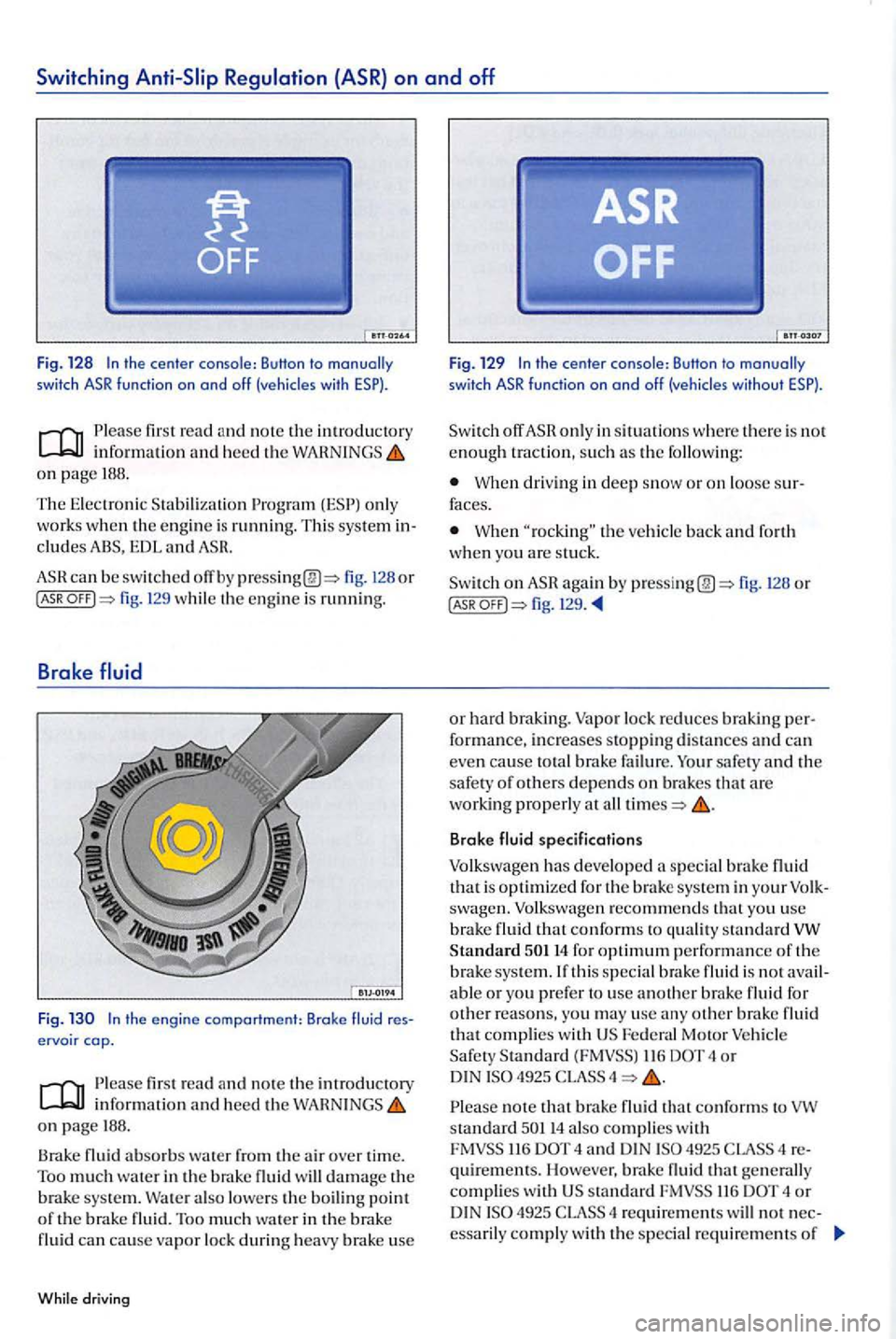
the center console: Button to with
Please fir st read and no te the introductory informatio n and heed the on page
The Electronic Stabili zation Program
cludes
can b e switched off by fig. (ASR fig. 129 whil e th e engi ne is running.
B rake
ervoir cop.
Please fir st r ead and note the introductory information and heed the on page 188.
Brake fluid
absorbs wate r from the air over time. Too much water in the brake fluid will damage the brake system. Wa te r a lso lowers th e boiling point o f the brake fluid. Too much wate r in the brake
fluid can cause vapor lock during heavy brake use
Whi le driving
Fig. 12 9 the center console: Button to switc h function on and without
off only in situations w here there is not enough traction, s u ch as the fo llo wing:
When driving in deep snow o r o n loose faces.
W hen
on again by fig. 128 or (ASR fig. 129 .
or hard braking. Vapo r lock reduces braking
safety and the safe ty of others d e pends o n brakes that are working properly at all
Brake
swagen. Volkswagen recommends that yo u use brake fluid that conforms to quality standard 14 for optimum p erformance of the brake system. If this s pecial brake fluid is not
Motor Vehicle 116 4 or 4
Please note that brake fluid that conforms to standard 14 a lso complies w ith 116 4 and DIN 4 quirements. However, brake fluid that generally complies with 116 4 or 4925 CLASS 4 requirements w ill not essarily comply with the s pecial requirements of
Page 198 of 541
the info rm ation on the co ntainer for the brake fluid you want to use to
mak e sure it meets th e requirem ent s for your hicl e.
A ppro priat e brak e fluid can
be purchased from your authorized deal er or authori zed Facility.
Brake fluid level
The fluid
level in the transparent brake fluid voir must always be betw een th e MIN and MAX
some vehicle s, eng ine components blo ck th e
v iew of th e brake fluid reservoir and make it po ssibl e to see the brake fluid level. I f you cannot clearl y see the brake fluid leve l in the brake fluid reservoir, please see an authoriz ed deale r or authorized Facility.
The brake fluid level drop s slightl y when the hicle is being use d becaus e the brake pad s wea r
down and the brak es automatically adjust to thi s.
Changing brake fluid
Brak e fluid
must be changed a ccor ding to the
thori zed
Brake failure and reduced brake performance can be caused by not having enough brake fluid
in the reservoir or by old or incorrect brake fluid.
change brake fluid according to the service schedule in your Warranty and
lock reduces braking
standard 4925 another brake fluid can
standard 50114, 116 4 or 4925 4, do not use it.
The brake fluid must be new.
Always make sure that only the correct brake fluid is used. the container does not say that the brake fluid complies with standard 4925 4, do not use it.
Brake fluid is poi sonous.
To reduce the risk of poisoning, never use food, beverage or other non-original containers
to store brake fluid. might be misled
by the label on th e non-original container, or by the shape of the container, and drink the brake
fluid. This could occur even if you re-label the container as
dren.
Note
Brake fluid
Brake fluid can pollut e the en vironment.
196 197
Page 200 of 541
Efficient driving
Please information and heed the on page 198.
Shifting faster
As a rule, the following applies: The higher gear is
a lways the more efficient gear. The rule of thumb for most vehicles is to drive in 3rd gear at mph f km/h, 4th gear at 25 mph f km/h, and 5th gear at mph f km /h.
If
and driving conditions permit, gears when upshifting also saves fuel.
Do
not run the gears up to their limit.
mati c transmissions .
Vehicles with gear recommendation aid in fuel fic ient dri ving by indicating the optimum time to shift gears.
livery to the engine is interrupted, which lowers
fuel consumption.
T herefore, when nearing a red stop light , for s tanc e, allow the vehicle to coast without using the accelera tor. Press the clutch pedal and release it only if the v ehicle is moving too slowly or the coasting distance is too long. The engine will then continue to run at idl e.
In situati ons
where the vehicle will be stopped for
a longer period of time, such as at a train cros sing,
physically switch off the engin e.
D efens ive driving
and with traffic
Fre
quent braking and accel eration increases fuel consumption sign ific antly. Just by driving sivel y and keeping a su fficiently large distance away fro m the vehicle in front of you can make up for the speed fluctuation s caused by taking your foot off the accelerator. Active braking and ating is then not necessarily required.
system information
The power stee ring syste m i s not hydrauli c.lt is an electro-mechanical syste m. The advantage of this
s te ering system is tha t no hydra uli c hoses, draulic oil, pumps, filters or other parts are quired . Th e e lectro-m echanica l system is more fue l effi cient. A hydraulic system requires constant oil pressure in the syste m; an electro -mechanical
s teerin g sys tem, however, needs power only whil e
s teering.
Th e el
ectro-mechanical power steering
chanical power steering works only when the gin e is running.
and smooth driving
Consistency is more important than speed. The more smoothly yo u drive, the less fuel the vehicle consumes.
When driving on the highwa y or freeway, a
stantly accelerating and braking. you can r each your destinatio n just as quickly by driving at a moderate, but steady speed.
The c rui se control syste m can a ssis t in
sciou s manner.
Some dev ices can increase fuel consumption when activated (examples):
C limate control air conditioning system:
trasting temperatures, it requires a large amount of energy, which is generated by the e ngin e. T he
tr emely different from that of the outside
windows increase fuel consumption.
Switch off seat heating once it has served its
purpose.
Sw itch off the windshield and rear window
Malfunctioning engine control.
Driving in the mountains.
Towing a trailer .
page 257
Towing and page 357
Turning the steering wheel is very hard when the power steering system is not working. This makes it harder to control the vehicle.
steering works only when the engine is running.
Never let the vehicle coast with the engine switched off.
Never remove the key from the ignition
switch while the vehicle is moving or rolling to a
stop. The steering column will lock and you will be unable to control the vehicle.