inter VOLKSWAGEN GOLF PLUS 2007 User Guide
[x] Cancel search | Manufacturer: VOLKSWAGEN, Model Year: 2007, Model line: GOLF PLUS, Model: VOLKSWAGEN GOLF PLUS 2007Pages: 541, PDF Size: 98.86 MB
Page 99 of 541
Always make sure that th e side airbag can inflate without interfe re nce :
- Neve r in sta ll
seat covers or replacement uphols tery over th e front seat backs that h ave
not been specifically approved by Volk
swage n. the s ide airbag may not
b e able to deploy fully.
-Neve r put seat c u shi ons, blanke ts , or other cove rings over th e areas where th e s ide ai r
b ags inflate.
Side Curtain Protection ® Airbag
-Damage to th e original seat covers or to the seam in the area of the si de airbag module must a lways be repaired imme di
a te ly by an au thorized Vol kswagen dealer or authorized Volkswage n Service Facility.
Always prevent th e sid e airbags from
b eing damaged b y heavy objects hitting the
s ides of the seat back s or force be ing put on the scat backs, especially in the area w here the
s id e a irbag modul e is located. The air bag sys te m
A lways have work involving the s ide airbag system, including removal, rep lacement, and ins talla ti on of airbag compo n en ts, or other re pairs performed by an authorized Volkswagen deale r o r authorize d Volkswage n
Service Facility. the airbag system may not work correctly. Neve r remove th e front seats from th e vehicl e or modify parts of the front seats. Never attempt to modify a ny components of the air bag system in any way. I f excess ive force is exerted on the seatback bols te rs, the s ide airbags may deploy not at al l o r
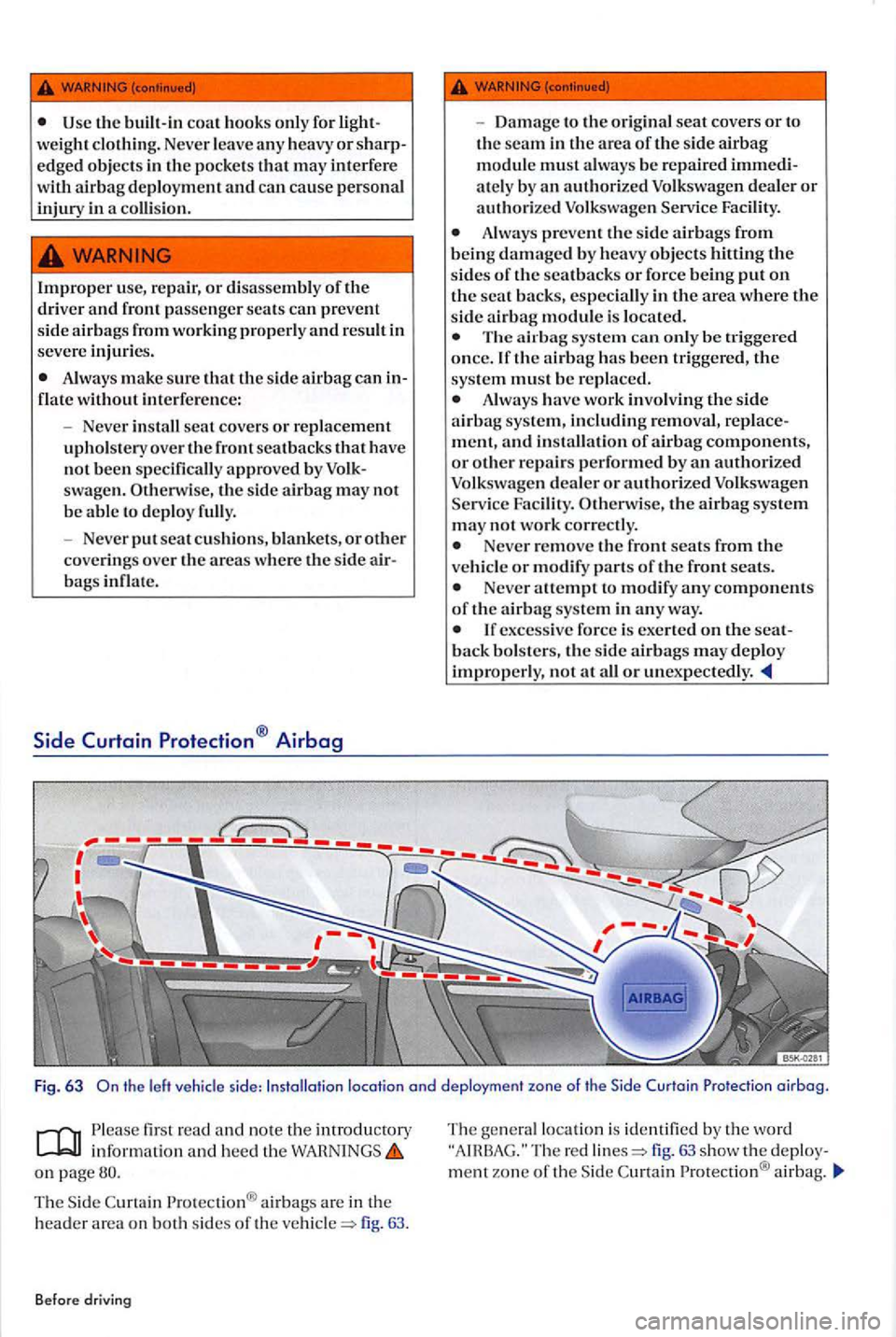
Fig. 63 th e left ve hicle side: In stallation location and deploym ent zone of th e Side in airbag.
information and h eed th e WARNINGS on page
Th e Sid e C urta in ai rbags are in the
h eader are a on bot h sid es of th e fig. 63.
Befo re driv ing
The ge nera l lo ca tion is id entified by the word The red fig. 63 sho w th e deploymen t zo ne of the Sid e Cu rtain airbag .
Page 100 of 541
The Side Curtain airbag system in
An elec tron ic control module and side impact se nsors.
T he above th e
f ro nt
An monitoring sys te m 82.
Th e
airbags betwee n th e
fig . 63 . The airbag system supplem ents th e sa fety bel ts can help to reduce th e risk o f injury for occupants' heads and uppe r to rsos on the sid e of the that is s truck in s id e
order to he lp provid e thi s additional p ro tectio n,
t h e
w it h in the bl in k of an eye high speed and wi th grea t force. The airbag could injure you if your positio n is
n ot prope r o r upright or if ite ms arc locate d in the area w he re the supp le m ental airbag to page
sys te m is monitored e lectro nically to
make sure it is workin g properly at times. Eac h time you tu rn on the ignit io n , the airbag sys te m dicato r come on for few seconds
( s clf-d iag nosis).
Th e
airbag sys te m i s not it is part of th e ove rall occupant res tra int sys te m in your page 56,
is important to remember the airbag sys te m is desig ned to help reduce the like lihood of ser iou s inju ry. H oweve r, it is possib le that a deployed m ay cause oth e r in juries s u ch as bruising, burns and abras io ns. Hc m ember too ,
airbags that have deploye d in sa fe ty be lts areal
way s th ere to offer protection in those accidents in
w hich
The Side Curtain airbag
if the ign ition is switched w hen occurs,
in sid e collisions w he n the accele ra tion m ea
sure d by th e sensor is too low,
in front-end
in rear-end
in over s , unless the deployment thresh o ld
f o r deploym ent sto red in the control unit is met.
some ty pes of accidents th e front, and sid e airbags m ay be triggered togeth er.
inflating airbagcan cause serio us or even f ata l injury . wearing safety belts and improper seating positions increase the risk o f serious personal injury and death whenever a is being used.
A lway s make sure tection® can inflate without interference.
or sharp
edge d objects in the pockets that interfe re
with deployment and c a use personal injury in a
Never u se hangers to on the
hooks.
use facto ry-ins talled sun shades or, if are the leaves the usc only genuine Volkswagen sun shades.
Neve r swing the sun viso rs ove r to the s ide
windows if it ems such pens, door o pe ne rs, hands -free speakers, etc. arc attached to t he su n visors. They could come lo ose and cause serious injury if the
deployed airbag second and at extreme ly high speed.
Neve r objects to the cover or in the deployment zone of a Curtain
The
between a ny
v ehicle occupant and a t
98 99
Page 103 of 541
Accident stati sti cs have shown childr en are
generally safer in the rear seat area than in the front restrain any child age 12
All ve hicl e occupants and especially childr en must be restrai ned properly whenever ridin g in vehicle. An unrestrained or improperly strained child could be injured by striking the
interior o r by being ejected from the vehicle during sudden maneuver or impact. An strained or improp erly restrained child is at
airbag.
suitab le child rest raint properl y install ed and used
Forward-facing child seals installed on the front passenge r seat may interfere with the ment of th e a irbag and cause serious personal injury th e c hild .
exceptional circumstances require the u se of fonvard-fac ing child restraint on the front
passenger's seat, the child's safety and being requir e th e following special preca utions to be taken:
- Always
make sure that the fonvard-faci ng seal has bee n designed and certifi ed by its
m anufacturer for use on
ch ild res traint without top tether strap if the child
restraint manufacturer's instructions quire the top tether strap to be u sed.
- Never
putt he fonva rd-facing chil d
ment panel.
Before driving
-Always set the safety bell upper anchorage to the adjustmelll position permits
p roper
in the up and down
position in the seat's fore and aft adjustment range, as far away from the airbag as possib le
before installin g the fonvard -facing child s traint .
- Always
make sure that nothing prevents t h e fro nt passeng er' s scat fr o m being moved
justment range .
- Always
make sure that the backr est is in
th e upri ght position.
- Never place ad dit ional it
ems on the seal
th at can in crease th e total weight registered
b y the weight-se nsing mal cause jury in a crash.
- Always
make sure
BAG light does
not come on and stay on, immediately install
t h e fonvard-facingchi ld seat in rear seating sys tem spected by your authorized dealer or auth ori ze d Se rvice
A lways buckle the child seal in place
even if loose child seat ca n around during a sudd en slop or in a
Always read and heed all WARNINGS ever using child res train t in ve hicl e 67, Safety page 80,Airbagsystem page safety
A lways replace child restraint s that were s talled in cras h. Damage to
a child res traint that is not visib le co uld cause it to fail in another collision situati on
Page 107 of 541
Alw ays follow the child restraint manufacturer's in stalla tion
tion in th e se at's up and down adjustm ent range and to th e rearmost p osit ion in th e se at's fore and aft adj ustment ra nge, as far away from the air ba g
a s poss ib le before in sta llin g th e forwa rd-facing
chil d res train t a nd mak e sure th e backre st is in th e
upr ig ht
If a te th er str ap is being used to tie the child s traim to th e front passe nger seat, make su re that
it is not so tigh t that it causes the we ight-se nsin g mat to meas u re m ore weig h t than is actu ally on
the seat.
Alway s remember: E ven though your vehicl e is
e qu ipped with an Advanced Airb ag System, all
child re n , es pecially th ose 12 years and younger, mus t a lways ride in the back seat pro pe rly
tion.
All ve hicl e oc cupants and esp ecially childr en must always be restrain ed proper ly w he neve r
ridi ng in a vehicle.
-
An unres tra ined or imp roperly restrained
c hild can be injured or kill ed by being thrown
agai nst th e in sid e of the vehicl e or by bein g
e je cte d f rom it duri ng a sudden maneuver o r impact.
- An
unrestrai ned or improperl y re strained
c hild is also at much grea te r risk of inju ry or death by be ing stru ck by an inflat ing ai rb ag.
Commercially available chil d seats must comply w ith U.S. Federal Motor Vehicle Standard 213).
- When buyin g a restraint, selec t o n e
th at your child and the ve hicle.
-
usc c hil d restra int sys te m s th at m ake
f ull contact with the flat portion of the scat cushion. Th e c hild restraint mus t n ot tip or
l ea n to ei ther side. Volk swa gen docs not ommend using child sea ts res t o n legs o r
t u be-like frame s. They do not prov ide qua te con ta ct wit h the seat.
Befo re driving
- Alwa ys heed all legal requ irement s ta ining to the in sta ll ation and use of child
sea ts and carefully follow the in structi ons
provid ed b y th e manufacturer of th e seat y ou arc using.
For safet y reasons, never allow child re n under 4ft. 9 in (57 in che s /1.45 mete rs) to wear a
normal3-p oint safety belt . They must a lways be r est rain ed b y a proper child rest rain t syste m .
O th erwi se, they could su stain injuries to domen and neck areas during sudden bra kln g
m an euver s or acci dents.
Neve r le t more th an one child occupy a ch ild
se at.
Neve r let babie s or older child ren ride in hicl e whil e sittin g on the lap of another senger.
- Holdin g a ch ild in
your arms is never a
subs titut e fo r child res traint syste m .
-
The stronges t perso n wou ld no t b e able to
hold c hild, give n th e for ces present durin g
a co llision. The c hild will strike th e interior of the ve hicl e and can also be impacte d by ot her pa sse nge r.
-
The c hild and the pass enger ca n als o jure eac h other in an acciden t.
Neve r in sta ll reanvard-facing ch ild sca ts or i n fa nt carri ers on the fron t p assenge r sea t. A
c hild will be se riously injure d and ca n b e kill ed
w he n th e pa sse nger airbag inflates-even with
a n Adva nce d Air bag System.
A lways install reanvard-facin g child scats or infant on th e rear scat.
Fonvard-fac in g child seats in sta ll ed on the
front passenge r's sca t can interfere with the airb ag wh en it inflates and ca use seriou s injury
to the ch ild . Always in stall forward -facin g child
sc ats on th e rear sea t.
fonvard-facing child restraint on th e front passe nger's sea t, th e c hild 's safety an d bein g require the followin g speci al precauti on s
to be take n:
Page 112 of 541
you must install a reanvard facing child
seat on th e front passe nger seat b eca use of ce pti ona l circumstances , but the light does not come on and stay
Facil ity.
Alway s read and heed all
page Safety pag e Airbn g sys te m page safety restraints.
An improperly installed child res traint can terfe re w it h th e airbag as it de plo ys and ously injure or even kill the child -eve n w ith an Advanced Airbag
being require the following sp ecia l precautions
to be tak en:
-
Fonvard-facing child seats in stalle d on the front passe nger seat may interfere with the de ploym ent of the airbag an d cause se riou s
p ersonal inju ry to th e c hild.
- Always make s
ure that the fonvard-facing seat has been des igned and certified by its manufacturer for use on a front passe nger seat wit h a front and sid e airbag.
- Always care full y follow the ture r's in struction s prov ided with the c hil d scat or carrier.
- Never install a child res traint w
ithout a properly attach e d top tether strap if the child
res traint manufacturer's instructions quire the top te th er strap to be u sed.
- Neve r
put the fonva rd-faci ng c hild straint up agains t o r very nea r the
properly and safely
- Always set the safe ty belt upper a n ch orage
t o th e adjustment positi on tl1at permit s proper in stallation in accordance with th e child restraint manufacture r' s in struction s.
- A
lways move the passenger seat to the
hi ghest position in the up and down
justment range.
- Always
make sure that th e backres t is in
th e upright position .
- Never place
additional items on the seat th at can increase the tota l we ight regi ste red by the weight-se nsing mat and cau se injury
in a c rash .
Mak e sure that the BAG
If the BAG OfF light does not com e on and sta y immediately in stall the fonvard -facing child seat in at a seatin g position on the rear seat and have the airbag sys te m
Fac ility.
Always buckle the c hild seat in place even if a child is not sitti ng in it. A loose child
collisio n.
Note
When installing a child res traint , b e ca reful
not to get the belt caught in tl1c structure of tl1e child res traint and become damaged, especia lly when the swi tc habl e lo ckin g feature has been tivated.
Be careful not to activa te th e sw itch a bl e
lo ckin g retra ctor when routin g th e safety belt s
a round the head restraints . p ull the safety
b elt out far enough to allow you to route tl1e belt around th e head restraint.
Page 118 of 541
seating position: Guide the upper te th er
s trap under th e o uter r ear head restra int (raise th e
h ead restra int if n ecessary).
Guide th e te th er strap betwe en th e re ar seat back and the lu ggage compartment cove r.
A ttach th e tether s trap an chorage hoo k
After you have install ed th e c hild seat, pull on bot h of t he adju stabl e strap s o n th e child sca t and p ull also on th e te th er strap to m ake certain the seat is sec ure an d prop erly attac hed.
R e le asing
L oose n th e te nsion o n th e strap followin g the chi ld re straint manufa ctu re r's in structio ns.
De press th e s pring ca tc h on th e hook.
tio n.
Move the hoo k in the dir ection of the vehicle floor so th at th ere is e no ugh sp ace to release the connector from the lo wer a n chora ge.
Release the teth er strap.
You must take sp ecia l preca utions w he n in sta lling
a child res traint w ith the vehicle safety belt or with
w ays route th e unuse d ce nt er scat s afe ty belt and th e unused safety belt for th e seatin g posit io n
w here the child restraint is be in g in stalle d
around th e rear h ead restrain! behind the c hild stra int to help preve nt a chil d from play ing w ith
th e unused b elt and beco min g e ntan gled in it.
Improper use of the sys tem can increase th e risk of serio us person a l inju ry and death in an accid ent.
Alway s care fully fo ll ow the child re straint manufacture r's in structions for proper
vers al anchorages or safety belts in your ve hicl e.
Never mount two lower unive rsal a nchorage point.
These anchors w ere developed only for c hild seats using th e sys tem.
Neve r attach other ch ild seats, be lts, lugg age or other thin gs to the anchorages.
Alway s make s ure that you hear a
the seat is not secure and co uld fly fo rward
and hit the interior of th e ve hicl e or be ejected from the ve hicle.
Be careful not to activa te th e sw itchab le
pull the
safety belt out fa r en o ugh to allow you to route th e
b el t around th e hea d restrai nt.
116 117
Page 126 of 541
may not come on in fog or heavy rain. You have to
s witch on the low-beam headlight s yourself.
cool o r h umid weather, th e in sid es of th e headligh ts , a nd turn sign als
can t e mporaril y fog up. Thi s is normal and does not affec t th e servi ce life of th e ve hicle's lighti ng
read and note t h e intr oductory
o n page
Instrum ent
page
Dynamic headlight range adjustment
ve hicles with the Adaptiv e Front Lighti ng th e hea dlight range is automati cally
adj uste d to the ve hicl e loading con dition once the
l ow bea ms are switch ed on.
H
eadli ghts that are aimed too high because of the way the vehicle is loaded can blind
Always adjust headli ght s to load ing
page
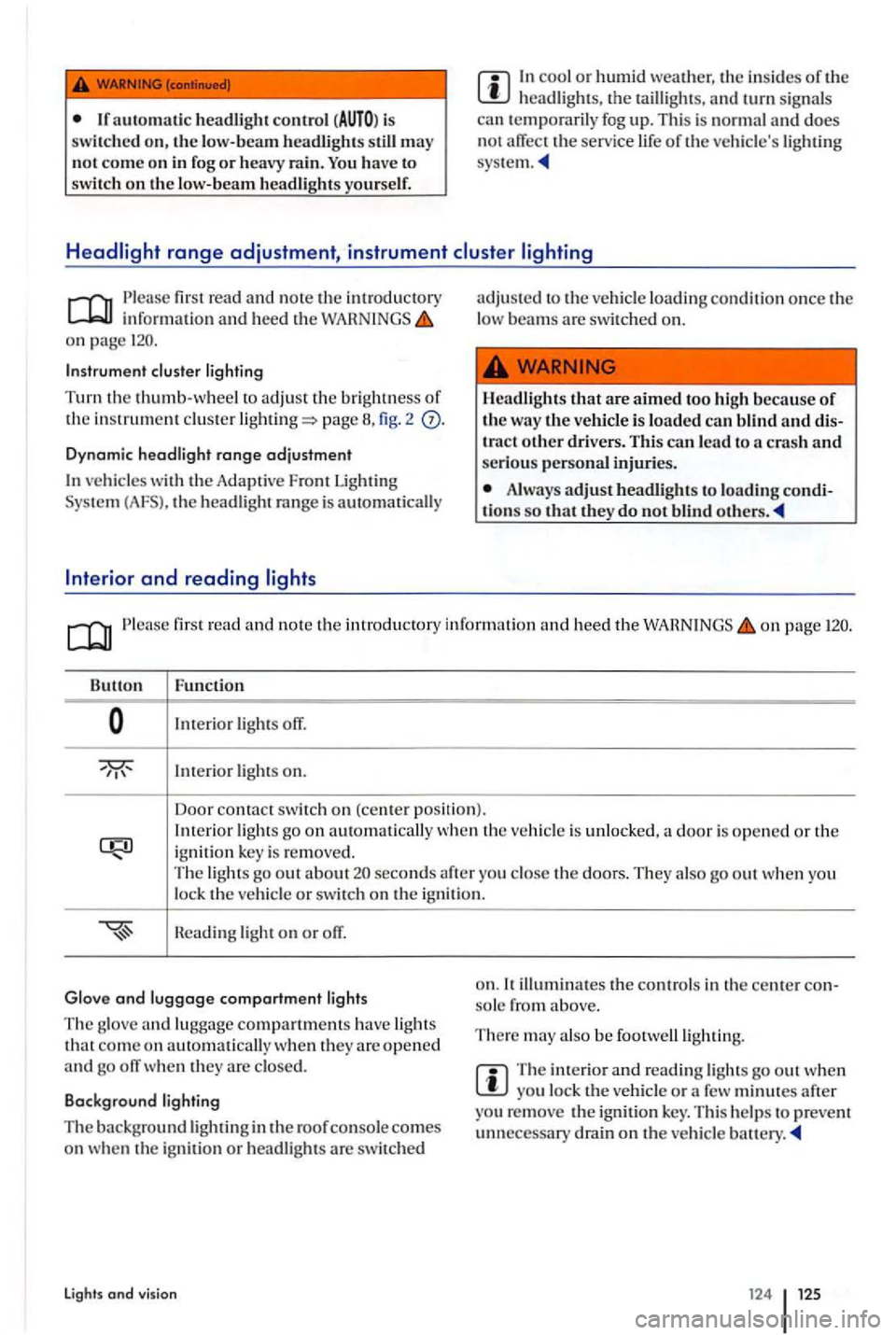
Int erior lig ht s off.
lmerior light s on.
Door conta ct
switch on (ce nter positio n). Int erior lig ht s go on wh en th e ve hicl e is unlock ed ,
seconds after th e doors. They also go out when you
lock th e
come on automati cally w hen they are open ed and go off when th ey are closed.
Background lighting
T he
background lighting in the roof console comes on w he n th e ig nit ion or headlig hts are s wit c hed
lights and v ision
o n . so le from above.
There m ay also be foo twe lllighting.
Th e interio r and rea din g lights go out when yo u lock the ve hicle or a few minutes aft er
yo u re m ove the ign ition key. Thi s help s to p reve nt
un necessary drain on the vehicl e
Page 130 of 541
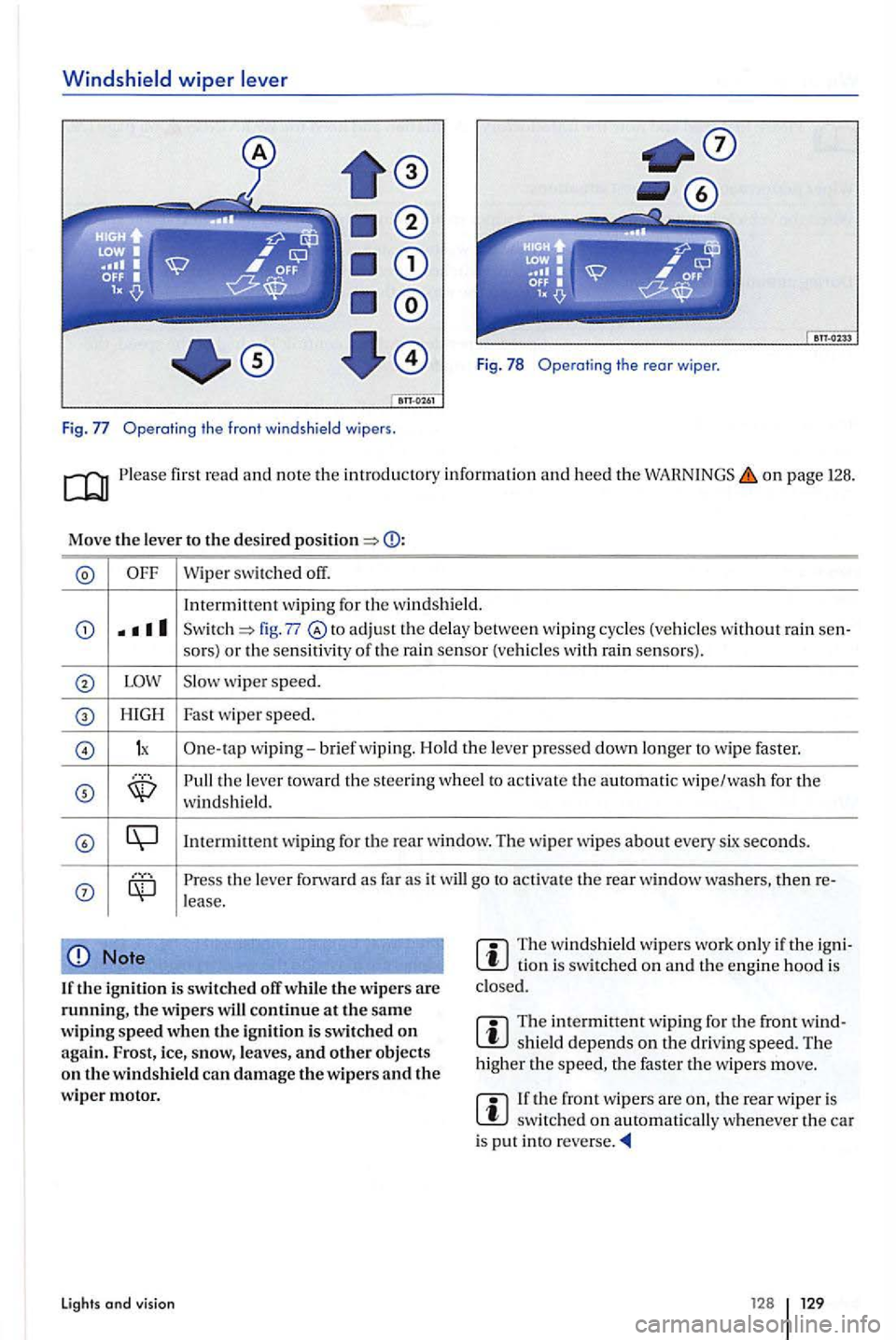
Windshield wiper lever
Fig . 78 Operating the rear wiper .
Fig. Operatin g t he front windsh ie ld wipers .
on page 128.
Move the leve r to t he des ired
Wipe r switched off.
In term itt
ent wiping for the w ind shield.
fig. 77 to adj ust the delay between wip ing cycles (vehicles wit hout rain sen-
so rs) or the sensit iv ity of th e rain sensor (vehicle s w ith rain senso rs).
w iper speed.
H IGH Fast wipe r speed.
1x One-ta p wip ing-brief wiping. Hold th e lever presse d down longer to wipe faster.
the le ve r towa rd t he stee ring whee l to activat e the au toma tic wipe/wa sh for the windsh ie ld.
the leve r forward as far as it will go to ac tiva te the rear window then re-lease.
Note
If the ig n it io n i s swi tc h ed off whil e the w ipers are th e w ipers continue a t the sa me
w ip ing sp eed when the ign ition i s swi tched on agai n.
The w in ds hield wipe rs work only if th e tio n i s sw itched on and th e engine hood is
clo sed.
Th e intermittent wip ing for the front shield depends on the driving speed. The
h igh er the the faster th e wipers move.
th e rear w ip e r is s witc hed on automatically w henever the car is pu t in to
Lights and visi o n 12 8
Page 131 of 541
Wiper functions
first read and note th e introductory informat ion an d heed the on page 126.
Wip
er p erformanc e in diffe rent situations:
W he n th e veh icle is
not mov ing : The wip er speed changes tempo ra ril y to the next lower speed.
W hil e
the washer sys te m is wo rking, the climate control
During automatic wipe/wash: sys
te m switches to recircul ation for about seconds h elp prevent th e w asher flu id odor from enterin g the ve hicl e int e-rior.
D urin g int e
rmittent wip ing: S
peed-dependent interval con tro l: The high er th e speed, the faste r the wipers m ove.
Heated washer nozzles
The heatin g tha ws frozen wash er nozzles, but not the fluid suppl y hoses. When the ig niti on is
sw itch ed on, th e heat applied to the was he r zles is au to mat ically regulate d d ep ending o n th e
outs id e ai r t emperature .
Headlight washer system
T he headlight washer sys te m clea ns the headli ght
glass.
I f th e ign it io n
and the headli ghts (high or lo w arc swit ch ed on, the headlight s time and every fifth time th e front windshi eld washers a re activa te d. Thi s happen s only when the low or hig h beams are on whe n th e
Windshiel d wi pe r service posit ion
Fig. 79 Wind sh ield wiper in ser vice position .
Before driving
windshi eld wip er leve r is pulle d towards th e
s teering w heel. Howeve r, th e headli ghts must s till
b e was hed by ha nd periodically (for i nstance, during fue ling) in order to get riel of move dirt insect splaller).
T o hel p
make sure th at th e headli gh t cleanin g syste m wo rk s during winter weather, a lways keep the headlight washer nozzles fre e of snow move an y ice w ith de- icer spray before drivi ng.
Use a de- icer spra y to re m ove an y ice.
wiper will try to wip e it away . fit continues bloc k the wiper, th e wiper wil l s top moving. move th e in terfer ence and swit ch th e wip er on
firs t read and note the introductory in formation and heed th e o n page 128 .
I n
the service posit io n, th e wiper arms can be
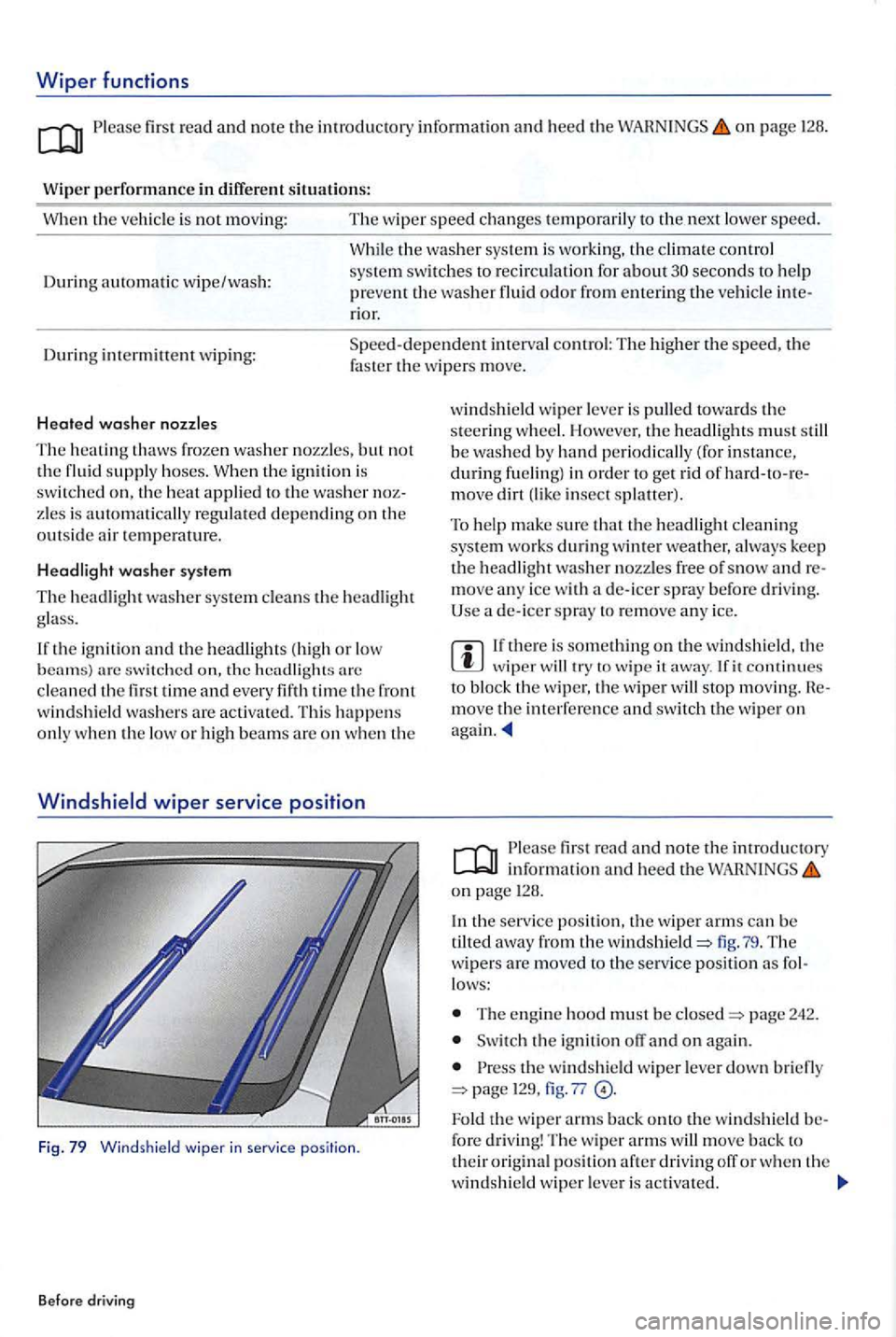
tilted away from the windshield=> lig . 7 9 . The w ipers are move d to the ser vice pos it io n as lows:
T he e ngin e hood must b e closed=> page 242.
Switch the ig nition o n again .
th e windshie ld wiper leve r down brie fly page 129, fig . 77
Fold the wipe r arm s back onto the w indshi eld fo re driving! Th e w iper arms will move back t o their origin al positi on afte r dri vin g off or w he n th e
winds hi eld wip e r leve r is activa te d .
Page 132 of 541
lifting and folding the wiper blades away from
th e
windshield
Move the wiper arm s th e serv ice position
Do not handle the wiper b lades; h andle the
wipe r arms o nl y at the a uachment above the w iper blades.
Rai n sens or
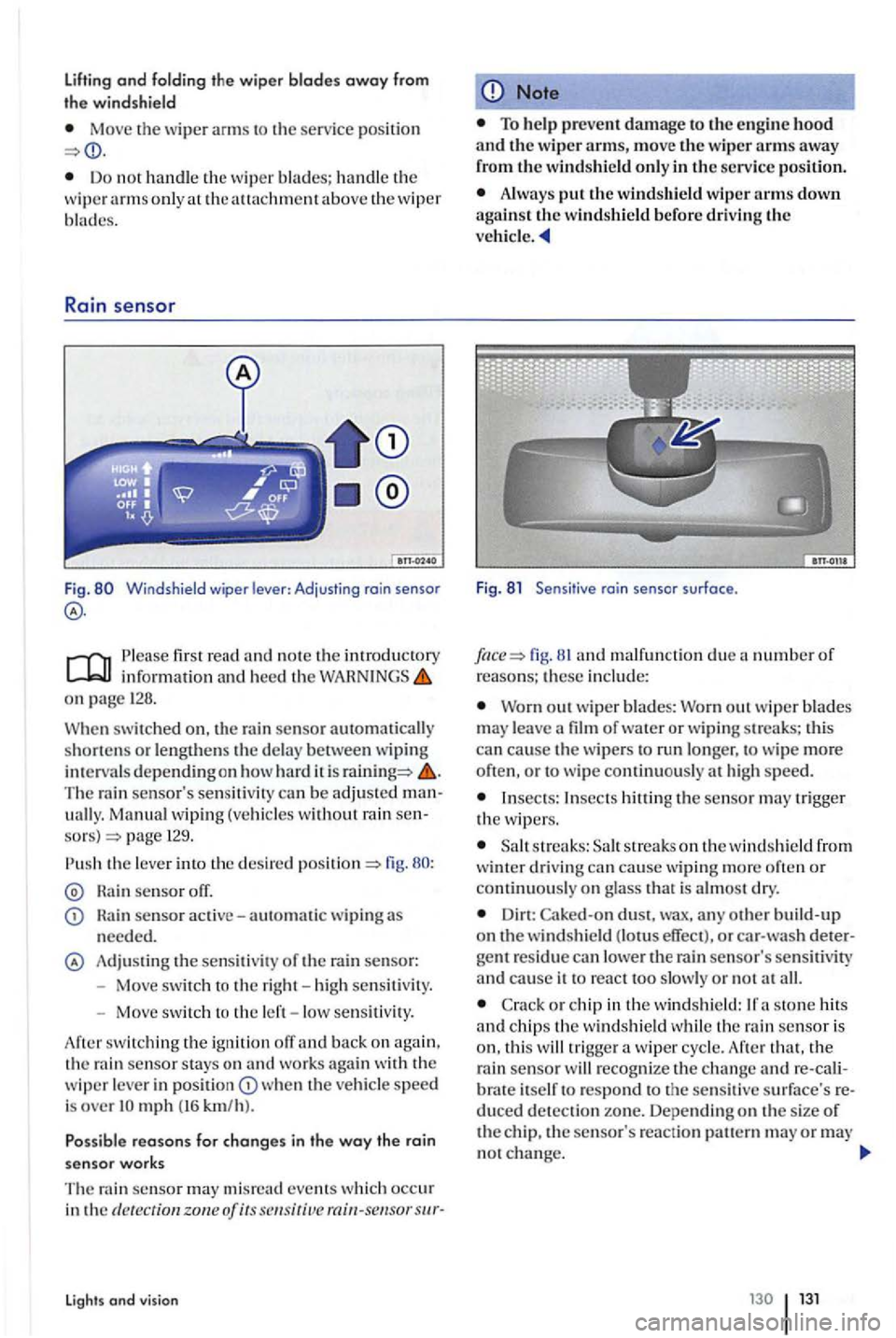
Fig. Windshield wiper lever : Adjusting rain senso r
first read and note the introductory information and heed th e WARNINGS on page 128.
When
swit ched on. the rain sensor automatically
shorte n s or le ngthens the de lay betwee n wiping in tervals depend in g on how hard it is The rain sensor's sensiti vity can be adjusted manuall y. Manual wiping (vehicle s w ith out rain sensors) page 129.
Rain sensor off.
sensor active-automatic wiping needed.
Adju stin g the sensit iv it y of the rain sensor:
- Move switc h t o the right -hi gh sen siti vity.
- Move sw itch to the left - low se nsitivity.
swit ch in g th e ignition off an d back on again ,
t h e ra in sensor stays o n and works agai n with the wiper leve r in w he n the vehicle speed is over
events which occur in the dete ction zone of its
Lights and vision
Note
Always the windshield wiper arms down against the windshield before driving the ve hicle.
Fig . 8 1 Sensit ive rai n sensor surface .
fig. 81 an d malfu nction due number of reasons; these in clu de:
Worn out w ip er blades: Wo rn out w iper blades m ay lea ve a film of water or w ipi ng streaks; thi s can cause the wipers run longe r, to wip e more often , o r to w ipe continu ously at h ig h speed.
Insects: Insects the sensor may tri gger the w ipers .
s tr eaks: streaks o n th e w indsh ie ld from
w inter drivin g can cause wiping more often or continu ously on g lass that is almos t dry.
Dirt: Caked-on dust, wax, any build- up on the windshield (lotus effect), or car -w ash detergent residue can lower the rain sensor's sen siti vity and cause it to react too slowly or n o t all.
C ra ck or chip in the wind shi eld :
th at, th e
rai n sensor will recog nize the c ha nge re -cal iitself to respond to the sensit ive su rface's reduced detection zone. Depending on th e s ize of the chip, the sensor's reaction ern may or may no t change.