drive VOLKSWAGEN JETTA 2007 Owners Manual
[x] Cancel search | Manufacturer: VOLKSWAGEN, Model Year: 2007, Model line: JETTA, Model: VOLKSWAGEN JETTA 2007Pages: 477, PDF Size: 77.6 MB
Page 329 of 477
Booklet 3.2 Tips and Advice
Braking power and braking distance
Braking power and braking distance are influenced by driving situations and
road
Worn brake pads will not provide good braking.
The amount of wear and tear on the brake pads
depends to a great extent on the cond itions
und er which the vehicle is opera ted and the way
the vehicle is dr iven. If you do a lot of city
driv ing, drive short distances or have a sporty
driving style, we reco mm end th at you have the
thickness of your brake pad s checked by an au
thor ized Volkswagen dea ler more frequently
than r ecommend ed in the service schedule.
I f you dr ive witJ1 wet brakes , for example after a
dri ving through water,
heavy rainfall or
after washing the vehicle, brakin g power will be
reduced and sto pping distances w ill be longer
because the brake d iscs will be wet or in winter
ma ybe even frozen
the brakes must be dried
with severa l ca reful brake applications.
Brake fluid absorbs water and must be c hanged
every two years. Heavy use of the brakes can
cause vapor lock if the brake fl uid is too old.
Va por lock reduces braking power, increases
stopp ing distances and can even cause total
brake failure.
WARNING
• New tires and new brake pads do not pro
v id e maximum grip, control or braking abilit y.
• To reduce the risk of losing control, a colli
s ion and se rious persona l injuries, drive with
special ca re for the first
350 mil es (560 km).
• New brake pads do not have the best stop
ping power for the first
150 mil es (240 km) and
must be broken in. You can com pensate for
the slightly reduced braking ability by drivin g
w ith care and applying more pressure on the
brak e pedal.
• Never fo llow other vehicle s too close ly or
put yourse lf into other situ ations that might
r equ ire s udden , hard brakin g especially when
th e brake pads have not been broken in.
WARNING
Wet brake s or brak es coa ted ice or road
sa lt react slower and need longer stopping dis
tanc es.
• Carefully apply brakes for a lest.
• Alwa ys dry brake s and clean olT ice coa t
ings and salt coa tings with a few cautiou s
brake app lica tions.
• Always read and hee d all
in "Break ing in tir es and brake pads" on
page 7.
WARNING
Overheated brakes will reduce the vehicle's
s topping power and increase stoppin g di s
tances.
• Always avoid over hea tin g the brakes!
• When driving downhill, the brakes have to
work hard and hea t up quickly .
• Before driving clown a long, steep hill, al
ways red uce spee d and downshift to a lower
gea r. This will let th e ve hicle use engine
braking and reduce the load on the brakes.
• Always c han ge the brake fluid at least
every two years. Hard braking with old brake
fluid may cause a va por lock. Vapor lock re
duces brakin g power, increases s topping dis
tan ces and can even ca use to tal brake failure.
• A damaged front spoiler or new non stan
dard spoile r ca n reduce the airflo w to the
brake s and cause them to overheat.
• Always sec an au thorized Vo lkswage n
dealer or qualil1ed workshop if yo u think th at
you may have damaged the front spoiler.
• Be sure to read and heed all WARNINGS
and the information =-page 27, "Accessories
and part s" before buying accessorie s.
8 Driving and protecting the environment
Page 330 of 477
Operate your vehicle safely
For drivin g safely, alwa ys follow t he speci fied
maint enance interva ls in your maint enan ce
bo okle t =boo klet
I.I "M aint en an ce" -es peci ally
fo r chan ging brake fluid. H ard use , pri marily
s top and go dr iv in g, o perat io n in very dusty
areas, t ra ile r towi ng as we ll as other con dition s
m ay make
neces sary maint enance
im erva ls -see your authorize d Vo lksw agen
d ea ler.
Your vehicle 's condition is dir ect ly relot ed to
driving safety
Th erefo re, always be sur e
ob serve fol
l ow ing points before yo u dr ive off:
• Check l ig ht s an d turn sig nals.
• Check f uel l eve l.
• Make sure
a ll ligh ts a nd all wi ndows are
clea n.
• Adjust
mirr ors .
• Make s ure
air intak e slo ts betwee n en gin e hood a nd wind shi eld are free of
l eaves, sn ow a nd ice.
• Check warning a nd indicato r light s when
s tarli ng the en g in e.
Your personal d riving style and attitude have a
lot to do with safety ..
T here fore , for you r ow n sa fe ty:
• Wear your safety bells a nd wear
pro p
er ly , ev en if you ar e just driv in g in city o r lo
th e co rner =book le t 2 .1 "Sa fe ty first",
c h apt er "Safet y
• Make sur e th at all passe ngers wear their
sa fe ty belt s proper ly. even those in rea r 2.1 "Sa fe ty chapter "Safety
belt s." Pa sse ngers wea ring en
danger not onl y th em selves in cra sh, but al so dri ver and oth er passengers .
• Make su re th at children a lwa ys
on rear
sea t prop erl y res tra in ed by a res traint system a p
propri ate for th eir size and age.
• Never tra nsp ort a child in a rear
c hild
or infant seat on the front passe nger seat
= bo oklet 2.1 "Safety
• Adju st yo ur sea t so that yo u ca n eas ily reac h
a ll co ntrol s whil e yo u are as from
Booklet 3.2 Tips and Advice
airb ag as pos sible but close r th an 10 inches
(25 cm ) = book let 2. 1 an d 3.1.
• The sea ting positi on is ve ry important for the
a irb ag perfo rm ance
2.l "S afety first",
cha pter "Air bag syste m.''
• Always a djust th e hea d res traints to
cor
r ec t h eig ht . For maximum pro tec tion , ad just the
h ead res trai nt so that the upp er edge is as eve n
w ith the top of yo ur hea d as possi ble,
no
l owe r than eye le v el a nd so that is as close to
th e ba ck of your head as possib le = bo okle t 2. 1
"Safe ty
• Alw ays make s ure that the mov ement of peda ls is no t res tri cte d in an y way 3. 1,
c h ap te r " Peda ls ."
• Store luggage an d light it em s prop erl y in
luggage compartme nt and on roo f
=book let 3. 1, c hap ter" Luggage compa rtment "
an d
3.1, cha pter rack."
If you drink, do not drive !
T he use of a lco hol, dru gs a nd certain medi ca
ti ons w ill seriously impa ir percept io n , reac tions
a nd dri vin g a bility ,
increa sin g th e
ri sk of an acci dent, cras h an d pe rso nal injury.
Do not drive if you are tired.
Make frequ ent rest stops , at le ast aft er every two
hours of dri ving.
Al ways adapt vehicle speed to traffic, road and
weather conditions.
H em ember , th at
o n sm ooth, slipp ery
roa ds, ve hicle han dling and br aking dep end a
d ea l on tire ad hes ion. On wet roa ds, the
front whee ls c an h ydrop lane, especi ally at
h ig her sp ee ds. If thi s hap pe ns, yo u will then no
l o nge r b e ab le to ste er or brak e prop erl y.
WARNING
• Alw ays observe the po sted spe ed Ii mils and
common sense. Your good judgment can
mean
diff ere n ce between arr iving safely at
your destination and being ser iously injur ed
in
crash or other kind of accide nt.
• Alway s rea d and hee d all WARNI NGS and
a dditi on al inform ation rega rding safety
= bookl et 2.1 "Safe ty
Driving and protecting the environment 9
Page 334 of 477
WARN ING (continu ed)
• Exceed ing permi ssibl e weig ht ratings can
r es ult in ve hicl e da m age, accide nts, and per
sona l
Driving tips
For th e best handlin g of ve hicle and trailer,
p lease note th e fo llowing:
• A "bala nce d" rig is easie r
operate and con
trol. This m ean s th a t th e tow vehicl e should b e
loaded to th e extent p ossible and p ermi ssible
whil e keep ing th e trailer as light as po ssibl e
und er th e circum stanc es. Wh eneve r po ssib le,
tran sfe r som e cargo to the
co mpar tment
of the tow vehicl e w hile obs ervin g tongu e loa d
req uirem ents and vehicle loa ding consid er
a tion s.
• The high er th e s pee d, the more
it be
come s fo r the drive r to control th e rig. Do not
dr ive at the maximum permis sibl e
• Always appl y br akes earl y. When driving
d ow nhill, d ownshi ft into a lower gear to u se the
e ng in e brak in g eff ec t to slo w down the ve hicle.
U se of the brake s alo ne ca n ca use them to ove r
h ea t an d fail.
• The coo ling effect of the rad iator fan cann ot
b e in crease d by dow nsh ifti ng beca use fan sp ee d
i s ind epend ent of engine sp ee d. The re for e,
Trailer towing tips
Your vehicle handles diff ere nt ly wh en t ow in g a
t ra iler b ecause of the a ddit io na l weight and
weig ht d is tribut ion. S af ety. perform ance and
e conomy will gr ea tly depend on how car efull y
yo u load your tra iler
yo ur rig.
B efor e y ou actua lly
your tra iler, practice
t urn ing. stoppin g and backing up in an ar ea
away from
until yo u l earn the feel of your
ve hicle and trailer unit.
Backing up is
r e quir es prac tice .
S teer ing w hile backing up is generall y opposite
of th at wh en backing your vehicl e w ith out a
tra iler.
Booklet 3.2 Tip s and Advice
wh en dr iving uphill , yo u can alwa ys dri ve in the
hi gh est po ssible gea r wit h low e ngin e sp ee d. If
th e coo lant te mp erature warning light in the in
s trument cluste r start s fla shin g in red , p ull off
the road , stop and le t th e e ngin e id le for abou t
minute s to pre vent hea t bu ildup and engin e
damag e.
WARNING
• Reduce you r speed even more under unfa
vora ble load, wea ther or w ind condi tions
p artic ular ly w hen goi ng dow nhill.
• Be especia lly carefu l w hen passing o ther
veh icles. Redu ce ve hicle sp eed immediate ly if
the tra iler sh ow s the sli ghtest sig n of sway ing.
• Neve r try to stop the sway ing by acceler
ating.
• Always heed speed lim its. In some a reas
speed lim its for vehicl es tow ing tra ilers are
l ower than for reg ular
Keep more di stan ce between your vehicl e and
th e one in front of you. will nee d m ore roo m
to stop.
To compens ate fo r th e traile r, yo u w ill n eed a
l a rger than normal tu rning
When passing , reme mber that you can not acce l
erate as fast as you normall y wou ld because of
t h e added load. Make sur e yo u ha ve enough
room to pas s. After passing, allow plen ty of room
fo r yo ur tr aile r befor e changing la nes aga in.
Avoid jerk y s tart s, sharp turns or rapid lan e
c h ange s.
Driving and protecting the env ironment 13
Page 350 of 477
Booklet 3.2 Tips and Advice
Cellular phones and CB radios
will need an antenna for cellular phones and CB radio s
Volk swa gen h as a pproved your vehicle fo r use
w ith cellul ar phon es and CB r adio s prov iding
th e fo llowi ng co ndition s:
• correc t in sta ll ation of outside antenn a,
• transm itting pow er is no more than a m ax
imum of
JO wa tts.
A n outs ide ante nna is nee ded
g ive the eq uip
m ent it s opt imal range and pr eve lll in terfer
ence with elec troni cs in th e vehicle.
I f y ou want to use a ce llul ar phone or a CB ra dio
w ith a tran smillin g powe r g re at er than 10 watts,
fir st ch eck wit h a auth orize d Vo lksw agen dea le r.
Ce llul ar phone s and CB radios s houl d be in
s ta lled only by a qualified worksh op or by your
a uthori zed Vo lkswage n deale r.
Carefu lly fo llow the o perat ing in stru ction s for
yo ur cellula r te lep hon e or CB radi o.
WARNING
• Always concentrate on your driving, and the road. Driver di str act ion causes acci
dents!
• Alwa ys set v olume le vels so that you can
clearl y hear horn s, sire n s a nd oth er warning
sounds outside the vehicle.
WARNING (continued )
• Using a cellul ar te lephone or CB radio in
side the vehicle without having a separate out
s ide antenna can be dangerous to your health
and that of your passengers because th e elec
tromagnetic radiation energy that the se de
vice s emit may be above esta blish ed limit s.
• Never attach anything, including acce sso
ries (for example cup holders or teleph one
brackets) to the airbag covers or within the
airbag d eployment zone.
• Objects on or near the surface s where air
bags are located can come loo se and cause se
riou s personal injury
if the airbag deploy s 2.1 "Safety first", chapter "Airbag
system."
Note
Improper in stallation of cellular te le phon es, CB
ra dios or other electro nic compon ent s can
ca use oth er ve hicl e systems to malfunction. Th e
m os t co mmon causes of fault s ar e:
• no ex te rnal
• incorrec tly insta lled ex te rnal antenna,
• tran smitting power in excess of 10 wa tts.
Accessories, new parts, repairs and modifications 29
Page 351 of 477
Booklet 3 .2 Tips and Advice
Checking and Filling
Filling the tank
fuel filler flap opens from inside the vehicle. The fuel tank holds 14 .5 gallons
(55 Liters).
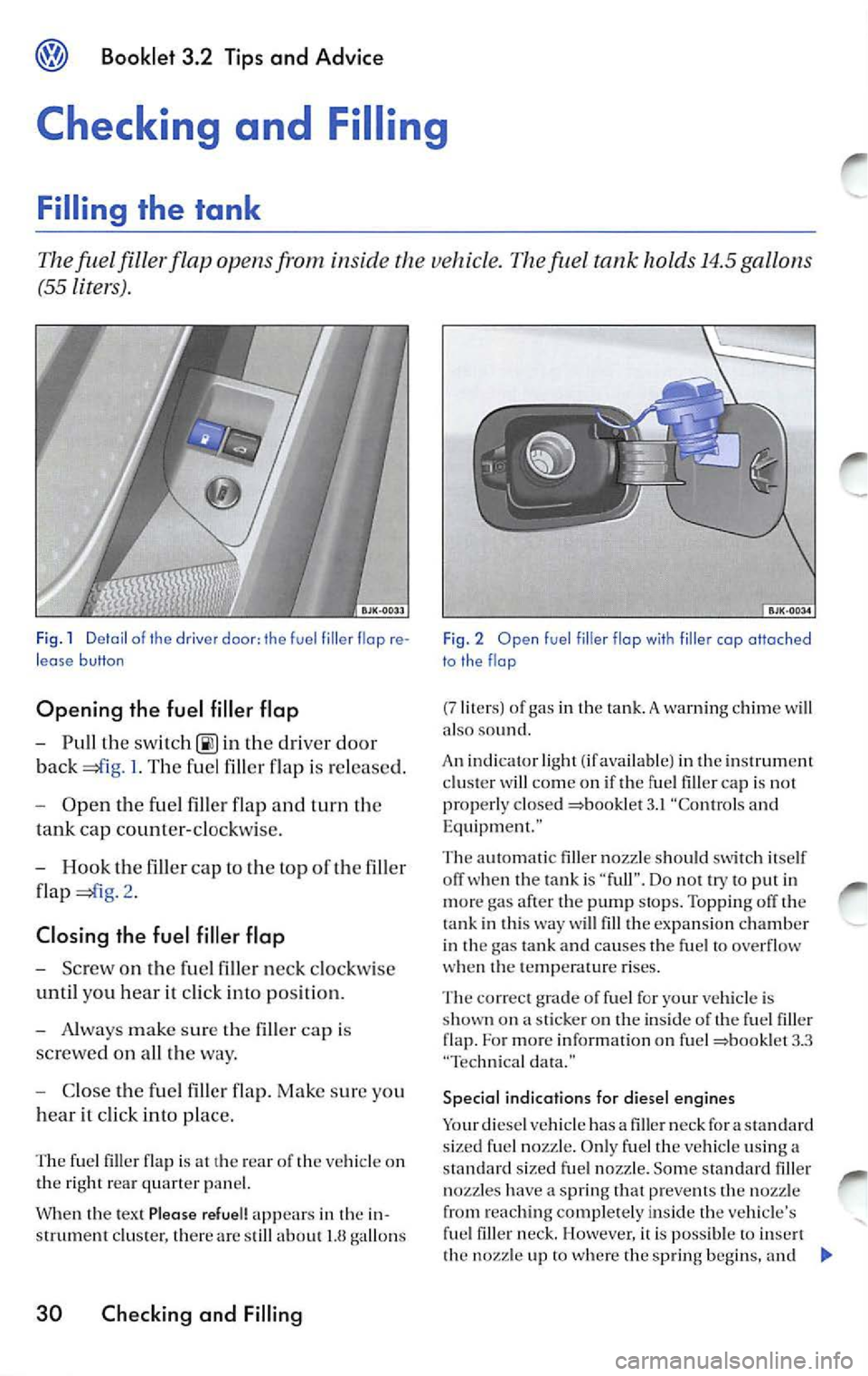
Fig . 1 Detail of the driver door: the fuel fil ler flop re
lease button
Opening the fuel filler flap
- Pull the switc h 00) in th e drive r doo r
back
I. T he fu el fill er flap i s re leased .
- Open the fuel filler flap and turn th e
tank cap counte r-cloc kw ise.
- Hook t he fill er cap to the top of the filler
flap
2 .
Clo sing the fuel filler flap
- Screw o n the fuel fi lle r ne ck clockwise
until you hea r it cl ick into position.
- Alway s m ake s ure the fi ller cap i s
screwe d on a ll way.
- Close the fuel fi ller flap. Make sure you
h ear it cli ck into place.
The fue l filler flap is at the re ar of the vehicle on
th e right re ar qua rter pan el.
Whe n the tex t Pleas e refuel! appears in the in
s trum ent clu ste r, th ere a re still abo ut
gallons
30 Checking and Filling
Fig. 2 Open fuel filler flap with f iller cap attached
to the flop
(7 liter s) of gas in the tank. A warning chi me w ill
a lso so und.
An indi cator lig ht (if availab le) in the in st rum ent
cluster w ill come on if the fu el fi ller cap is not
properly clos ed
3.1 "C ontrol s and
Eq uipment."
T he automat ic filler nozzle s hould switc h itself
when the tank is " full ". Do not try to put in
mor e gas after the pump stops. To ppin g off the
ta nk in this
will fill the expa nsion chamb er
i n th e gas tank and causes th e fuel to ove rflow
w hen the temperature ri ses.
The correct grade of fuel for your vehicle is
s h own o n
sti cker on the insid e of the fuel filler
flap. For mor e informatio n on fu el 3.3
" T ec hnical da ta ."
Specia l indications far diesel engines
Your diesel vehi cle ha s a filler neck for a sta ndard
s ized fuel noz zle. Onl y fuel the v ehicl e usin g a
s tan dard sized fuel nozz le. Some s tandard filler
no zzles have a sprin g that preve nts the nozzle
from reaching complete ly ins ide t he ve hicl e's
fille r neck. However, it is poss ible to t h e nozzl e up to wh ere the spring beg ins, an d
Page 371 of 477
Booklet 3.2 Tips and Advice
The electrolyte level be checked reg ularly in high-mileage vehicles, in hot
cou ntri es and in older batteries.
- Open the engine hood and open the
batt ery cover at the front.
- C heck th e co lor display in the round
w ind ow at the top of the battery.
- If there are air bubb les in the window,
tap the w indow gent ly un til they disp erse .
Th e positio n of th e battery is sh ow n in th e corre
spo ndin g engine compart ment diagram
3.3. Th
e ro und window ("magic eye '') on th e to p of
t h e batt ery chang es color, d epending on the
c harg e le vel and ele ctrolyt e le vel of the ba ttery.
I f th e c olor in the w indow i s co lor less or bri gh t
ye llow . the elec trol yte le vel of the battery is to o
I la ve the ba tte1y ch ec ked by a q ualifi ed
d eal ers hip ..
The col ors g ree n and b la ck ar c use d b y the work
s h op t o diagno se the battery.
Charging and replacing vehicle batteries
All work with the vehicle battery req uir es specia l know ledge.
Have th e batteries checked by auth orized
Vo lkswagen deale r o r qua lified workshop be
t ween regular ma inten an ce i nt erva ls if you of te n
driv e short distance s or i f th e vehicle is not
driven for lo ng peri ods.
I f the bat te ry has discharged and you have prob
l ems starting th e ve hicle, the battery might be
damaged . If thi s happens, we re comme nd you
h ave the ve hicle batte ry c hecked by an autho
ri ze d Vol kswag en dealer
it w ill he erly recha rged o r re pla ced.
C har ging vehicle batteries
T he c har ging of the vehicl e batt eri es s hould be
l ef t to an aut horized Vo lkswage n deale r o r qual
ifi ed workshop, b ecau se your ve hicle is
equipp ed w ith specia l batteri es th at mu st b e
charg ed in a contro lled e nvironm ent.
50 Checking and Filling
Rep lacing a battery
T he batt eries have been specia lly deve lo ped for
th eir lo cat io ns and they have specia l sa fe ty fea
Genui ne Volkswage n batte ries me et th e m aint e
nan ce, and safety sp ecificat io ns
fo r you r ve hicl e.
WARNING
• u se on ly maint en an ce -fr ee or
cycle -free, leak-proof batteries with the same
s pecification s and dimen sions as the ori ginal
e quipm ent batt ery. S pecifi cation s are liste d
on the batt ery hous ing.
• Before sta rtin g
work on th e batteries,
a lways rea d and heed a ll in
"Loca tion of battery" on page 49.
Page 374 of 477
Maximum (permissible) inflation pressure means the maximum cold inflation pressure to
which a tire may be inflated. Also called "max imum inflation pressure."
Normal occupant weight
means
150 lbs. (68 kilograms) times the number
of occupants seated in the vehicle up to the total seating capacity of your vehicle.
Outer diameter
means the overall diameter of an inflated new
tire.
Overall width means the linear distance between the exteriors
of the sidewalls of an inflated tire, including ele
vations due to labeling, decorations, or protec tive bands or ribs.
Ply
means a layer of rubber-coated parallel cords.
Radial ply tire
means a pneumatic tire in which the ply cords
that extend to the beads are laid at substantially
90 degrees to the centerline of the tread.
Recommended inflation pressure
see
52, "Cold tire inflation pressure".
Rim
means a metal support for a tire or a tire and
tube assembly upon which the tire beads are
seated.
Rim diameter
means nominal diameter of the bead seat . If you
change your wheel size, you will have to pur
chase new tires to match the new rim diameter.
Rim size designation
means rim diameter and width.
Rim width
means nominal distance between rim flanges.
Sidewall
means that portion of a tire between the tread
and bead.
Booklet 3.2 Tips and Advice
Speed rating (letter code) means the speed at which a tire is designed to be
driven for extended periods of time. The ratings range from 93 mph (150 km/h) to 186 mph
(298 km/h). These ratings are listed in the table
below 62. You may not find this informa
tion on all tires because it is not required by law.
The speed rating letter code, where applicable, is molded on the tire sidewall and indicates the
maximum permissible road speeds.
Tire pressure monitoring system
1 )
means a system that detects when one or more
of a vehicle's tires are underinflated and illumi nates a low tire pressure warning telltale.
Tread means that portion of a tire that comes into con
tact with the road.
Tread separation means pulling away of the tread from the tire
carcass.
Tread wear indicators (TWI) means the projections within the principal
grooves designed to give a visual indication of
the degrees of wear of the tread. See
59, "Tread Wear Indicator (TWI)" for more informa
tion on measuring tire wear.
Uniform Tire Quality Grading
is a tire information system developed by the United States National Highway Traffic Safety
Administration (NHTSA) that is designed to help buyers make relative comparisons among tires.
The UTQG is not a safety rating and not a guar antee that a tire
will last for a prescribed number
of miles or perform in a certain way. It simply
gives tire buyers additional information to com bine with other considerations, such as price,
brand loyalty and dealer recommendations .
Under UTQG, tires are graded by the tire manu
facturers in three areas: tread wear, traction and temperature resistance. The UTQG information
on the tires, molded into the sidewalls.
U.S. DOT Tire Identification Number (TIN)
This is the tire's "serial number."
It begins with
the letters "DOT" and indicates that the tire
meets all federal standards. The next two num-
Tire pressure monitoring system)
Checking and Filling 53
Page 375 of 477
Booklet 3.2 Tips and Advice
bers or w her e il manufactured, and fo ur numb ers re pre
s ent the week and year of manufa ctur e. For ex
ampl e, th e numb ers 180 1 m ean lhal
lir e produ ced in the wee k of 200 1. oth er
numb ers arc m ark e ting code s may or may
n ot b e use d by th e lir e m an ufa c tur er. T hi s info r
is use d lO cl co nsum ers if lir e dere quir es reca ll.
Vehicle capacity we ight
means cargo and luggage load pl us
1 50 lbs. (68 kilogra ms) lime s vehicle's I se
alin g capaci ty as
on label alt ached lo
t h e open ed ge of th e dri ver's door .
Vehicle maximum load on the tire
means that load on an ind iv idua l tire that is de
t erm in ed b y dis tribu ting e a ch ax le its shar e of ma ximum load ed ve hicle weig ht and di
v iding b y
Vehicle nor mal load on the tire
mean s load on an indi vidual lha l is de
termined by each axle i ls s hare of curb accessory and n ormal weighl in accordan ce below 54) and div id in g by
Occupant loading and distribution for vehic le normal load for various designated sealing capaciti es
Desig na ted sea ling capaci ty,
Vehicle norm al l oad, numbe r
Occupa nt distri bution in a
nu mber of occ upants
of occupants normally lo aded vehicle
2 th rough 4
2 2 in front.
5 3 in I in back scat.
Cold tire inflation pressure
pressure aff ects the overall safety of a icle .
TIRE AND LOADING INFORMATION
( SEATING CAPAOTY
amt,l D Of
TIR E SIZE COLD TIRE PRESSURE
FRONT
SPARE
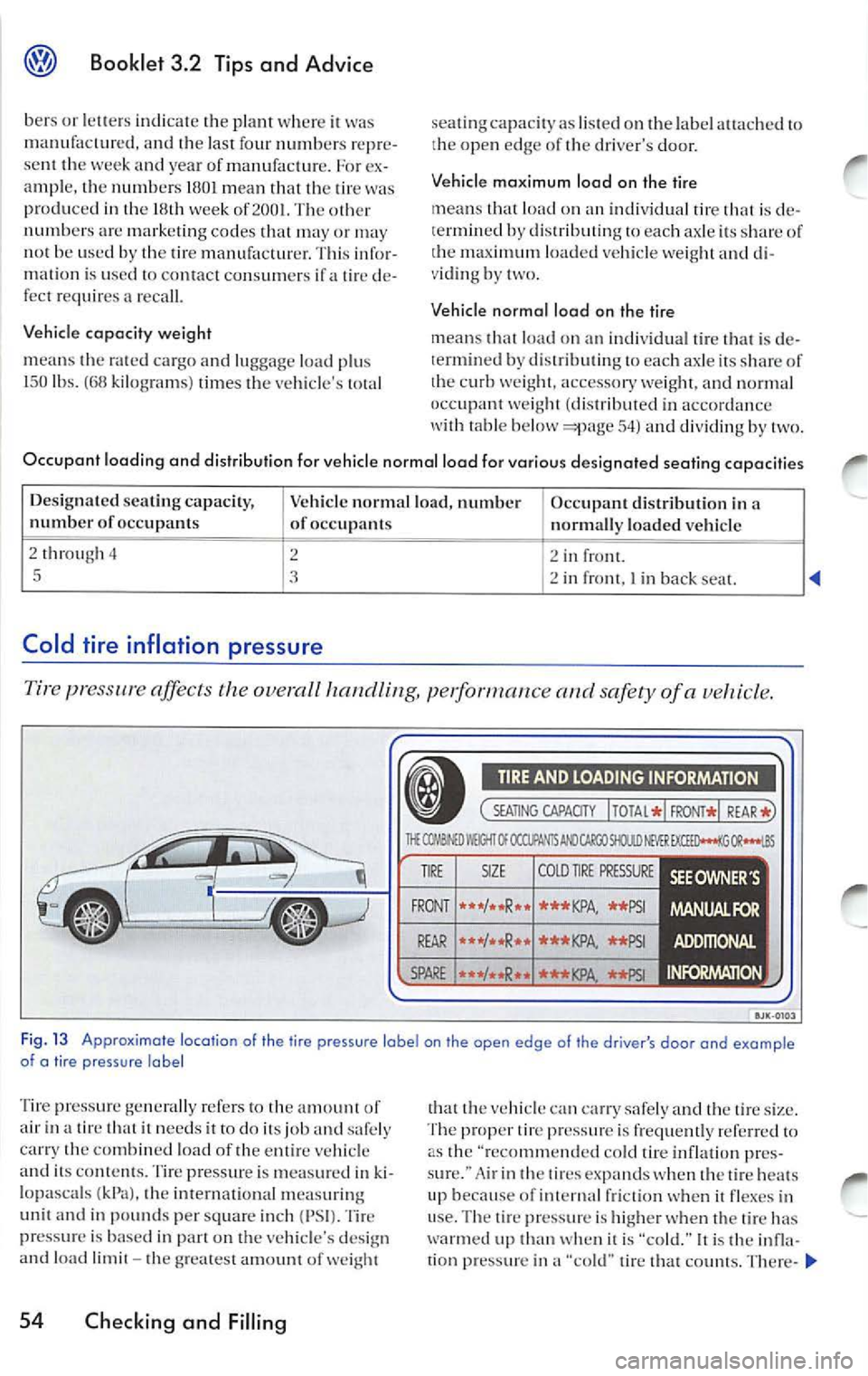
F ig . 1 3 Approximate location of fire pressure labe l on open edge of driver's door and example
of a fire pressure label
T ire p ress ur e ge nera lly refe rs to in a tire th at i l needs il t o do ils job an d sa fe ly
ca rry co mbin ed loa d of enti re vehicle
and it s content s. Tir e pre ssur e is meas ured in ki
l op ascals
imernat io nal meas urin g
unit and in poun ds per squar e in ch (P SI). Tir e
p ressure is based in pan o n th e ve hicle's des ig n
and l oad Ii mil -
greates t amount of
54 Checking and Filling
th at can car ry safe ly an d th e lir e s ize.
T he proper tir e press ure is frequ entl y to
as the "recom mend ed co ld tire inflation pr es
s ur e." Air in
!ires expa nds w hen tir e heat s
up because of fric tion when it fl exes in
u se . Th e tir e press ure is highe r w hen tire warmed up than when is "co ld.·· ll i s infla
t io n p ressure in a "co ld" lire Ther e-
Page 376 of 477
fore, you shou ld ne ver let air o ut of a warm ti re m atc h "cold tire inflation pressure" reco m
m endati ons. The tir es wo uld then be und erin
fla ted and could fail suddenl y.
Maint aining proper tire press ure is on e of the
mo st important things you ca n do
help avoi d
s udd en tir e failu re. Unde rinflated tire s are a
major cause of sudden tir e failure. Keeping t ires
a t th e righ t p ress ure is also important for saf e
and resp o nsiv e ve hicl e handl ing, tra ctio n,
and load carryi ng. Tire pre ssure s arc
part icu lar ly i mport ant when the ve hicle is
being driven at higher speeds, and then espe
cially when heavi ly lo ad ed eve n wit hin th e per
mi ssible load-carry ing capaci ties approved for
yo ur vehicle.
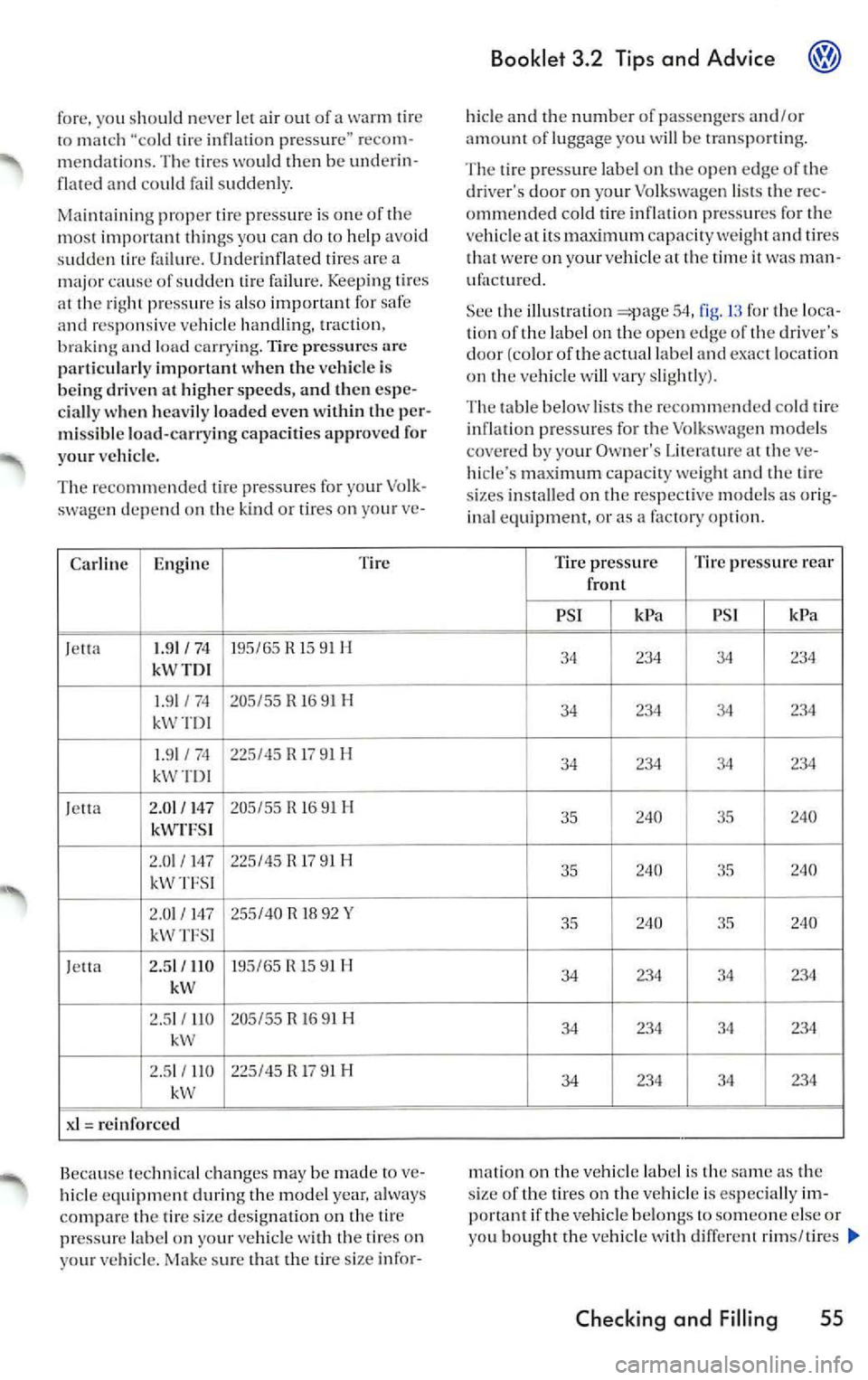
The reco mm end ed tir e pre ssure s fo r yo ur Volk
sw age n dep end on th e kind or tires on your ve-
Ca rlin e E ngin e Tire
Jet ta 1.91
/ 74 195/65
15 91 H
kWT DI
1.91/ 74 205
/55 R 16 91
kW TD I
1. 9 1 / 74 225/45
17 91 H
kW TDI
J etta 2.0
l / 147 205/55 R 16 911-1
2. 0l / 147 225/45
R 17 91 H
kWTF SI
2.0 1 / 147 255 /40
18 92 Y
kWTFSI
J e tt a 2.51/ 110 195/65
1 5 91 H
kW
2 .5 1 /
IIO 205/55 R 16 91 H
k W
2 .5 1 /
IIO 225/45 R 1791 H
kW
xi= reinfor ced
Be caus e
ch anges may be mad e to ve
hicl e equipm ent during the model year, always
c ompar e th e tire size designation on the tire
pr ess ure label on yo ur vehi cle
the tire s on
y ou r ve hicle. Make sur e that th e tir e s ize in fo r-
Booklet 3.2 Tips and Advice
hide an d th e number of passe ngers and /or
amo unt of luggage you will b e
The tire pr ess ure la b el on the op en edge of the
dri ver's doo r on your Volk swagen li sts th e rec
o mmended cold tire infla tion press ures fo r the
veh icle at its max imum capaci ty weight and tire s
th at were on your vehicle at the time it was man
ufa ctur ed.
See the illu stration
54, fig. for the loca
ti on of the label on the open edge of the drive r's
door (color of th e actual label and exact location
o n the vehicl e will vary slightl y).
table below li sts the recom mend ed co ld tire
inflation pressures for the Volk swa gen m odel s
cove red by your O wner's Lit era ture at the ve
hi cle's maximum capacit y weig ht and the tir e
s izes insta lled on th e res pec tive mode ls as ori g
in al e quipment , o r as a fa ctory opt ion .
Tire pressur e Tire pressure rear
front
PSI kPa
PS I kPa
34 234 34 234
34 234 34 234
34 234 34 234
3 5 240 35 240
35 240
35 240
35 240
240
34 234
34 234
34 2
34 3 4
234
34 234
34 234
mation o n the vehicl e lab el i s the same as th e
s ize of t he tir es on the ve hicl e is es pecially im
portan t if th e ve hicl e belo ngs to someo ne e lse or
y ou bou ght the vehicle with different rims/tires
Checking and Filling 55
Page 377 of 477
Booklet 3.2 Tips and Advice
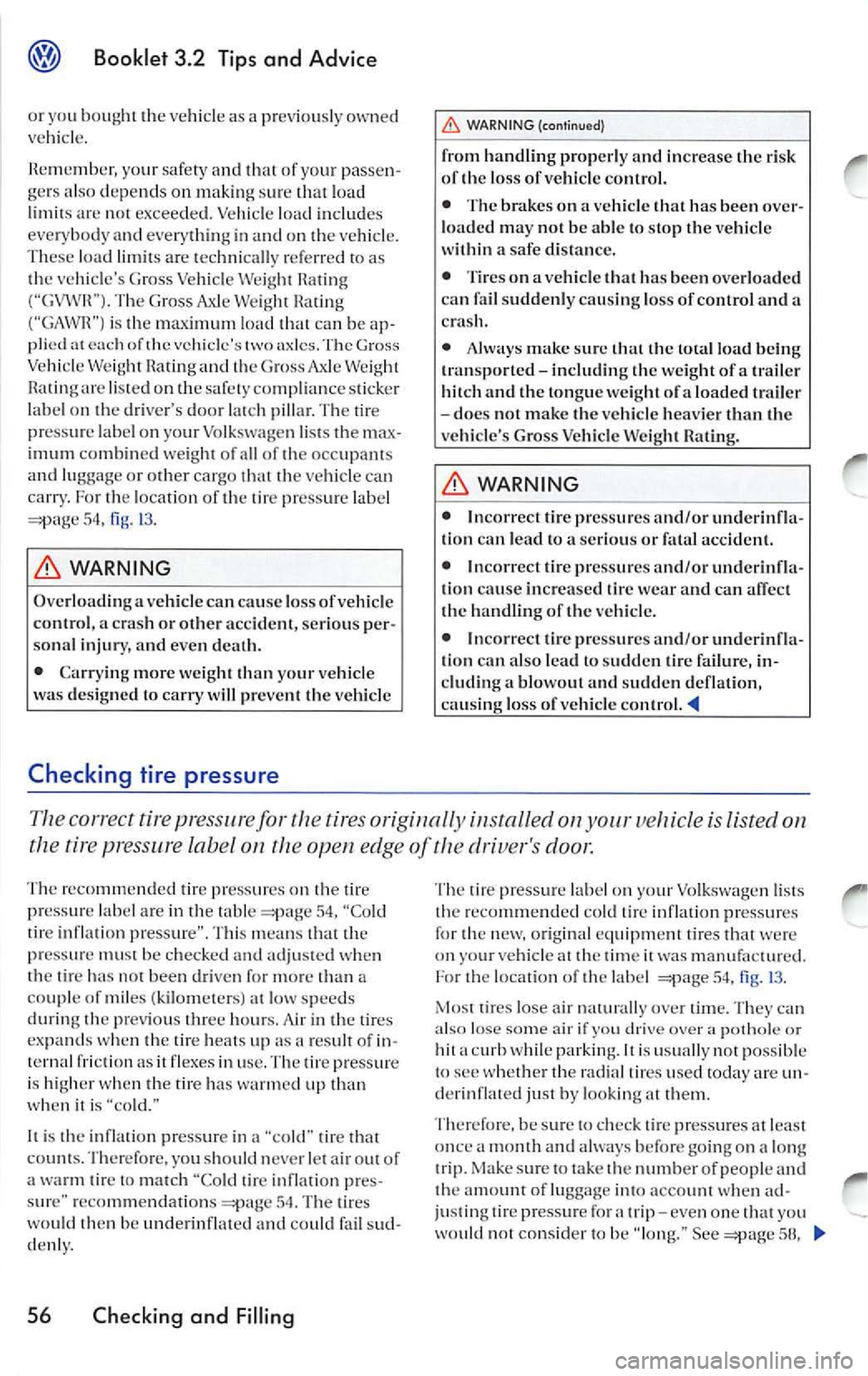
or you bought the vehicle as prev iously owned
vehicle.
R emember, yo ur safety and that of your passen
ge rs also depends on making sure that load
limit s ar c not exceeded. Ve hicle load includ es
every body and every thing in and on the vehicl e.
These lo ad limit s are t echni cally r efer re d to as
th e ve hicle's Gross Vehicle Weight H ating
The Gross Axle We ight Hating is th e maximum load that can be ap
plied each of the vehicle' s two axl es. The Gross
V ehicl e Rating and the Gross Axle Weight
Ratin g ar c listed on the safety compliance stick er
lab el o n the driver's door
pillar. The tire
pre ssure lab el on your Volkswagen lists the max
imum combined w eight of a ll of the occupants
and lug gage or other cargo that the vehicle can
carry . For the location of the tir e pr ess ure lab el
54, 13 .
WARNING
Over loa din g a vehicl e can cause loss of vehicle
control, a cras h or other accident, serious per
so nal injury, and even death.
• Carrying more weight tha n yo ur vehicle
was des ig ned to carry
will pr event the vehicle
Checking tire pressure
WARNING (continued)
from handling properly and increase the risk
o f th e lo ss of vehicl e con trol.
• Th e brakes on a vehicle th at has been over
l oaded may not be able to stop the vehicl e
w ithin a sa fe dis tance.
• Tire s on a ve hicle that has been overloaded
can fail suddenl y caus ing loss of control and a
crash.
• Always make sure that the total load being
tran sport ed - includin g the weig ht of a tra iler
hit ch and the tongue weig ht of a loaded trailer
docs not m ake the vehicle h eavier than the
ve hicle' s Gross Veh icle We ig ht Rating.
WARNING
• Inco rrect tire and/or underinfla
t io n can lead to a se rious or fata l accident.
• Inco rrec t tire pr essures and/or underin fla
t ion cause increased tire wea r an d ca n affect
th e handling of the ve hicle.
• Incorrect tir e pre ssur es an d/o r underi nfla
t ion can also lead to s udden tire failure, in
cluding a blowo ut and sudd en deflation,
ca usi ng loss of ve hicl e
correct pressur e for tires originally i 11stalled on your icle is listed on
the tire pressure label on the open edge of
doo1:
Th e recomme nded tire pr essures on the tire
pr ess ure labe l ar e in the table "Co ld
tire inflation pres sure''. Thi s m ea ns that the
pre ssure mu st b e checked and adjusted when
th e tire
n o t bee n driv en for more than a
co uple of mil es (k ilometer s) at low spee ds
during the pr evious three hours. /\ir in the tire s
e xpands when the tire heat s up a s
res ult of in
ternal fr ic tion as it flexes in use. The tir e pressure
i s hig h er whe n the tire ha s wanned up than
wh en it i s ··co ld."
It is the inflation pre ssure in
tir e that
co unt s. Therefo re , yo u shou ld never le t air out of
tir e to match tir e inflati on pres
s ure·· recomme ndations 54. T he tires
would then be underinfl ated and could fa il sud
d enl y.
56 Checking and Filling
The tir e pressure label on your Volkswag en lists
th e reco mmended cold tire inflation pressure s
fo r th e new, original equipm ent tir es that were
on your vehicl e at the tim e it was manufa ctur ed.
the loca tion of the lab el 54, 13 .
Most tires lose a ir naturall y over time. Th ey can
also lose some air if yo u dri ve over a pothole
hit a curb wh ile parkin g. It i s usually not possib le
to sec whether the radial tires used today ar e un
clcrinflated just hy looking
th em.
T herefo re, be sur e to chec k tire press ures at l eas t
o nce a month and always before going on
long
trip. Make sur e to tak e th e numb er of people and
th e amount of luggage into account when ad
ju stin g tir e pr ess ure for a trip-even o ne that you
not cons ider to be Sec