drive VOLKSWAGEN JETTA 2007 Owners Manual
[x] Cancel search | Manufacturer: VOLKSWAGEN, Model Year: 2007, Model line: JETTA, Model: VOLKSWAGEN JETTA 2007Pages: 477, PDF Size: 77.6 MB
Page 380 of 477
Determining correct load limit
Use the examp le below to calcula te the
total weigh t of the pa sse ngers and luggage
o r ot her thing s that you plan to transport
so that you can make s ure that your vehicl e
w ill not be overload ed .
Steps for Determining Correct Load
Limit
I. Locate the sta te m en t "TH E COMBIN ED
WE IG HT OF OCC UPA NTS AND CARGO
S HOULD NEVER EXCEED
XXX KG OR XXX
LB S" from the st ic ker
54, fi g. 13 .
2. Determine the combined weig ht of the
d ri ve r and passen gers chac w ill be riding in
your ve hicle.
3 . S ubtract the combined weight of the
driver and passengers "XXX" kilograms or
"XXX" po unds
4. Th e re sultin g figu re equa ls the ava ilab le
amount of cargo and luggage load ca
paci ty.
ex ample , if th e "XXX " am ou nt
equa ls
1400 lbs . and there w ill b e five 150
lb s. passengers in your vehicle , th e
amount of avai lab le ca rgo and luggage
lo ad capac ity is
650 lb s. (14 00- 750 ( 5 x 15 0 )
650 lb s.)
5. Determine the combined we ight of lu g
gag e and ca rgo bein g load ed on the ve
hicl e. Th at we ight may no t sa fely excee d
the ava ilable cargo and luggag e load ca
pa cit y ca lc ulat ed in Step
4.
6. your ve hicle will be towing a trailer,
load from your trailer will be transferred to
yo ur vehicle. Consult thi s manual to d eter
mine ho w this re d uces the ava ilable carg o
a n d luggage load capacit y of your vehicle.
- C heck the ti re sid ew all
fig. 16 ) to de te rmin e the de signated load
ratin g for a spec ific tire.
se rvice lif e of tires depend s on a lot of diffe rent inc/11di11g proper instal
balanc ing, correc t tir e pressu re and driv ing style .
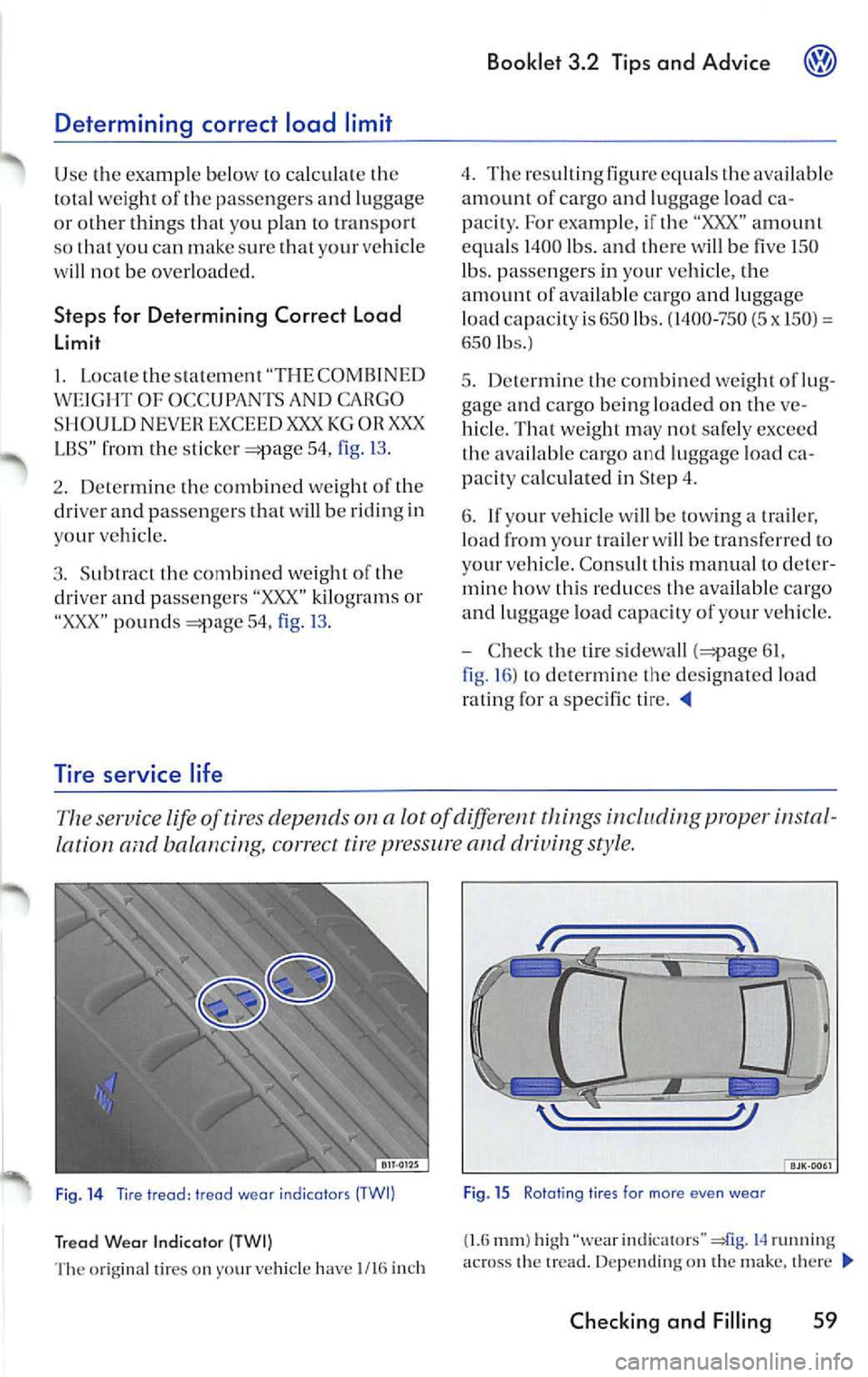
Fig. 14 Tire tread: tr ead wear ind icators (TW I)
Tread Wear Indicator {TWI)
Th e ori gina l ti re s on yo ur veh icle have I /16 in ch
Fi g. 15 Rotating t ires for more even we ar
(1. 6 mm ) hi gh indi cator s" 14 runn in g
a cro ss the Depending on th e m ak e, th ere
Checking and Filling 59
Page 381 of 477
Booklet 3.2 Tips and Advice
will be s ix 10 eight of them evenly pla ced aroun d tire. Marks on the tire s idewa ll (fo r ex amp le o r oth er symbols) indicate the p ositions
of the tread w ear in dica tor s. Wo rn tires mu st be
rep laced . Different figu res may apply in oth er
Tir e pressure
In co rrec t lir e pr ess ure cause s pr ematur e wear
and can cause s udden tire blow -out. F or thi s
r easo n, tir e pressure must be c hec ke d at leas t
o nce a m ont h
56.
Driving style
Drivin g fast around cu rves, heavy acce lera tio n
and hard braking increase t ir e w ear.
Rotating tir es for more even wear
I f th e front tires are worn consid era bly m ore
than t he re ar ones, rotate th em as sh own
59, fig. 15 . All the tir es will then last for
about sa me of tim e.
A ll
tir es s hou ld have th e sam e am ount of
wear. All four w heels must have the sa me ro lling
ci rc umf ere nce.
Wheel balancing
Th e wh eels on ne w ve hicl es are balan ced. H ow
eve r. various situations during every d ay driv ing
can cause them
b ecom e unbalan ced, r e
s ultin g in vib rat io ns y ou can usuall y fe el throug h
th e steering wheel.
Unbalan ced w hee ls mu st be reb alan ced to avoid
e x cessive wear on stee ring, suspen sion and
60 Checking and Filling
tire s. A wheel also be rebalan ced w hen a
new lire i s in stalled .
In correct whee l alignment
Incorr ect whee l alignment can cause exc ess ive
ti re wea r, impa ir in g
safe ty of the ve hicle. If
t ir es s how excess ive wear, have wheel align
m en t ch ecke d by an authori zed Vol ksw age n
d ea le r or qualifi ed work sh op.
WARNING
Sud den tir e fa ilur e ca n le ad to lo ss of con trol ,
a cra sh and serious persona l injury!
• Neve r drive a vehicle wh en th e trea d on
any tire is wo rn dow n to the wea r indicator s.
• Worn tires a rc a sa fety hazar d, the y do not
gr ip we ll on wet roads and increase y our risk
of "h yd ropl anin g" and lo ss of contro l.
• Always kee p ch emi cals that can ca use tir e
d amage, s uch as g rease, oil , gaso line and
brak e fluid away from tire s.
• Tire s age even if th ey a rc not b ein g use d
and can fail sudd enl y, es pecially al high
s pe eds . Tir es that a re more than 6 year s old
can onl y be use d in an emergen cy and th en
w ith sp ecia l care a nd at lowe r sp eeds.
• Neve r mount u sed tire s on your vehicl e if
you a rc not sur e of their "pr ev iou s hi stor y."
Old use d tir es ma y ha ve been d amaged eve n
th ough the d am age ca nnot b e seen that can
lead t o sudd en tir e failure and loss of vehicle
Page 384 of 477
Maximum Perm issib le Inflatio n Press ure
T his nu mb er is th e g re at est a mount of
pres
s ur e tha t sh oul d ever be put in the tire und er
norma l driv ing cond itio n s.
R ep lac in g tires or rims on vehicles equipp ed
wit h
The air va lve o n all four tires (no t on the spare
ti re) is equip ped with a senso r, w hic h co nsta ntly
m on itors
a ir pr ess ure in side the tire, a nd
the n this Lu If
yo u ar e going to re pl ace the wheel rim s o n yo ur
ve hicl e, make sure the rim s also have these
se nso rs. The se nsor s mu st be co mp atib le w ith
TPM S sys tem o n yo ur vehicle .
I f yo u install rim s. w hich do not have th e se n
sors, o r ha ve sensors w hich are not comp ati ble,
th e TP MS will not wor k pro perl y. In case, theTPM S would n ot b e ab le to m oni tor pr ess ure or wa rn you if is necessa ry.
• Wheneve r you c hange se nso rs, yo u ha ve to
i n sta ll
valves.
•
dri ve the valve ste m cap s se
c ur ely m ou nted. We reco mmen d usi ng fac to ry
i n sta lle d va lve stem caps. As k your auth ori zed
Volkswage n dea le r if yo u los t va lve
caps.
T he in sta llat io n of re pla ceme111 tires
c ord hody plies in the tire si dewa ll m ay ca use
ma lfu nction tir e pre ssure monitorin g
sys te m (TPM S), and i s not recommended (cord
mat eri al informatio n is m olded on
ti re s ide
wa ll).
ch ec k yo ur TPM S indi cator af te r r eone or more tires o n yo ur vehicl e. If t he
TP MS indi cator is on. your TPMS is m alfu nc
ti o nin g. Your
tire m ig ht be incom
patibl e yourTP MS system, or some co mp o
n en t of the TP MS may be dam aged .
WARNING
• Usin g in cor rect or unmatched tires and
I or wheels or improper tire and whee l co mbi
nation s can le ad to loss of con tro l, co llisio n
and serio us perso nal injury.
• Always use tires, rims and whee l bo lts th at
me et th e specification s of ori ginal fa ctory- in
s talled tire s or other combination s th at h av e
b een sp eci fica lly app roved by the vehicle
manufa ctur er.
Booklet 3.2 Tips and Advice
WARN ING (continued)
• Tire s age even if they arc not being use d
and can fail su ddenl y, es peci ally at high
s peeds. Tire s th at are more than 6 yea rs old
can only be use d in an em ergenc y and then
w ith specia l care and at lower speeds.
• Never mount use d tir es on your vehicle if
yo u are not sur e o f th eir "previou s hi story."
Old used tir es ma y ha ve bee n damag ed even
th ou gh th e dam age ca nnot be seen that ca n
l ead to sudd en tir e fa ilur e and lo ss of vehicl e
control.
• All four whe els must be fitted with radi al
tir es of the s am e type, size (ro lling cir cumf er
ence) and th e sa me tread p attern. Dri ving
w ith diff erent tire s reduces ve hicle han dling
a nd can l ead to a loss of control.
• If the spare tire is not th e same a s th e tir es
that are mount ed on the vehicle - for examp le
with winter tir es - only u se the sp are tir e for a
s h ort period of tim e and drive w ith extra care.
Refi t th e no rma l road w hee l as soo n as safe ly
possib le.
• Neve r dri ve
than th e spe ed for wh ic h th e tires on you r ve hicle are
rat ed because tires that arc driven fas te r than
their rated sp eed ca n
sudd enly .
• Overloadin g tir es cause h eat build -up ,
s ud den tire failur e, includin g a blowout and
sudden defl ation and loss of co ntrol.
• Temperat ure grades apply lo tir es that are
properl y inflat ed and not over o r underin
flated .
• For tec hni cal reaso ns it i s not always pos
s ibl e to use whee ls from oth er ve hicles-in
s om e cases not eve n whee ls from the sa me ve
hicle model.
• If you insta ll w hee l trim d iscs on th e ve
hicle whee ls, make sur e that th e air flow to the
brakes is not blo ck ed. R edu ced airflo w to the
brakes can th em to ove rheat , in cre asin g sto p
ping distances and causin g a colli sion .
Checking and Filling 63
Page 385 of 477
Booklet 3.2 Tips and Advice
• If the spar e tire is differe nt from the tires that
yo u have mounted on your ve hicl e ( for example
tir es or wide profil e tir es), then use the
spare tire for a sh ort period of on ly and
driv e w ith extra care . R ep lace the flat tir e wi th
th e tir e ma tc hin g th e o ther s on yo ur vehicle as
soo n as pos sibl e.
Uniform tire quality grading
Qualit y can b e found w here appli cable on
th e tire side be twee n tread sh ou ld e r and
m axi mum sec tion w idth 61. fig . 16 .
For exampl e: T rea d wear 20 0, T ra ctio n /Ill, Te mII.
1111 pa sse nger car ti res must conform to Federa l
Safe ty Hcquirem ents in additi on t o grade s.
Tr ead wea r
The
specifi ed gov
ernme nt test course .
F or examp le ,
tir e g raded 150 wou ld wea r on e
and one half (11 /2) tim es well on govern
me nt course as a tire graded IOO.
T he re lat ive perfor mance of tires depend s up on
th e act ual co nditions of the ir use, however. and
m ay depa rt sig nifi cantl y from th e no rm du e to
va riat io ns in dri vin g ha bits, se rvice practic es
a nd diff ere n ces in road chara cte ri sti cs and cli
grade s, from hig hes t to lowes t. are
AA . and C. Those grade s re pr ese nt the tir e's
a bilit y to stop on pav ement as m easure d
under controlled condit io ns on spec ified gov
e rnment
surfa ces of asp halt and concret e. A
ti re m ark ed C ma y ha ve poor tracti o n perfo r
64 Checking and Filling
• in sta llin g new tires, be c are ful no t t o
dam age the va lves o r sensor s.
• Never drive witho ut the va lve ste m cap. Th e
va lves a nd senso rs
get dama ged.
• I f
sensors must be rep la ce d, th e
va lve must likew ise be re pla ced sa m e
tim e.
c£> Fo r the sak e of environment
Di sp ose o f o ld tires in accordan ce wit h th e loca l
r e qu ire m ent s.
The 1e111pem111re grades are A (the hi ghes t), B. an d C. represen ting th e tir e's to the
gene ration of heat and its abi lity 10 di ss ipat e tes te d und er contro lled co ndi tions
on a spcci f'ied indoo r lab oratory te st w heel.
Sus tained hig h tempera ture ca n cause
mate
r ial of the lir e to deg enerat e and re du ce lire life,
and excess ive te mperature can lea d to sudd en
tir e
The C co rresponds to a leve l of perfor
m an ce whi ch all pa sseng er car tires mu st m eet
un der the
Motor V ehi cle Sa fe ty Standard
No. G rad es and A re pres ent higher lev els
of pe rfo rm ance on the laboratory w heel
th an minimu m re quir ed by law.
WA RNING
The trac t ion gra de ass igned to thi s tire is base d
on stra ig ht-ah ead brak ing tra ctio n t ests, and
d ocs not i nclude acceleration, corn erin g, hy
d ropla ning or peak tracti on cha racter is ti cs.
WARNING
Th e te m pera ture gra de fo r thi s tire is es ta b
li sh ed for tir e th at is proper ly in fl ated and
not overloaded. Excess ive spee d, und crinfl a
tion , or excess ive load ing, eith er separate ly or
in com binati on, ca n ca use hea t bu ildup and
po ssible tir e fa ilur e.
Page 386 of 477
Booklet 3.2 Tips and Advice @
Winter tires
Winter rires can improve vehicle handling on snow and ice. At temperatures
below 45 ° F (7 ° C)
recommend changing to winter tires.
In som e hea vy s now areas, loca l go vernment s
m ay re quir e tru e or "snow" tires, those
wit h very deepl y cut trea d. The se ti res sh ould
on ly be use d in pair s and be in sta lled on all four
w hee ls. Make sur e yo u purcha se snow tire s that
ar e th e s am e size and const ruction ry p e as the
othe r tir es on your vehicl e.
S umm er tire s prov ide less grip on ice and sno w.
Winter tires (s now tires) must be
on a ll
four whe els .
If you wa nt to us e th e tir e pre ssure monitoring
sys tem
compat ibl e se nso rs mu st b e
in sta lle d on all four wint er tire s 63.
Ask your authori zed Volkswage n deal er or qual
ified work shop for permitt ed winter tire sizes.
U se on ly rad ia l w int er tir es.
Wi nter tires lose their effectiveness w hen the
tr ead is worn dow n
to a depth of 4 111111 (0.1 57
inch ).
Onl y driv e wit h wint er ti res und er w int er co ndi
tion s. S umm er tir es hand le bett er w hen there is
no snow or ic e on the ro ads a nd th e temp erature
is above 45 ° F (7 ° C).
If yo u ha ve a flat tir e, see notes on spar e w heel
"New tires and replaci ng tire s an d
wh eels".
Pl eas e always re m emb er that winter tir es ma y
ha ve a lower spe ed
than th e tire s origi
nall y insta lled on your vehicl e at the time it was
manufactur ed. Pl ease see
53, "Spee d
rating (letter cod e)" for a listing of the spe ed
rating l ett er co de s and
maximum speed ar
w hi ch the tires c an b e driv en.
The sp eed rating letter code
53) is on the
s id e w all of th e tire fi g . 16 .
WARNING
Winter tires have maximum speed lim its that
may be lowe r than your vehicl e's maximum
speed. Always know the maximum speed b e
fore driving
Neve r drive fa ster than the
speed permitted your speci fic wi nter tires.
This cause damage to the tire s leading to
an accident and serious personal injury to you
and your passengers.
WARNING
Driving faster than the maximum speed for
which the winter tires on your vehicle are
veloped can cause sudden tire failure, loss o f
contro l and seriot• .s personal injury.
• Winter tire s have maximum sp ee d rating
that may be lower than your ve hicle's max
imum speed.
• Neve r drive fa ster than the sp eed for which
the wint er or other tires installed on you r
hicle are rated.
WARNING
Always a djust your driving to the road and
traffic condition s. Never let the good accelera
tion of the winter tir es and all -wheel drive
tempt you into taking extra risks. Alway s
member:
• When braking, an all-w hee l drive ve hicle
h andles in the same way as a front drive
hicle.
• Drive carefu lly a nd reduce yo ur speed on
ic y and slippery roads, eve n winter tire s
cannot help un der black ice conditio ns.
Fo r the sake of environment
U se s umm er tire s wh en weat her condition s
permit. The y are qui ete r, do not wear as qui ckl y
and redu ce fuel consumpti on
Where applicabl e (TP MS = Tir e pre ssure mo nitoring system)
Checking and Filling 65
Page 388 of 477
Booklet 3.2 Tips and Advice
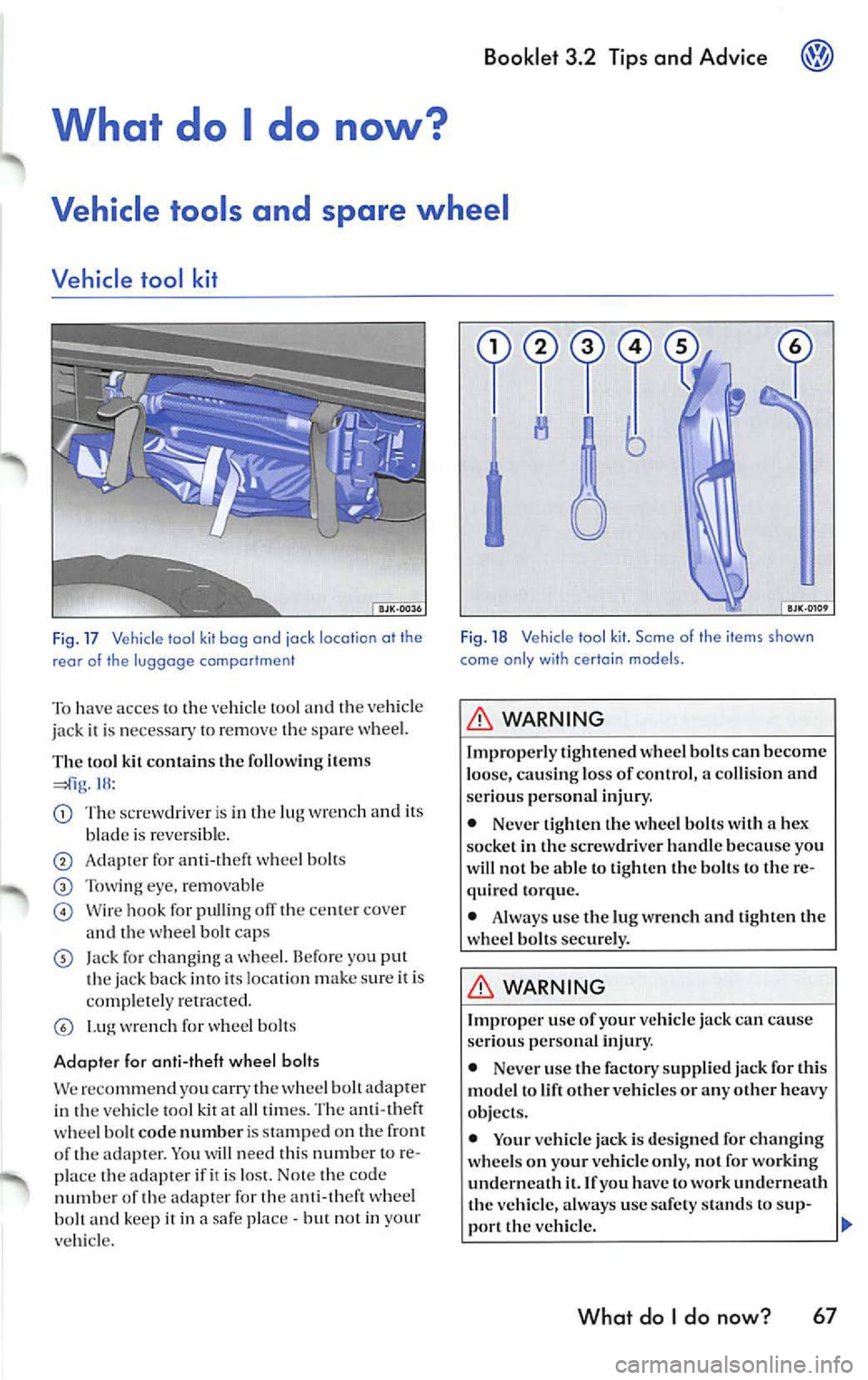
tool and th e vehicl e
jack
con tains th e follow ing items 18 :
Th e sc rew driv er is in th e lu g w re nch and its
b lad e is re ve rs ib le .
A dap ter for ant i-th eft wh eel bo lts
Tow ing eye, re movab le
W ire hook for pulling off the ce nte r co ve r
a nd th e w he el b olt cap s
Jack f or changing a wheel. B efor e yo u put
th e jack back in to i ts loca tion make sur e it is
co mp le te ly re tr a cted.
wr en ch for wheel bolts
Ad opter for anti-th eft w hee l baits
We reco mmend yo u carry t he wh eel bolt adap te r
in th e ve hicle tool kit at all times. The a nti-theft
w hee l bo lt code numbe r is sta mp ed on th e front
of th e ada pter. Yo u will need this numb er to re
p lace t he ada pter if it is lo st. No te th e c ode
numb er o f th e adapt er fo r th e an ti- th ef t whee l
b olt and kee p it in a safe pla ce
but not in your
veh icle.
Fig . 18 Vehicle too l kit. Some of th e it e m s sh own
come o nly w it h certa in models .
WARNING
Improper ly t ighte ned whee l bo lts can become
l oose, ca usi ng loss of contro l, a co llisio n an d
ser ious perso nal i nju ry.
• Neve r tig h te n th e w hee l bo lts wit h a hex
socke t in th e sc rew driver h and le because yo u
w ill n ot be ab le to tig hte n th e bo lts to t he re
qu ired torque.
• Always use t he lug wrench and tig ht en th e
wh eel bolts secure ly.
WARNING
Imp roper use of your ve hicle jack can ca use
ser io u s pe rso nal in jury .
• Never use the fac tory sup plied jac k for t his
mod el to lift othe r ve hicles o r any other heavy
ob jec ts.
• Your vehicle jac k i s des igned for ch ang in g
w hee ls on your vehicle on ly, not fo r working
un dernea th
it. If you have to wo rk un derneat h
t h e ve hicle , a lways use safe ty s ta nds to s up-
p or t th e veh icle.
What do I do now ? 67
Page 394 of 477
WARNING {continu ed)
• Never let anyone place any part of their
body underneath the vehicle when support ed
by the jack.
• Never support your vehicl e on cinder
blocks, bricks or other obje cts . These may not
Changing a wheel
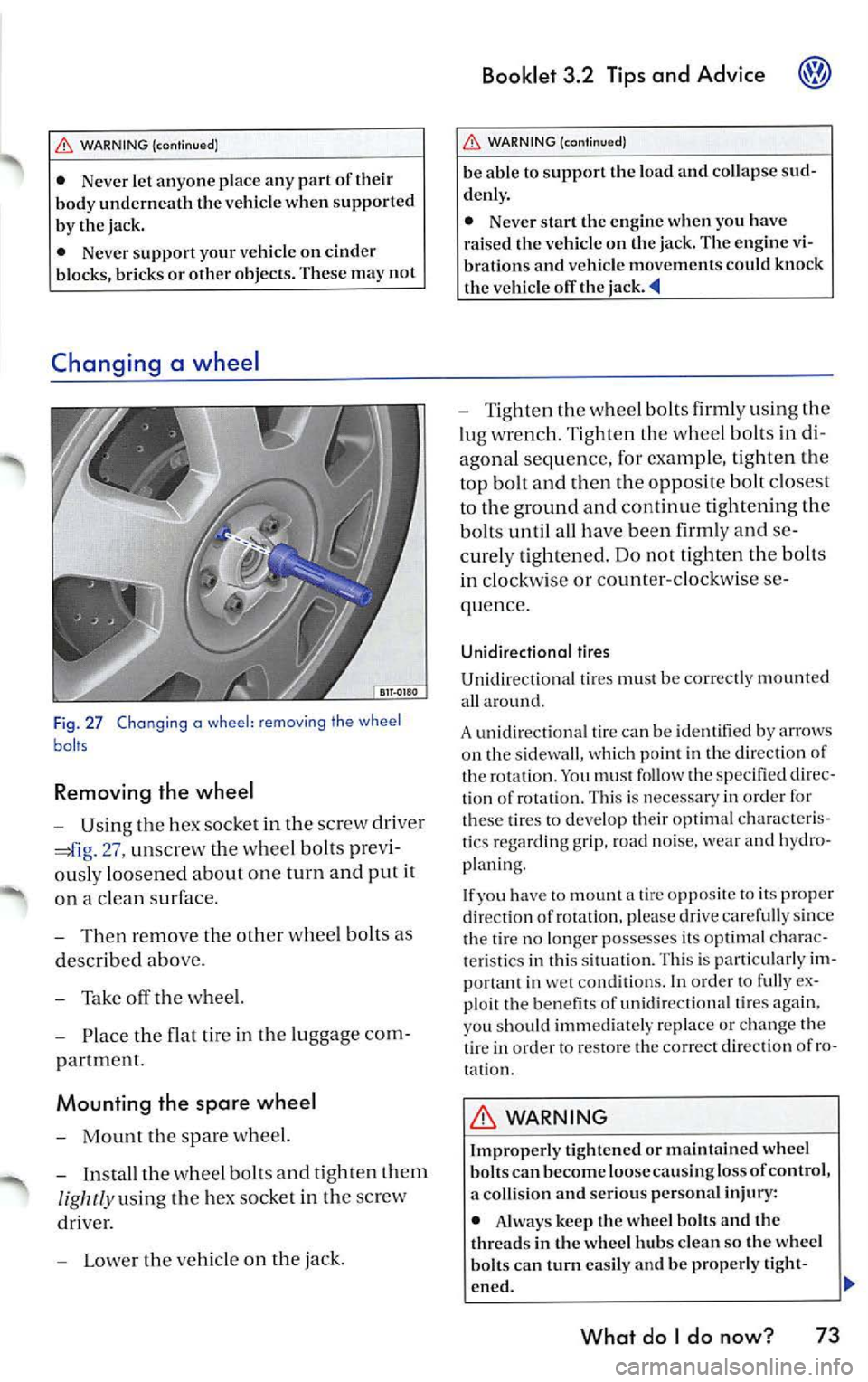
F ig . 27 Chang ing a wheel : removing the wheel
baits
Removing the wheel
-Usin g the h ex socket in th e sc rew dri ver
27, un screw t he w heel bo lts pre vi
o usly loo sen ed about on e turn and put it
o n a cl ean su rface .
- Then re mo ve the oth er whee l bolt s as
d esc ribed abo ve.
- Tak e off th e w he el.
- Place the flat ti re in the lu gg ag e co m-
p artmen t.
Mounting the spare wheel
-Mount the sp a re wh eel.
- Insta ll th e w hee l bolt s and tight en th em
lig htly u sin g th e hex so cke t in th e sc rew
dri ver.
- L ower th e ve hicle on the jack .
Booklet 3.2 Tips and Advice
WARNING {cont inu ed )
be able to support the load and collap se sud
denl y.
• Nev er start the engine when you have
raised the vehicl e on the jack. The engine vi
bration s and v ehicle movements could knock
the v ehicl e off the
- T ig ht en the wheel bolts firml y using the
lu g w re n ch. Ti gh te n th e whee l b olts in di
a gonal s equ ence , for e xampl e, tig h te n th e
top bolt and then th e oppo sit e bolt clo se st
to th e ground and continu e tight enin g the
bolt s until all have bee n firml y and se
c ur ely tight en ed. Do not tight en th e bolts
in clock wise or c ounter-cl oc kw ise se
quen ce.
Unidirectional tires
Unidir ectional tir es mu st be co rrec tly m ount ed
a ll arou nd.
A un idir ection al tir e ca n b e id en tified b y arrows
o n th e s idewa ll, w hi ch p oin t in the di rec tion of
t h e ro tation . Yo u mu st fo llow the speci fied dir ec
ti on of ro ta ti on. Thi s is necessary in orde r for
the se tires to deve lop t heir optim al cha racte ris
ti cs regar ding grip, road noise, wea r and hydro
p la ni ng .
I f y ou have
to moun t a tire opp osite to i ts pro per
dir ection of rot atio n. p lease drive caref ull y sin ce
th e tir e no lo nge r poss esses its o ptimal chara c
t e ri stic s in thi s s itu atio n. Thi s is parti cul arl y im
po rta nt in we t con ditions. In orde r to f ully ex
pl oi t th e benefi ts of unidir ectio nal tire s ag ain ,
yo u sh ou ld imm edi ate ly re place or change the
tir e in or der to resto re th e co rrect d irec tion of ro
t a ti on .
WARNING
Improp erl y tight en ed or maintain ed wheel
b olt s can b ecome loose cau sin g lo ss of control ,
a colli sio n and seriou s per son al inju ry:
• Alw ay s keep th e wheel bolt s and th e
thread s in the wh eel hub s clean so the whee l
bolt s can turn easily and be p roperl y tight-
en ed .
What do I do now? 73
Page 398 of 477
WARNING (continued )
hide. The doors can be lock ed using the re
mote control key or the powe r lock button.
Th is co uld res ult in peop le bein g trapped in
th e ve hicl e.
•
build -up in th e passenger com part
ment an d lu ggage compartmen t o f a parked
Fuses
Changing a fu se
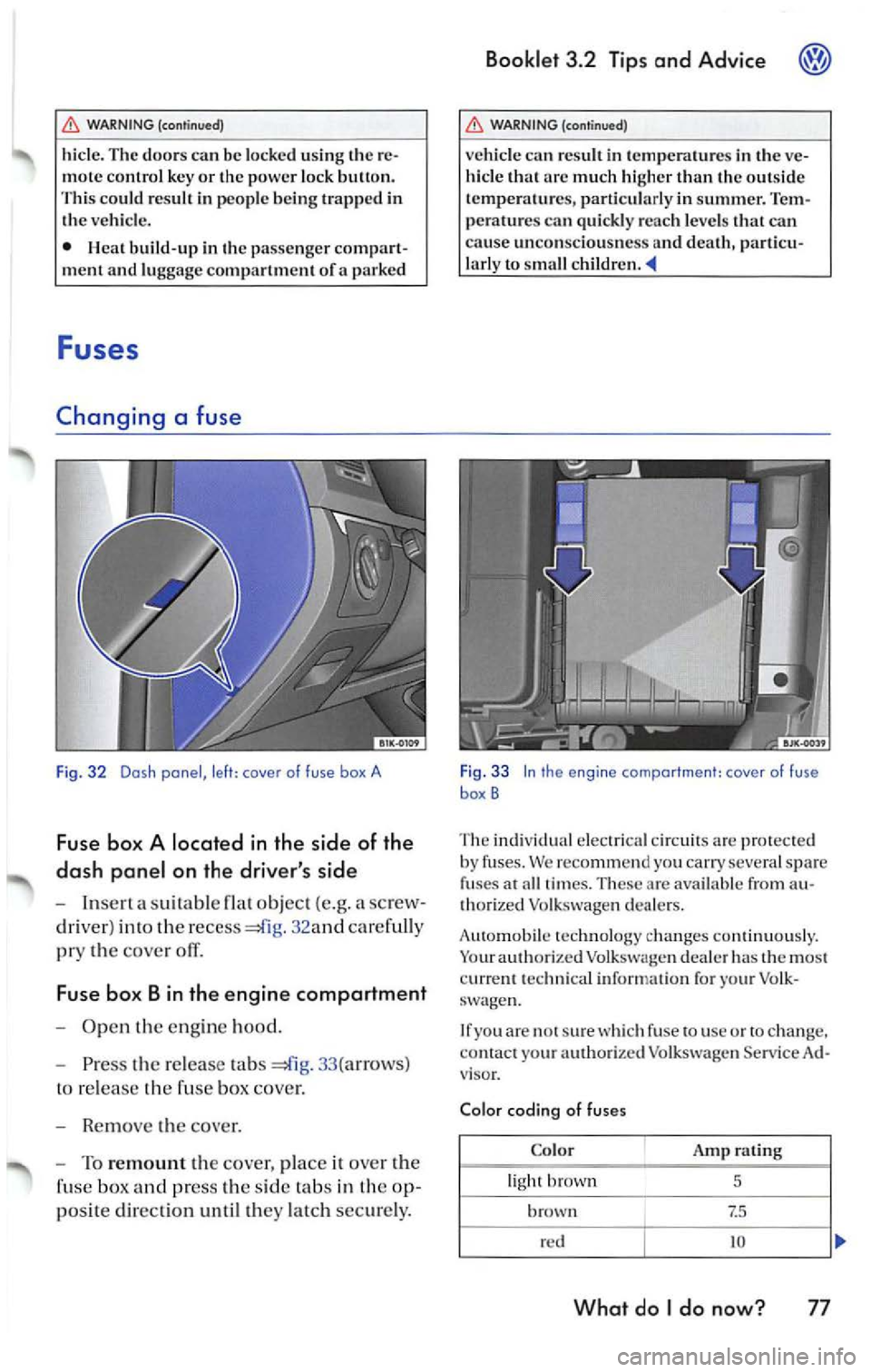
Fig. 32 Dosh panel, le fl: cover of fuse box A
Fuse bo x A locat ed in th e side of the
da sh pan el on th e driver' s side
In se rt a suit abl e obj ect (e .g. a sc rew
dr iver) into th e
32 and car efull y
pry the cove r oil
Fu se box B in the engine compartment
Open the en gin e hood .
Press the release tabs 33 (arrow s)
to re lease the fuse box cove r.
R e mo ve the cover .
To re mount the cover, place it ove r th e
fu se box
press the sid e tab s in the op
po sit e direct ion until they latch sec ure ly.
Bookl et 3.2 Tip s and Advice
WARNING (continu ed)
vehicle can re sult in tem peratur es in the ve
hicle that arc much higher than the out sid e
tem peratu res, p arti cularl y in su mmer. Tem
p era tures ca n quickl y reac h levels that can
cause unco nscio usne ss and death, particu
l ar ly to sma ll childre n. _.
Fig . 33 In the engine compa rtment: caver of fuse
box B
The indiv idu al el ec trica l ci rcu its are prot ecte d
b y fu se s. We reco mm end y ou sev eral spar e
fu ses at all tim es. T hese are availab le from a u
th ori ze d Vo lk sw agen dea le rs.
A ut omob ile te chnol ogy chan ges co ntinuously.
Your a uthori ze d Volkswage n deal er h as the mo st
curr ent t echn ica l in format io n for your Vo lk
sw agen.
I f yo u ar e
sur e w hich fu se to use or to ch an ge ,
co ntact your authori zed Vol kswage n Se rv ice
viso r.
Co lar cod ing o f fu ses
C olor
rating
li ght
5
brow n t 7.5
reel I 10
What do I do now? 77
Page 408 of 477
-Press the cove r together u sing both
hand s in the direc tion or th e arrows
42 and pull the cover
Booklet 3.2 Tips and Advice
-Screw th e tow ing eye into the t hread ed
ho le , turnin g
co1111t er-cl ockwi se as far as it
will go
43.
- Use the wre n ch for leverage to tighten
the towing eye.
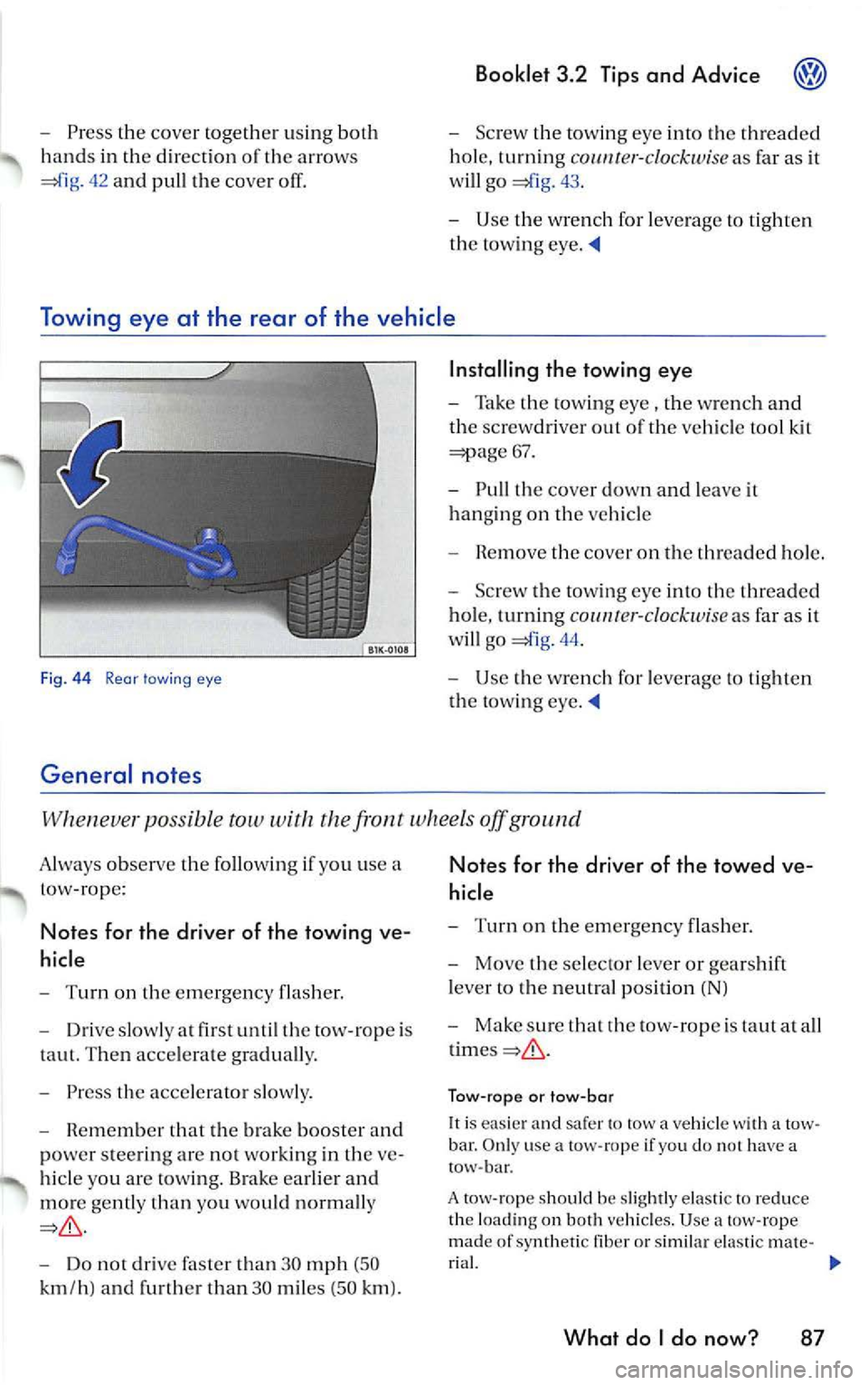
Towing eye at the rear of the vehicle
Fig. 44 Rear lawing eye
General notes
Installing the towing eye
-Take the towing eye , the wrench a nd
th e sc rew driver out of the vehicl e tool kit
=;:iage 67.
- Pull the cover down and lea ve it
hanging on the vehicl e
- R em ove the cove r on the threaded hole.
- Screw t he towin g eye into th e thr ea ded
hol e, turning
co 1111r er-clockw ise as fa r as it
w ill go
44.
- Use the wrench for leve rage to tight en
the tow ing eye.
po ssi ble tow with the fron t wheels off ground
A lways observe the following use a
t ow-rope :
Notes for the driver of the towing ve
hicle
- Turn on the emerge ncy flas her.
- Driv e slowly at fir st until th e tow-ro pe is
taut. Then acce lerate graduall y.
- Press the acce le rator slow ly .
- Remembe r that the brak e boo ster and
po we r stee rin g ar e not working in the ve
hi cle you are tow ing. Brake earlier and
mor e gently than you wo uld n orm ally
Do not drive than 30 mph (50
k m /h ) and furth er tha n 30 miles (5 0 km ).
Notes for the driver of the towed ve
hicl e
-Turn on the emergency flash er.
- Move the selecto r leve r or gears hi ft
l ever to the neutral posi tion (NJ
- Make sure tha t rh e tow -rope is taut at a ll
Tow-ro pe or tow -bar
It is easier and sa fer to tow a vehicle with a tow
bar . O nl y use a tow- rope if yo u d o no t h ave a
tow -bar.
A tow -rope s hould be sli ghtl y e las tic to re duce
th e lo adin g on both vehicl es. U se
tow-rope
mad e of sy nthetic fib er or sim ilar ela sti c m ate -
r ia l.
What do I do now? 87
Page 409 of 477
Booklet 3.2 Tips and Ad vic e
Attach the tow-rope or the tow-bar only to th e
tow ing eyes provid ed .
D riv in g s ty le
T ow ing require s some exper ie nc e, es pecia lly
when using a tow -rope. Both driv ers should be
familiar w it h th e tec hn iqu es required for tow ing.
In ex perienced drivers should not try to tow an
o th er ve hicle.
Do not pu ll to o hard w ith th e towing vehicle and
a vo id j erking the tow- rope . When tow in g on an
unpa ved road, there i s alway s
risk of over
l oad ing and damaging the an ch orage points .
T he ignition oft he ve hicle be in g towed must be
s witched on to prevent the stee ring whee l fro111
lo ck ing. Also ensur e that the turn signals, horn,
windshield wipers and wash ers work properl y.
Keep in mind that the brake b ooste r d oes not
work when th e e ngine is not running. You will
hav e to apply considerably more pressure to th e
brak e pedal than you wou ld nor111a lly.
A lso the pow er stee rin g do es not work when the
e n g in e is not running. You will n eed m ore for ce
to stee r than you would norma lly.
Tow in g ve hicl es w it h an aut om atic tran smi ssio n
• Move the se lec tor leve r to N. •
Do not drive fa ster than 30 mph (50 km/h)
wh en towing a ve hicl e.
• Do not tow further t han
3 0 111iles (50 km ).
• lfa tow tru ck i s use d, th e ve hicle must be
tow ed with a ll w heels off the ground .
WARNING
Towing a vehicle c hange s th e way yo ur vehi cle
h an dles a nd br akes. To help re du ce t he risk of
an acci den t lead ing to se rious persona l injury,
no te th e fo llow ing:
• T he dr ive r of t he ve hicle t hat is be ing
towe d:
- Will h ave to p ress th e bra ke peda l con
s id era bly harder than no rm al beca use th e
b ra ke boos te r i s not a cti ve. Always be alert
no t to rear-end the tow ing ve hicle .
- Will h ave to use cons idera bly more fo rce
t o t urn th e steerin g w hee l, b eca use th e
power steer ing is not active.
• The driver o f the ve hicle that is tow ing:
- Must accelera te grad ually a nd ge ntle,
avo id je rkin g m oveme nts.
- Must b ra ke ear lier a nd more gentle t han
yo u wo uld norm ally
When can your vehicle not be towed?
Yo ur ve hicle m ay no t be towe d un der the fo l
l ow ing con ditions:
• If th e tran sm iss ion mal fun cti o ns and there is
no tran smis sion flui d.
• I f th e veh icle e lectr ical sys tem is not func
ti o nin g beca use the s tee ring will lock up.
• If yo u ha ve to driv e fu rth er th an 30 mile s (5 0
• If the front or rea r axl e is off th e ground
because you dama ge th e gea r.
In the se cases the vehicl e mu st be transport ed
o n a car c arrie r or trailer.
WARNING
If you still tow your ve hicle un der these co ndi
tio ns, you could ca use an acci dent or ca use
d am age to th e ve hicle. Thi s w ill n ot b e covere d
by your Limit ed New Ve hicle Warra nty .
88 Wha t do I do no w?
Do no t tow your ve hicl e beh ind a re cre a tional
vehicle . The Automatic transmi ssio n can be se
ve re ly damaged. This can happ en even if these
l ec to r lever is in th e N (Ne utral) pos ition.
• If th ere is no oil in th e tra nsmi ssio n because
o f dama ge to yo ur vehicle , th e veh icl e s hould b e
mo ved with a ca r carrier .
• If th e front or rear axle is lift ed off th e grou nd,
thi s will serio us dama ge the dr ive gea r.
• If th e veh icl e ha s to be towe d more than 30
mi les (5 0
all whee ls must be rai sed to tow
t he vehicle. The vehicle should be m oved with a
car carrier .
• If vehicle has no e lec trica l po we r, th e
s te erin g will be locked. The ve hicle must