warning VOLKSWAGEN JETTA 2007 Owners Manual
[x] Cancel search | Manufacturer: VOLKSWAGEN, Model Year: 2007, Model line: JETTA, Model: VOLKSWAGEN JETTA 2007Pages: 477, PDF Size: 77.6 MB
Page 309 of 477
Booklet 3.1 Controls and Equipment
Electronic Parking Assistance
Applies to wit h E le ctro nic Perk ing Assis tance
Description of Electronic Parking Assistance
The Electronic Parking Assistance is a parking aid, which draws to
obstacles.
The electro nic parking a ssistanc e he lps th e
dr iver when parking the ve hicle. Th e driv er is
fo rm ed or warned by audibl e signals that hide is approac hing behind ve·
hide. The clo ser yo ur vehicle approach es
obstacle, quicker aud ible sig nal s w ill
so und. Th e audib le s ig nal will sound continu ·
o usly if lh e obs tacle i s very near.
It uses ultrasonic senso rs in rea r bumpers to
measure distanc e lo obstacle s.
Th e se nso rs ar e
lrans miller s and rece ive rs
o f ult rasoun d waves. The e lec tronic syste m s
uses ultra sou nd waves (i.e. transm iss ion, r e·
fl ec lion from th e obstacle a nd rece ption) to
th e di stance th e vehicle and obstacle .
O nc e yo ur vehicl e is very close lo
obstacle, will no longer be det.ec tccl and you
co uld cau se damage lo vehicl e. Always pay
close attention lo audibl e signals lo help you
park your vehicl e.
Switching on the electronic parking assistance
The parking distan ce warni ng
is
s witched on when reverse gea r is selected
and when i g niti on i s on. An audible sig nal is
g iv en. I f yo u do not h ear th is acoustic sig nal.
parking di stan ce wa rning sy stem is n ot on. Hav e sys tem insp ec ted b y yo ur au rized Vo lk swagen deal er.
106 Driving
Switching off the electronic parking assistanc e
Th e parki ng ass istanc e is
off when th e
r e ver se gear is desele cted.
WARNING
The elec troni c parking cannot re
p lace the driver's assessmelll of situation.
T he dri ver is per sonally respons ible for safe
parking and other maneuver s.
• The sensor s ha ve blind spot s in which ob
s tacles an d people are not registered.
•
p arti cul arly aware o f sm all children or
animals when backing up. The sens ors may
not always be abl e to det ect them.
may not way s be abl e dete ct object s such a s draw bar s, thin rails, fences, po sts e tc .
T hi s co uld resu lt in da mag e lo your car.
• The electroni c pa rking as sis tance work s on ly
al sp eeds of und er about 9 mph (15 km/h ).
• The elec troni c park ing senso rs in th e
bump ers mu st be k epl clea n and free of i ce.
When cleanin g wi th pre ssure hoses and
cleaner s, lhe sensors sh ould b e spra yed on ly
b riefly. A distan ce of a t least 0.3 ft. (0. 1 m ete rs)
betwee n th e se nso rs and I hose
nozz le must b e ob se rved.
Page 310 of 477
Booklet 3.1 Controls and Equipment
Cruise control
Applies to with co ntro l
Description
The control can be set to keep vehicle speed from about 18 mph to
110
(30 km/h to 180 km/h).
When yo u have re ached the ve hicle speed that
yo u want, yo u can set the crui se co ntrol and take
yo ur fo ot off th e accelerato r pedal.
The crui se co ntrol does
1101 wor k if the selec tor
l ever is in P , N orn.
WARNING
Using the crui se control it is not po ssible
to dri ve safe ly at a co nstan t sp eed is dan
ge rou s.
• Never use the c rui se control when driv in g
in h eavy o r vary ing traffi c, on steep, w inding
or s lippery roads (for examp le snow, ice,
s tr ee ts cove re d with water or gravel).
• To prevent unintended operation of th e
cru ise co ntro l, sw itch the syste m o!Twhcn it is
not being used.
L[:. WARNING (continued)
• It is dangero us to u se the resume feature
w hen the previou sly set speed is too high for
th e existi ng road , traffic or weathe r co ndi
tions.
Not e
• When tra vellin g downhill, the cru ise control
may not maintain cons tant s peed . The vehicle
wi ll accel erate as a resu lt of its ow n weig ht.
Downshift and/or use the foot brake
to slow the
ve hicl e.
• For ve hicles wi th a manual transmission, do
not mo ve the gea rsh ift l ever into n eutral without
d epre ssing the clut ch fully when the cru ise con
t ro l is activated. Othe rw ise the engine cou ld rev
up and be damaged.
Applies to vehicles: with independent lever for Cruise control
Using the cruise control
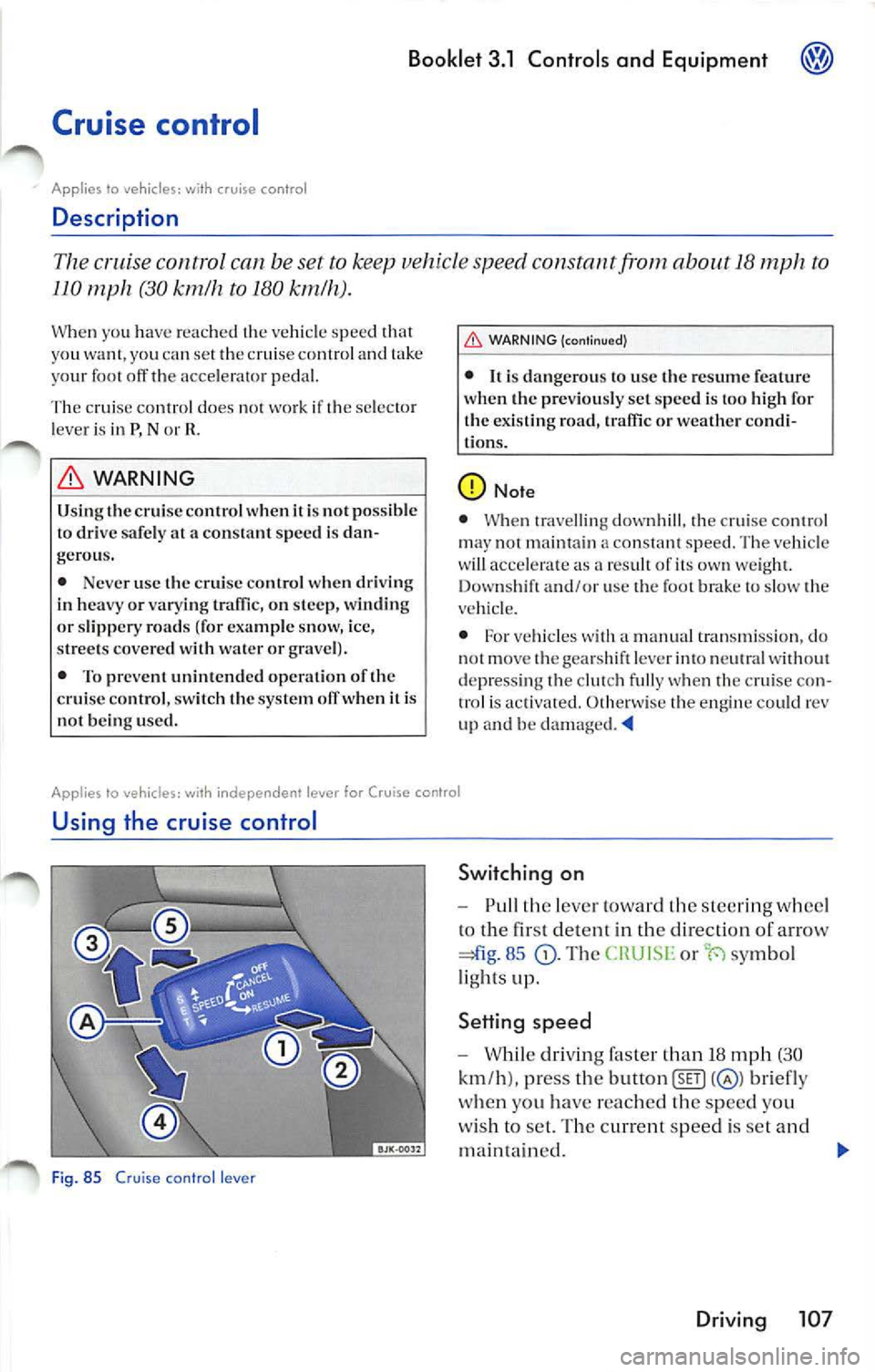
Fig. 85 C ruise con tro l lever
Switch ing on
Pull th e lever toward the steeri ng whee l
lo th e first detenl in the direction of arrow
85 Th e or symbo l
li ghts up.
Setting speed
Whil e dr iv in g faster than 18 mph (30
km /h ). press the button
briefly
w hen you have reac hed the speed yo u
w is h t o se t. Th e cu rrent speed is se t and
ma intained.
Driving 107
Page 311 of 477
Booklet 3.1 Controls and Equ ipment
Accelerating
- Pull th e lever upward in direction
to th e+ position to increase the
s peed by about 0.5 mph
(I km/h ).
Decelerating
- Pull the lever downward in direction of
a rrow © to the - positio n to lowe r the
s peed b y 0.5 mph (about I km/h).
Switching off
-Push the leve r in the direction of arrow
all the way to the OFF position whil e
d rivi ng. The CHU ISE or
symbo l goes off .
- Sw itch th e ignit ion off when the v ehicle
i s standing still.
WARNING
Using the crui se cont ro l whe n it i s not possib le
to dri ve sa fely at a constant speed is dangerous
in "Desc ription".
Tip s
• If th e cruise con trol is switc hed on th e
( or ·t-i sy mbol in the in stru ment cluster
li g ht s up .
• If th e c ruise co ntrol i s
the or symb ol goes o ut. The syste m is
swi tc h ed off compl etely when the selec tor leve r
is in P, Nor
• If yo u increase vehicl e speed with th e accel
erato r pedal, the prev ious ly programmed sp eed
will be re sum ed when the acce le rator p edal is re
leased . T hi s w ill not be the case. however, ifche
vehicle s peed is mo re than 6 mph (10 km/h)
hi gh er than the s tored speed fo r long er
5
minut es. The speed will then have to be store d
again .
• The set speed can be sw itche d off te mpo
rarily if you p ress the brake peda l or the clutch
pedal. Pull th e lever briefly towa rd th e steering
whee l to the point where you can start to fee l re
s is tance
107, fig. 85 to r esum e the
speed again. "'4
App lies to vehic les: with independent lever for Cruise cont·ol
Turning off control temporarily
You can turn off the control temporar ily as
follow s:
- Depress the brake pedal,
- Dep re ss th e clutch pedal, or
- Pu sh the l ever briefly to the point where
yo u can star t to feel r esis tanc e in the dir ec
t ion of a rrow
10 7, 85
Th e set sp ee d re mains in th e mem ory , but it is
not maintain ed. To res um e the spee d previo usly
se lected, re lease the brak e pedal and pull th e
l e ver bri efly coward the stee ring wheel to the
108 Driving
point whe re yo u ca n start to f eel resi stan ce 107, fig. 85
If you drive faster than about 1 10 mph (180 km/h)
the cru ise co ntrol is sw itch ed off automati cally
a nd you cann ot ac tivate the cruise contro l. To
ac tivate the cru ise control again, drive s lower
than about 110 mph (180 km/ h).
WARNING
Us ing the cruise contro l when it is not possib le
to drive safely at a constant spee d is dangerous
in "Descrip tion" on page 107. "'4
Page 313 of 477
Booklet 3.1 Controls and Equipment
Conve nien ce open ing 41
Conven ie n ce operatio n (elec tric
w ind ows) 18
Coo lant
li ght 11
Coo lant leve l
Warn ing 24
Coo lant te mperature
Gauge 6
Warn ing 24
Coo ling the glo ve
69
C ru ise co111rol 107
Wa rnin g light 29
Cup ho ld ers
I n the rear armrest 72
C up holder s in the center co nso le 72
C urrent f uel cons umption 9
D
Day time runnin g lights
Warning lig ht 30
Daytime dri vin g ligh ts 46
Di gita l c loc k 5
Di sp lay 7, 12
D is plays
One-co lo r display 12
Distance trave lled 9
Door re lease hand le 3
Door s
Wa rnin g lig ht 26
Drain the bauery 52
Driving time 9
Driving
an automatic transmi ssion 99
Dust
88
E
See Electron ic D iffe rentia l Lock
EDS
Wa rnin g light 27
E lec tric seal a djustment
See Seat adj ustme nt
Ele ctrical accessories 73
Elec tro-mechanica l power steering syste m
Warning light 29
110 Alphabetical index
Electron ic Diffe re nti al Lock
Wa rnin g lig ht 27
Electronic immobilize r 94
Wa rnin g light 23
Electro nic parking assistance 106
E lectro nic Power Control (EPC)
light 23
E lec tron ic Stabi liza tion Program 28, 91
Wa rnin g lig ht 28
Emergency
48
E m erge ncy wa rning lights
light 24
Engi ne fault
Warning light 23
E ngin e hood
Warning light 26
E ngin e malfun ction
Warn in g light 23
E ngine mana gement
Warn ing lig ht 23
E ngine oil pr essure
Wa rnin g light 11 , 25
Environmental inform ation
Fuel economy 6
Environmental tip
Fue l economy 77
ESP 91
See E lectronic Stabil ization Program
Exhau st warning light
Warning lig ht 22
F
Firs t- aid kit 74
Fog lig ht s 46
Foo t brak e
Wa rning lig ht 30
cen te r a rmr est 70
Fron t passenger
backre st
Folding forward 6 1
F ront seats 60
E le ctri ca l adj ustab le 62
Manua l ad justab le 60
Fuel filler cap Wa rnin g light 29
Fue l g auge
Di splay 7
Fuel level 7
Page 316 of 477
Set up menu 1 6
Se tting the cl ock 16
Me nu 1 6
Sho ppin g bag hook 78
Socket 73 Speed wa rning 9
S tar tin g th e di ese l e ngine
W ith the ig nition key 96
Sta rtin g th e gaso lin e e ngine
W ith the ig niti on key 95
S tee rin g 90
Stee ring lock 93
S teer ing w hee l h eig h t adju stme nt 90
S toppin g th e eng in e 97
S to rag e ar ea
Oth er storage areas 7 1
Roof 71
co mpartm ent 69
Front cen te r a rm res t 70
R ear a rmr est 70
S to rage fo r th e ve hicl e lite ral ure 69
Sto rin g seat positi ons 64
Su n sha de 79
Su n viso r 52
S unr oof 4 2
S un shade
powe r roof 42
S wit ch lig h ting 3
Sw itches
E mer gency
48
Li ght sw i tch cs 46
Powe r outsid e mir rors 56
Power roof 42
Po we r w ind ows 39
Sw itchi ng off the e ngine
W it h th e ig niti on key 97
T
Ta cho mete r 6
Ta nk
F uel g au ge 7
T ic -cl ow n hook s 78
Bookl et 3.1 Control s and Equipment
Ti re press ure m on itorin g sys tem
Wa rnin g lig ht 30
Trail er tu rn sig nal s
Wa rnin g light 49
Tran sp o rtin g lo ng ite m s 61, 68
Trunk l id 37
Turn sig n al and high bea m leve r 49
T urn sig n als 49
Warnin g lig ht 24, 49
u
U np leasa nt odo r 89
V
Veh. sta tu s 15
Ve hicle e lec tric syste m 24
Ve hicl e stat us 15
w
Wa rnin g lig ht
E lec troni c Power Con trol (E PC) 23
Warn ing ligh ts 20
E m erge ncy fla sh er 48
Turn sig nals 49
Warn ing tex ts in th e disp lay ll
Wa rnin g tri angle 74
W hen parkin g on slo pes 105
W hen should I ref uel th e ta nk of th e
ve hic le ? 7
W indows 39, 40
Wind shi eld was her fl uid
Warn in g light 26
w in dsh ie ld wash er flui d
Warning message 11
Wind shi eld wip er an d was her sys tem 53
Wind shi eld wip ers 53
R ain se n so r
Service pos iti on 53
W int er ope ration 54, 55
W int er tire s
Speed wa rning 16
Alphabetical ind ex 113
Page 321 of 477
About this booklet
This booklet contains important information,
tip s, s uggest ions and WARN INGS on usin g yo ur
veh icle. The other booklets in the Owner's Liter
ature contain further information tha t you
sho uld be aware of for yo ur own safety and for
the sa fety of yo ur pa ssenge rs.
Make sure that you always keep the comp lete
Owner's Literature in the vehi cle. Th is is es pe
cia lly import ant whe n you lend or sell th e ve
hicl e.
Thi s manual describes the vehicle equipm ent at
th e time of publicatio n. Some of the equipmen t
d escribed w ill not be availab le until a late r date,
or is only available for certain markets.
Illustrations may slightly vary fro m you r veh icle.
Fo r tl1is reaso n yo u sh ou ld regard illus tratio ns as
a general g uide.
A t th e beginning of this booklet, you
find a
table of contents sho wing all the item s de
scr ibed in this manua l in the order they appear .
An alphabetica l ind ex is a t the end of the
booklet.
Dire ction s and positions (for example right, left,
front, rear ) are a lways re lat ive to the direction o f
travel of the vehicle unless sta ted otherwise.
Some sections of this book let do not app ly to a ll
ve hicl es. If this is the case, a text at the beginning
section indicates w hic h veh icles it appli es
to , for examp le "App lies to veh icles wit h Diese l
engi ne" .
The section i s con tinued on t he nex t page.
In dicates the end of a section.
® Registered trademarks are marked
or®·
However, the absence of this sym bol does
not const itute a wa iver of th e rights con
ce rnin g any te rm.
Cross-reference to a "WA RN ING" within
o r outside of a sect ion.
WARNING
Texts symbo l co ntain imp ortant in
formation on safety and how to reduce risk
of personal injury or d eath.
Note
T exts
sym bol dr aw your attention to potential sources of damage to your vehicle .
For th e sake of environment
Texts w ith this symbo l contain infor mation
a bo ut the environment and how you can he lp
to protect it.
Tips
Texts with thi s symbol contai n spec ia l tips and
othe r information abou t gett ing the most out of
your veh icle and its features.
Page 323 of 477
Booklet 3.2 Tips and Advic e
Smart technology
Brakes
Brake booster
The brak e boo ste r incr ea ses the brake press ure
yo u put on th e peda l. wo rk s onl y wh en
t h e engi ne is runnin g.
If th e brak e boos te r is not workin g or if th e ve
hicl e has to be towe d, yo u wi ll h ave
to push th e
brak e peda l hard er to ma ke up for th e lack of
boo ste r ass is t.
WARNING
B rak ing w ithou t t he brake boos ter needs a
mu ch l onge r bra king distance and r equir es
Brake Assist Sys tem (BAS)
In a n emerg ency, mos t d river s brake in t im e, not w ith m aximum force. This res ult s in stop
ping dis tan ces th at are lo ng er th an they have to
b e!
T he brake a ssis t sys te m h elp s: if yo u pr ess th e
brak e pedal very quickly, t he brak e ass is t sy stem
r eg is te rs an em erge ncy situatio n. It th en very
qui ckly build s up th e full brake press ure so th at
t h e A BS can be activate d more qui ckl y and
cie nt ly, r educin g th e braking di sta nce and le t
tin g you steer at the sa me tim e.
D o not reduce th e pr ess ure o n th e brak e ped al.
T he brak e ass is t sys te m sw itches o ff aut omati
ca lly as soon as you re lease th e brake. The brak e
a ss ist sys te m works onl y wh en th e en gin e is
n ing.
If th e brak e sys te m i s not fun ction in g pro perl y, a
wa rnin g lig ht will com e on =bookl et 3.1 "Co n
t rol s and Equipm ent ."
WARNING
Always ad just you r sp ee d an d driv in g s ty le to
roa d, an d weather cond iti ons. Do not
2 Smart t echnology
WARN ING (con tinued)
yo u to p ush th e bra ke ped a l d ow n ha rder th an
n or mal.
• Never let th e ve hicle coa st w ith th e eng ine
switc hed off.
• If th e brake boos te r is no t ac tive, for
ample if th e ve hicle is bein g towed , yo u w ill
have to p ush th e brake pedal down much
h ar der than n ormal.
WARN ING (continu ed)
let the extra safety afforde d b y th e Brake Ass is t
Syste m temp t yo u int o taking ex tra ri sks.
• Never let t he extra sa fety offered by t he
Brak e Ass is t Sy ste m te mpt you into ta kin g
ex tra risks.
• The B ra ke As sis t Sys te m canno t re d uce t he
r isk o f a n acci den t, fo r examp le if yo u d rive too
fas t for co nditi on s or
if yo u d o not k eep yo ur
di stance fro m th e vehicl e in fr ont of yo u.
• Slippery and
roa ds are dangero us eve n
w ith th e Brake Assis t Sys te m!
WARNING
• Always reme mber th at ve hicle a ltera tio ns
or modificatio ns ca n affec t th e fu nctio n of th e
ABS, BAS , ED L and ES P sys te m s. Exa mpl es of
these alt era tion s or mo dificatio ns includ e a
di fferen t w hee l/tir e co mbin atio n and bra ke or
chassis modifi catio ns
28, and
t echn ic al m odi ficat io ns".
• Chan ging th e ve hicle su spe nsio n or u sing
un approved tir e
I r im combin atio n ca n ch an ge the w ay the A BS, B AS, EDL a nd ESP
Page 324 of 477
WARNING (continued)
systems work and reduce their
effect iveness.
Applies to vehicles: with Driver Steering Recommenda tion
Booklet 3 .2 Tips and Advice
Driver Steering Recommendation helps to the vehicle in certain sit
uations
The Driver Stee ring R ecomm endation i s a com
pl em entar y function of the ESP. This fea ture al
low s th e driv er
stabilize ve hicl e in certain
critical situati ons. Fo r example in certai n road
s ur face conditi ons ii is necessary to brake hard.
The vehicl e will then te nd to brak e awa y to the
r ig ht or t o 1h e lef t. Th e ESP reco gnizes this situ a
tion and supp ort s the drive r to steer to the oppo-
Anti -Lock Brake System {ABS)
sit e dire cti on by in crea sing th e stee rin g
s tr ength.
WARNING
The DSH only supports the driver in cri tical
dri vin g co ndition s. The ve hicl e will not s teer
by itse lf. The dr ive r is res pon sible fo r steering
the vehicle .
The Anti-Lock Brake System prevent s th e wheels from locking when the brakes are
applied.
Th e ABS is an important part of the vehicle 's ac
ti ve safety system. The Anti-Lo ck Brake Syste m
work s onl y when the en gine is run ning.
How the ABS works
If one w he el begi ns tu t urn too s low ly in r elat io n
t o ve hicl e speed an d le n ds to lock up, t he ABS
a utom ati ca ll y
brak e pres sur e lO preve nt
that whee l fr om locking. When ABS is do ing it s
job you will notice a sli ght vibrati on throu gh the
brake pedal and hea r a noise to l et yo u know tha t
yo ur speed must be adjuste d to road, traffic and
wea ther condi tion s. T his is a warn ing 1hat on e or
mor e of the whee ls is about to lock up and that
th e AB S co ntr ol function has inter vened . In thi s
s ituati on
is important to keep the brak e peda l
fully depr essed so the ABS can help to re gul ate
th e brake applica tion. Do not "pump " th e
peda l -ABS can not do its jo b if you do.
A BS helps you 10 kee p th e ve hicl e und er control
be cause i t prev ent s th e w hee ls from locking
w hen th e brak es arc ap plied. Th is m ean s th e ve
hicl e ca n still be s teer ed and is less likely
on
g rav el o r on fresh sno w cover in g a slipp ery sur
If AB S is not functioning properl y, a wa rnin g
li ght will co me on 3.1 "Co n1rol s and
E quipm ent. "
WARNING
Always ad just yo ur dri vin g to the road, traffic
and weather conditio ns. Neve r le t th e ex tra
s afe ty that ABS can provide te mpt you into
taking extra risks.
• Always drive safely .
• ABS canno t ch ange the
of ph ysics.
S lipp ery and wet roads are dangerou s ev en
wi th ABS!
• ABS ca nnot reduce th e risk of accide nts,
f or examp le if yo u drive too
for the co ndi
ti ons or if you do not keep your distance from
th e vehicle in front of you.
Smart technology 3
Page 325 of 477
Booklet 3.2 Tips and Advice
8 WARNING
• Alw ays remembe r that vehicle alterations
or modifi cation s can affec t the function of the
ABS, BAS, EDL and ESP syste ms. Exampl es of
t h ese a ltera ti ons or modifications include a
diff ere nt wheel/tire combination and brake or
c h ass is modification s =q1age 28, "Repairs and
t ec hni cal modifications".
Electronic differential lock {EDL)
WARNING (continued)
• Changing the vehicl e suspension or usin g
unapp roved tire I rim combination can
c h ange the way the ABS, BAS, EDL and ESP
sys tems work and re duc e th eir elJect iveness.
• The eff ec tiveness of ABS is a ls o d etermined
b y th e tir es on your vehicle
51, "Tires
and wheels"
The elect roni c differential lock helps red uce th e los s of traction if a wheel starts
s pinnin g.
T he E DL help s th e ve hicle mov ing, accel
era te and climb a gradient when t he going ge ts
s li pp ery where m ov ing ahea d ma y otherw ise be
diffi cult or eve n im possibl e. EOL u ses the AB S
se nso rs to monito r th e spe ed of t he w hee ls.
EDL works on ly when the eng ine is runnin g.
EDL can help to ba la nce out differen ces in the
rotat io n of the w hee ls of a ppro ximat ely
JOO rpm
ca use d by sli ppery gro und surface on side of the vehicl e. It do es thi s by braking th e whee l
t h a t h as los t tracti on and d is tributing more
d riv ing fo rce to the oth er d riven wheel v ia th e
diff ere nt ia l
E DL is ac tive at sp ee ds up to a bout
50 m ph (80 km /h).
E DL autom atically shut s
to pr event th e di sc
brak e of th e w hee l from over heating
under excess ive loa ds. Th e ve hicle re main s op
era tional the
way as ve hicl e without EDL.
For this reas on. the dri ver is not in form ed tha t
t h e EDL has been shu t
ED L w ill auto matica lly sw itch on again when th e
br ake ha s coo le d down.
4 Smart technology
8 WARNING
Always adjus t your driving to the road, and weather condition s. Never le t th e ex tra
sa fe ty that EDL can prov ide te mpt you into
takin g extra ri sks.
• When accelerating on a slippery surfa ce,
for example on ice a nd snow , pr ess the acce l
e rator care full y. De spite ED L, th e w hee ls may
s ta rt to spin lead ing to a loss of vehicle control.
8 WARNING
• Always remember that vehicl e alt erations
o r modifi cation s can affect the fun ction of the
AB S, BAS, EDL and ESP sys tems . Exa mple s of
th ese alt era tion s or modifications include a
di!Tcrenl wheel/tire combination and brake or
chass is modifications =q1age 28, "Repair s and
t ec hni cal m odi fication s".
• Changin g t he vehicle su spen sio n or using
u napprove d tire
I rim comb ination ca n
c hang e the way the ABS , BAS, EDL and ESP
systems work and reduce their
effective ness
Page 326 of 477
Booklet 3.2 Tips and Advice
help s th e ve hicl e to sta rt mov ing.
a cc ele rat e a nd climb a grad ient in slipp ery con
di tio ns w her e thi s m ay other wise be diffi cult or
ev en impo ssibl e.
WARNING
Alway s adj ust you r driving to the road, traffic
a nd weather condition s. Do not l et the extra
WARNING (cont inu ed)
safety that ESP and can provid e tempt
yo u into taking extra risks.
• Always drive safely .
• ESP and ASH can not defy the laws of
physics. Slipp ery and wet roads are dange rous
even with ESP!
• ESP and AS H cannot reduce the risk of ac
cident, for examp le if you drive too fast for
condi tions or if yo u do not keep your distance
from the vehicle in front of yo u.
WARNING
• Alway s remember that vehicle alterations
or modifi cations ca n the function of the
ABS, BAS, EDL and ESP sys tems. Examp les of
these altera tio ns or modifications include a
different wheel/tire combination and brake or
c h ass is modifications
28, "Repa irs and
technical modifications".
• Chan ging the vehicle suspension or usi ng
un approve d tire
I rim comb ination can
change the way the ABS, BAS, E DL and ESP
sys te ms work and red uce their effective ness.
• The elJec tivencss of ESP is also determined
b y the tires fitted
51, "Tires and
wheels ".
d iu s o f th e tir es ca n c ause the syste m to re du ce
e n gin e po we r - eve n w hen thi s is not th e bes t
thing
to d o und er th e ci rc um stan ces . '4
Smart technology 5