Tire VOLKSWAGEN JETTA 2007 Service Manual
[x] Cancel search | Manufacturer: VOLKSWAGEN, Model Year: 2007, Model line: JETTA, Model: VOLKSWAGEN JETTA 2007Pages: 477, PDF Size: 77.6 MB
Page 329 of 477
Booklet 3.2 Tips and Advice
Braking power and braking distance
Braking power and braking distance are influenced by driving situations and
road
Worn brake pads will not provide good braking.
The amount of wear and tear on the brake pads
depends to a great extent on the cond itions
und er which the vehicle is opera ted and the way
the vehicle is dr iven. If you do a lot of city
driv ing, drive short distances or have a sporty
driving style, we reco mm end th at you have the
thickness of your brake pad s checked by an au
thor ized Volkswagen dea ler more frequently
than r ecommend ed in the service schedule.
I f you dr ive witJ1 wet brakes , for example after a
dri ving through water,
heavy rainfall or
after washing the vehicle, brakin g power will be
reduced and sto pping distances w ill be longer
because the brake d iscs will be wet or in winter
ma ybe even frozen
the brakes must be dried
with severa l ca reful brake applications.
Brake fluid absorbs water and must be c hanged
every two years. Heavy use of the brakes can
cause vapor lock if the brake fl uid is too old.
Va por lock reduces braking power, increases
stopp ing distances and can even cause total
brake failure.
WARNING
• New tires and new brake pads do not pro
v id e maximum grip, control or braking abilit y.
• To reduce the risk of losing control, a colli
s ion and se rious persona l injuries, drive with
special ca re for the first
350 mil es (560 km).
• New brake pads do not have the best stop
ping power for the first
150 mil es (240 km) and
must be broken in. You can com pensate for
the slightly reduced braking ability by drivin g
w ith care and applying more pressure on the
brak e pedal.
• Never fo llow other vehicle s too close ly or
put yourse lf into other situ ations that might
r equ ire s udden , hard brakin g especially when
th e brake pads have not been broken in.
WARNING
Wet brake s or brak es coa ted ice or road
sa lt react slower and need longer stopping dis
tanc es.
• Carefully apply brakes for a lest.
• Alwa ys dry brake s and clean olT ice coa t
ings and salt coa tings with a few cautiou s
brake app lica tions.
• Always read and hee d all
in "Break ing in tir es and brake pads" on
page 7.
WARNING
Overheated brakes will reduce the vehicle's
s topping power and increase stoppin g di s
tances.
• Always avoid over hea tin g the brakes!
• When driving downhill, the brakes have to
work hard and hea t up quickly .
• Before driving clown a long, steep hill, al
ways red uce spee d and downshift to a lower
gea r. This will let th e ve hicle use engine
braking and reduce the load on the brakes.
• Always c han ge the brake fluid at least
every two years. Hard braking with old brake
fluid may cause a va por lock. Vapor lock re
duces brakin g power, increases s topping dis
tan ces and can even ca use to tal brake failure.
• A damaged front spoiler or new non stan
dard spoile r ca n reduce the airflo w to the
brake s and cause them to overheat.
• Always sec an au thorized Vo lkswage n
dealer or qualil1ed workshop if yo u think th at
you may have damaged the front spoiler.
• Be sure to read and heed all WARNINGS
and the information =-page 27, "Accessories
and part s" before buying accessorie s.
8 Driving and protecting the environment
Page 330 of 477
Operate your vehicle safely
For drivin g safely, alwa ys follow t he speci fied
maint enance interva ls in your maint enan ce
bo okle t =boo klet
I.I "M aint en an ce" -es peci ally
fo r chan ging brake fluid. H ard use , pri marily
s top and go dr iv in g, o perat io n in very dusty
areas, t ra ile r towi ng as we ll as other con dition s
m ay make
neces sary maint enance
im erva ls -see your authorize d Vo lksw agen
d ea ler.
Your vehicle 's condition is dir ect ly relot ed to
driving safety
Th erefo re, always be sur e
ob serve fol
l ow ing points before yo u dr ive off:
• Check l ig ht s an d turn sig nals.
• Check f uel l eve l.
• Make sure
a ll ligh ts a nd all wi ndows are
clea n.
• Adjust
mirr ors .
• Make s ure
air intak e slo ts betwee n en gin e hood a nd wind shi eld are free of
l eaves, sn ow a nd ice.
• Check warning a nd indicato r light s when
s tarli ng the en g in e.
Your personal d riving style and attitude have a
lot to do with safety ..
T here fore , for you r ow n sa fe ty:
• Wear your safety bells a nd wear
pro p
er ly , ev en if you ar e just driv in g in city o r lo
th e co rner =book le t 2 .1 "Sa fe ty first",
c h apt er "Safet y
• Make sur e th at all passe ngers wear their
sa fe ty belt s proper ly. even those in rea r 2.1 "Sa fe ty chapter "Safety
belt s." Pa sse ngers wea ring en
danger not onl y th em selves in cra sh, but al so dri ver and oth er passengers .
• Make su re th at children a lwa ys
on rear
sea t prop erl y res tra in ed by a res traint system a p
propri ate for th eir size and age.
• Never tra nsp ort a child in a rear
c hild
or infant seat on the front passe nger seat
= bo oklet 2.1 "Safety
• Adju st yo ur sea t so that yo u ca n eas ily reac h
a ll co ntrol s whil e yo u are as from
Booklet 3.2 Tips and Advice
airb ag as pos sible but close r th an 10 inches
(25 cm ) = book let 2. 1 an d 3.1.
• The sea ting positi on is ve ry important for the
a irb ag perfo rm ance
2.l "S afety first",
cha pter "Air bag syste m.''
• Always a djust th e hea d res traints to
cor
r ec t h eig ht . For maximum pro tec tion , ad just the
h ead res trai nt so that the upp er edge is as eve n
w ith the top of yo ur hea d as possi ble,
no
l owe r than eye le v el a nd so that is as close to
th e ba ck of your head as possib le = bo okle t 2. 1
"Safe ty
• Alw ays make s ure that the mov ement of peda ls is no t res tri cte d in an y way 3. 1,
c h ap te r " Peda ls ."
• Store luggage an d light it em s prop erl y in
luggage compartme nt and on roo f
=book let 3. 1, c hap ter" Luggage compa rtment "
an d
3.1, cha pter rack."
If you drink, do not drive !
T he use of a lco hol, dru gs a nd certain medi ca
ti ons w ill seriously impa ir percept io n , reac tions
a nd dri vin g a bility ,
increa sin g th e
ri sk of an acci dent, cras h an d pe rso nal injury.
Do not drive if you are tired.
Make frequ ent rest stops , at le ast aft er every two
hours of dri ving.
Al ways adapt vehicle speed to traffic, road and
weather conditions.
H em ember , th at
o n sm ooth, slipp ery
roa ds, ve hicle han dling and br aking dep end a
d ea l on tire ad hes ion. On wet roa ds, the
front whee ls c an h ydrop lane, especi ally at
h ig her sp ee ds. If thi s hap pe ns, yo u will then no
l o nge r b e ab le to ste er or brak e prop erl y.
WARNING
• Alw ays observe the po sted spe ed Ii mils and
common sense. Your good judgment can
mean
diff ere n ce between arr iving safely at
your destination and being ser iously injur ed
in
crash or other kind of accide nt.
• Alway s rea d and hee d all WARNI NGS and
a dditi on al inform ation rega rding safety
= bookl et 2.1 "Safe ty
Driving and protecting the environment 9
Page 333 of 477
Booklet 3.2 Tip s and Advice
Operating instructions
Maximum trail er weight
Yo u ca n onl y tow 1y p ic al clas s I o r cla ss 2
I railers
w ith your vehicle.
T he m ax imum gross trailer weigh1 and 1h e
tongue loa d mu sl never exceed 1he s pecifica
tion s liste d in
3.3 "T ec hni cal
Neve r ex cee d 1h e gro ss v ehicle weigh 1, w hich i s
th e we ight of 1 he veh icle. includin g driv er, pa s
se nge rs , lu ggage,
I raile r hi1 ch an d 1ongue wei gh I of t he loa ded trailer.
I n alt itude s abov e
3,000 f1. (1,000 redu ctio n
of 10% of co m bin ed lowing weight (v eh icle plu s
trai le r) fo r the beginn ing of every
3, 000 f1. (1,000 m ) shou ld be obser ved.
Trailer loa d distribution
sur e th e loa d in th e tra il e r is held secu rely in
plac e to gu ard against shif ting, b e ii forward ,
ba ckward or sidew ays. A load that shifl s can
mak e it hard or eve n imp ossib le 10 co n1rol your
ve hicl e, pa rticul arl y in an emergency s ituat ion.
Tongue load
F o r best ve hicl e handling when towing a tra iler,
adju st th e traile r load so
the tongue lo ad i s
at the maximum allow abl e or slightl y lo w er. You
ca n get an approxim ation o f th e tongu e load
wit h a bathroom scale or yo u can m ea sure the
load at a 1 rucking com pany or weig hing stat io n.
Th e to ngue lo ad in cre ases the we ig h t of t he rear
ax le and corres po ndingl y re du ces the oth er l oa d
that your vehicl e ca n
pressure
towing a trailer, inflat e th e tir es o fyourv e
hicle to th e co ld tir e pre ss ure liste d on th e stic ker
on th e op en edg e of the dr ive r's door . Inflat e
tra iler tires to traile r and tire
s p ec ification s.
Light s
Al way s che ck th e head lig ht se 1tin gs wit h th e
tra iler hooked up befo re dri vin g off. A djust a s
n ecessary so
you can see th e road ahead but
n ot b lind oncom ing traffic .
C hec k and make sur e tha t all vehicl e and
light s are wo rki ng properl y-esp ec iall y the light s. S
af ety chains
sur e tr ailer safet y cha ins are properl y co n
n ect ed from t he tra iler to the hi tch on th e ve
h icl e. Leave e nou gh slack in the c hain s 10 turn
co rner s. Whe n yo u in s1a ll safery cha ins, m ake
s ur e th ey will not drag o n the road w hile you are
d ri vin g.
T he chains shuultl
u ntler t he traile r to prevent it from dropping to th e grou nd in cas e
of sepa rat ion from the hitch.
Electronic Stabilizat ion Program (ESP )
A lwa ys leave th e ES P swi1ched on w hen you tow
a trail er. The ES P makes it easi er to stab ilize the
trailer sh ould it start to swerve o r sw ay.
WARNING
A lways adjust your dri ving lo th e road, traffi c
and weather condition s. Do not let the extra
s af ety that ESP/AS R can provid e te mpi you
i nto laking extra risks.
WARNING
Ridin g in a trail er i s da ng erous and may be il
leg al.
• A person who is not properly re str ain ed in
a m ov ing ve hicle ri sk ser iou s perso nal inju ry
a nd even death in a cras h.
• Nev er let anyone rid e in your vehicle
witho ut bein g prop erly restr ain ed.
• Never all ow
pa ssenger lo ride in trailer .
WARNING
Exceeding th e permi ssible weig ht
rat ings and permis sible trail er
we ig ht s ca n result in accident s leadi ng to se
r ious persona l injury.
• Neve r le t th e ac tual Gross Axle Weight
Ratin g at th e front and rear
exceed the
pe rmi ssibl e we ig ht s. Also neve r le t th eir com
b in atio n excee d th e Gross Vehicle Weig ht
Ra ting.
• Alw ays re member that the vehicle' s han
dli ng will be
by the extra load. There-
fo re, adju st yo ur spee d accordin gly .
12 Driving and protecting the environment
Page 339 of 477
Booklet 3.2 Tips and Advice
WARNING
Sharp edg es und er th e ve hicle can cut exposed
s kin.
• Always protect your hands and ar ms from
cuts on sh arp metal edges when cleaning the
und erb ody, the in sid e of the whe el h ousin gs
etc.
Note
• Neve r 10 re mo ve mud or du st if the
ve hicle s urf ace is dr y. U sin g a dry cloth or
s pong e for cleanin g co uld dam age the paint or g
la ss on yo ur vehicle. Soa k
mud or du st
w ith pl en ty of wa ter before re m ov ing it.
• When rin sing th e vehicle, do not le t w at er get
i nt o t he loc k cy lind ers or point the hose
at ga ps
aro und th e doors, hoo d or r ea r li d. The water
cou ld fre eze and make it
to op en th e ve
hicl e.
• To help pr evenl dama ge to th e painl, do not
was h the vehicle in dir ect sunli ght.
o nl y in sp ecia l was h ba ys th at ca n handl e oily
din that is was hed off th e ca r.
Washing the vehicle with a power washer
B e very careful when using a power washer!
- Alwa ys follow the in stru cti ons for t he
p ower washer, parti cularl y tho se about th e
pr ess ure and the spray ing distanc e.
- Increa se the spr ayi ng di sta nc e fo r soft
m ater ia ls and p aint ed bump ers
- Do not use a powe r was her to remo ve
i ce or sn ow from win dows
19.
- Never use concen trat ed je t no zzles or
so-ca lled "d irt b lasters" es peciall y on ti res
- Afte r the veh icle ha s be en wash ed , th e
b rake discs and pad s w ill b e wet (t hey
co uld even be icy in the w inte r) and stop
pin g di sta n ce s w ill be lo nger. Be s ure to
the brak es with seve ral care ful brake
app lica ti ons before dri vin g off
8.
WARNING
W et br ake s or br ake s coa te d with ice or road
sal t reac t slower an d need lo nge r stoppin g di s
t a n ce s.
• Care full y appl y brake s for a tes t.
• Alwa ys dry brakes and clean
ice coat -
in gs and salt coatin gs with a few cauti ous
brake application s.
18 Cleaning and protection
WAR NING (continued )
• Alw ays rea d and heed a ll 8, " Braking power and braking di stance".
WARNING
Improp er u se o f power wash ers can ca use se
riou s, invi sible and perman ent tire dama ge
l ea din g to tir e failur e and lo ss of v ehicl e co n
tr ol.
• Never was h tires w ith a jct that sprays the
wa te r out in a dir ect str ea m eve n at a di stan ce
ev en for a very short am ount of tim e.
Note
• Water sh o uld no t be more th an 14 0' F (60 ' CJ .
• If yo u use powe r wa sh er, b e sur e to ke ep it a
safe fr om the Park As sis t se nsors in th e
f ront and rear bump ers. If yo u ho ld it too clo se to
th e se nsors, you could dama ge th em.
• To pr event pos sibl e dam age
10 yo ur ve hicle,
h old t he po we r w ash er fro m soft mate
rial s, su ch as ru bb er hoses , plas tic e tc .
T his a lso app lies 10 b ump ers . Th e closer
yo u h old th e power wash er to th ese mat erials ,
th e greater is th e force again st them.
Page 342 of 477
Locks
Lock cylinders can freeze in winter.
To d e-ic e th e lo ck cylin ders use a sp ecial lo ck
cy lind er de- ice r spra y wit h lubri cating anti ·
corrosive
Cleaning chrome parts
- Cle an chrom e part s wi th a damp cloth.
- Po lish chrome part s with a so ft, dry
cloth .
You can als o u se s pecial chrome cleaner.
C hrome cleaners will help re mov e surfa ce grime
a nd stain s from chrom e surf aces.
Cleaning alloy wheels
Every two weeks
- Was h sa lt and brake du st off alloy
w heel s.
- Use an ac id free dete rgen t to clean the
w hee ls .
Every three months
- Appl y a har d wax compound to the
w hee ls .
Li ght alloy whee ls req uire reg ular car e re mo ve
road sa il a nd brak e by reg ularl y wa shi ng w hee ls, other wise fini sh will du ll and they
wi ll be hard lo clean.
Alwa ys use a n ac id-fr ee dete rge nt for alloy
w heel s.
Do not u se vehicle polis h or oth er abra sive
u cts . I f prot ective coat ing is damag ed , fo r amp le by s tone impact, th e dama ged area
s h ould be re pair ed imm edi ate ly.
Booklet 3.2 Tips and Advice
Note
To pre vent scra tc hin g chrom e surfaces:
• Do not use an abra sive care pro duct on
c hr om e.
• Do
clean or polish chr ome are or dusty or clean or p olish in sand y
o r dusty
WARNING
I mp roper use of power washers ca n ca use rious, invis ible and permanent tire damage
l ead ing to tire failure and lo ss of ve hicle
trol.
• Neve r was h tires with a jet that sprays the
water out in a direct stream eve n from a
tance or for a very short time.
WARNING
Wet brak es or brake s coated wi th ice or road
sa lt react slower and need longer sto pping
tan ces.
• Carefu lly appl y brak es for a
• Always dry brake s and clea n off ice ings and salt coating s with a few cauti ous
brake applications.
• Alw ays read and h eed all WAR NIN GS
8, " Brakin g pow er and braking
Cleaning and protection 21
Page 349 of 477
Booklet 3.2 Tips and Advice
Repairs and technical modifications
Repairs and modifications must always be carried out according to the manufac
turer's specifications
Unauthorized modifications to th e e lectronic
component s or software in the vehicle may
cause
E lectro nic comp o
nents are linked toget her in networks and other
sys tems may be nega tive ly affected by improper
m odificat ions or improperly installed accesso
ries. Thi s can se riously impair safety and lead to
excessive wear o f components.
Changing the vehicle's sus pens io n system can
change the way that the Advanced
Sys tem performs in a crash. For example, usin g
t ir e-rim combinations not approved by Volk
swagen, lower ing the vehicle, changi ng the stiff
ness of the suspension, including the spring s,
suspension struts, shock absorbers can chan ge
the forces that are measured by the airbag sen
so rs and sent to the con trol unit. Some su spen
s ion changes can, for exa mpl e, incr ease the force
levels measured by the sensors and make the
airbag system dep loy in crashes in which it
wou ld not deploy if the changes had not been
made. Other kinds of changes may reduce the
force levels measured by the sensors and pre
vent the airbag from deploying when it sho uld.
We recommend that all necessary work be per
formed by an authorized Volkswagen deale r
using genuine Volkswagen parts ®.
WARNING
Imp roperly performed modifications or other
work that is not properly performed on your
ve hicle can cause malfunctions leading to ac
cidents and serious pe rsonal injury.
• Never install suspension components that
d o not have the same performance character
i stics as the components originally installed
on your vehicle. Never use tire-r im comb ina
tions th at have not been approved by Volk
swage n.
WARNING
Improper care, servicing and repa ir proce
dures can increase the risk of personal injury
a nd death by preventing an a irbag from de
p lo ying w hen needed or deploying an airbag
unexpected ly.
• Chang ing th e vehicle's su spens ion in
cluding use of unapproved t ire- rim combina
tions can change Advanced Ai rbag perfor
mance and increase the risk of serious per
sona l inju ry in a crash.
• Be sure to read and heed the info rmatio n
a n d all WARN INGS
2. 1 "Safety
fir st", c hapte r "Airbag
28 Acc essories, new part s, repairs and modification s
Page 372 of 477
c£> For the sa ke of e nvironment
Batte ries
1ox ic s ubstan ces includin g sul
furi c acid and le ad . Th ey mus! be dis posed ap
p ro pria lc ly an d 110 1
ord inary garbage.
Tires and wheels
Genera l notes
Booklet 3.2 Tips and Advice
Tips
Wh en !h e ba ttery is reconne c1e d .
warning
li gh l for 1he S1abi lization Program
(ES P). (AS RJ ma y lig ht up
a nd sla y on. go out if yo u dri ve briefly in a line al a sp eed of 15 20 km /h .
Tires may le n st appr eciated and most abus ed parts of motor vehicle.
Tire s ma y be 1h e appr eciale d and mo st
ab use d pans of rn o!O r ve hicl e. Tire s are,
ever . o ne mo s! pans ofa ve
h icl e. p arli cula rly co nsid erin g comp arasmall o f rubb er on eac h tir e th al as
s ure s all-imponanl b etwee n yo u,
your vehicl e
road.
Mainl ainin g 1h e c orr cc1 lire pressure , ma kin g
s ur e
vehicl e an d i1s 1ir es do 1101 have to
ca rry mor e !hey can safe ly hand le ,
a vo iding dam age from haz ards and regu
larl y in spec lin g !ir es fo r d am age including
slas hes ir reg ular wear and co ndi tion are
th e mos! impor lan 11hin gs you ca n do lo
h elp avoid sudd en lire f ailur e includ ing tread
se para lion and hlo wo u1s.
Avoiding damage If yo u ha ve
dri ve ove r a cu rb or sim ilar ob
s tacl e, dri ve ve ry s lowly a nd as cl ose as po ssib le
a l a rig h1 angl e 10
curb.
ke e p ch emi ca ls including g rease. o il. gas
o lin e an d brak e fluid off 1 he 1ires .
ln spe cl
1ir es regul arly fo r damag e (c ut s.
c ra cks or c1c.J. any foreign
bo dies em bed de d in ! r e ad s.
Storing tires
Mark lires when yo u r em ove th em
to indi cale dire cti on T hi s ens ures y ou 10 be hie 10 m ou nl when yo u rein sta ll
!h em .
W hen
1h e whee ls or 1ires s hou ld be
s tor ed in a cool, dry and preferab ly dark place. S
!o re tir es in
a ven ica l po sil ion if th ey are 1101
m ount ed on rim s, in a horizo ntal pos i1 ion if1h ey
are mou n1ed on rim s.
New tires
!ir es have to be broke n
The !r ea d ofn ew lir es may vary, accor ding
10 1h e 1y pe and mak e of li re an d 1h e tre ad pat
l e rn.
Hidd en damag e
!ir es rim s is 11 01 r ead ily vis
ibl e. you n olice unu sual vibral ion or !he vepull s 10 one side, !his may indi cale th al o n e or 1h e 1ires be en dama ged. The tir es mu st b e
c h ec ke d imm ediale ly by an auth ori zed Vo lk
s wag en dea ler or qua lifi ed wo rk sh op.
U nidirectiona l tires
A unidir ec1ional lir e can b e id e111 ifi ed by arro ws
o n 1h e sid ew all , 1h a1
in 1he dir ection 1h e
l ire is designe d 10 ro la!C. Yo u must fo llow 1h e
s p ecifie d direc1 io n of ro 1a 1ion. This is necessa ry
so
1h es e 1ires de velo p !heir rega rding grip , road noi se, we ar
an d hydro plan ing For m ore info rm a
lion " Unidi re c tional 1ir es".
WARNING
tir es or !ires th al arc o ld, worn or dam
aged cannol provide max imum control and
brak ing abilil y.
• New tir es len d to be s lippery a nd mu st be
broken in.
re duce !he r is k of losin g conlrol ,
a co llisio n and serious pe rso nal injur ies, dri ve
Checking and Filling 51
Page 373 of 477
Booklet 3.2 Tips and Advice
WARNING (continued)
with special care for the fir st 35 0 mile s
( 560km ).
• Driving with worn or dam aged tires can
l ead to los s of co ntrol, sud den tire failure, in
clud ing a blowout and sudden deflation,
cras hes and se riou s perso nal injurie s. H ave
worn or damaged tires rep laced immediat ely.
• Tires age even if th ey arc not bein g used
a n d can fail sudd enl y, es pecia lly
at high
s p ee ds. Tire s th at ar c mor e than 6 yea rs old
WARNIN G (contin ued)
ca n onl y be use d in an em erge ncy and then
w ith specia l ca re and at lo w er sp eeds.
• Neve r m ount u sed t ires on yo ur vehicl e if
you arc not s ure of th eir "pre vio us hi story."
Old use d tir es ma y have been dama ged eve n
t h ough th e damage cann ot b e see n that can
l ea d to sudd en tir e fa ilur e and loss of vehicle
contro l.
• If yo u notice unu sual vibrat ion or if th e ve
hicle pull s to one sid e wh en drivin g, a lways
stop as soo n as it is safe to do so and check the
wheels and tires for dam age.
Glossary of tire and loading terminology
Accessor y weight
m ea ns th e comb ined weigh t (in excess of those
s tand ard item s wh ic h may b e re p laced ) of auto
matic tran sm iss ion, powe r stee ring . power
brake s, pow er wind ows, powe r se ats. radio, a nd
heat er, to th e ex tent that th ese item s are ava il
ab le as factory- in st all ed eq ui pment (w heth er in
s talled or not).
Aspect ratio m ea ns th e ra tio of th e heig h t
th e wid th of th e
ti re in perce nt. Numbers of70 or lowe r ind icat e
a sh ort sid ewa ll for imp roved steering r espons e
a nd be tter ove rall hand ling d ry pa vement.
B ead
m ea ns th e pan oft he tire that is m ade of stee l
w ires, wrapp ed or reinfor ced by ply cords and
t h at is s hape d to
th e rim .
B ead separation
mean s a breakdow n of th e bo nd b etwee n com
p on ent s in the bea d.
Cord mea ns th e s trands for ming the plies in t he tire .
Cold lir e inflation pressure
m ea ns th e tire press ure reco mmend ed by the
ve hicl e m anu factur er f or a tire of a des ig nate d
s ize th a t ha s not b ee n d rive n for th an a co up le of
m iles ( kilomete rs) at low sp eeds in th e thr ee
h our peri od befo re th e tire press ure is m eas ured
or ad juste d.
52 Checking and Filling
Curb weig ht
mea ns th e weig ht of
a moto r ve hicle sta n
dard equipm ent in cluding th e maxi mum ca
paci ty o f fuel. oil. a nd coolant, air co ndition ing
and additional weight of o ptional equipme nt.
Gr oss Axle Weight Roting
m ea ns th e load -ca rryi ng ca pacity of a sin gle axle
sys tem, measured at th e tire-gro und in te rface s.
Gro ss Vehicl e W eight Roling
means th e max imum t otal load ed weig ht of the
ve hicl e.
Groo ve
m ea ns th e spa ce betw een
ad jacent tread
r ib s.
L o ad rotin g (cod e)
m eans the maximum load that
tir e is ra ted to
carry for a given inflation press ure. You may not
this o n all tir es bec ause it is not
required by law.
Ma ximum load roting
m ean s th e load rating for
tire at th e perm iss ible inflatio n pressu re for that t ir e .
Ma ximum load ed ve hicle weig ht
mean s th e
of:
(a) C urb weig ht,
( b ) Accesso ry weight,
( c ) Vehicle capa city weigh t, a nd
(cl ) Pro duction o ptions we ig h t.
Page 374 of 477
Maximum (permissible) inflation pressure means the maximum cold inflation pressure to
which a tire may be inflated. Also called "max imum inflation pressure."
Normal occupant weight
means
150 lbs. (68 kilograms) times the number
of occupants seated in the vehicle up to the total seating capacity of your vehicle.
Outer diameter
means the overall diameter of an inflated new
tire.
Overall width means the linear distance between the exteriors
of the sidewalls of an inflated tire, including ele
vations due to labeling, decorations, or protec tive bands or ribs.
Ply
means a layer of rubber-coated parallel cords.
Radial ply tire
means a pneumatic tire in which the ply cords
that extend to the beads are laid at substantially
90 degrees to the centerline of the tread.
Recommended inflation pressure
see
52, "Cold tire inflation pressure".
Rim
means a metal support for a tire or a tire and
tube assembly upon which the tire beads are
seated.
Rim diameter
means nominal diameter of the bead seat . If you
change your wheel size, you will have to pur
chase new tires to match the new rim diameter.
Rim size designation
means rim diameter and width.
Rim width
means nominal distance between rim flanges.
Sidewall
means that portion of a tire between the tread
and bead.
Booklet 3.2 Tips and Advice
Speed rating (letter code) means the speed at which a tire is designed to be
driven for extended periods of time. The ratings range from 93 mph (150 km/h) to 186 mph
(298 km/h). These ratings are listed in the table
below 62. You may not find this informa
tion on all tires because it is not required by law.
The speed rating letter code, where applicable, is molded on the tire sidewall and indicates the
maximum permissible road speeds.
Tire pressure monitoring system
1 )
means a system that detects when one or more
of a vehicle's tires are underinflated and illumi nates a low tire pressure warning telltale.
Tread means that portion of a tire that comes into con
tact with the road.
Tread separation means pulling away of the tread from the tire
carcass.
Tread wear indicators (TWI) means the projections within the principal
grooves designed to give a visual indication of
the degrees of wear of the tread. See
59, "Tread Wear Indicator (TWI)" for more informa
tion on measuring tire wear.
Uniform Tire Quality Grading
is a tire information system developed by the United States National Highway Traffic Safety
Administration (NHTSA) that is designed to help buyers make relative comparisons among tires.
The UTQG is not a safety rating and not a guar antee that a tire
will last for a prescribed number
of miles or perform in a certain way. It simply
gives tire buyers additional information to com bine with other considerations, such as price,
brand loyalty and dealer recommendations .
Under UTQG, tires are graded by the tire manu
facturers in three areas: tread wear, traction and temperature resistance. The UTQG information
on the tires, molded into the sidewalls.
U.S. DOT Tire Identification Number (TIN)
This is the tire's "serial number."
It begins with
the letters "DOT" and indicates that the tire
meets all federal standards. The next two num-
Tire pressure monitoring system)
Checking and Filling 53
Page 375 of 477
Booklet 3.2 Tips and Advice
bers or w her e il manufactured, and fo ur numb ers re pre
s ent the week and year of manufa ctur e. For ex
ampl e, th e numb ers 180 1 m ean lhal
lir e produ ced in the wee k of 200 1. oth er
numb ers arc m ark e ting code s may or may
n ot b e use d by th e lir e m an ufa c tur er. T hi s info r
is use d lO cl co nsum ers if lir e dere quir es reca ll.
Vehicle capacity we ight
means cargo and luggage load pl us
1 50 lbs. (68 kilogra ms) lime s vehicle's I se
alin g capaci ty as
on label alt ached lo
t h e open ed ge of th e dri ver's door .
Vehicle maximum load on the tire
means that load on an ind iv idua l tire that is de
t erm in ed b y dis tribu ting e a ch ax le its shar e of ma ximum load ed ve hicle weig ht and di
v iding b y
Vehicle nor mal load on the tire
mean s load on an indi vidual lha l is de
termined by each axle i ls s hare of curb accessory and n ormal weighl in accordan ce below 54) and div id in g by
Occupant loading and distribution for vehic le normal load for various designated sealing capaciti es
Desig na ted sea ling capaci ty,
Vehicle norm al l oad, numbe r
Occupa nt distri bution in a
nu mber of occ upants
of occupants normally lo aded vehicle
2 th rough 4
2 2 in front.
5 3 in I in back scat.
Cold tire inflation pressure
pressure aff ects the overall safety of a icle .
TIRE AND LOADING INFORMATION
( SEATING CAPAOTY
amt,l D Of
TIR E SIZE COLD TIRE PRESSURE
FRONT
SPARE
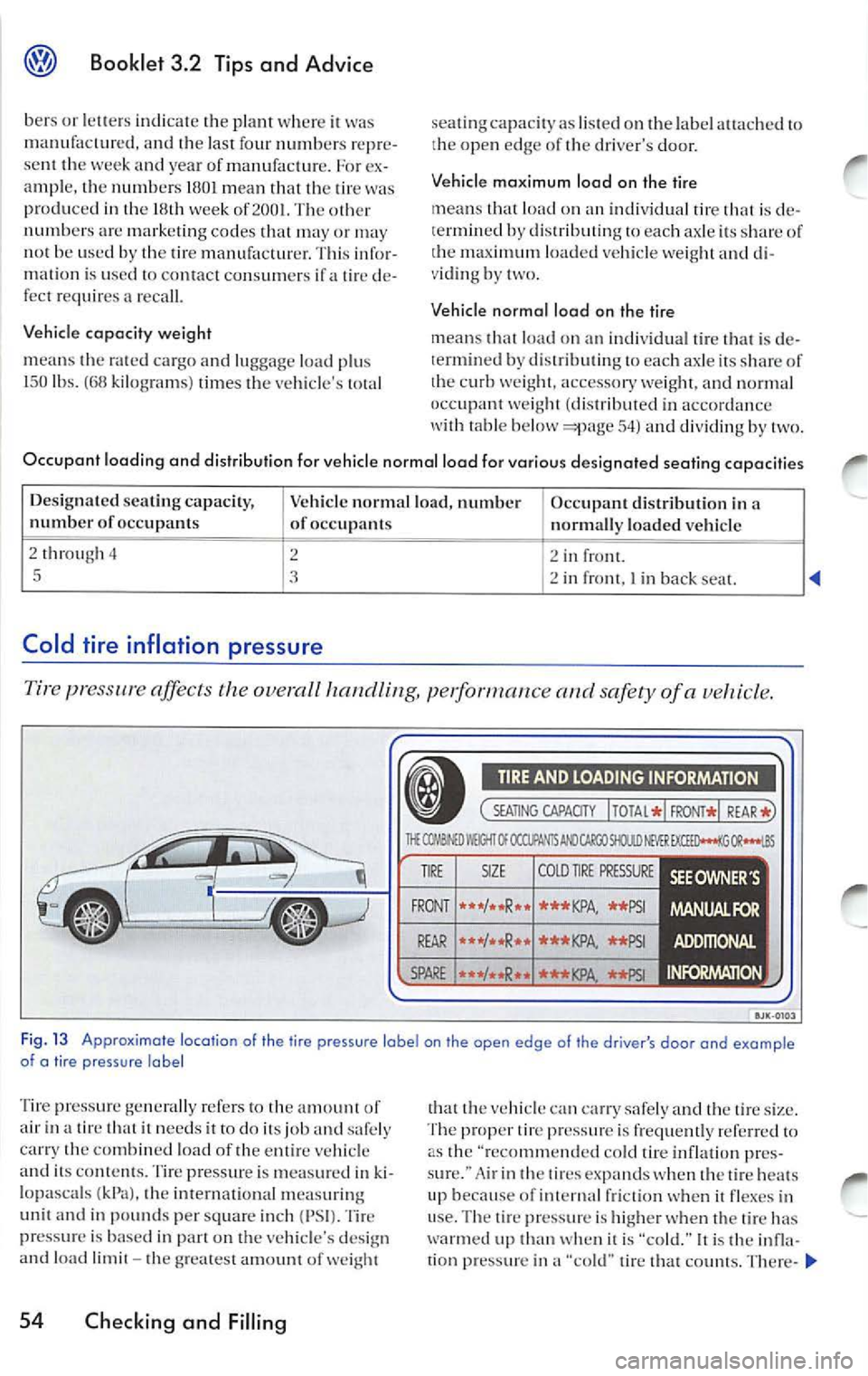
F ig . 1 3 Approximate location of fire pressure labe l on open edge of driver's door and example
of a fire pressure label
T ire p ress ur e ge nera lly refe rs to in a tire th at i l needs il t o do ils job an d sa fe ly
ca rry co mbin ed loa d of enti re vehicle
and it s content s. Tir e pre ssur e is meas ured in ki
l op ascals
imernat io nal meas urin g
unit and in poun ds per squar e in ch (P SI). Tir e
p ressure is based in pan o n th e ve hicle's des ig n
and l oad Ii mil -
greates t amount of
54 Checking and Filling
th at can car ry safe ly an d th e lir e s ize.
T he proper tir e press ure is frequ entl y to
as the "recom mend ed co ld tire inflation pr es
s ur e." Air in
!ires expa nds w hen tir e heat s
up because of fric tion when it fl exes in
u se . Th e tir e press ure is highe r w hen tire warmed up than when is "co ld.·· ll i s infla
t io n p ressure in a "co ld" lire Ther e-