safe VOLKSWAGEN JETTA 2009 Owners Manual
[x] Cancel search | Manufacturer: VOLKSWAGEN, Model Year: 2009, Model line: JETTA, Model: VOLKSWAGEN JETTA 2009Pages: 477, PDF Size: 77.6 MB
Page 259 of 477
Booklet 3.1 Controls and Equipment
Applies to vehicles : wi th power ou tside mirrors
Outside mirrors
It is impor tant for saf e dri ving to prop erly adju st th e ou tsid e ,ni rrors using joy
s tic k in
drive r's door.
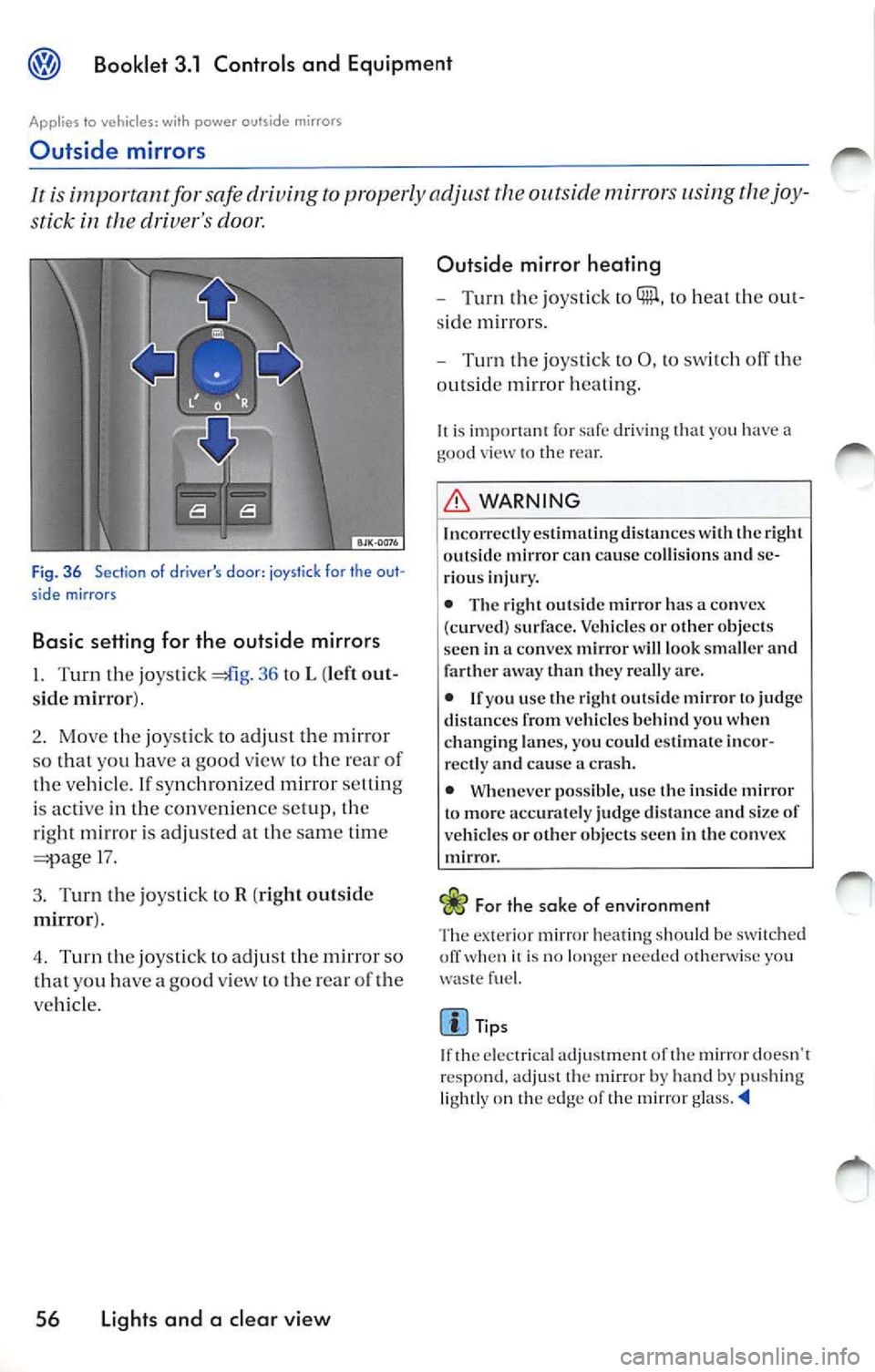
Fi g. 36 Se ct io n of dr iver 's door : joy sti ck fo r th e out
s ide m irr ors
Basic setting for the outside mirrors
I. Turn the joyst ic k 36 to L (left out
s id e mirror ).
2. Mov e th e joys tick
to ad ju st th e mirror
s o that you ha ve a good view
to the re ar of
th e ve hicle. lf sy nchroni zed mirror setting
i s act ive in th e conv en ie n ce setup, the
r igh t mirro r is adj uste d at the sam e tim e
17.
3. Turn the jo ystick to R (right out sid e
mirror ).
4. Turn the jo yst ick to adju st th e mirror so
that you have a good view to the rea r o f th e
ve hicl e.
56 Lights and a clear view Outside mirror heating
-
Turn the jo yst ick to Qiµ , to heat th e ou t
s id e mirrors.
- Turn the joys tic k to 0 , to swi tch
th e
o ut sid e mirror h eati ng.
It is imp ortant for safe driving yo u have a
goo d to th e rear.
WARNING
ln corr cctlyc stim atin gdi stan ccs with the right
o ut sid e mirror can ca use co llision s and se
riou s inju ry.
• The right outsid e mi rror has a co nvex
(c urv ed) surfac e. Ve hicle s or other obje cts
see n in a co nvex mirror
will look smaller and
farth er away t.han th ey rea lly are .
• If yo u u se the r igh t o ut side mirror to judg e
di stance s from vehicl es behind you when
c h an gin g lanes, yo u could estim ate in cor
rec t.ly and cau se a cras h.
• Whene ver po ssibl e, use the inside mirror
t o mor e accurat ely jud ge dist ance a nd siz e of
ve hicl es or other objects see n in th e co nvex
mirror.
For the sak e of environment
Th e ex te ri or mirror hea ting sh ou ld be s witc hed
off whe n it is no lo ng er nee ded oth erwi se yo u
was te fu el.
Tips
If th e e lect rica l adj ust m ent of th e mi rror doesn't
r es pond, adju st t he mirror b y hand by p ushin g
li ghtly on the edg e of the mirro r
Page 260 of 477
Booklet 3.1 Controls and Equipment
a
safety belt.
Th e dri ver sea t and front pa ssenger seat can be
adjusted in many ways to sui t the physi cal need s
of the ve hicle occupams . Seat position i s very
i mporta nt:
• fast and easy operation of all control s on th e
in strum ent panel,
• relax ed posture that does not ca use drow si
ness,
• safe driving,
• opt imum protection from the seat belts and
airbag syste m
2.1 "Safety fir st."
WARNING
Drivers or passe ngers who arc unbelted , out of
position or too close to the airbag can be seri
ously injured or killed by an airba g as it un
folds. To help reduce the risk of ser iou s per
so nal injur y:
• Alwa ys adjust the driver's seat and the
s teering wheel so that th ere a re at least 10
inches (25 cm) betwe en yo ur breastbone and
the steeri ng w heel.
• Alwa ys hold th e steer ing wheel on th e out
s id e of the s teer ing wheel rim with your hand s
at the 9 o'clock and 3 o'clock positions to help
reduce the risk of personal injury if the
driver 's airbag inflates.
• Neve r hold th e steer ing wheel at the 12
o'clock position or with your hands at other
pos ition s in sid e the steer ing w hee l rim or on
the steer ing wheel hub. Holding the ste ering
w hee l th e wrong way can cause serio us inju
ries to the h ands, ar ms and head if the driver's
airbag inflates.
• P assengers must alway s sit in an upright
po sitio n and ne ver lean against or place any ,0.
WARNING
(continued)
part of th eir body too close to the area where
the airbags arc located.
• Passengers who are unbelt ed, out of posi
tion or too close to the airbag can be seriously
injured by an
as it unfo lds with great
force in the blink of an eye.
• Always make sure th at there arc at least 10
in ch es (25 cm) between the front passeng ers
breastbone and the instrum ent panel.
• Each passenger must always sit on a sca t of
th eir ow n and properly fasten and wear the
safety belt belonging to that seat.
• Before driving, a lways adjust the front
seats an d head restra ints pr operl y.
• Neve r adjust the seats while the vehicle is
moving. Your scat may mo ve unexpectedl y
and you could lose control of the vehicle .
• Always keep your feet on the floor in front
of the scat. Neve r rest them on the seat, instru
m ent panel, out of the window, etc. The airbag
s ystem and safety belt will not be able to pro
t ect you properl y a nd can even increase the
ri sk of injur y in a crash.
• Never drive with the backrest recl ined or
tilt ed far back! The farther the backrests arc
tilt ed back, the greater the risk
due to
in cor rect positionin g of the safety belt and im
proper seating position.
• Safety belts only offer max imum protec
ti on wh en th e sea t back is sec urely latched in
th e upri ght position and the safety belts arc
proper ly positioned on the bod y. By not sitting
upright, a rear scat passenger increase s th e
r is k of per sonal injury from improperly pos i
ti oned safet y belts!
• Children must always ride in child seats.
Specia l precautions apply when insta lling a
child scat on the front pas senger sea t
2.1, ch ap ter "Chi ld
Seats and storag e 57
Page 261 of 477
Booklet 3.1 Controls and Equipm ent
Head restraints
Correct adjustment of head restraints
Properly adjusted h ead restraints are an importa 11t part of occupant protection
and can help to reduce the risk of
in accidents.
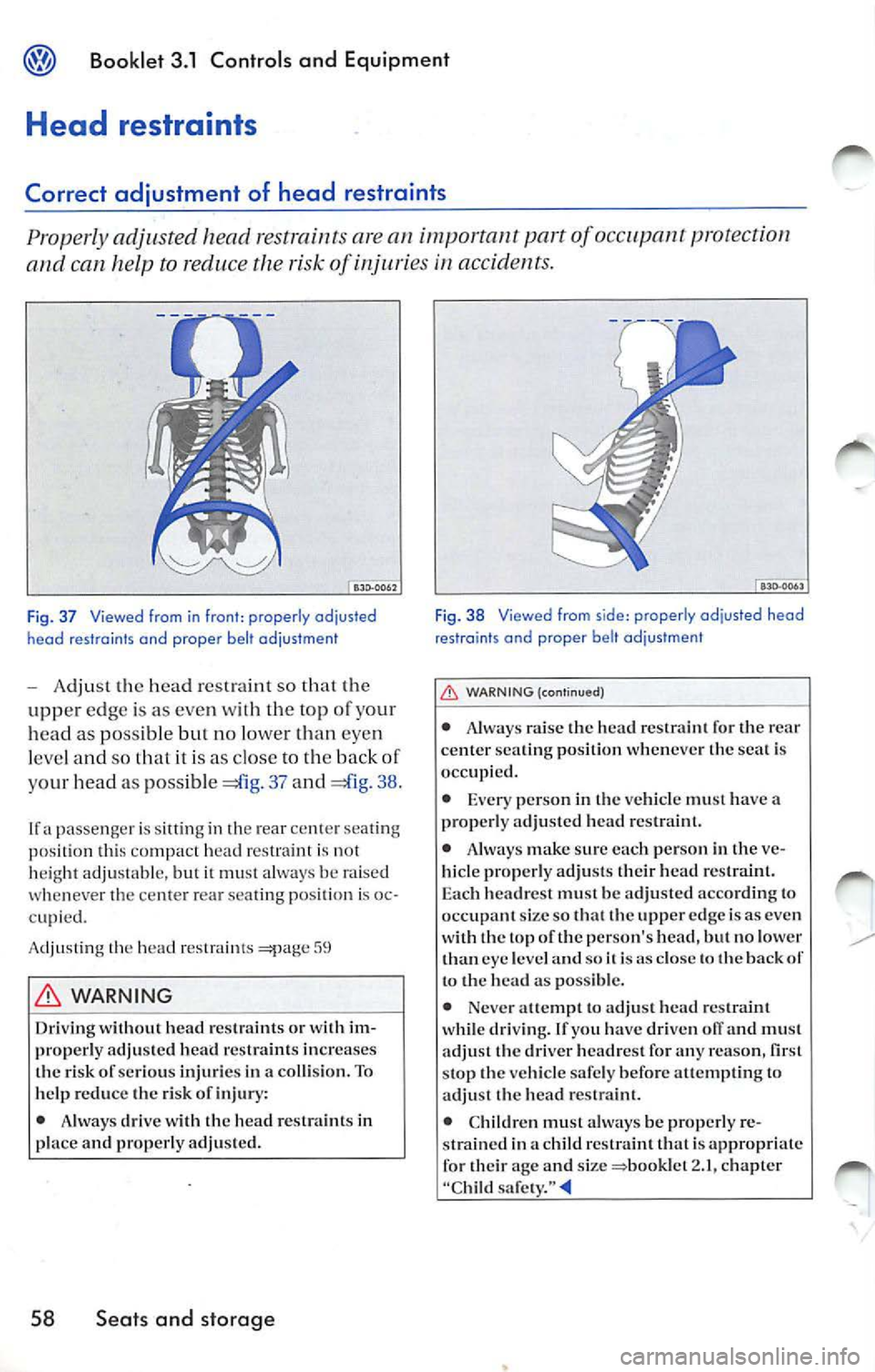
Fig. 3 7 Viewed from in front : properly odjusted
heod restraints end proper belt odjustment
- Adjust the head restraint so that the
uppe r edg e is as eve n wit h th e top o f your
head as possible
no lo wer than eyen
l eve l and so th at it is as close to th e bac k of
y our head a s possi ble
37 and 38.
If a passenger is s itting in th e rear center sea tin g
position thi s co mpact h ead r estraint is no t
h eight adju stabl e, but it must always be raised
whenever the ce nte r rear sea ting posi tion is oc
c upi ed.
A dju sting the head
WARNING
Driving without head rest raints o r wit h im
prop erly adjusted head restraints inc reases
th e risk of serious injurie s in a co llision. To
h elp reduc e th e risk of injury:
• Always drive with th e head restraints in
place a nd properly adjuste d.
58 Seats and storage
F ig . 38 Viewed from s ide: properly adjusted head
restraints and proper belt ad justment
WARNING (contin ued)
• Always raise the head restrai nt for the r ear
center seating position wheneve r the seat is
occupied.
• Ever y perso n in th e ve hicle must have a
properl y adjuste d head r estra int.
• Alway s make sur e eac h person in the ve
hicle properly adju sts their head restraint.
E ac h headres t must be adjusted a ccord ing to
occupant size s o that the upper ed ge is as eve n
wit h the to p of the person's head, but no lower
tha n eye leve l an d soi
is as clo se th e back to the head as pos sibl e.
• Neve r attempt to adj ust head r estraint
wh ile dri vin g. If yo u have driven
and mu st
adjust the driver h eadrest for any reason,
stop the ve hicle safe ly befo re atte mptin g to
ad just the head r estra int.
• Children must always be properly re
s trained in a ch ild restrain t that i s appropr iate
for their age and size
2. 1, ch apter
"Chil d safety. "
Page 263 of 477
Booklet 3.1 Controls and Equipment
WARNING (continued)
• If th e center head restraint does not your sea te d hei ght when fully extended, move
t o ano ther seati ng po sition to redu ce the risk
of injury in a collision
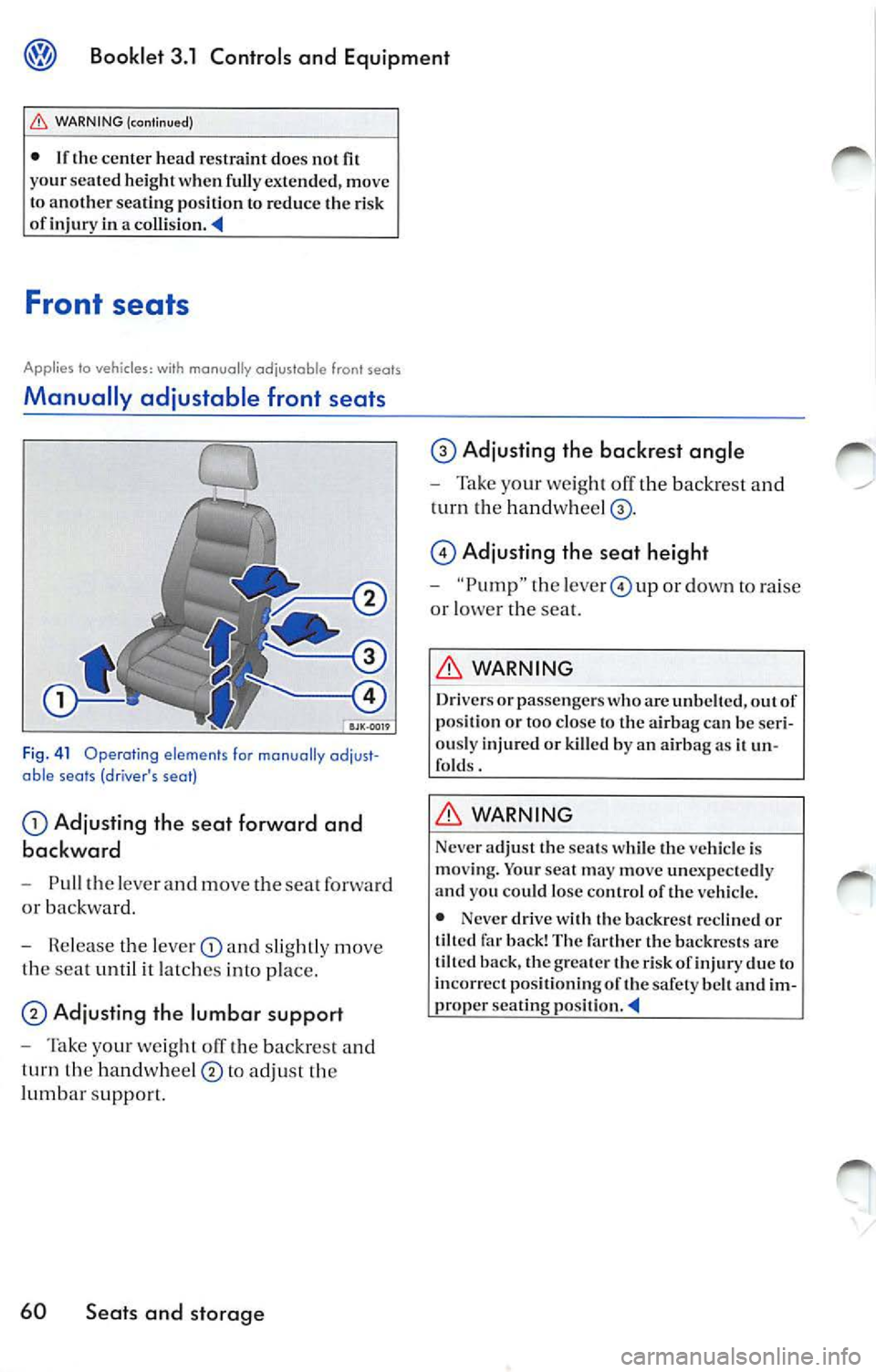
Adjusting the seat forward and
backward
- Pu ll the leve r an d m ove th e sea t for ward
or ba ckw ard .
He le ase t he le ve r and sli ght ly m ove
t h e se at until it la tc h es into pla c e .
Adjusting the lumbar support
Take y our weig ht off the bac kre st and
turn th e handwh eel
to ad just th e
lu mba r su pport.
60 Seats and storage
Adjusting the backrest angle
Take your weigh t off the b ackres t and
turn the handwh eel
Adjusting the seat height
"Pump " th e or do wn to rai se
or lowe r th e sea t.
Drivers or passenger s w ho are unbelted , out of
position or too clo se to the airbag ca n be ser i
o usly i njur ed or kil led b y an airb ag as it un
fo ld s .
WARNING
N ever adjust the sea ts whi le the vehicl e is
m ovin g. Yo ur seat may mo ve une xpe cted ly
and you cou ld lose co ntrol o f the ve hicle.
• Never drive with the backre st reclined or
lilted far back! The farther the ba ckr ests are
tilted back, the g reat er the risk of injur y due to
in corr ect po siti on in g of the safet y belt and im
prop er seatin g po siti on
Page 264 of 477
Booklet 3.1 Control s and Equipment
to vehicles: w, th foldoble front seat backrest
Folding the front passenger seat backrest forward
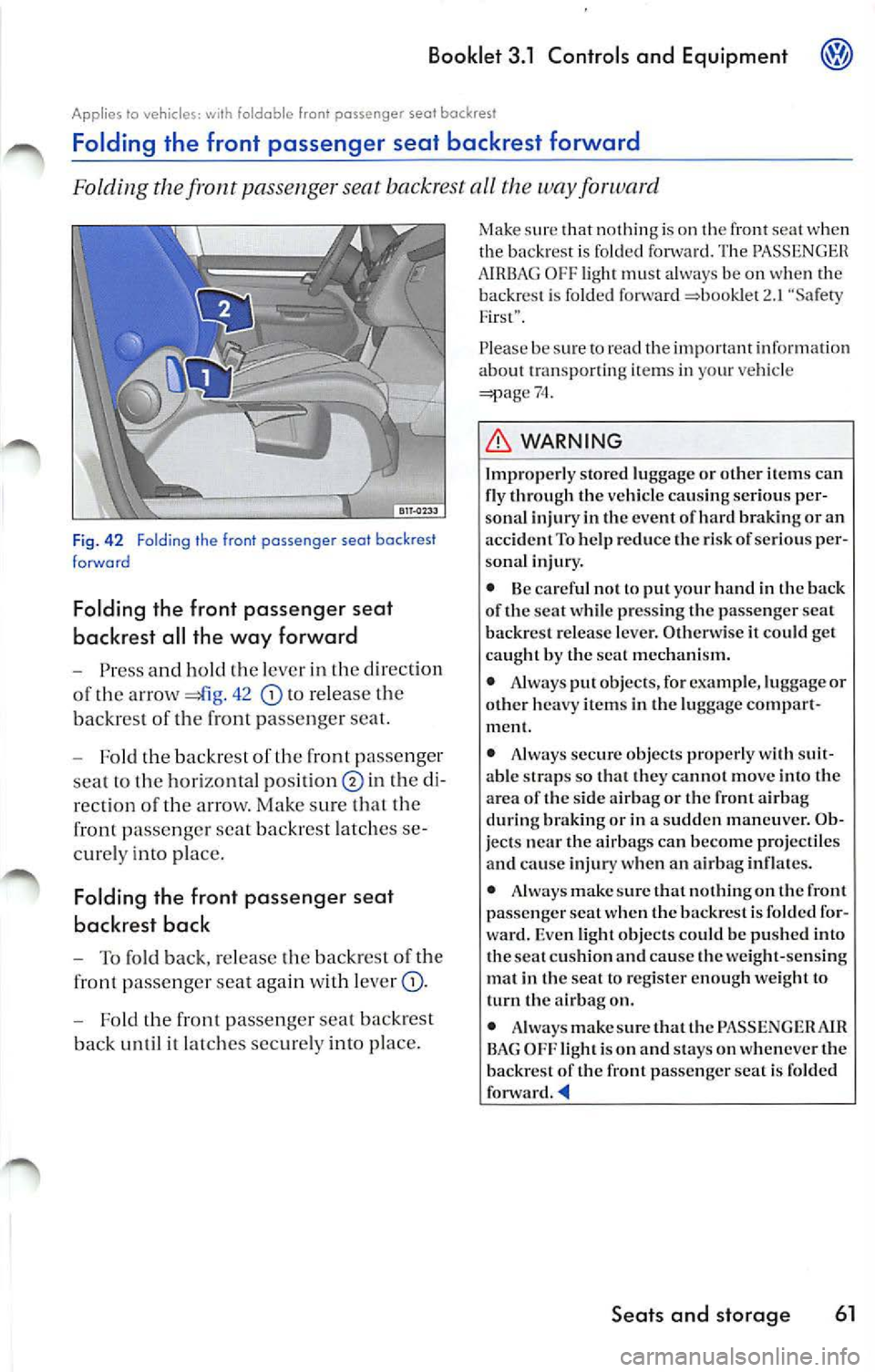
Folding the front passenger seat backrest the way forward
Fig . 4 2 Folding th e front passenger seal backrest
forward
Folding the front pa ssenger seat
backrest all the way for ward
Press and hold th e leve r in the direc tion
of the arrow
42 to re lea se the
backre st of the
pas seng er sea t.
Fold the backre st of th e fro nt pas senger
sea t to the hori zontal
in th e
rection of the arrow. Make sure that the
front pa ssenger seal backrest latches
curely into pla ce.
Folding the fr ont pas senger seat
backrest back
To fold back, release the backr est of the
front passeng er seat again with lever
Fold the front passeng er seat backrest
back until it latch es secure ly into pl ace.
Make sur e that nothin g is on th e front seat when
the back rest is fo lded The AIRBAG OFF light must always be on when the
backrest is folded forward 2.1 "'Safety
F irst".
P lease be s ure
74.
L'.D, WARNING
Im pr operl y store d lu ggage o r o th er it em s ca n
fl y thr ou gh th e vehicle ca using ser io us pe r
so nal i nj ury in th e even t of hard bra kin g or a n
ac cide nt To help red uce the risk of serious per
sona l inju ry.
• Be ca ref ul n ot lo p ut your hand in th e bac k
of the sea t wh ile press ing t he passe nge r scat
backrest re lease le ve r. O thenvise it co uld get
ca ugh t b y th e seal mech ani sm.
• Always put ob jects, for example, luggage or
o th er h eavy items in the luggage compar t
m ent.
• Always sec ure o bjec ts pro per ly wi th suit
a b le straps so th at they ca nno t m ove into the
area of t he s ide air bag or t he fron t a irbag
d u ring bra kin g or in a sud de n m an eu ver. O b
j ec ts nea r the air b ags ca n beco me pro ject iles
and cause injury when an a irbag inflates.
• Always make sure that no thin g on t he fro nt
passe nge r seal w hen th e backres t is fo lded for
war d. Eve n light ob jects co uld be push ed i nto
th e sea l c u shi on an d ca use the we ight- sens ing
mat in the seat to reg is te r en ough we ig ht to
t u rn th e airbag on.
• Always make su re that t he PAS SENG ER AJ R
BAG OFF ligh t is on and stays on whenever t he
b ac krest of the front passe nger sea t is fold ed
fo nva rd .
Page 267 of 477
Booklet 3.1 Controls and Equipment
WARNING
• Never adjust the driver or front passenger
seat while the vehicle is in motion. While ad
ju stin g your seat, you could adjust your seat to
an incorrect sitting position. Adjust your seat
before driving
or when th e vehicle is not
moving.
• The elect rical front seat adju stment also
work s with the ignition off. Therefore, chil
dren sh ould never be lef t unattended in the
vehicle -ther e is a risk of injury!
• Exercise caut ion when adjustin g the seat
height or fonvard/backward position. Care
l ess use of the front seat adjustment co ntrols
can cause injuri es.
WARNING (continued)
• To reduce the risk of personal injury in an
accident, front seat passenge rs must never
ride in a moving vehicle w ith the seat back re
clined. Safet y belt s offer prote ction only when
th e seatback is upright and belt s are properl y
po sition ed on the bod y. The more Lheseatback
i s re clined, the greate r th e risk of personal in
ju ry from an out of position safety belt.
avoid damaging the e lec trical co mp onen ts of
th e front seat, do not knee l on the sea t or apply
dir ect pressure at a sing le po int to the seat
cu shi on a nd
Applies to vehicles: wilh electrically adjustable fronts seat and memory buttons
Memory for driver 's s eat
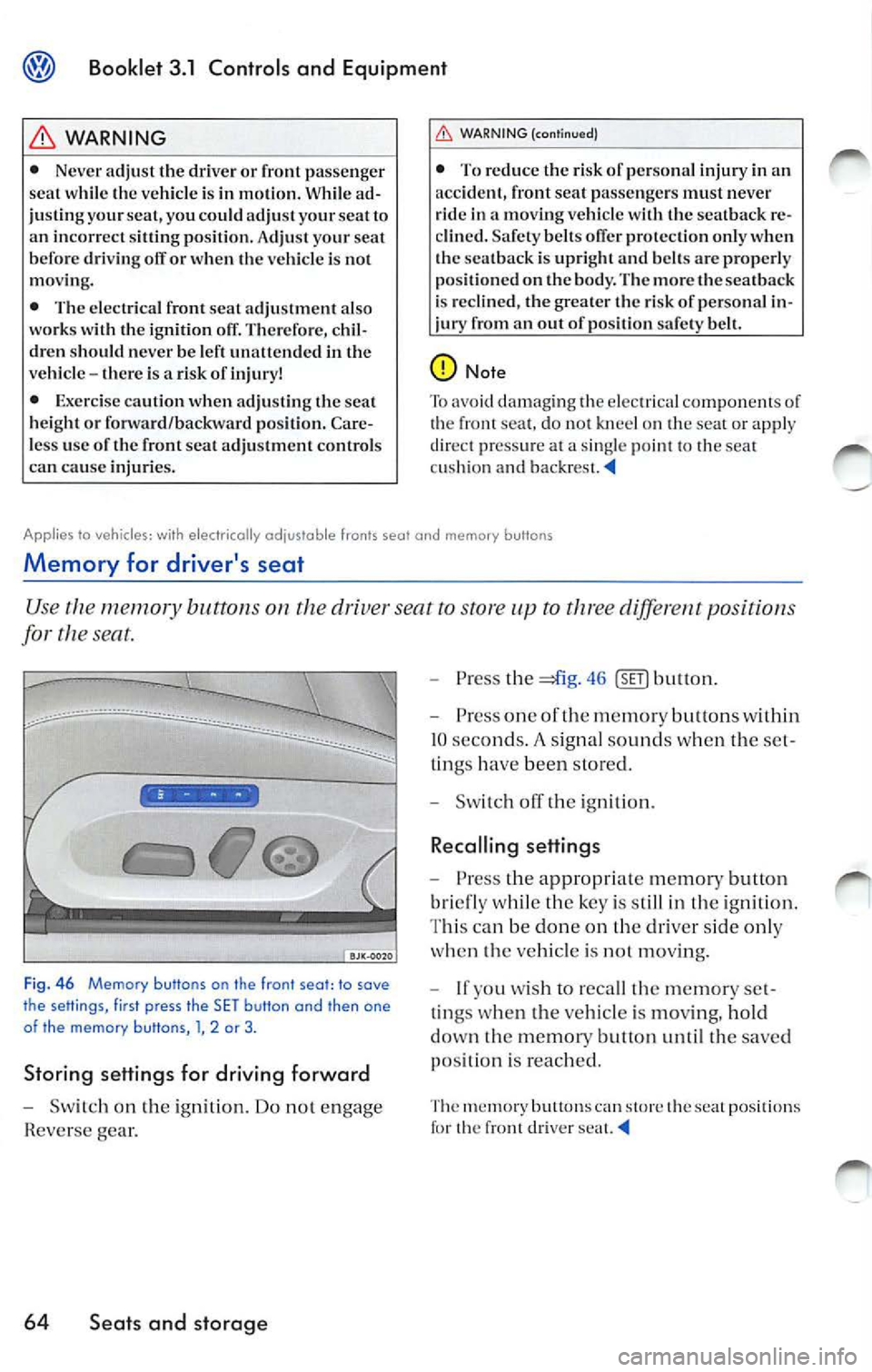
Use memory buttons on dri ver seat to sto re to three diffe rent positions
for
seat.
••••
F ig. 46 Memory buttons on the front seot: to sove
the setlings, first press the SET butlon and then one
of the memory butlons , l, 2 or 3 .
Storing settings for driving forward
-Sw itch on the igniti on. Do not en gage
Rever se gear.
64 Seats and storage
-Press the =*i g. 46
bri efly whil e the key is s till in the ignition .
T hi s ca n be don e on the driver side only
whe n th e ve hicle is
moving.
- lfyou w ish to reca ll the memor y set
t ings whe n the vehicle is moving, hold
dow n the memory button until the sa ve d
p osit ion is reac hed .
The m em ory butt ons ca n sto re th e sea t positions th e fron t d river
Page 270 of 477
Booklet 3.1 Controls and Equipment
Raising the backrest into place
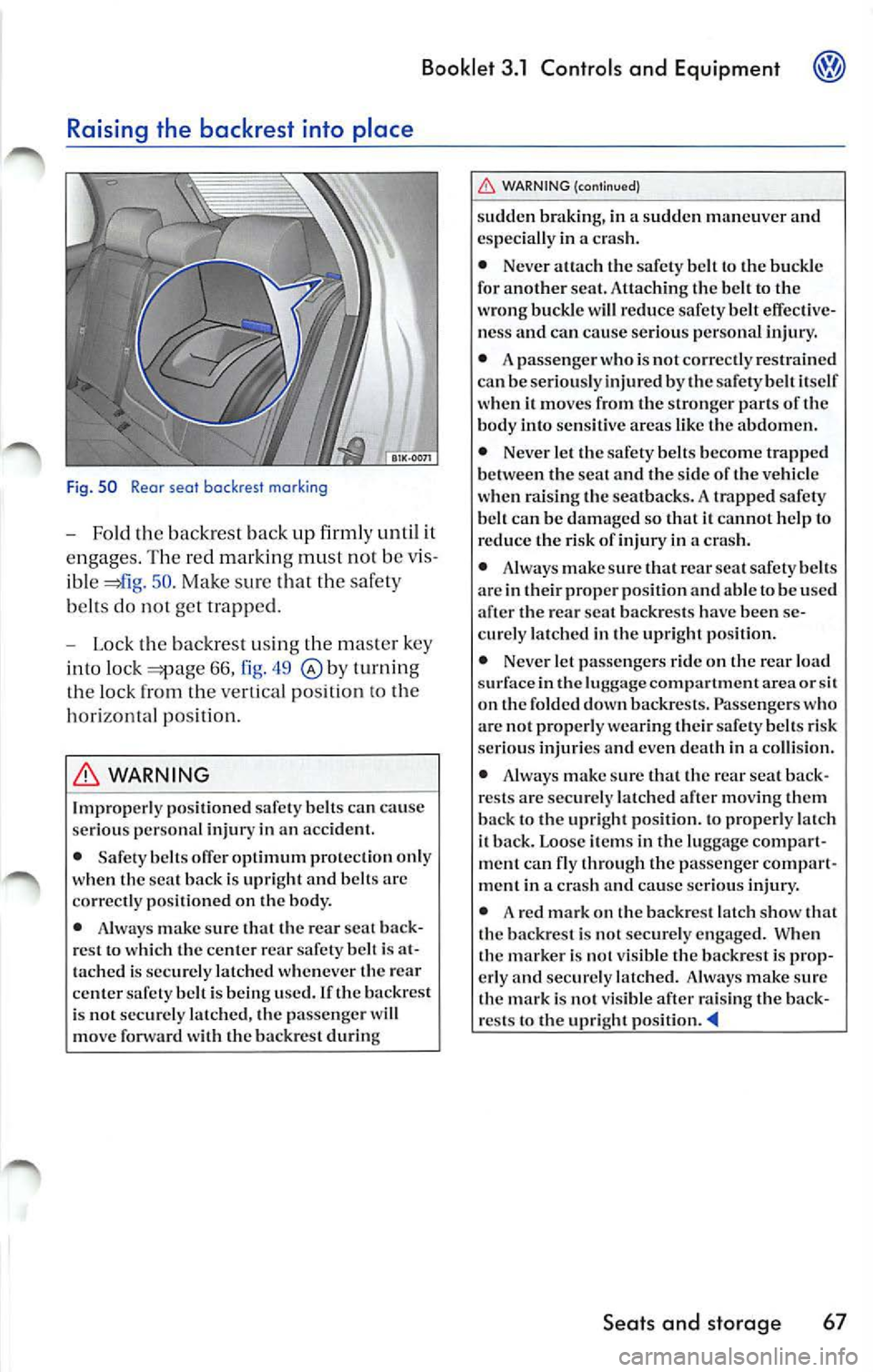
Fig. 5 0 Rear seat backrest marking
-Fold the backrest back up firmly until it
engages. The red marking must not be vis
ibl e
50. Make sure that the saf ety
bel ts do not get trapped.
- Lock the backrest using the master key
into lock
66, fig. 49 by turning
th e lock from the vertical position to the
horizonta l po sition.
WARNING
Improperl y positioned safety belts can ca use
serio us personal injury in an accident.
• Safety belts olTeroptimum protection only
w hen the scat back is upright and belts arc
correc tly positioned on the body.
• Always make sure that the rear scat back
rest to which the center rear safety belt is at
t ached is secure ly lat ch ed whenever the rear
center safe ty belt is being use d. If the backre st
is not secure ly lat ch ed, the passenger
will move forward with the backrest during
WARNING (continued)
sudde n braking, in a sudden maneuver and
es pecia lly in a cras h.
• Never attach the safety belt to the buckle
for another seat. Attac hing the belt to the
wrong buckle
will reduce safety belt effective
n ess and can cause serious persona l injury.
• A passen ger who is not correc tly re strain ed
can be ser ious ly injured by the safety belt itself
when it move s from the stronger parts of the
bod y into sensitiv e areas like th e abdomen.
• Never le t the safety belts become trapped
between the scat and the side of the ve hicle
when raising the scat back s. A trapped safety
belt can be damag ed so that it can not help to
r ed uce the risk of injury in a cras h.
• Alway s mak e sure that rear seal safe ty belts
arc in their proper positio n and able lo be used
after the rear scat backr ests have been se
c ur ely lat che d in the up right position.
• Neve r let passengers ride on the rear load
surface in the luggage compartment area or sit
on the folded clown backrests. Passengers who
are not properly wearing their safety belts risk
ser ious injuri es and even dea th in a co llisio n.
• Alwa ys make sure that the rear seat back
r es ts are securely latched after moving them
back to the upright positio n. to properly latch
it back. Loose items in the
compart
ment can fl y through th e passenger compart
ment in a crash and cause ser ious injury.
• A red mark on the backre st latch show that
the back rest is not secur ely engaged. When
th e marker i s not visible th e backrest is prop
erly and securely latched. Always make sur e
the mark i s not visi bl e after raising the back
re sts to the upri ght
Seats and storage 67
Page 278 of 477
Booklet 3.1 Controls and Equipment
WARNING
Heavy load s will influ ence the way your ve
hicle handl es and heavy loads t hat are not
properly stowe d or sec ured can cause loss of
contro l a nd se rious injury.
• Always keep in
when transporting
h eav y ob ject s, that a chan ge in th e center of
gravity can also cause c hanges in vehicle han
dling:
-Always distribute the load as evenly as
po ssib le.
- Secur e heavy object s properly as far for
ward in the lug gage compar tment as pos
sible.
- Alwa ys s ecure heavy items securely
using the tie-downs provided wit h suitable
s trap s.
• Never excee d the Gross Axle Weight
or the Gross Ve hicle Wei ght Hating on the
s afe ty compliance sticker o n th e left d oor
jamb. Exceedi ng permi ssible weig ht can ca use
the vehicle to slide and handle difTerently.
• Always read and heed a ddition al imp or
in forma tion on driving 2.1
" Safety first."
WARNING
To help p rev en t poisonou s exhaust gas from
being drawn into the vehicle , a lways ke ep the
rear lid clo sed w hile driving.
• Never transport objects larger than those
fitting completely into the luggage area be
cause t he rear lid cannot be full y closed.
• If you abso lut ely must drive with the rear
li d open, observe the following notes to reduce
th e risk of poisoning:
WARNING (continued)
-Close all wind ows,
- Close the power roof,
- Open all air outlets in the in strumen t
panel,
- Switch off the air recirculation,
- Set the fresh air fan to the highest speed.
WARNING
Always make sur e that the doors and rear lid
are secure ly clo sed and locke d to redu ce the
risk of injury when the vehicle is not being
u sed.
• Afte r clo sing the rear lid , a lways mak e sur e
that it is p roper ly closed and locked.
• Never leave yo ur vehicle unattended espe
cially with th e rear lid left open. A child could
craw l into the vehicle through the luggage
compartment a nd pull the re ar lid or window
s hut becoming trapped and unab le to get ou t.
Being trapped in a ve hicle can lead to serious
p ersona l inju ry.
• Never le t ch ildr en play in or around the ve
hicle.
• Never let passe ngers ride in the luggag e
com par tmenl. Vehicl e occupants must always
be properl y re strained in one of the veh icle's
s eat ing po siti on s.
Note
o bj ec ts o n th e hat sh elf co uld d am age the
w ires of the re a r w ind ow d efogg er.
Tips
D o no t co ve r th e ve ntilatio n slo ts in front of th e
r e ar sid e w ind ows beca use this ca n pr event sta le
a ir fr om esca ping the vehi cle.
Seats and storage 75
Page 279 of 477
Booklet 3.1 Controls and Equipment
Roof rack
Markings for attaching the roof carrier mounts
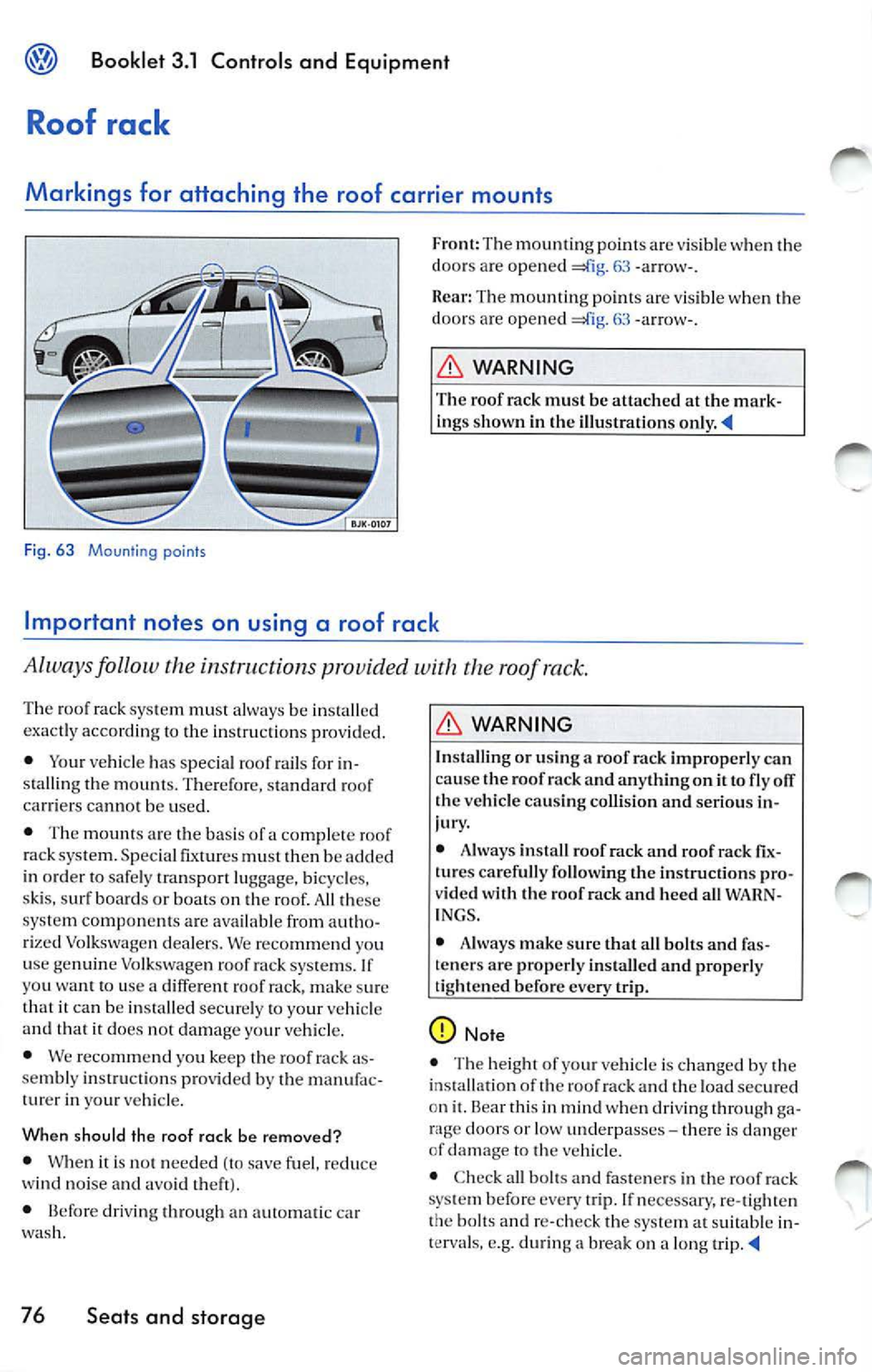
Fig. 63 Mounting points
Front: The mounting points are visible whe n the
door s are opened 63 -arrow-.
Rear: The mounting po ints are v is ibl e when the
door s are opened
-arrow-.
L'.0, WARNING
The roof rack must be attach ed at the mark
ings sh ow n in th e illu stra tions only.
Important notes on u sing a roof rack
Always follow the instructions provided with the roof rack.
The roof rack system must always be install ed
exactly according to th e instru ctions provid ed.
• Your vehicle has special roof rails for in
sta lling the mounts . The refore, standard roof
ca rrie rs canno t be use d.
• The mount s are the basis of a comp lete roo f
rack syste m. Specia l fixt ures mu st th en be add ed
in order to safe ly transport luggage, bicycles,
s ki s, surfboard s or boats on the roof. All th es e
syste m com pone nts are ava ilable from autho
ri zed Volkswagen dea lers. We recommend you
u se genuin e Volkswagen roof rack sys te m s. If
yo u wa nt to u se a different roof rack, make sur e
that it can be in stall ed sec urely to yo ur veh icle
and that it does not damage your vehicle.
• We recomm end you keep the roof rack as
se mbly instru ction s provid ed by the manufa c
turer in yo ur vehicle .
When should the roof rack be removed?
• When it is not needed (to sav e fuel, reduce
w ind noise and avo id th eft).
• Before dri ving through an aut omatic ca r
was h.
76 Seats and storage
WARNING
Installing or using a roof rack improperly can
ca use the roof rack and a nyt hin g on it to off
th e vehicle ca using collision and serious in
ju ry.
• Always insta ll roof rack and roof rack fix
tures carefully following th e instructions pro
v ided with the roof rack and heed
all INGS.
• Always make sure that all bolts and fas
te ne rs are proper ly installed and properly
t ight ened before every trip.
Page 286 of 477
Booklet 3.1 Controls and Equipment
Cooling system
When the air condit ion ing is on, not on ly th e
temperatur e, but also the air humidit y in th e ve
h icle interior is re du ced. Thi s improve s comfort
for the vehicle occupallls and preve nts th e w in
dows from fogging up when th e o utsi de a ir i s
very humid.
I f the air conditionin g does not
on, it
co uld be for one of the follow ing reasons
• the eng ine is no t running.
Applies to vehicles: with Climatic
Air recirculation mode
• th e fan is sw itch ed off.
• t he outs id e te mperatu re is lower than
rou ghly
+ 40 ( +3 °CJ .
• the air conditioner compr essor has bee n
tempor aril y sw it ched off because th e e ngi ne
coo la nt te mp erature i s too high.
• the air condition er fu se is blow n.
• have the air condit ione r ch ecked by an au
th ori ze d Vo lkswage n deale r.
Air recirculat ion mod e prevent s fum es or unpleasant smells from entering the ve
hicle.
- Pre ss the butt on 82, 68
switch air r eci rculat io n mode on or off.
When it is s witch ed on a yellow light in the
button light s up.
Air r ecircul atio n m ode pre vents stro ng out door
odors from ent erin g th e ve hicle interior, for ex
amp le when driving th rough a tunnel or in
de nse traffi c.
the out side te mp erature is low, usin g air
r e circulat io n m ode prov ides mor e effective
h ea tin g by hea ting air fr om th e ve hicle int eri o r
instead of cold air from outsid e.
W hen th e o utside te mperat ure is hi gh, usin g air
r eci rculation mode prov ides m ore effectiv e
coo ling
cooling air from th e ve hicle i111erior
in ste ad of wa rm ai r from ou ts id e.
For safety re aso ns, air re cir cu lati on is not pos
s ib le
th e colll ro l for air di stributi on i s set
t o th e® pos ition. The air reci rc ul atio n m ode ca
n b e sw itch ed back on b y pressing
bu lion .
WARNING
Stale air cau ses driver fatigue and reduces
dri ver alert ness . Thi s can lead lo acciden ts,
co llisio ns and seriou s perso nal injury.
• Neve r use air reci rculation for lo ng period s
of tim e becau se no fresh air will come into the
pa ssenger com partm ent.
• If the coo ling sys tem is sw itch ed o ff, the
w indows can fog up qui ckl y and decrease
dr ive r vis ibilit y.
• Always sw itch the recirculation mode off
wh en i t is not nee ded.
Do not s moke whil e a ir reci rc ul atio n m ode is on,
as sm oke draw n i111 0 the clim ate-co ntrol sys te m
ca n leave a re sidue on th e evaporator, producin g
perm an en t unpl easant odo r.
Air conditioning system 83