wheel VOLKSWAGEN POLO 2015 Owner´s Manual
[x] Cancel search | Manufacturer: VOLKSWAGEN, Model Year: 2015, Model line: POLO, Model: VOLKSWAGEN POLO 2015Pages: 100, PDF Size: 4.14 MB
Page 40 of 100
Downloaded from www.Manualslib.com manuals search engine 12/29/2015Bedienungsanleitung < Service & Zubehör < Volkswagen Deutschland
5/136
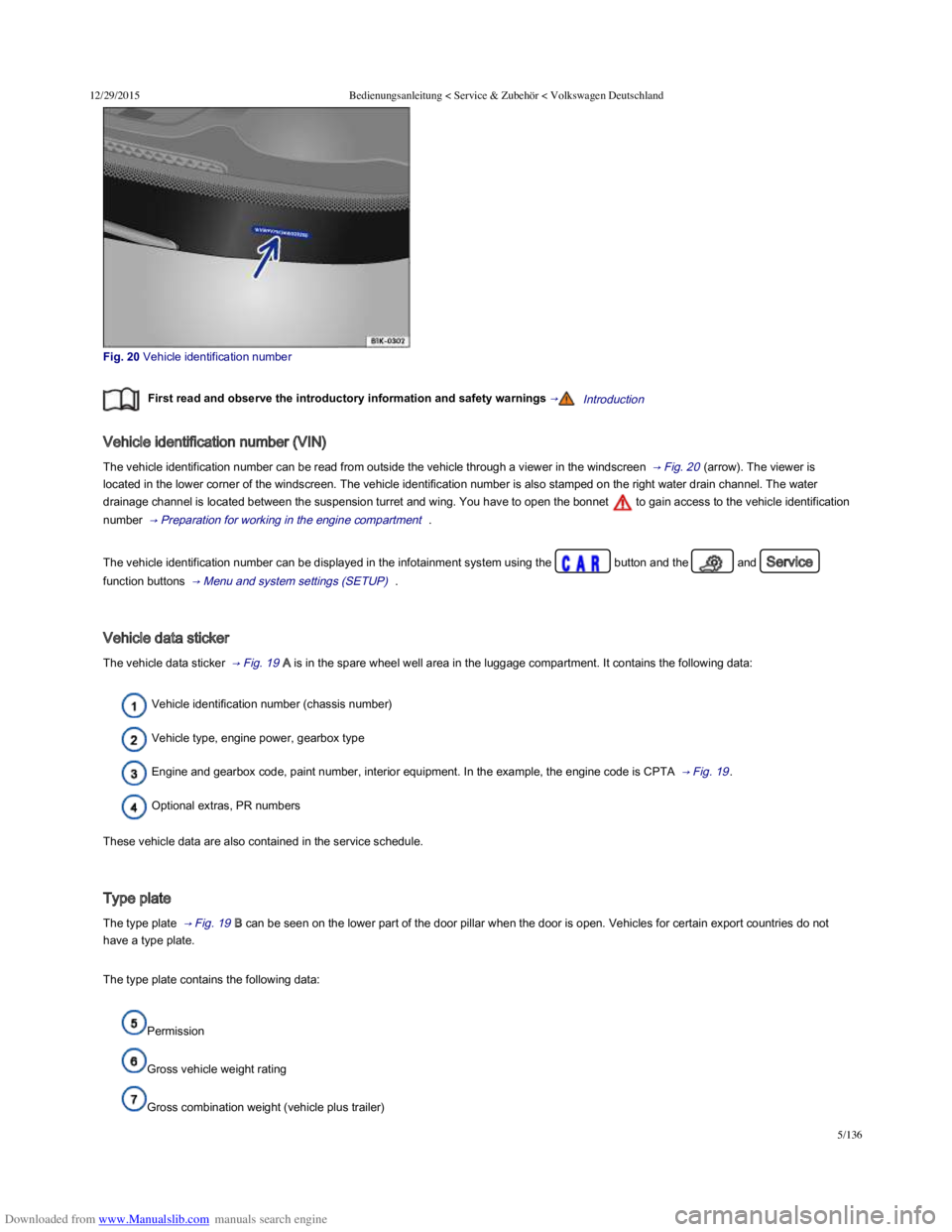
Fig. 20 Vehicle identification number
First read and observe the introductory information and safety warnings →Introduction
Vehicle identification number (VIN)
The vehicle identification number can be read from outside the vehicle through a viewer in the windscreen → Fig. 20 (arrow). The viewer is
located in the lower corner of the windscreen. The vehicle identification number is also stamped on the right water drain channel. The water
drainage channel is located between the suspension turret and wing. You have to open the bonnet to gain access to the vehicle identification
number → Preparation for working in the engine compartment .
The vehicle identification number can be displayed in the infotainment system using the button and the and Service
function buttons → Menu and system settings (SETUP) .
Vehicle data sticker
The vehicle data sticker → Fig. 19 A is in the spare wheel well area in the luggage compartment. It contains the following data:
Vehicle identification number (chassis number)
Vehicle type, engine power, gearbox type
Engine and gearbox code, paint number, interior equipment. In the example, the engine code is CPTA → Fig. 19 .
Optional extras, PR numbers
These vehicle data are also contained in the service schedule.
Type plate
The type plate → Fig. 19 B can be seen on the lower part of the door pillar when the door is open. Vehicles for certain export countries do not
have a type plate.
The type plate contains the following data:
Permission
Gross vehicle weight rating
Gross combination weight (vehicle plus trailer)
Page 42 of 100
Downloaded from www.Manualslib.com manuals search engine 12/29/2015Bedienungsanleitung < Service & Zubehör < Volkswagen Deutschland
7/136
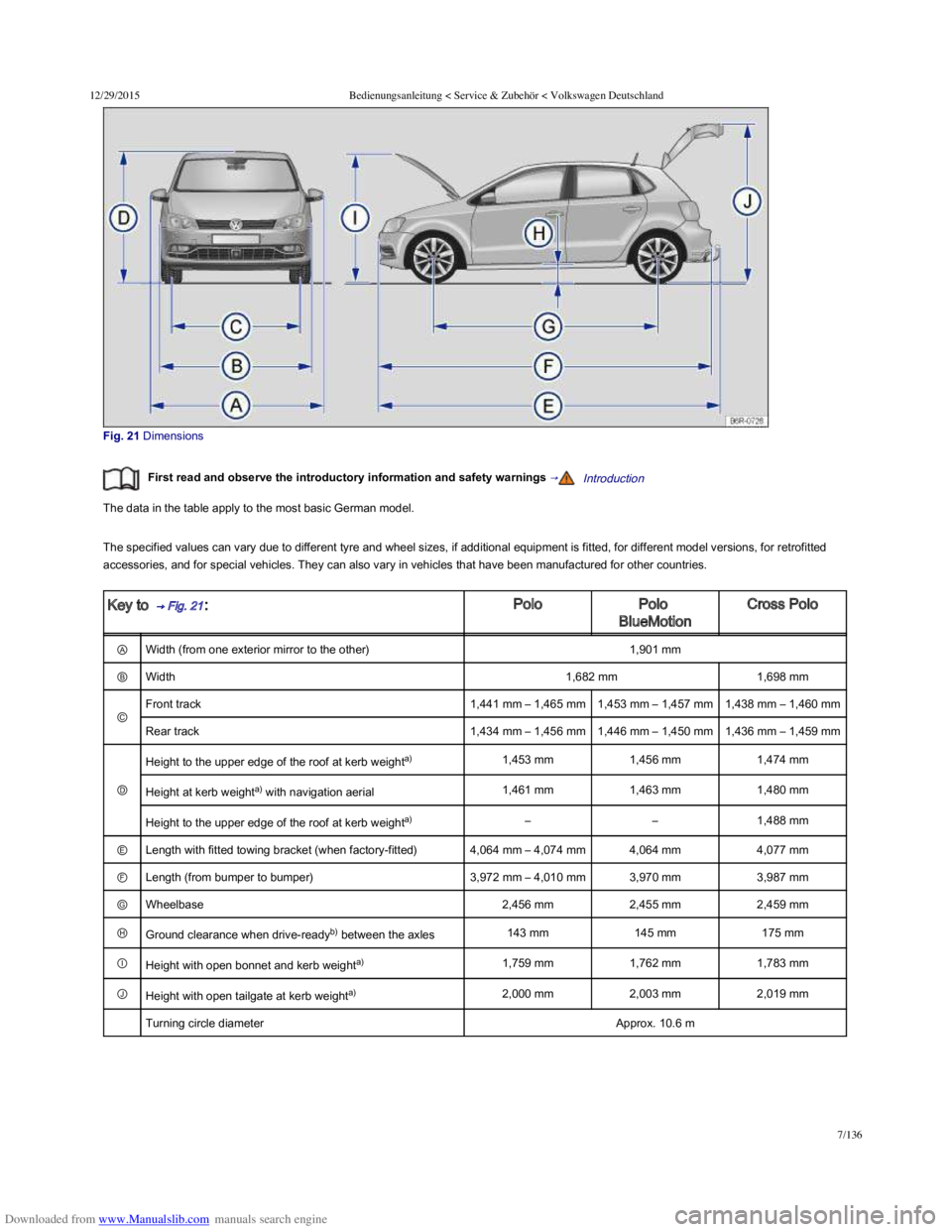
Fig. 21 Dimensions
First read and observe the introductory information and safety warnings →Introduction
The data in the table apply to the most basic German model.
The specified values can vary due to different tyre and wheel sizes, if additional equipment is fitted, for different model versions, for retrofitted
accessories, and for special vehicles. They can also vary in vehicles that have been manufactured for other countries.
Key to → Fig. 21 :PoloPolo
BlueMotion
Cross Polo
ⒶWidth (from one exterior mirror to the other)1,901 mm
ⒷWidth1,682 mm1,698 mm
Ⓒ
Front track1,441 mm – 1,465 mm1,453 mm – 1,457 mm1,438 mm – 1,460 mm
Rear track1,434 mm – 1,456 mm1,446 mm – 1,450 mm1,436 mm – 1,459 mm
Ⓓ
Height to the upper edge of the roof at kerb weighta)1,453 mm1,456 mm1,474 mm
Height at kerb weighta) with navigation aerial1,461 mm1,463 mm1,480 mm
Height to the upper edge of the roof at kerb weighta)––1,488 mm
ⒺLength with fitted towing bracket (when factory-fitted)4,064 mm – 4,074 mm4,064 mm4,077 mm
ⒻLength (from bumper to bumper)3,972 mm – 4,010 mm3,970 mm3,987 mm
ⒼWheelbase2,456 mm2,455 mm2,459 mm
ⒽGround clearance when drive-readyb) between the axles143 mm145 mm175 mm
ⒾHeight with open bonnet and kerb weighta)1,759 mm1,762 mm1,783 mm
ⒿHeight with open tailgate at kerb weighta)2,000 mm2,003 mm2,019 mm
Turning circle diameterApprox. 10.6 m
Page 68 of 100
Downloaded from www.Manualslib.com manuals search engine 12/29/2015Bedienungsanleitung < Service & Zubehör < Volkswagen Deutschland
33/136
→ Convenience opening and closing .
Introduction
This chapter contains information on the following subjects:
→ The dangers of assuming an incorrect sitting position
→ Correct sitting position
→ Mechanical controls on the front seats
→ Adjusting the head restraints
→ Removing and fitting head restraints
→ Adjusting the steering wheel position
→ Centre armrest
Number of seats
The vehicle has a total of 5 seats: 2 at the front and 3 at the rear. Each seat is equipped with a seat belt.
Additional information and warnings:
Seat functions → Seat functions
Seat belts → Seat belts
Airbag system → Airbag system
Child seats → Child seats
Cleaning and caring for the interior → Cleaning and caring for the interior
Sitting correctly and safely
Adjusting the seat position
Assuming an incorrect sitting position in the vehicle can increase the risk of severe or fatal injuries during a sudden driving or braking
manoeuvre, in the event of a collision or accident, or if the airbags are triggered.
All vehicle occupants must assume a correct sitting position before setting off and maintain this position throughout the trip. This also applies
to the fastening of seat belts.
The number of vehicle occupants must never exceed the number of seats with seat belts in the vehicle.
Always secure children in the vehicle in an authorised restraint system which is suitable for their height and weight → Airbag system ,
→ Child seats .
Always keep your feet in the footwell while the vehicle is in motion. Never place your feet on the seat or dash panel, for example, and never
ride with your feet out the window. When you are sat like this, the airbag and seat belt cannot provide optimal protection and could actually
increase the risk of injury during an accident.
WARNING
Page 69 of 100
Downloaded from www.Manualslib.com manuals search engine 12/29/2015Bedienungsanleitung < Service & Zubehör < Volkswagen Deutschland
34/136
The dangers of assuming an incorrect sitting position
First read and observe the introductory information and safety warnings →Introduction
If the seat belts are not worn or are worn incorrectly, the risk of severe or fatal injuries increases. Seat belts can only provide optimal protection if
the seat belt routing is correct. Assuming an incorrect sitting position considerably impairs the level of protection provided by a seat belt. This
could lead to severe or even fatal injuries. The risk of severe or fatal injuries is especially increased when a deploying airbag strikes a vehicle
occupant who has assumed an incorrect sitting position. The driver is responsible for all occupants transported in the vehicle, especially children.
The following list contains examples of sitting positions that can be dangerous for all vehicle occupants.
Always adjust seats, seat belts and head restraints to their correct position before any journey and ensure that all passengers have fastened
their seat belt.
Push the front passenger seat as far back as possible.
Adjust the driver seat so that there is at least 25 cm between your breastbone and the hub of the steering wheel. If your physical build
makes it impossible to fulfil this requirement, you must contact a qualified workshop so they can make any necessary modifications.
Never travel with the backrest tilted far back. The further back the backrest is tilted, the greater the risk of injury caused by incorrect seat belt
routing or an incorrect sitting position.
Never travel with the backrest tilted far forwards. When a front airbag is triggered it could force the seat backrest backwards and injure
vehicle occupants on the back seats.
Adopt and maintain the greatest possible distance from the steering wheel and dash panel.
You should always sit upright with your back against the seat backrest with the front seats properly adjusted. Do not position any body part
too close where the airbags are fitted.
The risk of serious injury is increased for passengers on the rear seat if they are not sitting upright because the seat belts are incorrectly
positioned.
WARNING
Incorrect adjustment of the seats can cause accidents and serious injuries.
The seats may only be adjusted when the vehicle is stationary, or else the seat could change position unexpectedly while the vehicle is in
motion, leading to a loss of control of the vehicle. Furthermore, an incorrect seating position is adopted while adjusting the seat.
Only adjust the height and tilt of the seat or move it forwards and backwards when the area around the seat is clear.
There should be no objects in the adjustment area of the front seats.
WARNING
Cigarette lighters in the vehicle could be damaged or accidentally lit. This could lead to serious burns and other injuries.
Before adjusting the seats always make sure that there is no lighter on or near the moveable parts of the seat.
Before closing stowage areas or compartments always make sure that there is no lighter in the way.
Never stow lighters in stowage areas or compartments or on other surfaces in the vehicle. Cigarette lighters may self-ignite on high-
temperature surfaces, especially in summer.
WARNING
Page 70 of 100

Downloaded from www.Manualslib.com manuals search engine 12/29/2015Bedienungsanleitung < Service & Zubehör < Volkswagen Deutschland
35/136
Whenever the vehicle is in motion:
Never stand in the vehicle.
Never stand on the seats.
Never kneel on the seats.
Never tilt the backrest too far to the rear.
Never lean against the dash panel.
Never lie on the rear bench seat.
Never sit on the front edge of a seat.
Never sit sideways.
Never lean out of a window.
Never put your feet out of a window.
Never put your feet on the dash panel.
Never place your feet on the seat cushion or seat backrest.
Never travel in a footwell.
Never sit on the front armrest.
Never travel on a seat without wearing the seat belt.
Never travel in the luggage compartment.
Correct sitting position
Fig. 39 There must be a distance of at least 25 cm between the driver and the steering wheel
Every incorrect sitting position in the vehicle increases the risk of severe or fatal injuries in the event of an accident or sudden driving or braking
manoeuvre.
All vehicle occupants must maintain a correct sitting position and wear their seat belt properly while the vehicle is in motion.
Sitting in an incorrect position, not fastening the seat belt, or being too close to the airbag exposes the occupants to the risk of sustaining
critical or fatal injuries, especially if the airbags are triggered and strike an occupant who has assumed an incorrect sitting position.
WARNING
Page 71 of 100
Downloaded from www.Manualslib.com manuals search engine 12/29/2015Bedienungsanleitung < Service & Zubehör < Volkswagen Deutschland
36/136
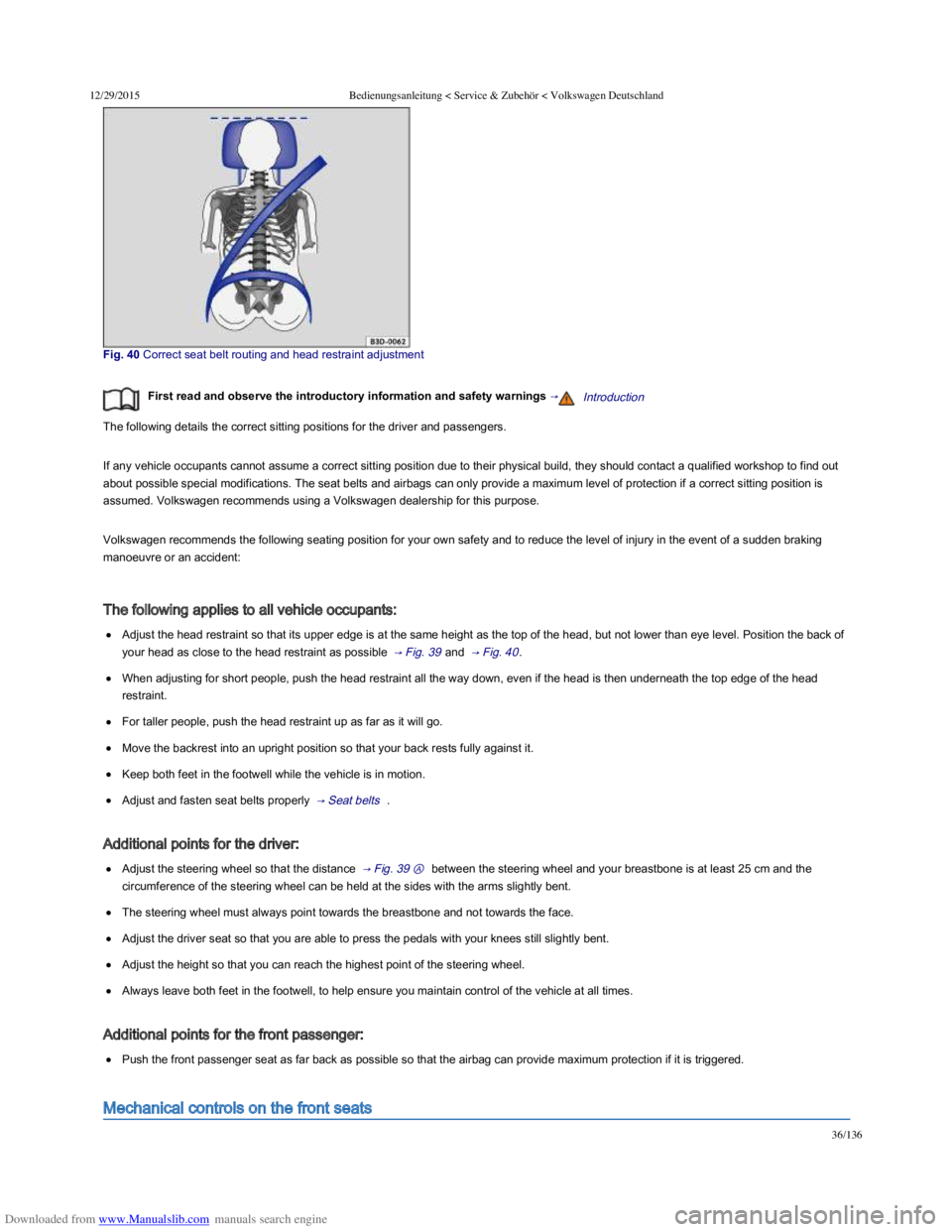
Fig. 40 Correct seat belt routing and head restraint adjustment
First read and observe the introductory information and safety warnings →Introduction
The following details the correct sitting positions for the driver and passengers.
If any vehicle occupants cannot assume a correct sitting position due to their physical build, they should contact a qualified workshop to find out
about possible special modifications. The seat belts and airbags can only provide a maximum level of protection if a correct sitting position is
assumed. Volkswagen recommends using a Volkswagen dealership for this purpose.
Volkswagen recommends the following seating position for your own safety and to reduce the level of injury in the event of a sudden braking
manoeuvre or an accident:
The following applies to all vehicle occupants:
Adjust the head restraint so that its upper edge is at the same height as the top of the head, but not lower than eye level. Position the back of
your head as close to the head restraint as possible → Fig. 39 and → Fig. 40 .
When adjusting for short people, push the head restraint all the way down, even if the head is then underneath the top edge of the head
restraint.
For taller people, push the head restraint up as far as it will go.
Move the backrest into an upright position so that your back rests fully against it.
Keep both feet in the footwell while the vehicle is in motion.
Adjust and fasten seat belts properly → Seat belts .
Additional points for the driver:
Adjust the steering wheel so that the distance → Fig. 39 Ⓐ between the steering wheel and your breastbone is at least 25 cm and the
circumference of the steering wheel can be held at the sides with the arms slightly bent.
The steering wheel must always point towards the breastbone and not towards the face.
Adjust the driver seat so that you are able to press the pedals with your knees still slightly bent.
Adjust the height so that you can reach the highest point of the steering wheel.
Always leave both feet in the footwell, to help ensure you maintain control of the vehicle at all times.
Additional points for the front passenger:
Push the front passenger seat as far back as possible so that the airbag can provide maximum protection if it is triggered.
Mechanical controls on the front seats
Page 72 of 100
Downloaded from www.Manualslib.com manuals search engine 12/29/2015Bedienungsanleitung < Service & Zubehör < Volkswagen Deutschland
37/136
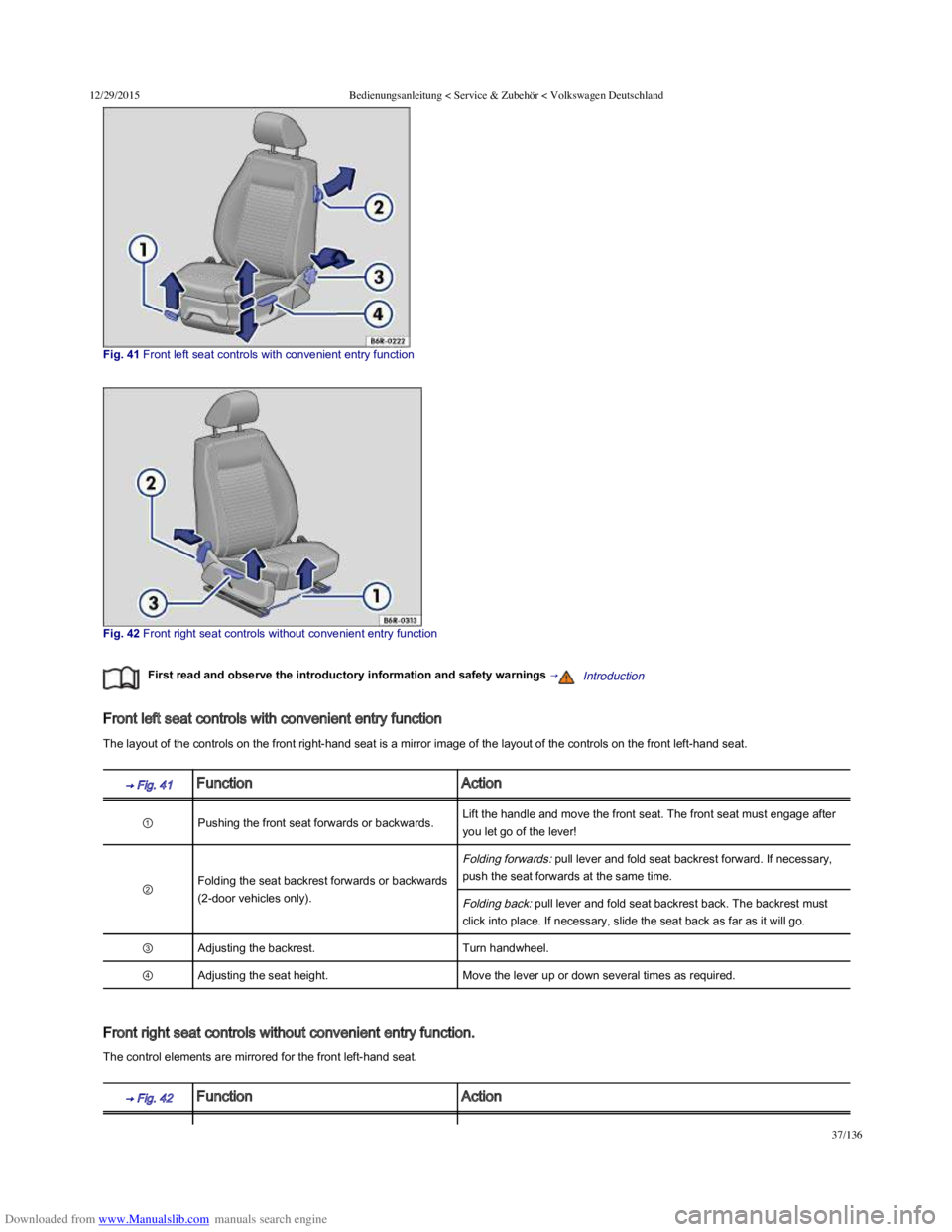
Fig. 41 Front left seat controls with convenient entry function
Fig. 42 Front right seat controls without convenient entry function
First read and observe the introductory information and safety warnings →Introduction
Front left seat controls with convenient entry function
The layout of the controls on the front right-hand seat is a mirror image of the layout of the controls on the front left-hand seat.
→ Fig. 41 FunctionAction
①Pushing the front seat forwards or backwards.Lift the handle and move the front seat. The front seat must engage after
you let go of the lever!
②Folding the seat backrest forwards or backwards
(2-door vehicles only).
Folding forwards: pull lever and fold seat backrest forward. If necessary,
push the seat forwards at the same time.
Folding back: pull lever and fold seat backrest back. The backrest must
click into place. If necessary, slide the seat back as far as it will go.
③Adjusting the backrest.Turn handwheel.
④Adjusting the seat height.Move the lever up or down several times as required.
Front right seat controls without convenient entry function.
The control elements are mirrored for the front left-hand seat.
→ Fig. 42 FunctionAction
Page 75 of 100
Downloaded from www.Manualslib.com manuals search engine 12/29/2015Bedienungsanleitung < Service & Zubehör < Volkswagen Deutschland
40/136
Removing and fitting head restraints
First read and observe the introductory information and safety warnings →Introduction
Every seat is fitted with a head restraint. The centre rear head restraint is designed solely for use with the centre rear seat. This head restraint
should therefore not be installed in any of the other positions.
Removing the head restraint
If necessary, unlock the backrests and fold them forwards → Luggage compartment .
Push the head restraint all the way up → .
Pull the head restraint out while pressing the ① → Fig. 43 or → Fig. 44 button.
If necessary, push back the backrest and allow to engage securely.
Fitting the head restraint
If necessary, unlock the backrests and fold them forwards → Luggage compartment .
Position the head restraint correctly over the head restraint guides and then insert into the guides of the corresponding seat backrest.
Press and hold the ① → Fig. 43 or → Fig. 44 button and push down the head restraint.
If necessary, push back the backrest and allow to engage securely.
Adjust the head restraint so that a correct sitting position can be assumed → Adjusting the head restraints .
Adjusting the steering wheel position
Driving without head restraints or with incorrectly adjusted head restraints increases the risk of severe or fatal injuries in the event of an
accident or sudden driving or braking manoeuvre.
If a seat is occupied, the head restraint for that seat must be fitted and adjusted correctly.
Head restraints that have been removed should be fitted as soon as possible so that passengers have correct protection.
WARNING
When removing or fitting head restraints, make sure that they do not hit the roof or other parts of the vehicle. This could damage the headliner
or other parts of the vehicle.
NOTICE
Page 76 of 100
Downloaded from www.Manualslib.com manuals search engine 12/29/2015Bedienungsanleitung < Service & Zubehör < Volkswagen Deutschland
41/136
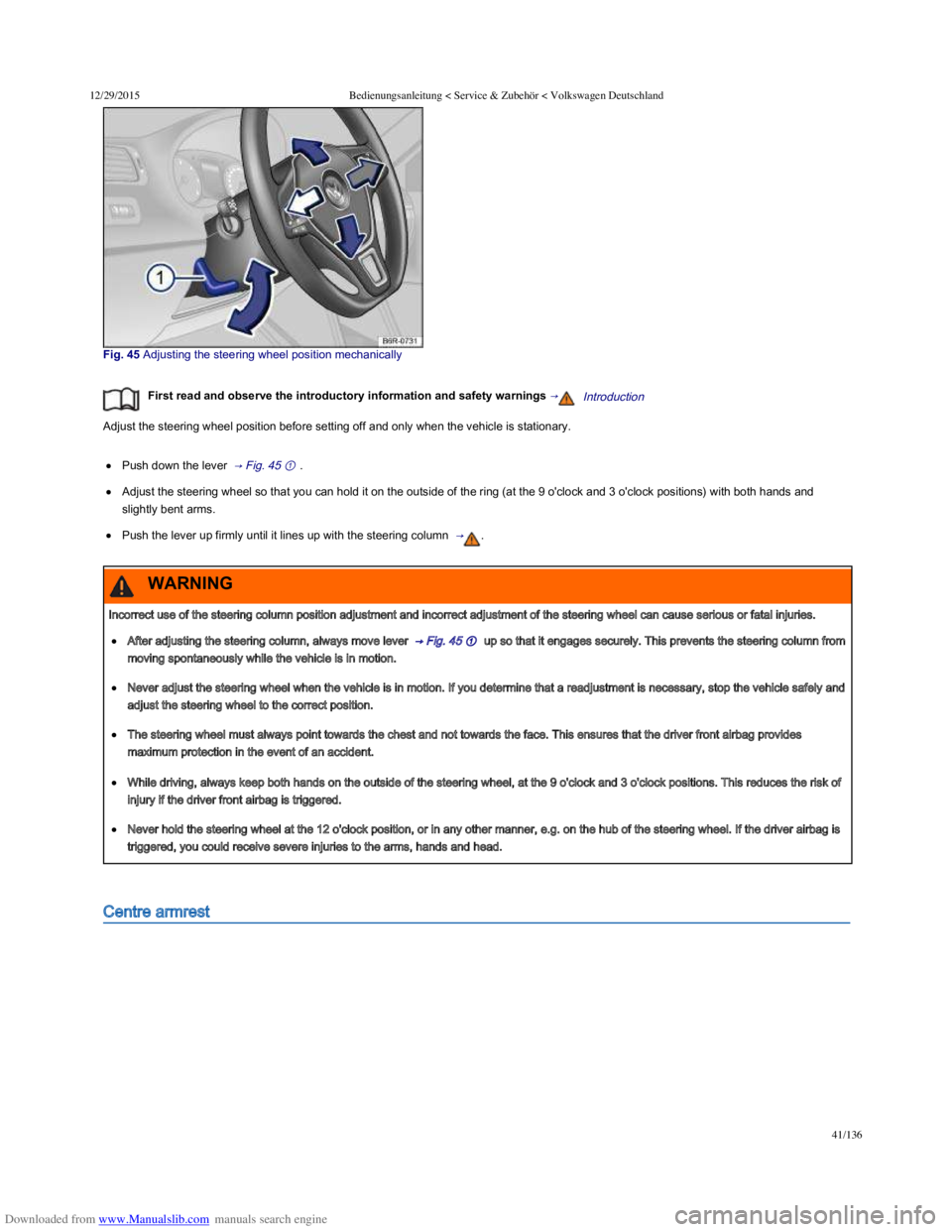
Fig. 45 Adjusting the steering wheel position mechanically
First read and observe the introductory information and safety warnings →Introduction
Adjust the steering wheel position before setting off and only when the vehicle is stationary.
Push down the lever → Fig. 45 ① .
Adjust the steering wheel so that you can hold it on the outside of the ring (at the 9 o'clock and 3 o'clock positions) with both hands and
slightly bent arms.
Push the lever up firmly until it lines up with the steering column → .
Centre armrest
Incorrect use of the steering column position adjustment and incorrect adjustment of the steering wheel can cause serious or fatal injuries.
After adjusting the steering column, always move lever → Fig. 45 ① up so that it engages securely. This prevents the steering column from
moving spontaneously while the vehicle is in motion.
Never adjust the steering wheel when the vehicle is in motion. If you determine that a readjustment is necessary, stop the vehicle safely and
adjust the steering wheel to the correct position.
The steering wheel must always point towards the chest and not towards the face. This ensures that the driver front airbag provides
maximum protection in the event of an accident.
While driving, always keep both hands on the outside of the steering wheel, at the 9 o'clock and 3 o'clock positions. This reduces the risk of
injury if the driver front airbag is triggered.
Never hold the steering wheel at the 12 o'clock position, or in any other manner, e.g. on the hub of the steering wheel. If the driver airbag is
triggered, you could receive severe injuries to the arms, hands and head.
WARNING
Page 83 of 100
Downloaded from www.Manualslib.com manuals search engine 12/29/2015Bedienungsanleitung < Service & Zubehör < Volkswagen Deutschland
48/136
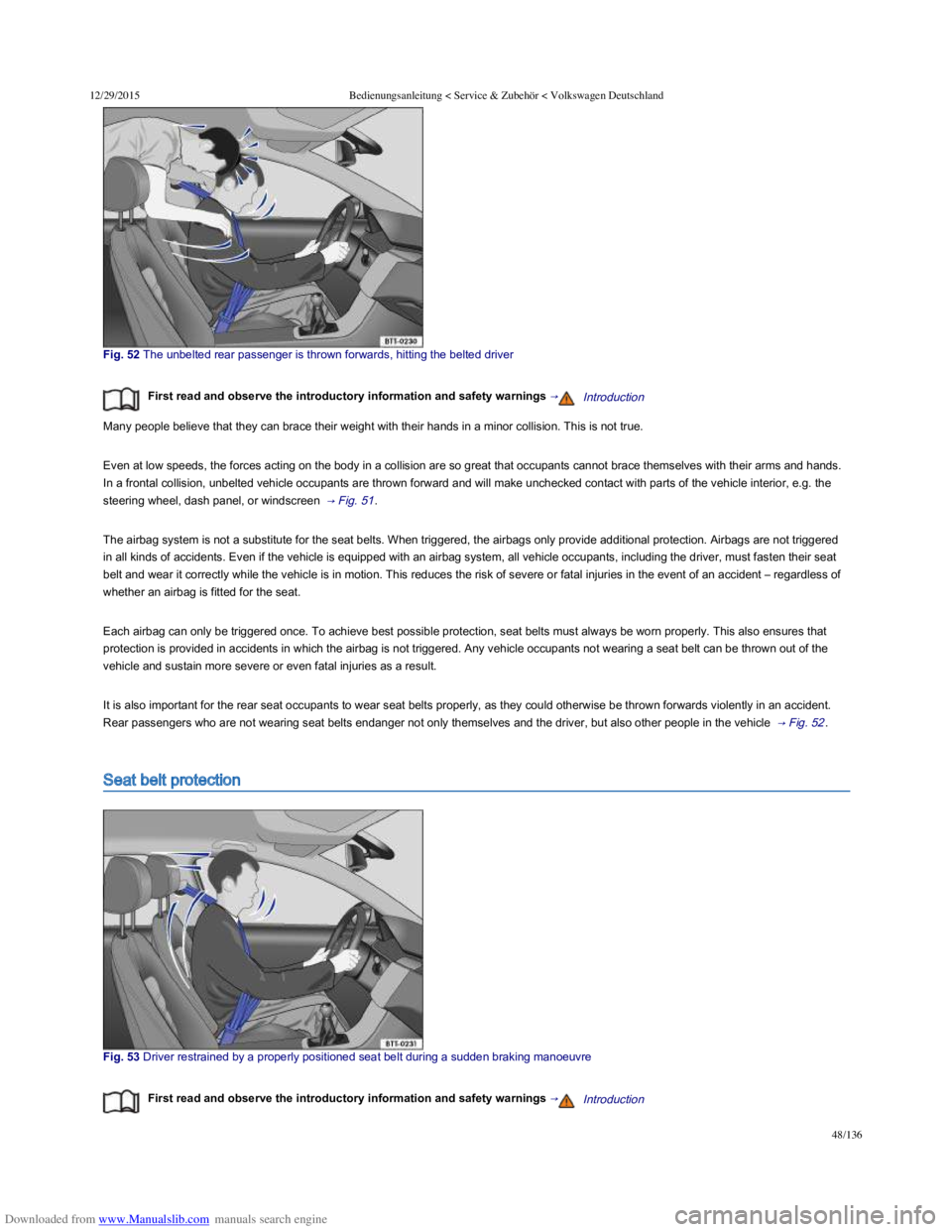
Fig. 52 The unbelted rear passenger is thrown forwards, hitting the belted driver
First read and observe the introductory information and safety warnings →Introduction
Many people believe that they can brace their weight with their hands in a minor collision. This is not true.
Even at low speeds, the forces acting on the body in a collision are so great that occupants cannot brace themselves with their arms and hands.
In a frontal collision, unbelted vehicle occupants are thrown forward and will make unchecked contact with parts of the vehicle interior, e.g. the
steering wheel, dash panel, or windscreen → Fig. 51 .
The airbag system is not a substitute for the seat belts. When triggered, the airbags only provide additional protection. Airbags are not triggered
in all kinds of accidents. Even if the vehicle is equipped with an airbag system, all vehicle occupants, including the driver, must fasten their seat
belt and wear it correctly while the vehicle is in motion. This reduces the risk of severe or fatal injuries in the event of an accident – regardless of
whether an airbag is fitted for the seat.
Each airbag can only be triggered once. To achieve best possible protection, seat belts must always be worn properly. This also ensures that
protection is provided in accidents in which the airbag is not triggered. Any vehicle occupants not wearing a seat belt can be thrown out of the
vehicle and sustain more severe or even fatal injuries as a result.
It is also important for the rear seat occupants to wear seat belts properly, as they could otherwise be thrown forwards violently in an accident.
Rear passengers who are not wearing seat belts endanger not only themselves and the driver, but also other people in the vehicle → Fig. 52 .
Seat belt protection
Fig. 53 Driver restrained by a properly positioned seat belt during a sudden braking manoeuvre
First read and observe the introductory information and safety warnings →Introduction