ECU VOLKSWAGEN T-ROC 2020 User Guide
[x] Cancel search | Manufacturer: VOLKSWAGEN, Model Year: 2020, Model line: T-ROC, Model: VOLKSWAGEN T-ROC 2020Pages: 502, PDF Size: 8.58 MB
Page 81 of 502
-facing child seat is on the front passenger seat.
Move the front passenger seat as far back as possible and adjust to its highest position to create the
largest possible distance between the child seat and the front passenger front airbag.
Move the backrest to the upright position.
Adjust the seat belt height adjuster to the highest position.
Use only child seats that have been approved by the child seat manufacturer for use on a front
passenger seat with front and side airbags.
WARNING
To help avoid injuries caused by inflation of a curtain airbag or side airbag:
Ensure that no children are seated within the airbag deployment zones Airbag system
Do not place any objects in the side airbag deployment zones.
Securing systems
First read and observe the introductoryinformation and safety warnings
Different countries use different securing systems for safely fitting child seats in the vehicle.
Overview of securing systems
ISOFIX: ISOFIX is a standardised securing system for fitting child seats in the vehicle quickly and
safely. The ISOFIX attachment system creates a rigid connection between the child seat and the
vehicle body.
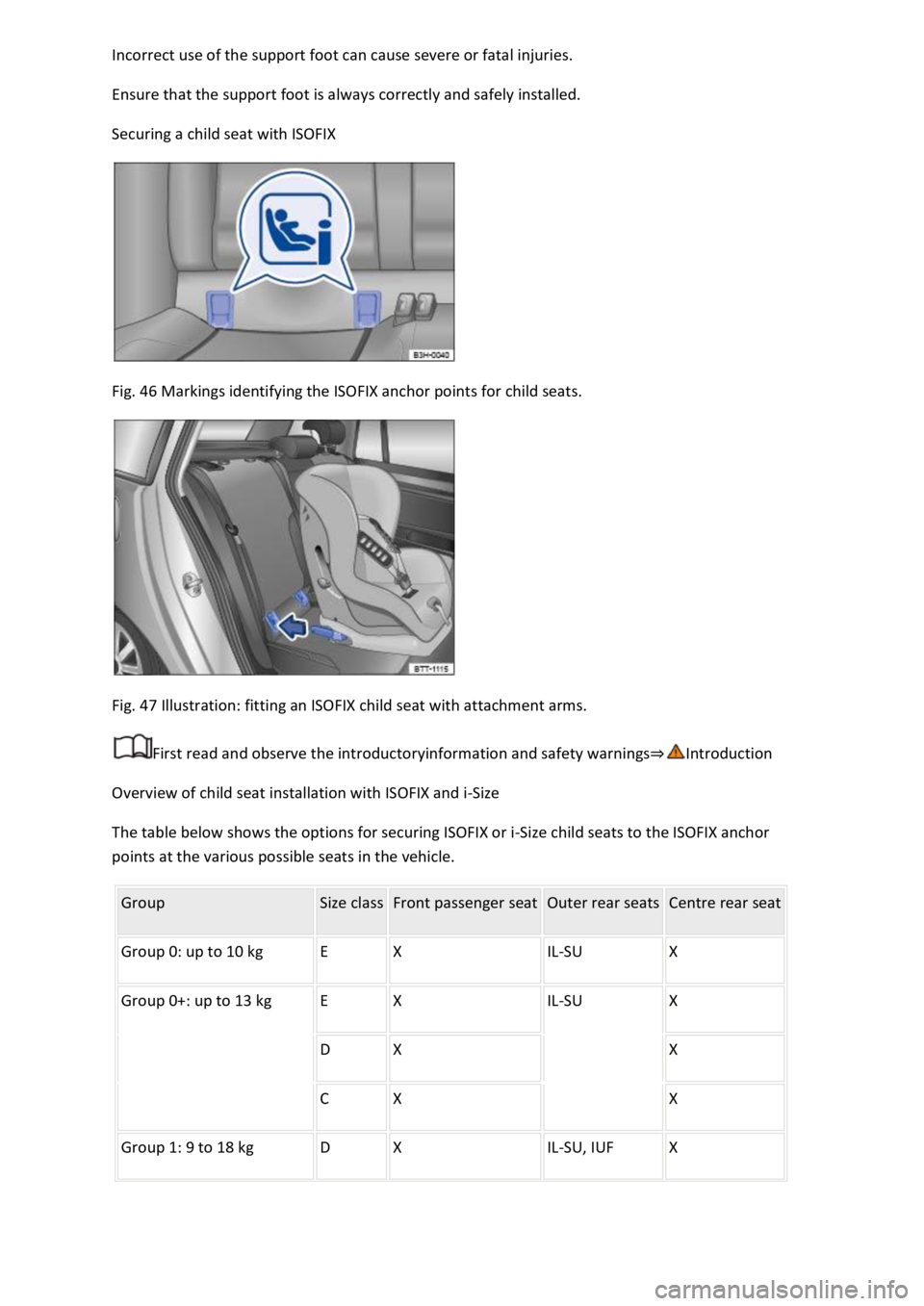
Compatible child seats have two rigid attachment arms that engage in ISOFIX attachment points at
the bottom of the backrest (on the outer rear seats). The ISOFIX securing system as described here is
specific to Europe Securing a child seat with ISOFIX
foot may sometimes have to be used in addition to the ISOFIX anchor points described above.
Three-point automatic seat belt. It is preferable to secure child seats using the ISOFIX system, if
available, rather than with a three-point automatic seat belt Securing c
Additional securing points:
Recommended child seat securing systems
Volkswagen recommends that child seats are secured as follows:
Infant carrier or rear-facing child seat: ISOFIX and support foot.
Front-facing child seat: ISOFIX and top tether and possibly also support foot.
WARNING
Page 82 of 502
Ensure that the support foot is always correctly and safely installed.
Securing a child seat with ISOFIX
Fig. 46 Markings identifying the ISOFIX anchor points for child seats.
Fig. 47 Illustration: fitting an ISOFIX child seat with attachment arms.
First read and observe the introductoryinformation and safety warnings
Overview of child seat installation with ISOFIX and i-Size
The table below shows the options for securing ISOFIX or i-Size child seats to the ISOFIX anchor
points at the various possible seats in the vehicle.
Group Size class Front passenger seat Outer rear seats Centre rear seat
Group 0: up to 10 kg E X IL-SU X
Group 0+: up to 13 kg E X IL-SU X
D X X
C X X
Group 1: 9 to 18 kg D X IL-SU, IUF X
Page 83 of 502
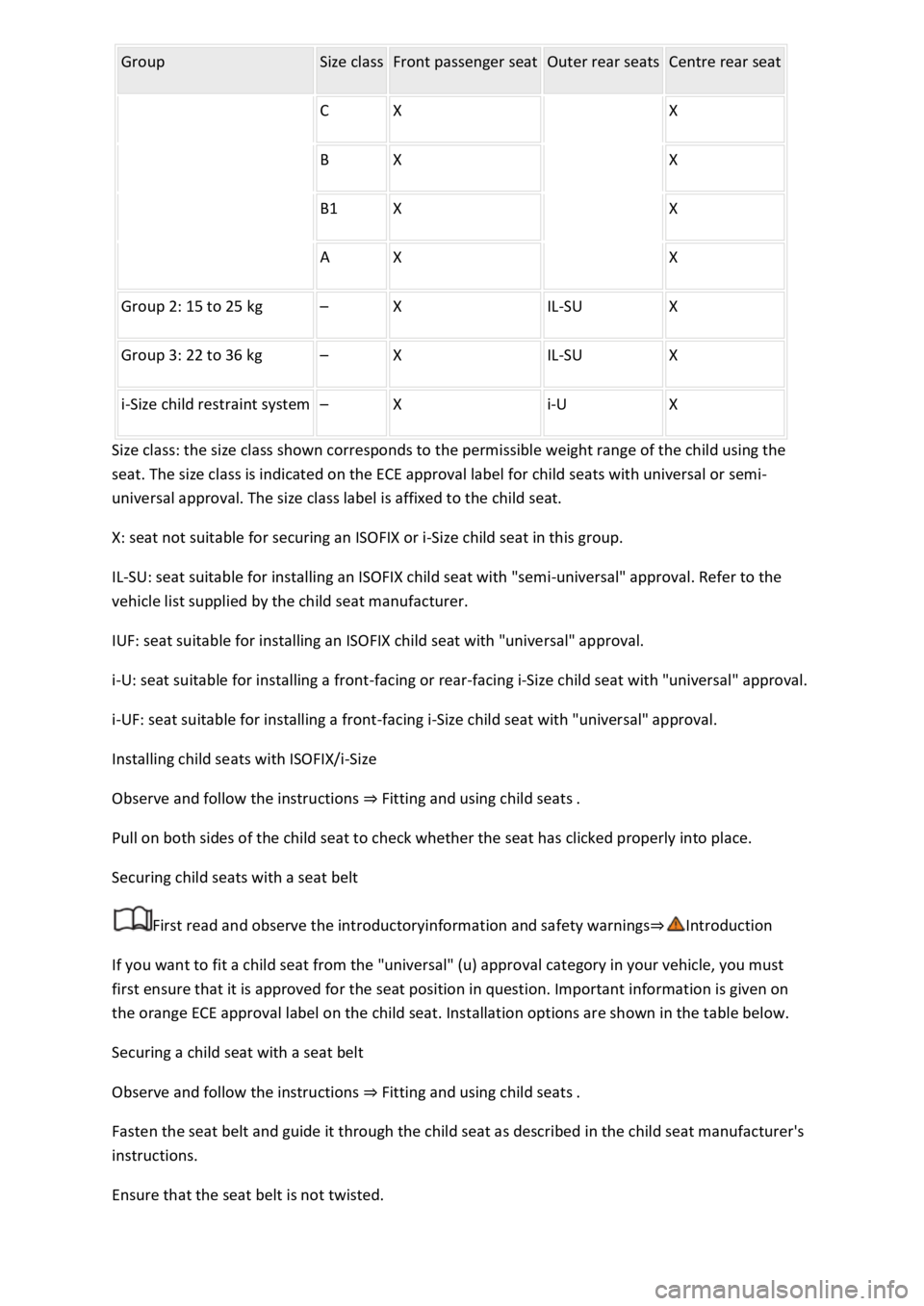
seat. The size class is indicated on the ECE approval label for child seats with universal or semi-
universal approval. The size class label is affixed to the child seat.
X: seat not suitable for securing an ISOFIX or i-Size child seat in this group.
IL-SU: seat suitable for installing an ISOFIX child seat with "semi-universal" approval. Refer to the
vehicle list supplied by the child seat manufacturer.
IUF: seat suitable for installing an ISOFIX child seat with "universal" approval.
i-U: seat suitable for installing a front-facing or rear-facing i-Size child seat with "universal" approval.
i-UF: seat suitable for installing a front-facing i-Size child seat with "universal" approval.
Installing child seats with ISOFIX/i-Size
Observe and follow the instructions Fitting and using child seats
Pull on both sides of the child seat to check whether the seat has clicked properly into place.
Securing child seats with a seat belt
First read and observe the introductoryinformation and safety warnings
If you want to fit a child seat from the "universal" (u) approval category in your vehicle, you must
first ensure that it is approved for the seat position in question. Important information is given on
the orange ECE approval label on the child seat. Installation options are shown in the table below.
Securing a child seat with a seat belt
Observe and follow the instructions Fitting and using child seats
Fasten the seat belt and guide it through the child seat as described in the child seat manufacturer's
instructions.
Ensure that the seat belt is not twisted.
Page 87 of 502
-visibility waistcoat may be located in a stowage
compartment in the front door trim or in the stowage compartment on the front passenger side
Driver doorFr
The high-visibility waistcoat must comply with legal requirements.
Fire extinguisher
Depending on the equipment, a fire extinguisher may be located in a holder in the footwell under
the front passenger seat.
The fire extinguisher must meet legal requirements, be ready for use at all times and be checked on
a regular basis (see inspection seal on the fire extinguisher).
WARNING
In the event of a sudden driving or braking manoeuvre or accident, loose objects could be flung
though the vehicle and cause severe injuries.
Always secure the first-aid kit, warning triangle and fire extinguisher safely in the holders in the
vehicle.
Stow the high-visibility waistcoat in the stowage compartments so that it can be easily accessed.
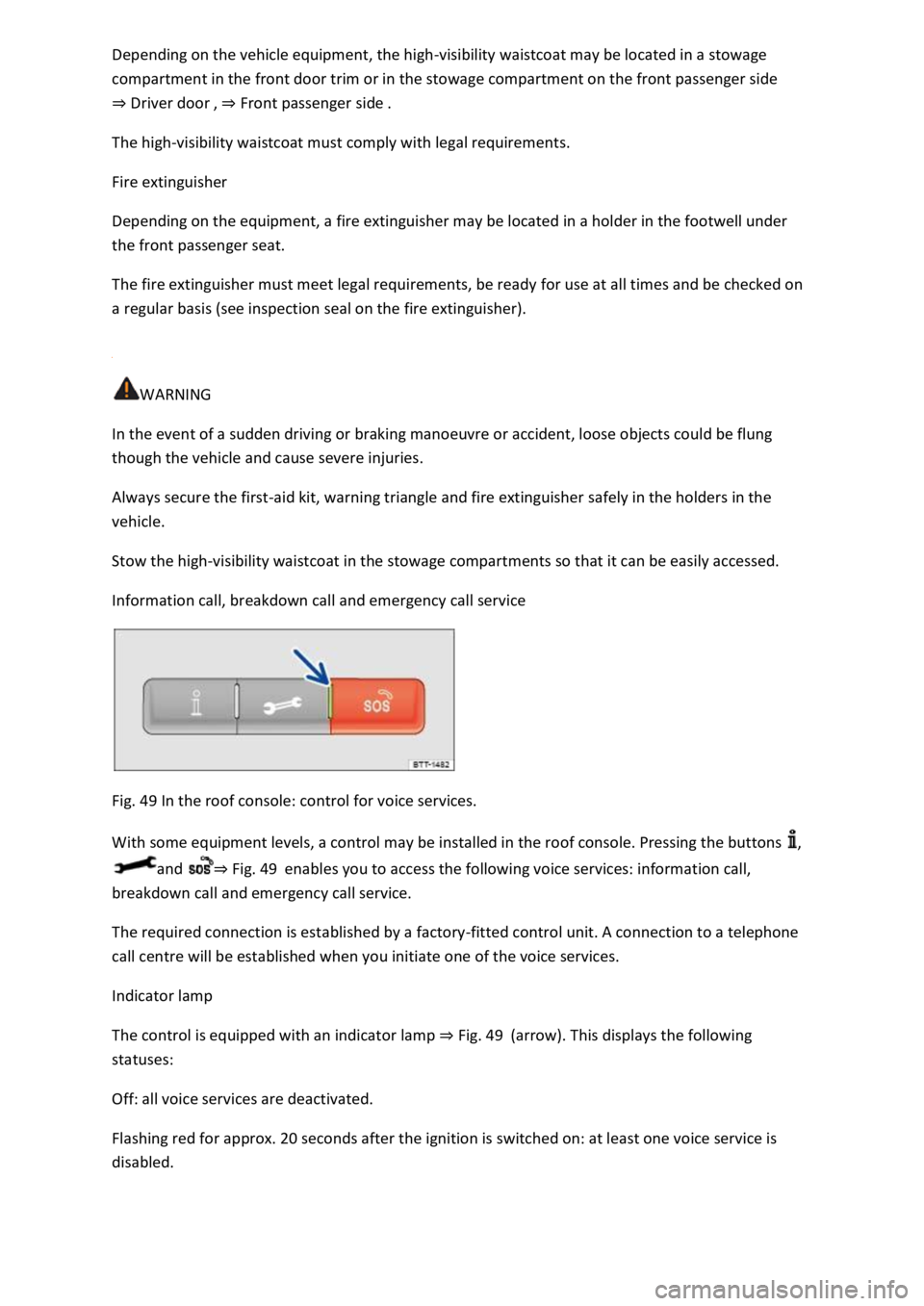
Information call, breakdown call and emergency call service
Fig. 49 In the roof console: control for voice services.
With some equipment levels, a control may be installed in the roof console. Pressing the buttons ,
and Fig. 49enables you to access the following voice services: information call,
breakdown call and emergency call service.
The required connection is established by a factory-fitted control unit. A connection to a telephone
call centre will be established when you initiate one of the voice services.
Indicator lamp
The control is equipped with an indicator lamp Fig.
Off: all voice services are deactivated.
Flashing red for approx. 20 seconds after the ignition is switched on: at least one voice service is
disabled.
Page 117 of 502
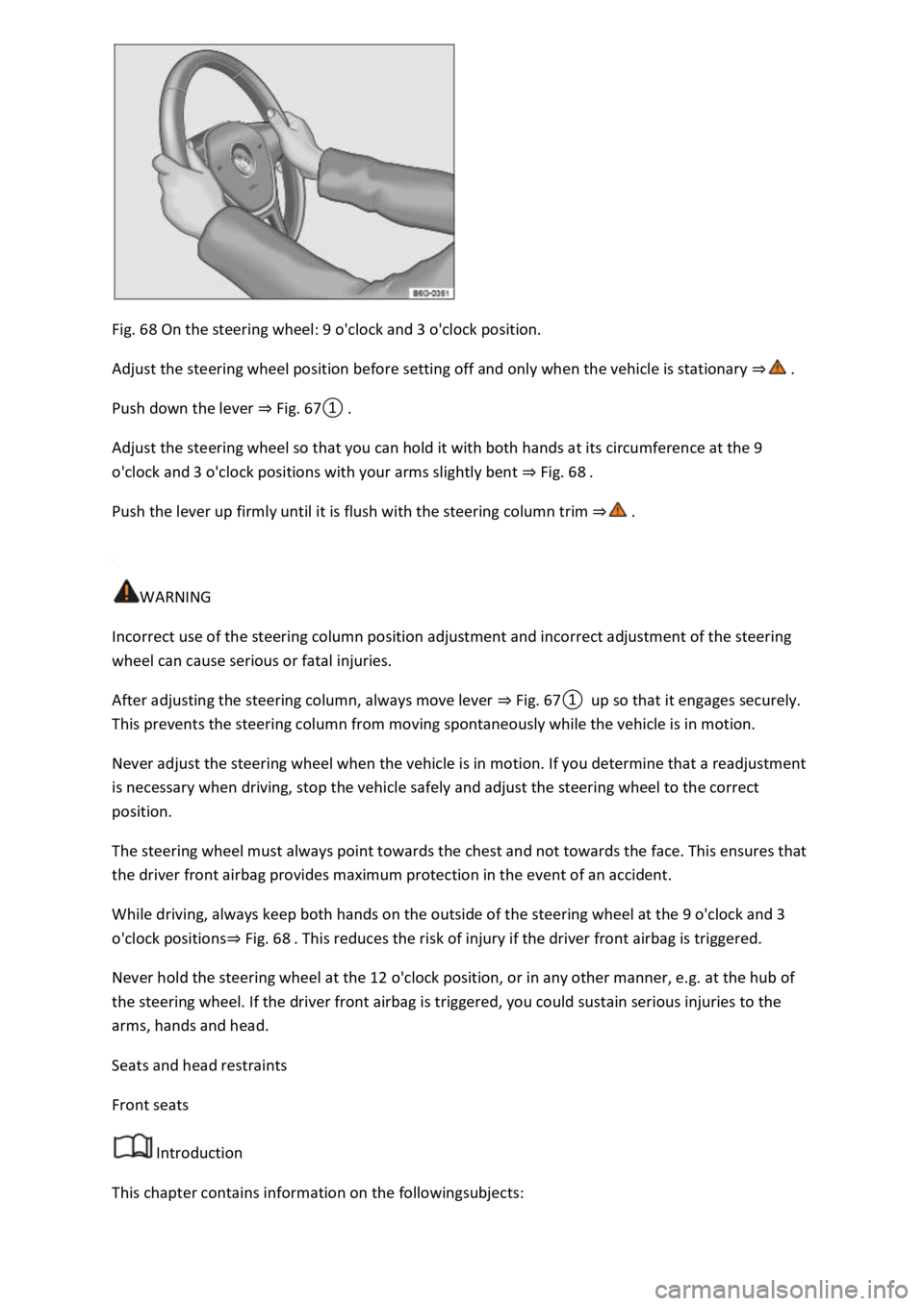
Fig. 68 On the steering wheel: 9 o'clock and 3 o'clock position.
Adjust the steering wheel position before setting off and only when the vehicle is stationary
Push down the lever Fig.
0
Adjust the steering wheel so that you can hold it with both hands at its circumference at the 9
o'clock and 3 o'clock positions with your arms slightly bent Fig. 68
Push the lever up firmly until it is flush with the steering column trim
WARNING
Incorrect use of the steering column position adjustment and incorrect adjustment of the steering
wheel can cause serious or fatal injuries.
After adjusting the steering column, always move lever Fig.
0up so that it engages securely.
This prevents the steering column from moving spontaneously while the vehicle is in motion.
Never adjust the steering wheel when the vehicle is in motion. If you determine that a readjustment
is necessary when driving, stop the vehicle safely and adjust the steering wheel to the correct
position.
The steering wheel must always point towards the chest and not towards the face. This ensures that
the driver front airbag provides maximum protection in the event of an accident.
While driving, always keep both hands on the outside of the steering wheel at the 9 o'clock and 3
o'clock positionsFig. 68
Never hold the steering wheel at the 12 o'clock position, or in any other manner, e.g. at the hub of
the steering wheel. If the driver front airbag is triggered, you could sustain serious injuries to the
arms, hands and head.
Seats and head restraints
Front seats
Introduction
This chapter contains information on the followingsubjects:
Page 121 of 502
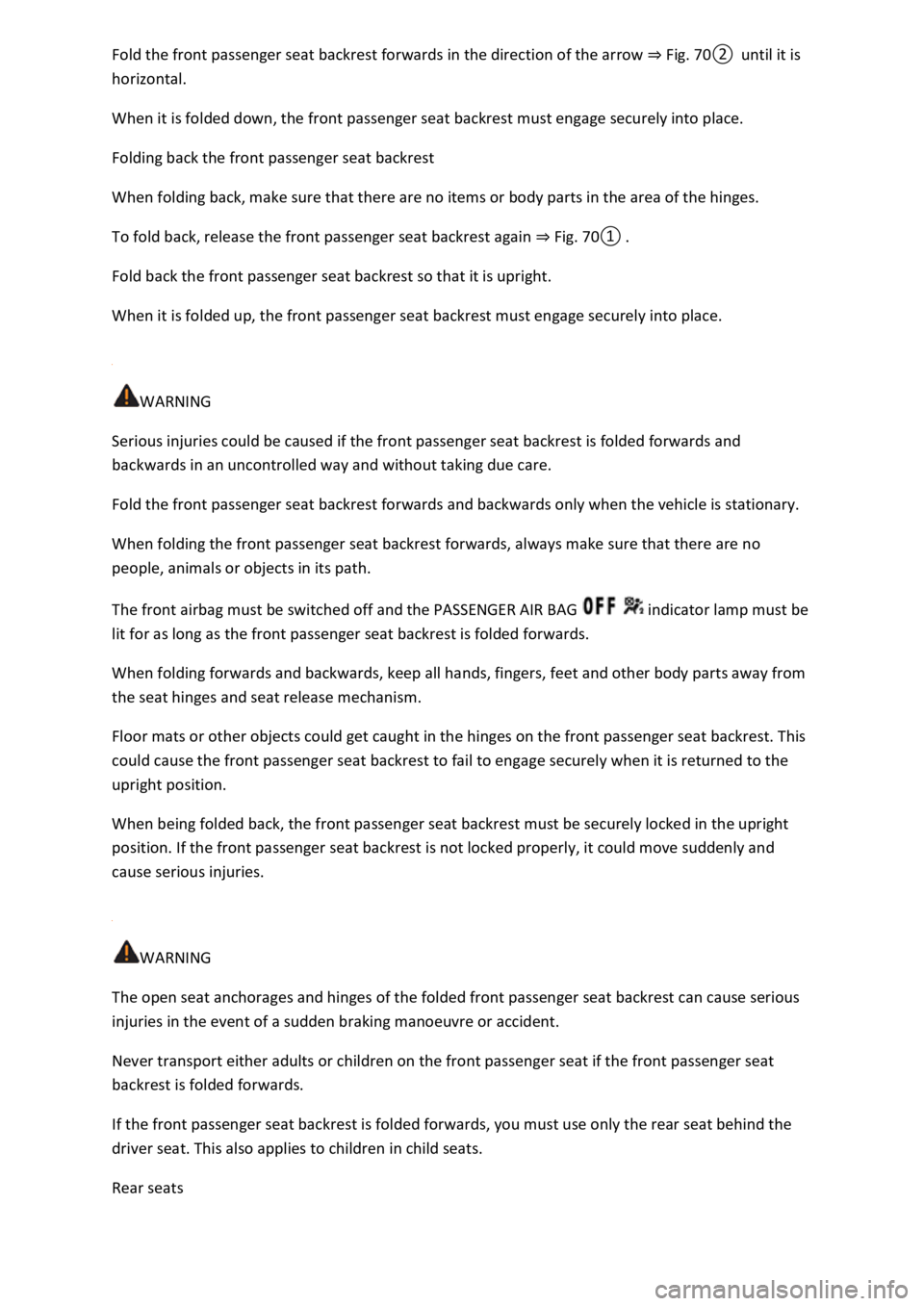
Fig.
0until it is
horizontal.
When it is folded down, the front passenger seat backrest must engage securely into place.
Folding back the front passenger seat backrest
When folding back, make sure that there are no items or body parts in the area of the hinges.
To fold back, release the front passenger seat backrest again Fig.
0
Fold back the front passenger seat backrest so that it is upright.
When it is folded up, the front passenger seat backrest must engage securely into place.
WARNING
Serious injuries could be caused if the front passenger seat backrest is folded forwards and
backwards in an uncontrolled way and without taking due care.
Fold the front passenger seat backrest forwards and backwards only when the vehicle is stationary.
When folding the front passenger seat backrest forwards, always make sure that there are no
people, animals or objects in its path.
The front airbag must be switched off and the PASSENGER AIR BAG indicator lamp must be
lit for as long as the front passenger seat backrest is folded forwards.
When folding forwards and backwards, keep all hands, fingers, feet and other body parts away from
the seat hinges and seat release mechanism.
Floor mats or other objects could get caught in the hinges on the front passenger seat backrest. This
could cause the front passenger seat backrest to fail to engage securely when it is returned to the
upright position.
When being folded back, the front passenger seat backrest must be securely locked in the upright
position. If the front passenger seat backrest is not locked properly, it could move suddenly and
cause serious injuries.
WARNING
The open seat anchorages and hinges of the folded front passenger seat backrest can cause serious
injuries in the event of a sudden braking manoeuvre or accident.
Never transport either adults or children on the front passenger seat if the front passenger seat
backrest is folded forwards.
If the front passenger seat backrest is folded forwards, you must use only the rear seat behind the
driver seat. This also applies to children in child seats.
Rear seats
Page 123 of 502
backwards.
When the rear seat is moved forwards, objects can get into the space between the seat and luggage
compartment floor. Remove any items or objects from this space before pushing the rear seat back.
NOTICE
Sharp edges can damage the seats.
Do not touch the seats with sharp-edged objects. Sharp-edged objects such as zips, rivets on clothing
or belts can damage surfaces. Open Velcro fasteners can also cause damage.
Folding the backrests on the rear bench seat forwards and backwards
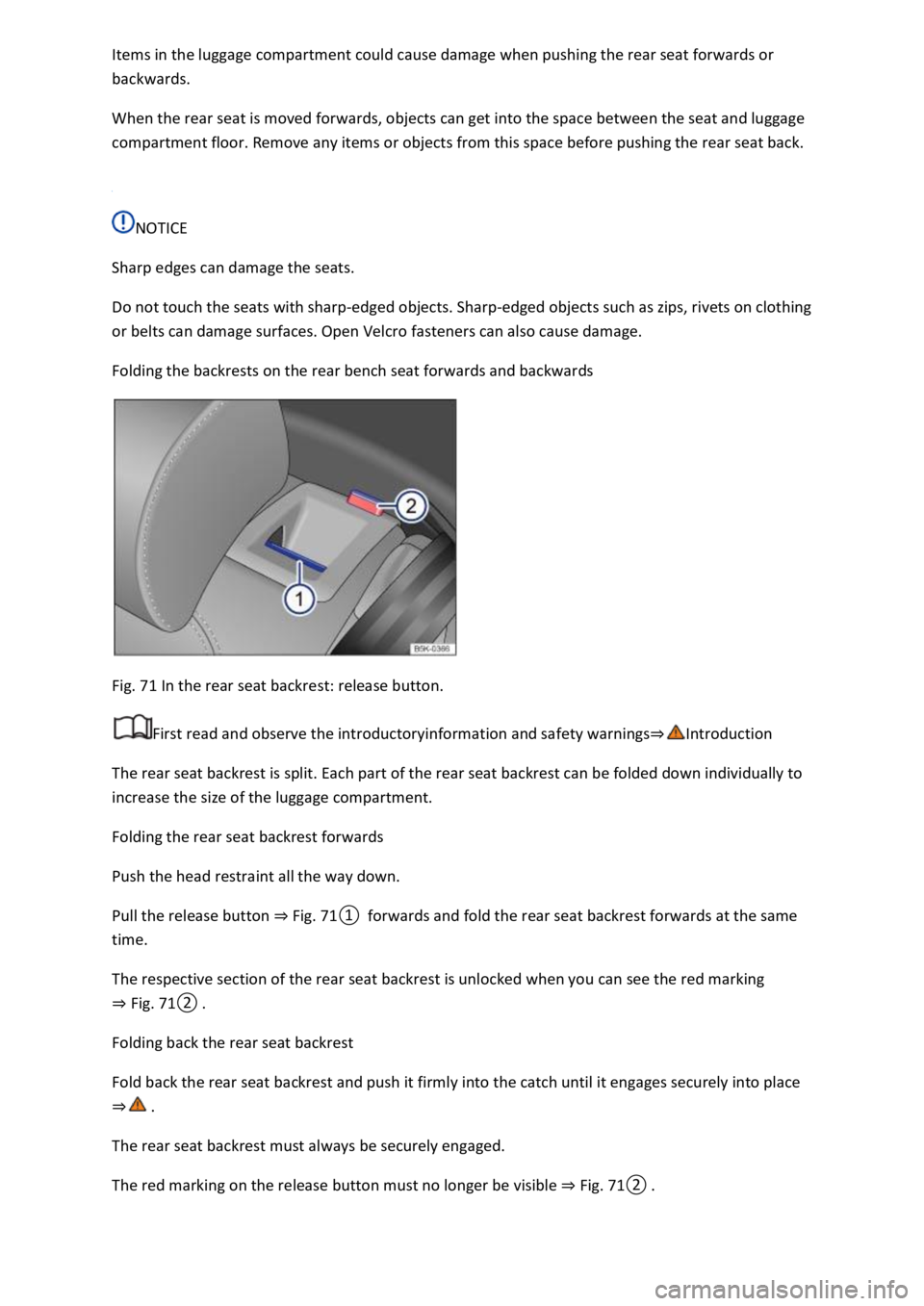
Fig. 71 In the rear seat backrest: release button.
First read and observe the introductoryinformation and safety warnings
The rear seat backrest is split. Each part of the rear seat backrest can be folded down individually to
increase the size of the luggage compartment.
Folding the rear seat backrest forwards
Push the head restraint all the way down.
Pull the release button Fig.
0forwards and fold the rear seat backrest forwards at the same
time.
The respective section of the rear seat backrest is unlocked when you can see the red marking
Fig.
0
Folding back the rear seat backrest
Fold back the rear seat backrest and push it firmly into the catch until it engages securely into place
The rear seat backrest must always be securely engaged.
The red marking on the release button must no longer be visible Fig.
0
Page 124 of 502
WARNING
Injuries can be caused if the rear seat backrests are folded forwards and backwards in an
uncontrolled way and without taking due care.
While folding the rear seat backrest forward, always make sure that no people or animals are in its
path.
Never fold the rear seat backrest forwards or backwards while the vehicle is in motion.
Ensure that the seat belt is not trapped or damaged when folding back the rear seat backrest.
Always keep hands, fingers, feet or other body parts away from the swivel area when folding the
rear seat backrest forwards and backwards.
Ensure that each rear seat backrest engages securely, otherwise the seat belts for the rear seats will
not offer maximum protection. This applies to the centre seat of the rear bench seat in particular. If
a seat is occupied and the corresponding rear seat backrest has not engaged securely into place, the
seat occupant and rear seat backrest may move forwards in the event of a sudden braking or driving
manoeuvre or during accidents.
Adults and children must not use seats if the corresponding backrest is folded forwards or is not
engaged securely into place.
NOTICE
Damage to the vehicle or to other objects could be caused if the rear bench seat backrest is folded
forwards and backwards in an uncontrolled way or without due care.
Before folding the rear seat backrests forwards, always adjust the front seats so that the rear head
restraints or rear seat cushions do impact the front seats.
Before folding down the rear seat backrest, always make sure that there are no objects located in its
path.
Head restraints
Introduction
This chapter contains information on the followingsubjects:
Adjusting the head restraints
Removing and installing head restraints
The following section describes the options for adjusting and removing the head restraints. Always
ensure that you adjust the correct sitting position Sitting position
Every seat is fitted with a head restraint. The centre head restraint at the rear is designed solely for
use with the centre rear bench seat. Therefore you should not install this head restraint in any of the
other positions.
Page 126 of 502
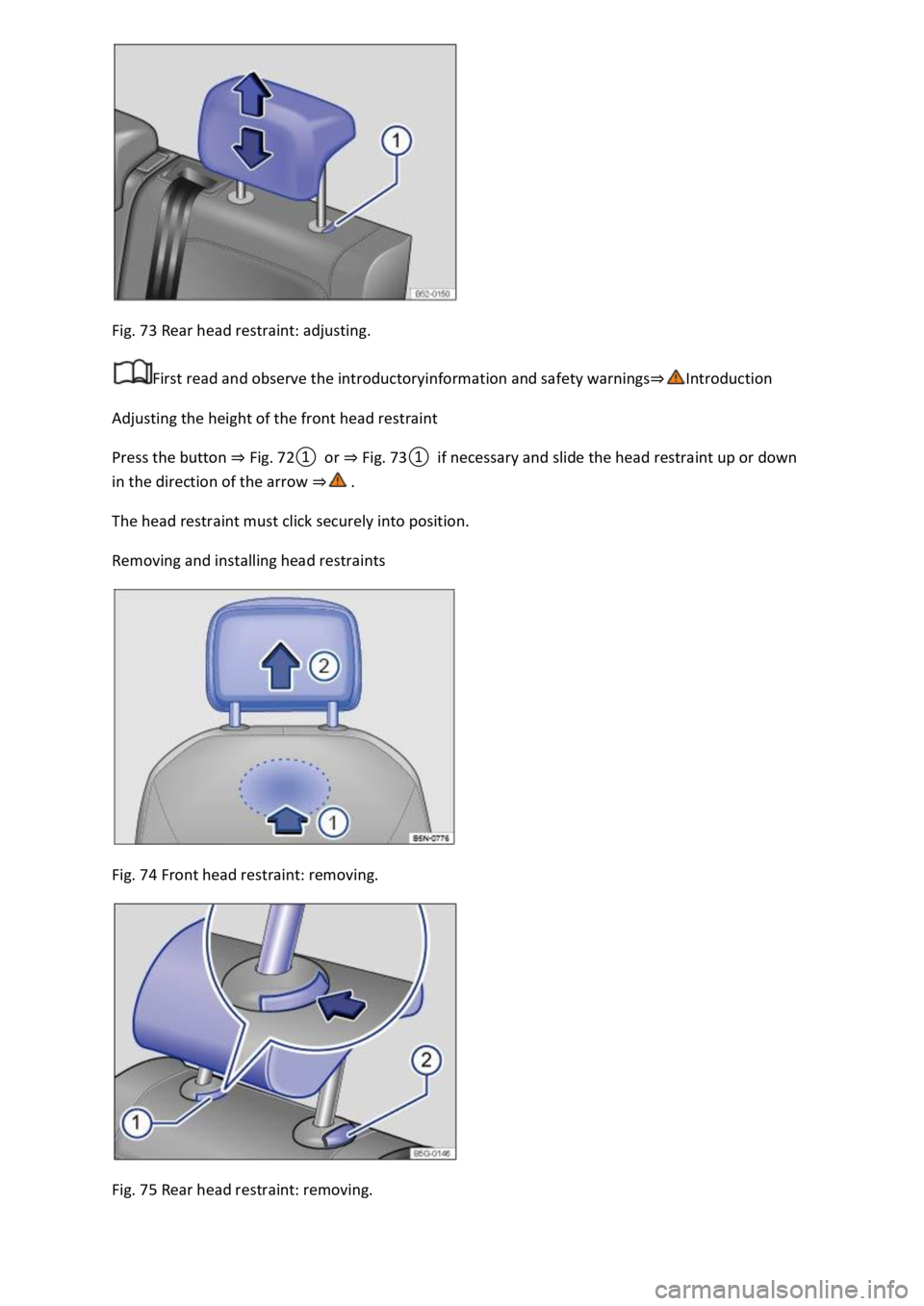
Fig. 73 Rear head restraint: adjusting.
First read and observe the introductoryinformation and safety warnings
Adjusting the height of the front head restraint
Press the button Fig.
0or Fig.
0if necessary and slide the head restraint up or down
in the direction of the arrow
The head restraint must click securely into position.
Removing and installing head restraints
Fig. 74 Front head restraint: removing.
Fig. 75 Rear head restraint: removing.
Page 127 of 502
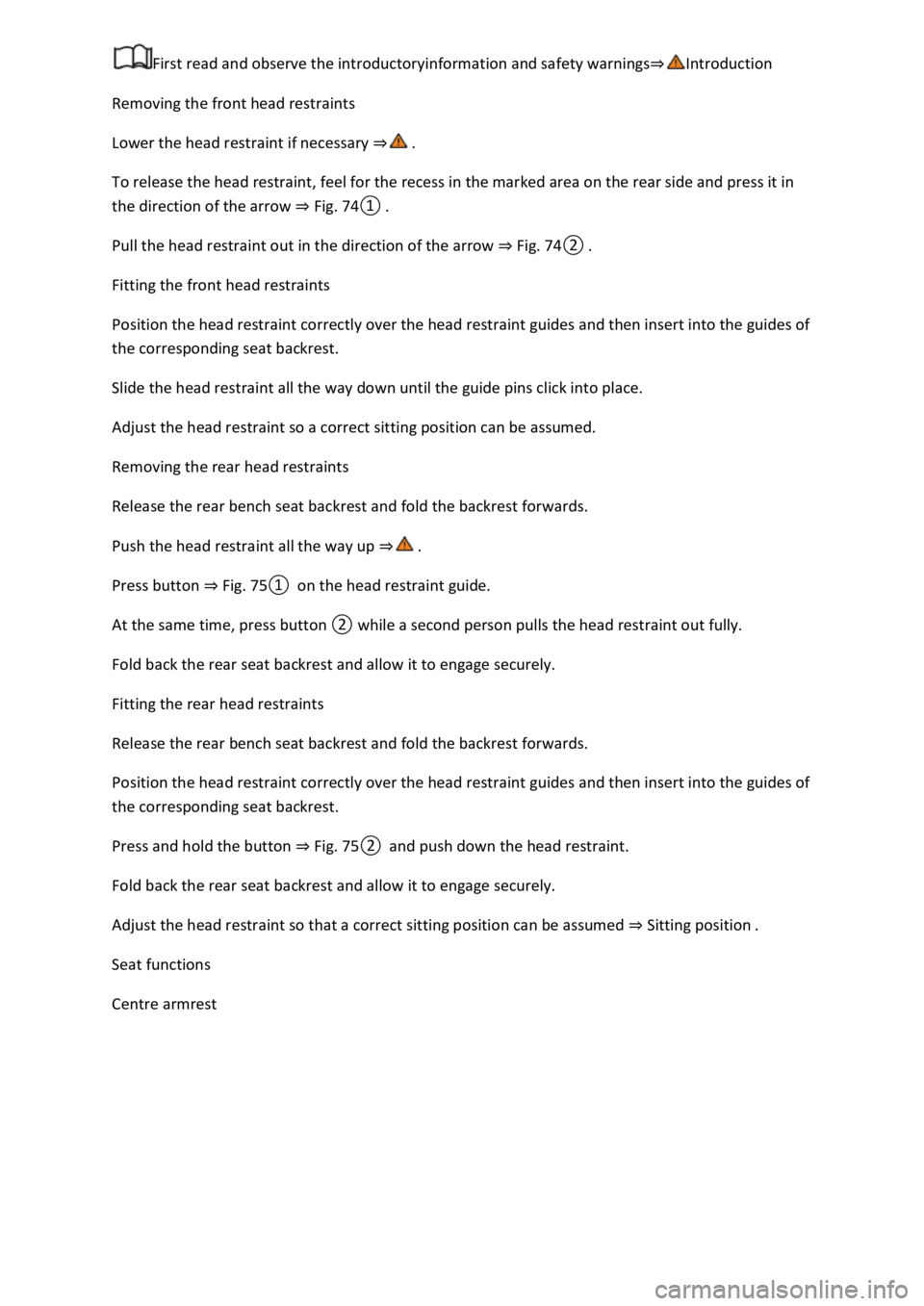
Removing the front head restraints
Lower the head restraint if necessary
To release the head restraint, feel for the recess in the marked area on the rear side and press it in
the direction of the arrow Fig.
0
Pull the head restraint out in the direction of the arrow Fig.
0
Fitting the front head restraints
Position the head restraint correctly over the head restraint guides and then insert into the guides of
the corresponding seat backrest.
Slide the head restraint all the way down until the guide pins click into place.
Adjust the head restraint so a correct sitting position can be assumed.
Removing the rear head restraints
Release the rear bench seat backrest and fold the backrest forwards.
Push the head restraint all the way up
Press button Fig.
0on the head restraint guide.
Fold back the rear seat backrest and allow it to engage securely.
Fitting the rear head restraints
Release the rear bench seat backrest and fold the backrest forwards.
Position the head restraint correctly over the head restraint guides and then insert into the guides of
the corresponding seat backrest.
Press and hold the button Fig.
0and push down the head restraint.
Fold back the rear seat backrest and allow it to engage securely.
Adjust the head restraint so that a correct sitting position can be assumed Sitting position
Seat functions
Centre armrest