ECU VOLKSWAGEN T-ROC 2020 Service Manual
[x] Cancel search | Manufacturer: VOLKSWAGEN, Model Year: 2020, Model line: T-ROC, Model: VOLKSWAGEN T-ROC 2020Pages: 502, PDF Size: 8.58 MB
Page 308 of 502

DANGER
It is dangerous to transport people in a trailer and it may also be illegal.
WARNING
Improper use of the towing bracket can lead to a loss of vehicle control, accidents and serious
injuries.
Only use the towing bracket if it is fitted properly and is not damaged.
Do not carry out any alterations or repairs to the towing bracket.
Wherever possible, swivel in or remove the ball head when a trailer is not being used in order to
reduce the risk of injury in rear-end collisions, and the risk of injury to pedestrians and cyclists when
the vehicle is parked.
Never install a weight-distributing or load-balancing towing bracket to the vehicle. The vehicle is not
designed for these kinds of towing brackets. The towing bracket can fail, causing the trailer to tear
loose from the vehicle.
WARNING
Towing a trailer and transporting heavy or bulky items can change the vehicle handling and increase
the braking distance. This can lead to accidents.
Always secure loads properly using suitable and undamaged lashing, retaining or securing straps.
Always adapt your speed and driving style to suit visibility, weather, road and traffic conditions.
Reduce your speed, particularly when going downhill.
Trailers with a high centre of gravity are more likely to tip over than trailers with a low centre of
gravity.
Always drive carefully and think ahead. Accelerate very carefully and gently. Avoid abrupt and
sudden driving and braking manoeuvres.
Take special care when overtaking. Reduce your speed immediately if the trailer shows even the
slightest sign of snaking.
Never drive faster than 80 km/h (50 mph) when towing a trailer, also 100 km/h (60 mph) in
exceptional cases. This also applies to countries where higher speeds are permitted. Keep to
country-specific speed limits, which may be lower for vehicles with trailers than for vehicles without
trailers.
Never try to stop a trailer from snaking by increasing your speed.
Never install a weight-distributing or load-balancing towing bracket on the vehicle.
Page 313 of 502

Step 5: safety check
Before hitching a trailer, check if the ball head is fixed correctly.
The locking lever Fig. 155
The green section of the release pin
The lock must be locked and the key
The lock cover
WARNING
Improper use of the towing bracket can cause injuries and accidents.
t diameter of the ball Fig. 155mm, do not use the towing
bracket.
injuries.
been pre-tensioned. When the ball head is
pressed into the mounting, the locking lever will spring back to its original position.
workshop.
wing bracket if the ball head does not engage properly or if you are unable to
pre-tension it.
ball head has been mounted. This means that ball head is not locked properly.
NOTICE
and undamaged. Otherwise you may not be able to lock the ball head securely.
-pressure hose or steam cleaner directly at the ball head mounting. This could
wash the grease required for lubrication out of the mounting.
1) Not always included in the scope of delivery.
Page 318 of 502
Tyre pressure
Follow the trailer manufacturer's recommendations concerning the tyre pressure for the trailer
tyres.
When towing a trailer, inflate the wheels on the towing vehicle with the maximum permitted tyre
pressure Tyre pressure
WARNING
Accidents and serious injuries can occur if you exceed the vehicle's maximum permitted gross axle
weight rating, drawbar load, gross vehicle weight rating or gross combination weight rating.
exceed the permissible gross vehicle weight for the vehicle with weight at the front and rear of the
vehicle.
WARNING
Loads that may slide can severely impair stability and driving safety, which can cause accidents and
severe injuries.
secure loads using suitable and undamaged lashing, retaining or securing straps.
Driving with a trailer
First read and observe the introductoryinformation and safety warnings
Headlight adjustment
Towing a trailer can raise the front end of the vehicle enough for the dipped beam to dazzle other
road users. Use the headlight range control to lower the light cone as required. Vehicles with
dynamic headlight range control are adjusted automatically.
Things to note when driving with a trailer
If the trailer has an overrun brake, apply the brakes gently at first and then firmly. This will
prevent the jerking that can be caused by the trailer wheels locking.
Page 333 of 502

The yellow catalytic converter lamp lights up or flashes.
Faults in the exhaust system caused by misfiring, which can damage the catalytic converter.
to the nearest qualified workshop immediately.
There may be engine faults and fuel consumption may be higher if the indicator lamps are lit up or
flashing.
If and when
Vehicle toolkit
Introduction
This chapter contains information on the followingsubjects:
Stowage
Vehicle toolkit contents
Observe any country-specific legislation when securing your vehicle in the event of a breakdown.
Vehicle toolkit in the vehicle
In vehicles that are factory-fitted with a spare wheel, emergency spare wheel or winter wheels,
additional vehicle tools may be located in the luggage compartment.
WARNING
In the event of a sudden driving or braking manoeuvre or accident, a loose vehicle toolkit,
breakdown set and spare wheel or temporary spare wheel could be flung though the vehicle and
cause severe injuries.
always secured in the luggage compartment.
WARNING
Unsuitable or damaged tools in the vehicle toolkit can lead to accidents and injuries.
Stowage
Page 344 of 502
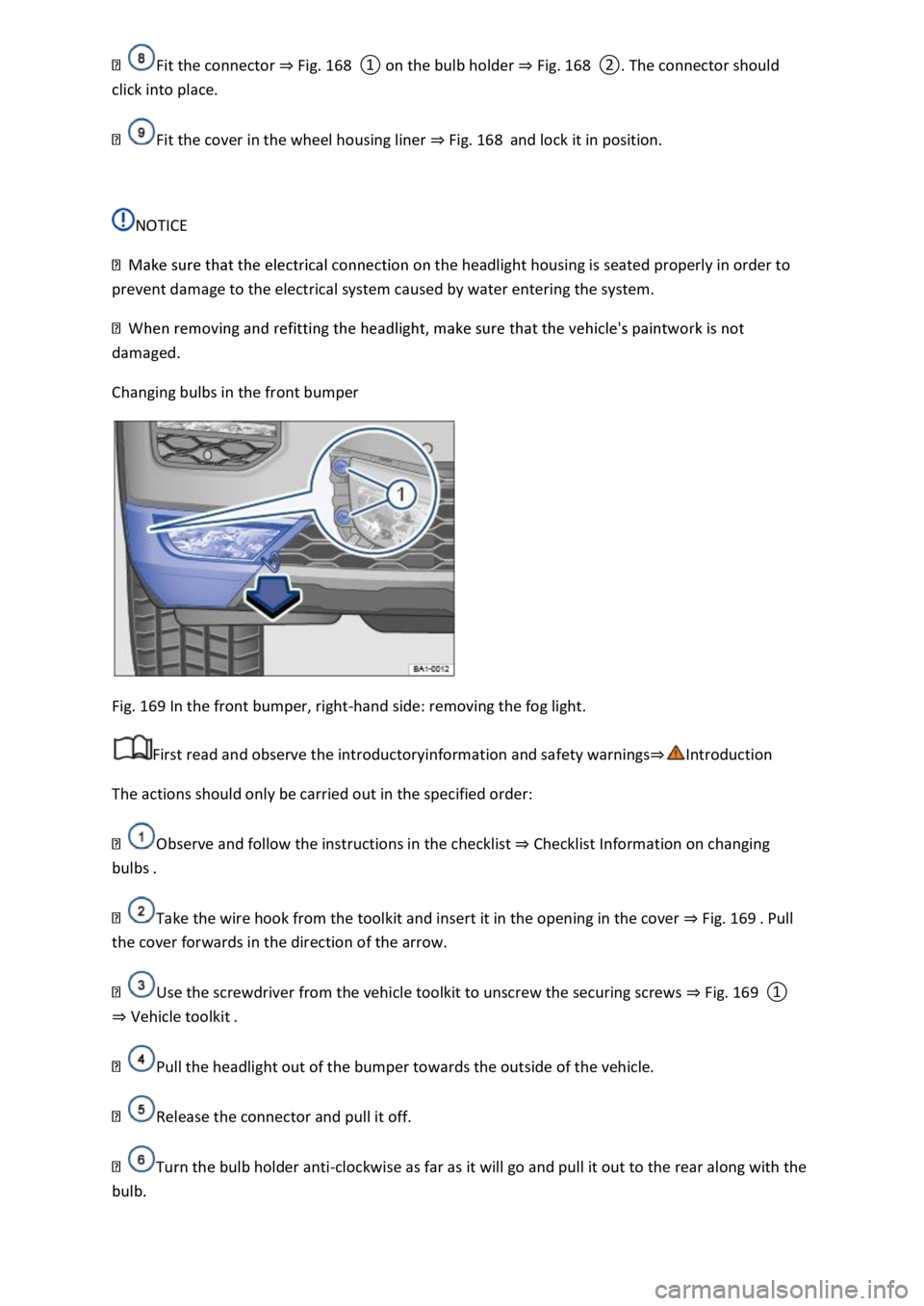
Fig. 168Fig. 168
Fit the cover in the wheel housing liner Fig. 168and lock it in position.
NOTICE
the headlight housing is seated properly in order to
prevent damage to the electrical system caused by water entering the system.
damaged.
Changing bulbs in the front bumper
Fig. 169 In the front bumper, right-hand side: removing the fog light.
First read and observe the introductoryinformation and safety warnings
The actions should only be carried out in the specified order:
Observe and follow the instructions in the checklist Checklist Information on changing
bulbs
Take the wire hook from the toolkit and insert it in the opening in the cover Fig. 169
the cover forwards in the direction of the arrow.
Use the screwdriver from the vehicle toolkit to unscrew the securing screws Fig. 169
Vehicle toolkit
Pull the headlight out of the bumper towards the outside of the vehicle.
Release the connector and pull it off.
Turn the bulb holder anti-clockwise as far as it will go and pull it out to the rear along with the
bulb.
Page 345 of 502

Insert the bulb holder into the headlight and turn it clockwise as far as it will go.
Connect the connector to the bulb holder. The connector must audibly click into place.
Push the headlight from the outside into the openings and insert into the bumper.
Use the screwdriver to tighten the securing screws Fig. 169
Fit the cover in the bumper Fig. 169
Stow the wire hook and screwdriver in the vehicle toolkit.
Changing bulbs in the tail light clusters (LED lights)
First read and observe the introductoryinformation and safety warnings
These lamps use LED technology. The LEDs cannot be replaced by customers. If some LEDs fail, this
may be an indication that more elements are on the point of failure. In this case, have the lights
checked and renewed if necessary at a qualified workshop. Volkswagen recommends using a
Volkswagen dealership for this purpose.
Changing bulbs in the number plate light (LED lights)
First read and observe the introductoryinformation and safety warnings
These lamps use LED technology. The LEDs cannot be replaced by customers. If some LEDs fail, this
may be an indication that more elements are on the point of failure. In this case, have the lights
checked and renewed if necessary at a qualified workshop.
Troubleshooting
First read and observe the introductoryinformation and safety warnings
Fault in vehicle lighting
The indicator lamp lights up yellow.
Fault in vehicle lighting or fault in cornering lights.
Check the vehicle lighting and change the appropriate bulb as required Changing bulbs
bulbs are OK or there is a fault in the dynamic cornering light, go to a qualified workshop.
Changing fuses
Introduction
This chapter contains information on the followingsubjects:
Fuses in the dash panel
Page 354 of 502

int (earth connection), a
solid metal part which is securely bolted onto the cylinder block, or the cylinder block itself.
The discharged 12-volt vehicle battery must be properly connected to the vehicle's electrical system.
The vehicles must not touch. Otherwise electricity could flow as soon as the positive terminals are
connected.
Ensure that the battery clamps have good metal-to-metal contact with the battery terminals.
If the engine does not start immediately, switch off the starter after about 10 seconds and try again
after about a minute.
If the engine still does not start, seek expert assistance.
Attaching the jump leads
The jump leads should be connected only in the order A B C DFig. 177
The black jump lead should never be connected to the negative terminal (-volt vehicle
battery. Connecting the lead to the negative terminal can cause incorrect condition evaluation of the
12-volt vehicle battery in the vehicle electronics.
Starting the engine
-volt vehicle battery in the engine compartment, if a cover is installed
12-volt vehicle battery
discharged 12-volt vehicle battery Fig. 177
providing assistance Fig. 177
Fig. 177
connection point (earth connection) or otherwise to a solid metal part that is securely bolted onto
the cylinder block, or to the cylinder block itself of the vehicle providing assistance.
-volt battery, connect the other end of the black jump lead
Fig. 177
s in such a way that they cannot come into contact with any moving parts in the
engine compartment.
Starting the engine
2-volt vehicle battery and wait two or three
minutes until the engine is running smoothly.
Removing the jump leads
Page 360 of 502
Notes on tow-starting and towing
Fitting the rear towing eye
Vehicle toolkit
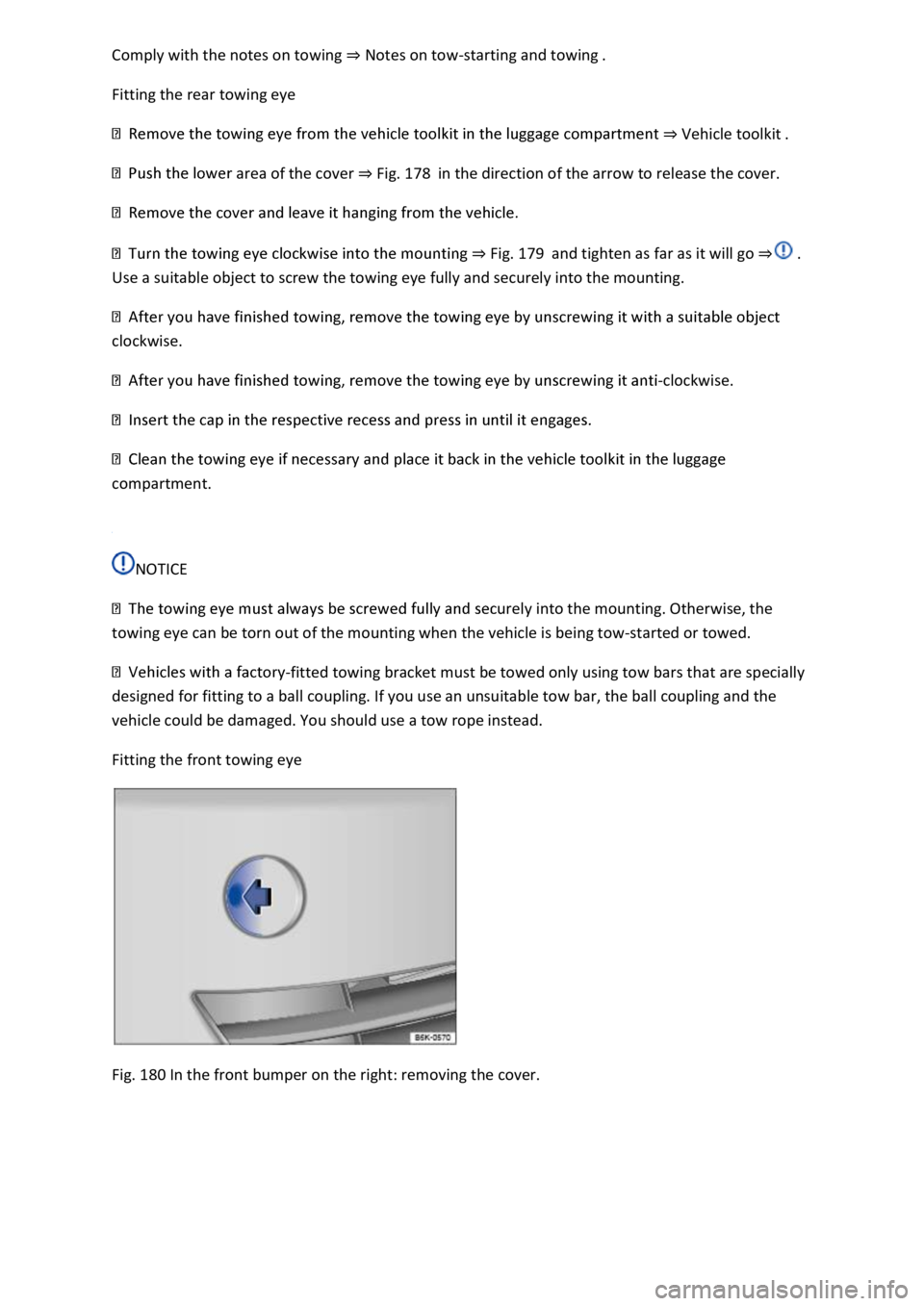
area of the cover Fig. 178in the direction of the arrow to release the cover.
Fig. 179and tighten as far as it will go
Use a suitable object to screw the towing eye fully and securely into the mounting.
clockwise.
-clockwise.
compartment.
NOTICE
urely into the mounting. Otherwise, the
towing eye can be torn out of the mounting when the vehicle is being tow-started or towed.
-fitted towing bracket must be towed only using tow bars that are specially
designed for fitting to a ball coupling. If you use an unsuitable tow bar, the ball coupling and the
vehicle could be damaged. You should use a tow rope instead.
Fitting the front towing eye
Fig. 180 In the front bumper on the right: removing the cover.
Page 361 of 502
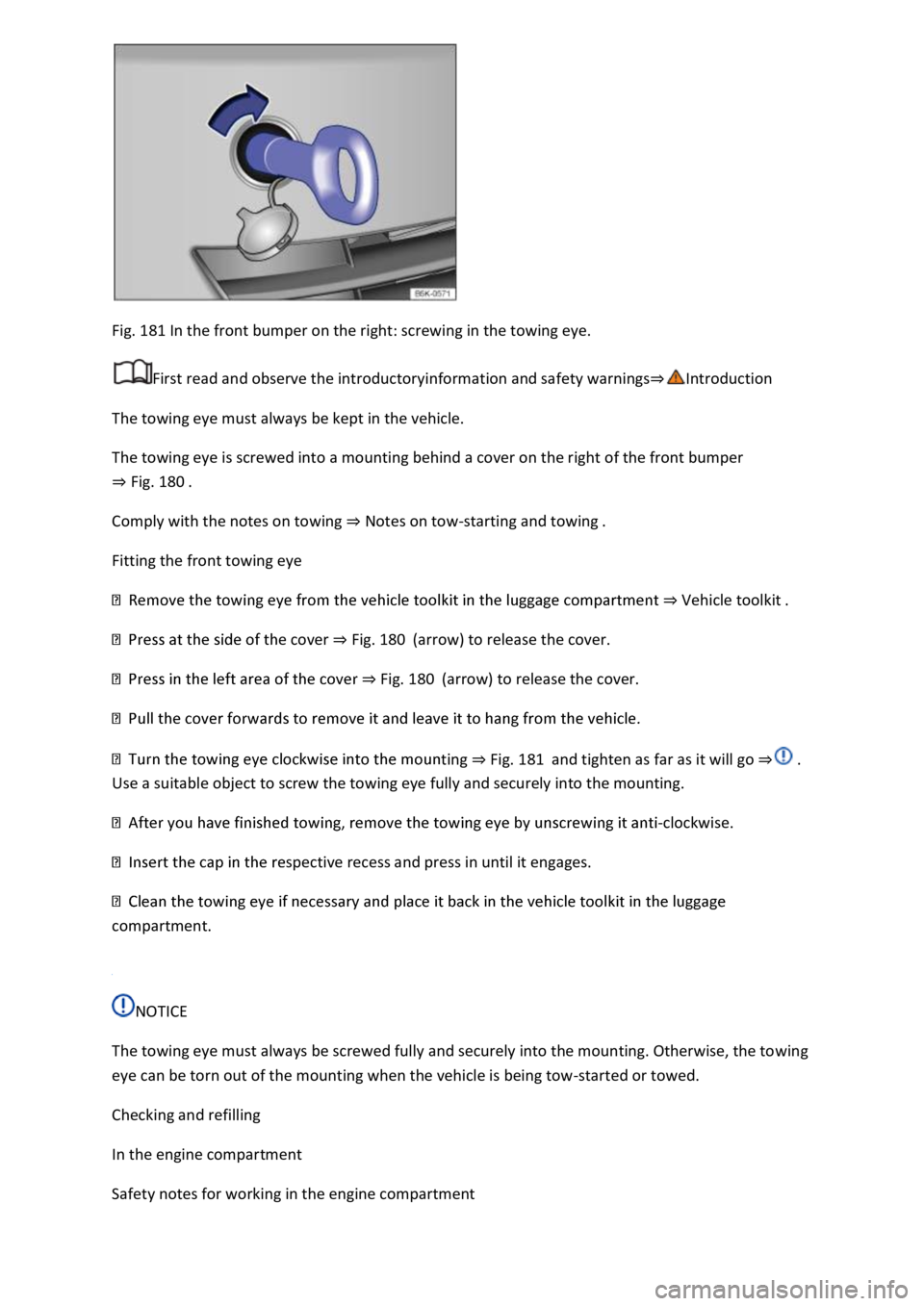
Fig. 181 In the front bumper on the right: screwing in the towing eye.
First read and observe the introductoryinformation and safety warnings
The towing eye must always be kept in the vehicle.
The towing eye is screwed into a mounting behind a cover on the right of the front bumper
Fig. 180
Comply with the notes on towing Notes on tow-starting and towing
Fitting the front towing eye
Vehicle toolkit
e cover Fig. 180(arrow) to release the cover.
Fig. 180(arrow) to release the cover.
ting Fig. 181and tighten as far as it will go
Use a suitable object to screw the towing eye fully and securely into the mounting.
-clockwise.
spective recess and press in until it engages.
compartment.
NOTICE
The towing eye must always be screwed fully and securely into the mounting. Otherwise, the towing
eye can be torn out of the mounting when the vehicle is being tow-started or towed.
Checking and refilling
In the engine compartment
Safety notes for working in the engine compartment
Page 404 of 502
response. Unbalanced wheels will affect the level of tyre wear. In this case, the wheels should be
balanced again.
Incorrect wheel alignment impairs driving safety and increases tyre wear. The running gear should
be checked by a qualified workshop if tyres show excessive wear.
WARNING
If you notice unusual vibration or the car pulling to one side while the vehicle is in motion, this may
indicate that one of the tyres is damaged.
Check the tyres and wheel rims for damage.
have the vehicle checked.
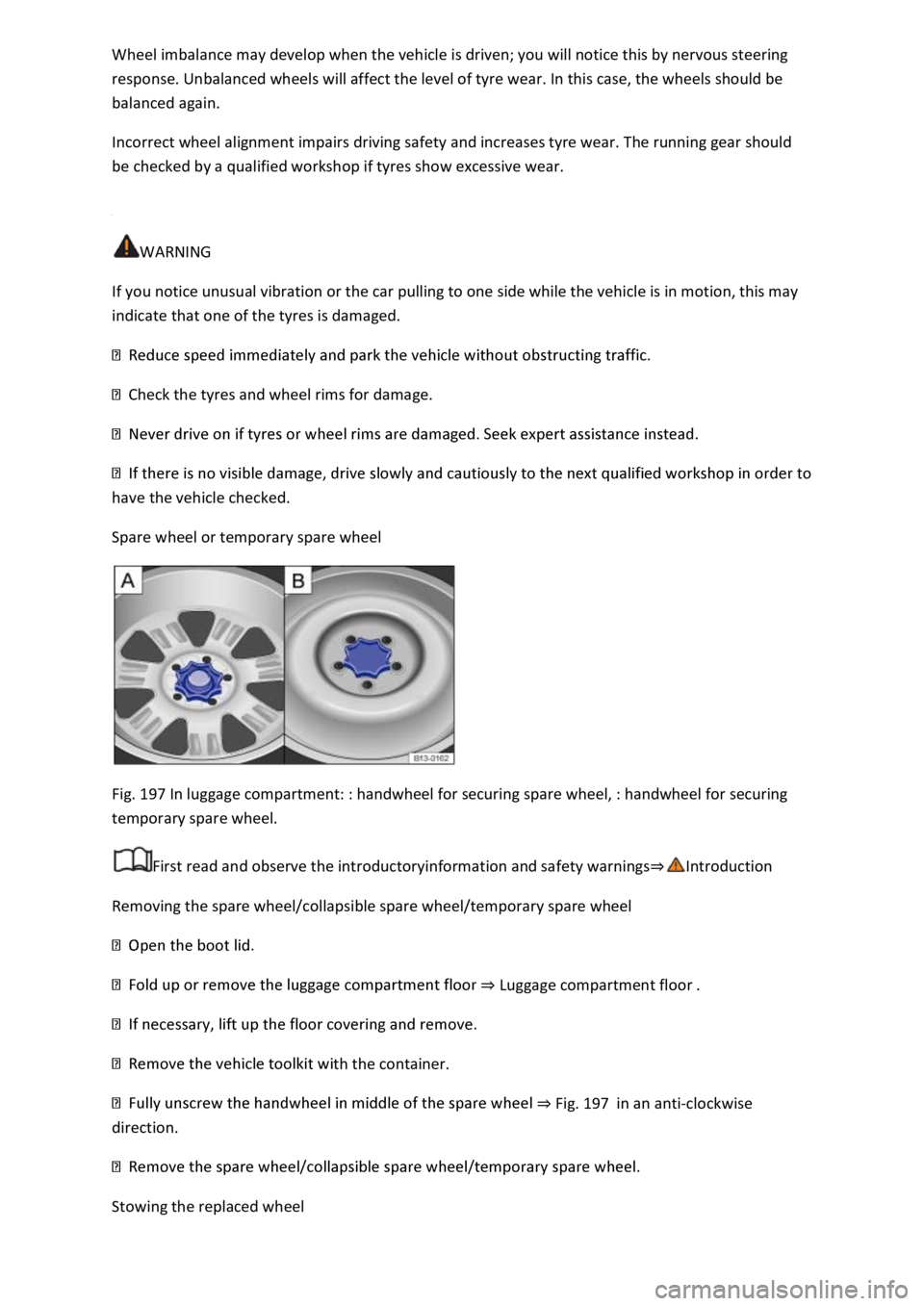
Spare wheel or temporary spare wheel
Fig. 197 In luggage compartment: : handwheel for securing spare wheel, : handwheel for securing
temporary spare wheel.
First read and observe the introductoryinformation and safety warnings
Removing the spare wheel/collapsible spare wheel/temporary spare wheel
Luggage compartment floor
th the container.
Fig. 197in an anti-clockwise
direction.
Stowing the replaced wheel