brake VOLKSWAGEN T-ROC 2021 Owner´s Manual
[x] Cancel search | Manufacturer: VOLKSWAGEN, Model Year: 2021, Model line: T-ROC, Model: VOLKSWAGEN T-ROC 2021Pages: 502, PDF Size: 9.42 MB
Page 433 of 502

The service events differ according to oil change service and inspection. The service interval display
in the display of the instrument cluster serves as a reminder for the due date of the next service
event.
Your vehicle will receive either the fixed service or flexible service for the oil change service,
depending on the vehicle equipment, the engine type and the operating conditions.
How do I know which type of service my vehicle needs?
⇒ Fig. 210 (arrow) ⇒ Technical data .
Service eventa) PR No. Service type Service interval
Oil change service QI1 Fixed Every 5,000 km or 1 yearb).
QI2 Every 7,500 km or 1 yearb).
QI3 Every 10,000 km or 1 yearb).
QI4 Every 15,000 km or 1 yearb).
QI6 Flexible According to service interval display.
Inspection According to service interval display.
Observe the information on engine oil specifications according to VW standards ⇒ Engine oil .
Features of the flexible service
With the flexible service, you only need to have an oil change service carried out if your vehicle
requires one. Individual operating conditions and personal driving style are taken into account in
order to determine this point in time. An important part of the flexible service is the use of LongLife
engine oil instead of conventional oil.
Observe the information on engine oil specifications according to VW standards ⇒ Engine oil .
If you do not wish to have the flexible service, you can opt for the fixed service instead. However, a
fixed service can affect your service costs. Your service advisor will be pleased to help.
Service interval display
Scheduled services at Volkswagen are displayed in the service interval display in the instrument
cluster ⇒ Service interval display or in the Vehicle settings menu in the Infotainment system
⇒ Vehicle settings menu . This service interval display provides information on services that include
an oil change or inspection. When an individual service is due, additional work that is due can also be
carried out, e.g. changing brake fluid and spark plugs.
a) Information is stated for vehicles used under normal operating conditions.
b) Whichever comes first.
Page 440 of 502
After the car has been washed, the brakes may react slowly and the braking distance will be
increased as the brake discs and pads will be wet, or possibly iced up in winter.
-ice the brakes by performing careful braking manoeuvres. Do not endanger any other
road users when doing this.
NOTICE
Serious vehicle damage can be caused if the vehicle is not washed correctly.
could freeze up.
NOTICE
Painted parts and surfaces with a matt finish, unpainted plastic parts, headlight lenses and tail light
clusters can be damaged if the vehicle is not washed correctly.
-painted vehicle only in a textile car wash.
-painted surfaces with hot wax.
-painted surfaces.
Wash the vehicle only in specially designated washing areas. This prevents any waste water
contaminated with oil from entering the sewerage system.
Caring for and cleaning the vehicle exterior
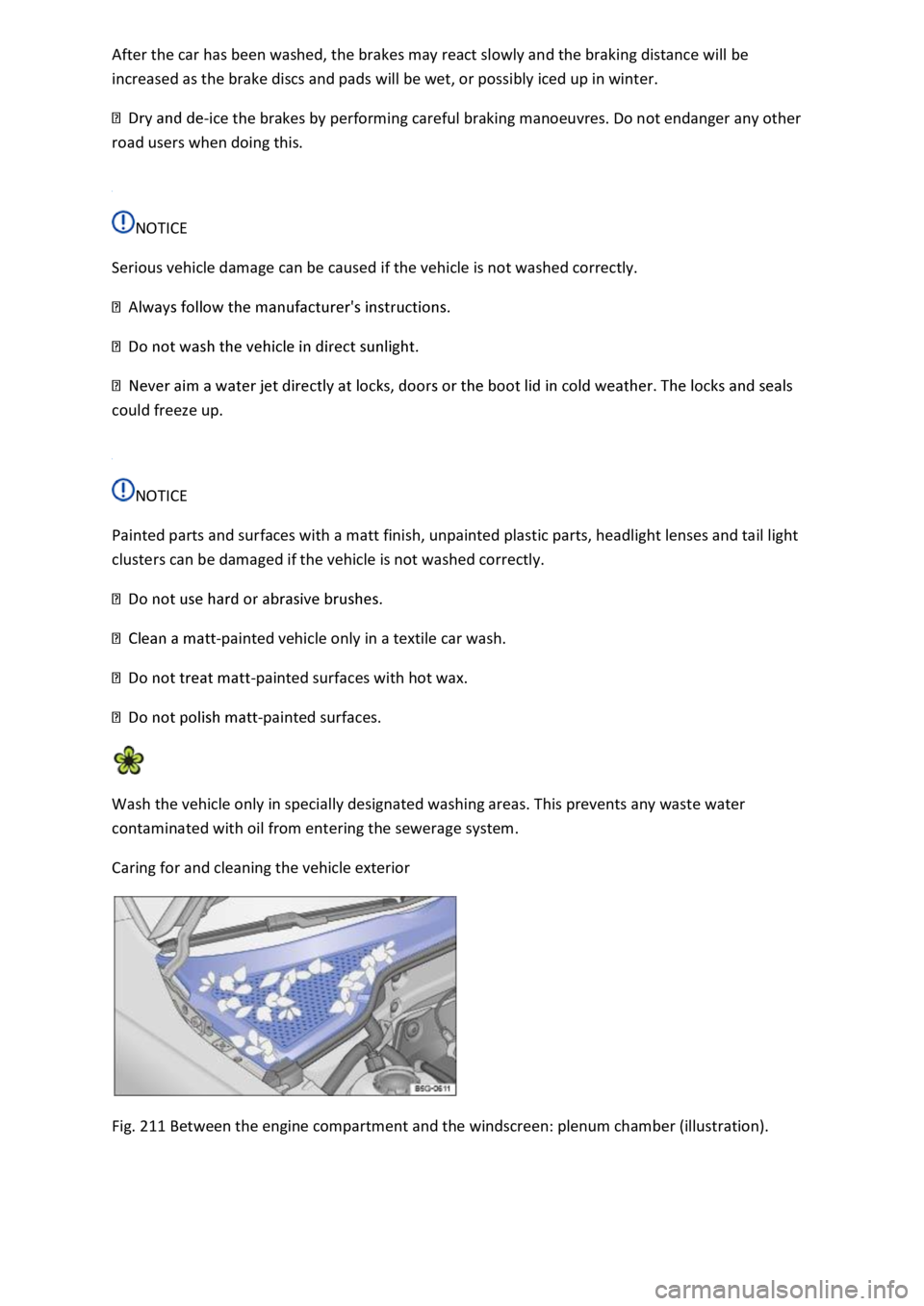
Fig. 211 Between the engine compartment and the windscreen: plenum chamber (illustration).
Page 452 of 502

Please note that the validity of the Volkswagen LongLife mobility guarantee may differ depending on
the country in which the vehicle was sold. Please ask your Volkswagen dealership for further
information.
The selling Volkswagen dealership will issue a comprehensive LongLife mobility guarantee for every
new vehicle which applies from the time of delivery until the first due inspection. If you purchase
your new vehicle directly from Volkswagen AG, Volkswagen AG will issue the LongLife mobility
guarantee from the time of delivery until the first due inspection.
Your Volkswagen dealership will extend the LongLife mobility guarantee until the following
inspection when the due inspection is carried out by the dealership. The service costs include the
entire guarantee package.
The comprehensive LongLife mobility guarantee includes the following services:
If your vehicle can no longer be driven due to a technical defect1), corresponding assistance will be
provided in the case of breakdown or accident. The LongLife mobility guarantee provides with you
protection and mobility.
The inspection is not only about car maintenance - it also ensures that your car remains roadworthy
and in perfect working order. For this reason, servicing should be carried out regularly in accordance
with the manufacturer's specifications.
Your entitlement to the LongLife mobility guarantee is documented in the digital service schedule
each time your car is serviced. A full service history shows that your car has been professionally
maintained and cared for.
1) A vehicle which can no longer be driven is a vehicle which cannot reach a workshop under its own
power.
Data storage and services
Your vehicle is fitted with electronic control units. Some of these are required to make sure your
vehicle remains safe while others provide support while driving (driver assist systems). Furthermore,
your vehicle is equipped with convenience and Infotainment functions, which are also made possible
using electronic control units.
Electronic control units contain data memories which can store information regarding the vehicle
status, component load levels, servicing requirements, technical events and faults on a temporary or
permanent basis. This information generally documents the status of a component, a module, a
system or the environment, e.g.:
. filling levels, tyre pressure, battery status.
deceleration, lateral acceleration, display of fastened seat belts.
tem components, e.g. lights, brakes.
stability control systems.
Page 453 of 502

e.g. temperature, rain.
As well as performing the actual control functions, these data are also used to detect and rectify
faults and help Volkswagen to improve vehicle functions. The majority of these data are temporary
and are only processed within the vehicle itself. Only a very small amount of data is stored in the
event memories or possibly on the vehicle key.
Reading out the vehicle's event memory
There is a diagnostic interface in the vehicle interior for reading out the event memories (on-board
diagnosis) ⇒ .
If you have service work performed on your vehicle, the technical data can be read out of the vehicle
together with the vehicle identification number by service employees, e.g. workshops, or third
parties such as breakdown services. Service work includes, for example, repairs, maintenance,
warranty work or quality assurance measures. The service workshop or third party collects,
processes and uses the data. The data document the vehicle's technical status, help in
troubleshooting and in improving quality and may be sent to Volkswagen in some cases.
Furthermore, the manufacturer is subject to legal product safety requirements. To make sure it
complies with these requirements, the manufacturer requires technical data from the vehicles.
Event memories in the vehicle can be reset by a service workshop as part of repair or service work.
The event memory should be read out and reset only by a qualified workshop. Additional
information on the stored data is available from the qualified workshop.
After a fault has been rectified, the information in the memory relating to the fault is deleted. Other
memory content is overwritten on an ongoing basis.
Event data recorder
This vehicle is equipped with an event data recorder. The main task of an event data recorder is to
record data in particular accident scenarios or accident-like situations, e.g. in the event of airbags
being triggered or a collision with an obstacle on the road. These data help in analysis of how a
vehicle system behaved in these situations. The event data recorder records data relating to driving
dynamics and the restraint system for a short period of 10 seconds or less. This information includes,
for example:
of the driver and front passenger were fastened.
These data help to obtain a better understanding of the circumstances in the situations where
accidents and injuries have occurred.
Data from driver assist systems are also recorded. In addition to information about whether the
systems were switched on or off, available only to a restricted extent or inactive, it is also possible to
determine whether these functions steered, accelerated or braked the vehicle in the above-
described situations. Depending on the vehicle equipment, these systems include the following:
Page 495 of 502

drive
entrances,
ramps,
kerbstones
and other
objects.
Low-lying
vehicle
components
such as the
bumper,
spoiler and
parts of the
running
gear, engine
or exhaust
system
could be
damaged.
Gross
vehicle
weight
rating
kg 1,780
Gross front
axle weight
rating
kg 920
Gross rear
axle weight
rating
kg 910
Maximum
trailer
weight,
braked,
gradients up
to 12%
kg 1,300
Maximum
trailer
weight,
braked,
gradients up
to 8%
kg 1,500
Page 496 of 502

Maximum
trailer
weight,
unbraked
kg 630
Maximum
gross
combination
weight
rating
kg 3,080
Power
output
85 kW
Engine code DKRA
Maximum
torque
200 Nm
Gearbox MG6
Maximum
speed
km/h a)
Kerb weight kg 1,270
Gross
vehicle
weight
rating
kg 1,780
Gross front
axle weight
rating
kg 920
Gross rear
axle weight
rating
kg 910
Maximum
trailer
weight,
braked,
gradients up
to 12%
kg 1,300
Maximum
trailer
kg 1,500
Page 497 of 502

weight,
braked,
gradients up
to 8%
Maximum
trailer
weight,
unbraked
kg 630
Maximum
gross
combination
weight
rating
kg 3,080
Power
output
110 kW
Engine code DADA
Maximum
torque
250 Nm
Gearbox MG6 DSG®7
Maximum
speed
km/h a) a)
Kerb weight kg 1,327 1,460
Gross
vehicle
weight
rating
kg 1,850 1,860–
1,960
Gross front
axle weight
rating
kg 970 980–
1,030
Gross rear
axle weight
rating
kg 930 930–
980
Maximum
trailer
weight,
braked,
kg 1,300 1,500–
1,600
Page 498 of 502

gradients up
to 12 %
Maximum
trailer
weight,
braked,
gradients up
to 8%
kg 1,500 1,700–
1,800
Maximum
trailer
weight,
unbraked
kg 630 660–
730
Maximum
gross
combination
weight
rating
kg 3,080 3,350–
3,560
Power
output
140 kW
Engine code CZPB
Maximum
torque
320 Nm
Gearbox DSG®7
Maximum
speed
km/h 216
Kerb weight kg 1,495
Gross
vehicle
weight
rating
kg 1,990
Gross front
axle weight
rating
kg 1,060
Gross rear
axle weight
kg 980
Page 499 of 502

rating
Maximum
trailer
weight,
braked,
gradients up
to 12%
kg 1,700
Maximum
trailer
weight,
braked,
gradients up
to 8%
kg 1,900
Maximum
trailer
weight,
unbraked
kg 740
Maximum
gross
combination
weight
rating
kg 3,690
Power
output
140 kW
Engine code DKZA
Maximum
torque
320 Nm
Gearbox DSG®7
Maximum
speed
km/h a)
Kerb weight kg 1,495
Gross
vehicle
weight
rating
kg 1,990
Page 500 of 502

Gross front
axle weight
rating
kg 1,060
Gross rear
axle weight
rating
kg 980
Maximum
trailer
weight,
braked,
gradients up
to 12%
kg 1,500–
1,600
Maximum
trailer
weight,
braked,
gradients up
to 8%
kg 1,700–
1,800
Maximum
trailer
weight,
unbraked
kg 740
Power
output
85 kW
Engine code DGTA
Maximum
torque
250 Nm
Gearbox MG6
Maximum
speed
km/h a)
Kerb weight kg 1,397
Gross
vehicle
weight
rating
kg 1,890